die' etiketine sahip kayıtlar gösteriliyor. Tüm kayıtları göster

19 Nisan 2017 Çarşamba

"I don"t think anything can prepare you for seeing a patient die"

‘It’s the best feeling in the world knowing that you were able to care for someone during their last days’


I saw my first patient death a few months ago, during my first placement on a medical ward. It was a woman with dementia. I was there when the doctor made the decision to remove her oxygen mask. We drew the curtains and I rubbed her leg, just to let her know that someone was with her. I was glad to be there as she took her final breaths.


I still think about her. She was unmarried and had no family. She died alone, but we were there, so I guess she wasn’t completely alone.


We joke about certain things on the ward – obviously nothing inappropriate, but humour needs to come into it. The woman had a pair of glasses, and while I was packing her stuff away to bring down to the morgue, a nurse asked me: “Do you think she’ll be needing them?”. We needed a little laugh.


I don’t think anything can prepare you for seeing a patient die. But as a student nurse, it’s the best feeling in the world knowing that you were able to care for someone during their last days and moments, holding their hand.


I went home, where my flatmates are student nurses with their own experiences of death. We sat down and talked it through, which made me feel better. I’d recommend that to new students: make sure you can talk about losing a patient. There’s lots of support out there. First-year nursing student


‘I feel like being upset, but there’s no time.’


‘I feel like being upset, but there’s no time.’ Photograph: Alamy

‘It changes your personality’


Working on the stroke ward was the hardest. Deaths came as more of a shock there because the patient would often have been around for weeks. One morning I admitted a man with his wife. I chatted to them all day – they were lovely. But then he became unresponsive. I did all the tests and noticed that he wasn’t reacting to my voice or pain. His wife was standing right next to me. It was my first emergency situation and I had to comfort the family at the same time. I was trying not to cry in front of them – they were so friendly. It isn’t always the way with relatives when they’re stressed.


Death is more common on other wards. I remember a woman who needed blood transfusions and had to go to intensive care. But she refused. The staff said: “This is serious, you might die if you don’t.” At that point she got quite mouthy.


She eventually said yes to intensive care, but she didn’t get there on time. It wasn’t a dignified death. There was blood pouring out of her in the middle of a transfusion, in front of other patients. She might have been able to recover – but you have to respect the patient’s right to make their own decisions. It was a gnawing feeling, knowing that it could have been different.


The course changes your personality a bit. You cope with stress better after dealing with upsetting situations. It’s like a second skin you develop; I feel like being upset but there’s no time. My philosophy is better nowadays – I’m doing my best to keep people healthy and if the death was unpreventable, I just have to accept it and move on. If I don’t, you can’t be there for the family or the other patients. Third-year nursing student


patient in hospital bed


‘Staff often take the opportunity to teach you even though they’re under a lot of pressure.’ Photograph: Alamy

‘It’s important not to shy away from death. You can learn a lot’


It was my fourth day of being on a ward. The patient was an elderly man who’d been in a traffic accident. It was frightening, only being 18 and experiencing that so soon. I was there with the doctor the moment he passed away.


I was worried to begin with. Sometimes, as a student nurse nobody realises you haven’t seen this stuff before. There were doctors and nurses all around me in a busy, enclosed space. Fortunately, the patient wouldn’t have had any idea of what was going on around him.


When I saw that first dead body, I thought, “I don’t know what I’m doing”. I didn’t know how I was supposed to tell the family, or how to clean a body or who to call. It did knock my confidence. But you get used to it – it doesn’t sound like a nice way to put it, but you do.


I stayed with the doctor while he certified the death. I had to listen to the patient’s breath for five minutes to see if there were any sounds. I was lucky to have a good mentor who made sure I was all right afterwards and explained how to tell the family. The nurses seem grateful to have a second pair of hands. People often take the opportunity to teach you even though they’re under a lot of pressure.


I try not to take any of it home with me. I used to live with other students who weren’t studying nursing. I’d come home and they’d listen to my stories, but no one could really relate. They’d just been at lectures or sleeping in all day. Now I live with nurses, which is a lot easier because they get it.


I’ve found it’s important not to shy away from death. You learn a lot if you get involved as much as possible, right from the beginning of your course. Third-year nursing student


Keep up with the latest on Guardian Students: follow us on Twitter at @GdnStudents – and become a member to receive exclusive benefits and our weekly newsletter.


"I don"t think anything can prepare you for seeing a patient die"

31 Mart 2017 Cuma

How mental health problems affect relationships: "They"re scared that this time you might die"

Anonymous
Last night I had a dream about my eldest son who’s just turned 11. Because of my mental illness, I have not been able to speak to or see my three boys for eight months now. In the dream I’m hangin’ with my eldest, shooting the breeze as we’ve done many a time, but this time I notice a difference; his voice has broken, and with this realisation my heart broke, too.


This dream is analogous of all those golden moments of childhood I have missed in their lives, that can never be relived, moments that seem even more precious when it comes to my eldest, as he rapidly approaches adolescence. The dream also feels analogous of everything I’ve lost as a result of mental illness; my marriage, career, liberty (sectioned twice), self-respect and societal approval.


What really frightens me about my mental illness is the way it suddenly grabs me and leads me to do things that I, when feeling stable, just would never want to do. Like right now I love my boys and mum so much I cannot believe I’d want to never see them again and devastate them through taking my own life. Yet out of the corner of my eye, I can see the omnipresent scar on my left wrist that is a constant reminder of how my mental health can construct a vast distance between me and my values.


Anonymous, 21
I have bipolar disorder, a highly stigmatised diagnosis. One of the hardest things to deal with is knowing you’re hurting people around you. After taking an overdose, lying in A&E with someone who loves you and feeling the guilt and horror of what you’ve done. They’re scared that this time you might die, but the urge was so strong you couldn’t stop yourself from doing it. Even when you know you are loved, you still wish to die. I have an illness. I wrote this poem in art therapy.


Today you are possible of great things,


Things of beauty, of purpose and of wonder.


Your voice is of importance, your body is of splendour.


Today you are tasked with only being fair to yourself and your soul, and to be fair to yourself and your soul is to be kind.


Kindness is all that you deserve.


Today you are you, and that is a magical thing, no one else will ever be you.


You are strong, you are mesmerising, you are intelligent, you are divine.


Today you are loved, as you should be, and as you always will be.


Anonymous
Go me: a poem about mental health, from a mother’s perspective


I am the world’s greatest mum


My teenage daughter is perfect


Good grades, no shouting, no drinking, no boys, no worries


I’m expert at giving lifts, coordinating activities, supporting vegetarianism, saying no to piercings, organising cultural excursions and understanding UCAS points


I’ve got this covered. Go me!


I am the world’s most understanding mum


I can support this exam stress


Distant, withdrawn, eating less, sleeping more, staying in


I am an expert at finding French tutors, arranging extra physics, breathing exercises, pep talks and staying positive


One of life’s challenges. Go me!


I am the world’s most bewildered mum


I don’t know why this is happening


School dropout, counselling, anger, a handful of pills, some minor cuts


I am expert at managing panic attacks, investigating colleges, negotiating the NHS and weird piercings


But I’m up for this. Go me!


I am the world’s most exhausted mum


I love her to death


Major overdose, psychiatrist, cardiac ward, cutting, minor overdose, more cutting


I am expert at bandaging cuts, hiding razor blades, 999 calls, police statements, social services, riding in ambulances, fighting for support, staying up all night, dispensing pills


But we’re still here and stronger. So go us


Helen, Manchester, 35
Fourteen years ago, I found my flatmate (and close friend) almost unconscious, with an empty bottle of pills next to her bed. I got her to the hospital. I stayed all night, until she was released in the morning. It was horrible. What came next was worse. At the hospital I asked the doctor what I should do the next day. He drew a blank. My other flatmate and I had no idea how to react. We were angry, we blamed her, we thought she was selfish. We treated her like a stranger. I went to my GP, who suggested we focus on ourselves because finals were coming up. Within a week, we just left her – went to our respective homes to study, claiming that we needed peace and quiet away from university.


I’ve never forgiven myself for that response, or forgotten how awful it was when she quietly confronted me about lying to her. In the end we both apologised, cried a lot, and made peace. It took me a few years, though, to fully accept that she wasn’t selfish or to blame. I hope that today’s 21-year-olds already know that, and that their doctors are giving better advice. By removing the stigma around mental health, and by educating people in how to support their friends and family, perhaps we can prevent other people being judged and abandoned.


Anonymous, early 40s


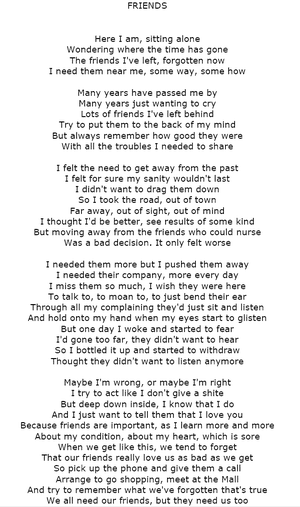
A poem dedicated to friends past, hopefully to return.


A poem dedicated to old friends, hopefully to return.

In the UK, the Samaritans can be contacted on 116 123.
In the US, the National Suicide Prevention Hotline is 1-800-273-8255.
In Australia, the crisis support service Lifeline is on 13 11 14.


How mental health problems affect relationships: "They"re scared that this time you might die"

18 Kasım 2016 Cuma

NHS cuts in Devon: "If these services end my boys will for certain die"

The proximity of North Devon district hospital to Anne-marie Wiles’ home – it is less than five minutes away – is crucial.


Her twin sons, Jed and Peirce, were given just six months to live after being born with multiple complex health needs. They are now doing well, aged 16, thanks in large part to the efforts of a loving family, but also the dedicated staff at the hospital in Barnstaple.


“I intentionally live opposite the hospital because when the boys stop breathing there is not enough time to call an ambulance,” said Wiles. Jed has been resuscitated three times at the NDDH and both have been nursed countless times at the Caroline Thorpe children’s ward.


“If these services end then my boys will for certain die once they become ill,” said Wiles. “I am fearful of losing my children.”


She is one of thousands who have joined marches, written to local MPs, organised benefit gigs, signed petitions over the Wider Devon STP – sustainability and transformation plan – which is proposing radical changes to healthcare in the county.


If the plan comes to fruition in its present form, 600 community and acute beds across this sprawling, largely rural county will be gone within five years.


Cherished community hospitals at Honiton in the east – nicknamed the Honiton Hilton because it so beloved – Okehampton in central Devon and Paignton and Dartmouth in the south would go. There have been howls of protest everywhere – but nowhere more than in and around Barnstaple.


Here there is deep alarm that the plan may lead to the shutting down of maternity, neonatology and paediatric services as well as triggering the loss of other departments, including A&E. The Royal Devon and Exeter hospital is 50 miles away – an hour and 10 minutes by car down a winding road if conditions are good, much more if not.


Tina Day’s son, Jaiden-Lee, was born at the NDDH with a collapsed lung and spent a week in the special care baby unit for a week before developing type 1 diabetes. “It terrifies me if services like maternity and A&E are re-located. People will die, guaranteed,” said Day.


John Tate claimed his wife and daughter would both have died had the NDDH not been near. “My daughter had her umbilical cord wrapped around her neck. She had breathing problems and was trapped head down. This caused my wife life-threatening problems. An emergency cesarean saved their lives. Both would have died if Barnstaple was not there.”


Crystal Steinberg said the closure of the maternity department would make her think twice about having a second child. She underwent an emergency caesarean section because her unborn baby, Dylan, was in distress. “I do not want to be stranded at the side of the road while my uterus ruptures and my baby and I die.”


It is not just mums who are worried. Tracy, 46, suffers from a mental health condition that leaves her suicidal. “I have been to A&E three times this month after being picked up by police.” Should the A&E close she believes she would be held in a cell or have to head to Exeter. “I’d have no way of getting there but to walk or hitch. Both are a scary.”


Jacob Egan, seven, was so concerned when he got wind of the proposals that he dictated a letter to Theresa May. He has brittle asthma, which can result in severe attacks, and has been admitted to the NDDH around 10 times.


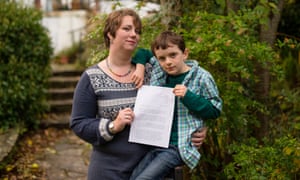
Jacob Egan with his mother and his letter to Theresa May.


Jacob Egan with his mother and his letter to Theresa May. Photograph: Jim Wileman for the Guardian

“Dear prime minister,” he said. “Just think about it, every time any child in our area of north Devon needed to go to hospital they would have to go to Exeter. Exeter is a long distance away and if your heartbeat stopped you couldn’t just wait for a train or car to get you there.”


At the heart of the plan is a “new model of integrated care” that will “reduce reliance on bed-based care and enable people to live healthy independent lives for longer, closer to where they live”. In other words the idea is to look after people at home rather than in hospital.


According to the latest draft of the report, which is up for consultation, every day more than 600 people in Devon are medically fit to leave hospital beds but do not.


The plans argues change must take place. Health and social care services in Devon are likely to be £557m in deficit in 2020/21 if nothing is done, the plan says. It also says the system as it stands isn’t working. The 95% standard for patients being seen in A&E within four hours is not being met – the Devon system is currently achieving 91.6%.


Devon’s demographics also have to be taken into account. There are more elderly people here than in other parts of the UK – in one area of Torquay almost one in 10 are aged over 85. Some need a lot of care – in north, east and west Devon, 40% of people use almost 80% of health and social care.


Angela Pedder, lead chief executive for the plan, said she understood people’s concerns. “But if we sit back and say let’s just let things happen, that’s a much bigger risk not just for the whole of Devon.


“We have to be pro-active. We have responsibilities to make sure the service is safe and sustainable two, five, 10 years down the line. That’s what we’ve got to plan for. That’s the framework we are trying to put in place.”


Politicians, activists and patients are not impressed.


The East Devon Tory MP Hugo Swire said: “We are in danger of putting the cart before the horse. Until we can absolutely ensure that we have got social care right, we should not look at unnecessarily closing community beds.”


Jan Goffey, the mayor of Okehampton, called the proposals cruel and claimed the NHS was being “dismembered”. If the people who actually live in Barnstaple are worried, those that live even further north – and so even further from Exeter – are even more concerned.


Sarah Vander, who runs a shop in the cliff-top village of Lynton, 20 miles north-east of Barnstaple, said her mother had been saved from a stroke and her husband from a diabetic hypo – a drop in blood glucose level – because they got to the NDDH quickly. “We are incredibly remote and we must be able to rely on the excellent services of NDDH otherwise the simple fact is, people will die unnecessarily.”


The seaside town of Ilfracombe, 12 miles north of Barnstaple, suffers a double whammy. The town is isolated and some areas are deprived: life expectancy in central Ilfracombe is 75 compared with 90 in parts of east Devon.


Rebecca McGarry, from Ilfracombe, the mother of daughters aged two and three, said she felt sick thinking about the prospect of losing services. Both her children have received excellent treatment in Barnstaple including for severe croup, which makes it difficult for them to breathe.


McGarry’s husband is a carer and needs the car for work so she often has to take her children to the hospital on the bus. “I honestly don’t know how we would manage if these appointments were moved even further away. The idea that such a remote region should lose these vital services is totally absurd. People will lose their lives if these closures do happen.”


NHS cuts in Devon: "If these services end my boys will for certain die"

5 Ağustos 2016 Cuma

Babies breastfed within an hour of birth are less likely to die. Yet only 50% are | Frace Begin

What happens in an hour can make all the difference. When I had my first baby, the support I received from my nurse was indispensable in helping me initiate and continue breastfeeding. It may not be obvious, but putting newborns to the breast within the first hour of life can make the difference between life and death. Delaying the start of breastfeeding beyond one hour after birth can raise a newborns risk of dying by 80% compared to those who are breastfed immediately.


Newborns now account for nearly half of all deaths of children under five. Early breastfeeding plays a critical part in reducing newborn mortality and keeping babies healthy. But are we doing everything possible to make that happen?


It turns out we’re not. New research from Unicef shows that more than half of all newborns are not breastfed within one hour of birth. That means that 77 million newborns – over 50% of babies born each year – are losing out on the benefits of early initiation, exposing them to a higher risk of disease and death.


This is happening because women are not getting the support they need around the time of birth, even when a doctor, nurse or midwife is assisting their delivery.


Globally, more than three quarters of all mothers give birth with the help of a skilled birth attendant. But in many hospitals, rather than initiating the practice of breastfeeding by immediately placing a newborn on the mother’s chest, well-intentioned attendants will take the baby away to give the mother time to rest or feed the newborn formula. In the Middle East, North Africa and in South Asia, women who deliver with a skilled birth attendant are less likely to initiate breastfeeding in the first hour of life, compared to women who deliver with unskilled attendants or relatives.


When babies are given alternatives to breastmilk, they breastfeed less often, making it harder for mothers to start and continue breastfeeding. In some countries, the rise in caesarean deliveries has reduced this crucial practice and delayed breastfeeding initiation; however, with the right support, even most newborns delivered by Caesarean section can be put to the breast within the first hour of life.


Traditional practices also interfere with getting an early start to breastfeeding, depriving newborns of the essential nutrients, antibodies and skin-to-skin contact with their mother that protect them from disease and death. In India, some women are taught to discard colostrum—the nutrient-dense breast milk a mother produces right after birth. In Nigeria, some newborns are given water or tea in lieu of breast milk, putting them at risk of diarrhea and malnutrition. Countries in other parts of the world are inundated with formula marketing, which has led to plummeting breastfeeding rates.


Placing newborns on their mother’s bare chest – known as skin-to-skin contact – immediately after birth helps reduce mortality by regulating a baby’s heart rate, temperature and breathing, while also facilitating breastfeeding. Not only that, exposure to the bacteria on the mother’s breast helps to colonize a newborn’s digestive system with essential antibodies. Immediate skin-to-skin contact promotes bonding between newborn and mother and ensures that babies receive the nurturing they need from the very first moments they enter the world.


And mothers practicing early skin-to-skin contact and early initiation of breastfeeding with their newborns are more likely to produce sufficient milk, breastfeed within the first months of their baby’s life, and continue breastfeeding longer – a practice proven to improve health outcomes for both children and mothers.


The Lancet reported earlier this year that breastfeeding exclusively for the first six months could save more than 800,000 children’s lives each year because it acts as a baby’s first vaccine, protecting infants from diseases, and giving them a perfectly adapted nutritional supply they need at each developmental stage. This amounts to a 13% reduction in the deaths of children under five and also supports healthy brain development, increased IQ scores and better school performance for all children.


Breastfeeding is a powerful intervention – it’s time-tested, backed by research and doesn’t require preparation or expensive new medications. Breastfeeding has incredible developmental benefits, and, in areas that lack access to clean environment and clean water to mix with formula powder, saves babies from life-threatening diseases such as diarrhea and pneumonia.


To be sure, there are many barriers to breastfeeding we must work to overcome so mothers who want to breastfeed are able to, and there are a small number of mothers for whom breastfeeding isn’t an option. But to serve millions of mothers and children better, one simple and important thing we can do now is support early initiation of breastfeeding.


Providing new mothers with guidance on initiating breastfeeding, not supplying any liquids or foods other than breastmilk and ensuring that staff are appropriately trained are all simple adjustments that can help a woman breastfeed successfully.


Given what research has taught us about the importance of early initiation, we have countless reasons to do everything possible to increase rates globally – especially when solutions come at little to no extra cost.


Babies breastfed within an hour of birth are less likely to die. Yet only 50% are | Frace Begin

16 Temmuz 2014 Çarşamba

"I want to manage how and when I die"

Steve Riley-Snelling on his wife Tracy Snelling


I initial met Tracy at perform. She walked into a meeting, smiled, and it lit up the room. She was really funny, complete of lifestyle and just brilliant. We have been both married – I had a grown-up daughter and she had a sixteen-12 months-old son – but you never ever know when enjoy will strike and we eventually acquired engaged in 2005.


She was the enjoy of my daily life and we adored each other. If you sit in a restaurant you seem all around and you can tell the married couples, because they are staring at their iPhones or their foods, but we usually had some thing to say.


We only found out that she was sick when a doctor observed that she had been on gastric reflux tablets for a prolonged time. He sent Tracy for tests and a week later on we had been told she had stomach cancer.


Originally, the doctors have been optimistic and said they could operate, but a week before Christmas 2012 we received news that there was proof that the cancer had spread into her stomach cavity. It was a enormous blow, but Tracy was matter-of-fact about it and we had a beautiful loved ones Christmas with the two of our kids. On Christmas Eve, Tracy told them if items didn’t perform out she would go to Dignitas. She stated: “I consider I will survive, but if not I want to management how and when I die. I don’t concern death, but I do worry how I might die.”


On New Year’s Eve, she started chemotherapy. It was genuinely tiring and there have been lots of instances when we would sit and hold each and every other and cry. By April, it looked like her tumour was shrinking but a few months later, in July, we noticed the oncologist and he stated it was game above: the cancer was spreading and she only had three to 6 months to live.


Steve Riley-Snelling and wife Tracy Steve Riley-Snelling and wife Tracy


Tracy was quite calm, but I was distraught. They supplied her a 2nd course of chemotherapy which may well have offered her an further two months, but she explained there were only two issues she wanted to do: go on holiday with her son, and marry me. She applied to join Dignitas and then we all flew to Spain. When we came back all our efforts went into preparing our wedding in September.


On our wedding day she looked stunning but could not consume anything and I had to take her out of the room 10 times to be sick. Regardless of this it was a perfect day – or as near to ideal as it could be when you know your wife is going to die. A week later on she was hooked up to a syringe driver of morphine and anti-emetics. During the day her pain was below control, but at evening it was hard. With stomach cancer it really is not the ache, but the 24-hour nausea, the vomiting ten to 12 times a day, and excruciating, debilitating constipation. She could no longer eat so she lost excess weight rapidly.


It was then that I realised I had produced a mistake. Tracy nonetheless needed to go to Dignitas, but then she was also unwell to travel. She could not fly, and wasn’t properly adequate to stand up to such a lengthy drive. I even looked into acquiring the medication they utilised in the Dignitas online, but it’s illegal and you hear horror stories of purchasing talcum powder. She could have committed suicide earlier, and had a excellent death, but rather she chose to marry me and had the worst death imaginable.


Six weeks following our wedding we had a good day deciding on her funeral music. Then at midnight she mentioned she wanted a word with me and she told me: “I didn’t want to die but I do now. I have had a wonderful existence and the very best part has been with you. But now I am prepared to go due to the fact I am so exhausted and I just wish it was in excess of.”


The up coming morning her breathing was so shallow and she looked so weak. I believed, I could place an finish to this. I couldn’t do it. It was unlawful and I considered she was so weak I wouldn’t need to – she would just slip away. But that is not what happened.


By 2.30pm she was vomiting what looked like coffee grounds, but was really blood from her mouth and nose. And it went on, and it went on, and it went on. She was screaming in ache. She died in my arms at 7.15pm. I wish now I had place an end to it when I had the opportunity. But I had promised Tracy I would assistance her son and I could not do that from a prison cell.


Now I’d like this assisted dying bill to grow to be law so folks will not have to endure this.


Simon Birch


My father died 10 years ago. He had cancer and wasted away. He weighed barely seven stone when he died. He was full of morphine, he couldn’t eat, he had sores round his mouth and was in a dreadful state. It was horrifying to witness, and if I could have helped him I would have accomplished. I wouldn’t want any individual to go by way of that. You would not deal with an animal that way, letting them endure towards their will.


When I became ill, I was a manager in a retail business I was underneath a whole lot of stress and I was being taken care of for ulcers. They stored diagnosing me with diverse factors, and then in 2012 I had an operation to remove a part of my intestines, due to the fact they considered there was a issue there. They discovered I had cancer, which had spread from my huge intestine to my tiny intestine, to my bladder and my bowel and my appendix. The news I got two many years in the past at the surgeon’s office was “book your coffin”. I have not been advised it is terminal, but they haven’t given me anything to be optimistic about. I had chemotherapy final 12 months but my liver could not stand it. My existence expectancy is as extended as a piece of string.


I dwell on the north Wales coast so there are lakes, mountains, seas and park close to me. I try to remain constructive and I do come to feel fortunate since two years in the past I did not believe I would be here. You begin to appreciate the sea and the birds and the trees and all the gorgeous items you will not notice when your thoughts is on the grindstone.


But I know I do not want to die like my father – or enable my family members to see me die like that – so I have joined Dignitas. I want a a lot more peaceful and dignified finish. I don’t believe there is dignity in struggling or discomfort, or becoming pumped full of morphine. I feel in self-determination. Quite usually men and women never die peacefully. Even when my father was unconscious his physique was contorted and he was fighting for each breath. I noticed my auntie with bone cancer and she went via endless agonies. It isn’t going to usually happen like in the movies when people near their eyes and slip away. Occasionally it goes on and on.


We are supposed to dwell in a secular, present day society, and for me which is the crux. It’s about compassion for the individual. Folks ought to have the proper to select and I’m sure we could come up with a framework to safeguard the vulnerable.


Jenny Jones on husband Christopher


Christopher Jones Christopher Jones


Christopher died of terminal cancer in 2012. I didn’t know that much less than 6 months just before his death he wrote the letter published this week, in which he argues against legalising assisted dying. I read the letter for the first time three weeks in the past when Richard Chapman, the Church of England’s secretary for parliamentary affairs, emailed it to me. I am a mere music teacher, and I don’t know the theological ins and outs of this. I just know what it was like residing with Christopher.


Following a set of scans in November 2010 uncovered the presence of 3 lively secondary growths in the liver, it was apparent that Christopher had reached rock bottom. He received himself up every day. He did not keep in bed that bit was Ok. But he just sat in a chair didn’t want the television on, did not want a book, didn’t want music. My daughter had organised an MP3 player and Christopher had put Bach on it and that aided him through the periods of chemotherapy. He stared into room, day right after day. He muttered to himself too, and I discovered that distressing.


We did not talk about assisted dying, but in the letter he wrote: “I was topic to excessive anxiety and a sense of hopelessness, and I might have been open to the option of ending my daily life by legal indicates, had these existed.”


I can not feel what jolted him out of it but it turned all around in the matter of two weeks. I noticed this difference. He thought: “Correct, I’m going to be good about this. I could only have six months. Who do I want to see? What do I want to do?” He certainly had an internal tick record. It was a innovative time and a prayerful one particular. He wrote words to hymns. He genuinely embraced life. He became considerably happier in his own skin.


I was even now in cuckoo land. Even the week just before he died, I imagined, “He will bounce back from this.” I did not ever consider in my mind, this will be my final conversation with him. In fact, my last conversation with him was when he hauled himself up in the hospital bed and stated: “They can’t do any a lot more.” I just held his hand. Quite tough.


What did the last six months give me? I would say we did turn into closer. And merely that I had virtually a new guy.


Dr Ian Basnett


Dr Ian Basnett Dr Ian Basnett


Whilst your heart goes out to the individuals in person cases, that doesn’t suggest it is correct to have legislation for assisted suicide for the whole country. Individuals drafting the bill have made a distinction in between terminal illness and disability. But that’s often a false dichotomy: a lot of disabilities, this kind of as muscular ailments, will be life-ending. A lot of disabilities are so significant they will meet the definitions of this bill.


I was in a rugby accident 29 years in the past, when I was 24. As a result I am tetraplegic: I can’t move my arms or legs a great deal, ample to move my wheelchair and that’s it. Right after the accident there were times when I did not want to live. That time was as black as it could be and I could effortlessly have taken a diverse route. It truly is not a enormous leap to come to feel existence will often be like that. But this transformed when I received appropriate assistance when I was residing somewhere I could very easily get into and be cared for, and when I had proper emotional support networks. What I have learnt from my encounter was that decisions about the value of life and whether or not you want to proceed existence don’t consider area in isolation but are the solution of assistance you have and the environment you dwell in.


Right now, I am even now doing work as a physician. I am the public well being director at Barts Well being, and I have a partner. I think that introducing legislation to permit people to destroy themselves is the wrong intervention. We need to be hunting at alleviating their symptoms and giving them the help they need. I have reservations about the role we are asking medical professionals to perform – we train to preserve daily life, not to end it. And to alter that would be a substantial change to the position. I also feel there are not ample safeguards in this bill and once the legislation is brought in the pressure to widen its scope even additional would be significant.


"I want to manage how and when I die"

25 Nisan 2014 Cuma

Anorexic female "could die" following therapy refused, say family members

Beverley Duffy, her mother, said a consultant at Roseberry Park, a facility exactly where Emma is at the moment currently being cared for, referred her to The Retreat since she believed it was the only area that could supply her Emma the help she required to overcome her illness.


“Emma truly had to think about regardless of whether she truly did want the help or not, but sooner or later determined this was the only way to conserve her life,” Mrs Duffy explained.


“Then The Retreat turned round and advised Emma that she was not the sort of person they could deal with and she was refused on of the NHS beds.”


Mrs Duffy explained that whilst The Retreat is a personal facility, the NHS does very own a quantity of beds and can refer individuals there.


“I just can’t understand how one particular portion of the NHS can say anything will truly assist – then another arm of the very same institution refuses, it’s not correct,” she said.


Emma’s troubles started when she was just eight, soon after she overheard a dance teacher saying a single of the other women would never make it as a dancer since she was also obese.


Her household claim the throwaway comment marked as the begin of a lifelong battle towards anorexia.


Mrs Duffy stated: “We have hope, and believe that she will get greater. But even now we do not know the complete story.


“It’s like a million piece jigsaw, and we have only filled the very first line in. It really is a psychological sickness. It really is not just about eating.”


Mrs Duffy, who did not know anything at all of her daughter’s disorder until finally she was 18, additional that Emma suffers from borderline character disorder.


She explained: “She is a various Emma sometimes. It truly is in her eyes. She is violent, she will assault us. She as soon as accused me of attempting to murder her and rang the police.”


Mrs Duffy and Emma’s sister, Amy, have set up a campaign, Saving Emma, to increase the money needed to send her to the unit, with costs up to £1 million for 3 years of treatment.


“We want everyone to know what is going on” Mrs Duffy stated.


“This will not be the initial time it has took place and it wont be the last. Absolutely everyone keeps passing her on.


“She’s acquiring weaker and weaker and she wants help. I hope we can raise the funds ourselves before it is also late for her.”


A spokesman for Tees, Esk and Dress in Valleys NHS Basis Believe in explained: “We are sorry the family has concerns about their daughter’s care and would encourage them to get in touch with us by way of our patient guidance and liaison services to go over these.


“It would not be appropriate for us to comment on the personalized information of an individual’s care. The obligation for funding care placements rests with the commissioners of NHS services.”


Anorexic female "could die" following therapy refused, say family members

21 Mart 2014 Cuma

Inside the UK"s mental health crisis: "It is my view that men and women will die"

Overnight there have been 7 admissions to this psychological overall health crisis unit in west London, which implies that 68 out of the 71 beds are full. There are almost no beds elsewhere in west London, and the senior management team use their eight.30am meeting to go over who may well fairly be discharged to make room for incoming sufferers.


Working with just three free beds in the unit is both a mark of commendable efficiency, or a sign of the terrifying strain the technique is beneath, and even the consultants are not certain which it is. A senior manager concedes: “We are sailing quite near to the wind.”


Ward managers are asked to assess if anybody on their lists could be sent home. “We’ve currently sent residence absolutely everyone we could,” 1 says, scanning his listing. “There is a remote opportunity we could discharge Maria,” a ward nurse, says doubtfully. “Have there been any improvements in Mikhail?” the senior manager wonders, but there have not. “Is there no one else?”


Occupancy ranges for acute adult psychiatric beds elsewhere are frequently running at one hundred%, and this level of intense demand is not regarded notably intense. But the pressure on beds is not the only indicator of strain the staff faces. One particular senior nurse complains that the trust’s psychological well being teams have been so radically and repeatedly restructured above the past two years that it is her view that “folks will die”. A psychologist describes feeling “despairing” and “heartbroken” at the eight-month waiting record for his providers. Some patients are angry at currently being discharged from hospital and offered what they come to feel is inadequate adhere to-up care.


3 days with the teams operating with patients going through a mental health crisis in west London reveal some of the profound pressures the NHS’s support is working under. But it also reveals how overworked employees are managing to search after a tough group of sufferers with immense care and dedication, in spite of the combined pressures of those restructurings and ongoing funding cuts (which are nonetheless officially supposed to be referred to as “efficiency financial savings”).


Staff in the crisis resolution and house treatment method group have a fluctuating listing of among thirty and forty individuals who they are treating at house, working to avert them from becoming admitted unnecessarily to hospital, and making an attempt to get those who are admitted discharged as rapidly and as safely as attainable. The whiteboard that covers a wall of their cramped staff meeting area, up to date twice a day, detailing names and signs, provides an insight into how significantly unwell these sufferers are and exhibits the higher degree of chance concerned in caring for them.


A woman has been admitted right after trying to throw herself off a bridge into the Thames, distraught that her children have been eliminated from her, but also also drunk to be noticed by medical professionals. Another girl has been provided a bed on the ward soon after going to the police and telling them she has murdered some babies. 1 patient is at the moment locked up in a police station right after punching his mum in the encounter. A third girl is hearing voices telling her to harm her sister. A fourth has named the team to tell them that unless they visit her urgently, she is going to consider an overdose and end up in A&ampE. The board offers quick summaries of signs – patient a single: lower mood, psychotic depression patient two: low mood, suicidal, helpless patient 3: schizoaffective patient 4: hearing voices.


The list goes on, with each and every patient presenting disturbing troubles that need attention, but personnel members are cheerful, and relieved that this morning’s caseload is fairly light. “We necessary this lull,” a nurse says. “Individuals had been truly operating flat out and asking yourself, how long can we can sustain it? Is this the consequence of the reorganisation, or is this the cuts truly biting?”


It isn’t going to truly feel like significantly of a lull. The workplace is incredibly hectic personnel eat their breakfast and lunch at their personal computers, and there is no time amongst visits, meetings and typing up notes for any breaks. Full-time staff are becoming paid to do overtime to make up for posts that have been cut – which managers concede tends to make no sense financially, but is the best way of coping with the new staffing pressures.


It has been obvious for several months that mental well being services within the NHS are underneath enormous strain. They had been currently underfunded – accounting for 28% of the condition burden but receiving just 13% of the NHS budget – but concern about new cuts has prompted foremost mental health charities to warn that lives will be at threat. Sue Bailey, president of the Royal College of Psychiatrists, explained just lately that mental wellness companies were at a tipping level.


Meanwhile, charities warn that the cocktail effect of the recession and welfare reform has elevated demand for mental well being providers. In a recent survey, 90% of managers with the psychological overall health charity Mind recently mentioned benefit cuts and unemployment had been partly responsible for the enhance in demand for mental overall health providers.


A pile of kinds headed “How to Challenge Your Benefit Sanctions” is next to the whiteboard, in situation personnel believe it could assist their individuals. Benefit cuts, housing issues and debt are a issue with at least eleven of the 30 people on the listing right now. A single woman is beneath increased pressure because she has to depart the three-bedroom flat she has lived in for decades and downsize, because of the bedroom tax – but there are really number of one particular-bedroom flats to move into in the spot. An additional current patient had all his rewards cut off, for motives that are not completely clear, so personnel brought him loaves of bread from the hospital when they visited. One particular loved ones with a psychotic teenage son who hears Bob Marley and Tupac speaking to him are renting rooms in a shared property. Several have been housed in extremely poor top quality short-term accommodation. One more couple with 4 kids are struggling in a two-bedroom flat. Only 3 people have no fiscal troubles, the staff feel.


The house remedy team make a quick routine of sufferers they require to check out. They go over what precautions they want to consider ahead of going to a new patient who has a background of aggression in direction of specialists, and who recently knocked someone unconscious by hitting them more than the head with a skateboard. Prior to every single go to, they record their spot on a ‘lone worker’ device – an electronic alarm system that makes it possible for them to summon the police if they get into problems.


Most of their sufferers, even so, are welcoming and grateful for their interest, and need no this kind of precautions. First they attend a meeting to discharge a guy who was hospitalised with suicidal ideas a few weeks ago. They give him medicine for the up coming number of weeks, and ask how he is feeling.


“So several ideas buzzing through my thoughts that I am bewildered, then I will not sleep, and then I do not come to feel that I am real. I really feel like I’m residing in a dream,” he says, but he understands he is a lot greater than he was, and is no longer feeling suicidal. “I genuinely will not want to die. I just want the ache to stop.”


He is worried he will not get the help he requirements following discharge. He hasn’t been allotted a focused care co-ordinator (a named individual who would have personalized responsibility for his care) but has been, in the team’s perplexing jargon, “discharged to duty” – handed on to someone who has never ever noticed him prior to, and who is unlikely to see him yet again, with the outcome that no one will have supervisory duty for his continued treatment. He might be better served by becoming allocated a care co-ordinator, rather than an intermediary figure who is just passing on notes, but there is a shortage of care co-ordinators, and so they are sparsely allocated. “I just need some help for a little bit – not just medicines. I truly feel that, in the mental wellness planet, any excuse is used to discharge men and women.”


Personnel acknowledge that the pressure on these co-ordinators has elevated, despite the fact that Dr Jonathan Scott, a consultant psychiatrist and deputy clinical lead, says the individuals who most need to have this sort of personalised assist do nonetheless get it. But workers are nevertheless coming to terms with the fallout from the restructuring of their teams, and locate it hard to inform whether selections this kind of as these signify excellent clinical practice, or are just the very best response to increased strain on employees.


The particulars of the reorganisation are technical and puzzling, even for everlasting workers members. This services utilised to have 3 community mental health teams two many years in the past, these had been reconfigured into two recovery teams (for people who were in excess of their crisis, and in require of longer-phrase help) and 1 assessment team (which helped folks for the duration of their crisis, and gave them short-term help). But then there was another restructuring, which meant that the evaluation team only assessed men and women, and no longer gave them brief-term assistance. The outcome has been that more individuals have been referred to the recovery teams, where care co-ordinators have observed their lists of individuals soar from all around 25 to as many as 40, or a lot more when their colleagues are on leave. This has made it difficult to allocate more individuals to them, and has produced their job very nerve-racking.


“We have been restructured twice in two years. The method keeps shifting, so you shed track of it. No one particular knows who they are working with,” 1 senior team leader says. “Every single time we have a reorganisation, men and women fall through the cracks. We are becoming asked to discharge a specified percentage so they can make area for new men and women, irrespective of how well they are.” She feels that individuals are nevertheless just about getting the services they require, but it’s really shut to currently being inadequate. “There is no slack. Complaints from support users are going up.”


On busier days, she feels so rushed that she is unable to give patients the help she is skilled to give. “You are clock-watching. You have an additional 4 visits … You cannot keep as extended as you want to,” she says.


A senior nurse who has been functioning right here for numerous years is much more blunt about the attainable consequences of the restructuring. “The adjust in the support is horrendous. It is my view that individuals will die,” she says. She, as well, points to the strain on the recovery teams (whom she describes as “overwhelmed”) and the shortage of care co-ordinators, and also says a current closure of a walk-in assessment services has led to quite hefty use of A&ampE.


mental health crisis man at window in home ‘The technique keeps shifting, so you get rid of track of it. Every single time we have a reorganisation, folks fall through the cracks,’ says 1 psychological overall health crisis staff leader. Photograph: Graeme Robertson for the Guardian


The next individual they are due to see is not in, but there are alarming new deep depressions in his wooden front door, as if it has been attacked by a hammer. They drive as an alternative to provide some medication to a patient with schizophrenia, who is unwilling to speak to them, but who grudgingly agrees to take the medication.


They check out a woman who has just lately produced a plan to destroy herself, booking a hotel space so her husband wouldn’t discover her. She is no longer feeling so suicidal, but cries throughout the meeting, silently. For some of the meeting they speak about how friendly her cat is, but gently they tease out how she is feeling, and what help she wants. This patient, as well, is mindful that there are long waiting lists that stand amongst her and the therapy she hopes to have.


“I would like to talk to an individual about the items that are worrying me. I was advised it would consider a few months for psychology appointments,” she says.


They acknowledge that there is a wait, and request her if she has the cash to go personal she says she will consider about it.


“You have carried out quite nicely. Make confident you give oneself some praise,” the home group employee says. The patient tries to smile, but her fingers are clasped together whilst her nails claw at the flesh on the back of her hands, and the tears continue to pour down.


The team’s psychologist, who has worked right here for seven years, is annoyed that individuals have to wait so lengthy, and is dismayed by the reduction of (he estimates) three psychology posts out of 10 for this support across the trust in excess of the past couple of years.


“There is an eight-month waiting list for psychology my impression is that it is a great deal longer than it was 3 or 4 months ago. You get folks in absolute tension – screaming misery, death appears far better than the place they are – and we patch them up above a few weeks, quite intensively, in hospital or in home remedy. They will go from that to the recovery group, where folks have a caseload of 40 men and women. I commence a piece of psychological function with them and there is no one particular to take that on for eight months. The very best I can do is to give them a self-aid guide,” he says. “It is pretty depressing.”


He, as well, dislikes becoming under strain to see as several as five or six sufferers throughout a round, when ideally he would visit two or 3. “It leaves you ten or 15 minutes. You’ve barely got time to say, ‘Hello, how are you, have you taken your meds?’ We will not want to be like Domino’s Pizza for meds, just delivering the medicine. We want to help men and women,” he says.


An additional pair of nurses go to Stella in her flat, the place she is making an attempt to readjust to normality soon after her second hospital admission (due to depression and suicidal intent) in four months. She is tearful and angry about the service she has received, and tells the nurses she is going to make a formal complaint.


She explains that she was in hospital for three weeks the very first time, prior to currently being allowed house in December. “I wasn’t treated. I was just contained. I wasn’t given abilities to support me when I leave,” she says. She was discharged at the beginning of December and wasn’t given an appointment with a psychiatrist until finally 31 January, she says. “They mentioned, ‘If you have a crisis, phone us or go to A&ampE.’ I received progressively worse.”


Hospital employees sustain that she was offered assistance, but she believes the house remedy staff has been too active to aid her appropriately. “Often they do not have time to speak to you. They just tick a few boxes – ‘Are you suicidal? No?’ – and then they depart.” She was hospitalised for a handful of days final week, following police discovered her wandering a distant element of London in excellent distress. She is feeling greater, but is dismayed that she now has to wait between 6 and 12 months for treatment. “I’m just asking yourself how I can cope,” she says.


The team’s psychologist acknowledges that this “is a far more acquainted story than it ought to be. I am certain that would not have occurred two many years in the past.” He feels despondent when former sufferers bounce back into the system because of obvious lack of help soon after discharge. “It really is heartbreaking. I feel despairing,” he says. “Individuals feel that there are no NHS cuts, but there are horrible cuts.”


Jonathan Scott won’t examine person cases, but says there are circumstances in which it can be positively useful for a patient to be encouraged to come to feel they can control on their own, rather than reinforcing their sense of their own vulnerability and inability to cope by admitting them, or making them really feel they need to have optimum assistance. “Even in a excellent technique, we may possibly not be able to handle each and every case nicely,” he says.


But he acknowledges that the alterations imposed on the group have designed challenging pressures, and stresses that the division is feeling “reorganisation fatigue” presently, even as further reorganisation plans are mentioned. “There is yet another round of cuts on the way. We have stored our head above water so far, but we are close to the point the place we cannot get a lot far more, and we’re told that there are significant financial savings that require to be produced. I never know how significantly more vitality there is for reorganisation. There need to be a level at which employees just burn up out, since it is countless, but as you see, we haven’t really burned out nevertheless.”


He worries that, when companies are minimize, the real losers are the most profoundly sick – individuals who are unable to fight for their demands. “The focus is slowly shifting to folks with typical mental problems, I suspect at the expense of individuals with severe problems. People with schizophrenia don’t have the capacity to lobby for themselves.”


Scott pays a go to to Noor, an asylum seeker from Pakistan, in the small box-room she is borrowing from a pal who rents it in a shared terrace residence. He has to squeeze all around the door to get into the area, in which there is no area for anything at all except the narrow bed, a suitcase and a black plastic bag full of Noor’s belongings. He perches on the edge of her bed to speak to her. The curtains are hanging off the rail dispiritingly, letting light in at the best. The noise of planes taking off from the close by airport is so powerful that it drowns out the patient’s quiet voice each two or three minutes. The walls are bare, and there is nothing in the area that is not depressing.


She tells him she is hearing the voices of men from her past, threatening to beat her they are so terrifying that she has to consider to hide when they start. When she goes out, she hears her dead mother berating her, and when her mom isn’t speaking, she hears computerised voices in her head.


“I never know if I can dwell this daily life. I don’t want this life. I just want to get rid of this lifestyle. Occasionally I truly feel this lifestyle is burdening on me,” she says, as one more plane howls above the house.


“It’s not effortless,” Scott tells her. “What do you do for the duration of the day?”


“Practically nothing.”


“You have to persevere. It is extremely difficult for you.”


“The voices, they are shouting at me.”


He recognises that she is experiencing a higher level of distress, and promises that a psychologist will come to give her some help to get her through this. In the end she is moved to new accommodation in Liverpool by the Property Workplace just before she can be noticed.


Regardless of the bleak funding outlook, there is nonetheless one thing inspiring about the operate workers do in tough conditions. For numerous individuals, their focus so clearly has a constructive influence.


They go to a middle-aged guy, Bill, and are pleased to discover him feeling significantly far better a number of weeks right after he took an overdose and cut his wrists and abdomen following a split from his spouse.


“I am managing to maintain away from knives. I know they are a element of each day existence, but I am more able to control myself,” he tells them, as they sit on a mattress on his floor. “I am feeling more positive. This is the very first time I’ve opened the curtains in two weeks. Prior to, I considered people would be searching in at me.


“There is a lifestyle out there to be lived. Why be dead?” he says, searching out at the spring sunshine.


He rolls up his sleeves and pulls up his shirt to demonstrate the nurses the spot he minimize himself. “When I wash now, I seem at this and I believe, ‘How stupid! Why did I do that?’”


Names in this write-up have been altered. Samaritans: 08457 90 90 90.


Inside the UK"s mental health crisis: "It is my view that men and women will die"
4 Mart 2014 Salı

Teenager screamed "I"m going to die" as ambulance went to incorrect spot

Mrs Keeling, 33, explained: “It was a good day for Ellie’s asthma. She appeared definitely fine. I asked if she had her inhaler with her and she said yes.


“She desired to go to the sports activities day so I was persuaded.”


Mrs Keeling said her daughter named her just following 7.30pm to tell her mom her asthma had received truly poor. She then referred to as 10 minutes later and said: “I can’t walk and I can’t breathe.”


“When I arrived I could see Ellie on the floor unconscious with her eyes broad open,” extra Mrs Keeling.


The youngster collapsed at RAF Brampton near Huntingdon, Cambridgeshire on June 25 last yr and an ambulance was called at seven.44pm.


But a contact handler wrongly sent the paramedics to RAF Wyton – 7 miles away – and it did not arrive right up until 8.03pm. The bases had the identical postcode.


Mrs Keeling, of Ellington, added: “The cadet was extremely clear in his mobile phone contact.


“He stored saying its RAF Brampton. I heard him say: ‘No, you happen to be in the incorrect RAF base.’ He was quite distressed.


“I talked to Ellie and I advised her to preserve breathing. She was gasping and it was a lengthy time just before the ambulance arrived to be by her side.


“They seemed extremely slow receiving out of the motor vehicle. They just strolled over to us.


“The products kept failing – the oxygen cylinders kept running out. It seemed like chaos.


“My mother and father arrived by then and my dad held Ellie’s hand.”


The teenager was pronounced dead an hour later.


The inquest heard ambulances had been sent to the wrong air base on two preceding occasions in 2006 and just eight months earlier in December 2012, because the two bases had the exact same postcode.


Since the child’s death the two bases have been provided separate postcodes.


Michael Smith, 19, the cadet who created the 999 call, informed how he repeatedly asked the call handler to send the ambulance to RAF Brampton, not Wyton.


He stated: “I was making an attempt to calm her down and she was very panicked. She was shouting ‘I’m going to die.’


“I called the ambulance and I told them it was RAF Brampton in the village of Brampton. I mentioned there had been two distinct stations.


“I had to uncover the postcode on my telephone. The lady asked if I was in RAF Wyton and I mentioned no, Brampton.


“Then she mentioned an ambulance was on its way.”


The inquest heard the transcript of the 999 phone in which the operator reassured Mr Smith, saying: “There is no require to panic sir. We’re properly on the way.”


Mr Smith responded and explained: “The lady asked me if we had been close to a white tower and I realised they’d been sent to to Wyton.


“I explained ‘You’re in the wrong spot.”


The East of England Ambulance Services has been extensively criticised more than delays in current months. Crews are supposed to reply to the highest priority instances inside eight minutes but this journey took 19 minutes.


On the day she died, Eloise had not taken part in the sports activities day but had been asked to jog a short distance to a sports activities area.


A statement from her greatest buddy Kayleigh Parker, 14, explained how Eloise collapsed and pleaded with the cadet leaders to call an ambulance as she struggled for breath.


She mentioned: “A single of the sergeants asked if we had been Okay to jog. Me and Ellie were laughing and saying how unfit we were.


“Then I observed Ellie having issues with breathing. I asked if she was Ok and she said she imagined she was having an asthma assault.


“Ellie went blue in the lips and she stated she needed an ambulance but practically nothing occurred.


“Then following she referred to as her mum she mentioned she necessary an ambulance once more.


She added: “While we were waiting for the ambulance to arrive Ellie became blue in the encounter.


“She was panicking and stated ‘I’m going to die’ three instances. She threw her water bottle and kicked the floor – it was frightening to view.


“I bear in mind him telling the ambulance to come to RAF Brampton – then I was taken away.”


The inquest in Huntingdon continues


Teenager screamed "I"m going to die" as ambulance went to incorrect spot