David etiketine sahip kayıtlar gösteriliyor. Tüm kayıtları göster

7 Mayıs 2017 Pazar

Radio DJs are suppliers of banal chatter, not health advice on partying | David Mitchell

Sometimes it’s the little things that get to you. Viruses, obviously. Bacteria. Tiny, tiny flakes of asbestos. Or, to be less literal, the inconsequential things. An inconsequential thing that got to me last week was a report of some Northumbria University research saying that Radio 2 DJs’ repeated references to alcohol were making their listeners hit the bottle.


That’s how it was spun by the tabloid reporting it. But I suppose that was just its way of dragging the story closer to one of the small collection of things it likes to always say: “Women who aspire to do anything deserve the misery they inevitably suffer”; “Decent people are no longer safe in their own homes”; “The BBC is evil”; “Everything gives you cancer”. “This one’s a three!” someone must’ve shouted across the newsroom.


I’m sure the details of the study are more nuanced. The researchers analysed four radio stations aimed at listeners who were middle-aged or older – three commercial ones and Radio 2 – to find out the frequency and nature of the booze-mentioning. And what do you think they found out? You’re right, it’s that.


They are blaming Simon Mayo for ‘normalising’ drunkenness. I’m pretty sure it’s been normal since Dionysus


Yes, obviously the DJs mentioned booze loads and repeatedly implied that it was fine and nice. As Northumbria’s associate professor of public health and wellbeing put it: “Alcohol consumption is often portrayed as the norm without negative consequences, and just 5% of references on all stations were about sensible drinking.” That’s a lot more discussion of sensible drinking than I would’ve expected.


This is a bit of a soft target, you might think. Leave the guys at Northumbria University alone. If they can get funding for counting the number of times Steve Wright mentions Lambrusco, maybe I should wish them luck. But I don’t. Because it’s another case of people scrutinising how other people talk and vetting them for inadvertent divergences from an approved value system. A mild case, perhaps – these guys aren’t no-platforming Peter Tatchell – but they are blaming Simon Mayo for “normalising” drunkenness. I’m pretty sure it’s been normal since Dionysus. The study will probably be ignored but, in these inane times, you just can’t be completely sure.


So it might be worth saying something obvious: DJs on the radio have to talk like human beings – the specific human beings they happen to be. That’s the premise of this form of entertainment: natural chat interspersed with music. It’s not high culture but it passes the time in heavy traffic.


But it won’t work if the people at the microphone, desperately trying to keep the energy up, also have to reflect some externally imposed consensus of how life should be lived. That’s Thought for the Day, which is scripted in advance and lasts under three minutes. Any longer than that and it really would drive listeners to drink…


DJ 1: And Chris from Reading has tweeted to say he’s “just kicking back and chilling with a couple of beers”. Nice one, Chris, but do remember that’s at least four of your recommended maximum of 14 weekly units right there. So do maybe stick at two.


DJ 2: Depending on how much you’ve been drinking the rest of the week, Chris. Are these really your first? Or has it been two every night? Maybe it’s time for a break. I’d hate to think you can’t kick back and chill without the soporific effect of beer. I wouldn’t want to normalise that.


DJ 1: But it’s good that you’re talking about it. Perhaps this is the first step towards a better understanding of your problem.


DJ 2: Yes indeed. And keep those tweets, texts and emails coming in. The weekend starts here…


JINGLE: It’s Friiiiidaaaaaaaaaaaaay! The weekend starts here!


DJ 1: Julie from Norwich has asked for a shout-out to everyone who works with her…


DJ 2: Hi guys!


DJ 1: And says they’re partying already.


DJ 2: Nice one!


DJ 1: She says they’re “already popping the prosecco around the photocopier”.


DJ 2: Ooh. Now, erm, should we be normalising that? I assumed she meant dancing, games, cake…


DJ 1: Not to underplay the obesity crisis.


DJ 2: Of course not – we’re sitting on a diabetes timebomb. Nevertheless, cake is OK occasionally, at a party.


DJ 1: Mary Berry is stick thin.


DJ 2: Exactly. And it certainly doesn’t lead to the sort of partying that results in poor life choices. You know, money problems, problems in the home…



Illustration by David Foldvari of a wine cask with a radio dial on the side.


Illustration by David Foldvari.

DJ 1: Neil, I was really hoping we could get through one drivetime without you mentioning domestic violence.


DJ 2: It happens, Tim!


DJ 1: I know.


DJ 2: Do you want me to say it doesn’t happen?!


DJ 1: No, because that would involve mentioning it again.


DJ 2: It’s a terrible world out there.


DJ 1: Yeah, but… you know… Friday!!


DJ 2: Yeah.


DJ 1: Good. So, take it easy on the prosecco, girls. It’s got a higher ABV than you’d think, but nevertheless have a great one.


DJ 2: Just not the sort of great one you look back on with bitterness in a couple of decades when you get cirrhosis of the liver!


DJ 1: We should get that turned into a jingle. Here’s one from Andy in Luton: “At the end of a long week working for a faceless corporation, I intend to make myself feel briefly better by consuming more alcohol than is medically wise, something as ingrained in western European culture as that weird thing that makes the women’s necks all long is with whoever does that…”


DJ 2: That should have gone through Compliance.


DJ 1: “…but I really miss the days when your show used to make that feel normal and positive and like it was how I’d want to live my life. I’m not fulfilled and I like a drink. It’s essential that society has a way to make people like me continue to acquiesce in our existences, and media references to ‘having it large’, ‘chilling’ and ‘having a massive one’ may be a crucial part of what makes that happen. After all, I’ve long since realised I’m never going to stop drinking and follow my dream of becoming a sculptor and it would only harm the economy if I tried. Cheers.”


DJ 2: I’m quite surprised you read all of that out.


DJ 1: It’s for balance. And here’s one from the regulars at the Crown in North… actually let’s go to a song.


DJ 2: I expect the lyrics somehow reinforce the patriarchy.


DJ 1: Here’s hoping.


Radio DJs are suppliers of banal chatter, not health advice on partying | David Mitchell

28 Nisan 2017 Cuma

Spice ruins lives and costs taxpayers a fortune. It doesn’t have to be this way | David Nutt

Last year I wrote to the health and home secretaries with suggestions on how antidotes for spice could be developed. Their replies revealed a complete lack of appreciation of the magnitude of the synthetic cannabinoid problem and lack of interest in the idea of an antidote.


Spice-induced “zombie” outbreaks in New York and in Manchester have hit the headlines in the past year. Use of these new damaging and powerful forms of synthetic cannabinoids is rife in our prisons and by homeless people, with estimates of up to 50 deaths last year. They can produce extremely strong psychotic states often with very violent behaviour. Sometimes a frozen unconscious state results. Either of these outcomes are health emergencies that consume vast amounts of police, prison officer and health professionals time, and so waste a huge amount of public money.


Spice is a generic term for the hundreds of synthetic versions of cannabis that are used instead of herbal cannabis. The first synthetic cannabinoids were made in the 1970s as potential medicines, but initial human testing found them to be so unpleasant and potent in their actions that none were marketed. Since then they have been sold as legal alternatives to cannabis, and called spice.


The problems with spice are multiple. The first is lack of any quality control: the amount of synthetic cannabinoid in each unit is not known. Second, these substances have little, if any, safety data. Third, many of them are much more potent than traditional cannabis, up to a hundred times more potent in the test tube and have never been tested in animals – let alone humans – so there is no data on real-world safety.


Most are not detectable by current testing processes which is why prisoners prefer them. This high potency means they are very profitable drugs. A spice solution costing a few pounds can be soaked into a single A4 sheet of paper, which, when dried, can be cut up into about 100 units, each of which will give a decent “hit” at £5 each.


The government’s response has been to ban these drugs in a series of amendments to the misuse of drugs act. So now all synthetic cannabinoids are illegal. But, as with other drugs, banning spice doesn’t stop its use. Heroin has been illegal for 50 years yet deaths reached an all-time peak in England and Wales last year.


So what should the government do about spice? First, it must recognise that this problem is not going to be dealt with by simplistic approaches such as more bans or more severe sentencing of users. We should understand that the authorities’ focus on herbal cannabis use is the main reason for spice emerging in the UK. So we should stop testing for cannabis in prisoners and others to encourage a move by users back to herbal cannabis.


The Manchester police commissioner has now publicly wondered if the problem has been exacerbated by the Psychoactive Substances Act which has taken synthetic cannabinoids out of “head shops” and into the underground marketplace. Perhaps we should develop a harm reduction strategy by allowing the sale of safer versions of synthetic cannabinoids, or even cannabis itself, back in head shops?


But to deal with the current epidemic of use we need urgently to develop cannabis antagonists as antidotes to spice for use by health professionals.


The success of naloxone as an antidote for heroin overdose is now well recognised to save lives, and is given to opioid users and their friends for this reason. Several antagonists at the cannabis receptor are known and one, rimonabant, has extensive safety data in humans. It was licensed in Europe a decade ago as a treatment to stop weight gain after people stopped smoking. However post-marketing surveillance found that in some people rimonabant was associated with an increase in depressive reactions, sometimes with suicidal thinking (though not suicides). This led to it being taken off the market for having too low a benefit-risk ratio for this medical indication. But for spice reversal these considerations do not apply – it would only be used once to reverse a bad reaction, and hopefully keep people from harming themselves or others.


The other approach is to develop the herbal antidote THCV. This is made in the cannabis plant alongside d9THC and many other cannabinoids. It has recently been shown to have antagonist actions against the psychosis produced by d9THC and so would almost certainly attenuate spice intoxication. Sadly, just a few months ago, the Advisory Council for the Misuse of Drugs refused to make it available for this purpose on the spurious grounds that a note in a 1974 paper said that when given intravenously in high doses it was a little like d9THC.


Surely it is time for government to push to develop such an antidote to spice if not for humane and health reasons then for economic ones?


Spice ruins lives and costs taxpayers a fortune. It doesn’t have to be this way | David Nutt

16 Nisan 2017 Pazar

‘End PJ Paralysis’ is more symptom than solution | David Mitchell

You don’t have to be seriously ill to realise the NHS is in trouble. In fact, ironically, some forms of serious illness would preclude the realisation. I’m sure that, as I type, delirious patients on trolleys in superbug-infested corridors are among a tiny minority of British citizens oblivious to the healthcare crisis. Let’s hope they get the treatment they need to bring into focus the desperate surroundings in which they’ve somehow got the treatment they need.


Research published last week in the medical journal BMJ Open says that two in five GPs are planning to quit their jobs within five years in what has been dubbed, perhaps in celebration of Passover, an “exodus of GPs”. Though in this case, the plagues will come after they’ve left.


The flaw in the research is that there’s no control: what’s the percentage of the UK’s overall employed population who are planning to quit their jobs within five years? It’s going to be quite high: everyone within five years of retirement, plus everyone from other EU countries who suspects they’ll have to (or will want to) return home, plus everyone who dislikes their job.


Because that’s what you say if you dislike your job but need the money: “I tell you what, I’m definitely quitting within five years.” You want to assert that this isn’t how life is going to be and yet you know you won’t quit now. And quitting within a year seems a bit close and scary. And quitting in 10 years seems too remote and dismal. So “within five years” is a nice, vague, woolly resolution to change.


So let’s assume that among those who, say, work for McDonald’s, the number who imagine quitting within five years is higher than two in five. But also that among those who, say, live their childhood dream of earning their living directing live opera or managing a large acreage of ancient woodland or being leader of the opposition, fewer than two in five envisage moving on in so little time as half a decade.


If you average that out – and since there are probably more in the former group than the latter – I wouldn’t be amazed if the overall rate of people with jobs saying they want to quit within five years isn’t also about two in five. I’m just guessing. I haven’t had research commissioned by a careers advice website or anything. But I don’t sniff Britain and get waves of job satisfaction pheromones coming off the workforce. And I live in London, where the streets are paved with oligarchs’ discarded onyx worktops and we’re all so rich we don’t hate immigrants.


Then again, GPs’ annual earnings are on average about £100,000, a salary that usually militates against dissatisfaction. Which makes the two in five figure more worrying again: it’s a well-paid job, and a worthwhile one, and it’s not physically dangerous, yet 40% of the people who do it want to stop. The unavoidable conclusion is that it’s horrible. Like Egypt under Pharaoh.


This report is just one recent example of troubling news about the health service, which also includes nurses balloting for strike action, a cluster of “avoidable” infant deaths, the number of people waiting more than 18 weeks for surgery “set to double” and new cancer drugs being ruled too expensive. Despite Trump, Brexit and Syria, the NHS is clinging to its share of column inches as doggedly as Mel B’s love life, and is just as bleak.


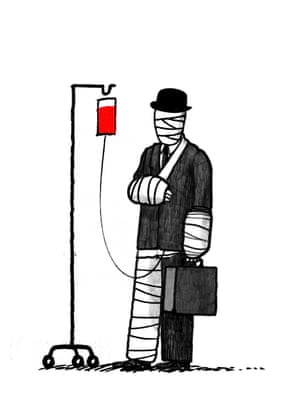
It’s clear that a solution must be found before the whole thing collapses into an enormous heap of rubble, crutches, wheelie drip-stands and little cardboard dishes of vomit. Well, it has been! Last week came news of a campaign, pioneered by Nottingham university hospitals NHS trust that aims to get patients out of bed, dressed and walking around. Obviously, in a sense, the whole NHS is supposed to be a campaign to do that. But the difference with this scheme, referred to as “End PJ Paralysis”, is that it aims for patients to do it before they’re necessarily better.


Illustration by David Mitchell.


Illustration by David Mitchell.

The premise of the scheme is that lying around in bed feeling sorry for yourself becomes self-perpetuating. So staff are encouraging patients to get dressed, move around and in general act like they don’t feel terrible. At a time when the NHS is under unprecedented pressure to free up beds, this is a refreshingly direct approach. “Get out of that bed!” say the staff. The patient does. The bed is freed up. It’s much more efficient than waiting for them to die in the bed, at which point you have to send for a couple of guys and a trolley.


Instinctively I believe this idea works. We’ve all done it: just decided we can’t be ill, either because there’s stuff we have to do or because we’re fed up of the sweaty sheets, the daytime TV, the endless Lemsip. By getting up and pretending everything’s normal sometimes it becomes so. You get distracted from the symptoms and by the time you remember them, they’ve receded or disappeared.


This idea has much in common with alternative medicine. In that field, because patients are listened to, given time and respect in a comforting environment often involving a CD of wind chimes, they frequently feel better despite it having been proved that the actual treatment doesn’t do any good. It’s an effective mood-changer for someone who doesn’t feel 100% but is basically fine.


“End PJ Paralysis” is doing the same thing in a different way. It’s the “Pull yourself together!” to reflexology’s “I’m so sorry to hear that” and is much less costly in time, staffing and vaguely oriental-looking indoor water features. Like homeopathy, it absolutely cannot fail unless accidentally applied to someone who happens to be actually ill.


Some people’s recovery will be helped by greater pressure to get dressed and move around. But can we be sure patients will succumb to this pressure according to whether they’re really up to it, rather than because of their own personality – their instincts to obey authority or deny the seriousness of their condition?


The principle that people who have been hospitalised should restart normal life as soon as they can is already well established. So it’s suspicious that a campaign exclusively pushing the idea of getting up and going home should coincide so precisely with the NHS’s dire shortage of money. It feels like a treatment it’s financially convenient to prescribe.


‘End PJ Paralysis’ is more symptom than solution | David Mitchell

21 Mart 2017 Salı

Good social workers are invaluable. So let’s give them proper support | David Brindle

About three in every 10 people in Britain think social workers help with household chores like cooking and cleaning, with personal care like washing and dressing, and with childcare. Two in 10 reckon they will nip to the shops for you. Asked to choose from a given list of professionals they consider important providers of mental health support, 69% of people identify psychiatrists and 65% GPs – but only 41% pick social workers.


These findings come from a ComRes survey commissioned by Think Ahead, the fast-track training graduate scheme for mental health social workers, to mark this week’s World Social Work Day. As Lyn Romeo, England’s chief social worker for adults, comments with a certain understatement, “there is still more to do to communicate the crucial role of social workers”.


That was to have been the role of the short-lived College of Social Work, set up by ministers in 2010 with plans for it to grow to become a royal college on a par with those for the most esteemed professions, but shut down in chaos five years later. News that the College of Occupational Therapists is to become royal – richly deserved, by the way – has rubbed a good deal of salt into that wound.


There is a fresh plan, however. From 2018, part of the brief of a proposed new regulator for social workers in England will be “to promote and maintain public confidence” in the profession. The mandate for the organisation, provisionally titled Social Work England (SWE), is contained in the children and social work bill currently before parliament. After a rocky start, it enjoys broad support.


One reason SWE is being welcomed is that it will give social work its own regulator again after six years under the generic Health and Care Professions Council. A second is that ministers accept it cannot be self-financing, at least in the short term, and are underwriting it by £16m in its first two years. And the most significant reason is that an initial idea for it to be run direct by Whitehall has been ditched.


Just how independent it will be remains moot: a quango accountable to government, not parliament, it will need ministerial approval of the professional standards it polices. But the social work world sees the lifting of the spectre of regulation by a government department as a clear win.


Another success being celebrated is the withdrawal of clauses from the bill that would have allowed councils to seek exemptions from children’s social care law to test innovative ways of working. Critics saw the idea as erosion of vital safeguards and mounted a strong, successful campaign against it – but the issue was almost certainly settled when Eileen Munro, the leading social work academic often cited by ministers in support of professional reform, opposed it.


However, real tensions remain between the government’s social work reform vanguard led by Isabelle Trowler, chief social worker for children, and the bulk of the sector establishment, with plans for accreditation tests for children’s social workers looming as a new flashpoint. But there is a sense of a thawing in relations.


Herbert Laming, sector elder statesman and crossbench peer who led both the seminal inquiry into the death of Victoria Climbié, which published its report in 2003, and a review of child protection six years later following the Baby P affair, hopes the thaw continues. He tells me: “What social work needs above all at this time is a bit of tender loving care.”


In a lecture on Wednesday at the University of Suffolk, Lord Laming will spell out the enormously high expectations that society has of frontline workers’ skills and judgment when dealing with vulnerable children and adults. The task, he will say, has been made infinitely more difficult by austerity, which is why he joined the call for withdrawal of the exemption clauses at this point even though he understood and backed the case for innovation.


Social workers are crying out for support and encouragement, Laming says. He is surely right. There has been too much stick and not enough carrot in the mix of late.


Good social workers are invaluable. So let’s give them proper support | David Brindle

20 Ocak 2017 Cuma

A moment that changed me: holding the newborn baby I never thought I’d have | David Akinsanya

I never thought I would become a father. I grew up in care and as far back as I can remember I had issues with my sexuality. By the time I was in my 20s I had accepted that I was gay, even though I’d had a couple of heterosexual flings. Over the years, through my work as a mentor and as a foster carer, I met a number of youngsters whom I took care of and some of whom called me Dad. But I’d always wanted to have my own child too.


I met the mother of my child through work. I was delivering health and well-being workshops, and she wanted to talk about the possibility of fostering. We became friends: unbeknown to me pretty early on she decided that I was the ideal candidate to father her child. P was a heterosexual, professional woman in her early 30s. She had always wanted to have a child with a gay man – and someone who really wanted to be a father.


We went ahead without professional advice, gleaning what we could from the internet. For the initial few attempts I produced sperm in east London and took it over to west London. Soon we decided it was best to be in the same place. It was embarrassing to do this in someone else’s home but she blasted a TV programme while I got on with it, which helped. Then a simple syringe was used to insert the sperm.


It took only two attempts like this before we conceived. I remember exactly where I was when I got the news. I was driving, and picked up my phone on hands-free when P told me to pull over. She was pregnant. Sadly, at the 12-week scan we discovered the baby had died. This was one of the saddest days I’d had – to get this far, and for it to end so suddenly. I was comforted by friends who’d had miscarriages and I did consider that maybe it wasn’t to be. The miscarriage wasn’t straightforward, and all I could do was empathise with P. She decided she wanted to try again as soon as possible so we did, and the second attempt was successful.


After the miscarriage it was difficult to accept we were pregnant and there was a lot of worry all the way through the pregnancy. Pregnancy can be an odd thing for men to get their heads around, and it was even stranger for me as I was not in a relationship with the mother. I didn’t see her every day and it was hard for me to be emotionally supportive just through the odd phone call and weekly meet-up.


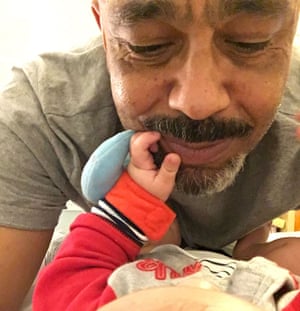
David Akinsanya with his son


‘I’d never felt like this about anyone before – even myself.’ Photograph: David Akinsanya

We did have a minor hiccup during pregnancy where we spent a few days not talking. It was my fault: I was angry about some of the pregnancy purchases and treatments, which I thought were unnecessary and costly. P suggested counselling, so we went to eight sessions, learning how to express our concerns, how to listen to really hear each other and say what we mean.


But none of this really felt real to me until the day my son was placed on to my bare chest by his mother’s birthing partner. I was unable to be in the room during the birth as had been arranged in advance. P was supported by her friend who acted as her birthing partner and had three children of her own. Yes, I felt guilty and lots of my mates who were fathers told me how amazing it was to be present. But I am extremely squeamish and hate blood, pain and hearing people struggle. As it happened, our son was eventually delivered by caesarean section so P was in surgery while I spent my first moments with this child we had made.


It was such an emotional experience for me that I couldn’t stop crying. I was crying for the younger me who was abandoned by my parents into the care system; I was crying for every time I was rejected by foster parents as a child needing a family home; I was crying for all the young people I know who had failed because of a lack of love in their lives. Thankfully, P understood and allowed me to just sit with our little man with tears streaming down my face. These were good tears, healing tears. It felt like my brain was rewiring to allow me to love my son unconditionally.


As I sat alone with my son, this brand new little life in my arms, my life changed. That’s why I cried. I thought about whether I had loved anyone unconditionally before him and the answer was no. I’d never felt like this about anyone before – even myself. I felt an overwhelming sense that this person needed me and will love me back if I do things correctly.


I used to have a cavalier attitude to life. I’d let my career slip as I wasn’t that bothered about taking care of myself after my father died. Now I had someone to work for, someone to impress, someone to think about all the time. After all the rejection and hurt of my past, through my son I finally felt like I had a family of my own.


A moment that changed me: holding the newborn baby I never thought I’d have | David Akinsanya

11 Ocak 2017 Çarşamba

Social care does need more funds, but there are also savings to be made | David Brindle

Ministers last week stepped in with an extra cash boost for social care. On top of a funding increase announced three months ago, they unveiled a further rise to help meet payroll costs and to help professionalise the workforce. Council leaders “warmly welcomed” the move and the emphasis on preventive support for older and disabled people.


You may have guessed this wasn’t in England. It was in Wales, where, as the Welsh Local Government Association (WLGA) observes, the policy position is “very different”. True, the sums involved are not huge. After a £25m grant increase for social care in 2017-18 set out last October, the Welsh government last week found a further £10m and raised the individual cap on homecare costs – a feature of the system not replicated in England – from £60 a week to £70, which should give councils another £4m for the year from April.


Overall, that makes £39m more against what the WLGA says would have been a £92m shortfall in social care funding. Still a problem, then, but if the Westminster government were to make an equivalent contribution towards a previously forecast £1.9bn shortfall in England in 2017-18, that would be worth £805m. As it is, measures hastily put together just before Christmas may amount to a maximum of £281m, according to the Institute for Fiscal Studies, and only £75m of that is grant.


If ministers thought a combination of face-saving package and festive goodwill would get them off the hook, they were mistaken: last week, the chairs of three influential Commons select committees sent a joint letter to the prime minister urging cross-party agreement on the future of social care and health funding, and the Liberal Democrats’ health spokesman, Norman Lamb, is expected to put the idea of a cross-party convention directly to Theresa May in the Commons on Wednesday.


Leading care charities are rallying behind Lamb with support for a cross-party “process” – note the difference – in another letter to May. “Such a process should not aim to ‘take the politics out of health and care’,” says the letter, coordinated by older people’s charity Independent Age, “but rather to make clear the costs and consequences of the political decisions that must be made.”


That is a degree of clarity May is unlikely to be comfortable with. In all her (admittedly limited) utterances on what she concedes is a need to review the social care funding system, she has been careful not to include reviewing NHS resources, too. The prospect of opening another bidding war on NHS cash plainly terrifies her. And the ease with which the hospitals lobby has slipped back into its familiar importunate mode in recent days – muscling social care aside after their brief united front last autumn – shows why.


Would social care be better off going it alone? While logic and principle suggest that the care and health system should be seen as an inseparable whole, and reviewed as such, realpolitik may dictate otherwise.


But social care should also show willingness to look at its own performance. May is convinced there remains money to be found in the system by making better use of existing resources. Although this does not obivate the need for funding reform, it is true that better value is being found in some places than others. Research by the Social Care Institute for Excellence (SCIE) in Birmingham shows that significant savings could be made if the city adopted three models of care reform pioneered elsewhere: the Living Well scheme of support for older people in the community, developed in Cornwall; Kent county council’s hospital discharge programme; and the Shared Lives concept of family-based accommodation for people with disabilities.


Using data supplied by Birmingham council, SCIE estimates that applying the three approaches could save the council £6.6m a year and the NHS £1.4m. To put that into perspective, the council has to make cuts of £78m in its overall budget in 2017-18 and the care and health economy across Birmingham and Solihull faces a £720m shortfall by 2020. But £8m is not to be sniffed at. Equally important, the kind of community support fostered in SCIE’s models plays perfectly to May’s vision of a “shared society”. If that’s the flow, social care needs to go with it.


David Brindle is the Guardian’s public services editor


Social care does need more funds, but there are also savings to be made | David Brindle

11 Aralık 2016 Pazar

What makes celebrity meltdowns entertainment instead of tragedy? | David Ferguson

When I was in my 20s, I remember my therapist patiently listening to me complain about how out-of-my-depth I often felt around other gay men. I was asking her why they always seemed so effortlessly aloof and cool, whereas I was – and to some extent, still am – a slobbering golden retriever of a person, quivering with eagerness to be your new best friend.


“You’ll waste a lot of time and spoil a lot of happiness comparing your insides to other people’s outsides,” she told me.


I think about this a lot when I see famous people – rock stars, celebrities, politicians – going into meltdown mode. Trainwreck TV is one of our culture’s most avid pleasures. In the words of Edina Monsoon from Absolutely Fabulous, “It’s the only blood sport they haven’t banned, darling.”


Right now, everyone is waiting to see what the next eruption from Kanye West will be now that he’s out of the hospital after months – some would say years – of erratic behavior, bizarre concert spectacles and public meltdowns. It’s almost expected, since the Grammy nominations were announced this week and West was again shut out of the major categories.


A few years ago the spectacle du jour was Amanda Bynes, and before that, Britney Spears when she shaved her head and ended up under psychiatric care.


We’ve shaken our heads and tutted over the breakdowns of Mariah Carey and Courtney Love, Amy Winehouse and Gary Busey, Katt Williams and Dave Chappelle, Lindsay Lohan and Anna Nicole Smith – any celebrities who have had the misfortune to exhibit symptoms of mental illness while living in the public eye.


We take a certain sanctimonious pleasure in these people’s public disintegration and show shockingly little compassion, as though their wildly successful careers and personal fortunes make their pain more acceptable than that of mere mortals.


If a random woman we don’t know starts babbling nonsense and getting hysterical while we’re out shopping, it’s tragic. We avert our eyes. We tell our families when we get home how unsettling and upsetting it was. But when Spears does it, it’s a Rolling Stone cover story that we consume with the eagerness of kids tearing into a bag of candy.


It’s the same mentality that allows a racist troll like Milo Yiannopoulos to airily wave away the steaming, reeking mountain of harassment his followers and supporters firehosed at Saturday Night Live and Ghostbusters actress Leslie Jones, mostly on Twitter. Leslie Jones is a rich and famous actress; who cares if people say nasty things about her on the internet?


At what point do we stop valuing celebrities’ humanity?


Is it an income-level thing? Kanye West has got a lot of money. He’s one of the most well-known performers on the planet who isn’t Beyoncé or Beyoncé-adjacent. He has broken paradigms and yes, over-extended his brand, as it were, in a couple of areas, but he’s also a creative young person with a young family under tremendous pressure who lost his beloved mother nine years ago.


He has written openly about his love for liquor, cocaine and other intoxicants. It does not take a tremendous amount of imagination to piece together what may have happened here to a stressed-out artist in pain.


Let’s pretend for a moment that it isn’t Kanye West, but Keith West, who you knew in college who works for a life insurance company now. What if his mother died in surgery and he began a multi-year downward spiral?


Would you be gawking if Keith got placed on involuntary hold in a psychiatric unit? Would you be sharing links about Keith on Twitter and Facebook and marveling that someone could become such a mess?


Kanye West may be, as President Obama once said, “a jackass” from time to time. But he’s also still a person.


Millions of dollars in the bank doesn’t mean anything when you want your mom and she’s gone, I suspect, any more than the significantly less princely sum in my own checking account does. You can’t buy five more minutes to be with your dead mom for any amount of money, large or small.


So, maybe the next time you start to click on that Perez Hilton link about whichever celebrity’s mind has most recently hit the big bug-zapper, take a second. Ask yourself how you’d feel if your life’s most humiliating, confused, disoriented moment was out there for public amusement.


If the person suffering at the other end of that hyperlink was Keith and not Kanye, would you still click it?


What makes celebrity meltdowns entertainment instead of tragedy? | David Ferguson

15 Eylül 2016 Perşembe

The evidence of an NHS weekend effect is shaky | Letter from Neena Modi, David Owen, Robert Winston, Stephen Hawking and others

We call on Theresa May to act in the public’s interest and take immediate action over freshly disputed evidence surrounding a “weekend effect”. Department of Health documents leaked to the Guardian and Channel 4 News revealed NHS policy concerns from Jeremy Hunt’s own civil servants. His repeated claim about thousands of patients dying unnecessarily because of poor weekend hospital care “has not been helpful” in justifying new seven-day services. The internal briefing document proposed other means to vindicate his policy, but repeats the assertion that “eight independent studies have set out the evidence for a ‘weekend effect’ – unacceptable variation in care across the week”.


The evidence for these claims is not supported by reliable research. Of the eight “studies” cited by Hunt, only four are independently peer-reviewed, yet peer-review is essential. Three use data from the same population and are not independent, with just two from the last decade. The remainder are not peer-reviewed medical literature, being opinion pieces, the lowest form of clinical evidence. Critically, when his claims began, at least 13 independent, peer-reviewed papers were available to the secretary of state that refute his definition of a weekend effect.


Hunt has cherrypicked research, causing a devastating breakdown of trust between government and the medical profession. In making these claims without faithfully representing the evidence, he has obstructed fact and misled parliament and the public.


We call on Theresa May to commission an independent inquiry into the process behind these policies. It is wrong to waste precious resources, or lives, because of bad evidence. Like NHS treatments, health policy should be evidence-based to demonstrate clinical and cost-effectiveness. Additionally, we call for a pause on any policies or contractual reform driven by this evidence until it can be examined objectively and with rigour.


Dr Taha Nasser
Dr Ben White
Dr Hugo Farne
Dr Antonio De Marvao
Dr Rachel Clarke
Dr Margaret McCartney
Dr Philippa Whitford MP
Dr Phil Hammond Vice-president, Patients’ Association
Professor Alistair Hall Epidemiologist
Professor Trisha Greenhalgh Evidence-based practice
Professor Neena Modi President RCPCH
David Owen House of Lords
Professor Robert Winston House of Lords
Professor Stephen Hawking


Join the debate – email guardian.letters@theguardian.com


The evidence of an NHS weekend effect is shaky | Letter from Neena Modi, David Owen, Robert Winston, Stephen Hawking and others

14 Eylül 2016 Çarşamba

As a thalidomider, ‘I feel I’m being treated like a scrounger’ | David Brindle and Sue Learner

For Phil Spanswick, who has lived all his life with shortened limbs, three fingers on one hand and four on the other, as a result of the thalidomide scandal, it was galling enough to have his benefits cut after reassessment. But it was doubly so to discover that the assessor had put his condition down as genetic.


“She was 21 and had trained as a paramedic and asked me three times how I had got my disability and what age was I when I got it,” says Spanswick. “She didn’t even know what thalidomide was, that it was manmade and babies were born with it.”


It is almost 60 years since the thalidomide drug was first licensed for use in the UK to counter the effects of morning sickness in pregnancy. By the time it was withdrawn within three years, in 1961, hundreds of babies in Britain and tens of thousands worldwide had been born with limb defects caused, it later transpired, by a component of the drug inhibiting the development of blood vessels and stunting growth.


The scandal became a cause celebre. The drug’s manufacturer in the UK, Distillers (now Diageo), fought a lengthy legal battle with the families affected and it was only after a campaign by the Sunday Times that compensation was settled in 1973 for most of the children, who were by then entering their teens. A long-awaited government apology finally came in 2010 and it was only after half a century in 2012 that the German inventor of the drug, the Grűnenthal Group, issued a statement saying it regretted the consequences.


Remarkably, people are still coming forward with claims for compensation. But as Spanswick’s experience suggests, the thalidomide story is slipping from the consciousness of even health and care professionals and the drug’s survivors – known as “thalidomiders” – are certainly winning no special favours from the reformed benefits system.


Spanswick, 54, has had his lifetime award of disability living allowance (DLA) downgraded under the reassessment process carried out as part of the benefit’s transition into the new personal independence payment (PIP). He is not alone: the Thalidomide Trust, set up as part of the 1973 settlement to administer compensation and represent the interests of survivors, knows of three other cases and suspects there are “quite a few” more.


“The effects of thalidomide are not well understood and the new assessment process can be difficult for individuals to understand and navigate,” says Deborah Jack, the trust’s director. While her team has been able to help other thalidomiders to protect their DLA awards, she explains, it was unaware of Spanswick’s case before it was too late.


Spanswick, who lives with his wife, Rachel, and two grown-up children in Lambourn, Berkshire, has one leg five inches shorter than the other, no left hip, virtually no arms and no thumbs. He is unable to tie his shoelaces, wash his hair and body, or use the oven or washing machine. He needs assistance to get dressed, although he has mastered the art of putting on a sock by using his other foot. 


When he falls, which can be quite often, he cannot put his arms out to break the fall and so tends to hit the ground, injuring his head. He is incapable of getting back up by himself. Yet despite this, he has been assessed under PIP as being entitled to the standard mobility component, worth £21.80 a week, rather than the enhanced rate of £57.45.


Back in the 1980s, Spanswick was awarded higher-rate DLA for what he believed would be the rest of his days. “Up until then I had to keep having medicals, but the doctor said I obviously had a disability that was not going to get better and would only get worse –so they awarded me DLA for life,” he says.


Three years ago, however, the government began to roll out PIP as a replacement for DLA for people with a long-term health condition or disability. The reform meant compulsory testing regardless of previous lifetime DLA.


In December last year, the assessor, working for private contractor Atos, came to Spanswick’s house. “She filled in multiple-choice questions and asked me how far I could walk,” he recalls. “I have one leg shorter than the other, so it all depends. Cobbles are really hard and I can walk further if there are benches along the way so I can sit down and have a rest. These questions cannot be answered with a simple ‘yes’ or ‘no’.”


A few weeks later, on Christmas Eve, he was shocked to receive a letter saying he was eligible only for the standard mobility component. As a consequence, he has lost free car tax worth £515 a year for his vehicle and automatic entitlement to free parking. If he had run a car under the Motability scheme for disabled people, rather than his old, adapted 4×4, he would have had to forfeit that too. He asked for the mobility assessment to be reconsidered. At the end of February, he was informed that the decision had been upheld. He then lodged a formal appeal, but a tribunal has rejected his case.


A Department for Work and Pensions spokeswoman says PIP is a fairer and more objective system than DLA. “Decisions are made after consideration of all the evidence, including an assessment and information provided by the claimant and their GP”.


Spanswick who still gets the higher-rate “daily living” component of PIP, worth £82.30 a week and receives an amount of compensation through the Thalidomide Trust that he prefers not to disclose, says he used to have faith in the system, but now feels “completely let down” and the victim of injustice. “I feel like they are treating me like a scrounger. These assessments try and pigeonhole you, but you can’t pigeonhole disabled people.”


His battle with the DWP has also brought back bad memories for Spanswick’s elderly father. “My father is so upset at this as he feels he had to fight for me when I was young for something that was caused by a drug company. Now I am having to fight all over again.”


Thalidomide: the facts


There are currently 465 thalidomiders on the books of the Thalidomide Trust, but people are still coming forward with potential cases – at an average rate of one a week over the past two years.


Deborah Jack, director of the trust, admits that even she is amazed. But she explains that people who were born with relatively limited physical disorders, and have been able to cope for more than 50 years, may now be struggling.


“One of the most common minor disabilities caused is absence of thumbs, or really tiny thumbs,” Jack says. “While you may have been able to manage with that, after all this time the strain of using your hands unnaturally to compensate starts to tell on your hands.”


By no means all claims for compensation are accepted after investigation. Many similar disabilities have other causes.


The trust administers investments of £130m provided by Diageo and a separate fund set up by the government in 2012, worth £80m in England over 10 years. Payments are made to thalidomiders according to the extent of their impairment.


As a thalidomider, ‘I feel I’m being treated like a scrounger’ | David Brindle and Sue Learner

11 Eylül 2016 Pazar

I cough at all the wrong times. Thank God I"m not Hillary Clinton | David Ferguson

If you are a character in a Victorian novel – which, much to my occasional dismay I am not – you know you’re going to die if, at an otherwise slow plot point, you begin to cough. Within two chapters, your cough will be spraying drops of dark red blood on to your linen kerchief and before long, you’ll be carried off by consumption.


These days we don’t live with the constant threat of tuberculosis and yet, from the way a certain segment of the right wing fever swamp is treating Democratic presidential nominee Hillary Clinton, you’d think she was Fantine from Hugo’s Les Miserables.


Matt Drudge, Sean Hannity, Rush Limbaugh, some ghoul named Steve Malzberg – who probably can’t help it that he’s a dead ringer for 90s make-believe car salesman Joe Isuzu – and even Republican nominee Donald Trump have seized upon Clinton’s seasonal allergies and resulting cough as a sign that she is trembling at death’s door, barely able to function.


“People don’t cough like that,” Malzberg insisted on his Newsmax.com podcast last week. People don’t have coughing fits ‘all the time,’ in public that go on and on and on and on and on and on. Not unless there’s something going on that’s not right.”


Please allow me to disabuse you of that notion, sir. Plenty of people “cough like that,” myself included. According to the Centers for Disease Control and Prevention, an estimated 19.1 adults over 18 were diagnosed with seasonal allergic rhinitis – also known as “hay fever” – in 2014 and 6.1 million children.


I’ve got big sinuses. It’s part of what makes my singing voice able to cut through layers of drums and guitars – a network of large, resonant holes in my skull. My late mother sang opera and had a glorious lyric soprano voice that could fill a whole theater and shake the chandeliers.


Twice a year, for 2 to 4 weeks in the spring and fall, those holes in my head fill up with gunk and it makes my face and forehead feel like a huge throbbing, aching, seriously clogged bottle of rubber cement.


If I don’t get enough sleep, drink quarts of water, eat right and keep my stress levels down, that respiratory distress will move straight down into my chest and I will develop a booming, persistent cough.


For some reason, the fall of 2009 was particularly nasty. I’d quit smoking the year before and thought that would make my seasonal battles with pollen and mold less miserable, but that first year, it seemed to have the opposite effect.


That was when I was a late night classical music DJ. My show went out live to the whole state of Georgia four nights per week. I remember it was Thursday, Sep. 10 because I was queuing up John Adams’ solemn, exquisite symphonic remembrance of the 9/11 victims, On the Transmigration of Souls.


“Our next selection,” I began, “is John Ad–” and I was seized with a violent coughing fit. Most radio consoles have what’s known as a “cough button” for just such an emergency. It mutes your microphone until the cough or sneeze or period of hoarseness passes.


But this coughing fit didn’t pass, it just kept going on and on. I killed my mic and started the music because I wasn’t sure what else to do. I was mortally embarrassed and for an awful moment felt sure I was disgracing the memory of all those people who were killed in the terror attacks of September 11, 2001.


The control room phone rang. I gulped down two swallows of tepid coffee and answered, still weak-voiced and froggy.


“You okay in there?” it was my boss calling from home.


“I’m fine,” I sputtered. “Just fighting for breath.”


He asked if I needed someone to come take over. I said no, I’m fine, it’s already passing. I hung up the phone and it immediately rang again. I picked it up and it was my twin brother calling from his car.


“Boy, that sounded terrible,” he said, laughing. “You’ve really got to quit smoking crack rocks at work.”


“It went out live to the whole state,” I said. “Our listeners probably think I’m dying.”


I wasn’t, though, any more than Hillary Clinton is. The fact is, even an able-bodied, healthy, athletic person like myself can get a cough that sounds like the end of the world. A week later I was back to running four miles a day and breathing like normal.


Sometimes, oh ye right-wing vultures, a cough is just a cough and the woman candidate whose health you’ve never cared one iota about before now is probably just fine, suffering from – as her personal physician disclosed in detail – a round of seasonal allergies.


So, if you’re expecting Hillary Clinton to keel over dead like Mimi, the consumptive heroine of Puccini’s La Boheme, or Hugo’s Fantine, I wouldn’t get my hopes up. I think she’s got a couple of arias to sing first.


I cough at all the wrong times. Thank God I"m not Hillary Clinton | David Ferguson

26 Ağustos 2016 Cuma

Politicians have failed the NHS. We need people power to save it | David Babbs

“I have a teenage daughter with heart and kidney failure,” says Jo from Wolverhampton. “Regardless of the great care she receives, her condition can and does suddenly become critical. Her mother lives in constant fear of changes to the NHS and her support system. We must keep a tight hold on our very precious NHS.”


The story of Jo’s family is moving. But it’s not that surprising – most of us have some experience of the NHS as a true life-saver. And sadly, many of us will also recognise the anxiety Jo describes about the future of the NHS.


Elizabeth, from north-west London, has a rare autoimmune disease that requires regular visits to hospital, including overnight stays. She echoes Jo’s fears. “It is imperative that numbers of beds are not cut,” she says, “my last wait for a bed, following complications with an outpatient procedure, was approximately seven hours.” Valerie from Dorset gave 33 years of her career to the NHS as a registered nurse. “Now I am possibly facing cardiac surgery,” she says, “and I need the NHS to support me.”


Many of us have gradually started to feel less confident than our parents and grandparents were that we will be able to rely on the NHS into our old age – let alone that our children or grandchildren will have a service they can trust.


Not all the pressures on today’s NHS are the fault of politicians. We’re living longer. There are more of us. Demand has risen in hospitals and in health centres. But at the same time, government funding for the health service has been dangerously squeezed. Social care is continually neglected, putting even more pressure on hospitals. And successive ministers have refused to listen to doctors, nurses or patients when pushing through politically motivated NHS reorganisations.


Conventional politics has failed us when it comes to the NHS. The voice of ordinary people – the likes of Jo, Elizabeth and Valerie – has never been more needed. And that’s why they and hundreds of thousands of us are taking matters into our own hands. Think back to David Cameron’s costly and damaging NHS reorganisation. Without a people-powered campaign to prevent the worst elements of Cameron’s legislation, the Health and Social Care Act would have had far more harmful consequences.


A new investigation commissioned by the campaign organisation 38 Degrees, where I work as executive director, is published today. Carried out by a team of health policy experts at Incisive Health, it exposes new plans being drawn up for the NHS across England, called “sustainability and transformation plans” (STPs). The investigation has been funded by hundreds of thousands of people making individual donations via the 38 Degrees website. People like Jo, Elizabeth and Valerie have shared their personal stories, signed the campaign petition and donated to fund the research. Independent of party politics, we’ve chipped in to protect the health service we value so much by putting these plans under the spotlight.


The research finds huge funding gaps for local services, which, the experts say, could lead to A&E closures, cuts to beds and mergers of hospitals. Put together, the projected funding shortfalls across England would see a £23bn deficit in health and social care spending by 2021.


Where Jo lives, in the Black Country, there are plans for major changes at Midland Metropolitan hospital, including the closure of A&E. The plans also include the proposal to shut one of two district general hospitals. By 2021, the health and social care system in the Black Country is projected to be £476.6m short of the funds it needs to balance its books while maintaining the same level of care. Where Elizabeth lives, the draft plan indicates “reducing demand for acute services by approximately 500 beds”. That’s health manager-speak for cutting 500 hospital beds.


Our crowdfunded investigation shows that this worrying plan for the Black Country is typical of many others across England.


These kinds of cuts aren’t the fault of local NHS leaders. They’re being planned all across the country, the result of a growing black hole in the funding provided to the NHS by the government. Whether or not Theresa May allows these cuts to go ahead will be a key test of her commitment to protecting the NHS.


The NHS belongs to all of us. So before these plans go any further, local people should have a say on any changes to their services. That’s why almost 250,000 people have already signed the 38 Degrees campaign petition to the health secretary, Jeremy Hunt, calling for full public disclosure of the STPs for each and every one of the 44 areas across England.


No one is suggesting that all changes to NHS services are bad. There may be a good case for some of the changes that are being proposed. But because the plans are not out in the open – we have had to hire specialist researchers to give us even a partial picture – there’s every reason to fear that many of these will be about cost cutting at the expense of patient care and patient safety.


One thing is certain: we know that when we leave the politics of the NHS to the politicians, it doesn’t end well. Now, more than ever, people-powered campaigning is critical to the future of the NHS.


Politicians have failed the NHS. We need people power to save it | David Babbs

19 Temmuz 2014 Cumartesi

Poll: David Cameron"s reshuffle boosts Tories

The findings came as one of the ministers whom Mr Cameron sacked launched an extraordinary assault on his political opponents.


In an article for The Telegraph, Owen Paterson, the former Environment Secretary, says that he accepts the Prime Minister’s “right to decide on his team” but argues that the jubilant reaction to his sacking from green activists displays he was demanding them “rather effectively”.


Mr Paterson mounts a vigorous defence of his record battling the influence of green groups in Brussels, fighting Liberal Democrats in coalition over wind farms, and responding to the flooding of the Somerset Ranges last winter.


In his write-up, he denounces the “Green Blob” – his phrase for environmental campaigners, renewable vitality firms and some public officials – and calls on politicians to stand up to the strain groups.


“This tangled triangle of unelected busybodies claims to have the interests of the planet and the countryside at heart, but it is increasingly clear that they are focusing on the incorrect troubles and carrying out genuine harm even though profiting handsomely,” he writes.


Some activists even sent him death threats and circulated his property handle “worldwide” on the net in the hope that it would be attacked, the MP says.


According to the Telegraph’s poll, voters strongly assistance the appointment of women like Nicky Morgan, the new Training Secretary, and Liz Truss, Mr Paterson’s substitute at the Division for Setting, Meals and Rural Affairs.


In all, 81 per cent mentioned getting a lot more ladies in the Cabinet was a good issue.


Ukip supporters were least impressed with the new female appointments: 36 per cent did not agree that getting much more female ministers is a very good point.


The appointment of Eurosceptic ministers like Philip Hammond, the new Foreign Secretary, and Michael Fallon, promoted to Defence Secretary, was meant to reach out to Ukip voters.


Mr Fallon has predicted that the new Tory crew will win back those who have “flirted” with Ukip.


The poll suggests that Ukip-inclined voters can be won back. Two thirds of voters described Ukip as a excellent way of placing strain on the principal events, but would hesitate to back them in a basic election.


The benefits also recommend that the Conservative attempt to depict Ukip as extremists has persuaded some men and women.


Some voters explained that they would struggle to back Ukip because of its “extreme” views (36 per cent) even though other people felt their vote would be wasted (21 per cent).


A single in three voters – 33 per cent – title Mr Cameron as the greatest Prime Minister for Britain, regardless of their personal voting intentions, confirming him as the most highly rated of all the party leaders.


He is far a lot more common with his personal side than Mr Miliband is among Labour supporters. Some 90 per cent of Tory voters back Mr Cameron as Prime Minister, while only 59 per cent of Labour voters feel Mr Miliband is the best leader for Britain.


Meanwhile, new specifics have emerged of the personal negotiations between the Prime Minister and his senior colleagues about which jobs they would be provided.


William Hague informed Mr Cameron a year ago that he wished to quit as Foreign Secretary simply because he did not want to be “hanging around” when the Prime Minister would commence renegotiating Britain’s relations with the EU prior to a planned in/out referendum.


A Cabinet supply mentioned: “David Cameron has known for about a year that he was going.


“He was extremely clear he wanted to stage down. You would begin to get questions about the Foreign Secretary and Europe, especially with the Europe referendum coming in the next parliament. He did not want any of that.”


Considerably of the coverage of the reshuffle centered on the “demotion” of Mr Gove from the submit of Training Secretary to the function of Conservative Chief Whip.


Mr Cameron asked Mr Gove, a single of his closest pals and allies, if he desired to move jobs to become Chief Whip two weeks prior to the reshuffle.


A senior government supply mentioned: “He went away to go and have a proper believe about no matter whether it would be a good factor. He came back and made the decision it would be good to do.”


Mr Gove spent a lot of the day just before the reshuffle acting as Chief Whip, helping Mr Cameron to finalise the new line up of government ministers, even just before it was announced that his part had transformed.


Even so, Downing Street has privately identified for some months that the Conservatives want a friendlier face than the divisive Mr Gove to current the party’s schooling policies to voters ahead of the next election.


A senior Cabinet minister privately conceded that the reshuffle was focused solely on winning following year’s common election, with small time left for introducing new reforms in government.


“You want your prime team in the middle doing the heavy lifting for the election,” the senior Tory said. “That’s what we are going to be doing in the next nine or ten months – we have acquired to get re-elected.”


Poll: David Cameron"s reshuffle boosts Tories

16 Temmuz 2014 Çarşamba

David Cameron "not convinced" over assisted dying bill

Prime Minister

The issue was raised by during prime minister’s questions ahead of the second reading of Lord Falconer’s assisted dying bill. Photograph: PA


David Cameron has said he is worried about moves to legalise euthanasia although he would be happy for the Commons to debate the issue of assisted dying.


Speaking ahead of a controversial debate on the issue in the House of Lords, the prime minister said he was “not convinced that further steps need to be taken” by parliament on the issue.


The issue was raised by Sir Richard Ottaway during prime minister’s questions ahead of the second reading of Lord Falconer’s assisted dying bill, which would allow doctors to prescribe a lethal dose to terminally ill patients judged to have less than six months to live.


“In the recent case of [Tony] Nicklinson on the question of assisted dying, Lord Neuberger, the president of the supreme court, said that parliament now had the opportunity to consider reform of the law in the knowledge that if parliament doesn’t act, the courts may. This could raise serious constitutional issues,” Ottoway said.


“Does he agree that whatever your views on the subject, the other place is to be commended for having a debate, but what the public really want is a debate in this house?”


Cameron suggested William Hague, the new leader of the House of Commons, would think about allowing MPs to talk about the issue as well.


“I am very happy for a debate to be held here and of course there are now opportunities for backbenchers to hold debates in the chamber and I am sure the new leader of the House of Commons who I am sure we all want to welcome to his place, will be listening carefully to that request,” he said.


“For myself I am not convinced that further steps need to be taken, I worry about legalising euthanasia and people might be being pushed into things that they don’t actually want for themselves, but by all means let’s have the debate.”


Former archbishop of Canterbury Lord Carey has said he changed his mind on the issue of assisted dying, after considering cases like that of locked-in syndrome sufferer Tony Nicklinson and “the reality of needless suffering”.


However, the church is officially opposed to the idea and Justin Welby, the archbishop of Canterbury, has spoken strongly against it.


On Tuesday, leading doctors called for terminally ill patients who are suffering “unendurably” to be able to end their lives with doctors’ help, in an 11th hour attempt to persuade the Lords to back such plans.


Twenty seven senior figures, including 11 present or former presidents of royal medical colleges and a former NHS medical director, wrote to every peer urging them to back the bid to legalise assisted dying.


David Cameron "not convinced" over assisted dying bill

David Cameron "not convinced" in excess of assisted dying bill

Prime Minister

The issue was raised by during prime minister’s questions ahead of the second reading of Lord Falconer’s assisted dying bill. Photograph: PA


David Cameron has said he is worried about moves to legalise euthanasia although he would be happy for the Commons to debate the issue of assisted dying.


Speaking ahead of a controversial debate on the issue in the House of Lords, the prime minister said he was “not convinced that further steps need to be taken” by parliament on the issue.


The issue was raised by Sir Richard Ottaway during prime minister’s questions ahead of the second reading of Lord Falconer’s assisted dying bill, which would allow doctors to prescribe a lethal dose to terminally ill patients judged to have less than six months to live.


“In the recent case of [Tony] Nicklinson on the question of assisted dying, Lord Neuberger, the president of the supreme court, said that parliament now had the opportunity to consider reform of the law in the knowledge that if parliament doesn’t act, the courts may. This could raise serious constitutional issues,” Ottoway said.


“Does he agree that whatever your views on the subject, the other place is to be commended for having a debate, but what the public really want is a debate in this house?”


Cameron suggested William Hague, the new leader of the House of Commons, would think about allowing MPs to talk about the issue as well.


“I am very happy for a debate to be held here and of course there are now opportunities for backbenchers to hold debates in the chamber and I am sure the new leader of the House of Commons who I am sure we all want to welcome to his place, will be listening carefully to that request,” he said.


“For myself I am not convinced that further steps need to be taken, I worry about legalising euthanasia and people might be being pushed into things that they don’t actually want for themselves, but by all means let’s have the debate.”


Former archbishop of Canterbury Lord Carey has said he changed his mind on the issue of assisted dying, after considering cases like that of locked-in syndrome sufferer Tony Nicklinson and “the reality of needless suffering”.


However, the church is officially opposed to the idea and Justin Welby, the archbishop of Canterbury, has spoken strongly against it.


On Tuesday, leading doctors called for terminally ill patients who are suffering “unendurably” to be able to end their lives with doctors’ help, in an 11th hour attempt to persuade the Lords to back such plans.


Twenty seven senior figures, including 11 present or former presidents of royal medical colleges and a former NHS medical director, wrote to every peer urging them to back the bid to legalise assisted dying.


David Cameron "not convinced" in excess of assisted dying bill

3 Temmuz 2014 Perşembe

Celebrities At Wimbledon: Prince William, David Beckham, Pippa Middleton, And Other Stars Hold Court On Centre Court

The Wimbledon Championships have always brought celebrities, moguls and specifically royals to centre court to witness the splendor on the grass. But this year a galaxy of British stars came out to see if Andy Murray could repeat as men’s champion. (Alas, he misplaced in the quarterfinals.) But that did not end David Beckham, Richard Branson, Colin Firth, and the Duke and Duchess of Cambridge from showing their really like of the sport. Although you have to feel undesirable for the fans who have been seated behind Shaquille O’Neal on opening day—and presumably had an obstructed see.


Celebrities At Wimbledon: Prince William, David Beckham, Pippa Middleton, And Other Stars Hold Court On Centre Court

2 Temmuz 2014 Çarşamba

Ed Miliband: "NHS is getting worse on David Cameron"s watch"


The Labour leader stated following the NHS reforms, have the quantity of men and women waiting much more than two months for cancer therapy had gotten worse and the numbers of folks waiting on trolleys had increased from 61,000 to 167,000.


He claimed the Prime Minister had promised that the reorganisation would boost the NHS, but that it was “obtaining worse on his observe”.


Mr Cameron replied saying that A&ampE waiting occasions were down and extra that if Mr Miliband could not do much better than that on the NHS he “actually is in problems”.


Ed Miliband: "NHS is getting worse on David Cameron"s watch"

1 Temmuz 2014 Salı

Grownup care providers at breaking point as squeeze on funding requires its toll | David Brindle

Oxfordshire county council has for the previous 4 many years pulled out all the stops to avoid passing on a 38% minimize in its grant for providers for homeless folks. But now the authority says it has nowhere left to turn and is reluctantly planning to phase in the reduction, including stopping all funding for dedicated support for those with substance misuse difficulties.


“It is not one thing I like to do, but we’re not uncommon in performing it,” says John Jackson, the council’s director for social and community companies. “The reality is that I have to shield providers for men and women I have a statutory responsibility for.”


According to new investigation published right now, Oxfordshire’s choice is emblematic of the state of adult social care services across England. Findings from a survey of adult social care directors reveal that half say that fewer people are getting solutions barely a single in three says they are safeguarding the size of the individual budgets older individuals and disabled adults acquire to pay for their care and support, and 6 in 10 directors are braced for much more legal difficulties.


The Association of Directors of Adult Social Companies (Adass), which conducted the survey, has hitherto been notably measured – critics may say overly so – in its response to cuts ordered by the coalition government since 2010. But now it warns that the social care program is on the brink of becoming unsustainable. Its president, David Pearson, calls on wider society to say how far it is ready to shield “a great number of vulnerable individuals who will fail to obtain, or not be ready to afford, the social care providers they require and deserve”.


Recalling that earlier this year the National Audit Office (NAO) questioned no matter whether councils had been approaching the limits of their capability to soak up pressures on social care budgets, Pearson says: “Our survey shows past doubt that we have reached the point in which we are unable to absorb the pressures they, and our survey, have recognized.”


The survey adds to the sense of financial crisis. Demands for extra cash for the NHS are mounting and this week the Neighborhood Government Association (LGA) warns that councils in England face a £5.8bn funding gap by March 2016 due to even more cuts in grant – forcing twelve.5% savings in 2014-15 alone – and escalating demand for services, especially for older folks.


The funding gap for adult social care on its very own will be £1.9bn by March 2016, the LGA estimated. Following yr, 2015, is “make or break” for social care with the introduction of the government’s Better Care Fund, expected to pool more than £5bn of current money from councils and the NHS to devote on integrated companies that are created to hold individuals out of hospital. Recent government funding for social care is £14bn.


Pearson, even so, says the scale of the challenge far outstrips any benefit that may possibly come from integration. “It is not the directors’ occupation, but that of the country as a complete and its politicians, to debate how significantly, in times of the most serious adversity, vulnerable people should be protected from the consequences of that adversity by the introduction of new cash into social care.”


Norfolk gives a flavour of the challenge. The county’s population is projected to rise 25% by 2033, but numbers of people aged 65-74 will increase 54% and numbers aged 75 or above will soar by 97%. Significantly of this growth will be in isolated rural communities in the north of the county.


Norfolk’s grownup social solutions department already reviews development of 53% in referrals above the past 5 years, collectively with a near-tripling of demand for intensive homecare assistance of ten hours a week or more, at the very same time as it has been creating £72m cost savings, which contains cutting the numbers of social perform posts and paring back preventive services. Nevertheless, it says paying on frontline care has been protected.


With more cuts of £59m in Norfolk social providers planned in excess of the following three years, nonetheless, continuing to safeguard care is no longer practical. Some £14m is coming out of people’s personalized budgets, £6m from support for people with learning or physical disabilities and £4.5m from the contract with the council’s very own residential care firm.


Asked what the future holds, Sue Whitaker, Labour chair of Norfolk’s adult social services committee, says: “I have a feeling that attempting to provide anything at all on best of what is needed statutorily is going to be exceptionally hard, if not impossible.”


This displays the national image painted by the Adass survey. Primarily based on returns from directors in 144 councils with adult social care responsibilities, 95% of the complete, Adass calculates that an additional £266m (1.9%) is becoming taken out of services in 2014-15, producing a complete 12% real-terms minimize in investing given that 2010 whilst demand for companies has risen 14%. The net effect, for that reason, is stated to signify complete cost savings given that 2010 of 26% or £3.5bn.


Questioned about the most likely affect in excess of the subsequent two many years, 47% of directors say men and women who employed solutions would get smaller sized individual budgets for their care and assistance 48% say fewer men and women would be ready to get solutions 50% forecast greater pressure on the NHS 55% expect care providers to encounter financial problems and 59% anticipate receiving more legal issues to cuts.


With most provision of care these days outsourced, 19% of directors admit not being aware of if all their contractors paid the national minimum wage and only three% are assured that all paid the larger, unofficial residing wage. As numerous as 75% say they commission some homecare visits of just 15 minutes, despite the fact that 90% of them say this kind of visits were merely to check on an individual’s wellbeing or medication.


Richard Humphries, assistant director of policy at the King’s Fund thinktank, says the survey rings painfully accurate. “This is the consequence of the 2010 paying settlement that supposedly protected the NHS but left the social care technique totally exposed,” he says. “It was all completely predictable.


“What we are seeing now is a double whammy with each the NHS and social care simultaneously facing a crunch year up coming yr. Most people cannot see how to get beyond this without extra income – not just funds for much more of the exact same, but for transformation of companies. The Better Care Fund is Ok, but it truly is a extremely modest step in direction of a lot larger measures that are needed.”


Back in Oxfordshire, Jackson thinks the county council has a sustainable – if unpalatable – 4-yr strategy for social care. His political boss, Conservative cabinet member Judith Heathcoat, has advised the Oxford Mail she is “as relaxed as I can be” with the planned 38% cuts in housing-associated support, which are component of a £64m financial savings package across the authority in excess of 4 years.


Other cost savings will come by means of less expensive help for men and women with finding out disabilities, moving them both out of residential care or perhaps from two-man or woman flats to shared accommodation for five. Older people will also be hit: individuals attending overall health and wellbeing centres might up coming year be charged £20 a day.


Jackson’s dread is that growing numbers of legal issues will be incurred over people’s statutory rights to care. “In the end we cannot not meet people’s care requirements” he says. “We would want to do that morally anyway, but the law is really clear about it. We will not require the courts to tell us that.”


Grownup care providers at breaking point as squeeze on funding requires its toll | David Brindle