advice etiketine sahip kayıtlar gösteriliyor. Tüm kayıtları göster

7 Mayıs 2017 Pazar

Radio DJs are suppliers of banal chatter, not health advice on partying | David Mitchell

Sometimes it’s the little things that get to you. Viruses, obviously. Bacteria. Tiny, tiny flakes of asbestos. Or, to be less literal, the inconsequential things. An inconsequential thing that got to me last week was a report of some Northumbria University research saying that Radio 2 DJs’ repeated references to alcohol were making their listeners hit the bottle.


That’s how it was spun by the tabloid reporting it. But I suppose that was just its way of dragging the story closer to one of the small collection of things it likes to always say: “Women who aspire to do anything deserve the misery they inevitably suffer”; “Decent people are no longer safe in their own homes”; “The BBC is evil”; “Everything gives you cancer”. “This one’s a three!” someone must’ve shouted across the newsroom.


I’m sure the details of the study are more nuanced. The researchers analysed four radio stations aimed at listeners who were middle-aged or older – three commercial ones and Radio 2 – to find out the frequency and nature of the booze-mentioning. And what do you think they found out? You’re right, it’s that.


They are blaming Simon Mayo for ‘normalising’ drunkenness. I’m pretty sure it’s been normal since Dionysus


Yes, obviously the DJs mentioned booze loads and repeatedly implied that it was fine and nice. As Northumbria’s associate professor of public health and wellbeing put it: “Alcohol consumption is often portrayed as the norm without negative consequences, and just 5% of references on all stations were about sensible drinking.” That’s a lot more discussion of sensible drinking than I would’ve expected.


This is a bit of a soft target, you might think. Leave the guys at Northumbria University alone. If they can get funding for counting the number of times Steve Wright mentions Lambrusco, maybe I should wish them luck. But I don’t. Because it’s another case of people scrutinising how other people talk and vetting them for inadvertent divergences from an approved value system. A mild case, perhaps – these guys aren’t no-platforming Peter Tatchell – but they are blaming Simon Mayo for “normalising” drunkenness. I’m pretty sure it’s been normal since Dionysus. The study will probably be ignored but, in these inane times, you just can’t be completely sure.


So it might be worth saying something obvious: DJs on the radio have to talk like human beings – the specific human beings they happen to be. That’s the premise of this form of entertainment: natural chat interspersed with music. It’s not high culture but it passes the time in heavy traffic.


But it won’t work if the people at the microphone, desperately trying to keep the energy up, also have to reflect some externally imposed consensus of how life should be lived. That’s Thought for the Day, which is scripted in advance and lasts under three minutes. Any longer than that and it really would drive listeners to drink…


DJ 1: And Chris from Reading has tweeted to say he’s “just kicking back and chilling with a couple of beers”. Nice one, Chris, but do remember that’s at least four of your recommended maximum of 14 weekly units right there. So do maybe stick at two.


DJ 2: Depending on how much you’ve been drinking the rest of the week, Chris. Are these really your first? Or has it been two every night? Maybe it’s time for a break. I’d hate to think you can’t kick back and chill without the soporific effect of beer. I wouldn’t want to normalise that.


DJ 1: But it’s good that you’re talking about it. Perhaps this is the first step towards a better understanding of your problem.


DJ 2: Yes indeed. And keep those tweets, texts and emails coming in. The weekend starts here…


JINGLE: It’s Friiiiidaaaaaaaaaaaaay! The weekend starts here!


DJ 1: Julie from Norwich has asked for a shout-out to everyone who works with her…


DJ 2: Hi guys!


DJ 1: And says they’re partying already.


DJ 2: Nice one!


DJ 1: She says they’re “already popping the prosecco around the photocopier”.


DJ 2: Ooh. Now, erm, should we be normalising that? I assumed she meant dancing, games, cake…


DJ 1: Not to underplay the obesity crisis.


DJ 2: Of course not – we’re sitting on a diabetes timebomb. Nevertheless, cake is OK occasionally, at a party.


DJ 1: Mary Berry is stick thin.


DJ 2: Exactly. And it certainly doesn’t lead to the sort of partying that results in poor life choices. You know, money problems, problems in the home…
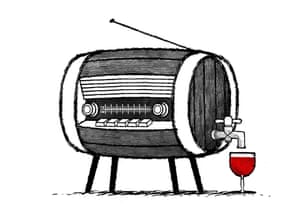


Illustration by David Foldvari of a wine cask with a radio dial on the side.


Illustration by David Foldvari.

DJ 1: Neil, I was really hoping we could get through one drivetime without you mentioning domestic violence.


DJ 2: It happens, Tim!


DJ 1: I know.


DJ 2: Do you want me to say it doesn’t happen?!


DJ 1: No, because that would involve mentioning it again.


DJ 2: It’s a terrible world out there.


DJ 1: Yeah, but… you know… Friday!!


DJ 2: Yeah.


DJ 1: Good. So, take it easy on the prosecco, girls. It’s got a higher ABV than you’d think, but nevertheless have a great one.


DJ 2: Just not the sort of great one you look back on with bitterness in a couple of decades when you get cirrhosis of the liver!


DJ 1: We should get that turned into a jingle. Here’s one from Andy in Luton: “At the end of a long week working for a faceless corporation, I intend to make myself feel briefly better by consuming more alcohol than is medically wise, something as ingrained in western European culture as that weird thing that makes the women’s necks all long is with whoever does that…”


DJ 2: That should have gone through Compliance.


DJ 1: “…but I really miss the days when your show used to make that feel normal and positive and like it was how I’d want to live my life. I’m not fulfilled and I like a drink. It’s essential that society has a way to make people like me continue to acquiesce in our existences, and media references to ‘having it large’, ‘chilling’ and ‘having a massive one’ may be a crucial part of what makes that happen. After all, I’ve long since realised I’m never going to stop drinking and follow my dream of becoming a sculptor and it would only harm the economy if I tried. Cheers.”


DJ 2: I’m quite surprised you read all of that out.


DJ 1: It’s for balance. And here’s one from the regulars at the Crown in North… actually let’s go to a song.


DJ 2: I expect the lyrics somehow reinforce the patriarchy.


DJ 1: Here’s hoping.


Radio DJs are suppliers of banal chatter, not health advice on partying | David Mitchell

10 Nisan 2017 Pazartesi

No conflict of interests on pesticide advice | Letters

The assertion by Professor Dave Goulson (Farmers could slash pesticide use without losses, research reveals, 6 April) cannot go unchallenged. He says that pesticides are massively over-used because farmers are advised by agronomists working on commission to sell products.


The Agricultural Industries Confederation represents the majority of businesses that supply both agronomy advice and crop protection products to UK farmers. Farmers can elect to pay separately for agronomy advice and crop protection products. Farmers also have access to information from agrochemical manufacturers as well as independent agronomy research organisations – much of it free online. In many instances, those delivering advice do not receive commission.


The UK crop protection industry is focused on ensuring optimum, rather than maximum, use of crop protection products to ensure the farming industry delivers safe, wholesome and affordable food. It is a legal requirement that agronomists selling crop protection products are highly trained and kept up to date with agronomic developments to deliver advice to ensure efficient production and environmental protection.
Hazel Doonan
Head of the crop protection and agronomy sector, Agricultural Industries Confederation


Join the debate – email guardian.letters@theguardian.com


Read more Guardian letters – click here to visit gu.com/letters


No conflict of interests on pesticide advice | Letters

23 Ocak 2017 Pazartesi

Delicious roast spuds are part of the good life. Poor cancer advice isn’t | Suzanne Moore

There wasn’t exactly a muted reaction today to the news that your breakfast may kill you. Trump may start a war on facts, a missile may go astray, but it turns out that the final straw is telling people that their toast is bad for them. According to the Food Standards Agency (FSA), burnt toast is potentially bad, as are crisps, and well-browned roast potatoes. With this news, something has stirred deep within us. You will only take away our delicious crispiness by prising it from our cold dead hands. We will fight for the right to fluff: that is, to increase the surface area of potatoes before roasting them in order to maximise the brown, crispy bits. Isn’t that Jamie Oliver’s contribution to humanity? We don’t want warm bread, we want actual toast, toasted. Don’t even start me on crisps.


But the latest abomination, according to the FSA, is that we are consuming too much acrylamide. This has been shown to increase the risk of cancer in mice and therefore is likely to have the same affect on us. It is a chemical produced by cooking starchy foods at high temperatures. Which is, of course, the miracle of deliciousness that we must now shun, or moderate – if not give up altogether.


Actually, none of this information is new. We knew in 2002 that burnt foods suspected of being carcinogenic, and we’ve since learned that the process of curing is considered risky. We are now told that sugars – basically, what carbs turn into – are the work of the devil, so we shouldn’t be eating them crisped to perfection anyway. But hey, life too short and all that …


Or we could be making it so. The problem with all this is partly to do with our understanding of risk, which is extremely poor, and partly to do with the message everywhere now that cancer is reducible to lifestyle. Scientists have to give us the information they have. But we need more context, or otherwise their studies just become a list of things that are bad for us, because … rat studies. The mature response would be to eat less of the bad things and give up all that is lovely. Live a life of vegetables and the odd nut. Clearly most of us never reach this level of maturity. And anyway, I don’t buy this whole “you are what you eat” argument.


Cancer is not a choice or simply a result of diet. This is a vast over-simplification. We can say that two-thirds of cancers are related to lifestyle “choices”: obesity, smoking and drinking primarily, but a third aren’t. We have to take in genetic and environmental factors. What Susan Sontag described as “disease-producing lifestyles” we could now say is basically modern life. There are carcinogens in the environment as well as those we choose to put into our bodies. Pinning cancer to environmental factors is extremely difficult because epidemiologists rarely get the chance to link individual cancers to specific pollutants.


Here are a few other things that increase your risk: paint, Chinese salted fish, contraceptive pills and wood dust


So the lay person has to wade through this advice on eating without comparative studies, and without fully understanding the risks. Yes, burnt toast might up your risk of cancer. (How much would you have to eat, and for how long though?) Here are a few other things that will also increase your risk: paint, vinyl, Chinese salted fish, contraceptive pills and wood dust. We have to navigate our way through this minefield as best we can.


All those crappy alternative health books that somehow blame people for their own illness – attributing it to their repressed-anger “cancer personalities” – are now being rewritten from the perspective of clean living. The proponents of this talk as if we are all only individually responsible for our own health. They hold up the myth of the ever well, pure, toxin-free body. Obviously they live in a different environment to the rest of us. Planet Denial.


Of course we can all take better care of ourselves. Eat more veg and steam more stuff. Moderation and all that. Crisped-up carbs may indeed be the opium of the masses, and the masses will hold on to them. We may seek to extend, life but someone also has to talk about the point of living. If roast potatoes aren’t part of that, I don’t know what is.


Delicious roast spuds are part of the good life. Poor cancer advice isn’t | Suzanne Moore

5 Ocak 2017 Perşembe

NHS to trial medical advice smartphone app

An app that helps people get medical advice on their smartphones is to be trialled by NHS England, it has been announced.


The technology uses an algorithm to run a chat service that will search a database of symptoms, before advising whether to see a GP, go to hospital, visit a local pharmacy or stay at home.


NHS 111 is designed as an alternative to the NHS’s non-emergency 111 helpline, which has seen an increase in demand from two million calls a year to 15 million calls annually in four years.


But concerns have been expressed that the introduction of the app targets a symptom, rather than the cause, of the pressure on NHS services.


“Whilst it’s always important to maximise use of technology to empower patients and make efficient use of NHS resources, this initiative does not address the fundamental problem that we have a severe shortage of GPs and health professionals in community settings,” said Dr Chaand Nagpaul, the British Medical Association GP committee chairman.


He said that the app would rely “slavishly” on algorithms, rather than on clinical staff, which would leave no room for “clinical interpretation in certain instances”.


Nagpaul added: “This proposal does not address this fundamental limitation and may make the situation worse. What we should instead be doing is investing in having properly trained and appropriate clinical staff handling calls and requests from patients, complementing the use of new technologies.”


The six-month trial, beginning this month, will be available to north London residents in Barnet, Camden, Enfield, Haringey and Islington. Patients who choose to continue using the 111 helpline will still be able to do so.


Clinical commissioning groups have worked with technology firm Babylon to trial the app.


Adam Duncan, chief operating officer at GPs’ out-of-hours cooperative London Central and West, said the body was “happy to be working with NHS England and the other providers involved to ensure the piloting of the NHS 111 app is evaluated robustly”.


He said: “We aim to provide an alternative to using the NHS 111 telephone number for service users that would find it most convenient to their lifestyle. The use of the app could also reduce the demand on NHS 111 during the most busy periods, whilst retaining the high quality and accessible service.”


NHS to trial medical advice smartphone app

Chiropractic Advice for Expectant Mothers

Any mother can confirm that pregnancy causes significant strain on a woman’s body. Globally, the average female weighs around 150 pounds. Add to this the additional weight of a growing baby and it is understandable why many expectant mother suffer though high levels of discomfort during their pregnancy.


Studies indicate that more than half of soon-to-be mothers suffer from lower back pain, as well as irritation of the sciatic nerve. There are however, many ways to reduce this discomfort. A trained chiropractor – especially one with experience in pregnancy chiropractic care – can by utilized to help make this process more bearable. With regular adjustments, a body can be prepared for a forthcoming delivery with reduced or even complete prevention of many of the pains and aches commonly associated with maternity. Here are some tips on how you can feel your best during the months leading up to childbirth.


Consult a Trained Professional


Most chiropractors are professionally trained when it comes to taking care of pregnant women. Properly trained chiropractors will utilize techniques which are both beneficial and safe for the caring of unborn babies and their mothers. Some chiropractors even specialize in baby chiropractic, which means they will likely have years of reference experience to help make your initial transition into a parent a less painful process.


Chiropractors are trained in pre-natal care to ensure that they don’t put too much pressure on the abdomen while relieving back and nerve pain. They also have knowledge in areas such as nutrition and diet specifically geared towards helping expectant woman, both during and after pregnancy.


Get Regular Treatment


If you are trying to have a baby, even before becoming pregnant it is advisable to visit a chiropractor. A visit to your local professional will help identify any imbalances that may be present in the pelvic region. A chiropractor can also detect any subluxations; partial dislocations or any misalignment of your vertebrae, which can lead to pain and discomfort during pregnancy.


Most medical experts and women who have previously been treated by a preganacy chiropractor agree that spinal adjustments offers non-invasive relief against the back pain caused by pregnancy. The correct techniques and stretches to relieve sciatic pain can reduce pressure and unwanted strain on hips and back. Such care is considered a safer option than medicines, both for the mother and her new born. When combined with exercise and proper nutrition, the mother and the baby are able to experience a drug-free and mostly pain-free pregnancy.


Post Birth Care


After birth many women suffer thorough joint pain in addition to the discomfort because of the childbirth. With chiropractic care, any arising joint problems caused by the additional weight of the baby, together with any strain occurring on the body due to unbalanced or improper lifting can be treated. This reduced the suffering the mother undergoes even after the baby is born.


Various aches and pains including headaches that can occur during and after childbirth can also be treated with the help of a chiropractor. If you manage to maintain regular chiropractic care during the entire period of your pregnancy, then you can minimize or dispel completely some of the severe causes of pain and discomfort. Such discomfort and pain is caused by the huge changes occurring in the body. With a pelvic alignment, more room is created for the baby to grow. It has also been proven that pregnant women who visit chiropractors regularly minimize their chances of having a breech baby, where the baby is born bottom first instead of head first. Chances are also reduced that they will be required to undergo a C-section birth which has been shown to cause evolutionary changes in babies who are now being born with larger heads.


Bottom Line


Consult your regular physician as soon as you become pregnant, if not earlier. They will help you to determine whether you require chiropractic care during your pregnancy. Even for low risk mothers, it is good to visit a pregnancy chiropractor at least once to ensure things go smoothly. Find yourself a local chiropractor who is highly-trained and experienced, and makes you feel at ease, and you’ll be well on your way to a happy, healthy child-birthing process.


Chiropractic Advice for Expectant Mothers

3 Ocak 2017 Salı

"Terrified" mother died after C-section advice dismissed, inquest hears

A mother lost half of her blood and died after midwives disregarded advice that she give birth via a caesarean section, an inquest has heard.


Frances Cappuccini was terrified of giving birth to her second child, according to her husband, and went into hospital in labour apparently certain she wanted the C-section recommended by her consultant obstetrician.


After the procedure was delayed, however, and after a serious error relating to the treatment of her placenta, the 30-year-old bled heavily and died in intensive care.


“Frankie was terrified,” Tom Cappuccini said on Tuesday at the inquest in Gravesend, Kent. “She was very certain she wanted me to make sure she had a C-section on arrival.


“I put my trust and Frankie’s trust in the people that were there. They disregarded previous medical advice and we were made to feel small and insignificant. In hindsight I wish I had never agreed.”


The inquest heard the expectant mother, from Offham in Kent, booked an elected C-section for 10 October 2012 at Tunbridge Wells hospital following an obstetrician’s advice at nearby Maidstone hospital. But she went into labour two days before, arriving at Tunbridge Wells hospital at about 8.30pm, where she explained she did not want a natural birth or epidural.


The primary school teacher had suffered a placental tear while giving birth to her first child, Luca, four years previous. But midwives and doctors allegedly had “almost a smirk across their face, almost laughing”, saying a decision should not be made based on “pain and fear”, and allegedly said there was no reason she could not give birth naturally.


After 12 hours in labour, she was rushed for a C-section at 8.30am, when surgeons made the serious error of leaving a large piece of placenta in the uterine cavity. She was feeding her son for the first time when she felt blood “flowing between her legs”, the inquest heard. She died from a cardiac arrest.


Tom Cappuccini said: “I had the opportunity to kiss her and tell her how much I loved her. She said: ‘I love you and if anything happens make sure you look after the boys.’”


The family’s lawyer, Neil Sheldon, told the coroner, Roger Hatch: “If the C-section had been undertaken in an elected basis promptly on arrival at hospital, possibly by a different surgeon, then that basic error may not have been made.”


He asked the midwife Julie Ann Michaud: “You have a competent, intelligent, articulate adult patient who has come in and expressed a clear wish for a certain type of treatment. Why was that not the end of the matter?”


Michaud, who described Frances Cappuccini as coming in with a feeling of “impending doom”, and denied talking her out of the C-section, said: “She was a lovely lady to look after.”


Mike Atkins, representing Maidstone and Tunbridge Wells NHS trust, said the error that occurred could have been made regardless of when the surgery took place.


The inquest was originally halted in 2014 when the NHS trust made legal history by becoming the first to face corporate manslaughter charges.


A judge dismissed the case at the Inner London crown court in February 2016.


The inquest continues.


"Terrified" mother died after C-section advice dismissed, inquest hears

21 Ekim 2016 Cuma

How to Get Rid of Skin Tags Naturally – Top 7 Simple Advice for You

It is clear that no one can look down on the importance of skin as it has direct influence on others’ thought about your appearance. Particularly, once you are lucky to have a perfect skin layer without any signs of damage, it is likely that you will feel so good. Unfortunately, not everyone are happy enough to stay away from skin-related issues. Among certain skin problems, skin tag is a popular one. Facts have shown that skin tags will be easily identified by small spots which are known as outgrowing soft skin in many body parts.


On the way of removing skin tags, people usually seek for the help from chemical-based products which are purchased popularly in the market. Unfortunately, these creams sometimes make customers feel satisfied as it may lead to some unwanted consequences. Instead of pouring much money on these products, you are strongly suggested to make use of some ingredients which are available in your house to stay away from skin tags.


1. Tea Tree Oil


Certainly, tea tree oil is one of the most effective tips on how to get rid of skin tags which is used by many people. It is proved that thanks to the huge amount of antiseptic properties in tea tree oil, your skin will be protected from skin tags. More than this, tea tree oil is able to support acne prevention.


  • Use some water to dilute tea tree oil

  • Use the diluted tea tree oil to insert into your affected area using a cotton ball

  • Have your skin massaged gently in 30 minutes

  • Ríne off with cold water

  • Repeat this process several times

2. Fenugreek Seeds


Another effective tip on how to get rid of skin tags is fenugreek seeds. In reality, this special type of seed will be responsible for naturally motivating skin tags to disappear quickly without leaving any annoying scars.


  • Dip some fenugreek seeds into water

  • Leave it on overnight

  • Strain the solution and have yourself drink the water

  • Repeat this recipe as your daily habit

3. Aloe Vera


When it comes to the natural treatments for skin tags, people usually mention to aloe vera. It is easy for us to find aloe vera in many skin products since it is loaded with healing properties. Unexceptionally, aloe vera can bring skin tags ways and help your skin condition improve much.


  • Extract some aloe vera gel from its leaves

  • Apply the solution in to your affected skin before massaging it

  • Leave it on 3-4 minutes

  • Wash your skin gently with lukewarm water

You can also read other effects of aloe vera at: Home Remedies for Labor and How to Get Rid of Syringomas.


4. Banana


It is highly certain that people can make an endless list of banana’s benefit. To specify, we eat bananas to lose weight, treat blemishes, etc. Furthermore, banana can well address the question: how to get rid of skin tags effectively and naturally. This wonderful effect is derived from banana’s loading with many essential nutrients for skin. What’s more, bananas owns antioxidant and enzymes, which may promote skin health and make it lighter and lighter day by day.


  • Make skin mask from ripe bananas and some honey

  • Use the solution to cover the skin tag area

  • Add a bandage into your skin

  • Go for sleeping

  • In the next morning, rinse off your skin with cool water

5. Garlic


Garlic is such a rich source of enzymes that it can support the process of healing skin tags well. Particularly, this cooking ingredient can control the development of skin and control the roots of skin tags naturally.


  • Crush some fresh garlic cloves before turning them into a perfect taste

  • Cover your affected skin area with the paste

  • Apply a bandage into your skin before going to bed

  • Use lukewarm water to wash off in the next morning

6. Oregano Oil


People have been using oregano oil to remove skin tags for such a long time. This simple home remedy is highly recommended for anyone who is busy with work as it is very simple. All of what you have to do is inserting a thin layer of oregano oil into your skin tag area. The habit of taking advantage of oregano oil regularly will not only foster your skin’s health but also function as a tip on how to get rid of skin tags successfully.


7. Vitamin E Oil


In the battle against skin tags, people can lean on the help from vitamin E oil. Loading with an abundant source of antioxidant qualities, vitamin E oil can effectively turn into a good tip on how to get rid of skin tags. Particularly, it will clean your skin pore, gently take out dirt and lighten your skin naturally.


  • Use a thin layer of vitamin E oil to cover the skin area with tags

  • Wait for 3-4 hours before washing off your skin with warm water

  • Do like this repeatedly

Source:


https://authorityremedies.com/how-to-get-rid-of-skin-tags/


https://www.ncbi.nlm.nih.gov/pmc/articles/PMC4013658/


https://nihseniorhealth.gov/osteoporosis/prevention/01.html


More by Jenny Heth:


How to Get Rid of Skin Tags Naturally – Top 7 Simple Advice for You

3 Ekim 2016 Pazartesi

Doctors" political views can affect advice given to patients, says survey

Doctors’ political beliefs can skew the advice they give patients on sensitive issues such as abortions and cannabis use, according to new research.


A survey of more than 200 doctors found that those with conservative views were more likely than others to discourage patients from having an abortion in the future. They also handed out more stern warnings over the legal and health risks of using cannabis.


The results suggest that doctors’ political leanings can spill over into the guidance, and even the treatments, they offer to patients under their care. The findings build on previous work that has highlighted gender and race biases in the medical treatment different people receive.


“Doctors need to think through these kinds of issues, because if they are dealing with politically sensitive issues, this is unavoidable,” said Eitan Hersh, a political scientist at Yale University. “If we can get this out to physicians, they can be more aware of it.”


“If you’re a patient and you are choosing a new doctor, you might want to know their views beforehand,” Hersh said.


Writing in the journal, Proceedings of the National Academy of Sciences, Hersh and his colleague Matthew Goldenberg, describe how they linked more than 20,000 primary care doctors in 29 US states to their political party affiliations using public voter databases. From these they selected more than 200 doctors, half Democrat, half Republican, to receive a survey from Yale medical school, rather than their own Institution for Social and Policy Studies, to disguise the political nature of the study.


In the survey, the doctors were asked to rate the seriousness of nine scenarios presented by patients. The vignettes included references to drinking too much alcohol, smoking cigarettes, using marijuana, being depressed, visiting sex workers, riding a motorbike without wearing a helmet, storing guns in a house where there were children, and having had two elective abortions in the past.


The doctors more or less agreed on the seriousness of the less politically-charged issues, such as alcohol abuse and not wearing a helmet. But they differed substantially in their reaction to more sensitive issues, such as cannabis use, elective abortions and having guns in the home. The Republicans were more concerned than Democrats about patients having future abortions and using cannabis. Meanwhile, Democrats were more vexed than Republicans at patients having guns in the home.


A similar split emerged when doctors proposed how they would treat each patient. The survey found Republican doctors were more likely to warn patients about the health risks of using too much cannabis. They raised the legal risks of the drug too, and urged patients to cut down. They took a stronger line on abortions, too, the researchers found.


“As a patient, it’s useful to ask ‘is my doctor telling me this because it’s what the medical evidence says, or is it because of their world view?’” Hersh said. “Doctors sometimes say they think of themselves as mechanics, that whatever patient comes in they will treat them the same way. But it’s obvious that’s not true. It’s never the textbook scenario.”


Hersh says the findings point to a need for greater transparency. With that in mind, he is considering setting up a website that links doctors to their political affiliations, an idea he said did not appear to be popular among doctors he had spoken with. “There’s a strong economic incentive for them not to close off half of their business because they are with what patients might regard as the wrong party,” he said.


Doctors" political views can affect advice given to patients, says survey

7 Eylül 2016 Çarşamba

NHS to have one website for appointments, prescriptions and advice

A one-stop NHS website where patients book appointments, order prescriptions and access medical advice is being developed, health officials have announced.


For minor ailments patients will be able to check their symptoms online and read up on all manner of diseases.


The NHS.uk website will also enable patients in England to register with a GP and download their own medical records.


Patients will also be able to compare how well their local health service performs against others for areas including cancer, dementia, diabetes, mental health, learning disabilities and maternity care.


Information about individual trusts performances on dementia, diabetes and learning disability services will be published through the MyNHS website immediately, with more information added in the autumn. This data will be taken in to the NHS.uk site at a later date.


The NHS.uk system, which is hoped to be ready by the end of next year, will offer a new online triage system for the NHS’s 111 service. Patients will be able to enter symptoms online and get tailored advice or a call-back from a healthcare professional, a Department of Health spokeswoman said. The triage system is being developed with patients and clinicians and will be trialled before it is available for the general public to use.


The move, which is to be announced by the health secretary, Jeremy Hunt, at the NHS Expo event in Manchester, aims to give the smartphone generation easier access to NHS services. “We live in the age of the smartphone and we want the NHS to reflect that,” Hunt said.


“Our new plans will make it easier for patients to get the medical support and information they need, and should encourage more of us to use the growing range of online NHS services available. This is a way of supplementing patients seeing their doctor in a more conventional, face-to-face setting, and crucially it will give people more choice and the opportunity to access healthcare in a way that works for them.”


The announcement has been made at the same time as a review of IT in the NHS is published. Prof Robert Wachter was commissioned by the Department of Health to look at the English healthcare system’s approach to IT.


He made a series of recommendations to help the NHS, including highlighting “exemplar” NHS trusts that are leading the way. Prof Wachter said: “The NHS is a gem – delivering excellent outcomes at costs well below other international systems such as those in the US. However, for it to continue to provide a high quality and accessible service for staff and patients it simply must digitise. The one thing that the NHS cannot afford to do is to remain a largely non-digital system – it is time to get on with IT.”


Responding to the review, Hunt said he will make 12 trusts exemplars, so others can learn from their experience. He also outlined plans to introduce an academy dedicated to training NHS staff in digital skills.


In the past UK health leaders have been heavily criticised over a failed multi-billion-pound IT system. Ministers shelved an ambitious scheme, designed to create electronic patient records for use across the NHS in England, in 2011.


NHS to have one website for appointments, prescriptions and advice

1 Ağustos 2016 Pazartesi

NHS workers: what advice do you have for new junior doctors?

On Wednesday, thousands of newly qualified medical graduates start work in hospitals across the country.


Junior doctors will take to hospital wards after years of studying and doing work placements. They are supposed to work with a senior colleague before changeover day, to settle into their role before being expected to take on responsibility.


We want to know what advice you have for the junior doctors starting work in August. If you are a doctor, nurse, paramedic, healthcare assistant, admin staff or other healthcare professional working in a hospital with new staff, how have you found working with newly qualified medical graduates in previous years? Is there anything they should avoid? What top tips have you got for them?


Or, if you’re a patient, what would you like to tell the people who will care for you when they first start out?


We want to hear from you. Share your advice by filling in the form below. We’ll use a selection in our reporting.


NHS workers: what advice do you have for new junior doctors?

18 Temmuz 2014 Cuma

Statins advice to GPs is a victory for vested interests more than evidence | Kailash Chand

Statins could be prescribed to more men and women, with a smaller sized risk of heart condition, right after the NHS medicines watchdog lowered the bar for prescriptions.


Good (the National Institute for Overall health and Care Excellence) has issued advice that proposes lowering the cardiovascular primary prevention chance threshold – the degree of danger at which statins can be prescribed – from 20% to 10%.


Several believe that such advice would not have the self-confidence of the pros charged with its implementation. In Could a nationwide conference of general practitioners passed a unanimous movement calling for Good to recommend such adjustments only on the basis of a complete disclosure of trial information. This was followed in June by an unprecedented open letter to Wonderful from a variety of senior medical doctors and academics expressing four major areas of concern: medicating wholesome folks non-disclosed side-result information relying on market-funded statins trials and conflicts of curiosity within Good.


Nice is basing this advice on an examination of market-sponsored trials that might have exaggerated benefits whilst under-reporting harm. Most statins data is presented employing relative chance, which inflates benefit. For example, the heart safety review claimed a forty% reduction in mortality from cardiovascular disease, but the reduction in overall mortality was .3% per yr.


Concomitantly, the side-result information has been declared commercially out of bounds, leaving medics and individuals unable to evaluate the cost-advantage of these drugs.


I have been a GP for more than thirty years and prescribed statins with little concern, right up until I took statins myself for in excess of two years. I developed side-results like myalgia, backache and rest disturbance. I stopped taking statins and my signs and symptoms largely disappeared.


An intervention trial evaluating rosuvastatin unveiled that one particular in one hundred females taking a statin risked building type 2 diabetes at one.9 years. For these individuals the chance of contracting diabetes is roughly the same as the likelihood of keeping away from a non-fatal heart attack. For individuals with a minimal danger of cardiovascular illness, 130 men and women require to get statins for a 12 months to avoid just one undesired overall health outcome.


Wonderful describes itself as follows: “We offer independent, authoritative and proof-based advice on the most successful methods to avoid, diagnose and deal with ailment and unwell health …”


The health care occupation should hence assume Great to base its findings on full data disclosure and independently evaluated cost-benefit of statins. Nevertheless, it transpires that eight out of twelve people on the Wonderful guideline improvement group have ties to the drug organizations, and Wonderful is recommending this guideline on the basis of the Cholesterol Therapy Trialists Collaboration drug-business-funded trials. Nice simply asserting that is independent seems unconvincing.


At existing, it is estimated that about 7 million individuals in the United kingdom consider statins. If Great guidance is followed the number could enhance by numerous million. The evidence for the benefit in major prevention – ie preventing cardiovascular condition in men and women who do not have any diagnosed cardiovascular ailment – is weak.


Three-quarters of people having a 1st heart assault, for instance, have standard cholesterol amounts. According to the Planet Well being Organisation, 80% of cardiovascular illness is caused by smoking, inactivity, an unhealthy diet regime, and other way of life variables. Statins give the illusion of protection to numerous individuals who would be significantly much better served by merely strolling more and staying away from processed food.


Excellent medicine ought to usually be proof based and offered to the correct patient at the proper time. Statins have an important position in patients who have an current heart illness or have had a heart assault. Sufferers should be wary of these guidelines, and engage in meaningful dialogue with their medical doctor, just before deciding regardless of whether or not to medicate. If growing numbers of folks without having heart condition consider statins it will be a victory for vested interests more than proof.


Statins advice to GPs is a victory for vested interests more than evidence | Kailash Chand

17 Haziran 2014 Salı

Medical doctors ought to seek advice from dying patients in "Do Not Resuscitate" choices, court guidelines

As a lot of as 80 per cent of individuals who die in hospital do so with instructions to medical professionals in area not to try resuscitation, he stated.


Mrs Tracey, who had been diagnosed with terminal cancer, died on March seven, 2011 two weeks soon after breaking her neck in a auto crash.


A former care home manager, she was described as “medically minded” and had expressed a “clear wish” to be involved in choices about her care, the court heard.


Despite the fact that barely in a position to communicate and unable to move, she routinely questioned medical doctors and nurses about medicine and products by creating on a notepad or whispering.


When a single doctor mentioned the probability of “tough decisions”, she replied “I will do my damdest” incorporating: “Please do not exclude me.”


A so-called DNACPR (Do Not Try Cardio-Pulmonary Resuscitation) order – at times identified as a DNR – was positioned in Mrs Tracey’s notes at the finish of February but removed a couple of days later right after her “horrified” daughter, Alison, objected, the judgment explains.


A couple of days later, when Mrs Tracey’s well being deteriorated once more, a fresh buy was place in spot, this time with the agreement of the family.


But following her death, Mrs Tracey’s husband, David, was given permission to deliver judicial assessment proceedings challenging the legality of the original DNR notice on her behalf, because of the relevance of the issue.


Lord Dyson, sitting with Lord Justice Longmore and Lord Justice Ryder ruled the hospital had violated Mrs Ryder’s right to “private and household life”.


But they rejected a separate attempt to force the Overall health Secretary, Jeremy Hunt to situation national suggestions to hospitals to clarify the principles.


Lord Dyson said the court must be “slow to give common guidance” about the exact situations essential to situation this kind of notices simply because of the complexity of person situations.


“But I feel it is appropriate to say that, considering that a DNACPR selection is one which will probably deprive the patient of daily life-saving therapy, there ought to be a presumption in favour of patient involvement,” he additional.


“There want to be convincing factors not to involve the patient.”


He mentioned even though there was small doubt it would be inappropriate to involve patients if performing so would clearly cause them physical or psychological harm, just wishing to keep away from distress did not come below this category.


“In my see, medical doctors ought to be wary of being too prepared to exclude sufferers from the process on the grounds that their involvement is probably to distress them,” he explained.


He also rejected the argument that it was inappropriate to involve a patient if the doctor was sure CPR would be futile.


But he additional that the courts should also be “slow” to rule that decisions not to seek the advice of sufferers violated their rights,”if conscientiously taken.”


In Mrs Tracey’s situation, he mentioned the reality that a later observe was agreed with the household did not justify the earlier decision.


Mr Tracey mentioned afterwards: “Patient care has acquired to come initial, and this will deliver more care to people.”


Dr Keith McNeil, chief executive of Cambridge University Hospitals trust, said: “Today’s ruling hinges on a distinct stage of law. There was no criticism of our clinical care.


“It is a truth of life that each day men and women die in hospitals. From my own expertise as a professional hospital medical doctor, the most essential thing is that these individuals are treated with the utmost respect and dignity.


“End of life scenarios involve physicians and nurses obtaining emotionally demanding but needed conversations, with patients and their families about what happens in the ultimate phases of their care. Medical staff use a blend of their compassion, experience and judgment at these hard times, to try out and discover the right pathway for each person patient, and supply the assistance necessary for everyone involved.”


A spokeswoman for the Division of Overall health stated: “Selections on whether an individual should be subject to Do Not Try Cardio Pulmonary Resuscitation (DNACPR) Notices are extremely delicate and tough, as the court recognised.
“It is important that medical professionals stick to the extremely greatest practice so requirements of care in this in area can be improved. We will carry on to operate with professional bodies to make confident advice is understood by health specialists.”


Medical doctors ought to seek advice from dying patients in "Do Not Resuscitate" choices, court guidelines

23 Mayıs 2014 Cuma

Abortion medical doctors can consult girls on cellphone or by means of Skype: advice

It could indicate that the consultation was performed through a webcam, it explained.


The advice said: “Though there is no legal necessity for at least 1 of the certifying medical professionals to have noticed the pregnant lady ahead of reaching a choice about a termination, the Department’s view is that it is very good practice for this to be the situation. It is recognised even so that, with technological advances, this could nicely suggest that a doctor does not physically see the girl, e.g. there could be a discussion by mobile phone or more than a webcam.”


Josephine Quintavalle of the campaign group, Comment on Reproductive Ethics, explained: “A telephone consultation to guarantee authorisation – presumably with a professional-decision doctor – totally ignores the existence-taking nature of abortion, can make a full mockery of the authentic Act and would absolutely not be tolerated in any other branch of medicine.”


Also medical doctors ought to not pre-signal kinds approving terminations, the advice mentioned.


It said: “The clear intention of the Act is for every physician to consider the woman’s situations in forming a excellent faith viewpoint. This is reflected in the recognition that the medical professionals could discover that diverse grounds are met (though they should the two locate the same ground is met for the abortion to be lawful).


“Treating certification by one particular or both physician as a ‘rubber stamp’ exercise is for that reason contrary to the spirit of the Act and calls into question regardless of whether that medical doctor is in reality delivering an viewpoint that they have formed themselves in very good faith rather than relying solely on a colleague’s viewpoint, however trusted that colleague’s judgment may be.


“DH considers the signing of kinds with out consideration of any info relating to the girl to be incompatible with the requirements of the Abortion Act.”


Ann Furedi, chief executive of the British Pregnancy Advisory Services which carries out the majority of abortions in Britain, stated: “This advice endorses our practice at bpas.


“One in 3 ladies will require an abortion since their contraception fails, their lifestyle circumstances abruptly alter, or a problem is identified with a considerably needed pregnancy.


“Not too long ago, doctors providing abortion services have felt under intense political scrutiny, and this document need to give them the reassurance that neither the law nor regulations have altered to accommodate those who think their operate is wrong.


“The law impedes best practice.


“There is no clinical want for two doctors to certify a woman’s causes for abortion, in addition to acquiring her consent, it merely leads to delays. Bpas trusts girls to make accountable options and Bpas physicians comply with the law.”


Public Health Minister Jane Ellison explained: “This brings clarity to abortion care. During its improvement we’ve worked closely with healthcare skilled bodies and consulted the Crown Prosecution Services to give clear advice to clinicians about their roles and responsibilities below the law so that they can continue to offer the very best feasible care for females.”


Abortion medical doctors can consult girls on cellphone or by means of Skype: advice

13 Mayıs 2014 Salı

Girls must give birth without medical professionals, says new NHS advice

The Birthplace Review brought on controversy in 2011 when it reported that for lower risk ladies obtaining their second or third youngster, a property birth or midwife-led unit was as safe as hospital.


It also discovered that women having their initial youngster at home had been 3 occasions more most likely to suffer complications such as the death of their youngster.


This locating led Great to advocate that 1st time mothers give birth in midwife-led units rather than at home.


Major physicians, however, have warned that half of ladies in midwife-led units or giving birth at residence in the research have been transferred into hospital wards and the groups had been selected to give a favourable impression of midwife-led units.


Dr Antony Falconer, then president of the Royal School of Obstetricians and Gynaecologists and colleagues wrote to the British Health-related Journal, which published the study, to level out troubles with the investigation including, how twenty out of the 32 deaths of infants occurred to reduced threat ladies offering birth at residence or in free of charge-standing midwife-led units.


A spokesman for The Royal University of Obstetricians and Gynaecologists (RCOG) mentioned: “We welcomes the publication of this draft advice on intrapartum care from Nice, bearing in mind that this is only in draft and topic to modify pending consultation.


“The RCOG supports choice for reduced-threat women who have had effective prior births to give birth at house provided transport arrangements are in location for hospital transfer in the occasion of an emergency or need to there be a request for ache relief.


“Based on the findings from research, there are issues close to the chance evaluation of pregnant females and the RCOG is in favour of alongside midwifery units (AMUs) for ladies who may possibly need multidisciplinary care for the duration of delivery.”


Alongside midwifery-led units are based mostly on hospital websites up coming to standard obstetric labour wards in which there are medical professionals current while cost-free-standing midwifery-led units might not be on a hospital web site and any ladies needing the care of doctors would have to be transferred by ambulance.


Maureen Treadwell, analysis officer at the Birth Trauma Association, criticised the new draft advice from Good.


She said: “This advice could place the babies of 1st time mothers at threat and in the long run deny choice to girls.


“There are critical flaws in the research utilized to make assertions about the security of midwifery units and until we have robust proof on safety females should be capable to choose where they give birth.”


Christine Carson, clinical guideline programme director for Nice said: “Since we published our unique advice, more proof has come to light about the rewards and risks connected with giving birth at property, in an independent or hospital-based mostly midwife-led unit and on a standard labour ward.


“We now know that these units are as risk-free as traditional labour wards for all reduced risk pregnant females and are far more most likely to result in a far better birth experience with much less health-related intervention.


“The evidence also highlights that residence births are just as protected as other settings for lower chance pregnant ladies who presently have at least one particular child, but not for girls expecting their first little one.


“Nevertheless, each girl should ultimately have the freedom to choose in which she desires to give birth and be supported in her choice.


“We’re pleased we are now in a position to propose far more definite guidance to aid pregnant females decide on the ideal alternative for them. We now want to hear what others think so that we can make certain the final, updated advice will encourage the safest attainable care for women and their babies.”


Cathy Warwick, chief executive of the Royal College of Midwives, stated: “We undoubtedly welcome the alter in guidance.


“The proof displays that for reduced risk girls giving birth in a midwife-led unit or at property is safe, certainly, may be safer than hospital.


“Women also have a tendency to have higher satisfaction charges and a better birth expertise when offering birth in these environments.”


The advice also explained right after birth the baby’s umbilical cord ought to not be clamped and minimize quickly except if the baby needs urgent health care consideration.


The cord should be left for much more than a minute and up to 5 minutes unless of course the mother requests a longer interval.


Studies have shown this can facilitate blood flow into the child.


The advice also reiterated the require for ample staffing ranges to allow ladies to be cared for by 1 midwife at all occasions in labour


The guidance is open for consultation until June 24 and final guidance will be issued later in the 12 months.


Girls must give birth without medical professionals, says new NHS advice

12 Mayıs 2014 Pazartesi

A lot more girls must give birth at property, advice suggests

Newborn baby

Presently just 2% of the 800,000 births a year in the United kingdom take place at house. Photograph: Danny Lawson/PA


Far more women should give birth with only midwives current, which includes at property, since that is much better for them and their babies than labour wards where medical doctors are in charge, the government’s health advisers say on Tuesday.


Midwives ought to advise mothers-to-be who presently have at least a single kid and whose newest pregnancy appears simple to opt for a midwifery-led unit (MLU) or a house birth when deciding where to have their little one, the National Institute for Well being and Care Excellence is urging.


The forty% of women providing birth who are 1st-time mothers ought to also be advised to choose either place, Good is recommending in draft recommendations to the NHS in England and Wales.


Each groups of women should decide on either location “since the charge of interventions is reduce and the outcome for the baby is no diverse compared with an obstetric unit”, Great says.


If the NHS follows the new tips, it could lead to a huge shift in patterns of childbirth in which hundreds of 1000′s much more females pick these spots alternatively of advisor-led obstetric units, exactly where most births arise.


At present just 2% of the 800,000 births a 12 months in the Uk get area at property.


One in 4 hospital births ends in a caesarean-section delivery and a more 1 in eight involves the use of either forceps or ventouse suction cups.


Great mentioned it had revised its guidance on location of birth, which had been in force because 2007, in the light of fresh proof about the security of delivery in MLUs and at house. The only caveat it included was that midwives need to inform first-time mothers that “if they program birth at house there is a little boost in the danger of an adverse end result for the child”.


The Royal College of Midwives (RCM) and the NCT, the parenting charity, welcomed Nice’s proposals. Nonetheless, maternity doctors voiced some unease.


The Royal College of Obstetricians and Gynaecologists (RCOG), which represents the UK’s 10,000 maternity doctors, mentioned it did not object to far more girls going via low-threat pregnancies possessing a house birth. But it warned that transport had to be obtainable to consider this kind of girls to hospital at quick recognize if they created problems or required soreness relief.


The RCOG urged females at threat of issues to steer clear of freestanding midwife-led units, which are not located at hospitals, and use instead so-referred to as alongside units, exactly where these whose labour gets to be problematic can get virtually immediate aid from physicians. It extra that assessments as to which pregnancies are minimal-threat are not usually correct.


Prof Cathy Warwick, the RCM’s chief executive, said: “The proof exhibits that for reduced-danger women, offering birth in a midwife-led unit or at property is protected certainly might be safer than hospital.” Ladies who birthed there usually had larger fulfillment charges and a greater birth encounter than in hospitals, she additional.


Great explained neighborhood NHS organisations should ensure that women in their area could decide on among all four spots to give birth. Warwick referred to as for far more investment in midwife-led care and house births.


NCT chief executive Belinda Phipps said Nice’s tips “are evidence-based mostly and confirm what we have been saying for decades – that birth in a midwife-led unit or at home is a protected decision, especially for people expecting a 2nd or later infant.” But much more midwives were needed to flip Nice’s proposals into actuality, she extra.


A lot more girls must give birth at property, advice suggests

28 Nisan 2014 Pazartesi

Sufferers ought to get fiscal advice at GP surgical procedure, watchdog says

Mr Selbie highlighted a scheme in Derbyshire, in which Citizens Guidance have set up clinics in practically 100 GP surgeries. They evaluate the economic guidance they give to offering sufferers a flu jab.


He stated: “In Derbyshire, there are 102 GP practices, of which 98 have a weekly clinic operated by the Citizens Suggestions Bureaux to guarantee individuals have access to support, which can resolve nerve-racking issues this kind of as housing, employment and advantages troubles or any other matter obtaining in the way of their excellent overall health.”


The chairman of the Royal College of GPs stated patients could be left feeling that fiscal solutions had been being “forced on them” when they wished healthcare help.


Dr Maureen Baker mentioned monetary tips in surgeries was not one thing that the occupation “could or should” be expected to offer.


She stated: “Doctors are skilled and skilled to diagnose and treat illness this is what our individuals rely on and expect from us, and it is important that this remains our principal priority.


“GPs are already struggling to cope with ever-growing workloads while funding for common practice is at an all-time lower. Some medical professionals are seeing upwards of 60 sufferers a day, and it would not be feasible or proper for them to consider on an extra function as economic advisers.


“We would also be concerned about economic representatives operating from GP surgeries if they have been for-revenue. The partnership between patient and physician is one of trust and confidentiality, and this could be broken if sufferers felt that GPs were forcing other services on them.”


Referring to the Derbyshire scheme, Mr Selbie said: “We know that not getting enough cash to dwell on, or somewhere respectable to dwell are barriers to people’s very good wellness and wellbeing, and we have the voluntary sector, council and CCGs [clinical commissioning groups] functioning collectively in a way which implies men and women have assistance via early intervention guidance services and staying away from the possible require for high-priced wellness care later on.”


In accordance to the Workplace for National Statistics, kids in the richest areas in Britain can count on to reside an energetic lifestyle for up to 20 years longer than their counterparts in the poorest neighbourhoods.


In a survey by StepChange, a charity offering debt guidance, practically 3- quarters of men and women explained that debt worries impacted their sleep, whilst six in ten recommended that mood modifications relating to debt concerns impacted their behaviour.


A spokesman for the British Health-related Association explained it was unlikely that the vast majority of GP practices would have the sources to provide this kind of a support.


Sufferers ought to get fiscal advice at GP surgical procedure, watchdog says

15 Nisan 2014 Salı

Poor advice at fault for heart ailment deaths | @guardianletters

Far much more than salt reduction (Fall in salt consumption has helped cut deaths in Uk, researchers declare, 15 April), a top factor in the decline in deaths from heart ailment is the reduction in the consumption of hydrogenated body fat (transfats) above the past decade. Just a month ago this plastic-like body fat was removed from the US’s “normally recognised as safe” record, and the US government has suggested that the foods sector phase it out totally. This has occurred right after a 75% decline in transfat intake in excess of the past decade, but it is nonetheless estimated that the choice will prevent 100,000 premature deaths annually from heart ailment. The decline in transfat consumption throughout the world had practically nothing to do with the Food Specifications Agency or other government bodies – it was due to relentless campaigning by citizens and a response from the meals business.


In 1993 I launched a marketing and advertising campaign to help Total Earth Superspread, the initial transfat-free margarine. For the preceding two decades people with substantial blood pressure had been advised to quit consuming butter and switch to margarine. The top “heart healthful” margarine at the time contained 21% transfats regular margarines have been thirty% or more transfats. Dietitians and margarine companies complained to the Marketing Standards Company, which blocked my advertising. They continued to suggest switching to margarine. This advice underpinned heart illness and stroke amounts.


There has in no way been an apology from the wellness authorities who encouraged medical doctors to market a toxic foods ingredient. The try in the British Health care Journal to draw some parallel among diminished heart illness and decreased salt consumption obfuscates the actual lead to of decreased deaths, which arose from decreased transfat consumption, reduced cigarette use and far better health-related treatments. If we are truly to recognize how to deal with public well being troubles we have to commence by admitting our blunders.
Craig Sams
(Founder of Total Earth Meals), Hastings


Poor advice at fault for heart ailment deaths | @guardianletters

24 Şubat 2014 Pazartesi

Pro-anorexia websites: advice for mothers and fathers

‘Thinspiration’ is defined as any articles that inspires men and women to be thinner, and contains photos and video clips of typically renowned thin folks.


A lot of of these web sites have been created by individuals with consuming disorders who falsely believe that they are well and that anorexia is a life style decision. These kind of internet sites have resources that inspire other people via starvation or purging.


Simply because anorexia and bulimia go by the code names ’ana’ and ’mia’ these internet sites are frequently referred to as pro-ana and professional-mia. They selection from promotion of eating ailments with info on how ideal to even more build the disorder, to sites that supply a wonderful deal of professional-recovery material – this kind of as Beat’s.


Seem into your child’s video viewing historical past. Individuals with consuming problems seek out internet sites such as YouTube the place there are thousands of movies made to encourage people with consuming disorders in their quest to be thinner, plus guidelines and tricks for attaining their objectives.


Have a gentle conversation to request why your kid was visiting these web sites prior to jumping to conclusions. A typical misperception is that only girls struggle with consuming ailments. Males can also struggle with eating disorders so the very same degree of concern need to be utilized to the two.


Mother and father need to always preserve an eye out for dramatic excess weight reduction that is either obvious, or is currently being masked by numerous layers of clothing – a common tactic employed by individuals with eating issues.


If you do find cause for concern then get in touch with your GP for support. The sooner you seek out assistance, the much better the chances of your child overcoming these severe psychiatric illnesses and go on to lead a normal, fulfilling and wholesome daily life.


There is a great deal of details offered on the Beat website and Beat’s helplines and messageboards are a source of support and support to concerned dad and mom and carers.


For a lot more information visit b-eat.co.united kingdom or phone the helpline on 0845 634 1414.


Consuming Problems Awareness Week 2014 runs from February 24 to March two.


Pro-anorexia websites: advice for mothers and fathers