The death of a man after prolonged restraint by police on a mental health ward was caused in part by “disproportionate and unreasonable” use of force, pain compliance techniques and multiple mechanical restraints, an inquest has found.
The narrative conclusion, which came after the coroner ruled out a verdict of unlawful killing, found fault with both police officers and medics involved in the death of Olaseni Lewis at Bethlem Royal hospital in south London in 2010.
Lewis, 23, an IT graduate with no prior history of mental illness, collapsed at the hospital after being taken there by relatives on 31 August 2010. He never regained consciousness and was pronounced dead at Croydon University hospital on 4 September.
A postmortem examination found he had suffered a hypoxic brain injury, which occurs when the brain is starved of oxygen, jurors heard on the second day of the inquest.
Early in the inquest, Lewis’s mother, Ajibola Lewis, recalled how a nurse at the Maudsley hospital in south London, had warned her not to allow him to be transferred to Bethlem, where the incident occurred.
“She said to me, ‘Look, don’t let him go to the Bethlem, don’t let him go there,’” Ajibola Lewis said. However, she took the decision, on the advice of doctors, that her son should attend the mental health hospital as a voluntary patient.
The case only came to inquest after years of investigations into who should be held responsible for Lewis’s death. In 2015, following an investigation by the Independent Police Complaints Commission, the Crown Prosecution Service determined that the officers involved had no criminal case to answer.
Last year, it was decided that no charges of corporate homicide would be brought against the South London and Maudsley NHS foundation trust, which manages Bethlem, after it was investigated by Devon and Cornwall police.
A Health and Safety Executive investigation into Lewis’s death is pending following the conclusion of the inquest.
A jewellery expert from Antiques Roadshow died days after being restrained by five paramedics and police officers following suspected postpartum psychosis, an inquest has heard.
The psychotic episode that struck Alice Gibson-Watt, 34, resulted in delusions so severe she believed her five-week-old baby was communicating with her telepathically.
The inquest at west London coroner’s court that began on Tuesday will determine whether the way Gibson-Watt was restrained while being taken to hospital injured her.
Gibson-Watt was a jewellery expert at Sotheby’s who had appeared on the BBC1 antiques show. Her husband Anthony described to the court the “deeply traumatic” events of 13 November 2012, when his wife began crawling on the floor and screaming that her daughter had died, despite her being alive.
She had given birth to Chiara, her first child, the previous month and was thought to be suffering from postpartum psychosis, which can cause hallucinations, paranoia and delusions. The condition affects about one in 1,000 mothers.
PC Sue Thomson was one of those who helped to restrain Gibson-Watt in the ambulance that attended the couple’s home in Fulham, west London.
The officer said in evidence on Wednesday that Gibson-Watt, who had been strapped down with restraints across her chest and legs, was screaming so loudly that talking to the paramedic was difficult.
“She was thrashing from side to side and I was worried she could harm herself or those trying to help her,” Thomson said. She joined other personnel in the ambulance to help restrain Gibson-Watt, along with her mother Miranda Phillimore.
At one point Thomson said it appeared Gibson-Watt was “trying to bite out at someone’s arms”. After arriving at accident and emergency at Chelsea and Westminster hospital, she was given a sedative that calmed her.
Thomson said she then had a “normal conversation” with Gibson-Watt before she told her “she could hear the baby speaking to her and it was saying to her that it was dead”.
Consultant psychiatrist Dr Miriam Barrett, of the North West London mental health trust, told the inquest on Wednesday that in a meeting with Gibson-Watt at 6am on 14 November she “appeared quite rational and normal, but underneath she was showing in her thinking there were delusions”.
“She was convinced that she was communicating with her baby and the baby could communicate with her,” Barrett said. “The baby was part of her delusions and that is where the risk arose.”
She said during the meeting there was no sign Gibson-Watt was in pain or discomfort from any possible injury to the abdomen.
PC Thomson told the court that at no time did she see anyone touch the patient’s chest or abdomen. She had used “calm, even pressure on the shoulders and knees” to restrain her.
Other officers who gave evidence also said they did not see any of those restraining Gibson-Watt touching her chest or abdomen, or touching her in a way that could harm her or injure her liver.
After being assessed at A&E, Gibson-Watt was taken to a mental health unit at west Middlesex university hospital in Isleworth. There she suffered a cardiac arrest and it was then decided she required urgent surgery after a tear was found on her liver that had caused serious internal bleeding.
Gibson-Watt was transferred to an intensive care unit at Kings College hospital in south London, where she died on 20 November 2012.
The inquest is expected to continue until late April.
The dozens of balloons that fell on the crowd at Adele’s concert earlier this month in Adelaide, Australia, was probably a fun surprise for most attendees. But for Pooja Newman, a mother of three with a severe latex allergy, the trick nearly killed her.
The balloons were coated in latex powder, Newman, 38, told a local news station, and caused her to have a dangerous reaction. “I felt my lips swelling and couldn’t breathe,” she told 7 News. “I knew I was in trouble.”
Newman’s sister called an ambulance after three EpiPens were not enough to stop her swelling. She was transported to a local hospital, where she was still recovering in the intensive care unit a few days later.
Latex is a natural rubber that’s found in thousands of products, from condoms to children’s toys. About 1% to 5% of the general population is allergic to latex, but the number is higher—about 10% to 17%—among health-care workers. (Doctors and nurses who wear gloves or handle equipment made with latex are more likely to develop an allergy, because the risk increases with repeated exposure.)
Newman is, in fact, a doctor, and is president of the advocacy group Anaphylaxis Australia. After her close call, she is urging event organizers to rethink using props that could expose large crowds of people to the material.
A latex allergy can appear at any time in childhood or adulthood, says Purvi Parikh, MD, an allergist with the non-profit Allergy & Asthma Network. (As a result of the concert incident, the Allergy & Asthma Network partnered with Avella Specialty Pharmacy to release a new paper on the risks associated with latex allergies.) Latex reactions can also vary a great deal, she says, from mild to deadly.
Some people may only develop a rash or itching, while others can go into anaphylactic shock. “If you have anything more than a rash, even if it is sneezing, coughing, wheezing these are all signs you are at risk for a severe reaction,” Dr. Parikh says.
It’s also important to know that latex allergies aren’t just triggered by touch, she says. Some people are so sensitive that inhalation of latex particles—like the fine powder that can coat gloves or balloons—can also set off a reaction.
RELATED: How to Make a Fat-Burning Tea with Ginger, Lemon, and Honey
Once someone is diagnosed, Dr. Parikh says, it’s important for them to avoid latex in any form. As the public becomes better educated about latex allergies, its use has declined—but, as Newman’s experience shows, it’s still out there. Just a few places latex can still be found are in condoms, adhesives, bandages, rubber bands, toys, sports equipment (like tennis and basketballs), compression stockings, medical masks, catheters, stethoscopes, and—yup—balloons.
“The main thing we can learn from the concert in Australia is that it is very important to have your emergency medication and use it immediately when you start experiencing distress,” says Dr. Parikh, “but also to not hesitate to call 911, as the medication may not be enough to stop the reaction.”
To get our best wellness advice delivered to you inbox, sign up for the Healthy Living newsletter
She also recommends carrying at least two epinephrine auto injectors, as often one is not enough during severe reactions. “Timing is everything, even with an ambulance on the way,” she says.
It’s also a good idea for people with latex allergies to carry an antihistamine like Benadryl (although this won’t help during a severe reaction), and to wear a medical alert bracelet so medical providers will be aware of their allergy if they’re unconscious or unable to speak. “A lot of medical devices or facilities may contain latex, so it is important to let all health care facilities know,” she says.
Jeremy Hunt, the health secretary, has told the private memorial service for a one-year-old boy who died from blood poisoning that the child was let down by the NHS and the government.
Speaking at the service in Cornwall, Hunt said he had “come here to say sorry” to the family of William Mead, who died after the emergency services failed to diagnose a fatal case of septicaemia.
Hunt told those gathered at Truro Cathedral in Cornwall: “I as health secretary, the government, and the NHS, let down William.
“I’ve come here to say sorry. This weekend William should have been enjoying beautiful Cornish sunshine with his parents.
“We didn’t spot his sepsis before it was too late.”
William’s mother, Melissa Mead, has become a prominent campaigner for better diagnostics of sepsis, saying last year that the NHS system was “broken”.
She has also described her son’s final hours, his symptoms and her repeated pleas to health services in painstaking detail on her blog site.
An NHS England report revealed there were 16 mistakes associated with William Mead’s death. Photograph: PA
The health secretary became aware of the case last year and has taken a personal interest in Mead’s campaign, a Department of Health spokesman said.
The spokesman added: “He went down at the request of the family and was also down there to visit a hospital. He had obviously become quite close to Melissa and they have worked quite a lot on the campaign on sepsis.”
An NHS England report last year found there were four missed opportunities to save William’s life in December 2014. Doctors and the 111 non-emergency helpline failed to diagnose pneumonia and the common but lethal infection of sepsis, and he died within 12 hours of Melissa Mead’s last call.
The report found there were 16 mistakes contributing to his death, which included that the “tickbox” system used by call handlers failed to include “sepsis red flags”.
It added that doctors were under constant pressure not to prescribe antibiotics and that doctors working out of hours were unable to access patients’ medical records.
Melissa Mead (@amotherwithout)
RT: Official Sepsis Public Awareness Campaign Video. Do you know the #SymptomsOfSepsis Please watch & RT to help us save thousands of lives. pic.twitter.com/5jV6ePxBaO
December 14, 2016
Sepsis – which includes common symptoms of fever, increased heart rate and confusion – kills approximately 37,000 people each year in England.
Melissa Mead said on Sunday: “We invited Jeremy to William’s memorial as he’s played a pivotal part in the sepsis campaign and we couldn’t have got it off the ground without his government support.
“Jeremy agreed to come in a personal capacity and it was a very intimate event for friends and family. The relationship that we have shows how productive a constructive approach can have.
“We know William was let down, but William didn’t know blame or regret, only love, and it is with this love that we keep putting one foot in front of the other.”
Hunt has admitted letting the family down and in January 2016 Mead welcomed his apology then.
She said: “We are quite overwhelmed, to be honest. We are just a little family from Cornwall but William is going to make an impact on the world and we are very thankful for that.”
The Department of Health spokesman added that Hunt was working with Mead’s awareness campaign in conjunction with Public Health England and the UK Sepsis Trust.
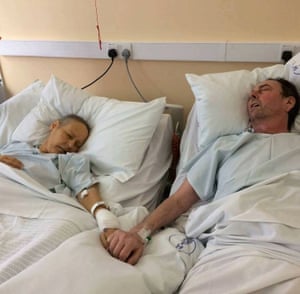
The children of a terminally ill couple who died of cancer within days of each other have said they are “overwhelmed” after more than £100,000 was raised for them.
The money flooded in after the children of Julie and Mike Bennet, from Wirral, released a photograph of their parents holding hands on their deathbeds.
The picture was taken hours before Mike Bennet died last Monday from a brain tumour. His wife, Julie, died on Saturday night at the same Merseyside hospice.
More than £115,000 had been raised on Monday morning for the couple’s three children – Oliver, 13, Hannah, 18, and Luke, 21 – by 5,370 members of the public on a JustGiving page set up to help them “continue to live at home and sustain their activities and studies”.
Donations flooded in after the children of Julie and Mike Bennet released a photograph of their parents holding hands on their deathbeds. Photograph: Family handout
In a statement, Luke Bennet said: “My brother, sister and I are overwhelmed by the enormous support and generosity we have received from so many friends and well-wishers.
“Mum has appreciated all the help from close friends in supporting the family over the last three years through difficult times and it would be a huge relief to her to know this support will continue.”
Mike Bennet was diagnosed with a brain tumour in 2013 and had been nursed at home by Julie and the children.
The 57-year-old was a self-employed cabinetmaker who had served his apprenticeship with Baldock’s Furniture Manufacturers in Liverpool.
Julie, 50, who was a primary schoolteacher at Somerville school in Wallasey, was diagnosed with liver and kidney cancer in May 2016.
Family friend Heather Heaton Gallagher described the couple as “the most supportive parents”. She said: “Facing a double terminal cancer diagnosis is beyond belief and as a community we are working hard to support the family so that they can stay together and ensure that they can continue their education as planned.
“The biggest challenge is that the family car, a Motorbility car has to be returned, meaning that the kids can’t get around to manage practical and personal activities.
“Julie and Mike have been the most supportive parents, encouraging their children’s interest in dance and acting from a very early age.
“All three children thrive on the stage and I know that Julie and Mike would not want this to stop their children from dancing and performing. To help them do this, we need to make them mobile again and help cover the costs that this brings.”
The fundraising page, set up only six days ago, raised more than £15,000 in the first 24 hours. A family friend, Sue Wright, said of Julie: “I told her the community would come together to help look after her kids – and she opened her eyes and smiled.”
Eight years ago, while returning home from a stag do in Blackpool, Scott Gibson began getting headaches that were so excruciating he rang the NHS’s 24-hour helpline and then had a stroke while on the phone. They sent an ambulance, but he turned it away and simply took to his bed instead – for four days. As he lay there, one thought kept going through his head: “I must be OK because I’m young and healthy.” Finally, he tried to head back to work, only to find himself going blind in one eye. Somehow he made it to hospital, where doctors diagnosed an aneurysm an inch-and-a-half deep behind his right ear. He needed major brain surgery, they said. The operation took seven hours.
After Gibson pulled through, he was determined to live life to the full – to live the life he’d always dreamed of, in fact. “I always wanted to be a storyteller,” says Gibson. “And, from day one, I knew this would be the first story I’d tell.” So, as a lifelong comedy lover, the Glaswegian embarked on a college standup course and was soon gigging regularly. In 2012, he took redundancy – £632 – from the call centre where he worked to focus fully on his new career.
But it wasn’t until last year that he made his Edinburgh fringe debut – after a false start in 2015, when the Stand Comedy Club, which has venues in Newcastle, Glasgow and Edinburgh, refused to book Life After Death, as he called his show. “I don’t know why,” says Gibson, now 32. “I don’t know if they thought I was worthy of a room.”
[embedded content]
A clip from Scott Gibson’s show Life After Death on YouTube
At no point did I think: ‘I’m going to win an award with my debut show’
In Edinburgh, however, he proved an overnight sensation. The unheralded Glaswegian swiped the coveted best newcomer comedy award with a show you’d happily watch even if there were no laughs in it, so gripping is his near-death tale. Looking back, Gibson says he is glad about the enforced wait: the extra year’s work contributed, he believes, to his extraordinary success. I could fill this whole article with quotes expressing the burly Scotsman’s astonishment at winning his gong, joining a pantheon that includes Sarah Millican, the Mighty Boosh and Tim Minchin. “I never thought in a million years I’d even be nominated,” he says, having arrived at the festival with “no manager, no PR, no buzz. Didn’t even have a press release. I don’t know if that helped, having no expectations. But at no point did I think, ‘I’m going to win an award with my debut show.’”
Even being shortlisted, says Gibson, propelled him into a glamorous new world. “The nominees turned up to have press pictures taken – and there’s free coffee and bacon rolls! I’m thinking, ‘This is how the other half live!’” Of 18 acts nominated, Gibson believes he was the only one without an agent or manager. He credits his venue, the Gilded Balloon, with providing the support that made his triumph possible.
What made it doubly sweet, he says, was that the main award was won by his compatriot Richard Gadd, a first ever Scottish double-whammy and a rare instance of Edinburgh’s comedy awards recognising local talent. “Rightly or wrongly,” says Gibson, “we [Scottish comics] have an idea we don’t belong at the fringe. There is a voice in our heads saying we cannot compete with London, or the establishment.”
That’s partly because, for Scottish acts, the fringe is awkwardly positioned between home gig and alien environment. “It’s a home gig in that it’s in Edinburgh,” says Gibson, “but not in terms of the audience.” Then there’s the lack of a sustainable comedy circuit in Scotland, meaning acts can only ever do short sets in pubs, and seldom the hour-long narrative or themed shows that prosper on the fringe.
“It’s a hard apprenticeship,” says Gibson. “But it’s the best, because if you come through it, you can play anywhere.” So will his triumph be a confidence-booster for Scottish acts? “There’ll have been comics in Scotland who heard the result and went, ‘Brilliant! Next year, I’m going.’ And others who’ll say, ‘Well, that’s us for another 25 years.’ That’s unfortunately how we think, and it’s stupid.”
At any rate, Gibson will be back, with a show called Like Father Like Son, about “the male figures in my life and how those relationships formed me”. Already nearing completion, it will be one in the eye, Gibson promises, for anyone thinking: “All right, one-trick pony, let’s see what you’ve got.”
In the meantime, he is midway through a run at Soho theatre in London. Before his fringe success, getting a gig there was all he dreamed of, the apex of his ambition. However, his aspirations have not been much affected by awards glory. “I just love doing standup,” he says. “If you can pay your bills, go on holiday once a year, and do standup … ” The ex-call centre employee’s voice tails off. “I don’t know what else you’re wanting. It’s just a good life. Life’s good, man.”
•Scott Gibson: Life After Death is at Soho theatre, London, until 14 January.
A mother lost half of her blood and died after midwives disregarded advice that she give birth via a caesarean section, an inquest has heard.
Frances Cappuccini was terrified of giving birth to her second child, according to her husband, and went into hospital in labour apparently certain she wanted the C-section recommended by her consultant obstetrician.
After the procedure was delayed, however, and after a serious error relating to the treatment of her placenta, the 30-year-old bled heavily and died in intensive care.
“Frankie was terrified,” Tom Cappuccini said on Tuesday at the inquest in Gravesend, Kent. “She was very certain she wanted me to make sure she had a C-section on arrival.
“I put my trust and Frankie’s trust in the people that were there. They disregarded previous medical advice and we were made to feel small and insignificant. In hindsight I wish I had never agreed.”
The inquest heard the expectant mother, from Offham in Kent, booked an elected C-section for 10 October 2012 at Tunbridge Wells hospital following an obstetrician’s advice at nearby Maidstone hospital. But she went into labour two days before, arriving at Tunbridge Wells hospital at about 8.30pm, where she explained she did not want a natural birth or epidural.
The primary school teacher had suffered a placental tear while giving birth to her first child, Luca, four years previous. But midwives and doctors allegedly had “almost a smirk across their face, almost laughing”, saying a decision should not be made based on “pain and fear”, and allegedly said there was no reason she could not give birth naturally.
After 12 hours in labour, she was rushed for a C-section at 8.30am, when surgeons made the serious error of leaving a large piece of placenta in the uterine cavity. She was feeding her son for the first time when she felt blood “flowing between her legs”, the inquest heard. She died from a cardiac arrest.
Tom Cappuccini said: “I had the opportunity to kiss her and tell her how much I loved her. She said: ‘I love you and if anything happens make sure you look after the boys.’”
The family’s lawyer, Neil Sheldon, told the coroner, Roger Hatch: “If the C-section had been undertaken in an elected basis promptly on arrival at hospital, possibly by a different surgeon, then that basic error may not have been made.”
He asked the midwife Julie Ann Michaud: “You have a competent, intelligent, articulate adult patient who has come in and expressed a clear wish for a certain type of treatment. Why was that not the end of the matter?”
Michaud, who described Frances Cappuccini as coming in with a feeling of “impending doom”, and denied talking her out of the C-section, said: “She was a lovely lady to look after.”
Mike Atkins, representing Maidstone and Tunbridge Wells NHS trust, said the error that occurred could have been made regardless of when the surgery took place.
The inquest was originally halted in 2014 when the NHS trust made legal history by becoming the first to face corporate manslaughter charges.
A judge dismissed the case at the Inner London crown court in February 2016.
An ambulance service has apologised for the death of a woman after a paramedic told her to take paracetamol for chest pains.
Carol Wilson’s husband, Peter, called 111 on New Year’s Day in 2015 after she had been suffering from chest pains for a few days, as well as severe throat and ear pain, and pain on breathing.
The 111 service sent a paramedic to the couple’s Sheffield home at about 7am but, rather than giving her a heart scan or taking her to hospital, they said she should take paracetamol.
Wilson, 70, who had three sons, died in her sleep two days later as the result of a heart condition.
Medical negligence lawyers at Irwin Mitchell investigated her treatment and found the paramedic had failed to carry out an ECG scan, which would have identified abnormalities that needed hospital treatment.
Lawyers argued that if Wilson had been admitted to hospital, it is likely that pericarditis – a swelling of the fluid-filled sac surrounding the heart that causes chest and breathing pain – would have been picked up and treated.
Yorkshire ambulance service trust has admitted that, on the balance of probabilities, Wilson’s death could have been prevented if she had been given an ECG and sent to hospital by the paramedic.
Peter Wilson, 72, a retired HR director, said: “Since those three days at the start of 2015, my life has been turned upside down. We’d been married for over 40 years and I don’t think I will ever truly get over Carol’s death and I’m still devastated thinking about it now.
“Carol was an active, healthy woman who practised yoga on a daily basis, walked regularly and ate healthily. Her sudden illness was just such a shock.
“Nothing can turn back the clock, but I just hope that the trust will learn the importance of investigating chest pain in the future.
“Carol was devoted to her family. She was proud of her sons and adored her young grandchildren, who she thought she would see progress at school and beyond. She was cruelly denied that opportunity.”
Hayley Smith, a medical negligence lawyer at Irwin Mitchell in Sheffield, representing Mr Wilson, said: “Peter was understandably distraught at his wife’s unexpected death and wanted answers about what happened to her.
“One minute he was being told to get paracetamol and just two days later, his wife had died during her sleep.
“After our investigation the NHS trust has admitted its mistakes and apologised for the substandard care provided. Although paramedics do a difficult job and have to make split-second decisions, the symptoms and medical history in this case clearly show that more should have been done to diagnose Carol’s chest pain.
“Patient safety should be the number one priority of the NHS and Peter hopes that lessons will now be learned from this tragic incident to reduce the risk of other families suffering in similar circumstances.”
Steve Page, executive director of quality, governance and performance assurance at the ambulance service, said: “First and foremost our thoughts are with Carol Wilson’s family following their sad loss.
“We would like to apologise for the standard of care that was provided to Mrs Wilson on 1st January 2015. The assessment carried out by a member of our staff was not reflective of the high-quality clinical care provided by the trust and actions have been taken as a result of this incident to prevent such an occurrence in the future.
“We would like to reassure members of the public that we take very seriously any concerns that are raised by patients and their relatives and we are committed to being open and honest with them.”
A little more than two years ago, I was in the kitchen with my friend, Julia Jones, in a state of helpless sorrow. My father, John, was still alive then, although he was in his desolating last stages. His slow-motion dying had gone on for months and would continue for several more. While it endured we half wanted him gone, and when it ended, of course we wanted him back – a living ghost rather than a dead man who might haunt us but would never return.
My father’s drawn-out death lasted nine months: he went into hospital as someone living well with dementia; he came out quite lost and broken, and all the love in the world couldn’t have found him or put him together again.
It was Julia who suggested (and why hadn’t I thought of this before; why hadn’t it been obvious?) that carers of people living with dementia should have the same right to accompany them in hospital as the parents of sick children: that they should be welcomed by the bedside, to feed them, talk to them, hold their hand, stroke their hair, meet their gaze, be their memory, keep them safe, take them home whole. And after my father died, it was the Observer – which had 50 years earlier championed the demand by parents to be able do just that for their children – which gave me a place where my voice could be heard, and where sorrow, guilt and regret could be redeemed into change and rescue.
My father was beyond all help, but there are thousands of men and women with dementia who go into hospital each year and who come out diminished, through no fault of nurses and doctors, but because hospital is a hazardous place for those who are frail.
It was nearly two years since I wrote the piece in the Observer that launched John’s Campaign. Founded and run by Julia and me, its aim is simply that carers should be made welcome in hospital. Its beginnings were in a kitchen, but it is now part of a great movement for more enlightened and compassionate care for those with dementia.
At a conference last Wednesday dedicated to the campaign, tribute was paid to the paper’s honourable tradition of giving a voice to the voiceless, power to the powerless, hope to those in despair. The hall was full of generous people who had helped us on our journey – people with influence and connections, NHS leaders, consultants, chief nurses, heads of charities – but at the heart of the conference were the people whose voices are not usually heard, whose sorrow and anger and passion get drowned out in the great noise of the world.
As James Munro, chief executive of Patient Opinion, said: “Listening is the beating heart of healthcare” and in the act of listening “both speaker and listener are changed”.
In a session entitled “Voices”, 10 people, many of whom had never spoken in public before, courageously told of their experiences and were listened to. Sometimes what they said was hard to hear. Their stories, both the ones of anguish and the ones of kindness and optimism, illustrated why we started the campaign.
Tommy Dunne, who lives with dementia, described what it feels like to be in hospital, a “strange place surrounded by strangers”, where something tight squeezes your arm and something cold is put into your mouth; where a chicken pie is placed in front of you and then taken away, a mug of tea loudly offered and then removed; where, startled and scared, “you become dehydrated and delirium sets in … and the quick decline in your health begins. Yet no one knows or understands why.”
Several carers – partners, children, grandchildren, people who, as one of them had it, were the “voice and the memory” of the person with dementia – spoke about their experiences of heartbreak.
Teresa Canale-Parola’s partner, John, was 60 when he died. The hospital in which he spent his final days was too far away for her and her daughters to visit regularly, and – in spite of their battle to get this reversed – there were strict visiting hours, so that for much of the time he was quite alone. In his dementia, John had become violent and was placed under a mental health order. He was medicated and, even when he was placid, he was restrained.
He stopped eating and drinking. Soon he could no longer walk. Thirty-five days after his admission, Teresa had a call to say his health had deteriorated: she and her daughters found John, by now starved and badly dehydrated, “restrained in a chair, dying” . It was a brutal way for a man to go.
The death of someone with advanced dementia can be a sad blessing for those who have loved them, restoring that person to all the selves they have ever been – but a bad or lonely death makes mourning painfully difficult, full of anger and regret and terrible failure, of almost unendurable memories of distress. Not to be with them, not to comfort them, not to rescue them from abandonment and fear, not to accompany them up to the threshold.
Alongside stories of anguish, there were ones of hope: a junior geriatrician (of whom I am the proud aunt) spoke about being part of a cultural change in hospitals. Liz Charalambous – a nurse who has been fighting to get unrestricted visiting for carers for years – said that “one day we will look back in astonishment” at the time when carers were not made welcome.
Rebecca Myers, a health professional whose mother had dementia at a cruelly young age, spoke movingly about the “pragmatic empathy” that lies at the heart of healthcare: “One human being connected to another, in the moment, in the environment, for a shared purpose – to take care, of and with, each other.”
And Theresa Clarke, a former nurse from Northern Ireland now living with dementia, spoke with clarity and spirit about how people with the condition “need to be part of the conversation … not just spoken about, like an object, but talked with and to”. She certainly did not like her diagnosis, she said, and being left in hospital was “deadly, like being in deep space”, but she urged us all to remember that “we can live well with dementia, we can still contribute to society, our family and the world beyond”.
Seeing Theresa, this diminutive firecracker of a woman, hearing her talk, hearing Tommy’s vivid account, was a forceful reminder that people with dementia – who we often reduce to statistics, to costs, to problems, even (horrible words) to “bed blockers”, are not “them” but “us”, valuable and human and precious, with stories to tell and voices to be listened to.
The session ended with Kate Kellaway, of the Observer, beautifully and tenderly describing her father’s last weeks. Her words, republished here, illustrate the ideals of our campaign and show how, up and down the country, nurses and doctors are bringing extraordinary compassion and empathy to the lives of people who are vulnerable, and to their deaths: to live as well as we possibly can; to have, as they say in Ireland, a gentle passing.
Kate Kellaway and her father on his 90th birthday, two months before he died. Photograph: Courtesy of Kate Kellaway
‘My dad’s care made us believe in the goodness of people’
My father died five months ago at Whittington hospital in Archway, north London – he’d had a fall, broken a hip, had an operation, recovered and been discharged. Then he had another fall and had to be readmitted and it turned out he’d had a silent heart attack. He was 90. He had for some time suffered from chronic kidney disease.
So – a medley of misfortunes, including, towards the end, dementia. He had an intermittent belief he was back in the war and that there was a soldier in the bed next to him – he was determined to know the soldier’s name. I helplessly selected “Jim”, which seemed to pacify Dad. But, of course there was no bed and no soldier other than Dad himself, gallantly fighting on.
When it was clear he was dying, the Whittington found him a room to himself. And that was just the first of the blessings of being in that hospital during Dad’s final three weeks.
The care was, in every way, exemplary. The staff were happy to waive visiting hours without question. We could come and go as we pleased and sit up all night with Dad if that was what we wanted to do. The number of visitors at any one time was left to our discretion.
My brother, sister and I were bowled over by one nurse in particular and the compassionate intelligence with which she grasped the emotional picture. Sam Hunt talked to Dad with warmth, respect and gentle humour. She tried to find out how he was feeling. At one point, he admitted he was frightened and she listened, smiled and reassured. And she reassured us too – she made us believe in the goodness of which people are capable.
The doctor, Dr Mitchell, was outstanding – a model of intelligence, sympathy and tact. She was exceptionally clear in her information – impressive, in particular, in telling us what she was not sure of as well as informing us about whatever she knew.
Towards the end of his life, Dad had given us instructions about not prolonging his life unnecessarily – we had power of attorney. The staff listened to us but as Dad became less and less able to speak, Dr Mitchell never neglected to address him first: “Mr Kellaway, I’m just talking to your daughters about how we can try to make you more comfortable…”
The palliative care team was first rate: educating us in the art, or science, of dying comfortably.
And when Dad gently breathed his last – it seemed to me that it resembled what a friend of mine once described as pushing your boat out – I was with him, and when he was gone, it was the nurse and doctor I embraced. They had retained the necessary professional distance and yet had allowed us to feel, if only for a moment, that they were – almost – family.
Third inquest into death of Carmel Bloom 14 years ago rules that ‘absences’ in routine aftercare contributed to cardiac arrest
A series of medical “absences” played a part in the death of a woman 14 years ago after a routine kidney stone operation, the third inquest into her death has ruled.
Carmel Bloom, 54, from Ilford, Essex, died on 8 September 2002, after surgery at the private Roding hospital in Ilford, where she worked as a health controller. She was taken to Whipps Cross intensive therapy unit (ITU) but died after her blood pressure fell and she suffered cardiac arrest.
Related: Tell us about your life in the red: how do you survive with debt?
Debt: $ 80,000+
Source: College
Estimated years until debt free: Uncertain
I was young, pregnant, married and happy. I had just moved into a beautiful apartment in a tranquil neighborhood. My husband had landed a well-paying job. Then one day, I started to bleed. Days later I learned that my baby, at only five months’ gestation, would not make it.
It was only recently that folks began to recognize a phenomenon known as birth-related post-traumatic stress disorder, but I’ve lived with it every day since I lost my daughter Margaret in 2012. It wasn’t her death that initially brought debt into my life. I had already accumulated debt from student loans and credit cards to help me pay my way through school. Though I made timely payments for a while, I was forced to stop paying when I was faced with two options: pay for food in my stomach, or pay my bills and starve. I chose the former.
Before my daughter’s death, my intention was to begin freelancing and use my supplemental income to pay my debts. But everything happened so fast. We’d only been in that new apartment for a month when she died, many of our belongings still in boxes. Losing our daughter left us broken; and now we had to figure out how much it would cost to cremate our baby, decide if we wanted to spring for the more expensive urn. I could barely stop crying long enough to take a Xanax let alone figure out all these financial logistics. This is how it all went wrong.
We lost Maggie in late September and on 1 December, my husband (who was only given one week to grieve) was let go from his job. I attempted to keep us afloat by taking the first gig I could find, but the money wasn’t enough and we lost our apartment. This meant breaking our lease and subsequently being charged thousands for the rent we would have paid had we kept our old lease. That is, of course, on top of the old card and loan debt I still owed. With every passing day, our debts grew into sizeable monsters lurking inside credit reports, waiting for the moment we might want to do something important like buy a car or find a home.
Related: I spent my life in debt. Now I know childhood trauma was to blame | Jody Allard
More debts accumulated any time we had a lapse in health insurance, a side-effect of lacking stable employment, which is hard to come by when your mental health is suffering. Funny thing is that you need insurance coverage in order to help battle issues like PTSD. How’s that for a catch-22?
Calls from collectors became commonplace, filling me with constant anxiety. My mailbox was full of bills or letters congratulating me on the birth of my child from companies who didn’t realize she was now a pile of ashes in a box inside my closet. I changed my phone number, moved into my parent’s house, ignored the world for a while. When your kid dies, you really can’t care much about what you still owe Sallie Mae. And that joke about being so in debt they’ll want your firstborn? It’s not funny any more.
Life has improved somewhat since my daughter’s death. I’ve started writing freelance on a regular basis and my husband has finally landed a job that will hopefully prove to be stable in the long run. We also now have a two-year old son who, though having spent two months in the Neonatal Intensive Care Unit, is now a happy, healthy toddler. But I still live with PTSD, from the birth and death of my daughter, and the complicated birth of my son.
Related: Will my boyfriend reject me if he finds out about my debt? | Anonymous
Some days it’s hard to make deadlines and juggle clients, hard to be a good mom, hard to breathe. I’m lining my ducks in a row to start repaying my loans and rebuilding my credit. I’m hoping this is the year we can finally move into our own place, and more importantly, the year we can finally get regular, uninterrupted care for our mental health.
My cat died just just before Thanksgiving. Twelve many years before my girlfriend had told me she desired a cat, and we traipsed through animal shelters until finally I saw this lovely, white, frightened creature, huddled in the back of a metal cage until finally she was given a hand to snuggle with.
We named her Bonny, after the Scottish folk song we sang to get her to creep out from underneath the sofa or down from the tiny, filthy area above the fridge. I’ve never felt so shut to an animal. Bonny would sit close to me whilst I wrote, near her eyes and purr at the sound of my voice, and follow me close to the house. My girlfriend, now my wife, would joke that I’d stayed with her to be with the cat.
When we had young children, Bonny taught them. My son, as a toddler, adored the cat, and when she meowed at him for getting as well rough he would cry. However the identical cat walked above to my little one daughter ahead of she could crawl and allow her clasp at tufts of fur. She aided us understand to be a family members.
I believe that’s what pets are for. A pet is not a man or woman, even if our hearts at times inform us diverse. But the way we relate to animals is an expression of our humanity. 1 of the motives we have pets is since they allow us learn about the challenging components of daily life – birth, really like, arguments, illness, death – in a way that is extremely actual, and extremely emotional, but far safer than when there is a human life concerned. And this is what happened when I carried Bonny to a veterinary urgent care center, singing to soothe her, and never saw her again. She led me to rethink my tips about healthcare, technological innovation, and how we shell out for them, and most of all about the part of medical doctors and their relationships with human sufferers.
As cats do, Bonny received sick very abruptly. At her final vet visit she’d been ten pounds, but it seemed as if in a week she’d dropped to six. When I took her in for an exam, the vet took her blood, gave her IV fluids, which led to a quick resurgence, and sent us home with highly caloric foods that Bon ate for only a day or so. It was the weekend, and although watching my daughter’s swim lesson I acquired an urgent get in touch with: Bonny’s levels of the liver enzyme bilirubin had been ten instances the upper restrict of typical. She essential an ultrasound, rapidly.
I came home and picked Bonny up from my son’s bed, in which she had taken to sleeping. I interrupted my kids and my wife to have them say goodbye. It was the initial time she didn’t resist currently being place in the bag. As I walked to an all-night veterinary hospital, I experimented with singing to her, modifying songs to try to get her to quit crying. We settled on R.E.M.’s “Man On The Moon,” which I sang aloud whilst strolling past brownstones.
At the vet, Bonny was actually scared to death, limp and flat towards the steel examination table. The vet and I mentioned her sickness, and determined that she’d most likely caught a cold (she had been sneezing), stopped consuming, and broken her liver. (This is a common problem with cats.) A veterinary assistant brought me an itemized estimate of what it would price to deal with her: at least a few days in the animal hospital whilst they attempted to get her to eat or fed her with a tube. It would expense at least $ two,500, probably a thousand or two far more.
How would they get the cat to consume when she was so terrified that she could hardly move? Wasn’t it attainable that hospitalizing her would truly make her worse? Would a cat with a feeding tube nevertheless be able to act like, nicely, a cat? The vet assured me that they could. I anxious about no matter whether I was worrying about Bonny or just becoming low-cost.
I named my wife. “Of course we’ll do this for her,” she stated. They took Bonny off for an ultrasound. I paid the $ 2,500 in advance.
But the ultrasound showed a liver covered with dark spots, more consistent with cancer than the vibrant, reflective fatty liver that would have been triggered by self-starvation. The vet wished to consider two liver biopsies I talked him down to one. I mentioned goodbye to Bonny, and promised her we would all check out the next day. I went home, manufactured myself dinner. My wife and the kids had been out.
Just following every person returned, the cellphone rang. It was the vet. His voice was calm in the way a voice can only be when it is staying awesome because one thing is incorrect. Bonny had taken a turn for the worse as soon as the biopsy needle went in. Her blood pressure had dropped, her heart price slowed. They were attempting to revive her. If it came to that, should they do CPR?
I imagined my tiny cat with broken ribs. No, of program not. She died even though I was on the mobile phone. My wife, my 4-yr-outdated daughter and I all started wailing. My 7-year-outdated son went into his area to be alone.
The up coming day I went to the veterinary hospital and collected a $ one,500 refund for providers not rendered. I was angry. Three-thousand dollars did not look like as well a lot to keep Bonny, but a grand seemed way also a lot to shell out to have her die in what I could only think about was the worst achievable way. Her bad cat brain should have felt totally abandoned by the folks she trusted. In her guide, Zoobiquity, UCLA cardiologist Barbara Natterson-Horowitz writes about how animals can have heart attacks purely from worry. I wondered if that occurred to Bon.
The entire method of hospitalizing a living issue seemed like a giant rip-off. I remembered my grandfather, the proudest guy I knew, a 3-piece tweed suit variety of guy, struggling in his dinky hospital gown, demented and terrified, soon after his heart-bypass operation twenty years before. He caught pneumonia in the hospital and died. It is simple to keep in mind the failures at times like this, tougher to remember my father-in-law, a decade later on, possessing a related operation – and thriving.
My 1st response was simply that the total of medicine was also expensive. I was, as it occurred, due for an MRI of my knee, which has harm considering that I had an arthroscopy process on it in fourth grade. My medical doctor, at the Hospital for Special Surgery, had ordered up a scan at that hospital’s imaging center. It was going to expense $ two,000, in accordance to a calculator provided by my insurer, United Healthcare, 4 occasions a lot more than what United explained the typical MRI in the location price. I named the medical doctor and got her to switch the prescription to a area the place the cost would only be double – but even now offer photos she believed she could believe in.
In the finish, the scan identified nothing, and she prescribed physical therapy, which I in no way signed up for. It felt very good, though, to conserve United Healthcare about as much as Bonny’s death had price me – a variety of symbolic victory.
She had fought the illness for more than 4 many years, Manchester Coroner’s Court was advised.
Her death came despite undergoing stem cell transplant, and her family members think she would have survived if she had chemotherapy.
But they explained she would not have been in a position to turn into a mom, which she longed for.
At the inquest, Dr Jim Cavet, consultant haematologist at Christie Hospital, Manchester, stated Mrs Cockx deferred remedy in 2010 and in 2011, when she grew to become pregnant.
Dr Cavet met his patient to discuss her remedy program all through her pregnancy right up until she gave birth to Harriet by means of a C-area.
Tests showed that following the birth of her daughter, the cancer had returned, but much more aggressively than before.
Dr Cavet informed how the new mom place her daughter’s well being first during, in spite of being in “a rather undesirable way” right after the birth.
“Nicola was really concerned for Harriet and her health and was reluctant to have any chemotherapy even then,” mentioned Dr Cavet.
“She did accept steroids and they dealt with the higher ranges of calcium but not the underlying myeloma.”
Mrs Cockx first realised she had a issue in June 2008 when she began limping.
3 months later she went on a company trip in Germany with her father, John Flowers.
Although there she decided to see an orthapaedic professional about her leg, but tripped and fell on the way to the medical doctor, breaking her femur.
It was only then she was diagnosed with bone marrow cancer.
Her husband Rudy Cockx informed the inquest that when the diagnosis came, it was “extremely stressful”.
The IT consultant, 39, mentioned she was initially taken care of with radiotherapy “but despite this she sought substitute medication and therapy”.
Dr Cavet explained Mrs Cockx needed to delay ‘toxic’ remedy so she could have a child initial.
She only makes use of steroids in the course of her pregnancy simply because “chemotherapy was not a excellent idea”, he told the inquest.
Dr Cavet explained it was only since of her youth and fitness the she was capable “to get to the stage of delivering the baby”.
By the time she gave birth: “She had had a lump in her chest that had presently broken her ribs and lumps in her skull that have been developing in various instructions.”
Following the birth, Mrs Cockx had further chemotherapy and a stem cell transplant which initially seemed to operate.
Even so, she later on experienced tremors and fevers – typical side-results soon after a transplant – and referred to Salford Hospital, Greater Manchester.
Sooner or later she was discharged from the hospital and died inside of a number of days – eight months soon after turning into a mother.
Pathologist Dr Leena Joseph informed the coroner’s court that Mrs Cockx died from sepsis and hypersensitivity myocarditis, a drug-relevant irritation of the heart
She told the inquest that the mom died from a complication brought on by one of the healthcare therapies she was on.
Recording a narrative verdict, assistant coroner Sara Lewis, stated: “Nicola’s primary concern was her fertility and the she must have a youngster and of course she did in 2012.
“Obviously it is very tragic that the stem cell transplant could not give a longer remission for her.”
The loved ones are now raising cash for a lot more investigation into the illness on a JustGiving page.
She was admitted to Royal Shrewsbury Hospital with a chest infection and died of a number of organ failure on August 24 last year following establishing a variety of viral infections. Dr Atheer al-Ansari, a advisor rheumatologist at the Orthopaedic Hospital in Gobowen, Shropshire, who cared for her throughout the trial, mentioned he was “shocked” by her issue and had never observed a patient with 3 such significant infections ahead of.
Mrs Owen, of Coed Y Go, Oswestry, suffered from rheumatoid arthritis and had been taking part in a clinical examine of a new drug, MK8457, to see if it could ease her symptoms.
He assured the hearing that he had created it clear from the commence that she ought to end taking the medication if she suffered any unwell effects.
Nonetheless, Heidi Knight, on behalf of Mrs Owen’s family, claimed that on the weekend she became sick, Dr Ansari informed her to keep taking the pills. He replied: “I spoke to Mrs Owen 3 instances that weekend and repeated that she ought to end the medication.”
He also sent a letter to her GP giving the very same advice.
Mrs Owen was the only Briton out of 60 patients in the globally study, run by a overall health care business referred to as MSD. In accordance to Dr Ansari, none of the other patients had suffered from severe infection.
Dr Catherine Whittall, analysis programme manager at the Orthopaedic Hospital, confirmed Mrs Owen totally understood the hazards and was content to get part. “Mrs Owen in no way expressed any concern about being on the trial and Dr Ansari often stored her up to date with the hazards and positive aspects,” she said.
The inquest heard Dr Ansari had ordered the review to be discontinued and the hospital had considering that carried out its personal inner assessment into the circumstances of Mrs Owen’s death.
John Ellery, the Shropshire coroner, ruled Mrs Owen had died from multi-organ failure due in component to rheumatoid arthritis and its treatment method.
The inquest into Mr Burrow’s death at the Royal Court Residence in Jersey heard how his grandmother, Doreen Burrow, 84, discovered him slumped unconscious on the floor of her bathroom in Saint Brélade, on November 26 last 12 months and dialled 999.
He had overdosed on following injecting himself with Fentanyl, a powerful prescription painkiller, and paramedics have been unable to revive him.
Mr Burrow turned to the drug, which is usually administered gradually in a patch in excess of a period of three days, soon after establishing a habit for heroin.
His addiction led to many stints in rehabilitation centres and a spell in jail for trying to smuggle heroin into the Channel Islands.
The day just before he died, Mr Burrow had overdosed on Fentanyl – a prescription opiate 100 instances more powerful than heroin – at a friend’s residence, but he refused to go to hospital for remedy.
The inquest heard he had .01 mg of Fentanyl and .43 mg of diazepam in his system.
Nicholas Hubbard, a medicines professional, informed the inquest that as tiny as .003 mg of Fentanyl can demonstrate fatal, less than a third of what Mr Burrow had injected.
Mr Hubbard explained that the patches had been getting to be a drug of selection for users who can not effortlessly entry heroin in the Channel Islands, in which it can expense 10 instances the street price tag in the Uk.
He explained: “It is a rather unsafe method since it is quite challenging to know how much Fentanyl has been abstracted from the patch and it really is impossible to know how significantly is acquiring injected.”
Emma Pankhurst, Mr Burrow’s cousin, told the inquest they had been close pals when he was in his sporting heyday, representing Britain, winning the European championship in 2002 and rising up the globe rankings as high as amount 13.
But she explained they fell out when he acquired into the “wrong crowd” and started out abusing drugs.
In April 2010 Mr Burrow was jailed for three many years for helping a lady, Helia Filipa Da Silva, to import heroin from the United kingdom to Jersey.
The inquest was informed he underwent treatment with the island’s Alcohol and Drugs Services and remained clean for short periods but frequently relapsed.
A statement read out to the inquest from a pal who experimented with to revive him the night just before his death, mentioned: “I don’t consider Matthew took his very own lifestyle.
“We all know the dangers of taking the gear. It really is like Russian roulette. We all know the consequences.”
The coroner, Deputy Viscount Mark Harris, said in summing up: “It was a unhappy and untimely death caused by Fentanyl poisoning, a powerful pain relief drug which Mr Burrow had unlawfully picked up.”
Mr Burrow’s grandmother explained following the inquest: “He started playing croquet when he was 14 and continued right up until about two years before his death.
“It was a prolonged time ago that he received into medicines. He stopped but then acquired in with the incorrect individuals once more.
“He was down in the dumps and could not find work. His dad dying eight many years in the past did not aid. I consider that he looked for something to help him come to feel far better.
“He did so nicely with his croquet. I was very proud of him – it was a shame it ended like this. I couldn’t have had a nicer grandson. To me he was a lovely lad.”
Michael Gafoor from the Jersey Alcohol and Medicines Support warned that prescription drug abuse is turning into rife in Jersey because typical narcotics are so difficult to acquire.
He said: “One gram of heroin in London is well worth £50, the exact same gram in Jersey is worth £500, so end users in Jersey have a tendency to depend far more on prescribed drugs.
“In the United kingdom people have a tendency to use heroin in excess of Fentanyl simply because it is more offered. Heroin is quite tough to get hold of in Jersey.
“It can be extremely unsafe if it is employed inappropriately.”
Her family members accuse staff at University Hospital of North Staffordshire of “abandoning” Mrs Lamberty before she died in April.
They are getting ready to sue the hospital.
Daughter Laura explained her mother was left to lie in blood-stained bed sheets for 24 hours and had to wait half-an-hour for a nurse to appear following buzzing for assist.
The 28-12 months-outdated stated: “My mum was failed by the physicians and the nurses.
“She was abandoned in a side room while she died in agonising soreness.
“It was horrific for her and the worst point I have ever had to see. We told the physicians in excess of and in excess of again she suffered from blood clots but they simply ignored us.
“We are established to get justice for mum and find out the truth about what happened. “No one ought to go through what she did.”
Mrs Lamberty, who also had eight grandchildren, was rushed to A&E at the University Hospital of North Staffordshire when she collapsed all of a sudden at property in Stoke-on-Trent on April 27.
Preliminary blood tests, CT scans, X-rays and a laparoscopy all came back clear and Mrs Lamberty was placed in a ward to await more exams.
She was transferred to a critical care ward two days later on on April 29 when her issue deteriorated.
Medical professionals then found Margaret had a blood clot in her bowel which brought on her organs to shut down and she died at 10pm on April 30.
Mother-of-5 Laura, from Chell Heath, Stoke-on-Trent, explained she took surprising photos of her mum writhing in agony to show the physicians how considerably soreness she was in.
“Before she was admitted to hospital, mum was match and healthy,” she stated.
“But then she was cradling her abdomen in a ball on the floor, she was in so considerably ache. She has been taken from us and we want to know why.
“My mum had arterial ailment but it was beneath control. A recognized difficulty is blood clots so I can not comprehend why it wasn’t spotted.
“She had scars on her legs from the other operations she had to remove blood clots. How could the physicians have missed them?
“If they had treated her for a blood clot earlier then she would even now be right here nowadays.
“She was in so much soreness. I pressed the buzzer to get in touch with for a nurse and we waited 30 minutes.
“I took pictures of her on the floor of the hospital due to the fact I wanted to display them to the medical doctors to demonstrate them how significantly agony she was in.
“When I went home that night mum rang begging me to do one thing. It broke my heart.
“The hospital advised me that she had far more exams when she was crucial and that medical professionals located a blood clot on her bowel which had shut all her organs down.
“I couldn’t think it. Mum had check soon after test. How could the physicians miss it?
“Mum wasn’t the type of lady who would moan for no purpose. She just acquired on with items.
“I just want the physicians would have taken her significantly and then maybe she would even now be right here.
“Two days ahead of she went into hospital we had been celebrating her starting up a new existence with her companion. She was so satisfied. But now she has been taken away from us.”
Mrs Lamberty underwent surgical procedure in 2011 to remove blood clots from her legs and took blood thinners to control her situation.
She leaves behind her 4 kids Laura, Sarah, 27, Tony Hills, 19, and 14-year-old Gemma Riseley.
Gemma stated: “I’m really angry about what occurred. Our mum was let down.
“I didn’t even get the opportunity to say goodbye simply because she was unconscious when I visited.
“We just want solutions about what took place.”
The loved ones have now written to the hospital complaining about their mother’s therapy.
A spokesman for the University Hospital of North Staffordshire NHS Believe in explained: “We not too long ago received correspondence from Mrs Lamberty’s household.
“The trust would like to offer its sincere condolences to Mrs Lamberty’s family members.”
North Staffordshire Coroners Court confirmed it had received a report into Margaret’s death and an inquest is expected to open later on this yr.
Her family accuse employees at University Hospital of North Staffordshire of “abandoning” Mrs Lamberty before she died in April.
They are getting ready to sue the hospital.
Daughter Laura mentioned her mother was left to lie in blood-stained bed sheets for 24 hours and had to wait half-an-hour for a nurse to seem right after buzzing for help.
The 28-yr-previous explained: “My mum was failed by the doctors and the nurses.
“She was abandoned in a side room while she died in agonising pain.
“It was horrific for her and the worst point I have ever had to see. We informed the medical professionals more than and in excess of once again she suffered from blood clots but they simply ignored us.
“We are determined to get justice for mum and locate out the reality about what happened. “No 1 must go via what she did.”
Mrs Lamberty, who also had eight grandchildren, was rushed to A&E at the University Hospital of North Staffordshire when she collapsed abruptly at residence in Stoke-on-Trent on April 27.
First blood exams, CT scans, X-rays and a laparoscopy all came back clear and Mrs Lamberty was positioned in a ward to await far more exams.
She was transferred to a vital care ward two days later on April 29 when her problem deteriorated.
Medical professionals then identified Margaret had a blood clot in her bowel which caused her organs to shut down and she died at 10pm on April 30.
Mother-of-5 Laura, from Chell Heath, Stoke-on-Trent, stated she took surprising pictures of her mum writhing in agony to show the doctors how a lot discomfort she was in.
“Before she was admitted to hospital, mum was match and healthy,” she explained.
“But then she was cradling her stomach in a ball on the floor, she was in so significantly soreness. She has been taken from us and we want to know why.
“My mum had arterial condition but it was under manage. A identified dilemma is blood clots so I cannot realize why it was not spotted.
“She had scars on her legs from the other operations she had to take away blood clots. How could the medical professionals have missed them?
“If they had treated her for a blood clot earlier then she would still be right here nowadays.
“She was in so a lot discomfort. I pressed the buzzer to call for a nurse and we waited thirty minutes.
“I took photos of her on the floor of the hospital due to the fact I wished to present them to the medical professionals to demonstrate them how much agony she was in.
“When I went property that evening mum rang begging me to do anything. It broke my heart.
“The hospital told me that she had far more exams when she was critical and that medical professionals identified a blood clot on her bowel which had shut all her organs down.
“I couldn’t think it. Mum had test following check. How could the doctors miss it?
“Mum wasn’t the type of female who would moan for no reason. She just acquired on with issues.
“I just wish the medical doctors would have taken her critically and then perhaps she would still be right here.
“Two days ahead of she went into hospital we had been celebrating her beginning a new daily life with her companion. She was so content. But now she has been taken away from us.”
Mrs Lamberty underwent surgical treatment in 2011 to get rid of blood clots from her legs and took blood thinners to handle her issue.
She leaves behind her 4 children Laura, Sarah, 27, Tony Hills, 19, and 14-year-previous Gemma Riseley.
Gemma mentioned: “I am truly angry about what took place. Our mum was let down.
“I didn’t even get the possibility to say goodbye since she was unconscious when I visited.
“We just want solutions about what occurred.”
The household have now written to the hospital complaining about their mother’s remedy.
A spokesman for the University Hospital of North Staffordshire NHS Believe in explained: “We lately received correspondence from Mrs Lamberty’s family.
“The believe in would like to supply its sincere condolences to Mrs Lamberty’s family members.”
North Staffordshire Coroners Court confirmed it had received a report into Margaret’s death and an inquest is expected to open later on this year.
Rob Newton, her brother, is now attempting to increase awareness of the ailment and how it can influence younger men and women.
He informed the Everyday Mail: “When she was diagnosed with a tumour, it was devastating but equally frustrating that we hadn’t recognized sooner.”
He said his sister was positive about her issue and needed to inform other youthful people about the hazards. She also volunteered to be a case examine for Bowel Cancer United kingdom in a presentation at the Homes of Parliament.
He extra: “It was a huge shock when we found it was terminal.
“But throughout it all Suzanne was brilliant and upbeat.”
Mr Newton, thirty, is undertaking a entertaining run to raise income for the Globe Cancer Investigation Fund.
On his justgiving page, Mr Newton wrote: “In 2012, my sister Suzanne, started out to have negative abdomen pains and other ailments. The medical doctors refused to believe she had bowel cancer due to the fact she was as well younger, even so in November 2012 she was rushed to A&E the place a cancerous tumor was removed, and her fight to get greater started.”
Dr Gould died on March 18. She was married to Dr Simon Gould, a lecturer.
The Kingston University technician, from Dorking in Surrey, invested months in the Royal Marsden Hospital in Sutton exactly where she endured chemotherapy and radiotherapy.
She was also treated in Medway Hospital and ultimately cared for in St Catherine’s Hospice in Crawley.
Mr Gouldburn had undergone shoulder surgery days before his death in April last yr and had been visited by a medical doctor that day right after he complained of feeling unwell to his wife Pamela, 70.
The medical professional could not discover anything significantly wrong, but provided to send him to hospital – which he refused.
Nonetheless, Mr Gouldburn collapsed at his property in Hartlepool at close to ten.20am, prompting his carer to get in touch with 999, telling get in touch with-handlers about the doctor’s earlier go to.
Despite explaining that Mr Gouldburn could not move, his situation was not deemed to be a “red” emergency and was allocated a 60-minute response time, the inquest heard.
At around 12.20pm an ambulance arrived, but it was a St John automobile manned by less-educated medics.
Realising the seriousness of the predicament, a car with an eight-minute response time was requested and sooner or later an ambulance and quick response car arrived.
Even so, it was also late – despite making an attempt for 10 minutes to conserve his existence, Mr Gouldburn was pronounced dead quickly right after.
Speaking at the two-day inquest, a dispatch manager for the North East Ambulance Services stated on the day Mr Gouldburn fell they had been going through a large degree of urgent calls.
Lynn Corrigan stated ambulance drivers had been hit by delays in admitting individuals to North Durham hospital due to a lack of offered beds.
Mr Donnelly asked her: “Is what I’m hearing you never have sources to meet demand?”
Mrs Corrigan said: “Yes, that’s correct. It is a nationwide dilemma.”
Dr Jan Lowe, a pathologist, informed the inquest Mr Gouldburn had an underlying heart situation, but that it was manufactured worse by the stress of becoming on the bathroom floor for so prolonged.
Mr Donnelly ruled the retired instructor died of organic leads to – his underlying heart illness – but his death was aggravated by a “lack of timely and proper medical intervention”.
Speaking of the ambulance service’s lack of assets, he extra: “The consequence of that would look to be that instances such as Mr Gouldburn are likely to be a unhappy consequence of the lack of sources.
“It would appear to be a consequence of stretched assets, probably performing the greatest they can, but folks are not receiving the support they may feel entitled to sometimes.
“My concern is the time it takes for deployment and when that does attend it is manned by a charity.”
Mr Gouldburn’s family expressed anger at the ambulance service’s “failure” to grasp the seriousness of the scenario right up until it was as well late.
Speaking after the inquest, they said: “This should by no means happen once again to anyone.
“We simply want recognition from the trust that a mistake was produced, and that the believe in failed a amazing guy.”
“He gave his existence to helping others and the trust failed him in his moment of require.
“We hope they will make sure as greatest they can this will never happen once more to an additional household in Hartlepool.”
Tom Howard, head of the North East Ambulance Service’s make contact with centre, admitted Mr Gouldburn did not obtain the degree of care he should have.
For the duration of the inquest he told the pensioner’s stepdaughter, Joanne Dobson, and her husband, Colin Dobson: “Mr Gouldburn did not receive the degree of care that he ought to have done. The 60 minute target was not met.”
He additional: “It is a resource issue which we have already had explained.
“It is very unfortunate, and I’m actually sorry it has took place.”
Mr Gouldburn was a phase-father of four and had nine phase-grandchildren and 3 stage-fantastic-grandchildren.
He served in the merchant Navy as an engineer, but invested most of his existence working as a instructor at a unique demands college.
Mark Elms, an ambulance trainee, advised the court he and a pupil colleague had arrived at the house in Wonderful Wakering, Essex, at 7.29pm on April eleven, 2011, and began making observations at 7.35pm.
Observations continued right up until eight.09pm, just before they set off with no emergency lights or sirens, as Mr Elms claimed that he feared making use of them might “increase the patient’s anxiety”. The court heard that, following the 15-minute journey, the crew queued up behind other ambulances, unaware of the emergency at hand. Mr Elms admitted that he had been education for only a 12 months and his information of ectopic pregnancies was restricted to two short paragraphs in training manuals.
He claimed he had followed his instruction by carrying out two sets of observations ahead of taking the patient to hospital.
A publish mortem examination unveiled Mrs Glenister had four to five litres of blood in her abdominal spot in what pathologist Dr Ian Caulder described as an “acute healthcare surgical emergency”.
The foetus in her Fallopian tube had ruptured her ovarian artery, causing hefty inner bleeding.
Roger Wicks, a solicitor, who represented Mrs Glenister’s household, named on the coroner, Caroline Beasley-Murray, to record health-related negligence as a factor in her death. He explained the trainee’s actions amounted to “gross failings in the provision of basic care”. The inquest was adjourned ahead of summing up up coming week.
Dave Hill, representing the ambulance believe in, said the incident had not been investigated and no procedures had been transformed because Mrs Glenister’s death.


 At the vet, Bonny was actually scared to death, limp and flat towards the steel examination table. The vet and I mentioned her sickness, and determined that she’d most likely caught a cold (she had been sneezing), stopped consuming, and broken her liver. (This is a common problem with cats.) A veterinary assistant brought me an itemized estimate of what it would price to deal with her: at least a few days in the animal hospital whilst they attempted to get her to eat or fed her with a tube. It would expense at least $ two,500, probably a thousand or two far more.