'wait etiketine sahip kayıtlar gösteriliyor. Tüm kayıtları göster

18 Nisan 2017 Salı

Revealed: 100,000 wait more than two weeks to see cancer specialist

More than 100,000 patients a year are “having their worst fears dragged out” by having to wait longer than the stated maximum of two weeks to see a cancer specialist to find out if they have the disease, new NHS figures obtained by the Guardian reveal.


A total of 102,697 people in England did not get to see a consultant within 14 days of being urgently referred by their GP last year – a key patient right in the NHS constitution. Some 25,153 people had to wait more than the official target of 62 days to start their treatment.


Macmillan Cancer Support said growing delays to see a specialist, have a diagnostic test and start treatment meant that “thousands of people are being left in an appalling state of limbo”. The Royal College of Radiologists said it feared that long waits beyond the supposed maximums may also reduce patients’ chances of survival and risk some cancers becoming untreatable.


The findings are contained in an analysis of cancer waiting times performance in 2016 undertaken by the House of Commons Library at the request of the shadow health secretary, John Ashworth. “These statistics should be a badge of shame for Theresa May. It’s a national disgrace that this Tory government’s sustained failure to properly fund cancer services has left thousands of patients waiting longer than expected for treatment they urgently need,” he said.


Dr Nicola Strickland, the president of the Royal College of Radiologists, said: “Any delay in diagnosis or time to start therapy risks a growth in the cancer, potentially making it incurable. These delays increase the anxiety experienced by patients and their relatives at this difficult time.”


Diagnostic services’ difficulty in meeting demand means that 230,000 patients a year are also waiting more than a month for the results of X-rays and CT and MRI scans, she said. NHS cancer services are hobbled by chronic shortages of radiologists and clinical oncologists, she said.


The Commons research also breaks down the month-by-month performance by about 150 NHS hospital trusts and several private sector organisations which provide NHS-funded cancer services against the three main cancer targets. They specify that 93% of patients must see a specialist within 14 days of being referred for suspected cancer, 96% should have their first treatment inside 31 days and that 85% of those feared to have a new primary cancer should start treatment within 62 days.


“These targets exist for a reason. If cancers are caught early, survival rates improve. Behind every single one of these figures is a family having their worst fears dragged out for even longer,” said Dr Ann McMahon, the professional adviser to the Royal College of Nursing and Breast Care Nursing Forum.


The analysis shows that 25 out of 157 providers, almost one in six, failed to ensure that the required 93% of patients urgently referred by their GP last year saw a specialist within 14 days. The troubled Worcestershire Royal Acute Hospitals NHS trust recorded both the worst monthly performance – seeing just 39.4% of patients – and also the worst overall performance across the year against that standard, with only 74% of patients seen on time.


It provided 13,100 people with an appointment with a specialist within 14 days, but it failed to do so with 4,605 other patients, by far the largest number of any hospital trust or private firm. The Shrewsbury trust has been involved in controversy recently after two patients died in early January during the NHS’s worst winter crisis in years, reportedly after long waits on trolleys to get a bed. The Care Quality Commission said that month that safety standards were inadequate.


FEighty-six of of all 155 providers, or 55%, breached the 62-day target.


“A cancer diagnosis is a devastating, life-changing moment in many people’s lives. Every cancer patient should be given the comfort of knowing they were diagnosed and treated as quickly as possible, but as these data show, thousands of people are being left in an appalling state of limbo each year,” said Moira Fraser, Macmillan’s director of policy, public affairs and campaigns.


“Extended waits to start treatment can have a serious impact on someone’s mental wellbeing and we are concerned may ultimately harm someone’s long-term health outcomes.


“Unless you have been through it, it is impossible to imagine the stress and uncertainty of waiting for treatment, treatment you know could be the only chance for you or a loved one. We are seeing more and more referrals, which is to be welcomed, but investment in cancer services has not been keeping pace,” McMahon said.


A spokesman for the Department of Health said: “Cancer survival rates are actually now at a record high, and the NHS treated over 110,000 patients – 82% – within the target of 62 days last year, as the NHS rises to the challenge of an increase in urgent referrals for suspected cancer of over 90% compared to 2009/10.


“To build on this progress we have announced up to £300m a year to meet our new target for patients to be given a definitive diagnosis, or the all-clear, within 28 days of a GP referral‎.”


Revealed: 100,000 wait more than two weeks to see cancer specialist

21 Mart 2017 Salı

NHS delays leave thousands facing long wait for wheelchairs

Thousands of disabled people face long delays to receive an NHS wheelchair, the first official figures on the subject show.


One in five children who need a wheelchair are being forced to wait beyond the supposed maximum 18 weeks, as are almost one in six adults. Campaigners say the figures reveal a “postcode lottery” in provision across England.


Some 7,200 people who received a wheelchair between October and December had waited at least 19 weeks, despite the NHS Constitution guaranteeing access to one within 18 weeks.


NHS England does not record how long over the 18-week threshold patients have waited for a wheelchair. But the charity Muscular Dystrophy UK says it knows of young adults who within the past year had waited more than eight months.


The NHS England figures obtained by the Health Service Journal (HSJ) show that those with the greatest need for the equipment can face the longest waits.


Nic Bungay, director of campaigns at Muscular Dystrophy UK, told HSJ that long waits for a wheelchair appropriate for their needs were stopping young people “going out independently … and accessing university, work and friends”.


An estimated one in 50 Britons is believed to use a wheelchair to go to work or school, get to the shops, look after their children or undertake other tasks. The Wheelchair Alliance, led by Paralympic champion Lady Grey-Thompson, claims “great variation in ability to access assessment and obtain service provision”, as well as delays in receiving equipment and having it repaired, were affecting too many people.


The campaign group is urging the NHS to ensure equality of access for everyone who needs a wheelchair, which “would prevent confusion and disadvantage when education needs mean a user moving to another area or changing their GP [and put] an end arbitrary age discrimination. This is especially the case where very young children may or may not be provided with chairs depending solely on where they live.”


Almost 40% of adults with high or specialist wheelchair needs, who are defined as “fully dependent on their wheelchair for all mobility needs”, wait more than nine weeks for the NHS to decide what kind of wheelchair they need. A further 37% wait more then nine weeks to then receive their equipment. Slightly smaller numbers of children with the same level of need have to wait the same lengths of time, the HSJ discovered.


The data also shows that waits for wheelchairs lengthened significantly between April and June and the last three months of 2016, especially for adults.


NHS England said it accepted that some local NHS clinical commissioning groups needed to get wheelchairs to those in need more quickly.


“While the majority of children and adults get their wheelchairs within a few weeks, there are parts of the country where local services are not sufficiently responsive and we fully agree that needs to change,” a spokesman said.


The organisation has pledged to halve the number of children waiting more than 18 weeks by April 2018 and eliminate overly long waits for anybody by April 2019.


NHS delays leave thousands facing long wait for wheelchairs

16 Mart 2017 Perşembe

NHS patients could face wait to access life-saving drugs

Patients could face delays accessing drugs on the NHS after health bosses agreed that the most expensive treatments can be stalled.


Even when a drug has been approved by the National Institute for Health and Care Excellence (Nice) – which already has strict rules on affordability – bosses at NHS England can now slow down its delivery to patients.


The move applies to any drugs that are expected to cost £20m or more in any of the first three years of their rollout across the NHS.


This could apply to cheaper drugs that will be used by hundreds of thousands of people or very expensive drugs used by a small number of people. Drugs used to treat a range of conditions, including diabetes or cancer, could be affected.


Under the move, NHS England can ask Nice to extend the amount of time the NHS has to bring the drug in for all patients – in some cases for three years. At present, the NHS has 90 days to make Nice-approved drugs available.


The new system also means NHS England and drug firms will have more time to discuss potentially lowering the cost of the drugs.


Charities have objected to the move and also worry that NHS England will try to restrict access to certain groups of patients.


Sarah Woolnough, Cancer Research UK’s executive director of policy and information, said: “If Nice thinks a cancer treatment is clinically effective and represents value for money, then patients should receive it without delay.


“A system that could add up to a three-year delay before patients can access treatments deemed clinically and cost effective is unacceptable.


“Cancer patients may lose their lives while they wait. We need to decide whether we want a world-class health system in the UK, and if so we need to pay for it.


“Manufacturers should be encouraged to price drugs responsibly, but we hope the government will reconsider the introduction of this new test, otherwise it will be patients, their families and carers who could pay the heaviest price.”


Mike Thompson, chief executive of the Association of the British Pharmaceutical Industry, said: “Today’s proposals from Nice/NHS England break the Conservative party’s 2015 manifesto promise to speed up the introduction of cost-effective medicines into the NHS.


“Thousands of patients will wait longer for treatment for conditions like heart disease, cancers and diabetes while medicines which stand to benefit the most people are caught up in the system.


“Use of new medicines in the UK is already poor, with patients seven times more likely to get a newly launched medicine in places like Germany or France.”


Sir Andrew Dillon, the Nice chief executive, said: “We hope, and we think it is perfectly possible, that for some treatments which exceed the £20m budget impact in their first three years, there will be commercial agreements between companies and NHS England which will at least minimise and in some cases avoid completely the need for any delay for access for patients.


“Even where there is a delay beyond the standard 90 days, NHS England has committed to ensuring that there is some funding available to provide access throughout the phased implementation period.”


He said the move would be reviewed in three years to see what impact it is having on allowing access to new drugs.


NHS England’s acting director for specialised commissioning, John Stewart, said it was “committed to working closely with companies that are willing to price their products responsibly”.


He said the “new flexibility will help us develop innovative win/win/win agreements – good for patients, good for taxpayers and good for those companies that are willing to price responsibly”.


Other changes agreed by the Nice board include the introduction of a new fast-track option for treatments which cost less than £10,000 per year of good quality of life to patients.


The upper end of Nice’s standard threshold range is £20-30,000 per year. The new fast-tracking will mean cheaper treatments go through the appraisal process in six months rather than nine.


NHS patients could face wait to access life-saving drugs

14 Ocak 2017 Cumartesi

NHS crisis: "My frail mum was forced to wait on the floor for eight hours"

Dozens of hospitals in England have had to declare a black alert – a status that means its emergency care facilities and beds are under extreme pressure – this week after becoming so overcrowded that they could no longer guarantee patient safety.


It follows a warning from the British Red Cross that the NHS is facing a “humanitarian crisis” this winter, claims that have been denied by Jeremy Hunt, the health secretary. We asked for your stories of the health service over the past few weeks. Here are a few of the responses we received:


Sylvie Newman, 63, Worcester: ‘A trolley isn’t the right place to put a person having a heart attack’


My husband got into bed at midnight on New Year’s Day and had trouble breathing. He also felt a tightness in his chest. He has a family history of heart disease so we called 999. We live in a rural part of Worcestershire but the paramedics were with us within 10 minutes. After their usual checks they said he needed to be admitted to hospital. We arrived there 20 minutes later.


My husband was wheeled into A&E on his ambulance trolley, and he stayed on that trolley for the next 12 hours.


The NHS staff there were working flat out to deal with the patients around them. While the staff were cool and collected there was chaos all around: patients on trolleys and ambulances arriving with new people. Three local hospitals had been diverting patients because they were swamped too. But there was no space here either – I saw an ambulance unable to unload a patient because of overcrowding. I counted 24 other ambulance trolleys around the corridors. There were a lot of older people around and everyone who was there looked like they needed to be there.


After five hours they said my husband wouldn’t be going home and that he’d had a heart attack. It was another seven hours before he went upstairs for an angioplasty and a stent. The A&E staff were under immense pressure, having to deal with far too many patients, but they did an amazing job.


It was shocking to find out he’d had a heart attack. That was a scary thing because you don’t know how it will end. The wait was worrying. We hadn’t gone to bed that night because he couldn’t rest on a trolley. It wasn’t the right place for a person in the middle of a heart attack.


I want to emphasise that the NHS staff were brilliant and reassuring; they kept us informed of progress the whole time. However, they are under unsustainable pressure and I fear for the future of our health service.


Robert Woodbridge, 57, Kent: ‘My wife had just had a stroke, but there were no beds and specialist staff to help’


Robert Woodbridge


Robert Woodbridge

My wife went outside to put the bin bags out when she got a headache on 5 January. She seemed disorientated, so I sat her down and then she started having a stroke. I immediately called 999. It took 30 minutes for the paramedics to get there but when they arrived they were brilliant.


The challenge came when we arrived at A&E. We had to wait in the ambulance because there were no beds. This meant the ambulance staff were forced to stay with us for three hours. During that time my wife got a CT scan. Eventually she went into accident and emergency in the middle of the night. It wasn’t until the next day, at 5pm, that she was placed on a ward.


My wife wasn’t comfortable at all during her trolley wait, but there was nothing anyone could do. It was so busy I thought something out of the ordinary had happened but staff said it was like this all the time.


My emotions were, and still are, all over the place. I don’t think I will relax until my wife is back home with me. While I was waiting with her I felt so helpless. In that situation all you want is for your loved one to be seen but help wasn’t forthcoming. Most of our stay that night was on a trolley in a room usually reserved for gynecology patients. It’s lucky there was no one there that needed the space.


I don’t want to blame the paramedics or any staff at the NHS. They do a wonderful job and do their best to take care of patients when they arrive. But the issue is with the government and the lack of funding to our healthcare services. The state we are in is because of policy decisions coming from higher up.


Barbara Procter, Wales: ‘No one as frail as my mum should lie on the floor for eight hours waiting for help’


On 5 January my 82-year-old mother had a fall and we had to wait eight hours for an emergency ambulance to arrive. She was in pain and lying on the floor. We couldn’t move her as we thought she had broken either her leg or hip. That was at 7.15pm and the ambulance turned up at 3.25am. She left for hospital at 4.45am. I sat next to her on the floor in one of the longest nights of my life.


I want to say now that paramedics, dispatchers and A&E staff were all excellent but resourcing was clearly the issue. Ambulances were in a queue at the hospital as there was no room in A&E. My mum was taken from the ambulance to get an x-ray and then back to the ambulance again. It wasn’t until later that they found her a space in accident emergency assessment.


Luckily my mother hadn’t broken any bones but she had badly sprained her knee. She is back home now. Nobody as frail as my mum should have to lie on the floor for eight hours waiting for an emergency service. How is that acceptable?


Andrew, 37, Wickham: ‘My frail mother was in the A&E unit for over 24 hours’


My mother was taken into hospital on 1 January. She had been complaining of serious chest pain, so an ambulance visited her care home – it took them four hours to arrive – and took her to our local A&E department.


My mother suffers from Alzheimer’s and upon arriving at hospital she was seen by the cardiac nurse before being moved to a corridor under the supervision of a nursing assistant for seven hours. There she waited for an assessment bed to become available. She became extremely agitated during this period. She had another ECG which showed a change to her sinus rhythm, which she received medication for. Finally, after 9pm an assessment bed was found and we left her in the care of the hospital in the understanding that she was being moved to a ward. But when I followed this up in the morning it turned out she hadn’t been moved because there was a lack of beds. They said she would be moved to a bed during the day as the consultant wanted to see her later. Reassured (but not entirely happy) I left, but when I called up in the afternoon I was told was she was being discharged that day. They said there weren’t any beds available in the hospital so they sent her back to the care home with tests not completed. My frail mother was in the A&E unit for over 24 hours. The staff even forgot to give us her discharge paperwork. I believe that the staff helped as much as they could but they are completely overworked.


Susan Perkins, 62, Hampshire: ‘We waited 13 hours to get on a ward. I was worried he’d have another stroke’


On Saturday my husband started to feel unwell and he described the symptoms of a minor stroke. He rang the 111 number and they said they would call him back but after two hours he had still not heard anything. I thought his symptoms sounded very worrying and that he needed medical attention quickly if it was a stroke. So I rang the 111 number again insisting we get help and they eventually called back an hour later.


A woman protests outside the Department of Health in in London on 12 January


A woman protests outside the Department of Health in in London on 12 January. Photograph: Daniel Leal-Olivas/AFP/Getty Images

We were then given an appointment to see the out-of-hours GP located at our nearest hospital. We were there at 3.30pm. The GP ran tests and said she also was concerned my husband had suffered a minor stroke. She rang the medical registrar who said to send us straight through.


We thought the next stage would be quick, but we had a huge wait – it wasn’t until 9.15pm that someone saw us again. I complained twice that we got seen. They kept saying they were waiting for a doctor to see us but it just didn’t happen. This seemed odd as the medical registrar was supposed to be expecting my husband – it later transpired that the real reason for the delay was there was no cubicle for my husband to be seen in. During this time I was sick with worry that he could have another stroke. For two hours we were repeatedly told that he was next on the list.


My husband decided he had enough of waiting (after five hours in A&E) and decided to leave. I went to the reception desk and told them that my husband had insisted I take him home, that I didn’t think this was a good thing to do but I couldn’t persuade him to stay. This prompted some action and about five minutes later a doctor came out and helped to persuade my husband to go back in and be seen.


When a doctor came and we found out that he had most likely had a minor stroke, things sped up and he was admitted. He had a CT scan and an ECG later that evening, followed by an MRI on the Sunday and an ultrasound on the Monday. We would have been waiting even longer if we hadn’t complained and said we were leaving.


Tom Lawrence, 25, London: ‘My lung abscess was misdiagnosed. NHS staff make mistakes when overworked’


Around Christmas I developed a fever and pain in my chest. I was coughing up little bits of blood and when I was examined in A&E – because my lungs were clear – I was diagnosed with muscle pain. I was advised to get paracetamol and ibuprofen for the fever.


But it felt like it was more serious than that. I developed pneumonia and a lung abscess this time last year and it felt similar to that. So I waited a day and made my way back to hospital. When I arrived it was very overcrowded. The reception said there were no doctors and advised me to visit another A&E in London. I decided to wait another day, telling myself that I would go to my GP in the morning and get a referral. Unfortunately the next day my surgery was closed so I called 111 who arranged an appointment for me at another hospital.


They listened to my chest, also said it sounded clear, but that given my history it wasn’t worth taking the risk and would be best if I had an x-ray. When that came back the doctor said they had seen something they “didn’t like the look of” and I gave me a prescription for five days of amoxicillin, which she said would clear my infection up. I was due to travel the next day to Amsterdam to visit family for Christmas and was told that I could do so. But when I left the country my condition worsened and I went to the GP who called the lung specialist at one of the hospitals in Amsterdam. They arranged for me to go and have an x-ray and a CT scan. At hospital I was diagnosed with a lung abscess and was admitted into care. The doctors there were surprised that it hadn’t been spotted in the UK and that they had let me travel.


I suspect I slipped through the net because I’m young and the likelihood of lightening striking twice is slim. Most of the hospitals I visited were completely overrun. When there are too many patients for doctors and the medical staff are overworked mistakes are bound to be made.


Dr Liam Brennan, president, Royal College of Anaesthetists: ‘These are no longer winter pressures, but perennial pressures’


In my 34 years as a frontline doctor I have never seen the breadth and scale of the relentless demands across the whole health and social care system that I see today. These are no longer “winter pressures”, but perennial pressures. I fear these are indicative of a system too often at breaking point, in urgent need of additional funds and reform. All too often there are simply not enough beds, staff and other resources to go around.


All healthcare professionals are finding it harder and harder to deliver safe and effective patient care. Many of my colleagues are distressed, demoralised and exhausted, physically and mentally, as they battle every day to do their best for patients in an increasingly beleaguered system.


The UK is spending less of our national wealth on our healthcare needs than most comparable nations. At this existential point in the NHS 69-year history, we desperately need an urgent injection of funds to alleviate the immediate crisis followed by a national conversation involving patients, healthcare professionals and politicians about the future of our NHS.


Without these actions and as someone whose family relies heavily on the NHS, I fear for the future.


NHS crisis: "My frail mum was forced to wait on the floor for eight hours"

10 Ocak 2017 Salı

More than 2m people wait over four hours in A&E, figures show

More than 2 million people had to wait more than four hours at A&E units last year, a sharp rise on the previous year, official NHS figures have shown.


The latest annual data from NHS Digital shows that more people than ever before were treated at an accident and emergency unit in England last year – the first time the figure has risen above 20m – which suggests shortstaffed units are under increased pressure.


In 2015-16, 20,457,805 people attended either an emergency department at an acute hospital or an urgent care centre or walk-in centre. That was about 900,000, or 4.6%, more than the previous year.


The NHS experienced a surge in demand last winter, similar to the one this year that has prompted widespread claims from medical groups that the service is in crisis.


While A&E attendances between April and December 2015 rose by just 2.2% to 15.2m, compared with the same period a year earlier, they shot up by 12.2% between January and March 2016 to 5.2m, again compared with the same quarter in 2015.


A&E attendances

More patients are waiting longer before they leave A&E. In 2015-16 a total of 2,090,200 people were not dealt with for at least four hours and one minute, well up on the 1,638,058 seen the year before. Last year, 5.2 million people waited between three and four hours for care, up from the 2.4 million who did so in 2007-08, and the 4.9 million who did so in 2014-15.


NHS waiting times

The figures, which underline the relentless and ongoing increase in demand for A&E care, come a day after the health secretary sparked a huge political row by vowing to water down the NHS’s commitment to treat and then admit, transfer or discharge 95% of patients within four hours of their arrival.


Jeremy Hunt told MPs: “This government is committed to maintaining and delivering that vital four-hour commitment to patients. But since it was announced in 2000 there are nearly 9m more visits to our A&Es, up to 30% of whom NHS England estimate do not need to be there. And the tide is continuing to rise.


“So, if we are to protect our four-hour standard, we need to be clear it is a promise to sort out all urgent health problems within four hours, but not all health problems, however minor.”


Labour and the Liberal Democrats said Hunt was letting down patients by saying that the four-hour pledge – which has existed since 2004 though initially with a target of 98% – should not apply to the 30% of people who attend A&E with a minor ailment.


Theresa May’s spokeswoman insisted on Tuesday that Hunt had made no change to the four-hour pledge when he addressed MPs.


“The point that the health secretary was making in the house yesterday is a point that the government has made before, which is about making sure that A&E is there for people for what it says on the tin – accident and emergency. It’s not about non-urgent care,” she said when asked if Hunt had weakened the target.


There was, the spokeswoman said, “more to be done to make sure that the public understand” when they should go to A&E departments. Hunt had briefed the cabinet on Tuesday about the pressures facing A&E, she added.


“The target is a target for accident and emergency,” she said. “I understand what accident and emergency should be about. If I have a cold, I’m not going to go to accident and emergency and expect to be treated for a cold within four hours.”


Asked whether the four-hour target originally featured this distinction, she said: “There’s a commitment that accident and emergency is for emergency care.”


NHS organisations say inadequate GP and social care services outside of hospitals, including sometimes long waits to see a family doctor, are prompting more and more people to use A&E.


Growing numbers of patients who arrive at hospital through A&E are having to be admitted as a medical emergency, with 4.1m such cases last year. But that remains about one in five of all attendees, and not a growing proportion, despite the growing numbers of older people and the often complex medical conditions they present with.


Four million (19.8%) other patients were discharged to be followed up by their GP, and 2.6m (12.7%) were referred to a specialist clinic or outpatients department, NHS Digital’s data shows.


NHS England also produces data on A&E activity. While it covers every type-one unit, urgent care centre and walk-in centre in England, NHS Digital’s figures are based on just 87% of such places, though they do include every hospital emergency department.


“This report confirms what we have been saying, that hospitals are coming under increasing pressure but in the main are continuing to cope,” said a spokesman for NHS England.


“In fact, these figures show that last year the median time to assessment was 11 minutes and, on average, patients left A&E just two hours and 40 minutes after arriving. This shows the fantastic job staff are doing in ensuring patients get the urgent care they need.”


NHS England repeated its plea to the 30% of people believed to be turning up at A&E unnecessarily to seek care elsewhere, such as with a GP, pharmacist or NHS111.


More than 2m people wait over four hours in A&E, figures show

3 Kasım 2016 Perşembe

Hospital made patients "wait two months to have their hair washed"

Hospital patients had to wear incontinence pads overnight and wait two months to have their hair washed because hospital staff were too busy to help them, an inquiry by NHS inspectors has concluded.


A&E patients were also being treated in corridors and in chairs because the Queen Elizabeth hospital in Woolwich, south-east London, was under such pressure when the Care Quality Commission (CQC) arrived on an unannounced visit in June.


The watchdog said that the hospital “requires improvement” after encountering a series of problems, including the deterioration of a patient with the deadly infection sepsis during their inspection because of inadequate monitoring.


Some staff were also observed speaking “sharply” and with a lack of kindness to patients, and children attending the A&E were not always given the full range of checks they needed. Patients also faced long waits to receive A&E care.


“This deeply shocking case is yet another example of a health service stretched to breaking point due to underfunding by the Conservatives,” said the shadow health minister Justin Madders.


The CQC’s report into the hospital’s A&E and acute medical units said: “We spoke with a patient on ward 18 who told us they had repeatedly asked staff for a bath or shower and had been told it wasn’t their job to provide this. Two other patients on this ward told us they would like to have their hair washed, but staff told them they were too busy.


“The nurse in charge … said staff were often too busy to provide personal care and this meant some patients could go up to two months without having their hair washed,” it added.


“In the acute medical unit one patient told us they had to use pads for incontinence because staff were too busy to help them use a commode. They said they felt very embarrassed because it meant they went to sleep with dirty pads. The nurse in charge … said patients were encouraged to wear pads because there were not enough staff for the volume of patients who would use commodes.”


Ministers’ “incompetent” decision in 2010 to cut the number of nurse training places had helped create the staff shortages that are common across the NHS, Madders said. “Nurses have been consistently saying for several years that they are so stretched they often find they are unable to complete all the tasks on their shift.”


Lewisham and Greenwich NHS trust, which runs the hospital, said: “We welcome the CQC’s report. The report does note that we have made progress since the last CQC inspection in February 2013, and we are pleased that our staff received a rating of ‘good’ for providing a caring, kind, and compassionate service.


“We recognise there is more to do and we have a detailed programme of improvements to our emergency pathway, and care in our wards,” it added.


The findings emerged as the Commons health select committee warned that hospitals could struggle to cope in the face of a winter that will be “substantially more difficult” than last year’s.


So many hospitals now fail to meet the target of treating 95% of emergency patients within four hours that patient safety is at risk, the cross-party group of MPs warned in a report on how winter pressures affect A&E units.


“The winter of 2015-16 was mild and the flu vaccine worked. We heard of a fear amongst leaders of acute NHS trusts that 2016-17 could be substantially more difficult,” the report said.


Philip Dunne, the health minister, said: “The NHS is better prepared for winter than ever before, with plans in place to help hospitals cope with additional demand – and the NHS is performing well despite the pressure of an ageing population, with nine out of 10 people seen in A&E within four hours.”


Hospital made patients "wait two months to have their hair washed"

21 Eylül 2016 Çarşamba

RNIB report: Patients in England face 15-month wait for cataract surgery

Patients in England are having to wait up to 15 months to have cataracts removed from their eyes amid increasing rationing linked to the NHS’s deepening financial woes, a new report has revealed.


People in the north London borough of Enfield face the longest wait – 467 days – between being referred for cataract surgery and actually having it, according to research by the charity RNIB published on Wednesday.


That is more than double the longest delay – 222 days – the RNIB found when it first examined waiting times for the procedure in England in 2013. That occured in Heywood, Middleton and Rochdale in greater Manchester


Other areas with notably long waits include those covered by the GP-led NHS clinical commissioning group (CCG) in Swindon (180 days), Havering in Essex (176 days) and Southampton (174 days).


Long delays caused by the NHS’s drive for “efficiency savings” are causing misery for the mainly elderly patients troubled with cataracts, the RNIB claimed.


“Waiting times for cataract operations are getting worse in some areas of England, such as Enfield and Swindon. Cost-cutting measures are forcing CCGs to restrict access to cataract treatment, leaving patients struggling to cope with daily life,” said Holly Heath, RNIB eye health policy and campaigns officer.


“Shockingly, the longest average waiting time for cataract treatment has more than doubled in the last three years. This is unacceptable and decisions about access to treatment must always be based on clinical need and in the best interests of patients,” she added.


By contrast, Luton CCG treated patients the quickest, within 15 days on average. Wolverhampton (19 days), north Norfolk and Sheffield (both 20 days) and Hastings and Rother in Kent (21) were the next fastest for giving patients the procedure.


The NHS undertakes more cataract removals per year than any other surgical procedure – 395,661 in 2015-16. The number of operations has been going up in recent years to try to keep pace with growing demand linked to the ageing population. Surgery usually helps patients to see much better and to be able to work and drive a car.


The RNIB’s report said: “Patients regularly tell us that they are being denied surgery despite it having a major impact on their quality of life. We are aware of many patients who desperately need this life-changing surgery but are unable to access it.”


Making patients wait is “a false economy” because delay increases the risk of depression, social isolation and hip fracture, the report said. “Treating mental health conditions and repairing hip fractures are substantially more costly to the NHS and social care services than cataract.”


NHS England said that most patients were treated within the 18 weeks guaranteed under the NHS constitution.


“Over the last decade, there has been considerable investment to improve access to cataract surgery. In the 1990s patients were waiting a year or more for cataract surgery. By 2010 approximately 90% of patients were seen within 18 weeks,” said David Geddes, NHS England national head of primary care commissioning.


The report comes as the Royal College of Physicians (RCP) has warned that the NHS has reached “a point of no return” as a result of underfunding and staff shortages and could be about to collapse.


“NHS staff increasingly feel like collateral damage in the battle between rising demand and squeezed budgets,” the RCP, which represents hospital doctors in England, said in a new report.


Andrew Goddard, the RCP’s registrar, said: “It is clear to all of us working in the NHS that we are at a point of no return and the NHS in its current form is unsustainable without a significant increase in funding.


“We can’t continue to provide ever-more-expensive treatments to an ever-increasing group of patients and not expect the system to collapse.”


The RCP report, Underfunded, Underdoctored, Overstretched, into the state of the NHS points out that while demand for care is going up 4% a year, the health service’s budget is due to rise by only 0.2% annually between now and 2020.


The chancellor, Philip Hammond, is under pressure to find extra money for the NHS in his autumn statement on 23 November.


Four in five trainee hospital doctors say their job causes them excessive stress, while 95% say that poor staff morale is affecting the safety of patient care.


RNIB report: Patients in England face 15-month wait for cataract surgery

28 Ağustos 2016 Pazar

Canines in court: therapy dogs making the wait for a verdict "more human"

David is waiting to find out if his children are going to be taken away from him. He paces the court waiting room and appears to be nearing the end of his tether. Other people instinctively give him a wide berth.


But Tina Jullings from Canine Concern approaches David with a small dog. “Would you like to stroke Bushy?” she asks brightly, offering up the chaotically hairy yorkshire terrier-chihuahua mix. He pauses, smiles, then laughs. “What’s a dog doing in a court?” he asks, touching Bushy gently on his head. “That’s crazy.”


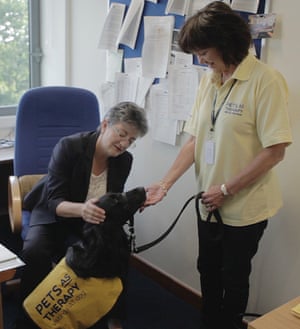
It was January when Judge Lynn Roberts, the designated family judge for Essex and Suffolk, decided to brings dogs into Chelmsford county court. Volunteers from Pets as Therapy and Canine Concern, who usually take their therapy dogs into care homes and special schools, agreed to bring their pets into the court building to visit everyone from the judges and staff to the court users and their families. Roberts also arranges bespoke visits by the dogs if a child will be at court on a day when the animals are not due to visit.


Dogs bring calm to family court.

Chelmsford is the only court in the country to welcome therapy dogs, but six months into the scheme, Roberts regards it as such a success that she is planning to introduce it to Ipswich county and family court.


“For many people, coming to court is the most stressful experience in their lives,” says Roberts, stroking the sleek head of Ella, a black, flat-haired retriever, who is visiting the judge in her retiring room before the official day begins. “It’s easy for us who work in the system to lose touch with how stressful it is but litigants are here because the future of their children is being determined, or their marriage, or where they’re going to live.


“In the US, they bring llamas and alpacas into care homes but I’m not going to attempt to bring in anything larger than a dog.” She pauses and gazes at Ella, who stares back with total canine devotion: “Having said that, I would love to bring in a donkey. I love donkeys too. But no, I think I will stop at dogs.”


So-called “courthouse facility dogs” are common in America, Canada and Chile, where they help children in all legal settings, as well as crime victims and witnesses, and those appearing in front of the drug and mental health courts.


But Roberts admits there is no tangible evidence as to the scheme’s impact. “I don’t think anybody could say if there’s any concrete result,” she said. “There was a suggestion from Cafcass [the body which represents children in family court cases] that we should assess the scheme but I don’t want to do that: I don’t want to make it all scientific. It’s working for us and it doesn’t cost the courts a penny.


“No one’s pretending it’s a cure-all,” she adds, reluctantly waving Ella goodbye and turning back to her case preparations. “It just releases a bit of stress and tension.”


The dogs have a schedule to keep to at Chelmsford: first they visit the judges, then the court staff and then the court users in the waiting rooms.


Judge Lynn Roberts stroking a black retriever dog in her office with a Pets as Therapy volunteer


Judge Lynn Roberts with Ella. Photograph: Guardian video

The circuit judge David Vavrecka is a fan of the scheme: “My initial, immediate reaction was that it was a fantastic idea,” he said. “A dog will not change the outcome of a court case but in a very bleak and conflicted situation, it can make the experience less intimidating and more human. And if, only in a very small way, we can improve the experience for our litigants, that seems to be very important.”


The circuit judge Catriona Murfitt agreed: “All the 101 things whirling around in my brain, about the cases I’m going to hear that day, stop whirring for those five minutes when the dogs come round,” she said. “But it’s probably most helpful for litigants in person, who come to court with no lawyers and are often entirely alone, knowing very little about what’s going to happen in the courtroom.”


Stephen Hodges, another district judge, is, however, less enthusiastic. “I just about tolerate the interruption to my morning when the dogs come round,” he said. “But I have two concerns. One is that certain cultures don’t traditionally feel the same way about dogs as British people tend to feel, and it could be quite off-putting for them to be approached by a dog at a moment of great stress.


“The other is that serious business happens in court. When the dogs visit the judges – between 9am and 10am – we’re doing very serious preparation for the cases we’re hearing that day. I personally find it an unwelcome distraction and I suspect the litigants feel the same if they’re talking to their representatives.”


An hour later, however, when Ella trots into his courtroom as he sits surrounded by paperwork, even Hodges appears won over by her canine charm. “Hello,” he croons quietly, tickling her under the ear. “You go all dreamy when I do this, don’t you?”


His concern that some litigants will find the dogs offensive or intrusive is countered by Kate Miller, a family law barrister at Chelmsford: “I have heard judges and lawyers voice concern that litigants who are facing the potential for losing their children don’t want to pat a dog or that certain cultures won’t appreciate it,” she said. “But I have myself observed the contrary: lots of people do want to pat a dog, and often exactly at moments of their greatest stress.”


In the court waiting room, the dogs are welcomed by some but waved away by others.


Angela has been waiting for two and a half hours to hear whether she will be able to keep her children. Visibly shaking and teary, she bends over Bushy and hugs him tightly.


“My little boy loves dogs,” she murmurs. “Bringing dogs in is such a good idea. It distracts me: I can push what’s happening to me to the back of my mind, just for a second.”


A woman standing at the edge of the waiting room is taking a break from giving evidence. When she spots Ella emerging from the lift, her distraught expression changes. She gives a brief laugh of surprise and smiles. Then the moment passes and she turns away.


The names of people in court have been changed.


Canines in court: therapy dogs making the wait for a verdict "more human"

6 Temmuz 2014 Pazar

Medical professionals May possibly Quickly Be Paid For Not Creating You Wait

A lot more physician pay is getting tied to patient satisfaction metrics, an additional indicator health care may possibly be coming far more client-friendly, according to a new national analysis of doctor compensation.


Currently, doctors and hospitals more and more have far more of their spend tied to health outcomes and related clinical measures as medical care moves towards value-primarily based compensation rather than fees for support.


But momentum is slowly constructing for physicians to also be measured on how speedily telephone calls are returned to how lengthy a patient sits in a physician office waiting spot as part of “patient satisfaction metrics” insurers are doing work into contracts with medical-care suppliers.


The Health care Group Management Association’s yearly compensation examination, unveiled final week, displays two.31 percent of specialists’ physician shell out was tied to patient satisfaction in 2013 compared to one.61 percent in 2012. Meanwhile, major care compensation tied to patient fulfillment experienced a “slight increase” from 2012 when it accounted for much more than two % of spend.


Although nonetheless quite modest percentages, doctors and people who run their practices are paying near interest to patient fulfillment, particularly provided the momentum clinical outcomes and worth-based mostly care has taken on in overall health care.


“Physicians have previously been patient-centered but the other scenario is a organization scenario . . . a buyer service scenario,” says Todd Evenson, vice president of consulting services and data solutions at MGMA, which looked at more than 66,000 healthcare care companies as component of its evaluation. “(Physicians) could be measured on how effectively the sufferers perceive the service they acquire.”


For instance, physicians could be measured on whether they have after-hours office hrs or regardless of whether patients recognize their expenses or can even pay out on the internet, Evenson said.


It is not just physicians.


More and more, firms and wellness insurance coverage firms are pushing for a lot more patient fulfillment metrics, adopting the “triple aim” framework designed by the Institute for Healthcare Improvement. The triple aim methodology operates to improve a patient’s knowledge and health care care by way of good quality and fulfillment, enhance the well being of populations, and reduce the per capita expense of wellness care.


Underneath the Medicare health insurance plan for the elderly, the star-rating method for privately-run “Advantage” programs that contract with the government to supply benefits to seniors incorporate particular top quality measures a lot of see as much more about consumer satisfaction than clinical.


Far more than half of seniors enrolled in so-referred to as Medicare Advantage strategies are now enrolled in programs with ratings of four stars or more on a five-star scale, a ranking method developed beneath the Cost-effective Care Act to guidebook seniors to expense-effective and larger quality advantages.


Strategies – offered by the likes of Aetna Aetna (AET), UnitedHealth Group UnitedHealth Group (UNH), Humana Humana (HUM) and Cigna (CI) –  are rated on such measures like cutting phone waiting instances as properly as how well they encourage preventive care this kind of as getting typical blood exams for diabetes.


A rating of four is regarded over common and a rating of five is outstanding and the highest rankings give well being plans a bonus payment and the capability of the insurers to tout their improvement.


The whole well being care industry sees patient fulfillment only becoming a lot more important and physicians will be a portion of that.


“We realize the place the industry is moving,” Evenson mentioned. “Reimbursement designs are not going to be a single-size fits all. “We know it is crucial.” 


Asking yourself how Obamacare will influence your well being care? The Forbes eBook Inside Obamacare: The Correct For America’s Ailing Wellness Care Program answers that query and far more. Available now at Amazon and Apple.


Medical professionals May possibly Quickly Be Paid For Not Creating You Wait

16 Haziran 2014 Pazartesi

Half who miscarry "wait 24 hours for a scan" - Mumsnet

“I had to wait 6 months to get counselling and lost six months of my existence as I was not coping with the loss,” one particular girl wrote.


And while 58 per cent of respondents wanted additional health-related care, just 26 per cent were presented it.


“The hospital explained they’d request a well being visitor to get in touch with me. That was two months ago nobody has been in touch,” replied an additional.


The survey located that aftercare following miscarriage is woefully inadequate. Photo: ALAMY


In 2012, Nationwide Institute for Overall health and Care Excellence (Nice) advice stated that miscarrying at property would be the default clinical response for girls undergoing miscarriage before the 13th week of pregnancy. But these outcomes show this policy is leaving women with out the assistance they need: only 15 per cent of females who miscarried at property, following a scan, felt they had the proper assistance, data and ache relief to cope.


“I was told, more than the telephone, to ‘just sit on the toilet and hopefully it will all come out’,” recalled a single Mumsnet user.


Eleven ladies were asked to retailer their miscarried foetus at residence – some reportedly in the fridge – prior to additional tests currently being carried out.


Only a quarter of the girls surveyed spoke of their experiences to pals and only 13 per cent told wider loved ones.


A campaign for greater care


Mumsnet users are campaigning for far better care in situation of miscarriage. They are calling for straightforward improvements in the treatment patients acquire like: supportive employees, accessibility to scanning, secure and appropriate spots for therapy, good info and powerful treatment method and joined-up care.


Many of the factors are integrated in greatest-practice advice from the Department of Well being. But the analysis exhibits that, also usually, it’s not becoming implemented.


Mumsnet is now asking for a parliamentary dedication to strengthening miscarriage care.


Mumsnet founder Justine Roberts (right) is campaigning for better miscarriage care. Photo: ABBIE TRAYLER-SMITH.


Justine Roberts, the founder of Mumsnet, explained: “There’s no escaping the ache of a miscarriage. But for this to be compounded by lack of treatment method, pain relief, very good care – or just plain human kindness – is fully unacceptable.


“We are calling on the three primary parties to contain a pledge in their manifestos to enhance miscarriage care, primarily based on the ideas in our code.”


Cathy Warwick, chief executive of the Royal College of Midwives, added: “Midwives and other overall health professionals have an important role to play in supporting ladies and families via the bodily and psychological influence of miscarriage.


“Kind, compassionate and empathetic communication about care and remedy is an important stage to assistance households. It is specifically important that there is successful communication amongst the hospital, GP and midwife to supply ongoing assistance or guidance, as essential.”


Half who miscarry "wait 24 hours for a scan" - Mumsnet

30 Mayıs 2014 Cuma

It truly is Not Just Vets Who Wait Months For Doctors. You Do Too

Amid the resignation of Eric Shinseki as secretary of the Veterans Affairs Department Friday, mismanagement at the VA’s network of hospitals and outpatient services has targeted in portion on months and months of wait occasions for veterans to see a physician.


But even just before the rollout of the Reasonably priced Care Act to millions a lot more sufferers with insurance coverage, all Americans are waiting for than two weeks to see a physician and in some markets a month or much more.


A survey earlier this 12 months by physician staffing and consulting firm Merritt Hawkins showed sufferers are waiting an typical of 18 days to schedule an appointment for a doctor, according to a examine of appointments for typically employed specialty physicians in 15 key U.S. cities.


The longest wait to see a physician was in Boston in which the common wait was 45.5 days to schedule an appointment with a family members physician, dermatologist, cardiologist, orthopedic surgeon or obstetrician/gynecologist. The survey came from a sampling late last 12 months of practically 1,400 medical offices across the country.


Even though portion of the issue comes as much more Americans acquire well being care advantages. It is also due to shortages in distinct specialties like major care doctors such as internists, pediatricians and family medical doctors.


The survey showed that an average appointment for a family members physician in the 15 metropolitan markets Merritt Hawkins evaluated took 19.five days.


“As the illustration of Boston illustrates, entry to overall health insurance coverage does not always guarantee entry to a physician,” authors of the Merritt Hawkins report said. “In addition, the survey demonstrates that many if not most doctors in the 15 markets examined are not accepting Medicaid as a form of payment.”


The report indicated that Congress requirements to pay much more consideration to the doctor shortage from enhanced payments to medical doctors to enhanced money for medical doctors in training.


“As millions of the previously uninsured obtain healthcare coverage by means of the ACA, methods will need to be located to ensure accessibility to doctors, via increases in the amount of health-related residency positions available nationwide, via the use of modern staffing


models that redistribute some of the work previously dealt with by doctors to other clinicians, by means of equitable payments to physicians, by way of the use of online and mobile technological innovation, and by means of other techniques.”


Congress has observed the Merritt Hawkins report and it was portion of a Senate hearing carried out by U.S. Sen. Bernie Sanders of Vermont in the final 12 months. Here’s a website link to Sanders world wide web page and his statements on the situation.


Asking yourself how Obamacare will influence the medical doctor shortage? ayour overall health care? The Forbes eBook Within Obamacare: The Repair For America’s Ailing Well being Care Method answers that question and a lot more. Accessible now at Amazon and Apple.


It truly is Not Just Vets Who Wait Months For Doctors. You Do Too

10 Mayıs 2014 Cumartesi

Millions wait a week to see GP

She said individuals had been becoming put at threat simply because household physicians have been overloaded, resulting in prolonged waits and rushed consultations.


Last night, the Royal College also launched the outcomes of a poll which identified that eight out of 10 GPs worry missing a serious sickness due to the fact of their hefty workload.


Dr Helen Stokes-Lampard extra: “When I get to the end of a day and I’ve had a hundred phone consultations and observed thirty patients encounter-to-face, I hope and I pray that absolutely nothing significant has been missed – both since of the relentless stress or because an individual who essential an appointment couldn’t get 1.” The Government says GP companies have been badly damaged underneath Labour, when loved ones medical doctors received generous shell out rises however have been freed of duty for out-of-hours care.


Ministers announced a series of adjustments last month in an try to improve entry to household medical doctors, like a £50 million fund to aid surgeries stay open for longer and a promise to give elderly sufferers a “named GP”. Norman Lamb, the care minister, also mentioned doctors necessary to make greater use of technologies to free of charge their time for longer appointments for other people.


Labour argues that the rise in waiting instances has been brought on by the Government’s selection to scrap a target which promised sufferers a GP appointment inside 48 hours.


The 48-hour rule was scrapped in June 2010, as part of Coalition efforts to dismantle a “target culture” in the NHS. It was amongst several waiting targets which had grow to be contentious simply because of worries that significantly ill patients have been obtaining care delayed simply because trivial cases had to be witnessed just as swiftly.


Patients’ groups stated yesterday that the issues in getting to see a GP had been contributing to a crisis in Accident &amp Emergency departments. Katherine Murphy, of the Individuals Association, named the figures “shocking” and said “urgent action” was essential to boost entry to GPs and lessen stress on overstretched casualty units.The British Health care Association is launching a campaign this week to highlight a recruitment crisis among loved ones medical professionals.


Last evening, a Department of Wellness spokesman said: “We’ve taken hard selections to shield the NHS budget, which is allowing us to restore appropriate loved ones doctoring, reform out-of-hours hospital care, and enhance GP access… But we know GPs are under strain, so we’re cutting GP targets by a lot more than a third to cost-free up much more time with patients and rising trainees so that GP numbers proceed to increase quicker than the population.”


Andy Burnham, the shadow wellness secretary, claimed the rise in GP waiting times was a “mess of David Cameron’s making”.


Millions wait a week to see GP

28 Nisan 2014 Pazartesi

Sufferers wait as well long for expert care in the NHS

Doctor looking at the x-ray

Bringing in experts into primary care can pace up the treatment method of patients, writes Dick Vinegar. Photograph: Alamy


The Swedish writer, Henning Mankell, creator of Wallander, who was diagnosed with cancer in January, wrote movingly about the agony of waiting for remedy. “This waiting can be tough, at occasions unbearable: but there is practically nothing 1 can do about it …”


I know the feeling. 5 many years ago, I was diagnosed with cancer, and had to wait for treatment method for 6 weeks. I went by means of a huge battery of tests in the quick diagnostic unit at the Surrey Marsden in about two hours flat, which resulted in a company diagnosis five days later and a date for an operation.


My wife and I have found in the final two months that sufferers with other maladies are not so rapidly served by hospital medical professionals.


My wife has been getting mysterious heart pains. I have created an irregular heartbeat, and, at the identical time, my kidney function has dropped. All these problems, I suppose, can be deemed life-threatening, even though none of them were severe enough to merit referral as inpatients. We felt that we would like to have a expert masterminding our therapy.


That did not occur for my wife’s heart or my kidneys. It was our GP who known as the shots about our treatment method. But all the time we had been not very sure that she had got it proper, and we remained anxious. The specialists, soon after all, are supposed to know ideal. After about 6 weeks we did get the specialists’ see, which confirmed that the GP had completed the right point. That was reassuring, but it seemed that all the specialists contributed had been a number of tweaks and an authoritative report.


What happened to my irregular heartbeat was somewhat different. By likelihood, my difficulties blew up two days prior to my yearly cardiologist’s MOT. So, proper from the commence, my therapy was dictated by a expert. My anxiety ranges dropped away, considerably lower than our worries about our other treatment options, which had not been blessed by a specialist consultant until rather late in the day.


I apologise for going on so extended about my very own ailments – a dreadful case of “anecdotal proof”, for which I am continually upbraided by clinical purists. I am trying to say some thing quite elementary: that sufferers are unhappy unless of course they do not obtain professional assistance from day 1. Maybe our conditions worsen if we do not get immediate expert care, notably if we have a heart condition.


So, what is the NHS going to do about this self-evident reality? Probably NHS England will say “we are not as undesirable as Wales”, in which I heard nowadays that individuals have to wait 15 months for cardiac surgical treatment. I think there is a culture in England as properly as Wales that it is okay for a patient to wait two months or more to see a specialist consultant. This might be okay for the consultants, and for the government attempting to balance the NHS books. But the patient, as ever, is suffering. Possibly, the NHS management may possibly also contemplate the heretical thought that the remedy of a patient seen promptly by a specialist could expense significantly less, and consume fewer scarce assets, than a lengthy, drawn out treatment. It could conserve the NHS millions.


So, how can we pace up the treatment of individuals? Carry specialists in cardiology, renal and orthopaedics into primary care. There, they will be nearer their individuals, and, hopefully, response instances will be faster. I collect that this is currently happening in some super-surgeries. Also, bring down the expense of X-ray tools and echocardiograms, so that they can turn into resources of main care.


What I am genuinely saying is that, currently, secondary care prolongs the agony of waiting, and primary care need to take above, and see if it can pace issues up. This may possibly indicate that some hospitals will wither and die. So be it.


Are you a member of our on-line local community? Join the Healthcare Specialists Network to obtain regular emails and exclusive provides.


Sufferers wait as well long for expert care in the NHS

23 Nisan 2014 Çarşamba

Pensioner died following two-hour wait for ambulance, inquest hears

Mr Gouldburn had undergone shoulder surgery days before his death in April last yr and had been visited by a medical doctor that day right after he complained of feeling unwell to his wife Pamela, 70.


The medical professional could not discover anything significantly wrong, but provided to send him to hospital – which he refused.


Nonetheless, Mr Gouldburn collapsed at his property in Hartlepool at close to ten.20am, prompting his carer to get in touch with 999, telling get in touch with-handlers about the doctor’s earlier go to.


Despite explaining that Mr Gouldburn could not move, his situation was not deemed to be a “red” emergency and was allocated a 60-minute response time, the inquest heard.


At around 12.20pm an ambulance arrived, but it was a St John automobile manned by less-educated medics.


Realising the seriousness of the predicament, a car with an eight-minute response time was requested and sooner or later an ambulance and quick response car arrived.


Even so, it was also late – despite making an attempt for 10 minutes to conserve his existence, Mr Gouldburn was pronounced dead quickly right after.


Speaking at the two-day inquest, a dispatch manager for the North East Ambulance Services stated on the day Mr Gouldburn fell they had been going through a large degree of urgent calls.


Lynn Corrigan stated ambulance drivers had been hit by delays in admitting individuals to North Durham hospital due to a lack of offered beds.


Mr Donnelly asked her: “Is what I’m hearing you never have sources to meet demand?”


Mrs Corrigan said: “Yes, that’s correct. It is a nationwide dilemma.”


Dr Jan Lowe, a pathologist, informed the inquest Mr Gouldburn had an underlying heart situation, but that it was manufactured worse by the stress of becoming on the bathroom floor for so prolonged.


Mr Donnelly ruled the retired instructor died of organic leads to – his underlying heart illness – but his death was aggravated by a “lack of timely and proper medical intervention”.


Speaking of the ambulance service’s lack of assets, he extra: “The consequence of that would look to be that instances such as Mr Gouldburn are likely to be a unhappy consequence of the lack of sources.


“It would appear to be a consequence of stretched assets, probably performing the greatest they can, but folks are not receiving the support they may feel entitled to sometimes.


“My concern is the time it takes for deployment and when that does attend it is manned by a charity.”


Mr Gouldburn’s family expressed anger at the ambulance service’s “failure” to grasp the seriousness of the scenario right up until it was as well late.


Speaking after the inquest, they said: “This should by no means happen once again to anyone.


“We simply want recognition from the trust that a mistake was produced, and that the believe in failed a amazing guy.”


“He gave his existence to helping others and the trust failed him in his moment of require.


“We hope they will make sure as greatest they can this will never happen once more to an additional household in Hartlepool.”


Tom Howard, head of the North East Ambulance Service’s make contact with centre, admitted Mr Gouldburn did not obtain the degree of care he should have.


For the duration of the inquest he told the pensioner’s stepdaughter, Joanne Dobson, and her husband, Colin Dobson: “Mr Gouldburn did not receive the degree of care that he ought to have done. The 60 minute target was not met.”


He additional: “It is a resource issue which we have already had explained.


“It is very unfortunate, and I’m actually sorry it has took place.”


Mr Gouldburn was a phase-father of four and had nine phase-grandchildren and 3 stage-fantastic-grandchildren.


He served in the merchant Navy as an engineer, but invested most of his existence working as a instructor at a unique demands college.


Pensioner died following two-hour wait for ambulance, inquest hears

18 Mart 2014 Salı

Dying forced to wait eight weeks as an alternative of eight days for assist amid "dire" advantages overhaul - MPs

They spoke of claims apparently vanishing into system, prolonged delays, cancelled appointments, clerical blunders and applicants becoming passed back and forth among officials on best of a mounting backlog of applications.


The MPs urged ministers to invoke penalty clauses in contracts with private businesses, this kind of as Atos and Capita, if needed, but pinned the principal blame mostly on an apparent rush to implement the new benefit just before the IT and call centre techniques had been appropriately examined.


The report also criticised the Division of Perform and Pensions for seemingly “spinning” statistics in a way which could more fuel public hostility toward disabled folks.


While the committee encountered issues across the technique it singled out troubles faced by people with terminal illnesses.


It noted that, underneath the previous the Disability Living Allowance system, men and women recognised as getting no a lot more than six months to reside have been generally processed inside eight operating days.


“Macmillan [Cancer Assistance] reviews that it is taking as prolonged as eight weeks for a PIP claim to move into payment,” the report remarks.


“Macmillan points out that the delays can indicate that terminally unwell claimants are dropping out on as significantly as £134 a week.


“It can also impact on caring provision as the PIP award wants to be in place ahead of Carer’s Allowance can be paid.”


They extra: “Urgent action is necessary. We advise that DWP closely examine its personal systems and that it operate with the contracted suppliers to resolve the existing dire scenario.”


Jason Feeney, benefits director at the DWP admitted that some terminally unwell men and women had had “awful experiences”.


But a spokeswoman said: “Claims for terminally ill people are fast-tracked and Macmillan has acknowledged that enhancements in the system have currently been produced.


“Latest statistics demonstrate over 99 per cent of individuals with terminal illnesses who have utilized have been awarded the benefit, which implies in excess of 9,500 terminally sick claimants are now getting PIP.”


Duleep Allirajah, head of policy at Macmillan, mentioned: “The enormous backlog of claims even now waiting to be processed is appalling.


“The Government need to deal with these delays in the first instance as a matter of urgency and commit to publishing waiting instances on a quarterly basis.”


Dying forced to wait eight weeks as an alternative of eight days for assist amid "dire" advantages overhaul - MPs

17 Şubat 2014 Pazartesi

Kenyan ladies get cervical cancer vaccine but women"s wait for treatment goes on | Jessica Hatcher

MDG : Kenya HPV vaccination : Schoolgirls been vaccinated against cervical cancer

Schoolgirls in Kitui, eastern Kenya, watch a friend acquiring an injection after they have been vaccinated against cervical cancer. Photograph: Karel Prinsloo/Gavi


Existence is rough for girls with cervical cancer in Kenya. Some of these attending the country’s only public therapy facility rest on benches and concrete floors outside the hospital to save funds for their treatment method. Other folks by no means make it to the capital for assistance because they can not afford the bus journey. Now, a vaccination programme has been rolled out, supplying hope for future generations.


“Cervical cancer vaccine now offered for girls in major school free of charge!” reads the turquoise poster outdoors the office of Christina Mavindu, senior nursing officer at the Kitui district hospital. Mavindu is two-thirds of the way via implementing Kenya’s initial public cervical cancer vaccination campaign in Kitui county. The third and last jabs will be administered in the following couple of weeks.


The campaign has been difficult. The amount of children wanting the vaccine has exceeded the doses obtainable and, at a price of far more than $ 50 (£30) per vaccine, many people have been unable to pay for it privately. “It need to be for everybody,” says Mavindu. Gavi (International Alliance for Vaccines and Immunisation) supported the trial to enable Kenya to demonstrate that it has the needed infrastructure and capability to vaccinate 9- to 13-12 months-olds on a nationwide scale.


Vaccination is needed urgently cervical cancer is a developing lead to of morbidity amongst girls in Africa, and a rising concern. The condition is virtually six occasions much more prevalent in Kenya than in western Europe, according to WHO information. It is also the cancer that kills most ladies in Kenya, whose neighbour Rwanda became the initial lower-earnings African country to attain nationwide accessibility to the vaccine.


The remedy for cervical cancer is inadequate: almost half of the women who have been getting taken care of in Kenya “disappeared” from their programmes, according to the outcomes of a latest survey published in the journal Plos One particular of sufferers at the only public cancer therapy centre. “Most likely they could not afford remedy,” says Dr Ian Hampson, head of gynaecological oncology at the University of Manchester, who oversaw the investigation. Just seven% of women obtained “optimum treatment method”, even though 41% dropped out.


From screening to diagnosis and treatment method, ideal practice in Kenya is impeded at each and every stage. Beatrice Ngomo, a nurse in Kitui district hospital’s maternal and little one wellness clinic, has a difficult time persuading girls to get screened. Several can not afford health care care so do not want to know if they are unwell, she explains. Others do not like invasive procedures, she says, and are scared.


Even when a female starts encountering signs, she will often not look for treatment, Ngomo explains. Some females believe cervical cancer is a outcome of witchcraft so they desire to see conventional healthcare practitioners. “They shed a great deal of time whilst they’re carrying out that,” Ngomo says. Or they go to witchdoctors due to the fact they are more cost-effective than contemporary health care care. As a result, 80% of circumstances at the hospital are late stage cancer, in accordance to doctors’ estimates.


Ngomo has diagnosed two girls with cervical cancer this yr. She recalls that at first the females assumed that the cancer would kill them. Ngomo advised them that treatment method was poshsible and referred them to the Kenyatta nationwide hospital in Nairobi. “But there the troubles really commence,” she says. In Kitui, most people are farmers and the common everyday wage is less than $ two. Girls cannot afford to travel to the capital, allow alone get substantial-price medicines, she adds. At times they reappear at the hospital in Kitui months after referral, possessing in no way made it to Nairobi.


The subsequent difficulty is that the waiting time for a 1st appointment at Kenyatta nationwide hospital can be up to 6 months, according to Dr Orora Maranga, who performed the Manchester research and is now practising in Kenya. “The cancer is not waiting,” he says. In six months, it can grow from stage two to stage 4, dramatically decreasing the likelihood of survival.


When sufferers receive an appointment, they are faced with the expenses of treatment method. Elizabeth Mumbua Njeru, 35, sits on a stage outdoors the casualty ward hugging her handbag to her chest. Njeru has a cancerous tumour in her cervix and is two months into a course of radiation and chemotherapy. Njeru, from Embu, 120km to the north, is unable to afford accommodation in the capital. She has been a resident of the casualty ward for two months and is occasionally forced to rest on this outside. But she is established not to turn into yet another girls who “disappears”.


Her malnourished physique is struggling to cope with the treatment regime. Her nails have turned brown, she suffers from nausea and diarrhoea, and her immune program has been severely compromised by day-to-day injections of cytotoxins. Njeru is aware of the emergency department is no place for her it is a hub of infectious diseases which she may catch at any minute. But she has no selection.


Maranga’s review found that just 7% of patients at Kenyatta nationwide hospital had been getting optimum remedy. But it is not just the price that prevents them getting the right remedy. The hospital lacks one essential piece of equipment: the brachytherapy machine.


As Njeru sits in the hospital canteen enjoying a uncommon plate of fried chicken, she is joined by her pal, Rhonda Waeni Ndundua, who also has cervical cancer. Ndundua has also spent two months sleeping rough in the hospital grounds. Rhonda has received excellent news – she has been discharged. Scribbled on her patient information was 1 word: “brachytherapy”. Rhonda is free of charge to go house, but has to return to see the medical doctor in two months. Then, she will be informed that she requirements to have brachytherapy, radiotherapy delivered internally, in buy to acquire the advised therapy.


Hampson describes Kenyatta nationwide hospital’s brachytherapy unit as having been “in a state of disrepair for a number of many years”. Sufferers like Ndundua must travel to both Dar-es-Salaam in Tanzania, or to Kampala in Uganda. There, they spend 30,000 Kenyan shillings ($ 360) for the brachytherapy food, accommodation and transport are added.


This may go some way towards explaining why just seven% of females in the Manchester research obtained optimal treatment. Hampson suggests there is no cash, and consequently no political will from the government to restore the brachytherapy machine.


Kenyan ladies get cervical cancer vaccine but women"s wait for treatment goes on | Jessica Hatcher

29 Ocak 2014 Çarşamba

Physician Wait Occasions Rise As Obamacare Rolls Out

Patients are waiting an average of 18 days to routine an appointment for a medical doctor, in accordance to a research of appointments for typically employed specialty physicians in 15 major U.S. cities.


The survey by physician staffing and consulting firm Merritt Hawkins Hawkins comes as a medical doctor shortage looms as much more sufferers seek health care care under the Affordable Care Act. The well being law is bringing millions much more Americans wellness benefits and consequently the ability to spend for a check out to the doctor’s office.


The longest wait to see a medical professional was in Boston in which the regular wait was 45.five days to schedule an appointment with a loved ones physician, dermatologist, cardiologist, orthopedic surgeon or obstetrician/gynecologist. The survey came from a sampling late final yr of practically 1,400 health-related offices across the country.


“In the up coming two to three many years, can we keep a poor predicament from acquiring worse?” asked Travis Singleton, senior vice president at Merritt Hawkins, a subsidiary of AMN Healthcare (AMN). ”Everything will tell you it is going to get worse and not far better.”


The improve in doctor wait instances to this stage is not entirely connected to the health law. The enhancing economic system is also driving more Americans to the doctor’s office. In recent years, information has showed slow growth in visits to doctor’s workplace for the duration of a time period of high unemployment as properly as the trend for insurance firms and employers to improve co-payments and deductibles.


“Finding a doctor who can see you nowadays, or three weeks from nowadays, can be a challenge, even in urban places in which there is a large ratio of physicians per population,” stated Mark Smith, president of Merritt Hawkins.  “The demand for medical professionals is merely outstripping the supply.”


When overall health care coverage is expanded and there is a lot more access to physicians, wait occasions rise.


Consider Boston, which has a high amount of “physicians per capita,” Singleton said. “Yet they even now have the longest waits for appointments.”


Massachusetts has had broad wellness care coverage for most of its residents for several many years now and the state’s law was the model for the Affordable Care Act.


“People are accessing the method (in Massachusetts) at better and higher ranges,” Singleton extra.


There is, even so, good information for appointment times as well being care reimbursement moves away from fee-for-services medication to value-based mostly care that emphasizes the use of accountable care organizations and patient-centered health-related properties.


In ACOs and other designs, physicians are handing off more responsibilities to physician assistants and nurse practitioners with the doctor as a lot more of a quarterback of kinds.


Medicare and most personal insurers like these operated by Aetna Aetna (AET), Cigna Cigna (CI), Humana Humana (HUM),UnitedHealth Group UnitedHealth Group (UNH) and most Blue Cross and Blue Shield plans are linking with ACOs, which push large quality, much less costly care rather than today’s payment method that usually prospects to extreme care by paying for every remedy or method that is not often much better.


The companies in an ACO are responsible for managing the care of the wellness prepare enrollees and are financially rewarded if the enrollees, or individuals, stay out of the much more costly hospital.


“We are significantly much better at managing the wellness care technique and using nonphysicians,” Singleton stated. “We are much far better at using nurse practitioners and doctor assistants.”


Click here to see the total listing.


Physician Wait Occasions Rise As Obamacare Rolls Out