verdict etiketine sahip kayıtlar gösteriliyor. Tüm kayıtları göster

8 Şubat 2017 Çarşamba

PMQs verdict: Jeremy Corbyn"s leaked texts give him the upper hand

Key points


A rowdy exchange, in which the Speaker interrupted four times to call for order. Jeremy Corbyn returned to a consistent theme this winter: the funding crisis in social care and the broader strain on the NHS. This time he came armed with what he described as leaked texts, exchanged between David Hodge, leader of Surrey county council, and a mystery official named “Nick” in the Department for Communities and Local Government.


Surrey had until this week planned to hold a referendum on a 15% rise in council tax to pay for the spiralling costs of social care, but on Tuesday abandoned the idea. Corbyn said the texts indicated the government had cut a secret deal with Surrey council – presumably to provide extra funding in return for the referendum being called off – and demanded to know the details, and whether the same deal would apply to councils across the country.


He wondered if it was merely coincidence that the health secretary and the chancellor represented Surrey constituencies. Theresa May dodged the question but said every council had been given the opportunity to raise a 3% “precept” to fund social care provision. She accused Corbyn, in a nod to US politics, of presenting “alternative facts” and claimed the Conservatives would spend £0.5tn on the NHS during the course of this parliament, whereas Labour wished to borrow the same amount.


Snap verdict


Flash rhetoric and clever questions are fine at PMQs, but facts are better – and Corbyn demonstrated how nothing beats a good, old-fashioned, leak-inspired ambush. His first two questions were a bit vague and waffly, he sought to lay a trap with his third, but then he surprised May with his leaked text allegations and, to his credit, he kept pressing her for an answer as to whether Surrey was getting a special deal for the rest of the session.


It was a successful hit. May stonewalled his questions quite forcefully, but without being able to conceal the fact that she was not answering his key question. Even without Corbyn’s Surrey deepthroat, May’s answers would have been unsatisfactory – she has not got anything substantial to say about her long-term review of care, and her attack lines on Labour on health, about spending, read as if they have come from David Cameron’s pre-2015 PMQs file – but having a strong attack story meant Corbyn easily had the upper hand.


Memorable lines


“Congratulating NHS staff on their hard work is one thing, paying them properly quite another” – Corbyn on NHS funding


“What we get from Labour is alternative facts. What they really need is an alternative leader” – May channels Donald Trump adviser Kellyanne Conway


PMQs verdict: Jeremy Corbyn"s leaked texts give him the upper hand

28 Ağustos 2016 Pazar

Canines in court: therapy dogs making the wait for a verdict "more human"

David is waiting to find out if his children are going to be taken away from him. He paces the court waiting room and appears to be nearing the end of his tether. Other people instinctively give him a wide berth.


But Tina Jullings from Canine Concern approaches David with a small dog. “Would you like to stroke Bushy?” she asks brightly, offering up the chaotically hairy yorkshire terrier-chihuahua mix. He pauses, smiles, then laughs. “What’s a dog doing in a court?” he asks, touching Bushy gently on his head. “That’s crazy.”


It was January when Judge Lynn Roberts, the designated family judge for Essex and Suffolk, decided to brings dogs into Chelmsford county court. Volunteers from Pets as Therapy and Canine Concern, who usually take their therapy dogs into care homes and special schools, agreed to bring their pets into the court building to visit everyone from the judges and staff to the court users and their families. Roberts also arranges bespoke visits by the dogs if a child will be at court on a day when the animals are not due to visit.


Dogs bring calm to family court.

Chelmsford is the only court in the country to welcome therapy dogs, but six months into the scheme, Roberts regards it as such a success that she is planning to introduce it to Ipswich county and family court.


“For many people, coming to court is the most stressful experience in their lives,” says Roberts, stroking the sleek head of Ella, a black, flat-haired retriever, who is visiting the judge in her retiring room before the official day begins. “It’s easy for us who work in the system to lose touch with how stressful it is but litigants are here because the future of their children is being determined, or their marriage, or where they’re going to live.


“In the US, they bring llamas and alpacas into care homes but I’m not going to attempt to bring in anything larger than a dog.” She pauses and gazes at Ella, who stares back with total canine devotion: “Having said that, I would love to bring in a donkey. I love donkeys too. But no, I think I will stop at dogs.”


So-called “courthouse facility dogs” are common in America, Canada and Chile, where they help children in all legal settings, as well as crime victims and witnesses, and those appearing in front of the drug and mental health courts.


But Roberts admits there is no tangible evidence as to the scheme’s impact. “I don’t think anybody could say if there’s any concrete result,” she said. “There was a suggestion from Cafcass [the body which represents children in family court cases] that we should assess the scheme but I don’t want to do that: I don’t want to make it all scientific. It’s working for us and it doesn’t cost the courts a penny.


“No one’s pretending it’s a cure-all,” she adds, reluctantly waving Ella goodbye and turning back to her case preparations. “It just releases a bit of stress and tension.”


The dogs have a schedule to keep to at Chelmsford: first they visit the judges, then the court staff and then the court users in the waiting rooms.


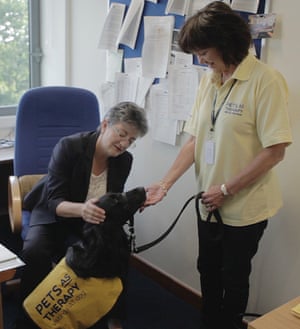
Judge Lynn Roberts stroking a black retriever dog in her office with a Pets as Therapy volunteer


Judge Lynn Roberts with Ella. Photograph: Guardian video

The circuit judge David Vavrecka is a fan of the scheme: “My initial, immediate reaction was that it was a fantastic idea,” he said. “A dog will not change the outcome of a court case but in a very bleak and conflicted situation, it can make the experience less intimidating and more human. And if, only in a very small way, we can improve the experience for our litigants, that seems to be very important.”


The circuit judge Catriona Murfitt agreed: “All the 101 things whirling around in my brain, about the cases I’m going to hear that day, stop whirring for those five minutes when the dogs come round,” she said. “But it’s probably most helpful for litigants in person, who come to court with no lawyers and are often entirely alone, knowing very little about what’s going to happen in the courtroom.”


Stephen Hodges, another district judge, is, however, less enthusiastic. “I just about tolerate the interruption to my morning when the dogs come round,” he said. “But I have two concerns. One is that certain cultures don’t traditionally feel the same way about dogs as British people tend to feel, and it could be quite off-putting for them to be approached by a dog at a moment of great stress.


“The other is that serious business happens in court. When the dogs visit the judges – between 9am and 10am – we’re doing very serious preparation for the cases we’re hearing that day. I personally find it an unwelcome distraction and I suspect the litigants feel the same if they’re talking to their representatives.”


An hour later, however, when Ella trots into his courtroom as he sits surrounded by paperwork, even Hodges appears won over by her canine charm. “Hello,” he croons quietly, tickling her under the ear. “You go all dreamy when I do this, don’t you?”


His concern that some litigants will find the dogs offensive or intrusive is countered by Kate Miller, a family law barrister at Chelmsford: “I have heard judges and lawyers voice concern that litigants who are facing the potential for losing their children don’t want to pat a dog or that certain cultures won’t appreciate it,” she said. “But I have myself observed the contrary: lots of people do want to pat a dog, and often exactly at moments of their greatest stress.”


In the court waiting room, the dogs are welcomed by some but waved away by others.


Angela has been waiting for two and a half hours to hear whether she will be able to keep her children. Visibly shaking and teary, she bends over Bushy and hugs him tightly.


“My little boy loves dogs,” she murmurs. “Bringing dogs in is such a good idea. It distracts me: I can push what’s happening to me to the back of my mind, just for a second.”


A woman standing at the edge of the waiting room is taking a break from giving evidence. When she spots Ella emerging from the lift, her distraught expression changes. She gives a brief laugh of surprise and smiles. Then the moment passes and she turns away.


The names of people in court have been changed.


Canines in court: therapy dogs making the wait for a verdict "more human"

26 Mart 2014 Çarşamba

Jury offers open verdict on teenager who died following "relationship with star"

Ben Cowburn

Ben Cowburn had mentioned he felt disgusted by what he had accomplished with the celebrity, referred to as Mr X at the inquest. Photograph: Apex


A jury has returned an open verdict on a teenager who died in a mental wellness clinic right after claiming he had been deeply upset by a sexual romantic relationship with an unnamed male celebrity.


The jury also explained it believed that “shortcomings” in the care of Ben Cowburn, 18, might have contributed to his death.


The coroner had earlier warned the jury that it ought to not try out to apportion blame over the death of the teenager.


Shortly just before his death Cowburn claimed he had created much more than 40 attempts to consider his daily life soon after getting “pressured” into performing “sexual issues” with the tv celebrity, the inquest heard.


Cowburn alleged the man had purchased him presents and taken him to nice places but he felt “disgusted” by what they had allegedly completed together.


The Cornwall coroner Emma Carlyon ordered that the celebrity at the centre of the allegations be referred to as Mr X throughout the inquest at Truro.


Summing up the proof before sending the jury out to attain its conclusions, Carlyon emphasised that no person was on trial. She also asked the panel not to undertake their personal research or search at any social network discussions about the situation.


She reminded the jury that a postmortem examination had located that Cowburn died of asphyxia in the en-suite bathroom of his space at Longreach House psychological overall health unit close to Redruth in Cornwall in December 2010. There was no suggestion that any person else was concerned.


Carlyon summarised the proof of a psychological wellness nurse who said Cowburn had told him he had had a partnership with a male celebrity who was older than him. The celebrity had allegedly given him presents, alcohol and medicines.


Cowburn explained he had not been raped or abused and what they had allegedly completed collectively was consensual. But Cowburn advised the nurse he had felt “dirty and ashamed”. Right after Cowburn’s death, police investigated the romantic relationship with the celebrity. They concluded he had not been abused or assaulted. The romantic relationship ended in the summertime of 2010.


The jury was reminded that medical professionals concluded Cowburn had been suffering from a depressive illness and may have had publish-traumatic pressure disorder.


Carlyon also flagged up considerations about how Cowburn was cared for. One particular skilled in mental wellness mentioned there had been failings in how the teenager was handled right after previous situations of self-harm and overdoses.


The inquest has been advised that Cowburn, a fashion college graduate, met the celebrity in a pub and began doing work as his stylist.


On Tuesday the police officer who led the investigation into Cowburn’s death in Cornwall, DC Joanna Sodergren, told the jury: “He mentioned the guy had brought him great items and took him to great spots but had done sexual issues to him. Asked if he had been raped or sexually assaulted he explained he had not, but agreed to them as he felt pressured to do the issues. He said if he killed himself it would make it far better as it would make it go away.”


Devon and Cornwall police informed Scotland Yard about his allegations. The star has not been arrested in excess of Cowburn’s allegations and has not been known as to give proof to the inquest.


Some media organisations have asked the coroner to reveal who Mr X is. The Tory MP Priti Patel explained “standard” details ought to be permitted into the public domain.


Jury offers open verdict on teenager who died following "relationship with star"

27 Şubat 2014 Perşembe

NHS ombudsman delivers scathing verdict on Furness hospital trust

Baby Joshua Titcombe

Joshua Titcombe was born in Furness standard hospital and died 9 days later soon after options to deal with an infection had been missed. Photograph: PA


An NHS trust’s lack of honesty induced “unnecessary pain and even more distress” to a household who had presently suffered from the tragic and avoidable death of a little one boy, the overall health service ombudsman has mentioned in the most recent scathing verdict on the defensive culture within the health services.


Alter was needed “from the ward to the board” explained Dame Julie Mellor as she upheld three of four complaints created by relatives of Joshua Titcombe towards University of Morecambe Bay NHS foundation believe in.


Mellor had presently upheld a complaint from James Titcombe, Joshua’s father, towards the NHS’s now-defunct strategic overall health authority in north-west England, in excess of how it investigated occasions at the believe in.


Cumbria police are even now investigating Joshua’s death. He was born at Furness common hospital, component of the believe in, in October 2008 but was transferred to hospitals in Manchester and then Newcastle exactly where he died from pneumococcal septicaemia, just nine days old. The believe in later on confirmed that Joshua would have had an exceptional likelihood of survival if possibilities to diagnose and treat his infection had not been missed.


In remarks that echoed the fallout from Sir Robert Francis’s report on the scandal at Stafford hospital final year and other incidents, the ombudsman mentioned that the partnership among the Titcombe household, whose identities are anonymised in the report, and the Morecambe Bay trust was “a additional unhappy instance” of the need for cultural adjust.


“Hospitals and other healthcare companies have a duty to sufferers and their households to investigate their considerations correctly. In these cases the trust failed to be open and trustworthy about what went incorrect and this triggered the complainant and his household further needless distress at a quite difficult time,” explained Mellor.


“When significant untoward incidents come about there demands to be an independent investigation which seems at the root cause of the complaint and the position of human elements such as men and women and the organisation’s culture.


“We expect all support providers to adopt this technique to help them understand why errors come about and support improve companies for everybody.”


Mellor explained hospital boards must “reward personnel who look for and react nicely to worries and complaints, which includes acknowledging problems.”


She also apologised for a decision in 2010 by her predecessor, Ann Abraham, not to investigate a complaint from Titcombe. “We recognise that had we investigated, the family members may possibly have had answers to some of their concerns regarding what took place to their little one sooner than they did. We are sorry for the effect this has had on the father and the child.”


Mellor said the believe in had been guilty of maladministration in the way it investigated occasions surrounding Joshua’s death and its failure to clarify two inappropriate e-mail exchanges among personnel at the believe in. James Titcombe had suffered injustice and she could recognize his reduction of all self confidence that the trust would discover from his son’s death.


The subject heading of one e-mail between workers, discussing an investigation into midwives’ perform and practice just before Joshua’s death by the Nursing and Midwifery Council, the skilled regulator, was “NMC shit”.


The believe in did not compose and apologise to James Titcombe until almost 17 months after the incident despite claiming in a press release in 2011 that it had apologised at the time, mentioned Mellor.


In one more exchange of emails, this time in between the trust’s buyer care manager and the head of midwifery, the head of midwifery replied to a message that there was some “great information” about James Titcombe’s complaint more than his son’s death. She wrote asking whether Titcombe had “moved to Thailand? What is the great news?” Joshua’s mom is Vietnamese.


Mellor mentioned she could not go as far as to say the head of midwifery had shown racial or ethnic prejudice, but her electronic mail “fell so far under the requirements of respect and courtesy to be expected in these situations that it amounted to maladministration”.


The ombudsman did not uphold Titcombe’s complaint, supported by his father, that midwives had colluded prior to the inquest.


Titcombe mentioned Mellor had manufactured robust suggestions for adjust which the household supported, “in particular the need for honestly and robust incident investigation following avoidable harm or death in the NHS” employing certain tactics for which personnel were properly skilled.


“This is a hugely essential recommendation and 1 which if the NHS implements, will make a substantial difference to patient security,” said Titcombe.


“We acknowledge and welcome the ombudsman’s apology for the unique decision not to investigate Joshua’s case. Nonetheless, important query marks about the situations of how that determination was created continue to be. As well several people have been failed by the ombudsman’s service in the previous and this need to not be allowed to come about again.


“My family members and I want to make it clear that we do not accept the ombudsman’s report in relation to how employees prepared for Joshua’s inquest,” he extra.


“Joshua’s death has had an unbearable affect on our loved ones. We miss him each and every day and continue to be haunted by the trauma of his quick existence and his horrific preventable death. The final five years have been created so a lot worse simply because of the way the believe in and other organisations responded to his reduction. “


The south and east Cumbria coroner, Ian Smith, criticised failings at Furness hospital at Joshua’s inquest in 2011 and an independent inquiry chaired by Bill Kirkup, set up by Jeremy Hunt, is nevertheless investigating a series of deaths of mothers and newborn babies at the hospital amongst 2004 and 2013.


Alleged cover-ups by the Care High quality Commission watchdog of what had occurred at the believe in led to Hunt, the well being secretary, saying this kind of flaws undermined the “amazing occupation” carried out day in, day out by most NHS personnel.



NHS ombudsman delivers scathing verdict on Furness hospital trust