'end etiketine sahip kayıtlar gösteriliyor. Tüm kayıtları göster

16 Nisan 2017 Pazar

‘End PJ Paralysis’ is more symptom than solution | David Mitchell

You don’t have to be seriously ill to realise the NHS is in trouble. In fact, ironically, some forms of serious illness would preclude the realisation. I’m sure that, as I type, delirious patients on trolleys in superbug-infested corridors are among a tiny minority of British citizens oblivious to the healthcare crisis. Let’s hope they get the treatment they need to bring into focus the desperate surroundings in which they’ve somehow got the treatment they need.


Research published last week in the medical journal BMJ Open says that two in five GPs are planning to quit their jobs within five years in what has been dubbed, perhaps in celebration of Passover, an “exodus of GPs”. Though in this case, the plagues will come after they’ve left.


The flaw in the research is that there’s no control: what’s the percentage of the UK’s overall employed population who are planning to quit their jobs within five years? It’s going to be quite high: everyone within five years of retirement, plus everyone from other EU countries who suspects they’ll have to (or will want to) return home, plus everyone who dislikes their job.


Because that’s what you say if you dislike your job but need the money: “I tell you what, I’m definitely quitting within five years.” You want to assert that this isn’t how life is going to be and yet you know you won’t quit now. And quitting within a year seems a bit close and scary. And quitting in 10 years seems too remote and dismal. So “within five years” is a nice, vague, woolly resolution to change.


So let’s assume that among those who, say, work for McDonald’s, the number who imagine quitting within five years is higher than two in five. But also that among those who, say, live their childhood dream of earning their living directing live opera or managing a large acreage of ancient woodland or being leader of the opposition, fewer than two in five envisage moving on in so little time as half a decade.


If you average that out – and since there are probably more in the former group than the latter – I wouldn’t be amazed if the overall rate of people with jobs saying they want to quit within five years isn’t also about two in five. I’m just guessing. I haven’t had research commissioned by a careers advice website or anything. But I don’t sniff Britain and get waves of job satisfaction pheromones coming off the workforce. And I live in London, where the streets are paved with oligarchs’ discarded onyx worktops and we’re all so rich we don’t hate immigrants.


Then again, GPs’ annual earnings are on average about £100,000, a salary that usually militates against dissatisfaction. Which makes the two in five figure more worrying again: it’s a well-paid job, and a worthwhile one, and it’s not physically dangerous, yet 40% of the people who do it want to stop. The unavoidable conclusion is that it’s horrible. Like Egypt under Pharaoh.


This report is just one recent example of troubling news about the health service, which also includes nurses balloting for strike action, a cluster of “avoidable” infant deaths, the number of people waiting more than 18 weeks for surgery “set to double” and new cancer drugs being ruled too expensive. Despite Trump, Brexit and Syria, the NHS is clinging to its share of column inches as doggedly as Mel B’s love life, and is just as bleak.


It’s clear that a solution must be found before the whole thing collapses into an enormous heap of rubble, crutches, wheelie drip-stands and little cardboard dishes of vomit. Well, it has been! Last week came news of a campaign, pioneered by Nottingham university hospitals NHS trust that aims to get patients out of bed, dressed and walking around. Obviously, in a sense, the whole NHS is supposed to be a campaign to do that. But the difference with this scheme, referred to as “End PJ Paralysis”, is that it aims for patients to do it before they’re necessarily better.
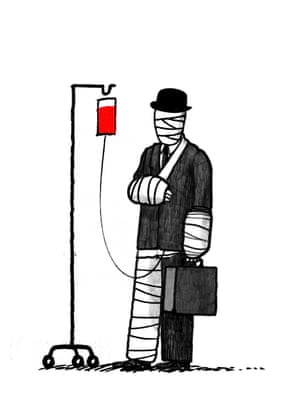


Illustration by David Mitchell.


Illustration by David Mitchell.

The premise of the scheme is that lying around in bed feeling sorry for yourself becomes self-perpetuating. So staff are encouraging patients to get dressed, move around and in general act like they don’t feel terrible. At a time when the NHS is under unprecedented pressure to free up beds, this is a refreshingly direct approach. “Get out of that bed!” say the staff. The patient does. The bed is freed up. It’s much more efficient than waiting for them to die in the bed, at which point you have to send for a couple of guys and a trolley.


Instinctively I believe this idea works. We’ve all done it: just decided we can’t be ill, either because there’s stuff we have to do or because we’re fed up of the sweaty sheets, the daytime TV, the endless Lemsip. By getting up and pretending everything’s normal sometimes it becomes so. You get distracted from the symptoms and by the time you remember them, they’ve receded or disappeared.


This idea has much in common with alternative medicine. In that field, because patients are listened to, given time and respect in a comforting environment often involving a CD of wind chimes, they frequently feel better despite it having been proved that the actual treatment doesn’t do any good. It’s an effective mood-changer for someone who doesn’t feel 100% but is basically fine.


“End PJ Paralysis” is doing the same thing in a different way. It’s the “Pull yourself together!” to reflexology’s “I’m so sorry to hear that” and is much less costly in time, staffing and vaguely oriental-looking indoor water features. Like homeopathy, it absolutely cannot fail unless accidentally applied to someone who happens to be actually ill.


Some people’s recovery will be helped by greater pressure to get dressed and move around. But can we be sure patients will succumb to this pressure according to whether they’re really up to it, rather than because of their own personality – their instincts to obey authority or deny the seriousness of their condition?


The principle that people who have been hospitalised should restart normal life as soon as they can is already well established. So it’s suspicious that a campaign exclusively pushing the idea of getting up and going home should coincide so precisely with the NHS’s dire shortage of money. It feels like a treatment it’s financially convenient to prescribe.


‘End PJ Paralysis’ is more symptom than solution | David Mitchell

5 Mart 2017 Pazar

‘Face-down restraint must end’: an open letter to Jeremy Hunt

Dear Jeremy Hunt


New figures released by Agenda, the alliance for women and girls at risk, have highlighted the routine use of physical and face-down restraint against women and girls in mental health settings. Although government guidance is clear that physical restraint should only be used as a last resort, this research shows that in many trusts it is widespread.


Given that more than half of women who have mental health problems have experienced abuse, restraint not only risks physical harm and can be frightening and humiliating, but being restrained, particularly face-down, can also re-traumatise those with a history of violence and abuse.


Mental health units are meant to be caring, therapeutic environments, for people feeling at their most vulnerable, not places where physical force is routine. That is why we believe face-down restraint must end and other forms of restraint should only be used as a last resort.


Instead, women and girls’ particular needs and experiences, including their histories of trauma, must be taken into account by mental health services and support given to tackle the underlying issues they face.


Katharine Sacks-Jones director, Agenda


Paul Farmer CEO, Mind


Mark Winstanley chief executive, Rethink Mental Illness


Sarah Hughes chief executive, Centre for Mental Health


Kathy Roberts chief executive, Mental Health Providers Forum


Liz Felton chief executive, Together for Mental Wellbeing


Professor Joy Duxbury chair, Restraint Reduction Network


Sarah Brennan chief executive, YoungMinds


‘Face-down restraint must end’: an open letter to Jeremy Hunt

31 Temmuz 2016 Pazar

Hope for "end of Aids" is disappearing, experts warn

Efforts to combat Aids in Africa are seriously faltering, with drugs beginning to lose their power, the number of infections rising and funding declining, raising the prospect of the epidemic once more spiralling out of control, experts have warned.


The UN has set a target of 2030 for “the end of Aids”, which has been endorsed by donor governments including the US, where the president, Barack Obama, said the end was in sight last month.


Related: Think the Aids epidemic is over? Far from it – it could be getting worse | Sarah Boseley


But the reality on the ground, especially in the developing world, looks very different. Many experts believe that the epidemic will continue to spread and the Aids death toll, still at 1.5 million people a year, could begin to soar again.


Prof Peter Piot, the first executive director of UNAIDS and director of the London School of Hygiene and Tropical Medicine, told the Guardian: “I don’t believe the slogan ‘the end of Aids by 2030’ is realistic and it could be counterproductive. It could suggest that it’s fine, it’s all over and we can move to something else. No. Aids is still one of the biggest killers in the world.”


At the recent International Aids Conference in Durban, South Africa, Bill Gates, a self-proclaimed optimist whose foundation has invested heavily in combatting HIV, warned of trouble ahead.


“If we only do as well as we have been doing, the number of people with HIV will go up even beyond its previous peak,” Gates said. “We have to do an incredible amount to reduce the incidence of the number of people getting the infection. To start writing the story of the end of Aids, new ways of thinking about treatment and prevention are essential.”


Those fighting the epidemic face a devastating combination of problems:


  • Every year, around the world, nearly 2 million people, 60% of them girls and young women, become newly infected with the virus, despite prevention efforts.

  • In developing countries, HIV is becoming resistant to the drugs used to treat people and keep them well, which means they will increasingly need other drugs that are currently unaffordable.

  • Donor countries are cutting back on funding.

Globally, 38 million people are living with HIV, 17 million of whom are now on drugs that stop them transmitting the virus to others. But the rise in infections appears inexorable.


Piot said: “It is as if we’re rowing in a boat with a big hole and we are just trying to take the water out. We’re in a big crisis with this continuing number of infections and that’s not a matter of just doing a few interventions.”


A woman walks past Aids information on a wall in New Kru Town near Monrovia, Liberia


A woman walks past Aids information on the wall of the Redemption hospital in New Kru Town near Monrovia, Liberia. Photograph: Ahmed Jallanzo/EPA

There had been hope that treating people would stop the spread, but studies are beginning to show that “test and treat” – putting people on drugs as soon as they test positive for HIV to prevent them being infectious – may not work. Many people do not want to take medication until they become ill. Piot believes that drugs will not stop Aids and that cultural change, which is far harder to bring about, will be necessary.


“We will not end HIV as an epidemic just by medical means,” he said. “People are not robots. Sex happens in a context. It is about power. Southern African girls and young women are infected by men who are much older than themselves. It’s about poverty. It’s also about a culture of machismo. There are also gay men all over the world who are discriminated against and underground, and there’s no way you can prevent infections if something is underground.”


Gates said the number of young people at risk in Africa is set to rise markedly. In a few decades, 40% of the world’s youth will live on the continent.


Related: It isn’t lack of drugs preventing us eradicating Aids, but inequality | Lilianne Ploumen


“The largest generation in history is entering an age where they are most at risk … In 1990, there were 94 million people between the ages of 15 and 24. Already, that number has doubled. By 2030, [there will be] more than 280 million young people. The vulnerable age group will be three times as large in 2030 as it was back in 1990,” he said.


Drug resistance is only now beginning to be monitored in Africa, but there are clear signs that it is growing. Médecins Sans Frontières has found 10% resistance in its projects.


A report for the World Health Organisation by Michael Jordan of Tufts University in Massachusetts tells of 40% resistance to one of the crucial drugs in the basic cocktail given to people in less economically developed countries. Resistance is widespread in Europe and North America, but people with HIV are moved on to newer drug combinations that are vastly more expensive. The basic regime in Africa costs $ 100 (£75) a year. Drug treatments in the US cost more than $ 20,000 a year.


Jordan’s report shows that more than one-third (35.7%) of nearly 1,200 clinics reported regularly running out of at least one drug over the course of a year. If antiretroviral drugs are not taken consistently, the virus mutates, resistance develops and the drug will no longer work. It also found that one in five patients was lost to followup, so nobody knows whether they are being successfully treated.


Funding for HIV is declining, in response to austerity measures, financial crises and the assumption that the epidemic is under control. A recent report from the Kaiser Family Foundation and UNAIDS said funding from donor governments fell last year for the first time in five years, from $ 8.6bn in 2014 to $ 7.5bn.


Hope for "end of Aids" is disappearing, experts warn

24 Ocak 2014 Cuma

"Palliative" or "end of life"? Why it is crucial to say the right phrases

Elderly woman

Individuals becoming cared for in the final years, months and days of their lives want clear, compassionate communication. Photograph: Libby Welch/ Social Care Institute for Excellence


Did you hear about the female who was advised her husband had ‘palliative’ care, only to discover out later that he was dying?


Just lately, as component of a film undertaking, we posed the query to the standard public: “What do you think and really feel when you hear the terms ‘palliative’ and ‘end of life’ care?”


The responses included: “Palliative care indicates you happen to be not getting much better, does not it?” “‘End of life care’ sounds a bit frightening.” ‘Palliative’ is gentler but much more perplexing” and “I have acquired no notion”.


These responses prompted us to commence a venture on terms utilized by professionals. We will be functioning in partnership with the Nationwide Council of Palliative Care (NCPC) who leads the Dying Matters Coalition. The proof we collect will be employed to take into account whether or not there may be other, much more readily understood terms or phrases that could be employed as an alternative of ‘palliative’ and ‘end of life care’. And if we can not uncover more acceptable words, we will disseminate our findings so that individuals working in health and social solutions are mindful of the confusion, bafflement and misunderstanding that these terms can develop for folks.


Current reviews, this kind of as ‘More care, significantly less pathway’ – which followed the evaluation of the Liverpool Care pathway – and the Keogh report, emphasise the urgent need for clear, compassionate communication, particularly when people are currently being cared for in the final many years, months and days of their lives.


The case, referred to earlier, of the woman who was told that her husband was obtaining ‘palliative care’, and who found two weeks later that he was really dying, highlights the significance of utilizing the correct words. One can only picture the damage that was completed, because she did not comprehending what the phrase meant.


Our project will aim to capture, comprehend and investigate what individuals think and come to feel when they hear the terms ‘palliative care’ and ‘end of life care’. We’ll be utilizing a broad assortment of methods to engage with men and women, in certain digital media and film.


In addition to members of the general public we are previously speaking to folks who are loosely linked to end of existence care tasks, this kind of as individuals functioning for insurance coverage business in the social care sector. We would as a result connect with people who are acquainted with the terms and other folks who are not.


We would like to hear views from a wide cross-section of the two health and social care professionals and the public. We also want to attain out to people who are isolated and individuals who are not connected to the web. We will be speaking to folks in a range of settings, for example buying centres, care residences, youth clubs, universities and schools.


We want to enhance the communication among those who give care and people who acquire it. 1 particular person we spoke to, misheard us and believed we’d asked her about “palace of care”. She described a stunning area where worries and cares could be hidden away the concept was interesting. Even so, as well typically, misunderstanding creates anxiousness and worry. That is why we are proud to be undertaking this perform. Collectively we can support to improve the care that men and women and their households obtain at the end of lifestyle.


Pamela Holmes is the Practice Development Manager at the Social Care Institute for Excellence (SCIE)


Why not join our social care local community? Becoming a member of the Guardian Social Care Network means you get sent weekly e-mail updates on policy and greatest practice in the sector, as properly as exclusive offers. Signal up for free here


"Palliative" or "end of life"? Why it is crucial to say the right phrases