thank etiketine sahip kayıtlar gösteriliyor. Tüm kayıtları göster

6 Nisan 2017 Perşembe

UK"s first double hand transplant patient delights in writing letter to thank surgeon

The first person in the UK to have a double hand transplant has said writing a letter to thank his surgeon has been one the highlights of his first nine months since the operation, as well as being able to clap for his favourite rugby league team.


Chris King, 57, described how he has got his life back since the surgery last July, when he became the second person to have a hand transplant at the UK’s specialist centre for the operation at Leeds General Infirmary (LGI) and the first to have both hands replaced.


King,from Rossington near Doncaster, said he can now do a range of tasks, including writing, making tea and gardening as he progresses even faster than his surgeon anticipated. He said he was improving every week and his next aims are to tie his shoelaces and button up his shirt – he said he had already cracked undoing them.


Looking at his hands, King said: “They are my boys, they really are.


“It’s been going fantastically. I can make a fist, I can hold a pen, I can do more or less the same functions as I could with my original hands. There are still limitations but I’m getting back to the full Chris again.”
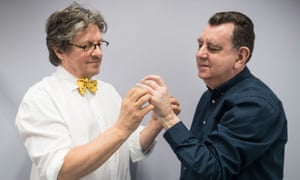


King has his hands examined by Prof Simon Kay, the surgeon who performed the transplant.


King has his hands examined by Prof Simon Kay, the surgeon who performed the transplant. Photograph: Danny Lawson/PA

King has also discovered he is now ambidextrous. “When I picked a pen up first time was with my right hand,” he said. “The next time I picked it up it was left. I might be able to write with both hands now.” He said: “I think it will be the icing on the cake when I can do my laces, and I don’t think that’s far off.”


King lost both his hands, except the thumbs, in an accident involving a metal-pressing machine at his workplace in Doncaster four years ago.


Consultant plastic surgeon Prof Simon Kay, who carried out the operation and two other hand transplants, believes the operation could become as routine as a kidney transplant.


Kay said he was amazed to receive a handwritten Christmas card and thank you letter from King.


Mark Cahill, 55, was the first hand transplant patient in 2012 at LGI, and a third man, who has not been named, became Kay’s third successful transplant patient earlier this year when he was given two new hands and a new forearm.


Two female patients are scheduled for surgery at the LGI as soon as donors become available.


Kay said: “The programme is now well-established. It’s now become mature. We understand the indications, the process. We now have three transplant patients completed and another two to go.”


“We would like hand transplantation to be as routine and unremarkable as kidney transplantation,” he said.
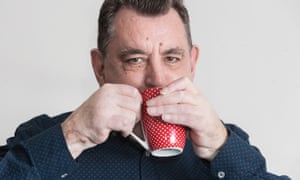


King with a cup of tea


King with a cup of tea. He lost both his hands in an industrial accident four years ago. Photograph: Danny Lawson/PA

Last year, NHS England awarded Leeds Teaching Hospitals NHS Trust the contract to become the UK’s specialist centre for hand transplants.


Referring to King, Kay said: “He’s proved to be, as he proved right at the beginning, a very robust, resilient patient, very enthusiastic about his hands, and I think he’s absolutely delighted.”


“When you bear in mind he will go on improving for another two years, he’s really remarkable – a real vindication for the surgery he’s had.”


“He’s doing more, sooner than we expected. He’s well ahead of our expectations.”


Cahill, a former pub landlord from Greetland, near Halifax, West Yorkshire, has since gained almost complete use of his transplanted hand. He reportedly used it to save his wife’s life last year after she had a heart attack.


Kay urged people to consider the need for future donors. Donating a hands is not yet an option on the organ donor card, but it can be discussed with potential donors if the opportunity arises, a spokeswoman for the NHS’s organ donor register said.


UK"s first double hand transplant patient delights in writing letter to thank surgeon

22 Kasım 2016 Salı

Thank you, Liz Jackson, for your candour and courage in facing a bastard of a disease | Paul Daley

“Parkinson’s disease” – my father never spoke these words before he died eight years ago from pneumonia associated with his decades-long endurance of this dreadful affliction.


My mother, who saw him through the worst of it until she could no longer do so, never said them. Neither did the doctors – not to his children at least.


Dad tried to keep the disease a secret from us even though the symptoms made the affliction obvious. After his death Mum said he’d never even admitted to her that Parkinson’s disease was killing him.


Maybe he was too proud to admit that something beyond his control, something so humiliating, had him in its python grip. He might’ve feared, irrationally of course, that we’d think less of him. Who knows? We never talked about that – and so much else besides.


I’ve long admired the journalism of Liz Jackson, the multi-award winning ABC broadcaster and film-maker. To me she has always been prominent in a milieu of journalists from the broadcaster who have shown us later generations the way.


And now my respect for her has grown further, having watched her heartbreaking documentary, A Sense of Self, about her diagnosis with – and life since – Parkinson’s.


Her candour and courage and humour in the face of the disease and for her decision to tell the story of her family’s experiences is beyond admiration. Ditto her dignity, in volunteering that she tried for a while to hide the disease from her children out of fear they might see her as weak, or colour their enduring impressions of her.


Then there’s her journalistic professionalism – to tell the story come what the hell may and probably will; the legacy grows exponentially. There is a lake of tears for Liz Jackson now, but not for the pity she despises. No, it’s to celebrate a world that can make a woman who Google-doctors her symptoms, understands the shitful truth of it all but continues to do brilliant work and goes from doctor to doctor to outrun it – and make this documentary.


Anyone familiar with Liz Jackson and who saw the program would be shocked at her decline. It illustrates starkly what a cruel, bastard of a disease Parkinson’s is, the way it robs one of bodily, intellectual and emotional control, and renders the previously strong so terribly, terribly prematurely frail.


The program is remarkable, however, for the humanity with which she emerges – a person defined by everything else that she is, except the disease, really.


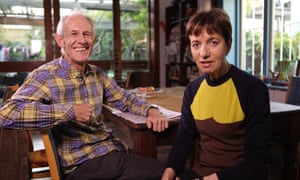
former ABC journalist Liz Jackson with husband Martin Butler


Former ABC journalist Liz Jackson and documentary maker husband Martin Butler. Together they produced A Sense of Self, documenting her struggle with Parkinson’s Disease Photograph: Tom Hancock

It is one of the most moving and important pieces of television I’ve seen, for the way it effectively transcends its immediate subjects so that it might interrogate and provoke us into considering how we approach and judge and emotionally respond to the dreadfully ill in our midst.


Dad was completely exhausted, wrung-out – a physical husk of a man – when he finally succumbed. He fought and fought and never really lost he will to live because he loved life and his kids, and especially his grandkids, so much.


He was a modest though proud bloke. Which is perhaps why he never volunteered what he had. And we never pushed him. When I think back, he probably lived with it for 20 years. But somehow, he kept the drug regimen a secret from us.


Even in his final months at home, before we intervened to move him into supported living because caring for him was going to kill our elderly mother, he would pretend it wasn’t happening. He’d sit there in his chair, drinking tea or on family occasions (which he loved), wine, through a straw, his hands shaking so violently that we’d want to help him.


Mum would give us a look that meant, “No,” then rescue his dignity, mop up, without a word or missing a beat, whatever he’d spilt on the floor or himself.


Parkinson’s is a dreadful curse. But nobody knows why we get it. Those who’ve seen a family member succumb to it reassure themselves that it is not hereditary. But its very mystery is testimony to the importance of what Liz Jackson has done in highlighting the cruelty and tragedy that freights it.


I have several friends who’ve lost loved ones to Parkinson’s. There is no common experience. Not all sufferers will endure the same symptoms. Dad had terrible tremors, he lost the capacity to write legibly, to remember – and say – names, even of family members such as my wife – and eventually he had terrible dementia.


But he was never afflicted with the depression and the panic attacks that have crippled Liz Jackson.


Liz Jackson, A Sense of Self

Just as my dad was spared her panic attacks and depression, I hope she and other Parkinson’s sufferers are spared his dementia.


In a way that was the hardest thing for us.


The dying months of the Bulletin magazine, for which I wrote, coincided with Dad’s terminal decline. Dad, though he never said so, read everything I ever wrote.


In late 2007 I skived off the federal election campaign when John Howard’s caravan passed through Melbourne. He was sitting in front of a TV in the nursing home, the Bulletin open, on his lap, at my story.


He looked at me. His eyes were blank. He no longer seemed to know me.


Thank you again Liz Jackson.


Thank you, Liz Jackson, for your candour and courage in facing a bastard of a disease | Paul Daley

11 Eylül 2016 Pazar

I cough at all the wrong times. Thank God I"m not Hillary Clinton | David Ferguson

If you are a character in a Victorian novel – which, much to my occasional dismay I am not – you know you’re going to die if, at an otherwise slow plot point, you begin to cough. Within two chapters, your cough will be spraying drops of dark red blood on to your linen kerchief and before long, you’ll be carried off by consumption.


These days we don’t live with the constant threat of tuberculosis and yet, from the way a certain segment of the right wing fever swamp is treating Democratic presidential nominee Hillary Clinton, you’d think she was Fantine from Hugo’s Les Miserables.


Matt Drudge, Sean Hannity, Rush Limbaugh, some ghoul named Steve Malzberg – who probably can’t help it that he’s a dead ringer for 90s make-believe car salesman Joe Isuzu – and even Republican nominee Donald Trump have seized upon Clinton’s seasonal allergies and resulting cough as a sign that she is trembling at death’s door, barely able to function.


“People don’t cough like that,” Malzberg insisted on his Newsmax.com podcast last week. People don’t have coughing fits ‘all the time,’ in public that go on and on and on and on and on and on. Not unless there’s something going on that’s not right.”


Please allow me to disabuse you of that notion, sir. Plenty of people “cough like that,” myself included. According to the Centers for Disease Control and Prevention, an estimated 19.1 adults over 18 were diagnosed with seasonal allergic rhinitis – also known as “hay fever” – in 2014 and 6.1 million children.


I’ve got big sinuses. It’s part of what makes my singing voice able to cut through layers of drums and guitars – a network of large, resonant holes in my skull. My late mother sang opera and had a glorious lyric soprano voice that could fill a whole theater and shake the chandeliers.


Twice a year, for 2 to 4 weeks in the spring and fall, those holes in my head fill up with gunk and it makes my face and forehead feel like a huge throbbing, aching, seriously clogged bottle of rubber cement.


If I don’t get enough sleep, drink quarts of water, eat right and keep my stress levels down, that respiratory distress will move straight down into my chest and I will develop a booming, persistent cough.


For some reason, the fall of 2009 was particularly nasty. I’d quit smoking the year before and thought that would make my seasonal battles with pollen and mold less miserable, but that first year, it seemed to have the opposite effect.


That was when I was a late night classical music DJ. My show went out live to the whole state of Georgia four nights per week. I remember it was Thursday, Sep. 10 because I was queuing up John Adams’ solemn, exquisite symphonic remembrance of the 9/11 victims, On the Transmigration of Souls.


“Our next selection,” I began, “is John Ad–” and I was seized with a violent coughing fit. Most radio consoles have what’s known as a “cough button” for just such an emergency. It mutes your microphone until the cough or sneeze or period of hoarseness passes.


But this coughing fit didn’t pass, it just kept going on and on. I killed my mic and started the music because I wasn’t sure what else to do. I was mortally embarrassed and for an awful moment felt sure I was disgracing the memory of all those people who were killed in the terror attacks of September 11, 2001.


The control room phone rang. I gulped down two swallows of tepid coffee and answered, still weak-voiced and froggy.


“You okay in there?” it was my boss calling from home.


“I’m fine,” I sputtered. “Just fighting for breath.”


He asked if I needed someone to come take over. I said no, I’m fine, it’s already passing. I hung up the phone and it immediately rang again. I picked it up and it was my twin brother calling from his car.


“Boy, that sounded terrible,” he said, laughing. “You’ve really got to quit smoking crack rocks at work.”


“It went out live to the whole state,” I said. “Our listeners probably think I’m dying.”


I wasn’t, though, any more than Hillary Clinton is. The fact is, even an able-bodied, healthy, athletic person like myself can get a cough that sounds like the end of the world. A week later I was back to running four miles a day and breathing like normal.


Sometimes, oh ye right-wing vultures, a cough is just a cough and the woman candidate whose health you’ve never cared one iota about before now is probably just fine, suffering from – as her personal physician disclosed in detail – a round of seasonal allergies.


So, if you’re expecting Hillary Clinton to keel over dead like Mimi, the consumptive heroine of Puccini’s La Boheme, or Hugo’s Fantine, I wouldn’t get my hopes up. I think she’s got a couple of arias to sing first.


I cough at all the wrong times. Thank God I"m not Hillary Clinton | David Ferguson

30 Ocak 2014 Perşembe

"I lastly acquired to thank the guy who saved my life"

Laybourn, a personalized trainer, could bear in mind Benjamin very nicely, however. He had frequently wondered what had took place right after the youthful man, then just twenty, whom he had talked to and experimented with to hold calm till the police, known as by one more bystander, had bundled him into a car and taken him to hospital.


“But I by no means followed it up. I sort of considered the police would speak to me,” says Laybourn, now 31. “I had no notion what had took place to him. I wondered if he had received more than it, or regardless of whether he had gone back and that day had created no difference.”


And then, two weeks ago, Benjamin – with the help of the Rethink Mental Illness charity – launched a campaign to “Find Mike”, his nickname for the stranger. Undertaking so, he made the decision, would not only enable him to “close the door on that chapter of my life”, but also assist to produce far more interest in mental well being issues.


The campaign spread rapidly thanks to social media. Within two days, Laybourn’s fiancée saw the story on Facebook and instantly knew her partner was “Mike”.


A meeting was swiftly organized. Benjamin admits that he was “petrified” about the encounter, but Laybourn was excited. Their hug lasted for some time so, also, did the talking – in spite of meeting in a pub, the two never even got about to possessing a drink.


“I have believed about him a good deal for the final six years,” says Benjamin. “It was a pivotal minute in helping me to get better. I’ve often wanted to say ‘thank you’.”


For Laybourn, there was likewise a sense of resolution. “Watching Jonny get some closure was truly wonderful. Seeing him be ready to express his gratitude was the best issue. That was why I was there.”


He found, as well, that Benjamin is now an engaging and animated youthful guy who performs as a charity campaigner. Indeed, it is challenging to picture that he lives with a continual schizoaffective disorder, which indicates he is susceptible to deep depressions and paranoia. “I am in a very good spot,” Benjamin says. “I am able now to speak about this. It is a enormous situation: 16 individuals each and every day get their own lives. Suicide is the greatest killer amongst younger guys.”


His personal troubles leading up to his suicide attempt have been acute. He grew up in a middle-class Jewish home and had completed effectively at school. But from the age of 11 he began hearing voices in his head, which grew to become progressively sinister. Extra to this, he genuinely believed – after watching The Truman Demonstrate – that he was becoming filmed and monitored each minute of the day by hidden cameras.


Also ashamed to admit to the voices in his head, he was in no way effectively diagnosed until he was 20.


These days, a mixture of medication, bodily workout, cognitive treatment workouts and mindfulness – a technique focusing on residing in the present – helps him keep on prime of his issue, he says. “There are 1000′s of men and women going to work each and every day, getting working lives, with schizophrenia. You can have a typical existence.”


The Samaritans charity is nervous that his tale might glamorise Laybourn’s intervention most suicide attempts are not averted by guardian angels.


But Benjamin says: “I am not striving to romanticise this. I was quite fortunate an individual came along. The point is, there is usually assistance out there. Getting somebody ready to pay attention – in excess of the cellphone, by e-mail, or face-to-encounter – can make this kind of a variation.”


For his component, Laybourn says he had no alternative but to act. “I noticed him from far away on the bridge it clicked right away why he was there. I did not believe I would reach him very first, due to the fact a great deal of folks had been going by. No 1 stopped hardly any person looked. It was evident he essential assist.”


Both guys say they will keep in touch. “We truly received on,” says Benjamin. “We’re last but not least going to have that coffee.”


For more details on psychological well being, visit rethink.org or call 0300 5000 927 (Mon-Fri, 10am to 2pm)


"I lastly acquired to thank the guy who saved my life"