writing etiketine sahip kayıtlar gösteriliyor. Tüm kayıtları göster

6 Nisan 2017 Perşembe

UK"s first double hand transplant patient delights in writing letter to thank surgeon

The first person in the UK to have a double hand transplant has said writing a letter to thank his surgeon has been one the highlights of his first nine months since the operation, as well as being able to clap for his favourite rugby league team.


Chris King, 57, described how he has got his life back since the surgery last July, when he became the second person to have a hand transplant at the UK’s specialist centre for the operation at Leeds General Infirmary (LGI) and the first to have both hands replaced.


King,from Rossington near Doncaster, said he can now do a range of tasks, including writing, making tea and gardening as he progresses even faster than his surgeon anticipated. He said he was improving every week and his next aims are to tie his shoelaces and button up his shirt – he said he had already cracked undoing them.


Looking at his hands, King said: “They are my boys, they really are.


“It’s been going fantastically. I can make a fist, I can hold a pen, I can do more or less the same functions as I could with my original hands. There are still limitations but I’m getting back to the full Chris again.”
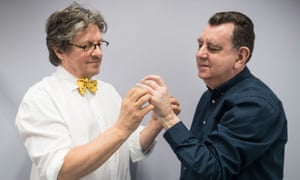


King has his hands examined by Prof Simon Kay, the surgeon who performed the transplant.


King has his hands examined by Prof Simon Kay, the surgeon who performed the transplant. Photograph: Danny Lawson/PA

King has also discovered he is now ambidextrous. “When I picked a pen up first time was with my right hand,” he said. “The next time I picked it up it was left. I might be able to write with both hands now.” He said: “I think it will be the icing on the cake when I can do my laces, and I don’t think that’s far off.”


King lost both his hands, except the thumbs, in an accident involving a metal-pressing machine at his workplace in Doncaster four years ago.


Consultant plastic surgeon Prof Simon Kay, who carried out the operation and two other hand transplants, believes the operation could become as routine as a kidney transplant.


Kay said he was amazed to receive a handwritten Christmas card and thank you letter from King.


Mark Cahill, 55, was the first hand transplant patient in 2012 at LGI, and a third man, who has not been named, became Kay’s third successful transplant patient earlier this year when he was given two new hands and a new forearm.


Two female patients are scheduled for surgery at the LGI as soon as donors become available.


Kay said: “The programme is now well-established. It’s now become mature. We understand the indications, the process. We now have three transplant patients completed and another two to go.”


“We would like hand transplantation to be as routine and unremarkable as kidney transplantation,” he said.



King with a cup of tea


King with a cup of tea. He lost both his hands in an industrial accident four years ago. Photograph: Danny Lawson/PA

Last year, NHS England awarded Leeds Teaching Hospitals NHS Trust the contract to become the UK’s specialist centre for hand transplants.


Referring to King, Kay said: “He’s proved to be, as he proved right at the beginning, a very robust, resilient patient, very enthusiastic about his hands, and I think he’s absolutely delighted.”


“When you bear in mind he will go on improving for another two years, he’s really remarkable – a real vindication for the surgery he’s had.”


“He’s doing more, sooner than we expected. He’s well ahead of our expectations.”


Cahill, a former pub landlord from Greetland, near Halifax, West Yorkshire, has since gained almost complete use of his transplanted hand. He reportedly used it to save his wife’s life last year after she had a heart attack.


Kay urged people to consider the need for future donors. Donating a hands is not yet an option on the organ donor card, but it can be discussed with potential donors if the opportunity arises, a spokeswoman for the NHS’s organ donor register said.


UK"s first double hand transplant patient delights in writing letter to thank surgeon

12 Ekim 2016 Çarşamba

"We are writing the history of Zika": one year into the crisis in Brazil

Two weeks shy of his first birthday, doctors began feeding José Wesley Campos through a nose tube because swallowing problems had left him dangerously underweight.


Learning how to eat is the baby’s latest struggle as medical problems mount for him and many other infants born with small heads to mothers infected with the Zika virus in Brazil.


“It hurts me to see him like this. I didn’t want this for him,” said José’s mother, Solange Ferreira, breaking into tears as she cradled her son.


A year after a spike in the number of newborns with the defect known as microcephaly, doctors and researchers have seen many of the babies develop swallowing difficulties, epileptic seizures and vision and hearing problems.


While more study is needed, Zika-caused microcephaly appears to be causing more severe problems in these infants than in patients born with small heads because of the other infections known to cause microcephaly, such as German measles and herpes. The problems are so particular that doctors are now calling the condition congenital Zika syndrome.


“We are seeing a lot of seizures. And now they are having many problems eating, so a lot of these children start using feeding tubes,” said Dr Vanessa Van der Linden, a pediatric neurologist in Recife who was one of the first doctors to suspect that Zika caused microcephaly.


Zika, mainly transmitted by mosquito, was not known to cause birth defects until a large outbreak swept through north-eastern states in Latin America’s largest nation, setting off alarm worldwide. Numerous studies confirmed the link.


Seven percent of the babies with microcephaly that Van der Linden and her team have treated were also born with arm and leg deformities that had not previously been linked to other causes of microcephaly, she said.


To complicate matters, there are babies whose heads were normal at birth but stopped growing proportionally months later. Other infants infected with the virus in the womb did not have microcephaly but developed different problems, such as a patient of Van der Linden’s who started having difficulties moving his left hand.


“We may not even know about the ones with slight problems out there,” Van der Linden said. “We are writing the history of this disease.”


On a recent day, José lay on a blue mat wearing just brown moccasins and a diaper, his bony chest pressed by a respiratory therapist helping him clear congested airways.


Jose, who has been visited by the Associated Press three times in the last year, is like a newborn. He is slow to follow objects with his crossed eyes. His head is unsteady when he tries to hold it up, and he weighs less than 13 pounds, far below the 22 pounds that is average for a baby his age.


Breathing problems make his cries sound like gargling, and his legs stiffen when he is picked up. To see, he must wear tiny blue-rimmed glasses, which makes him fussy.


Arthur Conceicao, who recently turned one, has seizures every day despite taking medication for epilepsy. He also started taking high-calorie formula through a tube after he appeared to choke during meals.


“It’s every mom’s dream to see their child open his mouth and eat well,” said his mother, Rozilene Ferreira, adding that each day seemed to bring new problems.


Studies are under way to determine if the timing of the infection during pregnancy affected the severity of the abnormalities, said Ricardo Ximenes, a researcher at the Fiocruz Institute in Recife.


Also, three groups of babies whose mothers were infected with Zika are being followed for a study funded by the US National Institutes of Health. The groups include infants born with microcephaly, some born with normal-sized heads found to have brain damage or other physical problems and babies who have not had any symptoms or developmental delays.


At birth, Bernardo Oliveira’s head measured more than 13 inches, well within the average range. His mother, Barbara Ferreira, thought her child was spared from the virus that had infected her during pregnancy and stricken many newborns in maternity wards in her hometown of Caruaru, a small city 80 miles west of Recife.


But Bernardo cried non-stop. The pediatrician told Ferreira that her baby was likely colicky and would get better by the third month. Instead, the crying got worse, so Ferreira took him to a government-funded event where neurologists were seeing patients with suspected brain damage.


“At the end of the second month, beginning of the third, his head stopped growing,” Ferreira said. “Bernardo was afflicted by the Zika virus after all. I was in despair.”


In Brazil, the government has reported 2,001 cases of microcephaly or other brain malformations in the last year. So far, only 343 have been confirmed by tests to have been caused by Zika, but the health ministry argues that the rest are most likely caused by the virus.


The health minister, Ricardo Barros, said there was a drop of 85% in microcephaly cases in August and September compared to those months last year, when the first births started worrying pediatricians. He credited growing awareness of the virus and government attempts to combat mosquitoes through spraying campaigns.


Despite all the problems, some infants with the syndrome are showing signs of progress.


On a recent evening, 11-month-old Joao Miguel Silva Nunes pulled himself up in his playpen and played peek-a-boo with his mother, Rosileide da Silva.


“He is my source of pride,” Silva said. “He makes me feel that things are working out.”


"We are writing the history of Zika": one year into the crisis in Brazil

7 Eylül 2016 Çarşamba

Health professionals: what should we be writing about?

Healthcare professionals often complain that they never read or hear of many success stories. It would seem sometimes that the media’s only emphasis is on the NHS being in a state of disarray, what with the ongoing battle over the junior doctors’ contract and nurses’ bursaries, recruitment problems, ever diminishing resources … the list goes on.


While mental health nurses bemoan not being able to provide compassionate care, GPs complain of burnout and staff at all levels lament the lack of integration in all aspects of their work, many more people are engaged in trying to address, fix or circumvent the mammoth problems facing the healthcare sector.


We want to highlight the partnerships that have an impact on the lives of healthcare professionals and patients. Whether it’s a charity working in collaboration with one part of the NHS (locally or nationally), an app or technological innovation, professionals partnering with patients, or simply a great example of collaboration, we want to hear about it.


Please share your suggestions of stories, projects, innovations and people you’d like to see included in a new series on partnerships in the form below.


Health professionals: what should we be writing about?