since etiketine sahip kayıtlar gösteriliyor. Tüm kayıtları göster

31 Mart 2017 Cuma

Young people and mental health: "Since diagnosis, I have taken massive strides"

Holly, 22, Sydney, Australia
I have suffered from depression and suicidal ideation since I was about 12. If my parents did not have private healthcare, I would probably be dead.


Vulnerable young people shouldn’t have to wait for months to see a psychiatrist, or to compensate for the lack of communication between specialists. Help-seeking behaviour should be supported and encouraged.


Young people in distress presenting to emergency rooms and hospitals should not be viewed as a problem. You don’t want us to kill ourselves, well, here we are. Mentally ill kids are often really intelligent. We can sense when you feel we are being a burden. Saying there are not enough beds, putting us in wards with elderly dementia patients or adults with drug-induced psychosis will ensure we do not ask for help again.


Malcolm Turnbull and Theresa May have the chance to make a real difference in the lives of vulnerable young people, who have a lot to offer the world in return. Don’t let us down.


Lindsay, London, 24
I am currently detained under section three of the Mental Health Act, and have been in hospital since 22 July 2016. Before this, I had a full-time job and always managed to keep my mental distress under control. I never imagined I would become a person to whom the psychiatric ward was home.


Amy-Hannah Charman, Cheltenham, studying A-levels
This poem was written in 2014 between two stints in psychiatric hospital with psychosis.


I want you to cry, I want you do die,


I don’t want to get hurt, I want to fight’


You need to hurt yourself so you can be free,


You need to ignore him, or in sin you will be,


If you don’t do what I say, I’ll make life hell,


You don’t want to slip; you’re doing so well,


Do this do that, you will be happier then,


Please just draw on yourself in a sharpie pen,


Arggg! Arrg! Cry cry cry,


Please! Please! I want to live life!


You’re a failure; this is not very hard,


Think of your friends, remember Mum’s card,


Cut cut cut, harm harm harm,


Relax relax, calm calm calm,


You need to scratch, you stupid cow,


Just go and find Mum she can save you now,


Cover your evidence, you must be sly,


Don’t do what he says, just look to the sky,


Listen to me, let me take over you now,


No I can’t, I need help, but how?


I hate you and you must hate yourself,


No I don’t want to get help,


You have nothing, nothing at all,


Actually I do like friends and all,


You don’t deserve to be happy like this,


Yes I do, think of that Taylor Swift gig,


You deserve everything I’ve done to you,


I don’t want this, I won’t listen to you,


I want to squish everything out of you,


Little, innocent me please shine through,


I will scar you and hurt you, I will do what I like,


I won’t let you win, I will always fight.


Caitlin Kitchener, 22, PhD student, York
It took an attempted suicide to gain access to therapy. I had been taking antidepressants for a few months, but they weren’t particularly working. It happened during the first year of my undergraduate degree and I remember being picked up in an ambulance outside the halls of residence, with people having a peek to see what was occurring.


Things worked out OK for me, but they didn’t for one of my best friends. She was utterly wonderful, witty, sassy, an absolute star of a woman. After my suicide attempt, she didn’t let me sleep alone for a week and made sure I looked after myself. She even helped arrange a surprise birthday party just four days after my attempt. Underneath all this charisma and humour and kindness was someone who was dreadfully sad. In the third year, she killed herself. She had attempted before, gone to hospital, had a review with a therapist, but faced excruciating waiting times. During her four-month wait for therapy, while she was also waiting for access to university services, she killed herself.


No one from the university or the NHS should be blamed. Maybe reduced waiting times wouldn’t have stopped her. But I can’t help it when I sit on her beautiful memorial bench to feel anger towards Tories whose actions are having real-life implications.


Anonymous, 19
I’ve had depression on and off since I was 11. Over the years, I’ve tried various coping mechanisms: self-harm, restrictive eating, bulimia – you name an unhealthy coping mechanism, and I’ve tried it.


The one that’s been the most constant is alcohol. It’s now got to the point where I’m drinking a small bottle of vodka pretty much every day, sometimes as early as 9am. Needless to say, this doesn’t help my depression, but I’m too dependent on it to give it up. I know I’m in desperate need of professional help, but it terrifies me thinking of my friends and family knowing I’m depressed. I worry that people will be awkward around me, feel guilty for not being able to help me or utter the dreaded phrase: “What have you got to be depressed about?”


I hope that one day the stigma surrounding mental health issues will be non-existent and I will have the courage to deal with my problems in a healthy way.


Anonymous, 17
At secondary school I was taught about religious education, maths, science, English and a plethora of other subjects. But there was one thing missing. After countless sleepless nights, and episodes of self harm, depressive thoughts and suicidal ideation, I had no idea what was wrong with me. I went to the top of a car park and watched the people walk past below like nobody in the world cared.


A woman spoke to me and saved me. After that, I got a correct diagnosis. Learning about mental health and that it is OK to ask for help is important.


Anonymous, 23
Over the years my depression and anxiety has come and gone in waves. After a friend who was having similar problems was diagnosed with Asperger syndrome, I visited a doctor and told him my symptoms. He laughed at me and said I simply had social anxiety, and put me on beta blockers.


When I was at university, a different doctor suggested I see a counsellor. After the first session the counsellor said she’d follow up and make a second appointment, which never happened. My confidence was shook, and I tried a second service. The session went well, and she said she’d make a second appointment for me. She never did. I was convinced that they didn’t think I was worth their time.


I called a mental health charity, when my depression got particularly bad. They arranged a time for them to call back and do a full assessment. They never called back.


I have a great family, and got a first in my degree, and a distinction in my postgraduate degree. Still, I constantly feel numb and almost completely emotionless. My few friends have all cut ties with me for unknown reasons.


Dolly Z, New Jersey
As a young adult, I wanted to share my life’s journey with mental illness in verse.
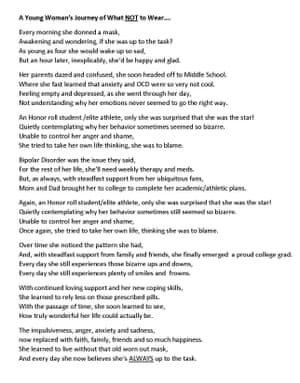


Dolly Z reflects on her mental illness.


Dolly Z reflects on her mental illness.

Laura Vale, 18, student on a gap year
“I’m so OCD about that, I have to have everything straight.” Or, “I’m such a clean freak, I’m so OCD.”


People don’t say these things maliciously, however, they do cause upset to actual sufferers of obsessive compulsive disorder. There are four main categories of OCD: checking; contamination/mental contamination; hoarding; ruminations/intrusive thoughts.


My OCD falls into the category of contamination/mental contamination. I cannot eat cold savoury food, and without medication I could not even be in a room with cold savoury food without having a panic attack. This is the main feature of my OCD, but I also can’t deal with foods touching, or sharing food and drink.


When it’s really bad, I cannot eat because I feel as though I am contaminating myself with food. I have to feel mentally clean, too, which kind of means mentally organised. This can be with relentlessly cleaning myself or tidying or harming myself because I was not clean enough.


Once (while taking Prozac, which really messed with me), I had to empty my room and paint it white. I knew this was illogical, I was crying because I felt insane, and yet I felt that this was the only way for me to be safe and comfortable. Intrusive thoughts control my life. From basic anxieties to more obscure ones, such as my absolute terror of ever having a child and then starving the child through my OCD. But it can be manageable and, for those who know me, since diagnosis I have taken massive strides.


The main issue with OCD is the lack of understanding in mainstream society. By making statements such as: “I am so OCD about that,” you are trivialising a mental illness that is so controlling, manipulative and horrible, and making the sufferer feel as though their struggle is not real and their feelings are irrelevant. Education is key.


In the UK, the Samaritans can be contacted on 116 123.
In the US, the National Suicide Prevention Hotline is 1-800-273-8255.
In Australia, the crisis support service Lifeline is on 13 11 14.


Young people and mental health: "Since diagnosis, I have taken massive strides"

9 Mart 2017 Perşembe

UK workers take fewest sick days since records began

Britons were more likely to struggle into work last year with coughs and colds than at any time since records began almost a quarter of a century ago, according to official figures.


About 137m working days were lost from illness and injury in 2016, said the Office for National Statistics, equivalent to 4.3 days per worker, the lowest rate since 1993, when it was 7.2 days.


Minor illnesses such as coughs and colds accounted for almost a quarter of the days lost due to sickness in 2016, at 34m. The second most common reason for not turning up to work was musculoskeletal problems including back pain, neck and upper limb problems, which accounted for 22.4% of days lost to sickness.


Mental health issues including stress, depression, anxiety and more serious conditions such as manic depression and schizophrenia resulted in 15.8m days being lost or 11.5%.


The total number of work days lost to sickness and injury peaked in the late 1990s at 185m. Although the figure reached a low of 132m in 2013, before rising again in 2014 and 2015, this was down to a steep increase in the working population.


The TUC general secretary, Frances O’Grady, said the fall in the sickness rate showed that “it is a myth that UK workers are always throwing sickies”.


She said: “We are really a nation of mucus troopers, with people more likely to go to work when ill than stay at home when well.


“Sickness absence rates have fallen steadily over the past decade, and let’s not forget that working people put in billions of pounds’ worth of unpaid overtime each year.”


The ONS said the groups with the highest rates of sickness absence were women, older workers, those with long-term health conditions, smokers, public health sector workers and those working in the largest organisations.


“The groups that have seen the greatest reduction in sickness absence rates over the past two decades are workers with long-term health conditions, workers aged 50 to 64, and those in the public sector,” it said.


Wales and Scotland suffered the highest rates of sickness absence in the UK, at 2.6% and 2.5% respectively, while the lowest rate was found in London at 1.4%.


Employees lost 2.1% of the year to sickness compared with 1.4% for the self-employed and the public sector lost 2.9% compared with 1.7% for workers in private firms last year.


ONS statistician Brendan Freeman said: “Since 2003, there has been a fairly steady decline in the number of working days lost to sickness, especially during the economic downturn.


“In recent years, there has been a small rise in the number of days lost, but due to an increasing number of people entering the workforce, the rate per worker and overall sickness absence rate have stayed largely flat.”


UK workers take fewest sick days since records began

17 Ocak 2017 Salı

US abortion rate is lowest since Roe v Wade – but contraception access may go

The rate of abortion in the US reached a lower level in 2014 than in any other year since the procedure first became legal, a study has found, a decline that appears to be due to the widespread use of contraception producing a drop in unintended pregnancies.


Nineteen percent of pregnancies ended in abortion in 2014 – the lowest abortion rate since the supreme court handed down Roe vs Wade in 1973, legalizing the procedure – and the number of abortions between 2011 and 2014 also fell, by 12%.


But the researchers found strong indications to link the decline in the abortion rate to the wider availability of highly effective contraception – which could be imperiled by efforts to repeal Obamacare by the incoming Republican administration.


The study appears in the latest issue of Guttmacher Institute’s scholarly journal, Perspectives on Sexual and Reproductive Health, and was conducted by two of the institute’s researchers, Rachel K Jones and Jenna Jerman.


The researchers made an estimate of the number of abortions by surveying local health department data and abortion clinics, which may be hampered by clinics that did not respond. Guttmacher is a think tank that supports access to reproductive care, but its data is widely trusted by supporters and opponents of abortion rights alike.


The decline in the abortion rate was greatest in the midwest, south and north east. Abortion is still a common procedure – in 2014, Jones and Jerman estimate, US women had 926,200 abortions – but there were nevertheless shifts in how abortions were performed. The number performed with medication, which is only effective early in a pregnancy, rose 7% to account for 31% of abortions outside a hospital setting.


There are competing theories to explain the decline in the abortion rate. The drop coincided with the enactment of the Affordable Care Act (ACA), which made more effective methods of contraception, such as IUDs, available to millions more women for no copay. But the decline also aligned with a historic spike in new, state-level abortion restrictions.


Some data – such as trends in contraception usage – that could help determine the reasons for the decline are not yet available for 2014. Still, the researchers predicted that the drop in the abortion rate had less to do with new restrictions than with changes in contraception usage and a reduction in unintended pregnancies.


One clue is that more than 60% of the decline in the abortion rate took place in states that had not enacted new hurdles to getting the procedure.


If the drop is due to contraception, it would have alarming implications for Republicans’ breakneck campaign to repeal the ACA. The law says that most health insurance plans must cover a broad range of contraceptive drugs and devices at no copay – the so-called contraception mandate. Public health advocates have credited this provision with an explosion in women’s access to more affordable and more effective birth control.


Between the fall of 2012 and spring 2014, a separate Guttmacher study found, the share of privately insured women who had no copay for contraception quadrupled. By 2015, the federal Department of Health and Human Services (HHS) found, 55.6 million US women had access to FDA-approved methods of contraception without a copay.


Vice president-elect Mike Pence has proposed a rule allowing business owners to refuse to cover contraception if doing so violates religious beliefs.


Vice president-elect Mike Pence has proposed a rule allowing business owners to refuse to cover contraception if doing so violates religious beliefs. Photograph: Evan Vucci/AP

If Republicans were to repeal Obamacare, it is not clear that their replacement would contain a similar provision. Tom Price, Trump’s nominee to lead the HHS, has put forth several proposals for an Obamacare replacement that do not contain a contraception mandate.


Separately, vice president-elect Mike Pence has proposed issuing a rule, through the HHS, that would allow business owners to refuse to cover contraception if doing so violates religious beliefs.


“Their agenda … could stop or reverse progress in empowering women to meet their childbearing goals, including by avoiding unintended pregnancy,” Joerg Dreweke, of Guttmacher, wrote in a policy brief accompanying the new study.


“There is strong evidence from recent abortion declines that supporting women’s decision-making across the spectrum of reproductive healthcare is very much compatible with reducing abortion incidence.”


The Guttmacher researchers found less evidence to link the decline in abortions or to new abortion restrictions. About 38% of the decline in the number of abortions was observed in 22 states that had enacted new restrictions significant enough to potentially impact women’s access to abortion.


These included laws that imposed extra counseling for an abortion. But only eight of those 22 states had abortion declines that outranked the national average, and four states – Arkansas, Michigan, Mississippi and North Carolina – actually saw an increase in their abortion rates.


There was, however, one type of abortion restriction that seemed to cause a decline in the abortion rate. These were laws that placed medically unnecessary regulations on abortion clinics in order to shut them down.


The number of abortion clinics fell by 6% between 2011 and 2014, and the loss of access appeared to be linked with a decrease in abortions – although it could not account for the entire declines observed in those states. In June 2016, the supreme court ruled these kinds of laws to be unconstitutional.


The decline in the abortion rate from 2011 to 2014 continues a long downward trend. The US also saw its abortion rate drop between 2008 and 2011, driven, according to Guttmacher, by a steep decline in unintended pregnancies, probably explained by improvements in the use of contraception. As the abortion rate fell, the birth rate did not rise commensurately.


In particular, the rise of the use of highly effective, long-acting, reversible contraception, such as IUDs, might account for the drop in abortions.


US abortion rate is lowest since Roe v Wade – but contraception access may go

13 Ekim 2016 Perşembe

Car parking charges at hospitals in England rises average 15% since 2014

A third of hospital trusts in England have increased their car parking charges in the last year, figures show.


Some are now charging as much as £4 for a one-hour stay, with a third increasing their average charge over a three-hour period.


The analysis, by the Press Association, includes figures obtained directly from NHS trusts and data submitted to NHS Digital.


The NHS Digital data suggests a 15% average rise in parking charges across trusts in England between 2014/15 and 2015/16.


Some trusts allow patients and visitors to park for free for the first 30 minutes before charges kick in but others have scrapped a one- or two-hour charge, meaning people have to pay a flat fee for three hours even if they stay for less than that.


The most expensive trust in the country for a one-hour stay is the Royal Surrey county hospital in Guildford, where patients pay £4 for any stay up to two hours. It does have a few bays where people can park for 20 minutes before being charged.


Hereford county hospital lets people park for free for 10 minutes, but then charges £3.50 for an hour and £5 for two hours.


Meanwhile, London’s Royal Free hospital charges a flat rate of £3 an hour.


Of the 209 hospital trusts that reported figures to NHS Digital for both 2014/15 and 2015/16, a third (69 trusts) showed an increase in their average hourly charge when calculated across three hours.


126 (60%) showed no change over the year while 14 (7%) showed a decrease.


Among those trusts that have hiked up parking charges in 2016 are the Royal Surrey, where the cost of an hour has doubled from £2 in 2013 to £4.


Stockport NHS foundation trust increased its prices by about 40% over the summer.


The cost of a four-hour stay at the town’s Stepping Hill hospital rose from £6 to £8, with a short stay rising from £2.50 to £3.50.


England is the only part of the UK where hospitals routinely charge patients and visitors for parking. Almost four out of 10 (38%) NHS trusts said they also charged for disabled parking.


Laura Keely, campaigns manager at Macmillan Cancer Support, said: “Cancer patients often need to make frequent trips to hospital. They should not be left out of pocket in order to receive life-saving treatment.


“Public transport is not always an option as cancer patients can have an increased risk of infection because treatment has compromised their immune system. Treatments can also leave patients feeling tired, sick and weak, so they have little choice but to travel by car.


“Car parking is free at most hospitals in Scotland, Northern Ireland and Wales but not across all hospitals in England. Those in charge of hospital car parking have a responsibility to ensure that their schemes work for vulnerable people, such as those living with cancer.”


At the other end of the scale, car parking at Trafford general hospital in Greater Manchester is free for up to three hours.


Alder Hey children’s NHS foundation trust charges £2 a day and the Christie cancer hospital in Manchester charges £1.50 a day. The Clatterbridge Cancer Centre on the Wirral offers free parking.


Some NHS trusts offer concessions to people visiting someone who is terminally ill, and also discounts or weekly tickets for lengthy courses of treatment.


Last December, figures obtained under the Freedom of Information Act by the Press Association revealed that some NHS trusts are making more than £3m a year from car parking fees.


Of more than 90 trusts that responded to the FoI request, half are making at least £1m a year.


Seven NHS trusts earned more than £3m in 2014/15 from charges, a further eight made more than £2m a year while a further 33 earned more than £1m a year.


Royal Surrey had a deficit of more than £11m at the end of March, against a forecast of £2m. It has blamed several factors including increasingly expensive agency staff. It said it was expanding its car park capacity by 100 spaces due to increased demand. A £10m multi-storey is planned to create a long-term solution, it said.


Deputy chief executive Alf Turner said: “I do not like having to charge people for car parking and in an ideal world we would not have to, however both my colleagues on the board and I know that it is an unfortunate necessity to cover our car parking improvement and running costs.


“We have listened carefully to the views of our patients, visitors and staff and they have been telling us that our current car parking provisions are inadequate and urgent changes need to be made. The trust’s challenging financial position means that it does not have the additional funds to invest in the future of its car parking facilities without making the incredibly difficult decision to charge people for using the car parks.”


Shadow health secretary Jonathan Ashworth said: “These figures show a worrying increase in the cost of car parking charges in our hospitals.


“Racking up charges on people who have no choice isn’t fair and will only cause more distress for patients and their families.


“Hospitals across the country are hard-pressed because of this Government’s underfunding of the NHS, but money should not be made up through charging patients and their families more and more for an essential service. These increases cannot be justified.”


Most expensive trusts in England for a one-hour visits:


  • Royal Surrey county hospital £4

  • Hereford county hospital £3.50

  • Stockport £3.50

  • Bristol royal infirmary £3.40

  • West Suffolk hospital £3.30

  • Northampton general £3.10

  • Royal Free, London £3

  • Basildon hospital, Essex £3

  • Whittington hospital, London (after 5pm) £3

  • St Thomas’ hospital, London £3

  • Chelsea & Westminster hospital, London £3

  • Aintree university hospital £3

  • Luton and Dunstable £3

  • Mid Cheshire hospitals £3

  • Mid Essex £3

  • Southend university hospitals £3

  • Princess Alexandra hospital, Essex £3

  • University hospital of South Manchester £3

  • Warrington hospital £3


Car parking charges at hospitals in England rises average 15% since 2014

31 Mart 2014 Pazartesi

Novartis Trial Was Stopped Early Since Of A Substantial Drop In Cardiovascular Mortality

The biggest-ever trial in heart failure was stopped early due to the fact of a extremely statistically significant reduction in cardiovascular mortality, in accordance to 1 of the trial’s two principal investigators.


Earlier today I reported that the PARADIGM-HF trial testing LCZ696, a novel, first-in-class Angiotensin Receptor Neprilysin Inhibitor (ARNI), had been stopped early due to the fact the trial had demonstrated a considerable reduction in the combined major endpoint of cardiovascular death and heart failure hospitalization. This info was taken from a Novartis press release.


But it turns out that the press release wasn’t entirely accurate. For after, a business appears to have in fact downplayed a optimistic discovering in its trial. In accordance to Milton Packer, the trial’s co-Principal Investigator, the information is a lot more persuasive than may possibly be gathered from the press release. (I spoke with Packer at the American University  of Cardiology meeting in Washington, DC.)


English: Mohawk Stop Sign

English: Mohawk Stop Sign (Photo credit score: Wikipedia)


In general when a trial has a mixed endpoint– for PARADIGM-HF it was the mixture of cardiovascular death and heart failure hospitalization– the results are largely driven by the “softer” part of the endpoint (in this case, heart failure hospitalization and not the “harder” endpoint of cardiovascular death.) This usually prospects to criticism when a trial has been technically superior in minimizing a combined endpoint but shows small or no effect on the harder, more crucial endpoint.


We will not know the full final results of PARADIGM-HF until finally they are presented at a medical meeting, maybe the European Society of Cardiology meeting in August in Barcelona. But in accordance to Packer, the trial will certainly show a huge and convincing reduction in the far more essential endpoint part, cardiovascular death.


Packer advised me that the stopping rule for the trial was “the most conservative stopping rule in any clinical trial I have ever been concerned with.” A lot more importantly, he stated, “the stopping rule was not on the primary endpoint, it was on cardiovascular death. It was a stopping rule that required a really high level of statistical significance for early termination.” And it was based mostly on this stopping rule that “the Data and Monitoring Board decided that stopping the trial was proper.”


Packer explained “the press release implies that the trial was stopped for the primary endpoint but that was not the situation, the trial was stopped for a persuasive impact on cardiovascular mortality alone, and my enthusiasm was based mostly on that very persuasive impact.”


Packer also advised me that the trial had been powered to detect a variation in cardiovascular mortality, so the finding may possibly not be quite so sudden. This also explains the trial’s huge dimension.


Novartis Trial Was Stopped Early Since Of A Substantial Drop In Cardiovascular Mortality

8 Ocak 2014 Çarşamba

White women much more probably to get breast cancer since of "lifestyle"

Ladies aged 50 to 64 had been enrolled into the study, made to investigate backlinks among well being and way of life, from 1996 to 2001. Participants completed questionnaires about residing routines, medical and social variables and cancer data was obtained from NHS cancer registries.


The authors found that following all around twelve many years, 217 of 5,877 South Asian females designed breast cancer, as did 180 of 4,919 black girls and 45,191 of 1,038,144 white women – meaning South Asian women had an 18% reduced fee of breast cancer compared with white females, and black women had a 15% reduced price in contrast to white ladies.


The research, published in the British Journal of Cancer, also found quite a few distinctions in recognized danger elements this kind of as alcohol consumption and use of menopausal hormone treatment, between other folks.


For instance South Asian and black women had far more young children than white women and have been much more very likely to breastfeed them – 69% of white women mentioned they had breastfed their youngsters compared to 83% of black females and 85% of South Asian girls.


Meanwhile, 75% of South Asian girls said they had been non-drinkers compared to 38% of black females and 23% of white females.


And 35% of white women stated they had been a current user of menopausal hormone treatment compared to 22% of South Asian ladies and 29% of black girls.


Ladies from black and South Asian backgrounds had been also less likely to have a 1st degree relative with breast cancer.


Right after the researchers excluded these, and other way of life and reproductive elements, from the analysis the chance of building breast cancer was found to be equivalent for females of all ethnic groups.


They concluded that the distinctions “largely, if not wholly” account for the diverse charges of breast cancer between ladies from different ethnicities.


The authors wrote: “These findings indicate that the decrease incidence prices of breast cancer noticed in South Asian and black women as in contrast with white women in England are largely, if not wholly, due to the fact of variations in known chance aspects for the condition.


“Once changes were made for danger aspects including age at menarche, height, childbearing and breastfeeding background, alcohol consumption, and use of menopausal hormone treatment, South Asian and black girls were proven to have equivalent breast cancer risks to white women.”


They additional that many of the black and South Asian females in the examine had been first-generation immigrants and warned that as second and subsequent generations of women of ethnic minority origin alter their lifestyles, their threat of breast cancer will improve.


Review author Dr Toral Gathani, from the University of Oxford, mentioned: “In this examine of largely submit-menopausal ladies in England, we see that the lower chance of breast cancer in South Asian and black girls is largely explained by differences in life style and reproductive patterns.


“It truly is important for females of all ethnic groups to realize what are the modifiable danger elements for breast cancer, this kind of as weight problems and excessive alcohol consumption, and to take measures to decrease their threat.”


Dr Julie Sharp, Cancer Research UK’s head of health info, extra: “Ladies can minimize their chance of breast cancer by cutting down on alcohol, retaining a wholesome fat by consuming a balanced diet and by maintaining energetic.


“If women recognize any changes to their breast such as lumps, any skin or nipple modifications, or modifications in their size, shape or come to feel they ought to inform their medical doctor straight away. It truly is almost certainly not cancer, but if it is, acquiring it diagnosed as early as possible offers the very best possibility of survival.”


White women much more probably to get breast cancer since of "lifestyle"