Everyone has a story about crap sex education. My own consisted of a single afternoon in primary school, where a shame-faced stranger haltingly warned us about our impending wet dreams in such abstract terms that she may as well have been explaining quantum chromodynamics. That was all we got. It’s a wonder we are not all dead.
So the news that sex and relationship education will soon be compulsory in British secondary schools, with children from four years old upwards receiving lessons in relationships, should be widely celebrated. I left school two decades ago and, despite spending a solid month on the subject, I am yet to encounter a situation where I have needed to know what an oxbow lake is. Meanwhile, had my school put the same effort into sex and relationships, I guarantee that I would still be using those lessons to this day.
Leaving youngsters to figure out how sex works for themselves is the very definition of madness. For a few years, I was heavily involved with World Contraception Day, and I got to see first-hand what happens when kids have to form their own ideas about sex. The misinformation I encountered was catastrophic. I met kids who did not think you could get pregnant if you did it standing up, and kids who thought the pill protected you against STIs. There were kids who believed that post-coitally rinsing yourself out with Coca-Cola was an effective form of contraception. On one particularly bleak morning in Maidstone, I found myself arguing with a teenager who maintained that, in an emergency, an empty crisp packet would be a fine alternative to a condom.
Sure, you could argue that this ruling has come a little late, since rates of teenage pregnancies in this country have now reached the lowest point since records began. And, yes, in a balanced and sensible world this would not be necessary because parents would have already fully equipped their children to learn the importance of healthy relationships.
But still, it is vitally important. The internet has meant that, without schools stepping in to lead the way, there is a real danger that kids will educate themselves about sex with pornography. After all, no generation has ever had such easy access to porn. When I was a kid, if we wanted to look at porn we had to scour local woodlands for miraculously discarded carrier bags full of year-old Razzles. I shudder to think of the ideas we would have formed if we could have just hopped on the internet. No wonder 75% of British people want to see sex and relationship education address the harmful effects of online porn and sexting.
We have known for years that teens are more responsible in their attitudes towards sex if they are given a proper educational grounding first. And, at last, that is what they are going to get. Even if it dents the sales of fizzy drinks and crisps a little, that has to be a good thing.
The rate of abortion in the US reached a lower level in 2014 than in any other year since the procedure first became legal, a study has found, a decline that appears to be due to the widespread use of contraception producing a drop in unintended pregnancies.
Nineteen percent of pregnancies ended in abortion in 2014 – the lowest abortion rate since the supreme court handed down Roe vs Wade in 1973, legalizing the procedure – and the number of abortions between 2011 and 2014 also fell, by 12%.
But the researchers found strong indications to link the decline in the abortion rate to the wider availability of highly effective contraception – which could be imperiled by efforts to repeal Obamacare by the incoming Republican administration.
The study appears in the latest issue of Guttmacher Institute’s scholarly journal, Perspectives on Sexual and Reproductive Health, and was conducted by two of the institute’s researchers, Rachel K Jones and Jenna Jerman.
The researchers made an estimate of the number of abortions by surveying local health department data and abortion clinics, which may be hampered by clinics that did not respond. Guttmacher is a think tank that supports access to reproductive care, but its data is widely trusted by supporters and opponents of abortion rights alike.
The decline in the abortion rate was greatest in the midwest, south and north east. Abortion is still a common procedure – in 2014, Jones and Jerman estimate, US women had 926,200 abortions – but there were nevertheless shifts in how abortions were performed. The number performed with medication, which is only effective early in a pregnancy, rose 7% to account for 31% of abortions outside a hospital setting.
There are competing theories to explain the decline in the abortion rate. The drop coincided with the enactment of the Affordable Care Act (ACA), which made more effective methods of contraception, such as IUDs, available to millions more women for no copay. But the decline also aligned with a historic spike in new, state-level abortion restrictions.
Some data – such as trends in contraception usage – that could help determine the reasons for the decline are not yet available for 2014. Still, the researchers predicted that the drop in the abortion rate had less to do with new restrictions than with changes in contraception usage and a reduction in unintended pregnancies.
One clue is that more than 60% of the decline in the abortion rate took place in states that had not enacted new hurdles to getting the procedure.
If the drop is due to contraception, it would have alarming implications for Republicans’ breakneck campaign to repeal the ACA. The law says that most health insurance plans must cover a broad range of contraceptive drugs and devices at no copay – the so-called contraception mandate. Public health advocates have credited this provision with an explosion in women’s access to more affordable and more effective birth control.
Between the fall of 2012 and spring 2014, a separate Guttmacher study found, the share of privately insured women who had no copay for contraception quadrupled. By 2015, the federal Department of Health and Human Services (HHS) found, 55.6 million US women had access to FDA-approved methods of contraception without a copay.
Vice president-elect Mike Pence has proposed a rule allowing business owners to refuse to cover contraception if doing so violates religious beliefs. Photograph: Evan Vucci/AP
If Republicans were to repeal Obamacare, it is not clear that their replacement would contain a similar provision. Tom Price, Trump’s nominee to lead the HHS, has put forth several proposals for an Obamacare replacement that do not contain a contraception mandate.
Separately, vice president-elect Mike Pence has proposed issuing a rule, through the HHS, that would allow business owners to refuse to cover contraception if doing so violates religious beliefs.
“Their agenda … could stop or reverse progress in empowering women to meet their childbearing goals, including by avoiding unintended pregnancy,” Joerg Dreweke, of Guttmacher, wrote in a policy brief accompanying the new study.
“There is strong evidence from recent abortion declines that supporting women’s decision-making across the spectrum of reproductive healthcare is very much compatible with reducing abortion incidence.”
The Guttmacher researchers found less evidence to link the decline in abortions or to new abortion restrictions. About 38% of the decline in the number of abortions was observed in 22 states that had enacted new restrictions significant enough to potentially impact women’s access to abortion.
These included laws that imposed extra counseling for an abortion. But only eight of those 22 states had abortion declines that outranked the national average, and four states – Arkansas, Michigan, Mississippi and North Carolina – actually saw an increase in their abortion rates.
There was, however, one type of abortion restriction that seemed to cause a decline in the abortion rate. These were laws that placed medically unnecessary regulations on abortion clinics in order to shut them down.
The number of abortion clinics fell by 6% between 2011 and 2014, and the loss of access appeared to be linked with a decrease in abortions – although it could not account for the entire declines observed in those states. In June 2016, the supreme court ruled these kinds of laws to be unconstitutional.
The decline in the abortion rate from 2011 to 2014 continues a long downward trend. The US also saw its abortion rate drop between 2008 and 2011, driven, according to Guttmacher, by a steep decline in unintended pregnancies, probably explained by improvements in the use of contraception. As the abortion rate fell, the birth rate did not rise commensurately.
In particular, the rise of the use of highly effective, long-acting, reversible contraception, such as IUDs, might account for the drop in abortions.
As Zika continues to spread through the western hemisphere, the women’s health aspect of the virus has not entered the public conversation. Perhaps more than the failure to control mosquito populations, lack of access to widespread, effective contraception is the root cause of microcephaly in most of Latin America and the Caribbean, and yet remains the least talked about aspect of the epidemic.
Ebola, like HIV before it, offered an impetus to improve general healthcare infrastructure in west Africa, as international money and political will joined the fight against the epidemic. For all its negatives, the Zika outbreak similarly provides an opportunity to press strongly for universal access to contraception and reproductive services for women in all Zika-affected countries, but this opportunity is being largely overlooked.
To prevent babies being born with microcephaly, the Centers for Disease Control and Prevention (CDC) and the World Health Organisation are choosing to encourage “delaying pregnancy”, as well as to recommend mosquito nets and protective spray to those who are already pregnant. Without putting any resources behind widespread contraception, this is merely lip service and fails to deal effectively with the problem. Only 62.5% of Latin American women use some form of contraception [pdf], and in Haiti, only 34% of women have access to contraception. In the US, 45% of pregnancies are unintended, and 65% in Puerto Rico are as well [pdf]. Health authorities in El Salvador estimate that as many as 90% of pregnancies may be unintended, and Haiti, without an effective public health system or quotable statistics, is likely not far off from this figure.
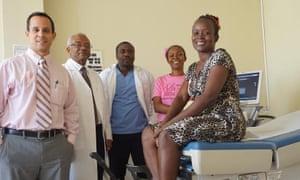
Doctors Vince DeGennaro, Jean Renald Cornely and Valery Caleb Suprien with nurse Ursilia Saintil in a gynaecology exam room at Hospital Bernatd Mevs in Port au Prince, Haiti. Photograph: Grace Tillyard/IHI
The choice to focus on expectant mothers rather than considering women as a whole will be costly, most of all for vulnerable women who are most likely to have an unintended pregnancy. In Haiti, where we work in women’s health, the cost – both social and economic – could be catastrophically high as the scale of the epidemic is probably drastically under-reported to date. In most low- and middle-income countries in Latin America, marginalised women’s chances of resuming their schooling and work will be decimated when they have to look after a severely disabled child.
The CDC’s efforts in Puerto Rico have been limited to handing out Zika-prevention kits, including insect repellent, mosquito nets, brochures and a condom as a reminder of the possibility of sexual transmission of Zika, and not as a form of contraception where no pregnancy is desired. Local authorities have also collected 1.2 million discarded tyres, dropped larvicide into abandoned pools, educated residents and trained local brigades in fumigation.
Efforts in Puerto Rico have been confounded because the US Congress has been unable to pass a Zika funding bill. None of the $ 250m (£200m) planned for Zika in Puerto Rico or the $ 376m for the Caribbean was earmarked for reproductive health services, sending signals to other governments and non-profits where to steer their efforts.
Widespread contraception would be one of the cheaper options for dealing with the Zika crisis, at only $ 31 per woman per year, including all the personnel costs of healthcare workers. Some have estimated that the cost of one child with Zika birth defects in the US is $ 4m, including extra ultrasounds, hospitalisations, surgeries and critical care. The CDC estimates that 138,000 women of reproductive age in Puerto Rico (19%) do not currently desire pregnancy and are not using contraception. At $ 31 per woman per year, the $ 4.3m additional cost for achieving universal access to contraception is dwarfed by the $ 250m in the US Senate bill allocated for the prevention of Zika infections in pregnant women and associated medical costs.
Widespread contraception would be one of the cheaper options for dealing with the Zika crisis
Our work in Haiti strives towards empowering women through delivering healthcare services. The failure to provide services that help women is in part due to the age-old problem of reducing women’s health to simply maternal health, and propelling programmes that tell women what to do rather then empowering them to make decisions for themselves. Zika, it seems, is no different.
Declaring contraception as the cheapest and most effective way to deal with the crisis would be a bold step towards lobbying all governments in the region to expand these much-needed services. In addition, contraception in low- and middle-income countries results in better birth-spacing, reduced maternal mortality and infant mortality, and advances in the socio-economic status of women.
The Zika crisis, like abstinence-based teachings for HIV prevention, is a missed opportunity to invest in women’s health infrastructure, where ideology trumps public health and financial logic in Latin America and the Caribbean. Transnational public health authorities, like the CDC and WHO, are allowing politics with antipathy to women’s reproductive health to pollute public health logic, forcing countries to commit ineffective funds and set a standard that leaves women behind. Will we let yet another crisis go by without addressing reproductive health services for half our population?
Grace Tillyard is Director of Communications and Outreach for Innovating Health International in Haiti.
Dr Vincent DeGennaro Jr is President of Innovating Health International in Haiti and Assistant Professor in the Division of Infectious Diseases and Global Medicine at University of Florida College of Medicine.
On Wednesday morning, gynecologist Deborah Ottenheimer went to work determined not to talk about the election. “I never do that,” she says. “You just never know where people are at.” But as her doors opened, she quickly realised she wouldn’t have a choice. “Every single patient that walked in burst into tears,” she says. “Women and girls were sobbing. Just sobbing. Everybody was wrecked.”
Ottenheimer’s New York City clinic treated nearly 40 patients the day after Donald Trump was elected, and the only thing more unusual than their tears was that so many of them had the same question: “Should I get an IUD?”
Feminists, queer and transgender activists gather to protest against Donald Trump. Photograph: Pacific Press/LightRocket via Getty Images
This tiny T-shaped plastic-and-copper coil, designed to stop an egg and sperm from surviving in the womb, has become an unlikely weapon on the frontline of women’s rights. “These are not people who were thinking about it already – or were unhappy with their current method,” Ottenheimer says. “These people were afraid.”
In fear of what a Trump presidency might mean for reproductive rights, thousands of women have taken to social media to urge each other to seek out access to IUDs, a form of birth control that can last anywhere from three to 12 years. Trump has promised to defund Planned Parenthood, the reproductive health organisation that provides contraception to many women around the US, and dismantle the Affordable Care Act, which guarantees access to contraception. Depending on the brand, an IUD inserted before Trump’s inauguration guarantees that a woman is protected from unwanted pregnancy for the duration of his presidency and beyond. “It’s a ‘fuck you’ to this president to get birth control that will outlast him,” said Margot Judge, a 25-year-old from New York who is considering getting an IUD this week.
Since the election, Ottenheimer says she has continued to be overwhelmed with requests about the device, and she is not alone. Planned Parenthood has reported a spike in inquiries while Google reported a “massive peak” in searches for “IUD” this week. And while this step towards self-protection is a measure of reassurance, plenty of women remain deeply uncertain about what the future holds.
Planned Parenthood supporters rally for reproductive healthcare. Photograph: Nick Ut/AP
“For me, my motivation is fear,” says Jennifer, 35, from Maryland. “For the past eight years, we’ve seen expanded healthcare and more acknowledgement of reproductive rights – but I remember how tense things were under George Bush. So, for me, there’s a sense that I need to protect myself because I don’t think lawmakers will.”
Jennifer has thought about getting an IUD before, but feels urged to get one now. She says that the panic she has noticed among women after the election has left her feeling unsettled about making a decision. “I don’t like the feeling of being painted into a corner. I feel like I am being rushed, like I’m having to make a decision right now that I would like to be more thoughtful about.”
Even without the threat of a pussy-grabbing president, IUDs make a lot of women anxious. They are the third most popular form of contraception in the US – and the most effective form of reversible contraception available – but it requires a medical procedure, and tales of perforated uteruses, heavy bleeding and painful cramps have long sent women running to the pill instead.
A mass rally on the fourth day after the election. Photograph: Pacific Press/LightRocket via Getty Images
However, gynaecologists insist complications are rare. Ottenheimer says that, while there are other forms of long-term birth control such as the implant (inserted in the arm, lasting up to 3 years), IUDs are a “really good option” for most women. Clare Lyons, a registered nurse who urged women to get an IUD on the night of the election, says that IUDs are “incredibly safe” and that women should get informed about whether it might be a good option for them. “Ultimately, my message is to make an appointment with a provider; figure out what is best for you.”
Ayelet Bitton, a 25-year-old software engineer from San Francisco, has read a few horror stories about IUDs, which have always held her back from getting one. But now she is re-evaluating. “I used to say I didn’t want to deal with getting it inserted, or the fear that it might be dislodged. But now I want to reconsider all of that,” she says. “Because the stress of something going wrong with my IUD is a lot less than the stress I’ll have if this other stuff happens.”
Hannah Weinberger is also reconsidering the downsides. The 26-year-old from Amaeus, Pennsylvania, is an avid cyclist. She was once put off having the procedure to avoid physical side-effects that could stop her from cycling. But now that has changed. “My strong feelings about being able to take control of my body mean that temporary discomfort doesn’t [matter] very much to me any more.”
Most women cite two reasons for wanting to get an IUD: wanting to take advantage of their current right to free contraception, and uncertainty about rising costs of contraception in the future. But there’s another reason, too.
A #GOPHandsOffMe protest outside Trump Tower. Photograph: Pacific Press/LightRocket via Getty Images
“Contraception is a feminist issue,” Weinberger says. “Getting an IUD means I have a tool in my body that the government can’t touch. Making my own choice about what my body can and cannot do in the face of an administration that wants to change that is a political act.”
And let’s be clear, this administration does very much want to change that. Although Trump has flip-flopped on abortion and has seemingly softened his perspective on Obamacare, Mike Pence, his beady-eyed running mate, has been vehemently opposed to reproductive rights throughout his political career. He signed a whopping eight anti-abortion bills into law in fewer than four years as governor of Indiana, including one that mandated women hold funerals for their aborted foetuses and allowed hospitals to deny abortions to women even if they would die without care.
So, while an IUD is a form of armour that women can use to shield themselves against Pence and Trump’s crusade to control their bodies, there’s still reason for women to be anxious about their future in Trumpland.
“Even if I decide to get an IUD today,” Jennifer says, “how do I know that in a few years I’ll be able to see someone to get it taken out?”
It really is crunch time at the US supreme court, exactly where the justices are racing to situation opinions in far more than a dozen instances above the following two weeks.
On Monday, the court threw out out Argentina’s appeal above 2001 debt default, and revived a challenge by two conservative groups who oppose an Ohio law that punishes knowingly false political statements.
But still to come: the religious rights of firms, the speech rights of abortion protesters and the privacy rights of folks underneath arrest are among the significant problems that are so far unresolved.
Summer season travel, European teaching gigs and relaxation beckon the justices, but only soon after the court hands down selections in all the circumstances it has heard because October.
In unusual instances, the justices will place off decisions and purchase a case to be argued yet again in the next term.
This is also the time of the 12 months when a justice could announce a retirement. But the oldest of the justices, 81-year-outdated Ruth Bader Ginsburg, has signaled she will serve at least one particular much more 12 months, and maybe longer.
The justices will meet again Thursday to situation opinions, and could wind up their perform by the end of the month. Main instances remain that will have key repercussions:
Cellphone searches and arrest privacy
Two instances weigh the power of police to search the cellphones of people they location under arrest without having very first getting a warrant from a judge. The Guardian’s Dan Roberts recorded how justices at occasions struggled to comprehend technological advances. “What is the variation amongst [pictures stored on a smartphone and] hard copy pictures in a billfold?” asked justice Samuel Alito. “I will not see there is much of a difference,” he extra.
Justice Stephen Breyer appeared to bemuse lawyers by referring to the “brzzing” sound of phones and “buzzers” you can push. “[What if] they can just cough and encrypt it?” asked Breyer when discussing why seizing a mobile phone may possibly not be sufficient to prevent evidence tampering.
When one particular lawyer commenced a response by saying “I don’t know what type of smartphone you have, maybe an iPhone,” Breyer responded: “I do not know either due to the fact I can in no way get into it due to the fact of the password.”
Harvard law professor Yochai Benkler argues that justices’ “narrow analogies will systematically fail to protect the values they did 5 or 10 years ago, specifically when we’re walking all around with all the metadata coming out … our pockets.” Privacy advocate Trevor Timm argues the case is “the tip of the iceberg”.
Tv on the Web
Broadcasters are fighting Net startup Aereo’s practice of taking television programming for totally free and providing it to subscribers who can then view on smartphones and other transportable units. Backed by the US government and organizations like the NFL, ABC, CBS, Fox and PBS accuse Aereo of blatant theft. Referring to the company’s organization description, Justice Sonia Sotomayor explained: “I go through it and say: ‘Why are not they a cable company?’” The case has main implications for streaming, cloud-based data storage and on-line programming.
Corporations’ religious rights and contraceptives
Companies are claiming the right to workout religious objections to covering women’s contraceptives beneath their employee well being insurance strategies, regardless of the new well being law’s necessity that birth handle be between a range of no-price preventive companies integrated in wellness plans. Reduce courts have been split on an issue “central to the situation, [of] regardless of whether for-revenue companies have a right to exercising religious freedoms beneath both the first amendment’s totally free physical exercise clause, or under a federal law, the Religious Freedom Restoration Act, the Guardian’s Karen McVeigh notes.
Abortion clinic buffer zones
Abortion opponents are challenging as a violation of their speech rights a Massachusetts law mandating a 35-foot protest-free of charge zone on public sidewalks outdoors abortion clinics. In 2000, court upheld a buffer zone decision in Colorado, but this case hinges on the justices’ balance of “free of charge speech rights versus the state’s duty to protest public safety against many years of intimidation and harassment from protesters”.
Recess presidential appointments
A federal appeals court explained President Barack Obama misused the Constitution’s recess power when he temporarily filled positions on the Nationwide Labor Relations Board in 2012. The Guardian mentioned that “most of the 9 supreme court justices who heard argument in a test situation on Monday appeared to take a dim view of the government’s position.” Justice Elena Kagan said: “This is not the horse and buggy era. There is no this kind of factor as congressional absence right here. What we are dealing with [the recess electrical power] is a historical relic.”
Greenhouse gases
Industry groups and 13 states, like Texas, assert that environmental regulators overstepped their bounds by striving to apply a provision of the Clean Air Act to control emissions of greenhouse gases from electrical power plants and factories. This case is unlikely to impact the current proposal from the Environmental Protection Agency to slash carbon dioxide emissions from energy plants by practically one-third by 2030 that program involves a distinct component of the identical law. Key justice Anthony Kennedy appeared to lean toward government’s situation, and the justices as a group did not appear inclined to hear disputes of climate science.
Union fees
Property healthcare workers in Illinois want the court to rule that public sector unions can’t acquire charges from workers who object to currently being affiliated with a union.
Securities fraud
Investors could find it harder to carry class-action lawsuits more than securities fraud at publicly traded companies in a case involving Halliburton Co, a provider of power, oil and infrastructure companies.
As a Catholic Melinda Gates admits she has wrestled with her faith above the concern of contraception, but says eventually she could not ignore the “rallying cry” of ladies from all in excess of the globe who require the resources to strategy their very own families.
“I would be out talking to ladies about vaccines – what I was interested in … and the females would say, ‘yes that’s crucial but what about that contraceptive instrument.’”
“So it grew to become a rallying cry for me to reply individuals women’s call, so yes, I wrestled with my faith and I’m Catholic and I use contraceptives and I believe in them and I think it truly is the right point for girls all more than the world.”
As joint head of the Gates Foundation with her husband, Bill, Melinda presides over an organisation whose endowment of $ 39 billion (much more than £23 billion), dwarfs the economic system of many nations.
When she addressed the Globe Health Assembly in Geneva this week, she urged international action on the largely preventable fate of people 5.5 million newborn babies who die every single 12 months without having leaving any trace that they ever lived. However her wider focuses are the irreducibles of daily life and death, her methods – vaccines, mosquito nets and contraception.
Indian younger brides are typically presurised to have children soon following they marry. Photograph: Sam Panthaky/AFP/Getty Pictures
Empowering adolescent women to entry and use contraception is a global public overall health priority. Large unmet want for contraception translates into higher numbers of unintended pregnancies, and into higher maternal mortality in nations with poor maternal overall health care methods. That is why minimizing the unmet require for contraception is a essential target in millennium advancement objective five.
Globally, progress is being manufactured in lowering the unmet require for contraception, but it is slow with far more progress in some countries than in other people. Bangladesh and Malawi are cited as accomplishment stories. In Bangladesh, the use of contraception amid married females aged 10 to 49 rose from 49% in 1996/97 to 61% in 2011. However, amongst married adolescents aged 15 to 19 years, contraception use rose by a lesser margin – from close to 33% in 1996/97 to 47% in 2011. In Malawi, the use of contraception in women aged 15 to 49 years rose from 13% in 1992 to 46% in 2010, whereas between adolescents aged 15 to 19 many years, it rose from 7% in 1992 to about 29% in 2010.
Barriers adolescents encounter in obtaining and making use of contraception
Erratic availability, value, laws and policies stop unmarried adolescents in lower and middle revenue countries from accessing contraceptives. Even when there are no legal restrictions, health staff usually refuse to supply unmarried adolescents with contraceptives since they do not approve of premarital intercourse. And when they do provide contraceptives, they frequently limit these to condoms, wrongly believing that long-acting hormonal approaches and intra-uterine gadgets are inappropriate for all youthful ladies and individuals who have not had youngsters.
Even when adolescents are able to receive contraceptive strategies, social pressure might avert their use. First, in several spots younger females are under pressure to bear young children quickly soon after marriage. Contraception is regarded – if it is deemed at all – following the first kid is born. Second, the stigma surrounding contraception prevents their use by adolescents who are not in steady relationships. A young lady who proposes condom use, for illustration, runs the chance of currently being regarded as ‘loose’. Third, adolescents in numerous areas have misconceptions about wellness results of contraceptives, which includes their potential capability to bear children. As a result, they tend to favor standard remedies or to use ineffective strategies such as withdrawal. Fourth, a lot of adolescents have poor knowing of how contraceptive strategies perform and use them incorrectly. Ultimately, sporadic and infrequent intercourse prospects to an inconsistent use of contraceptives. But even within stable relationships, the use of condoms tends to decline more than time since they recommend a lack of believe in.
Efforts to conquer these barriers
An excellent illustration of overcoming the barriers that adolescents encounter accessing contraception is Pathfinder International’s Prachar task. Intended to promote modify in reproductive behaviour of adolescents undertaking in Bihar, India, events have been held for newly married couples to celebrate their marriage and emphasise the rewards of delaying having youngsters and offered couples with a small supply of oral contraceptive tablets and condoms. Even more, male and female counsellors spoke to young married males and ladies individually in their properties on reproductive health. The undertaking also targeted unmarried adolescents aged 15 to 19 with workshops on sexual and reproductive wellness. The programme successfully delayed marriage of both male and female participants. It led to important increases in contraceptive demand and contraceptive use between married females underneath 25 and delayed childbearing.
The challenge is to build on the lessons discovered from projects this kind of as Prachar to build huge scale and sustained nationwide programmes. Core aspects of that task are now being utilized at scale in India’s Bihar state, but that is uncommon. A lot of other projects aimed at delivering contraceptive info and providers to adolescents in India and elsewhere carry on to be small-scale and time-constrained.
But there is developing readiness between government officials to change this. At the Family Planning 2020 partnership (FP2020), there is a genuine possibility to translate this readiness into action. FP2020 is a worldwide partnership which aims to support the rights of females and girls to determine freely and for themselves, no matter whether, when and how numerous kids they want to have. It works with governments, civil society, multilateral organisations, donors, the personal sector and the investigation and growth neighborhood to enable 120 million far more women and ladies to use contraceptives by 2020. This is very good news for adolescent sexual and reproductive health.
Venkatraman Chandra-Mouli is adolescent wellness and improvement co-ordinator at the World Well being Organisation. Follow @WHO on Twitter
This content is brought to you by Guardian Skilled. To get more posts like this direct to your inbox, signal up totally free to turn out to be a member of the Global Advancement Pros Network