wide etiketine sahip kayıtlar gösteriliyor. Tüm kayıtları göster

8 Ocak 2017 Pazar

Now, open wide. Then I can tell how rich you are | Barbara Ellen

A study published in the Journal of Oral Rehabilitation reports that more than 100,000 A&E visits a year are caused by tooth problems, with patients trying to avoid NHS dental charges by going to hospitals for free treatment, frequently at weekends.


This comes as no surprise. While it’s said that it will soon be possible to identify whether someone is rich or poor simply by how overweight they are, I’ve long thought that dentistry could turn out to be another poverty indicator, with many of the poorest unable to afford to maintain basic dental health.


In some areas of the country, NHS dentists are notoriously hard to find and oversubscribed, but it doesn’t end there. NHS dentistry is chronically underfunded, with patients forced to make up the shortfall for treatment costs, whatever their personal circumstances, while dentists who treat NHS patients complain that fixed fees don’t cover the time spent on complex issues.


British dental problems aren’t always about money; children are entitled to free care, but figures showed that two out of five hadn’t visited an NHS dentist in the past year. However, it does seem to be about money when so many adults are clogging up A&E departments or, as reported last year, turning to GPs, who are obviously ill-equipped to treat them.


Put bluntly, the poorest in British society are increasingly becoming too frightened to go to the dentist, not because of the treatment, but because of the cost. This is shameful. If these findings are anything to go by, Britain is well on the way to regaining its international reputation for notably bad dental health. Not all Britons, of course, just those who can’t afford basic care, with “basic” being the operative word.


At the risk of being accused of liberal hand-wringing, this feels very personal to me because, where dental treatment is concerned, I’ve been such a spoilt cow. When I was last with an NHS dentist, I was always able to afford upgraded treatment over the basic option, but it was obvious that for some people that “choice” was going to be as stark as the choice between extracting a tooth or – the more expensive option – trying to save it.


Then there’s cosmetic dentistry. I’m just coming towards the end of a lengthy period in adult braces, which has been quite an experience – I look as though I’m permanently vomiting a garden gate. Away from the comedy aspect, I’m painfully aware of how lucky I am. My orthodontic treatment, even with a finance plan, will have been way out of reach for many people. These are people who’d need the same treatment (which, without boring you with details, wasn’t purely cosmetic), but wouldn’t have been able to afford it or even been given the chance on the NHS.


Where teeth are concerned, what does “cosmetic” even mean anyway? Not everyone wants gleaming, whitened TOWIE choppers, but nor are teeth just for chewing. Teeth aren’t optional – teeth are crucial. And teeth are emotional. Not only is toothache vile, with teeth linked to general good health; people need teeth for everything from work and job interviews to personal confidence, relationships and every conceivable form of social interaction.


It’s not enough to say: “Well, look after them then.” Of course people should look after their teeth and most people, rich and poor, try their best. However, when things go wrong, it can’t be anything but a disgrace if people are so scared by dental costs that they end up sitting in casualty departments in the hope of free care.


This should be a source of national shame, as should be the growing realisation that it won’t be too long before a person’s social circumstances can be accurately assessed simply by them opening their mouth.


Who really needs a booze bracelet?



Where was this miraculous ‘stop boozing you idiot!’ device when the likes of me sorely needed it?


Where was this miraculous ‘stop boozing you idiot!’ device when the likes of me sorely needed it? Photograph: Philip Toscano/PA

Excitement is mounting as the world gets ever closer to a tracking device to tell you exactly how disgustingly sloshed you are. And that’s because, on realising how drunk we are, all of us are likely to say: “Good heavens, in that case, I must depart this fine hostelry to make my way homewards.” Because that’s how it always works, especially in Britain.


Milo Sensors, from California, has developed a product called Proof. It is “wearable technology” (or how about just admitting it’s a bracelet?), a bit like a Fitbit, and it monitors blood alcohol levels, alerting you to the point where you may start feeling the urge to sing, dance, cry or express your viewpoint more candidly than usual – a bit like being in a Question Time audience, only with more alcohol and less Brexit.


Where was this miraculous “stop boozing you idiot!” device when the likes of me sorely needed it? The angst we’d have avoided, the time we’d have saved, all those deathly mornings ringing around apologising for behaviour you couldn’t remember to people who’d rather not speak to you.


However, maybe the answer is that people like me didn’t need it. Or more precisely, we wouldn’t have heeded it. Instead of electronic devices, previous generations had these things called partners, family, friends and bar staff who told you when you’d had enough…and whoever bothered listening to them?


In which case, how many people are going to take any notice of an electronic bracelet nagging them about their alcohol levels?


I still like Proof as an idea, and I’d still like them to send me a free one, but it seems fated to be used by people who are more likely to be intoxicated by new technology than they are by alcohol.


It’s touching how much Robbie Williams likes his fans
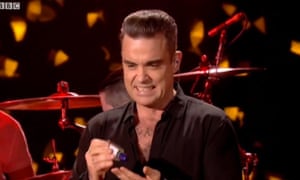


Coming clean: Robbie Williams using hand sanitiser.


Coming clean: Robbie Williams using hand sanitiser. Photograph: BBC

Robbie Williams has responded to the furore over the incident on New Year’s Eve, when, after shaking hands with members of the excited crowd, he was shown squirting sanitiser on to his mitts, his face plastered with the kind of grimace usually reserved for old footage of cow rectal examinations on All Creatures Great and Small.


Williams isn’t a complete PR dolt, so he’s now issued an amusing video of himself using hand sanitiser after he’s touched a family member.


Well played. However, it’s not quite enough to dispel the feeling that as much as celebrities such as Williams say they “love” their fans, it’s nowhere near as much as they love a nice relaxing bath in scalding hot Dettol after they’ve had anything to do with them.


The feeling that this “love” they feel for fans may be a tad selfish and needy, as in, wholly to do with wanting them to continue buying their stuff. And as much as they want to reach out to their public and touch hearts and lives, this doesn’t include any other kind of touching or the little bottle of Carex hand gel is coming out again.


Now, open wide. Then I can tell how rich you are | Barbara Ellen

16 Haziran 2014 Pazartesi

Supreme court situations ahead: cellphones, contraception and world wide web Television

It really is crunch time at the US supreme court, exactly where the justices are racing to situation opinions in far more than a dozen instances above the following two weeks.


On Monday, the court threw out out Argentina’s appeal above 2001 debt default, and revived a challenge by two conservative groups who oppose an Ohio law that punishes knowingly false political statements.


But still to come: the religious rights of firms, the speech rights of abortion protesters and the privacy rights of folks underneath arrest are among the significant problems that are so far unresolved.


Summer season travel, European teaching gigs and relaxation beckon the justices, but only soon after the court hands down selections in all the circumstances it has heard because October.


In unusual instances, the justices will place off decisions and purchase a case to be argued yet again in the next term.


This is also the time of the 12 months when a justice could announce a retirement. But the oldest of the justices, 81-year-outdated Ruth Bader Ginsburg, has signaled she will serve at least one particular much more 12 months, and maybe longer.


The justices will meet again Thursday to situation opinions, and could wind up their perform by the end of the month. Main instances remain that will have key repercussions:


Cellphone searches and arrest privacy


Two instances weigh the power of police to search the cellphones of people they location under arrest without having very first getting a warrant from a judge. The Guardian’s Dan Roberts recorded how justices at occasions struggled to comprehend technological advances. “What is the variation amongst [pictures stored on a smartphone and] hard copy pictures in a billfold?” asked justice Samuel Alito. “I will not see there is much of a difference,” he extra.


Justice Stephen Breyer appeared to bemuse lawyers by referring to the “brzzing” sound of phones and “buzzers” you can push. “[What if] they can just cough and encrypt it?” asked Breyer when discussing why seizing a mobile phone may possibly not be sufficient to prevent evidence tampering.


When one particular lawyer commenced a response by saying “I don’t know what type of smartphone you have, maybe an iPhone,” Breyer responded: “I do not know either due to the fact I can in no way get into it due to the fact of the password.”


Harvard law professor Yochai Benkler argues that justices’ “narrow analogies will systematically fail to protect the values they did 5 or 10 years ago, specifically when we’re walking all around with all the metadata coming out … our pockets.” Privacy advocate Trevor Timm argues the case is “the tip of the iceberg”.


Tv on the Web


Broadcasters are fighting Net startup Aereo’s practice of taking television programming for totally free and providing it to subscribers who can then view on smartphones and other transportable units. Backed by the US government and organizations like the NFL, ABC, CBS, Fox and PBS accuse Aereo of blatant theft. Referring to the company’s organization description, Justice Sonia Sotomayor explained: “I go through it and say: ‘Why are not they a cable company?’” The case has main implications for streaming, cloud-based data storage and on-line programming.


Corporations’ religious rights and contraceptives


Companies are claiming the right to workout religious objections to covering women’s contraceptives beneath their employee well being insurance strategies, regardless of the new well being law’s necessity that birth handle be between a range of no-price preventive companies integrated in wellness plans. Reduce courts have been split on an issue “central to the situation, [of] regardless of whether for-revenue companies have a right to exercising religious freedoms beneath both the first amendment’s totally free physical exercise clause, or under a federal law, the Religious Freedom Restoration Act, the Guardian’s Karen McVeigh notes.


Abortion clinic buffer zones


Abortion opponents are challenging as a violation of their speech rights a Massachusetts law mandating a 35-foot protest-free of charge zone on public sidewalks outdoors abortion clinics. In 2000, court upheld a buffer zone decision in Colorado, but this case hinges on the justices’ balance of “free of charge speech rights versus the state’s duty to protest public safety against many years of intimidation and harassment from protesters”.


Recess presidential appointments


A federal appeals court explained President Barack Obama misused the Constitution’s recess power when he temporarily filled positions on the Nationwide Labor Relations Board in 2012. The Guardian mentioned that “most of the 9 supreme court justices who heard argument in a test situation on Monday appeared to take a dim view of the government’s position.” Justice Elena Kagan said: “This is not the horse and buggy era. There is no this kind of factor as congressional absence right here. What we are dealing with [the recess electrical power] is a historical relic.”


Greenhouse gases


Industry groups and 13 states, like Texas, assert that environmental regulators overstepped their bounds by striving to apply a provision of the Clean Air Act to control emissions of greenhouse gases from electrical power plants and factories. This case is unlikely to impact the current proposal from the Environmental Protection Agency to slash carbon dioxide emissions from energy plants by practically one-third by 2030 that program involves a distinct component of the identical law. Key justice Anthony Kennedy appeared to lean toward government’s situation, and the justices as a group did not appear inclined to hear disputes of climate science.


Union fees


Property healthcare workers in Illinois want the court to rule that public sector unions can’t acquire charges from workers who object to currently being affiliated with a union.


Securities fraud


Investors could find it harder to carry class-action lawsuits more than securities fraud at publicly traded companies in a case involving Halliburton Co, a provider of power, oil and infrastructure companies.


Supreme court situations ahead: cellphones, contraception and world wide web Television

9 Haziran 2014 Pazartesi

Wide Range In Cancer Danger From Radiation In Children Undergoing Heart Surgical procedure

Kids with heart ailment are at elevated danger for establishing cancer later on in life due to their exposure to radiation for the duration of imaging procedures. Since an ever-increasing amount of young children with heart ailment now reach adulthood, this may possibly turn into an more and more essential public well being problem.


A new study published in Circulation offers some reassurance in locating that for most youngsters the elevated danger is lower or negligible. But for some youngsters who undergo far more complicated procedures, the increased chance is substantial.


Jason Johnson and colleagues calculated the radiation dose received by 337 kids who underwent 1 of seven cardiac surgical treatment procedures at Duke University. The median quantity of radiation-producing imaging procedures obtained by the children was 17. The median cumulative powerful dose was two.7 mSv, much less than the yearly background exposure of three.0–3.5 mSv in the U.S.


There was a broad variation in radiation publicity. For five of the seven procedures (atrial septal defect, ventricular septal defect, arterial switch operation, tetralogy of Fallot, and atrioventricular canal defect), the median yearly dose ranged from .9 to . 29 mSv, which the authors stated was “reassuringly minimal.” But children who underwent the most complex operations obtained a lot greater amounts of radiation: the median dose was twenty.08 mSv for youngsters who underwent the Norwood operation and 42.54 for people who underwent cardiac transplantation.


Even though cardiac catheterization represented only a small percentage (1.five%) of all imaging procedures, it was responsible for a majority (60%) of the complete radiation exposure.


The lifetime attributable chance for cancer due to radiation was little for the less complex procedures, ranging from a median of six-twenty instances per a hundred,000 exposed. But the danger was much far more elevated for the Norwood procedure (799 instances per one hundred,000) and cardiac transplantation (1677 per a hundred,000). Since of the anticipated affect of radiation on breast and thyroid cancer, women had a considerably higher boost in danger than boys.


The authors create that their findings can be used in clinical practice: “To decrease lengthy-phrase cancer danger, companies ought to target reducing radiation publicity in the highest-risk cohorts, like individuals young children who will call for repetitive large-exposure imaging and females simply because of their improved cancer danger. Companies can think about our relative exposure estimates when picking among numerous radiation-generating imaging modalities.”


Wide Range In Cancer Danger From Radiation In Children Undergoing Heart Surgical procedure

26 Mart 2014 Çarşamba

4 Techniques The World wide web Of Things Is Transforming Healthcare

By Laura Hamilton


Startups and established businesses alike are producing a slew of new “Internet of Things” (IOT) resources and units that are revolutionizing the healthcare market. The Net of Items refers to bodily units, such as a Nest thermostat or Fitbit exercise tracker, that connect to the web and download/upload information. According to Gartner, there will be nearly 26 billion gadgets on the Net of Things by 2020.


Healthtech startups and established organizations are developing a slew of higher-tech, lifesaving IOT equipment and gadgets. Here are 4 of the coolest new IOT devices.


#one – Infant Monitors


Dulcie Madden of Mimo produced an infant monitor that sends dad and mom genuine-time information on their baby’s breathing, skin temperature, sleeping place, and action level. Mimo sends baby’s sleep information straight to her parents’ smartphones.


#2 – Diapers


Jennie Rubinshteyn of Pixie Scientific has designed sensible diapers that analyze patients’ urine to verify hydration levels and identify signs of urinary tract infections (UTIs). The diaper information is then instantly sent to a caregiver’s smartphone after he scans a QR code on the front of the diaper. The team has produced sensible diapers for infants as nicely as elderly individuals with memory reduction.


#3 – Insulin Injection Trackers


A Swiss organization named Vigilant has created a wise insulin injection tracker to support diabetic patients deal with their wellness. The injection tracker, known as Bee+, is an electronic cap that fits most insulin pens on the market place. It wirelessly transmits a diabetic’s insulin injection data to a smartphone app.


#four – Prescription Capsules


Even prescription drugs have joined the Web of Items. Proteus Digital Well being has designed an ingestible sensor—part of the pill you swallow every single day—that tracks whether or not a patient is taking his medication on routine. When the pill reaches the patient’s abdomen and is exposed to stomach fluid, it sends a signal by way of the user’s personal physique tissue to a patch on the patient’s skin. The patch then relays its data to a smartphone, exactly where it can then be shared with caregivers and physicians.


Laura Hamilton is the CEO and Founder of Additive Analytics. She blogs regularly at lauradhamilton.com.


4 Techniques The World wide web Of Things Is Transforming Healthcare

20 Mart 2014 Perşembe

Is the world wide web harming health care study?

While the movie Dallas Buyers Club may not have been entirely factually exact, it raises an fascinating question about healthcare investigation. The movie depicts experimental trials for AIDs treatment options in the USA in the 1980s, and how a group of sufferers concerned in the trials came collectively to share their experiences about treatments, side effects and the like, eventually smuggling the experimental medication in to the US and marketing them to fellow AIDS sufferers.


Leap forward to the present, and in this on the web age it is never ever been less difficult for sufferers to look for out each other and talk about the minutiae of their symptoms and therapy.


An viewpoint piece in Nature Magazine lately referred to as for researchers to contemplate participants’ use of social media, as it might compromise the integrity of clinical trials. Nonetheless, it also pointed out the potential positive aspects of social media to researchers (and patients) as effectively.


If you discover yourself diagnosed with an sickness, it’s a organic response to want to seek out as significantly information as feasible about it. And of program, we turn to the world wide web to find it. But beyond that, patient self-support groups can be extremely valuable in stopping a individual feeling like they’re on their very own assistance from somebody who fully understands how you’re feeling can make a huge difference. The world wide web has made this kind of peer support less difficult, even for groups who can’t meet up in man or woman (sufferers of Cystic Fibrosis for illustration run the chance of cross-infections if they meet in individual).


There are a variety of causes, however, that individuals in clinical trials may possibly danger undermining the trial if they examine their experiences with every other. And what’s more, they may not even realise they are performing so. Clinical trials are doubled blinded wherever attainable, meaning the two the researcher and the participant don’t know regardless of whether the participant is in the experimental or manage situation. The randomisation will be set up by someone other than the researcher who interacts with the patient, so they will give a pot of drugs (or yet another treatment method) to the participant, with no being aware of regardless of whether these are sugar drugs, or the medicine currently being investigated.


There is plenty of proof why this is crucial. If the individuals administering the trial know who is in what situation, they may, consciously or unconsciously, deal with individuals differently. This could involve seeing improvements much more in the group you are expecting to increase much more, or downplaying side results.


But participants speaking to each and every other about their experiences inside a trial may accidentally unblind them as properly. Hearing about other participants’ side effects might make a man or woman much more likely to report such issues themselves. It might also become clear following speaking to other participants in a examine no matter whether you are in the treatment method or placebo group, which may possibly affect how you report your signs following time you communicate to the review organisers, with no you even realising.


Just before these digitally connected days, trials could operate out of a selection of different areas, minimising this bleed from participants. Today, when sufferers can talk about their experiences digitally, bodily distance is no longer a barrier.


It is unlikely that participants are deliberately sabotaging the trials they are involved in. Following all, they have signed up to be in the trial in the first place. The Nature editorial is clear in suggesting researchers want to actively contemplate this issue, and go over with participants the prospective harm to the study from sharing data about symptoms and side effects.


All this is not to say that the web shouldn’t be utilised by those in search of comfort and solidarity from people in the same predicament as them. In reality, there is evidence to recommend that on the web assistance groups of this type may supply wellness rewards as effectively as reassurance.


The internet is not going anywhere, and individuals should do what ever they feel will aid them come to terms with a diagnosis and comprehend their illness. But as the Nature piece concludes, it is anything researchers want to consider. What is the effect of social media on the biases in trials, and can individuals in trials be encouraged to keep away from accidentally un-blinding themselves with out forcing them to give up these valuable help networks?


Is the world wide web harming health care study?

19 Ocak 2014 Pazar

Depressed patients turn to the world wide web for "Skypotherapy"


The therapist’s couch has long been a staple of books and motion pictures, a location in which unpleasant truths are exposed and neuroses untangled. But, practically unnoticed, the delivery of psychological assistance is being transformed – by the net.


If you need NHS aid for typical problems such as anxiousness or mild depression, you will not automatically meet your therapist face-to-encounter. You could be at residence or even by the pool, typing your emotional strategies into a focused instantaneous messaging support. You may well be following a personal computer system that takes you step by stage by way of a CBT (cognitive behavioural treatment) programme, or possessing a digital face-to-encounter on Skype.


“The positive aspects of on the internet therapy are substantial,” says Joanna Bawa, a CBT practitioner with the NHS in Hereford. “Going into the cloud abolishes geography. You can be at home in Brighton and your therapist can be in Bradford.” Timing can be a lot more versatile, as well, she adds. “No a lot more having to miss function, or pay a babysitter, or invest half an hour travelling each and every way.”


The anonymity is especially eye-catching to men, who, says Bawa, “are more probably to go for therapy if they can confess to feelings of weakness and inadequacy with no getting recognised”.


But does net therapy – or “Skypotherapy”, as it has been termed – perform? Surely there is some thing special about the intimacy of the consulting room? “That’s what several of the much more classic therapists believed,” says Nadine Discipline, a qualified therapist who set up PsychologyOnline.co.uk several many years ago. The business, which now has a lot more than one hundred accredited CBT therapists on its books, many of whom operate for the NHS, uses an quick messaging system which can be accessed 24 hours a day.


“We locate folks become disinhibited considerably more rapidly,” she says. “Messaging is like creating in a diary just for you. The therapist’s comments pop up but you needn’t fret about what they think of you. And patients get a print-out of their conversation which helps them don’t forget and learn from the insights.”


A controlled trial of 300 depressed sufferers published in The Lancet in 2009 discovered that CBT via quick messaging aided far more of them get greater than standard GP care while a little study from Zurich, published final yr, showed the benefits of online treatment for depressed individuals could last longer than face-to-face time.


The delivery program closest to classic treatment is Skype, which offers net versatility and the extra visual element. The principal provider of a single-to-one particular consultations more than the world wide web is mootu.com, with 160 therapists, all members of BACT (the British Association of Counsellors and Therapists). It is a bit like a dating site, in that you can view a brief video of every therapist describing their method just before you commit. As John Witney, the site’s founder, says: “This gives you the best chance of obtaining one that feels correct for you.”


If you’re taking into consideration private e-therapy, it is essential to check out a site’s credentials and also to guarantee your privacy is protected.


Researchers at the University of Berne reported that a comparison of 7 therapies, such as psychodynamic treatment (which focuses on unconscious believed processes) and social skills education were discovered to be equally successful no matter whether delivered through the net or encounter-to-encounter.


When it comes to therapy, it looks, the medium isn’t the message.


psychologyonline.co.uk


Depressed patients turn to the world wide web for "Skypotherapy"