Anonymous I am once again in the mental health treatment sausage machine. Plucking up courage to approach a GP to admit defeat, being shoved on drugs to stop me topping myself, told that there’s a huge, long waiting list for treatment, the false hope of a “gateway worker” assessment followed by another interminable wait of undefined length. Then I know I will have my allocated batch of treatment before being deemed “fixed” and dispatched back to the world again. I am sick and tired of the roundabout. I suggested that instead of this system, once a mental health patient has had their allocation of therapy, they should remain on the books, so when they feel themselves slipping back down, they can call up for a booster session instead of having to go through the whole rigmarole again.
I’ve just quit my job of six years because, following a disclosure to my new boss that I have bipolar tendencies she proceeded to bully me into submission. She had absolutely no understanding of how to get the best out of (a very talented) employee who has mental health issues. I was stopped from working at home, an important aspect to being able to manage my condition. I had unreasonable targets imposed, with no support offered to go about achieving them. My job was chopped and changed, hours cut and autonomy removed. I have been pushed back to the brink of suicide and had to go on antidepressants to simply survive.
Anonymous From September 2015 until December 2016, while I waited for an NHS referral, I was so ill I didn’t know how to cope and resorted to self harming. These aren’t all of my scars, but they’re the ones no one ever sees; so it’s easy to think they’re not there. One year of my life, and I will have to be reminded of it forever.
Cat, 24, South Yorkshire People often mistake bipolar disorder as your mood rapidly changing from up to down. It’s not like that. That would be my other illness, borderline personality disorder (BPD) or as my psychiatrist put it, emotionally unstable personality disorder. It’s complicated telling people you have both bipolar disorder and BPD, as they both involve intense mood swings. Well, that’s when I do tell people – social anxiety sort of puts a brick wall between me and people. BPD makes your mood change within seconds and it is a strong mood swing. Like fire, it can destroy you and those around you. With bipolar, the mood swing sort of creeps up on you. It’s when the mood gets high (mania) or low (depression) that it becomes destructive.
Every day it feels like I must wear a mask, however, hiding never did me any good with these illnesses. It just becomes more of a shock to those around you when the symptoms start to leak through. Even as I write this, it’s hard to concentrate, thoughts and emotions are saying one thing, while that one bit of mind that tells you “everything will be ok”, is telling me to push on.
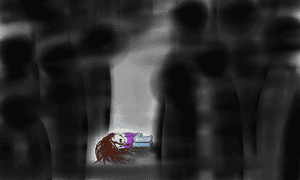
The rendition of a darker moment. A painting of a depression experience by Cat, South Yorkshire
I’ll admit when I’ve been at my lowest I’ve done things I’ve regretted. The overdose, which sent me into hospital, was one of the things. I know there’s a stigma around psychiatric hospitals, but I did meet people who it’s worked for. When I was admitted into hospital the first time, I had psychosis – a female voice was constantly screaming in pain in my head. I don’t even bother to count how many times a year I have to go through this. Medication helps keep me in some control, especially with the manic side. I prefer the manic side to the depression side. Mania brings with it the thought that you’re this amazing person, who can do anything, someone who deserves to be with people. The bad side of mania is that loss of control. Nights become sleepless and the thoughts running through your head won’t stop. Every time you try to grab one, it just slips through your fingers. Health and safety also goes out the window.
I managed to get through my art degree. I have to remind myself that I’m more than my diagnosis, but with the right help and support it does become a lot easier.
In the UK, the Samaritans can be contacted on 116 123. In the US, the National Suicide Prevention Hotline is 1-800-273-8255. In Australia, the crisis support service Lifeline is on 13 11 14.
Sesame Street is adding a new character to its ranks – a muppet called Julia, who has autism.
Julia, a four-year-old with bright orange hair, a pink dress and a favorite toy rabbit called Fluffster, will make her debut on 10 April in an episode called “Meet Julia”. She has already appeared in Sesame Street cartoons and books, but this will be her first appearance on the famous children’s show.
“We wanted to address autism in general because of the growing number of children who are diagnosed with autism spectrum disorder,” Sherrie Westin, EVP of global social impact and philanthropy at Sesame Workshop, the non-profit behind Sesame Street, told the Guardian.
“We felt that creating a character who was autistic would allow children to identify her but equally important, it would allow us to model for all children the differences and commonalities of a child with autism.
“It was an opportunity to help explain autism and to help increase awareness and understanding.”
On Monday, Sesame Street released a number of video clips featuring Julia. One shows her sitting at a table, painting with some of the other characters. Big Bird arrives and says hello to Julia, who carries on with her work rather than saying hello back.
Big Bird and Sesame Street stalwart Elmo appeared on CBS’s 60 minutes on 17 March, to talk with host Lesley Stahl. Big Bird told Stahl he had initially been perturbed by Julia’s lack of response.
“I thought that maybe she didn’t like me,” Big Bird said.
“We had to explain to Big Bird that Julia likes Big Bird,” Elmo said. “It’s just that Julia has autism. So sometimes it takes her a little longer to do things.”
[embedded content]
Sesame Street introduces Julia to the Associated Press.
Later in the episode – according to a clip seen by the Associated Press – Julia becomes distressed when a siren goes off.
“She needs to take a break,” the muppets’ human friend Alan calmly explains. Julia soon relaxes and the friends carry on playing.
Another video shows Elmo approaching Julia, who is playing with Fluffster on her own. Elmo sees that Julia is focused on her own activity and says: “We can play side by side, like we do sometimes.”
“There’s lots of ways to play,” Elmo tells the camera.
Julia’s introduction is part of an initiative: “Sesame Street and Autism: See Amazing in all Children”. Sesame Workshop said it consulted with more than 250 organizations and experts over a five-year period, ahead of unveiling the character.
Julia is played by puppeteer Stacey Gordon, who told the Associated Press her 13-year-old son also has autism.
“The ‘Meet Julia’ episode is something that I wish my son’s friends had been able to see when they were small,” Gordon said. “I remember him having meltdowns and his classmates not understanding how to react.”
It was in November 28 years ago when I saw a psychiatrist for the first time. I was 17. The school year was just finishing and I lived in Córdoba, Argentina, with my father and siblings. I had the same friends from kindergarten to high school. I knew their families, they knew mine; all of them had come to visit when my mother died, all of them were there when I held a party and kissed my first boy. All of them believed that I was crazy. After the first meeting with the psychiatrist, she prescribed me anti-psychotic medication – I was officially crazy.
But the doctors had other words for it: I had a gender identity disorder, that is to say, a serious mental health disorder.
I had been assigned female at birth but identified as a guy. Even worse, I identified as a guy sexually attracted to other guys. For the psychiatrist, my father and for many people around me, it was a disorder. For me, it was what it is today: just the person I am.
People like me, who identify as a different gender from the sex assigned to them at birth, have been historically pathologised, classified as people with mental disorders. In 1990 the World Health Organisation (WHO) started using the 10th version of the International Classification of Diseases (ICD), which include so-called “Gender Identity Disorders” in its chapter five on Mental and Behavioural Disorders.
Almost two decades later, the WHO is performing a comprehensive ICD revision, and a new version (ICD-11) is expected to be approved by the World Health Assembly in 2018.
Many trans activists from all over the world have been monitoring the ICD revision and reform process since the beginning – as we did around the reform of the Diagnostics and Statistical Manual on Mental Disorders, produced by the American Psychiatric Association. For us, the ICD process represents a historic opportunity to achieve trans depathologisation while ensuring full access to fundamental rights: legal gender recognition, access to gender affirming healthcare, and coverage under public and private healthcare systems.
To treat trans people as psychologically abnormal suggests that just being ourselves is a disorder. In many countries it also means that someone else – a psychiatrist, a psychologist, a therapist – needs to provide a specific diagnosis for us to have access to those key but basic rights: identity, freedom of expression, bodily integrity, autonomy and healthcare.
Currently, trans people rely on someone else’s authority to be recognised by the state with our name and gender, and to take informed decisions about our own bodies. This means that we are subjected to human rights violations, justified by the legal interpretation of those diagnostic categories pathologizing us, including those of gender identity disorder, gender dysphoria and transsexualism.
Different countries require trans people to be sterilised to apply for legal gender recognition, including 23 countries in Europe, while 22 European countries require trans people to divorce. In many places trans people, including children and teenagers, are subjected to “conversion” therapies – pseudo-scientific therapies to change their gender identity and gender expression.
Others, like me when I was a teenager, get treated with anxiety and anti-psychotic medication.
Despite these human rights violations, and the damaging ICD classification, the number of countries that respect trans people’s rights is growing. My own country, Argentina, is the first – and, so far, the only one – to grant access to legal gender recognition, gender-affirming healthcare and its coverage based on the human right to identity. Other countries, such as Malta, Mexico, the Netherlands, Bolivia, Sweden, Norway and Denmark are making advances in getting rid of requirements incompatible with human rights standards – to recognise trans people’s human rights.
Last year, Denmark announced it would no longer define being transgender as a mental illness, making it the first country to do so; and this year Sweden said it would do the same. A 2016 study found transgender identity should no longer be classified as a mental disorder, citing that the distress experienced by trans people was primarily a result of social rejection and violence, not the result of being transgender.
The world is undoubtedly changing. And how diseases are classified in changing as well.
In 2012 WHO announced the intention of removing all trans-related diagnoses from the chapter on mental health in ICD-11 – and to include a new category, called Gender Incongruence, in a different, non pathologising, chapter.
The proposed category will be divided into Gender Incongruence of Adolescence and Adulthood (GIAA) and Gender Incongruence of Childhood (GIC). GIAA is being critically accepted by many of the trans community as a far from perfect compromise to depathologise trans while ensuring access to fundamental rights.
Conversely, GIC is strongly rejected. Being a diagnosis to be only applied to children before puberty, it pathologises gender diversity in childhood. Trans and gender diverse children, and all children exploring their gender identity and expression as well as their sexualities, need love, acceptance, information and support – and no diagnosis is necessary to meet those needs. Access to hormonal blockers in puberty must be granted without depending on pathologising children because of who they are.
The completion of the ICD process in 2018 will hopefully bring good news for trans people around the world – but even the best possible ICD-11 version won’t be enough to change everything by itself. Legal pathologisation needs to continue to advance, to transform the rights landscape we are surviving in for good. Trans access to healthcare (including general healthcare) still needs to become a reality in too many places. And there is something else: achieving depathologisation will also open the way to justice. By struggling to put an end to human rights violations grounded on pathologisation, we are craving the time and place to talk about their victims’ human right to adequate reparations.
Mauro Cabral Grinspan is the executive director of Global Action for Trans Equality.
From 20–25 February the Guardian Global Development Professionals Network is highlighting the work of the LGBT rights activists throughout the world with our LGBT change series. Nominate LGBT heroes here, join the conversation at #LGBTChange and email globaldevpros@theguardian.com to pitch an idea.
Join our community of development professionals and humanitarians. Follow @GuardianGDP on Twitter.
As the cookie crumbles in my mouth, delivering a shot of much-needed sugar, a sudden urge flashes across my mind. I am tempted to grab another, and another, before dashing to the loo to purge. Stilling myself, I engage rationally with my feelings and manage to move on without giving in.
I’m not always so successful.
As a mother of five, and at 38 years of age, I’m under no illusions: I know I’m never going to be strutting down the catwalk; time has taken its toll on my once toned body and I’ve been through four stressful pregnancies. I want to be healthy, not excessively thin. But my anorexic and bulimic urges have always been more about control than any misguided notions of vanity.
That’s why I was unsurprised to read that recent research by UCL revealed that around 3% of women in their 40s and 50s have suffered from an eating problem in recent years. The number, which equates to tens of thousands, is probably just the tip of the iceberg – many sufferers, like myself, do not seek help when they experience problems. Instead, I have learned over the years, that I have to forgive myself when I slip up, pick myself up and focus on something else until the feeling passes.
My first foray into extreme dieting came at the age of 15 when, over the period of a few months, my weight plummeted from a healthy 55kg (8st 7lb), to just under 38kg (6st). What started as a vague wish to compete with my skinnier friend became an obsession that led to me skipping breakfast and lunch, and throwing most of my dinner into the bin.
I have come to believe that eating disorders, like a virus, lie dormant in our system, waiting to strike
Although I was initially motivated by the desire to be thin, looking back I can see that there was more to my illness than simple vanity. A combination of GCSEs, financial worries and feelings of inadequacy led me to focus on the one thing I felt I could control. And once on that path, the feeling of triumph I experienced every time the scales revealed weight loss was addictive in itself.
Despite the fact that I believed I’d beaten my anorexia back in the 1990s, it has resurfaced in various guises throughout my life: at university in my early 20s as an obsession with exercise; as bulimia in my mid-20s when I struggled with the stress of my first teaching post; even in my 30s, when adjusting to the demands of motherhood, I had to fight against the desire to make myself sick.
Since my original bout of anorexia, I’ve never weighed less than 44kg (7st). Something – my long-suffering husband, the thought of my children, or the realisation that I am hurting myself – always drags me back from the brink. The thought of passing on any tendencies to my children also plays on my mind, and I make sure I eat a healthy diet and encourage them to do the same.
But I’ve come to believe that eating disorders can never truly be cured; instead, like a virus, they lie dormant in our system, waiting for the right moment to strike. For me, the urge to diet excessively or – more commonly now – to binge and purge, comes when I’m moving house, am overworked or stressed. The disease is not a silly childhood blip that I can grow out of, but something that I will struggle to keep at bay throughout my life. Like an alcoholic, I am “on the wagon”, never free.
For women like me, the perception that anorexia is a disease of the young and is linked to narcissism is damaging. It’s embarrassing to admit, when teetering on the brink of your fourth decade, that you’ve just gorged on chocolate and found yourself hunched over the toilet bowl. But it shouldn’t be. Eating disorders are a mental illness; and while they may start with a wish to have the perfect body, the pattern of damaging behaviour that emerges is akin to a drug addiction.
The knowledge that disorders can flare up repeatedly throughout life, or even appear for the first time at middle age, should not lead us to despair, but give us greater understanding of what drives the anorexic brain and how sufferers can be helped. Eating disorders are often hidden, only noticed when a sufferer displays obvious physical signs; this is something acknowledged by the report’s lead author, Dr Nadia Micali, who noted that many of the women questioned told her that this was the first time they had ever spoken about their eating difficulties.
But bringing them out into the light, admitting that we have suffered or are suffering, is one of the keys to addressing the problem. Removing the stigma and challenging the assumptions that persist about eating disorders is the route to greater understanding and better health for those of us who struggle.
Have you been following the World Series this year?
Cleveland’s Mike Napoli never had a good night’s sleep and could not recall the last time he dreamed. Doctors broke his jaw to reposition it, so he could breathe.
This is just one example of what causes sleep apnea.
Sleep apnea occurs when people’s ways to get air are cut off while they sleep and it affects more people than you may imagine.
It has been thought to be a hereditary sleeping issue, meaning that it can be passed down from person to person. However it can also be caused by lifestyle choices, obesity and general unhealthiness.
It causes them to suffer oxygen deprivation, snore, and sleep in fits and starts. Most people just think of the overweight, barrel-chested middle-aged man when they think of sleep apnea. Yet, airways may be cut off for many reasons.
A big soft palate or a long uvula (that flap in everyone’s throat) may shut off the airway. Nostrils may be too narrow where air is supposed to enter the body.
Blame a deviated septum for that.
In most cases, people can either breathe through their nose or throat, so they are able to compensate. It means they continue with breathing struggles.
The issue is that because people can compensate they assume there is no problem. They could die because of this wrong assumption.
Playing Russian Roulette
Sleep apnea is like Russian roulette.
Add in a stuffy nose, sore throat, and the person with excess skin sagging into their throat has no way to breathe.
They may normally snore loudly, like a chainsaw, whose loud rhythm is normally interrupted by a cough, or a sniffle for air.
A head cold means all of their ways to get air are cut off and they die. Their heart cannot get sufficient oxygen, causing a heart attack.
There are many causes of apnea and many ways to solve the problem. Some are surgical, and some involve a machine to force air into the body, through a CPAP (Continuous positive airway pressure) machine.
6 Natural Methods to Alleviate This Disorder
There are many natural methods to help sleep apnea, but as with most things, some are better than others.
Now I want to make it clear here, that although these methods are very good at helping, you should visit your doctor before starting any method and also to get a fuller overview about how serious your sleep apnea really is.
Lose Weight
It is no coincidence that a great many sleep apnea sufferers also happen to be overweight. It is also no coincidence that many of those who lose weight discover that their symptoms disappear over time.
One study found that 20% of those involved in the study found an almost immediate cure with an intensive weight loss routine.
Change The Position You Sleep
This is a nice simple one that you might find has an immediate effect.
Lying on your back causes all of your throat muscles and tongue to move towards the back of your throat, thereby closing up your airways.
By giving side sleeping a go, you could reduce potential apnea episodes and help you to sleep more deeply whilst getting enough oxygen.
Increase Your Vitamins Intake
More specifically vitamin D and vitamin C.
Research has found a correlation between sleep apnea and Vitamin D deficiency. Whilst not a cure in of itself, it is a simple fix and one that can have quantitative benefits.
The vitamin C connection is more to do with fixing some of the damage that apnea might cause through helping to repair damaged cells.
Magnesium
This particular mineral is vital with muscle function so it is worthwhile to ensure that you get enough in your diet. If your throat muscles are working optimally, they are in a better position to stay strong.
Consider Herbal Remedies
Certain herbs such as lavender,can help to reduce sleep apnea symptoms. AGain this is not to be taken as a cure, but rather to help to reduce any adverse effects.
Serotonin Precursor 5-HTP
A serotonin precursor named 5-HTP, could be used for sleep apnea sufferers. This is because decreased serotonin levels have been shown to be a direct cause, therefore increasing this hormone might just do wonders.
So there you have it.
A very underestimated sleeping disorder that may not sound like a dangerous sleep issue, but it certainly is and one that anyone might think they have it should immediately visit a doctor.
I loved the army. It gave me a structure and a sense of camaraderie I will never forget. I could just about deal with the racial abuse I experienced at the beginning of my army career and I came to see it as family. But I wasn’t prepared for the impact those years of service would have on the rest of my life.
I served in Northern Ireland and Cyprus. Army life gave me a structure that I think I took for granted at the time and when I left the army I struggled. I don’t know why, but I know what it felt like – I was like a boat without a sail or a rudder. People talk about the transition from the armed forces to civvy street as if it is always a really smooth process but that’s not true for everyone. It wasn’t for me.
I spent some time in Germany. When I returned to England I felt completely lost, like I had no future. I tried a few different jobs but I struggled to adapt. I now know that I was trying to live a “normal” life while dealing with post-traumatic stress disorder.
The memories and flashbacks kept coming. My behaviour became erratic. Keeping work going was a struggle. I fell out with my wife. Then everything collapsed. I was homeless, camping down in the bin areas of blocks of flats. Getting by on people’s leftovers. Hanging round market stalls for the throwaways at the end of the day. My behaviour was getting more and more out of control and I ended up being sectioned.
I look at myself now, serving customers at the Veterans’ Kitchen, running a social enterprise – and I have to pinch myself. When I was homeless I didn’t trust anyone, let alone be able to serve them jerk chicken.
Initially, it was the charity Combat Stress that helped me out and put me in touch with Stoll, a charity with a few hundred homes for veterans. Stoll provided me with a flat in west London and made sure I had the support I needed at the time to get back on my feet. I now have a place I can call home; I have my sail and rudder back and a life to look forward to.
I am one of the lucky ones. I trained up as a chef at the Veterans’ Kitchen and when Bob, the previous owner, retired he passed the business on to me. I now run the Veterans’ Kitchen, next door to Chelsea Football Club. Having a stable home and being able to run our little cafe for veterans and the local community has helped me get back on track.
One of the hardest things for us military people to do is to ask for help. We are trained to be tough and independent. But my advice to anyone coming out of the armed forces is always ask for help.
This year’s theme for World Mental Health Day on 10 October 2016 is psychological first aid and the support people can provide to those in distress.
Talk to us on Twitter via @Guardianpublic and sign up for your free weekly Guardian Public Leaders newsletter with news and analysis sent direct to you every Thursday.
I found out my mum was dying four days before she passed away, and she wasn’t even the one who told me, it was my godfather. I had known she was unwell for some time, but her death still came as a shock. The last couple of days were very painful.
My issues with food started before her cancer diagnosis. At 12, I started to think I was fat. I have always been insecure about the way I look, so I went on a diet and it spiralled out of control. When I found out my mum was ill, everything got worse. I was eventually referred to children’s mental health services because I was so unwell. My life was so out of control that food, the one thing I thought I could control, became my obsession.
By the time my mum passed away, two years later, I was managing my eating disorder but not fully recovered. I was still very controlling about what I ate and worried about putting on weight. My family situation was getting more complicated: I had a difficult relationship with my dad and my grandfather suffered from Alzheimer’s, so I ended up in foster care.
The next few years involved seeing various therapists and moving to different foster families. At 16, when I was sitting my GCSEs I reached my lowest point. As I was walking in to take one of my exams I felt exhausted, cold and tired. My anorexia was the worst it had ever been and I didn’t want to be alive anymore. My latest foster placement wasn’t working out. I felt lost and alone, walking around in a blur. Shortly after this, I was sectioned. Those around me were worried I might kill myself. I ended up being taken into hospital to be looked after.
Sometimes in life you just crack, you cannot really explain it. I cracked and thought, “I cannot do this anymore.” I didn’t know who I was or what I was doing and I was still struggling to come to terms with my mum’s death.
It feels strange to look back at this time because now – as a 20-year-old woman – I am well on the path to recovery. Today, I am happy, with an amazing foster mother and about to embark on a trip to India to learn yoga. I’ve turned my life around, although it hasn’t been easy.
My journey to recovery was not plain sailing. I spent a year in a hospital ward, and it got to the point where I was afraid to leave, because being in hospital changed me. The thought of having to stay overnight in a hospital now terrifies me, but there was a point where, for me, it was the norm.
It was while I was in hospital, aged 16, that I met the woman who changed my life: my foster mum. She gave me hope and made me feel loved. At first, I was cautious because of past relationships, but gradually she helped lift me out of my depression and offered me a new life with her.
I remember we had this really awkward tour around the unit when she first arrived and the nurses were like, “It’s so nice to meet you.” The moment I thought she might be the right person for me was when I was flicking through this Cath Kidston magazine and saw a bag I wanted. The next day she bought it for me and I was so surprised. I suddenly felt that someone had noticed me.
The turning point that finally got me out of hospital was when I wanted to go to a vegan Buddhist camp with her and her family. Me and my foster mum are both very stubborn and we were like, “Let’s do this.” I got discharged three days before the holiday and never went back. It was a lightbulb moment, and I didn’t want to fall further behind in school. After this, I joined college and started my new life in London.
My foster mum is so supportive. She used to sit with me all the time when I ate, even if I took an hour to get through a single yoghurt. She was patient and kind. She never seemed annoyed at me and took me on at difficult time in my life. She also gave me the best advice, telling me that everything passes and a lot of the time we feel bad but then that goes, life is about change and nothing lasts for ever.
She made me realise that people are scared of change because it feels wrong, but if recovery feels wrong then that’s exciting. It’s hard being ill but it’s also hard taking those first steps to recovery, although it’s so worth it.
Having an eating disorder is like being stuck in a box and you know others have left the box before, but you’re not sure how you are going to do it. You hate being in the box, but the outside world also seems scary, so you are sat there looking out through the keyhole thinking, “How do I get out?” I was feeling very suicidal, which was part of the reason why I didn’t eat. My depression led to my anorexia, which was never really about the food at all.
I believe everyone can get through an eating disorder. My experiences have taught me to be more comfortable about being vulnerable. Strength is accepting we are human and bad times and good times all pass. Life has its ups and downs but you must be brave enough to keep going. Real strength is admitting you are vulnerable, and, if you need help, please go and get it.
The Beat youthline can help young people experiencing an eating disorder: 0345 634 7650. In the UK, the Samaritans can be contacted on 116 123. In the US, the National Suicide Prevention Hotline is 1-800-273-8255. In Australia, the crisis support service Lifeline is on 13 11 14. Hotlines in other countries can be found here
If you want your child to be a healthy weight, don’t use the D word. Talking about diets or even weight is bad for all adolescents, the American Academy of Pediatrics said this week. The academy’s latest guidelines aim to prevent not only eating disorders but also obesity. They are particularly aimed at preventing teenagers who are trying to lose weight from tipping into eating disorders such as anorexia nervosa. Neville Golden, professor of pediatrics at Stanford University Medical School and lead author of the guidelines, said that 40% of those admitted for eating disorders are dieters who got out of control. “Scientific evidence increasingly shows that, for teenagers, dieting is bad news,” he said.
Teenagers in the US who diet in ninth grade (around 15 years of age) are three times more likely than non-dieters to be overweight by 12th grade. But dieting is also the most important predictor for developing an eating disorder. Hence the academy’s new one-size-fits-all guidelines. Wellness is the word preferred to weight. But wellness needs to be managed, too. Eating disorders can start with teenagers wanting to eat “healthily” and eliminate “bad” foods. This can slip into skipping meals and severely restricting foods. Likewise, exercise can become compulsive – especially after people praise teenagers for losing weight.
So what can you do to reduce the risk of eating disorders? A Guardian reader criticised a piece I wrote earlier this year on children’s weight by saying “this article reads like a list of what not to do, but has very little advice on what to do”. Ouch. So here, thanks to the academy, is that advice.
The solution
Don’t talk about dieting with your child, but go big on healthy eating and more physical activity instead. Do not talk about weight – yours, theirs, anybody’s. Encourage your teenagers to feel positive about their bodies – which is tough when half of teenage girls and a quarter of boys dislike their shape. But adolescents who are encouraged by parents and peers to exercise and eat healthily are happier with their bodies. Family dinners are also protective. A study of more than 13,000 pre-adolescents and adolescents found that having family dinners most days reduced the risk of eating disorders – parents can be role models for healthy eating, monitor their child’s intake and have a chat.
Never tease teenagers about weight. Up to 40% of girls are teased – it doubles the risk of being overweight and increases the risk of unhealthy dieting. Dr Rachel Rodgers, associate professor at the department of applied psychology at Northeastern University in Boston, says families should try to protect teenagers from the emphasis society puts on appearance and weight. It is better to push a “total diet” – eat anything, but in varying quantities. Can these guidelines really prevent eating disorders? At the very least, they won’t encourage them.
Britain’s 650,000 people with bipolar disorder should take lithium to help control their condition, despite its reputation for dulling the senses, a significant new study has found.
Researchers claim that although the drug does carry some health risks, its overall effectiveness, especially its ability to reduce self-harm and suicide, mean it should be much more widely used.
The findings are contained in the first study comparing the side-effects of the four main mood-stabilising drugs the NHS prescribes. They have prompted calls for a rethink about attitudes towards lithium, given that only an estimated 10% of those with bipolar disorder use it, mainly because patients fear it will cause loss of personality, weight gain and other problems.
The lead author behind the research told the Guardian that widespread “lithium stigma” among patients is leading to them receiving the wrong treatment and ending up admitted to hospital unnecessarily because their condition is not as well controlled as it could be.
“Lithium is a drug with a bad reputation. It is seen by patients, and some psychiatrists, as a dangerous drug. People rightly have suspicions about it. Patients say that the downsides include emotional numbing – feeling that you aren’t connected with your feelings – as well as tremors,” said Dr Joseph Hayes, a psychiatrist at University College London.
But lithium’s reputation is largely misplaced and based on the experiences of patients from the 1960s to the 1980s who were given too large a dose of the drug, he added. The new research, published in the medical journal PLOS Medicine, found that the side-effects of the mood-stabilising alternatives used by most patients are either the same as or worse than lithium, Hayes said.
The paper, co-written by Hayes and four colleagues from UCL and Oxford University, concluded that: “Lithium remains an important treatment for individuals with bipolar disorder.” It accepts that “there is clear evidence that its use is associated with a number of adverse events.”
However, it adds: “These risks need to be offset with the potentially superior effectiveness and anti-suicidal benefits of the drug compared to other treatment options.”
The researchers studied a nationally representative sample of 6,671 patients across the UK who were treated for bipolar disorder between 1995 and 2013. Of those, 2,148 had taken lithium, 1,670 had used valproate, 1,477 had been on olanzapine and 1,376 had taken quetiapine. They experienced side-effects including chronic kidney disease, thyroid disease, weight gain and high blood pressure.
The researchers’ analysis bore out one of the two main criticisms of lithium, but found the other to be baseless. They found that patients on lithium had a higher risk of suffering kidney function problems and developing hypothyroidism or hyperthyroidism and also hypercalcemia. However, none of the drugs caused more severe kidney problems.
Meanwhile, lithium patients were less likely to put on weight than patients on the other drugs. While 15%-20% of those on the three other drugs were more likely to gain more than 15% of their body weight, just 10% of those on lithium put on the same amount of extra pounds. Those on olanzapine added the most weight and experienced high blood pressure as a result.
I think many patients are missing out quite commonly on the best available treatment
Separate research has shown that patients on the other three medications are 40% more likely to harm themselves than those on lithium. Bipolar disorder carries one of the highest rates of suicide of any mental illness, alongside schizophrenia and alcohol and drug addiction.
The very limited use of lithium is despite the National Institute for Health and Care Excellence (Nice) advising in 2014 that it should be the standard treatment for bipolar disorder, which is also known as manic depression and is characterised by manic highs and bouts of depression. That superseded its previous view, outlined in 2006, that any of the four drugs were useful first lines of treatment for the condition, which affects about one in 100 people.
“Lithium stigma, which includes some people in the psychiatric community, leads to people using drugs that are less effective [than lithium]. To me as a doctor that’s a big worry because my main aim is to help people to be well and if you aren’t doing that with the best available evidence then you are failing patients,” said Hayes.
“I think that many patients are missing out quite commonly on the best available treatment. That means that people end up in hospital more often than they need to and end up achieving less in their lives than they could do if they were on lithium. The high suicide rate with bipolar disorder should encourage greater use of lithium. There should be more sensible use of it.”
Stephen Buckley, head of information at the charity Mind, said: “We welcome research which adds to our understanding of treatments and medications for people experiencing mental health problems, including bipolar disorder. But as with all areas of mental health there is still more research to be done.
“Different people will find that different treatments help with managing their mental health problems. This may be medication, talking therapies, or a mixture of both.”
Last month, the Guardian Healthcare Professionals Network published an article about the dangers of doctors driving home after working nights. Two in five UK doctors (41%) have fallen asleep at the wheel after a night shift, according to an online survey of 1,135 doctors from Doctors.net.uk.
Within hours of publication, the network was flooded with emails, tweets and comments below the line and on Facebook from various healthcare professionals who wanted to share their thoughts and experiences. Here are some of them:
I crashed my car after a night shift and now have post-traumatic stress disorder
Back in 2005, I was an FY2 doctor in orthopaedics. Like most junior doctors even today, we would do seven night shifts in a row. Sleeping during nights (even if you had a chance) was frowned upon. When I started foundation training, there was a doctors’ office which had a bed but it was removed by the management in front of us. They insisted that junior doctors should never sleep during their night shifts and if they did have a free moment they should be doing discharge summaries etc.
One Wednesday morning after I had worked five, 12-hour night shifts and had two more to go, I managed to get home and caught a few hours’ sleep. I woke up at around 12pm and decided to drive to the shops. Once on the main road, I quickly began to feel very tired and disorientated. I turned around to head home, but at a major roundabout suddenly crashed into a car. I am convinced that more than 60 hours of night work were behind the accident that day and still feel incredibly lucky that I did not kill anyone that day or get killed myself.
The NHS is destroying its staff, sometimes literally by the accidents from driving home so tired.
As a result, I have post-traumatic stress disorder related to driving. I am so terrified of driving post-nights that I only live within walking distance of hospitals and walk home after every shift. I dare not apply for jobs that involve a commute of any kind and hence I am stuck in non-training jobs.
I fully understand that night shifts and night work is an integral part of my job but it does not have to be so hard or so difficult to provide us with on-call rooms or a reduced number of shifts. I will be 37 soon and I am still doing blocks of three or four very intense nights shifts. My body, my spirit and my life are feeling the pain.
Dr Hunniya Waseem, senior clinical fellow, emergency medicine, Bury St Edmunds
Nurses are not allowed to sleep on their breaks – it is a sackable offence
I have fallen asleep at the wheel after working a night shift. I have been a nurse for 10 years and this has happened to me on quite a few occasions.
Nurses are not allowed to sleep on their breaks – it is a sackable offence if they are caught. I spent almost five years working in emergency medicine and the shifts are tough. We often go without food and drink for the entire shift.
I once worked a shift where I had three patients suffer a cardiac arrest in one night. The first was an elderly gentleman; I hadn’t even been told his name before he arrested. He survived. The second was a man in his late 70s who we expected to pass away. The third was the toughest; it was a man in his 30s who had alcoholic liver disease. He arrested at 6.55am, just before the day staff came on. I was working with an agency nurse because we were short staffed. We worked on him for 90 minutes. I left the hospital at 9am after starting at 7pm the evening before.
That morning there had been two major accidents on the roads. It took me two hours to do a 20-minute journey. The traffic was going at a snail’s pace and I fell asleep multiple times that morning in the car. It was midday by the time I got home, showered, reflected on my horrific shift in order to rest properly and crawled into bed. My alarm went off five hours later to do it all again.
Anonymous
Sometimes I wonder how I’m still alive – who looks after NHS employees?
I am a mental health nurse who has worked within the NHS since 2003. Sometimes I wonder how I’m still alive.
In the morning, at about 5am when I’m about to finish my shift, I find it very difficult to keep my eyes open or concentrate enough to even have a conversation with my colleagues.
My concern is when you finish at 5pm, and then get a call immediately from A&E. We cover a big area and I have to go out and assess the patient within four hours. Then you get another call from another A&E, and then another. Sometimes I’m almost home by midnight and get another call.
Something really needs to be done about this. It’s dangerous for anyone to drive while tired, and I know some people would say, park and rest. At that time of the night/morning, where does one park and rest?
The NHS is destroying its staff, sometimes literally by the accidents from driving home so tired. Who looks after NHS employees, because the NHS certainly doesn’t?
Mental health nurse, West Yorkshire
Related: ‘Don’t be a smart arse’ – a junior doctor’s survival guide
I fell asleep at the wheel and was woken up by the car running out of petrol
I fell asleep at the wheel once as a student nurse coming home from a particularly difficult night shift at my placement hospital 30 miles from home. I was lucky as it could only have been for a minute before I got shaken awake by the car running out of petrol as I’d not been able to afford to fill it up on my way in. I sat on the hard shoulder and cried for a good hour until the police came along and knocked on my window. Luckily for me one of the kindest policemen I’ve ever met went and bought me a fiver’s worth of petrol and then followed me home to make sure I got there safely.
Anonymous nurse
It’s not fair for the doctors or their patients
Some hospitals still let you rest but some are militant against any sleeping (often the nurses get it worse than us). As a more experienced junior doctor now, I know my decisions around clinical care and my safety on the journey home require me to have some sleep. Even if that’s just 20 minutes, the difference is vital.
I have been a qualified doctor for three years. Last year my commute was 10 miles down winding country lanes and after a series of seven consecutive night shifts (totalling a 90-hour week) I crashed my car into a brick wall outside my house. Fortunately the damage was only material.
My hospital didn’t provide rest facilities after a night shift so when I finished my medical shifts at 10-11 am I would have to decide whether to risk driving home or sleep in our communal staff room where my day-time colleagues would be taking their breaks. There is no dignity in this. It is not safe and it is not fair to the doctors forced to make these decisions or to the patients they are treating half an hour earlier.
We are doctors, we are humans and our first priority is all too often our patients. Sometimes we need an advocate to protect our interests and safety and this is sadly lacking.
Jenny Worrall, doctor
Join the Healthcare Professionals Network to read more pieces like this. And follow us on Twitter (@GdnHealthcare) to keep up with the latest healthcare news and views.
Our family kitchen table was a rectangle of bare wood, with a worn surface patterned with rings from the tree. At one end, there was a drawer full of random stuff: rubber bands, bicycle repair kits, extra-strong mints. As a hungry child, I loved this table. It was where I ate eggy bread and toad-in- the-hole, beef stew with fluffy suet dumplings, and raspberries and cream covered in sugar. It was where my sister E and I sat side by side, taking it in turns to thump the end of the ketchup bottle until it finally splurted out a red stain on our fish fingers, like the poster paint we used for potato prints at nursery.
Like most siblings, we had battles over food: who could mash the most butter into a potato, who stole the nicest Quality Street chocolates at Christmas, who could make an ice-cream last the longest, pushing the melting vanilla ever deeper into the cones with our tongues. Two years older and wilier, she usually won. Her best trick was to finish everything on her plate before the last person had been served. Ha! On hot summer afternoons, after school, we could hoover up a whole bag of cherries, pausing only to hang a few from our ears, like earrings.
But then we got too big to be sitting next to each other any more – or so our parents thought – and she moved to the opposite side of the table. She became vegetarian and, across that rectangle of wood, we started to live in different worlds. She read books; I watched TV and spent my pocket money on comics and sweets. My idea of art was still a brightly felt-tipped house with four square windows and roses around the door, while she was painting dark, intelligent landscapes in oils. I unthinkingly devoured sausages and stews, roast pork and crackling with apple sauce, while she was worrying about animal welfare and nibbling nut roasts and cold slabs of “tricoloured” vegetable terrine (one layer beige parsnip, one green spinach, one orange carrot, all equally tasteless).
I kept my place at the table, while she hid in her room eating little apples. Under her bed was a graveyard of cores
I don’t remember the exact day when she started eating less, but she must have been about 14, so I was 12. At first, she just missed breakfast. It wasn’t a big deal. Lots of people are not hungry in the morning, though I’ve never been one of them. I’d sit and eat my porridge alone, pouring rivulets of golden syrup, comforted by the sweetness. But then she started skipping dinner, too. She’d say she wasn’t hungry and wanted to stay in her room.
No matter how feeble her excuses, our parents would carry on as if nothing were the matter, the three of us staring awkwardly at her empty place mat. I was happy to eat her portion, so long as it wasn’t vegetable terrine. I kept my place at the table, while she hid in her room eating little green apples. Under her bed was a graveyard of cores.
One day as we sat and ate New Year’s lunch – my sister had come down for the occasion – my father announced he was leaving. “My resolution is not to live with your mother any more.” We were eating a Marks & Spencer ready-made vegetable bake. It’s the only time I ever remember leaving a childhood meal unfinished. I had to get away from that table as fast as I could.
After he left, my sister and I – now 16 and 14 – ate in ever more diverging ways. No one called what E had anorexia, because ours was a family that didn’t talk about difficult emotions. She wasn’t actually hospitalised, but she lost an alarming amount of weight until her legs looked as precarious as snowdrop stems.
Often, she was tearful, or silent, or both. I missed the old squabbles, the innocent banter about who got another lick of the cake mixture from the wooden spoon. I missed her company at the table. Now there were whispered, fretful conversations about how to persuade her to eat. When she came into the kitchen, our mother froze. Would E – the suspense – actually take a yoghurt from the fridge, or just another apple? There was often a pot of ratatouille and another of brown rice on the hob (with my father gone, we hardly ever ate meat any more) and occasionally, she sat down and ate a little.
With the stress of divorce, my mother was buying a lot of ready meals and I started to take on ambitious cooking projects – as if trying to recreate the generous dynamic of a family supper all by myself. One day, I made a potato and tarragon pie, a Roux brothers recipe that I saw on a food programme. I layered up waxy potatoes and tarragon, baked them in buttery pastry and when it was out of the oven, poured in cream through a funnel. It’s the sort of hearty dish that should be shared among a table full of laughing siblings. I hoped to tempt E with it. But she anxiously picked at a tiny slice, leaving the rest for me.
Supposedly, I was the daughter who was fine, because I was the one who still had a “healthy” appetite. With one child refusing food, I was the only recipient left for treats, and after the divorce, the goodies came thicker and faster, especially at our father’s house. Our parents desperately needed someone to feed. I wasn’t complaining. I was still playing the old games of who could eat the most cakes, warm from the oven. With E starving, I was eating for two. I could sit at the kitchen table and eat a whole pint-sized tub of maple pecan ice-cream. I devoured peanut butter by the tablespoon and toast by the stack, each slice thickly buttered. In our family’s mythology – established when I was juvenile and skinny – I was the one who could eat “whatever I wanted”, without gaining weight. This may have been true when I only wanted to eat normal family meals. It didn’t play so well with my new bottomless hunger for pain au chocolat and McDonald’s.
As E got smaller, I got larger. The table and its offerings no longer gave me the same solace. When our mother was out and E was upstairs, I often sat there alone, staring at the rings on the brown wood, feeling disgusting and ashamed by how much I had consumed, wondering why no one ever mentioned the depleted fridge. (What happened to “don’t spoil your appetite”?) I tried to make myself sick a few times, ramming my fingers down my throat until the acid rose, but I hated the feeling too much to make a habit of it. Instead, I started a diet – the first of many. These punishing regimes would last half a week before I caved in and returned to my unhappy, shameful binges. E was still avoiding meals and I could tell she was miserable, too, but somehow, we couldn’t reach one another.
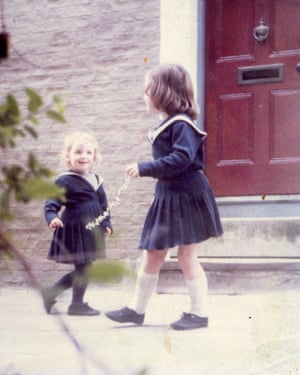
Bee Wilson (left) and her sister, aged two and four. Photograph: courtesy of Bee Wilson
The siblings of those with anorexia or other eating disorders are often overlooked. The UK’s leading eating disorder charity, Beat, has described siblings as the “forgotten victims”. In one report on the charity’s website, eight teenagers with anorexic sisters were interviewed about their experiences. All were negatively affected, even though they also sympathised with their sisters and knew that the illness was not their fault. Many of the siblings felt the eating disorder affected every aspect of family life. Each developed personal coping mechanisms. Some tried to pretend it wasn’t happening. Others found themselves talking about it obsessively. Some distanced themselves from their sister, but others became closer, often assuming an almost parental role.
Sophie’s younger sister, Grace, was diagnosed with anorexia five years ago, when Grace was 14 and Sophie was 16. One of the first things Sophie noticed, she tells me, was that her needs now came second in the family. As soon as Grace became ill, she felt she was “in the back seat”. She was doing AS-levels at the time, but felt she needed to ignore her own stresses to look after both Grace and her parents, who started going through a “rocky patch in their marriage”. Each of her parents and Grace used her as a sounding board for their own pain. She felt she was looking after all three. In the end, the pressure of trying to be strong gave Sophie depression. Her own eating is still relatively normal, although she spends much longer than she used to weighing up whether to eat something like chocolate cake (“It’s put a twist on my eating”). She is now at university, studying pharmacology. Back at home, Grace’s eating is slowly improving, with a new programme of treatment and meal plans.
But the pressure of the disorder is still there for Sophie, even when she is away from the family table. She is wary of mentioning Grace’s anorexia to new friends, partly because she feels it is not her story to tell, and partly because of the perceived stigma. “One boy that I told said, ‘Send her to my family in Italy and they will fatten her up.’ So there’s not much understanding.”
She and Grace remain close, and she has never blamed her younger sister; but she hates the anorexia itself, calling it a “selfish disease”.
This is something that Hannah can understand. One of four sisters, she tells me that anorexia “ruined my teenage years”. In the grip of the disorder, she had several hospital admissions and lengthy outpatient treatment; it took her many years to recover.
Now in her mid-30s, she feels, to her immense relief, that food and weight do not “control” her any more. But during the bad years, she was so immersed in the disorder – “like you are possessed by a demon” – that she never thought any of her sisters might be at risk, too. She was heartbroken to discover that her youngest sister – around 10 years younger – had been secretly bulimic while she was still recovering. “I couldn’t believe it was happening to my little sister and I didn’t notice.”
The same sister then developed anorexia, which Hannah says she found soul-destroying: “I would have had all the eating disorder back myself to take it away from her.” She thinks her sister would probably have developed the disease regardless of her own anorexia, but wishes there was more sibling support. Eating disorders confirm how deeply social our appetites are.
There’s a solidarity to how girls eat together – either we all have chips, or no one will!
When one person at the table radically changes the way they eat, the whole ecosystem of a family has to adjust. A meal is not the same thing when it is not shared. I wish I had understood better as a teenager how entangled eating behaviour between siblings was. My sister wasn’t to blame for my problems with eating; but it was only when she became ill that it was obvious how much my apparently robust appetite took its cue from her. Numerous studies confirm that peers have a very powerful effect on how a child eats. Under the influence of those who share our childhood meals, we may eat faster or slower; take a bigger or smaller portion; eat breakfast or not. The effect is stronger if that person is closely related to us; stronger still if we love them.
Among female meerkats, new research shows, sisters use food as a form of competition. The socially dominant sister actively works to grab more calories and gain weight faster than her peers, to reinforce her position. In human sibling relationships, the competition over food is more warped and oblique, but no less real. I once met a cookbook publisher who said that she spent her childhood pretending to be a fussy eater, to emulate a much-respected older sister. It was only when she left home that she realised that many of the foods she had been shunning were actually delicious.
There’s a solidarity to how girls eat together – either we all have chips, or no one will! – which might be admirable if only it weren’t so self-defeating. In 2002, 415 pairs of Dutch siblings aged 13 to 16 were followed for a year and asked about how they ate in relation to each other. The most startling finding was that it was generally the older sisters who copied the way the younger ones ate, rather than the other way round, particularly when the younger girls ate in a disordered way. The researchers decided it must be because the older girls envied their pre-pubescent lack of curves.
Among teenage girls, dysfunctional eating can be a way to forge instant intimacy, quicker and more inclusive than talking about boyfriends or clothes. When E left for university, I begged to go to boarding school for sixth form. I couldn’t bear to sit at that table alone any more and I fantasised that if I left home, I might lose weight. But my new school friendships brought fresh complexities over food. In our boarding house kitchen, eating was a joint obsession, an unquenchable topic of conversation. I still compulsively gobbled toast in between homework and TV. But now others sat there, too, passing the peanut butter and jam.
We went on crazy diets together, trying to subsist on raw carrots and Müller Light yoghurts while subjecting ourselves to cruelly demanding exercise regimes. We would make absurd declarations of how much weight we planned to lose (2 stone! 3 stone! all the stone!). One of my friends calculated how many chocolate bars you could eat as part of a 1,000-calorie diet if you ate nothing else.
We skipped our main courses – waste of calories – and ate heaping bowls of custard instead. One girl told me that she took laxatives, so I tried those, too, my stomach contracting in agonising cramps. I felt weak and stupid. To cheer myself up, I went out and bought a restoring slab of chocolate fudge cake and another of brownie and a triangle of cheesecake and ate them all, one after the other.
At school, I had a new best friend, who ended up at the same university as me. Like my sister, she suffered from anorexia. Once more, I was the chubby one in the relationship; the normal one; the one who supposedly didn’t have a problem. Unlike my sister, my friend didn’t mind talking to me about her deep unhappiness with food – and other things – as she sat, pale and thin on the floor of her college room. This time, I felt I could help, although listening to her was also, selfishly, a way for me to play out my own obsession with food. I hung off her every word as she told me how upset she was when a boyfriend gave her a cup of tea and she could taste the greasy fat in it from a splash of whole milk. We went to the cinema, and whipped ourselves into shared paranoia that the person behind the counter had given us regular sugary Coke instead of Diet. In private, I still binged, and despised myself for it, but when I was with her, I tried to emulate her ways of eating. Unlike me, she was so beautiful and so thin.
Looking back from a happier place, I can’t quite fathom the sheer brainpower we once squandered on food and weight
We had evenings where we put on too much makeup and drank cocktails and smoked Marlboro Lights and ate nothing. On the occasions that she did eat, anything she chose took on a deep cachet. It was as if her food preferences held the secret of slimness, even though she was only making these choices from a state of deep mental distress. By today’s standards, what she permitted herself to eat as she recovered was carb-heavy and dull. Side by side, we ate baguette with no butter and baked potato with low-fat cottage cheese and pasta with tomato sauce (never cream) and forests of salad with not a scrap of dressing. And, always, Diet Coke, which seemed to wash away all our sins.
Looking back from a happier place, I can’t quite fathom the sheer brainpower we once squandered on food and weight: the tedious minutiae of poached salmon versus skinless chicken breast. I wish I could go back and show us how wonderful eating can be when you feel free to think more about flavour than nutrients. Our teenage selves should have seen the dinner we ate together last winter, as 40-year-old women. We would not have believed we could sit together, freely enjoying glossy olives and flatbreads and hummus and spicy chicken and chunks of aubergine and thick garlicky yoghurt and glasses of red wine and sticky almondy cake without keeping count of who had what.
The old warped way of eating seems – thankfully – distant to me now. I fell in love and over a period of months, if not years, I learned how to eat in a different, more balanced way. I discovered that you might sometimes eat salad for pleasure, rather than as a cure for your upper thighs or to copy the thinnest person at the table. I now can’t imagine wanting to go on a diet and it horrifies me when my daughter, aged 13, comes home and talks about girls at school who have nothing but a cake and a sugar-free fizzy drink for lunch (“Please, don’t get too close to these girls,” I think but do not say).
I never dreamed I would reach the point where I would be free of the nagging voice in my head telling me that I was disgusting because I had eaten pudding. Still less did I think I could choose what to eat based on my own desires, rather than what another female at the table was eating. At last, my appetite was my own.
Both E and my friend slowly recovered from anorexia. E’s 20s were hard but her 30s were better and she emailed me this week to say she doesn’t remotely feel “defined” by her eating any more. She moved to America and found a new life. When I visit her and her kids now – not as often as I’d like – I’m amazed by how easy it is to sit down and share food together. There’s a Vietnamese place near her house and we sometimes get vegetarian takeout and sit laughing and drinking white wine as her three girls squabble over who gets the last rice paper roll. I don’t even notice if she eats more or I do, but the main thing is we are together at her table, which is nothing like the one we grew up with. It’s round.
•Bee Wilson is the author of First Bite: How We Learn to Eat, published by Fourth Estate at £12.99. To order a copy for £9.99, visit the Guardian Bookshop.
Comments will be pre-moderated because of the personal and sensitive nature of this piece.
A transgender identity should no longer be diagnosed as a mental disorder, according to the first field study to evaluate a proposed change in the WHO International Classification of Diseases (ICD).
The mental distress experienced by many transgender people is primarily the result of social rejection and violence, the study found. Not, as has been assumed for decades, solely the result of being transgender.
The findings, published in the Lancet, show that viewing transgender people as having a mental illness might force them to get psychiatric care rather than the physical care they seek.
Authors of the “Removing transgender identity from the classification of mental disorders” study also warned that association with mental illness could be used by governments to deny decision-making authority to transgender people, in matters such as child custody and reproduction.
According to the first report by a UK parliamentary committee to tackle transgender issues, which was published earlier this year, as many as 650,000 people in the UK are gender incongruent to some degree. The transphobia they experience undermines their careers, incomes, living standards and mental and physical health, it found.
A third of transgender adults and half of “gender-variant” young people attempt suicide, and transgender people in the UK face high levels of transphobia on a daily basis, the Commons Women and Equalities Committee concluded. MPs urgedministers to draw up a new strategy to tackle discrimination in the NHS, prison service, police and schools.
Changing the classification in the ICD, the most influential medical bible, will have a significant impact on how transgender people are treated by the medical establishment, as well as how they are viewed by society.
“Stigma associated with both mental disorder and transgender identity has contributed to the precarious legal status, human rights violations and barriers to appropriate care among transgender people,” said senior author Professor Geoffrey Reed, of the National Autonomous University of Mexico.
“The definition of transgender identity as a mental disorder has been misused to justify denial of healthcare and contributed to the perception that transgender people must be treated by psychiatric specialists, creating barriers to healthcare services. The definition has even been misused by some governments to deny self-determination and decision-making authority to transgender people in matters ranging from changing legal documents to child custody and reproduction.”
The study’s authors interviewed 250 transgender people. It is the first of several field trials and is currently being replicated in Brazil, France, India, Lebanon and South Africa.
“Our findings support the idea that distress and dysfunction may be the result of stigmatisation and maltreatment, rather than integral aspects of transgender identity,” said lead investigator Dr Rebeca Robles, of the Mexican National Institute of Psychiatry. “The next step is to confirm this in further studies in different countries, ahead of the approval of the WHO revision to the International Classification of Diseases in 2018.”
The study found 83% of participants had experienced psychological distress related to gender incongruence during their adolescence. More than three-quarters had experience social rejection related to gender incongruence, most commonly by family members, followed by school and workmates, and then friends.
Over 60% of participants had been the victim of violence as a result of their gender identity: in nearly half of these cases the violence was perpetrated by a family member. Psychological and physical violence were the most commonly reported, while some experienced sexual violence.
A WHO working group has recommended that transgender identity should no longer be classified as a mental disorder. But it would not be removed from the codebook. Instead, transgender would be moved into a newly created category: conditions related to sexual health.
This, however, has stirred further controversy. “I think there is a bit of a problem with the idea of putting it in a chapter on sexual health because it has nothing to do with sex,” said Dr Griet De Cuypere, a psychiatrist at the Center of Sexology and Gender at University Hospital in Ghent, Belgium, and a board member of the World Professional Association for Transgender Health. “If it’s possible to have it more separately, it would be better.”
High childhood IQ ranges are linked to an increased threat of bipolar disorder later in existence, according to new research.
The research, carried out at the University of Glasgow, measured the IQ of a massive group of individuals aged eight, who had been then tested for manic traits aged 22 or 23.
The test incorporated queries from a checklist typically utilized to diagnose bipolar disorder.
The check subjects created statements which created a score for researchers to see how numerous manic traits they had knowledgeable in the past.
It was found that amid people tested, those who scored in the best 10% of manic traits also had a childhood IQ ten factors larger than those who scored in the bottom ten%.
Daniel Smith, who led the study, advised the Guardian: “There is something about the genetics underlying the disorder that are advantageous.
“1 possibility is that serious ailments of mood – such as bipolar disorder – are the price tag that human beings have had to pay for much more adaptive traits this kind of as intelligence, creativity and verbal proficiency.”
• Melanie de Blank: I’m so proud of Polly, my bipolar daughter • Stephen Fry is the brave face of suicidal depression
A latest research also identified that imaginative folks are a lot more probably to suffer from a mental sickness such as bipolar disorder or schizophrenia.
The mood disorder influences 1 in one hundred folks in the United kingdom, and isusually indicated by bouts of mania followed by spells of depression. It can also include episodes of psychosis.
The research examined on 1,881 men and women, and is being published in the British Journal of Psychiatry.
When our son, Idan, is old enough, he will probably want to know why he has over 1,500 followers on Facebook. He will almost certainly want to know why we have shared dozens of photos and videos of his childhood with strangers. He will almost certainly request why, when he Googles his title, dozens of news articles or blog posts and come up telling his story. We will inform him that, at very first, we shared his story to assist him and us deal with the challenges we faced, but later, we shared his story to inspire other people who may be dealing with equivalent challenges. I hope he understands, and I hope he forgives us for offering him a digital footprint at this kind of a youthful age.
At eight months outdated, Idan was rushed to the emergency room by ambulance with a really lower oxygen fee and rapid breathing. A healthy and powerful child boy until finally that level, he invested the subsequent three weeks in the pediatric intensive care unit, two of those on a ventilator, clinging to life. Idan had pneumocystis jiroveci pneumonia, a unusual kind of pneumonia only a kid with a severely compromised immune method could contract. Idan’s pneumonia led physicians to diagnose him with a existence-threatening genetic disorder called X-Linked Hyper IgM Syndrome, or Hyper IgM for short. It keeps Idan from getting ready to generate any antibodies of his personal to battle off infection. It meant that with no weekly infusions of antibodies and antibiotics prophylaxis, his chances of lengthy-phrase survival were significantly diminished. A bone marrow transplant was the only identified remedy.
It had been the hardest three weeks of our lives, and we returned residence exhausted and hopeless. The very first thing that greeted us back home was a denial letter from our insurance coverage program for the antibody infusions, the only point retaining our son alive. It would be the initial of several healthcare and insurance coverage-associated setbacks that we would encounter in excess of the next couple of years as we fought for our son’s cure. But it set the tone of our struggle and inspired our first battle cry. We made the decision to share Idan’s story with the globe in hopes of not only raising money to support pay for the health-related expenditures that had been piling up but also to find other individuals like Idan and to discover from them.
In the two and a half years considering that, Idan has amassed a healthcare record longer than most nursing residence sufferers. He has endured thousands of needle pokes and dozens of invasive procedures and tests. He has had half a dozen surgeries and a single failed bone marrow transplant.
Nevertheless practically nothing looks to have phased him or slowed him down. He was identified at Seattle Children’s Hospital, the place he acquired his transplant, as the happiest baby they had witnessed throughout the process. His favored element was entertaining the staff of 14 doctors and nurses who came in in the course of his morning rounds. He learned his ABCs and 123’s throughout the long hospital stays ahead of most youngsters say their initial word. And he has grown and thrived regardless of obtaining a severely compromised immune method and numerous restrictions on human interaction.
But we want much more than that for Idan we want a remedy. We lately formed the Hyper IgM Foundation, a patient advocacy organization that will offer assistance and sources to families residing with Hyper IgM, educate the medical neighborhood regarding diagnosis and treatment and offer funds to support critical study and developments in gene editing, bone marrow transplant and other acknowledged and unknown therapies that could help Idan and the hundreds of others in the world grappling with Hyper IgM.
Our loved ones has been place by means of trial following trial, every single a lot more striving than the final. But we’ve learned so a lot, and through the wreckage, we have discovered anything new and beautiful past measure: hope. It’s challenging not to feel hope in the business of the most charming, loving and bright little one a mother or father can hope for. We are total of pride, and we come to feel utter joy in his presence. But we know that, with out mothers and fathers like us – empowered, informed and engaged – children with his condition do not stand a opportunity. Informed dad and mom join their child’s health care crew and have to continually make tough selections. Bone marrow transplants are lengthy and quite risky procedures. Even when a match is found, 15-20% might not survive the 1st yr, and a lot of a lot more have long-lasting effects from the chemotherapy and graft v host ailment. Mothers and fathers must be vigilant with the dozens of medicines and infusions their children require post transplant as well as with rigid isolation procedures.
For all these dad and mom who have the indicates and the desire to advocate for far more study into a remedy for a uncommon illness like Hyper IgM, we motivate you to do so. Patient advocacy groups are crucial to medical developments, are extraordinarily successful equipment and help methods and, importantly, can provide a meaningful path to a cure.