bipolar etiketine sahip kayıtlar gösteriliyor. Tüm kayıtları göster

31 Mart 2017 Cuma

Experiences of bipolar disorder: "Every day it feels like I must wear a mask"

Anonymous
I am once again in the mental health treatment sausage machine. Plucking up courage to approach a GP to admit defeat, being shoved on drugs to stop me topping myself, told that there’s a huge, long waiting list for treatment, the false hope of a “gateway worker” assessment followed by another interminable wait of undefined length. Then I know I will have my allocated batch of treatment before being deemed “fixed” and dispatched back to the world again. I am sick and tired of the roundabout. I suggested that instead of this system, once a mental health patient has had their allocation of therapy, they should remain on the books, so when they feel themselves slipping back down, they can call up for a booster session instead of having to go through the whole rigmarole again.


I’ve just quit my job of six years because, following a disclosure to my new boss that I have bipolar tendencies she proceeded to bully me into submission. She had absolutely no understanding of how to get the best out of (a very talented) employee who has mental health issues. I was stopped from working at home, an important aspect to being able to manage my condition. I had unreasonable targets imposed, with no support offered to go about achieving them. My job was chopped and changed, hours cut and autonomy removed. I have been pushed back to the brink of suicide and had to go on antidepressants to simply survive.


Anonymous
From September 2015 until December 2016, while I waited for an NHS referral, I was so ill I didn’t know how to cope and resorted to self harming. These aren’t all of my scars, but they’re the ones no one ever sees; so it’s easy to think they’re not there. One year of my life, and I will have to be reminded of it forever.


Cat, 24, South Yorkshire
People often mistake bipolar disorder as your mood rapidly changing from up to down. It’s not like that. That would be my other illness, borderline personality disorder (BPD) or as my psychiatrist put it, emotionally unstable personality disorder. It’s complicated telling people you have both bipolar disorder and BPD, as they both involve intense mood swings. Well, that’s when I do tell people – social anxiety sort of puts a brick wall between me and people. BPD makes your mood change within seconds and it is a strong mood swing. Like fire, it can destroy you and those around you. With bipolar, the mood swing sort of creeps up on you. It’s when the mood gets high (mania) or low (depression) that it becomes destructive.


Every day it feels like I must wear a mask, however, hiding never did me any good with these illnesses. It just becomes more of a shock to those around you when the symptoms start to leak through. Even as I write this, it’s hard to concentrate, thoughts and emotions are saying one thing, while that one bit of mind that tells you “everything will be ok”, is telling me to push on.
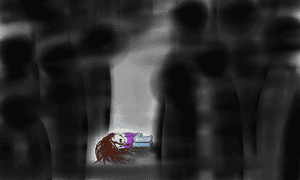


Painting of a depression experience by Cat, South Yorkshire


The rendition of a darker moment. A painting of a depression experience by Cat, South Yorkshire

I’ll admit when I’ve been at my lowest I’ve done things I’ve regretted. The overdose, which sent me into hospital, was one of the things. I know there’s a stigma around psychiatric hospitals, but I did meet people who it’s worked for. When I was admitted into hospital the first time, I had psychosis – a female voice was constantly screaming in pain in my head. I don’t even bother to count how many times a year I have to go through this. Medication helps keep me in some control, especially with the manic side. I prefer the manic side to the depression side. Mania brings with it the thought that you’re this amazing person, who can do anything, someone who deserves to be with people. The bad side of mania is that loss of control. Nights become sleepless and the thoughts running through your head won’t stop. Every time you try to grab one, it just slips through your fingers. Health and safety also goes out the window.


I managed to get through my art degree. I have to remind myself that I’m more than my diagnosis, but with the right help and support it does become a lot easier.


In the UK, the Samaritans can be contacted on 116 123.
In the US, the National Suicide Prevention Hotline is 1-800-273-8255.
In Australia, the crisis support service Lifeline is on 13 11 14.


Experiences of bipolar disorder: "Every day it feels like I must wear a mask"

27 Şubat 2017 Pazartesi

‘So, you know I have bipolar?’ – the perils of dating with a mental health problem

Dating is hard. It’s paved with heartache and unrequited crushes and the blurting out of gabbled nonsense in front of the unimpressed person you like. When I finally found myself in a conversation with someone I liked at work, whose head I had resolutely stared at the back of for a full three months, I answered an innocuous, “So, how’s your day going?” with, “I am awash with existential despair.” She stared, confused and unblinking, back into my face. I then followed it up with a tiny, pathetic, “Woo!” She sat down again. I continued to stare at the back of her head from my desk, in the full knowledge that she would never speak to me again. This isn’t just me, right? This is how it is for everyone. This is what it’s like to date. It’s awkward.


But what is it like when, in addition to your inability to say anything remotely funny or interesting to the person you are into, you have a mental health problem as well? How does that affect the way you interact with them? How does it affect a relationship once you are actually in one? And, more pressingly: how do you even tell someone you are, or have been, ill? At what point during the dating process is it appropriate to bring up mental health?


The pressure of not knowing when or how to reveal your mental health status can be an additional and very valid source of anxiety. If you tell them too soon it can feel like you are setting the stakes too high; but if you leave it too long you might find that the person you are dating has offensive views on mental health, doesn’t want to deal with it or just isn’t equipped to handle it at all.


As a serial dater it’s something I’ve contended with a lot. It’s also something I’ve done badly a lot. You would have thought there was a finite number of ways to do this wrong. There is not.


How not to tell someone you are mentally ill


Let’s start with some of the poor ways I’ve handled this so far.


Avoiding telling someone until it was catastrophically too late


Hey! I thought, after a month or two of relative tranquility. I think maybe I don’t have mental health problems any more! I think maybe things are going to be perfect for ever and I’m never going to have to think about this ever again. There’s absolutely no point telling my new boyfriend about it, is there? Nah. It’ll be fine. I’ll be fine. I’m fine.


It was not fine.


At that point I was deeply embarrassed bymy previous psychotic episode, and tried to distance myself from it as much as possible. It was easier for me to avoid the topic and skirt around it awkwardly than to confront it. I chose to blame my breakdown on the stress of starting university, moving away from home, and spending all my time drinking. I didn’t want to think about the possibility that it might continue to affect me for the rest of my life.


But eventually my boyfriend and I did end up talking about self-harm and suicide. It was two years into the relationship and we were in the pub. “It’s all just attention seeking, isn’t it?” he said. “It’s just people who want to feel special: ‘Oooh, look at me, I’m on antidepressants!’ Just get on with it.” He went on to tell me about an ex-girlfriend who had gone on antidepressants after her dad had died unexpectedly; he complained that she lay in bed all day and wouldn’t have sex with him no matter how much he bugged her. It was brutal to hear him write off what was clearly a traumatic experience for his ex as her being “lazy” and trying to “avoid sex” – as if her depression wasn’t about her at all, but was a punishment she had decided to enact upon him. After two dates, this would have been fine – I’d have just dumped him. After two months, even, I could have escaped from the relationship pretty much unscathed. After two years, though, it came as a horrifying blow, one that precipitated the end of the relationship. It forced me to consider how well I really was, and how integral my psychosis, my depression and my mania all were, in their own ways, to my self-image.


We argued about it a lot that day and from then on. He blamed me and said that he wished I would kill myself already and just get it over with if I was so serious about it. There’s no doubt that he was a dickhead about the whole thing, but I can’t help feeling that if I had talked about my experiences earlier in the relationship it might have been avoided.


Rule No 1: it is definitely a good idea to actually, at some point, tell them.


Couple on a date in a restaurant


Don’t do it! There is a time and a place for everything. Photograph: Jupiterimages/Getty Images

Blurting it out on a first date


I was on a genuinely brilliant first date. He was tall, good-looking (in a kind of dishevelled professor way) and the first person I had met who had piqued my interest since the breakdown of my previous relationship. I was very invested in not messing it up.


And I was nailing it. There was lots of wine and I was pulling out all of my best anecdotes. Then came this exchange:


Him: “So, you know I have a son?”


Me: “Oh. No. I didn’t, actually.”


Him: “Yeah. He’s 10.”


Me: “Don’t worry about it. I have bipolar.”


Not only had I completely failed to acknowledge anything he had just said, but I had also equated his beloved child with a debilitating and heavily stigmatised mental health problem. I felt like his child and my bipolar were both things that could and would put someone off, and that he had somehow just issued a dealbreaker amnesty by mentioning his son. In fact, he had just wanted to tell me a boring anecdote about a trip to the zoo.


Rule No 2: don’t compare someone’s child to a mental health problem on your first date.


Telling someone during sex


Things you can say during sex: “That feels amazing”, “Keep doing that”, “Could you stop leaning on my hair please?” We’ve all read Fifty Shades of Grey. We know what’s allowed.


But things you should not say during sex? “So, you know I have bipolar?” Don’t ask me why this happened. Don’t ask me about the chain of thought that led me to blurt it out like that.


Just remember rule No 3: never say it when you are literally having sex with someone. Never.


How to tell someone you’re mentally ill in none of the ways outlined above


I would love to be able to say, “Yeah, you should definitely say X after Y number of dates”, but relationships don’t work like a PlayStation cheat code, much as I wish they did. You have to play it by ear, pick up on the person’s vibe and try to work out how best to communicate it to them. I can give you some tips, though.


Actually tell them


Yes, this is obvious, but it’s important. Even if they are the understanding type, it’s best to tell them before you have an episode, because you will need to have a conversation about what you expect from them or what you might need. If they don’t want to date you because they can’t handle it, that’s fine, but it’s unfair on both of you if they are forced to make that decision while you are ill and will cause undue levels of stress when you really don’t need them. It may cheer you to know that a 2013 study undertaken by the charities Mind and Relate found that 77% of people with mental health problems actively told their partners about their mental health problems and just 5% experienced a breakup because of it. A further 74% of partners of someone with a mental health problem said they “weren’t fazed”. So you have almost nothing to worry about.


Couple walking down street


An honest approach is best Photograph: Hinterhaus Productions/Getty Images

Be honest


You don’t have to tell them all the gross minutiae, but it’s best to be broadly honest. Detail the type and severity of your illness. Tell them how it has affected you in the past and how it is likely to affect your relationship.


Don’t sugarcoat it.


For me, there are two major things that tend to go as soon as I become depressed: being able to leave the house, and being able to take a shower. These are obviously fairly big hurdles in a relationship – having a girlfriend who smells like a bin and who sits in the same spot on the sofa for three weeks may not be the most appealing prospect. But by talking about it – telling someone how best to coax me into leaving the house, how to encourage me to look after myself, how I might respond – I’ve found that these hurdles are far less daunting than they first seemed.


Offer some advice


You’re an expert on your own condition, but your partner might not be: help them out.


Encourage them to research your diagnosis so they know, roughly, what they are dealing with. Tell them what you might need and when, or how they might be able to spot warning signs. As with many people who suffer from mania in some form, the first symptom for me is a complete inability to sleep combined with a desperate compulsion to talk all of the time. Telling someone that those things are meaningful parts of my illness, rather than just random occurrences, means that they’re much better equipped to recognise and deal with them when they occur.


You should also, as a couple, draw up a contingency plan in case of emergency. Which family member or friend should your partner contact in a crisis? What resources do you need? This could be anything from bubble bath, music, books or puzzles to calm you down, to something more serious – do you have spare medication, for example? Make sure you are clear in advance about what actions you are happy to explicitly consent to – it’s important that your partner knows what you are comfortable with. And draw up a list of contacts – local authorities, your psychiatrist or doctor, your support worker, or whoever might be able to help.


Don’t be too hard on yourself


Having someone decide not to date you because they can’t cope with your mental illness sucks. It feels deeply horrible and personal. Talking to a newly single friend recently, she told me that several relationships that seemed to be going well had mysteriously withered away as soon as she mentioned her severe clinical anxiety. Some told her that was the case – that they were unable or unwilling to deal with it – and others mysteriously disappeared as soon as she mentioned it. It, understandably, bummed her out.


There is a silver lining, though: it is far better to be with someone who is willing and able to help you with your illness. Having a mental health problem obviously doesn’t define you, and it’s the same with relationships. But knowing that someone has chosen to stick with you on the bad days as well as the good can significantly reduce anxiety.


This is an edited extract from Emily Reynolds’s A Beginner’s Guide to Losing Your Mind (Yellow Kite, £14.99). To order a copy for £12.74 go to bookshop.theguardian.com or call 0330 333 6846. Free UK p&p over £10, online orders only. Phone orders min p&p of £1.99


‘So, you know I have bipolar?’ – the perils of dating with a mental health problem

9 Şubat 2017 Perşembe

Fish Oil – Get The Upper Hand On Bipolar Cognitive Disfunction With The Potent Natural Health Benefits of Omega 3’s

“Omega-3 fatty acids are considered essential fatty acids
The benefits of omega 3’s in fish oil cannot be overstated.”


My Story
According to the psychiatric community, I have bipolar 1 with ultra rapid cycling, but I don’t take pharmaceutical medications. What I do instead is, take responsibility for my own life by taking control of my sleep, food, diet and fish oil regimes.


It hard enough for most people to get their life in order according to what is healthful, useful and what serves you well. When you factor in a chemically imbalanced brain, the challenge is a little greater, but it’s certainly doable. I’m proof.


Out Of Control 20’s To Zen Mistress 40’s
I suppose that, yes, it’s partly to do with maturation, however, I feel that the process of my recovery from bipolar can be pinpointed to have started with the introduction of fish oil at the age of 35.


I have many years of working-out-my-stuff under my belt, and I’ve pretty much got my act together these days, especially when compared to my younger years. Out of control, thinking everyone ELSE was the problem, didn’t help in any way, to get better in the head. It was only once I seized onto the ideas of fish oil and omega 3’s and that yes I could help myself, than life started settling down for me.


It was only after I’d tried a few different pharmaceutical drug cocktails before the thought occurred to me, ‘Now hang on, this totally sucks and what if I NEVER find the right combo of drugs to meet someone else’s definition of normal?’


My Way Isn’t For Everyone
Not being on pharma meds is definitely NOT for everyone. Being an advocate for natural living, I don’t know that I’d ever recommend going the pharma route for anyone? I’m sorry if this offends, but, I see putting pills down my throat as non effective, lazy and a cop out. I also think that it’s quite enabling of non self responsibility.


It’s just about the easiest thing in the world to make a doctors appointment once a week, throwing pills down your throat all the while. To me, that looks a lot like sloughing off one’s responsibility to be the best version of yourself that you can be. Pills don’t change anything about the root cause of the problem, can make you very sick, and, psychiatry is based on you coming up with your own answers. The harder route, but infinitely more powerful and life affirming route, is that of self awareness and natural living. It actually works and without poisoning your body!


My Laypersons Logic
This is a disorder of chemical imbalance, so, let’s get a little logical about that idea and think about it for a minute. To effect a change in chemical balance, you add or subtract something from the equation, right? Therefore, your body being the chemical soup that it is, will also be affected by a change in it’s chemistry. All you need to do is hunt down the source of the missing vitamins, minerals, enzymes and molecules and put them back in. In a certified organic way, of course.


What’s harder to deal with is the root cause/s of why you’re so sick. I’m referring to your emotional health. Emotions have long been known to affect the body. I’ve known inherently for a long time that ‘bad thinking’ will give you cancer. It’s nice to know that the science bears me out on this.


How I Do My Best To Maintain Balance
So, no pharma for me, but I have to work hard at maintaining my whole life. This is something I think we should ALL do, not just those of us that have a problem to correct. Because I choose the non pills way, that means I MUST look after my body and life especially well. To be able to not only exist, but to thrive with bp and no meds, I MUST get 4 things right MOST of the time; sleep, exercise, diet and fish oil.


Sleep – I am naturally a night owl, but to get proper sleep I force myself to go to bed at 10.30/11pm every night except about once a week. I do love to stay up!


Exercise – I get in the form of yoga of about 30 min every second day. Or yogahh as I like to call it. It’s just that delicious!


Diet – is slowly getting better, forcing myself to eat at least one piece of fruit per day, and I love eating my own organic veges so that makes it easier to get the nutrients I need.


Fish oil – This is WONDER stuff! When I’m talking about fish oil, I’m referring to the EPA (Eicosapentaenoic Acid) and DHA (Docosahexaenoic Acid) levels in organic fish oil. The oil you choose should have very specific levels of EPA and DHA.


The Main Benefits Of Fish Oil
Fish oil will help you with;
– Supporting healthy cognitive function
– Relieving arthritis symptoms
– Keeping triglyceride levels within the normal range
– Supporting the body to maintain a normal LDL:HDA cholesterol ratio.


Dosage
The recommended adult dose is for 5mL daily, which is about a teaspoon’s worth.
You should be aiming for at least an equivalent of 500mg EPA and 800mg of DHA daily.


BIG HINT: Have a hot drink to wash it down with. NEVER use a cold drink!


If you really don’t want fish oil then you can get your EPA and DHA from flaxseed, chia seeds, tofu, walnuts, linseed and pumpkin seeds. However, before the body can uptake the EPA and DHA, it gets converted from alpha-linolenic acid (ALA) Bear in mind that getting your omega-3’s this way requires a bigger intake to achieve the same therapeutic benefits as from fish oil.


I first started taking 5ml of liquid fish oil daily approx 5 years ago. Yes, I do mean the “liquid” form. It’s pretty wrong-feeling in the mouth, but…
Within the first 5 minutes (I kid you NOT!) I was saying “Is this how balanced most people feel, most of the time?” This effect continues in the same way, even all these years later. Fish oil has removed the ‘sobbing-all-day-for-no-reason’ days and you can feel the clarity of the cognitive effect nearly immediately. It feels like you’re smarter. There’s no other way to explain the cognitive effect.


It Feels Like You’re Smarter
That’s because you are smarter on fish oil! The positive cognitive effects from taking fish oil are very, very well documented. The Google scholar results when I typed in ‘research review paper cognitive effect fish oil omega 3’ are in the reference section below. There are  20,500 results!


Please, bp’ers that aren’t on meds, get yourself on fish oil TODAY! It’s cheap and life changing-ly worth it!


Do It, Do It Now! 


The only other thing I have to say is DO IT, DO IT, DO IT because it’s a BIPOLAR LIFE CHANGER!


Remember to always choose a certified organic product to get the purest product as you can.
p.s. I was first recommended fish oil by a pdoc, who also put me on a script for pharma meds at the same time. So, I THINK you can still use the fish oil while on meds. I would check with your pdoc first to be sure.


References:


http://umm.edu/health/medical/altmed/supplement/omega3-fatty-acids


https://www.choice.com.au/health-and-body/medicines-and-supplements/vitamins-and-supplements/articles/omega-3-supplements
http://www.ehealthme.com/drug_interactions_side_effects/Adderall-XR-25mg-3109001


Fish Oil – Get The Upper Hand On Bipolar Cognitive Disfunction With The Potent Natural Health Benefits of Omega 3’s

14 Ağustos 2016 Pazar

Lithium should be more widely used for bipolar disorder, researchers say

Britain’s 650,000 people with bipolar disorder should take lithium to help control their condition, despite its reputation for dulling the senses, a significant new study has found.


Researchers claim that although the drug does carry some health risks, its overall effectiveness, especially its ability to reduce self-harm and suicide, mean it should be much more widely used.


The findings are contained in the first study comparing the side-effects of the four main mood-stabilising drugs the NHS prescribes. They have prompted calls for a rethink about attitudes towards lithium, given that only an estimated 10% of those with bipolar disorder use it, mainly because patients fear it will cause loss of personality, weight gain and other problems.


The lead author behind the research told the Guardian that widespread “lithium stigma” among patients is leading to them receiving the wrong treatment and ending up admitted to hospital unnecessarily because their condition is not as well controlled as it could be.


“Lithium is a drug with a bad reputation. It is seen by patients, and some psychiatrists, as a dangerous drug. People rightly have suspicions about it. Patients say that the downsides include emotional numbing – feeling that you aren’t connected with your feelings – as well as tremors,” said Dr Joseph Hayes, a psychiatrist at University College London.


But lithium’s reputation is largely misplaced and based on the experiences of patients from the 1960s to the 1980s who were given too large a dose of the drug, he added. The new research, published in the medical journal PLOS Medicine, found that the side-effects of the mood-stabilising alternatives used by most patients are either the same as or worse than lithium, Hayes said.


The paper, co-written by Hayes and four colleagues from UCL and Oxford University, concluded that: “Lithium remains an important treatment for individuals with bipolar disorder.” It accepts that “there is clear evidence that its use is associated with a number of adverse events.”


However, it adds: “These risks need to be offset with the potentially superior effectiveness and anti-suicidal benefits of the drug compared to other treatment options.”


The researchers studied a nationally representative sample of 6,671 patients across the UK who were treated for bipolar disorder between 1995 and 2013. Of those, 2,148 had taken lithium, 1,670 had used valproate, 1,477 had been on olanzapine and 1,376 had taken quetiapine. They experienced side-effects including chronic kidney disease, thyroid disease, weight gain and high blood pressure.


The researchers’ analysis bore out one of the two main criticisms of lithium, but found the other to be baseless. They found that patients on lithium had a higher risk of suffering kidney function problems and developing hypothyroidism or hyperthyroidism and also hypercalcemia. However, none of the drugs caused more severe kidney problems.


Meanwhile, lithium patients were less likely to put on weight than patients on the other drugs. While 15%-20% of those on the three other drugs were more likely to gain more than 15% of their body weight, just 10% of those on lithium put on the same amount of extra pounds. Those on olanzapine added the most weight and experienced high blood pressure as a result.


I think many patients are missing out quite commonly on the best available treatment


Dr Joseph Hayes


Separate research has shown that patients on the other three medications are 40% more likely to harm themselves than those on lithium. Bipolar disorder carries one of the highest rates of suicide of any mental illness, alongside schizophrenia and alcohol and drug addiction.


The very limited use of lithium is despite the National Institute for Health and Care Excellence (Nice) advising in 2014 that it should be the standard treatment for bipolar disorder, which is also known as manic depression and is characterised by manic highs and bouts of depression. That superseded its previous view, outlined in 2006, that any of the four drugs were useful first lines of treatment for the condition, which affects about one in 100 people.


“Lithium stigma, which includes some people in the psychiatric community, leads to people using drugs that are less effective [than lithium]. To me as a doctor that’s a big worry because my main aim is to help people to be well and if you aren’t doing that with the best available evidence then you are failing patients,” said Hayes.


“I think that many patients are missing out quite commonly on the best available treatment. That means that people end up in hospital more often than they need to and end up achieving less in their lives than they could do if they were on lithium. The high suicide rate with bipolar disorder should encourage greater use of lithium. There should be more sensible use of it.”


Stephen Buckley, head of information at the charity Mind, said: “We welcome research which adds to our understanding of treatments and medications for people experiencing mental health problems, including bipolar disorder. But as with all areas of mental health there is still more research to be done.


“Different people will find that different treatments help with managing their mental health problems. This may be medication, talking therapies, or a mixture of both.”


Lithium should be more widely used for bipolar disorder, researchers say

19 Ağustos 2015 Çarşamba

Substantial childhood IQ linked to bipolar disorder later in life


High childhood IQ ranges are linked to an increased threat of bipolar disorder later in existence, according to new research.


The research, carried out at the University of Glasgow, measured the IQ of a massive group of individuals aged eight, who had been then tested for manic traits aged 22 or 23.


The test incorporated queries from a checklist typically utilized to diagnose bipolar disorder.


The check subjects created statements which created a score for researchers to see how numerous manic traits they had knowledgeable in the past.


It was found that amid people tested, those who scored in the best 10% of manic traits also had a childhood IQ ten factors larger than those who scored in the bottom ten%.


Daniel Smith, who led the study, advised the Guardian: “There is something about the genetics underlying the disorder that are advantageous.


“1 possibility is that serious ailments of mood – such as bipolar disorder – are the price tag that human beings have had to pay for much more adaptive traits this kind of as intelligence, creativity and verbal proficiency.”


• Melanie de Blank: I’m so proud of Polly, my bipolar daughter
• Stephen Fry is the brave face of suicidal depression


A latest research also identified that imaginative folks are a lot more probably to suffer from a mental sickness such as bipolar disorder or schizophrenia.


The mood disorder influences 1 in one hundred folks in the United kingdom, and isusually indicated by bouts of mania followed by spells of depression. It can also include episodes of psychosis.


The research examined on 1,881 men and women, and is being published in the British Journal of Psychiatry.


Substantial childhood IQ linked to bipolar disorder later in life

30 Mayıs 2014 Cuma

Robert Burns"s suspected bipolar disorder employed to battle illness"s stigma

Robert Burns

‘May have been influenced by a recurrent disorder of mood’ … statue of Robert Burns in Stirling, Scotland. Photograph: Alamy


The chance that Scotland’s greatest-loved poet Robert Burns may have been bipolar sparked controversy when it was mooted 5 years in the past. Now professionals from the literary and healthcare worlds have been brought together by Glasgow University to handle the problem and try to tackle “stigma against these with mental illness”.


A symposium at the Royal College of Physicians and Surgeons in Glasgow on Thursday saw literary and health care academics appear at the back links in between physical sickness, mental disorder and creativity. Glasgow University said it was the 1st time professionals from both spheres of review had come collectively to tackle the problem especially, with subjects ranging from “Health care Expertise in Burns’s day, with reference to the poet’s operate”, to “Bipolar Disorder, Intelligence and Creativity”.


Dr Daniel Smith, who spoke at the latter session, mentioned of Burns that the poet “had a complex and some may say tempestuous individual history, with bouts of melancholic depression, heavy lifelong alcohol consumption and substantial instability in relationships, which includes a series of extramarital affairs”.


Smith, reader in psychiatry at the University of Glasgow’s Institute of Health and Wellbeing and a health-related adviser to Bipolar Scotland, said it was “achievable” that Burns’s “life history and his prodigious literary output could have been influenced by a recurrent disorder of mood, this kind of as bipolar disorder”, though “it is tough to prove conclusively”.


An earlier suggestion in 2009 that Burns could have been bipolar, sparked by examination of his handwriting, triggered waves when the National Believe in for Scotland, which commissioned the evaluation, chose not to mention the expert’s diagnosis, saying that there was not enough evidence to assistance the declare and that “there was actual concern that we were painting this picture of a lunatic Burns, which we weren’t trying to do at all”. The NTS was then accused of “editing historical past” by a mental well being campaigning group.


It was not the initial time the prospect had been raised. Burns’s biographer Robert Crawford points to a 1781 letter from the poet to his father, in which Burns wrote that “I am very transported at the thought that ere lengthy, perhaps really soon, I shall bid an eternal adieu to all the pains, and uneasiness and disquietudes of this weary existence for I assure you I am heartily tired of it”.


Later, in 1784, he would compose of the “specified period of my lifestyle that my spirit was broke by repeated losses and disasters, which threatened, and certainly effected the utter wreck of my fortune … in this wretched state, the recollection of which can make me however shudder, I hung my harp on the willow trees, except in some lucid intervals … “


Crawford believes that “even if the Burns who wept in public and veered between enthusiasm and despair was not bipolar there is powerful evidence (of which this … letter is part) that his ‘hypochondria’ was the mental illness now known as depression”.


“Occasionally he suffered acutely,” wrote Crawford. “It might not always have been politically proper to admit that Scotland’s national poet suffered from mental sickness, but he did.”


Liz Lochhead, Scotland’s Makar, said final year of Burns that “there is very a great deal of compelling evidence that he was fairly almost certainly what would now be called bipolar – that variety of energy that can get the most amazing, virtually supernatural quantity of perform completed in a brief time, while also ploughing the fields and generating enjoy to 4 distinct women”.


Smith, in Glasgow, stated that “the hyperlink among creativity and psychological illness has been recognized given that antiquity – for instance, Aristotle observed that ‘No great genius has ever existed without having a strain of madness’ – but much more current epidemiological study suggests a specific romantic relationship between creativity and bipolar disorder”, incorporating that “this website link has crucial implications for our understanding of the leads to of severe mood ailments and comprehending it more totally may possibly aid to tackle stigma against individuals with mental sickness”.


He now hopes to carry out a study of the data to make a definitive selection about the diagnosis, searching at the author’s creating, his functioning patterns and his genetic background. “Burns’s physical overall health has been assessed in huge detail but his psychological health has never been topic to the very same research and which is what we’re interested in doing. What we are right after is a far more correct see of him,” he advised the Herald Scotland.


“He had 13 offspring and no a single has actually documented how they did in terms of their mental well being and you would count on at least one particular or two of them to have had key concerns with mood difficulties if Burns had bipolar. We can also map intervals when he may have been depressed or overactive with the quantity and nature of his output,” Smith told the Scottish paper.


The analysis will involve the Centre for Robert Burns Studies, with funding becoming sought for a PhD pupil to research the subject additional.


“Possibly we will see Burns as a different force of nature – a force of a disordered or not fully typical brain,” Professor Gerard Carruthers, co-director of the Centre, told the Herald. “But if you start to speculate that the national bard may possibly have been depressive, it could also enhance acceptance of psychological health problems.”


Robert Burns"s suspected bipolar disorder employed to battle illness"s stigma