Spending etiketine sahip kayıtlar gösteriliyor. Tüm kayıtları göster

8 Mart 2017 Çarşamba

Budget will hold no big surprises on spending or tax, chancellor says

Philip Hammond has played down the significance of the spring budget and denied he plans to surprise parliament with big spending plans or tax reforms.


This was always going to be a “just in case” budget, only bursting into life should the public finances need rescuing from a further slowdown in the economy. But the economy is performing strongly, even as it slows, leaving the chancellor to continue where he left off in the autumn statement: focusing on relatively limited measures to improve the UK’s infrastructure, skills and education.


Austerity will continue to drive down government spending to levels not seen since before the financial crisis, while the tax burden is on track to reach its highest level as a proportion of GDP in 30 years.


What does that mean for the public finances and the choices the chancellor has before him?


The economic outlook


Growth
The Office for Budget Responsibility (OBR) – the Treasury’s independent forecaster – is expected to take an optimistic view of the short-term growth prospects, possibly raising the target from 1.4% this year to nearer the Bank of England’s 2% forecast. This could prove controversial. Critics say the recovery from the Brexit vote is built on consumer spending, which is about to face a squeeze from slowing wages growth and higher inflation. The OBR may also be forced to downgrade last year’s growth from its own estimate of 2% to the Office for National Statistics’ 1.8%. In March last year the OBR forecast 2017 growth at 2.2%.


Wages
How much the OBR expects wages to slow will be crucial. Average annual pay slipped in the final three months of 2016 from 2.7% to 2.6%, according to the latest figures. The most recent report for the Bank of England showed that average wage rises could slip from 2.7% down to 2.1% by the end of the year. Slowing wages growth would rob the economy of its main engine.


Inflation
Until now the OBR has said it expects this year’s inflation rate to be no more than 2.3% and then to peak at 2.5% in 2018. However, these forecasts are now among the lowest around and are likely to be revised upwards amid strongly rising food and petrol prices – probably to 2.6% this year.


Business investment
The OBR has always believed business investment will return to pre-crisis norms, whatever the evidence. It has mostly been wrong. But it is unlikely to drop its optimistic forecasts at such a delicate political moment, ahead of the article 50 negotiations, and risk accusations from Brexit campaigners that it is supping with the remain camp. It was forecast in November to remain negative this year, but pick up dramatically for the rest of the decade.


Trade
The lower pound means exports are likely to pick up and imports to decline. The OBR in November was considered by some to be conservative in forecasting a 0.3% increase in net trade this year. The new estimate could be higher.


The public finances


Deficit
Viewed from the economic depths in November last year, the forecast for this year’s government’s budget deficit will look rosy. The spending shortfall could be as much as £12bn less than previously feared, reducing the forecast budget deficit for 2016-17 from £68bn to about £56bn. This would offset upward revisions to borrowing over the next five years that the OBR said followed the decision to leave the European Union. Extrapolated over the next four years, it could put up to £40bn more in the chancellor’s pocket than he expected in November. The Resolution Foundation has pencilled in a conservative £29bn.


Demonstrators in Parliament Square on 4 March 2017 protesting against cuts to NHS funding. An increase in NHS England


Demonstrators in Parliament Square on 4 March protesting against cuts to NHS funding. Photograph: Daniel Leal-Olivas/AFP/Getty Images

Social care and the NHS
Social care has suffered a series of cutbacks, especially to local authority provision, despite rising need. Hammond is expected to loosen the purse strings, but possibly only to get him through the next six months before announcing a more substantial review in the autumn. Increases in NHS England’s budget, which amount to about 11% in real terms by 2020, are partly offset by cuts in other spending by the Department of Health. It is this cut – which ministers claim can be achieved by efficiency savings – that keeps spending in check.


Business rates
This is based on commercial property rents and raises about £29bn. Hammond is under pressure to dampen the effects of a business rates revaluation, delayed from 2015, that will send bills in London and the south-east rocketing. Figures from the Valuation Office Agency show businesses in London face an average 23.7% rise in their business rate. Treasury sources indicate that the chancellor will adjust the complicated business-rate capping regime to make life easier for the worst-affected, but will refuse calls for a complete rethink.


Income tax
The government wants to raise the income tax personal allowance to £12,500 and the higher-rate threshold to £50,000 by the end of this parliament. In April the personal allowance will rise to £11,500, and the basic rate limit will be increased to £33,500, meaning that the effective threshold for the 40p rate becomes £45,000.


Inheritance tax
Osborne’s inheritance tax giveaway, which will allow estates with gains from property sales to pass on an extra £175,000 tax-free on top of the existing £325,000, is another costly item for the chancellor to endorse. The new rates will be phased in by 2019-20. Under rules allowing spouses to receive a tax-free inheritance from their deceased partners, children will then be able to receive £1m tax-free.


Whitehall departments
Hammond has demanded further cuts amounting to £3.5bn, or 6%, by the end of the parliament. This sum is in addition to departmental cuts already going through the system and £12bn of welfare cuts targeted at housing benefit and tax credit claimants, which will deliver real-terms cuts in every year and maintain the combined cost of these two benefits at £50bn until 2019-20. The Treasury says there are efficiency savings to be made by the police and other government services. But the Institute for Public Policy Research thinktank says many of the savings are illusory and cuts will hit frontline services.


Education
Theresa May has revealed plans for a new generation of free schools and grammar schools costing £320m. Meanwhile, schools in England face the first real-terms cuts to their funding since the mid-1990s, with spending per pupil due to fall 6.5% by 2019-20. The Institute for Fiscal Studies said cuts to sixth-form and further education funding will mean funding for 16- to 18-year-olds is no higher than it was almost 30 years ago.


Skills and trainingIn the autumn statement last November, Hammond said he wanted to rebalance spending towards long-term infrastructure projects. An apprenticeship levy on large employers comes into effect in April, which will bring £3bn into the exchequer. This money is supposed to go back to employers that carry out training, but initially it will be banked by the Treasury. Also, a new category of technical qualifications called T-levels will be introduced in an effort to improve skills in the British workforce and boost productivity. Hammond said an extra £500m would be made available by 2022 to improve the quality of training in schools and colleges and offset the loss of foreign workers after Brexit.


Self-employment
In recent years self-employment has become synonymous with low pay and insecure employment, driven by firms seeking to cut their tax bills. Employers pay no national insurance when they commission work from someone who is self-employed and such workers pay a reduced rate of 9%, compared with the 12% paid by PAYE staff. Hammond could raise about £1bn from increasing the national insurance rate for the self-employed to 12%.


Budget will hold no big surprises on spending or tax, chancellor says

16 Şubat 2017 Perşembe

Britons spending more on food and leisure than booze, smoking and drugs

Britons are spending less on cigarettes, drugs and alcohol and more on eating out and hotels, according to the latest official snapshot of family spending.


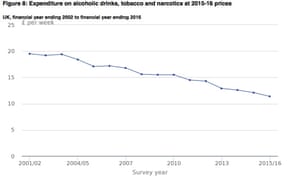
Weekly spending on booze, fags and narcotics fell below £12 for the first time since the survey began, partly reflecting the decline in the number of people who smoke.


On the other hand, households spent more than £45 a week on restaurants and hotels for the first time in five years, the Office for National Statistics said. The figures are for the year ending March 2016.


Jo Bulman, ONS statistician, said: “While overall household spending didn’t change much in real terms since the previous year, we did see some interesting shifts in the types of things people are spending their money on.”


Spending on alcohol, cigarettes and drugs has fallen below £12 a week


Spending on alcohol, cigarettes and drugs has fallen below £12 a week.

The report showed that households have still not fully recovered from the financial crisis, with family spending still below the levels seen before 2007.


Average total spending – adjusted for inflation – was unchanged from a year earlier at £528.90 a week. Low income families continued to spend a higher proportion of their spending on food and energy compared with people on higher incomes.


Transport was the biggest costs for households over the year, averaging £72.70 a week or 14% of spending. It was closely followed by housing – excluding mortgage interest payments and council tax – fuel and power, which averaged at £72.50 a week.


Average weekly family spending in the year ending March 2016


  • Transport: £72.70

  • Housing, fuel and power: £72.50

  • Recreation and culture: £68

  • Food and non-alcoholic drinks: 56.80

  • Restaurants and hotels: £45.10

  • Miscellaneous goods and services: £39.70

  • Household goods and services: £35.50

  • Clothing and footwear: £23.50

  • Communication: £16

  • Alcoholic drinks, tobacco and narcotics: £11.40

  • Health: £7.20

  • Education: £7


Britons spending more on food and leisure than booze, smoking and drugs

11 Ocak 2017 Çarşamba

Plans for seven-day GPs not thought out, says spending watchdog

Whitehall’s spending watchdog has criticised government plans to let patients see GPs every day of the week as poorly planned and likely to cost much more than weekday family doctor services.


In a new report, the National Audit Office said that Jeremy Hunt has set targets for rolling out the scheme – a key Conservative pledge – without evaluating the cost or working out where the money for it would come from.


Giving patients access to GPs from 8am to 8pm across the entire week by 2020 was championed by David Cameron while he was prime minister. Ministers also pledged to increase the number of GPs in England by 5,000 by 2020 – promises that have been backed by Hunt and Theresa May .


However, auditors who analysed the pledges found that the minimum additional capacity required by the new commitment equates to £230 per appointment hour at weekends and in the evening for every 1,000 registered patients. In GPs’ core contracted hours, from 8am to 6.30pm, the cost is just £154.


Hunt and the prime minister are under increasing pressure regarding serious problems within frontline services this winter. Ministers have been forced to deny claims by the Red Cross that the service is facing a “humanitarian disaster”.


Dr Chaand Nagpaul, BMA GP committee chair, said the government had been “irresponsible” in making uncosted pledges and must deliver extra investment to ensure patients could receive timely, safe care.


“Given that funding in general practice has failed to meet patient demand, NHS England and commissioners need to fully consider the consequences of their plans to extend access,” he said.


“To proceed without any sort of evaluation into the cost-effectiveness or the consequences of its objectives is irresponsible and could lead to much needed investment being spent on measures which don’t adequately meet patient needs,” he said.


The report, entitled Improving Patient Access, set out to evaluate how the Department of Health (DoH) and the NHS are tackling concerns around access to England’s 42,000 GPs in 7,600 GP practices.


The report found an apparent lack of knowledge within the DoH about the cost of extending GP surgery hours.


“We have not seen evidence that the department and NHS England fully understand the effect of this commitment to extend hours on continuity of care or other arrangements for providing general medical services outside of core hours,” it said.


Auditors, keen to establish the reality of extending opening hours, found that nearly half of all GP practices – 46% – close during core working hours, while 18% closed before 3pm one day a week.


Efforts to increase the workforce are at risk because GPs are leaving the service at a greater rate than they are entering it, thanks to shortfalls in recruitment, the report said.


Health Education England only filled 3,019 (93%) out of a target of 3,250 GP training places in 2016/17, according to auditors.


“The latest available data on part-time working in new GPs suggest there may be 1,900 fewer full-time equivalent GPs by 2020 than Health Education England had estimated there would be,” the report said.


The report sheds light on how patients registered with GP services open for fewer hours than average are more likely to attend accident and emergency departments. It found there were 22 more A&E attendances per 1,000 registered patients [8%] at practices open for 45 hours or less per week, after adjusting for differences in patients’ age and sex.


Meg Hillier MP, the chair of the public accounts committee, claimed that ministers were “trying to shoehorn in seven day access to general practice without a clear idea of the additional costs or benefits it will bring patients or taxpayers”.


Prof Helen Stokes-Lampard, chair of the Royal College of GPs, said the report “hits the nail on the head” by questioning the cost-effectiveness of forcing GP surgeries to deliver routine services seven days a week.


However, she went on to question why auditors failed to acknowledge the stresses that GPs are under or why surgeries may have to close temporarily during core hours for staff training, patient consultations or home visits.


“If general practice fails, the rest of the NHS collapses behind it. That’s why we urgently need NHS England to deliver in full on the pledges it has promised … swiftly and effectively, and for all governments in the UK to invest properly in the family doctor service, including more GPs,” she said.


The government claims that 17 million patients are already benefiting from evening and weekend appointments.


In response to the report, the health minister David Mowat said evidence shows that extended GP access is helping to relieve pressure on other parts of the health service such as A&E.


“We’re also relieving pressure on GPs by cutting red tape and investing an extra 2.4 bn to recruit 5,000 more doctors – in fact, fill rates for GP training this year were at a record level,” he said.


An NHS England spokesman criticised the NAO report for raising “the rather obvious fact” that it costs more to provide evening and weekend urgent primary care services than it does during Monday to Friday, nine to five.


“The alternative would be that patients simply head to A&E, with all the consequences that brings for more major cases.


“No one is suggesting each individual GP practice should offer this extended access, but there’s quite wide agreement that, as GP numbers expand, practices do need to club together to offer this service, a bit like the out-of-hours duty chemist rota.


“Across much of London, Manchester and a fifth of the country, GPs are already doing this, and more areas will follow next year,” he said.


Plans for seven-day GPs not thought out, says spending watchdog

12 Aralık 2016 Pazartesi

Social care spending falling below £554 minimum in most areas

Local authorities across the country are spending well below the £554 per week minimum amount recommended for the residential care of older people, new figures have revealed.


Statistics released by 90 councils across the country show that the vast majority fall well below a “floor price” cited by the Local Government Association (LGA) and reveal a worrying postcode lottery.


A number of councils, including Dartford, Wolverhampton, Leicester, Liverpool, Lancashire, Hampshire and North Lincolnshire, pay providers a local weekly rate well below £400, while others are above £600.


The figures come as the government prepares this week to allow local authorities to bring forward increases to council tax to help pay for social care, after warnings about a spiralling crisis.


The LGA called on ministers to use the autumn statement to plug a £1.3bn black hole in a system that they claimed was in a perilous situation, but Philip Hammond, the chancellor, failed to offer additional funding.


Ministers are preparing to respond to the resulting outcry by reforming an existing policy that allows local authorities to charge a precept of up to 2% a year on council tax to help fund social care.


The communities secretary, Sajid Javid, is expected on Thursday to allow councils to pull forward any increases that might have been made in subsequent years to help fill the current spending gap.


Hammond told MPs that the government felt it had offered a “substantial increase” in funding for social care, but acknowledged fears that this money was “back-end loaded” during the parliament, which had posed a challenge to local authorities.


“Local authorities will have to look at how they manage the situation to get from here to the very substantial increase in funding that will be available to them later in the parliament,” he said.


But he added that councils and the NHS had to play their part as well. “Money alone is not the issue. It is about effective cooperation and collaboration between the NHS and social services,” he said.


Others expressed frustration, with one minister telling the Guardian that there was a view that councils had “cried wolf” too many times with claims of crises over a lack of funding.


They suggested that some colleagues feared that too much extra money from central government would reduce local incentives for the NHS and social care systems to be better integrated.


Theresa May’s official spokeswoman argued that more needed to be done by local authorities among which there was a “significant variation” in performance.


“We know money alone is not the solution,” she said. “Many councils are providing high quality social care services within existing budgets.”


The figures on weekly rates came from a freedom of information request submitted by Labour MP Jess Phillips, who told parliament that Buckinghamshire paid £615 a week, while her local council in Birmingham had a rate of £436, with people being asked for top ups.


“Are nans and grandads in Buckinghamshire worth more than they are in Yardley?” she asked.


The MP was speaking after an urgent question was tabled by the shadow social care minister, Barbara Keeley, who blamed the Tories for the crisis and said raising council tax would not fix the postcode lottery.


“Labour has called for this vital service to be properly funded; the Tories should heed those calls but they’ve offered nothing, instead blaming everyone from councils to professionals for the mess of their own making. It will fall to a Labour government to rescue social care.”


Others in government suggested that there was a feeling that the NHS ought to take more responsibility for supporting social care as a means of preventing hospital admissions.


Cllr Isobel Seccombe, the LGA lead on social care, told the Guardian that councils had been praised for being innovative in delivering services but simply needed more money following years of cuts.


Social care spending falling below £554 minimum in most areas

17 Kasım 2016 Perşembe

Psychiatrists attack "scandal" of child mental health spending

NHS bodies are spending as little as £2.01 per child on mental health care for young people, despite the big spike in anxiety, depression and other serious problems among under-18s.


Psychiatrists claim the small sums being spent by GP-led clinical commissioning groups (CCGs) in England constitute a national scandal at a time when youth self-harm and suicide are rising.


“It is a national scandal that opportunities to prevent mental illness from occurring in childhood are being missed because of unacceptably low investment,” said Prof Sir Simon Wessely, the president of the Royal College of Psychiatrists.


“Our analysis shows that in many parts of the country, the proportion of money that NHS clinical commissioning groups are planning to spend on the mental health of our children and young people is negligible,” he added.


Luton CCG is spending the least amount of money for every under-18 in its area this year – just £2.01 – according to research into CCGs’ spending plans undertaken by the royal college.


Other CCGs spending notably small sums on children and adolescent mental health services (CAMHS) include the London boroughs of Enfield (£2.33), Tower Hamlets (£4.45) and Ealing (£6.39) and North Somerset (£5.89).


In contrast, Birmingham South and Central CCG has allocated the most for such services of any of England’s 209 CCGs – £135.85 – while the figure is £131.37 in Corby CCG and £126.76 in South Tyneside.


Ten CCGs are spending less than £10 a head this year treating the growing number of psychological and psychiatric illnesses which are occurring in under-18s. Twenty-five will spend £25 or less per head. Experts say that exam stress, body image issues, the negative effects of social media and pressure to succeed are among the key factors behind the increase in mental illness.


“The tiny sums being spent in some areas of the country are disgracefully low, particularly in light of sharply rising need,” said Luciana Berger, the MP and former shadow mental health minister who is now the president of the Labour campaign for mental health.


“This is yet further evidence of the gap between Jeremy Hunt’s continued promises for increased funding and the reality on the ground for our young people’s mental health services.”


The Guardian disclosed last month that NHS mental health services were treating 234,000 children and young people in England every month, and that the real figure was much higher because 40% of mental health trusts had not yet said how many patients under 18 they had.


Claire Murdoch, NHS England’s national director for mental health, said it was putting more money than ever before into CAMHS services.


“Improving mental health for children and young people is an absolute priority for the NHS, and councils, third sector organisations, schools and social care all have a role to play in this. The additional £1.4bn invested last year is helping us to make progress on our ambition to treat 70,000 more children and young people each year by 2021,” said Murdoch.


CCGs increased their spending on mental health overall by 8.4% during 2015-16, she added, but acknowledged that there was “variation around the country” in the exact sums invested.


But research earlier this week by the Education Policy Institute said much of the extra £250m a year which the coalition government pledged to put into CAMHS care during each of the five years of this parliament was not reaching the frontline. Specialist children’s psychiatrists in many areas agree.


Berger said that underfunding CAMHS care was “a false economy” because 75% of adults who developed mental health problems first exhibited symptoms in childhood, and problems left unaddressed cost the NHS more.


The NSPCC said the wide variation in the amounts put into CAMHS care reflected a “postcode lottery”.


A spokesman for the charity said: “It is a sad state of affairs if vulnerable children and young people are subjected to a postcode lottery when it comes to getting mental health support.


“It’s really concerning that some areas of the country will only spend a fraction on mental health services for children and young people compared to what others will spend elsewhere. It should go without saying that children and young people should be able to get proper support for mental health conditions regardless of where they live.”


  • In the UK, the Samaritans can be contacted on 116 123.
    In the US, the National Suicide Prevention Hotline is 1-800-273-8255.
    In Australia, the crisis support service Lifeline is on 13 11 14.


Psychiatrists attack "scandal" of child mental health spending

7 Ekim 2016 Cuma

Britain’s poor record on health spending | Letters

For a rich nation, we are asking our NHS doctors and nurses to provide excellent care with comparatively limited levels of support, and it is hardly surprising that standards of delivery in particular areas of care appear low (Nine out of 10 NHS groups failing on cancer care, ratings show, 4 October).


OECD figures for 2014-15 show that the UK ranks 15th out of 42 countries surveyed in public spending on health provision. The 14 countries ranked above the UK spend, on average, 25% more per capita than the UK. With 2.8 doctors per 1,000 inhabitants, the UK ranks 24th out of 39 countries surveyed by the OECD; and with 8.2 nurses per 1,000 inhabitants, the country ranks 17th out of 38.


It is in levels of bed provision, however, that the figures appear most disturbing. With 2.7 beds per 1,000 inhabitants, the UK ranks joint 27th of 35 countries surveyed. Thirteen countries have more than twice this number of beds per patient and four – Japan, Korea, Russia and Germany – have three times as many.


These figures reflect the relatively low priority that successive governments have given to public health provision over several decades.
David Wilcock
Dalston, Cumbria


I am dismayed to see the Guardian persisting with the popular conception that suffering from cancer somehow equates to having a fight (Actor Ben Stiller discloses prostate cancer fight, 5 October). Can we please remember that cancer is just one of a list of serious diseases, and that it does a profound disservice to cancer sufferers to infer that it is some sort of battle that you can either win or lose? As with all diseases, whether you get better or not is very often not in your control.


I, like Ben Stiller, had prostate cancer which was detected by a blood test and then treated by a radical prostatectomy. It was bad luck on me to have contracted the disease but I was fortunate to have been diagnosed at an early stage and to then receive the correct treatment with a successful outcome. I was not a winner. I had not won any fight but merely been well treated for a serious disease. If I had been less fortunate with my treatment would I be seen as a loser, one who had not fought hard enough?
Peter Clark
Nottingham


Join the debate – email guardian.letters@theguardian.com


Britain’s poor record on health spending | Letters

29 Haziran 2014 Pazar

The New Typical of Healthcare Spending


Beneath is the June 29th “Thoughts from the Frontline” newsletter, republished in total.


A rather fascinating shockwave came across the newsfeeds this week. I was truly doing a Tv interview when the host announced that GDP was down two.9% for the initial quarter. There was not considerably else I could do but note that that was a genuinely poor, ugly, terrible, not extremely great variety. But I had no true basis, with out any details in front of me, by which to recognize why the revision was so extreme. Certain, we have been all expecting a rather big revision, but what we acquired was the worst decline in 5 many years and the largest downward revision given that recordkeeping started. Later on, a fast perusal of the information on the BLS internet site revealed the culprits: exports and healthcare paying.


Final 12 months I was a single of the very number of who suggested that the implementation of Obamacare could cause a economic downturn (see more below). Such a suggestion was universally dismissed by all right-pondering economists, and for extremely good motives primarily based in sound financial theory, I may possibly include. But at times the actual globe neglects to adhere to our models and theories, and that was my concern.


Whilst I doubt we’ll see a recession – classically understood as two quarters in a row of negative GDP – this rather massive bump in the road provides a amount of educating opportunities. This week’s letter will search at the actual numbers and then, rather than try out to spin the numbers to fit some preconceived political agenda, we will examine what in fact happened in the paying data and why. And although it may possibly surprise some of you, I truly consider a few excellent issues did take place, factors I uncover encouraging.


Anytime I publish about healthcare it’s controversial, and I count on this letter will be acquired that way as well. Nevertheless, as I (and a lot of other folks) haveclearly established, the healthcare method in the United States is massively dysfunctional. We are basically investing also a lot income on healthcare and are on a path to investing an unsustainable sum of funds by the end of the decade. Items are going to alter no matter what. The Affordable Care Act (ACA or Obamacare) was one way to attempt to tackle the dilemma. The majority of the nation now feels this may not have been the very best way, but that genuinely doesn’t make any big difference. It is going to be the simple law for another 3 to 4 years. My occupation, at least in this letter, is not to examine policy but rather the economic results of the policies we have chosen to apply, and what these results may suggest for our investment portfolios.


GDP Shocker: a Drop of 2.9%!


First, let’s search just at the information as given to us by the BLS. US Q1 GDP Q/Q was revised considerably lower, to -two.9% on an annualized basis, down from the -1.% previously reported (which itself was revised lower from the +.1% initially reported) and nicely beneath the anticipated decline of -1.8%. How did we go from barely positive to down two.9%?


When the BLS offers us its initial estimate of preceding-quarter GDP, it is forced to use versions based on previous trends until the real data comes in. This is why we get two month to month revisions and in long term years will get even more revisions. (Sidebar: really don’t you want the US Bureau of Labor Statistics could be as good as their Chinese counterparts? The Chinese never have to revise their numbers. Naturally they are really excellent at this kind of point.)


And we all know that assumptions will sometimes bite you in the derrière. Search at this chart of projected healthcare paying from the authentic release of first-quarter GDP information in April. Discover that the projected investing was almost double what it had been just the preceding quarter and more than 4 times the preceding year’s typical. I’m not fairly particular how trend versions acquired to that quantity, but then I’m not a mathematician. In any occasion, here’s the chart, courtesy of Zero Hedge:


140628-01


Now quickly-forward to final week’s revision and observe that the healthcare paying number has dropped from the earlier quarter, not doubled. In reality, it dropped an huge six.4%. Rather than contributing .62% to GDP is it did in the fourth quarter of 2013, in Q1 2014 it subtracted .16% from GDP development.


140628-02


Just for the record, here are the actual numbers from the BLS information. Approximately two/3 of the unfavorable revision in Q1 GDP was from healthcare spending, and the rest was from falling exports and increasing imports (from an accounting standpoint, imports are a unfavorable in figuring GDP).


140628-03


I want us to seem swiftly at two charts to get some historical viewpoint on development in the US. The 1st is GDP quarter by quarter for the last seven many years. Recognize that only two quarters ago we had a 4.one% good quarter. For the duration of the 19 quarters since the present expansion began in June 2009, the economy has grown at an annual charge of two.1%, in contrast to the four.1% average in each and every other growth because 1960.


140628-04


In fact, rather than the comfy +three% from 1950 via 2000, development fell to +one.9% for the total decade of the aughts and has not risen appreciably above that in the last 4 many years. Right here is a chart displaying the rolling 4-quarter regular for GDP growth considering that 1980. With final quarter’s negative revision integrated, we’ve only grown one.6% for the last twelve months. Dude, who stole my productivity?


The New Typical of Healthcare Spending

15 Haziran 2014 Pazar

Children can be "damaged" by spending evening with father, kid specialist claims

She also mentioned when attorneys bid for their client to have overnight accessibility with their younger young children they are ignoring proof about the distressing and damaging affect on the youngster.


Leach said the rights of the kid have to usually outweigh those of the mother and father and extra: “It can be damaging to the youngster to divide time equally between the mothers and fathers.”


Ian Maxwell, from Households Want Fathers, informed the Independent on Sunday that society had moved on from traditional attachment concept when bonds amongst mother and little one have been observed as the strongest.


He additional: “The bond between fathers and youngsters is just as essential and we would query the evidence Ms Leach is citing for the primacy of the maternal bond.”


He stated her argument did not accord with typical sense was described her claims as “worrying.”


Leach has previously drawn criticism for her prior bestselling guide, Your Little one &amp Little one: From Birth to Age 5, published. In this she claimed only mothers could care properly for their kids.


She has also attracted controversy after she claimed scientific evidence showed that leaving a child to cry could impact the improvement of its brain and make it prone to anxiousness in later lifestyle.


It comes as a consider tank recommended that working fathers should be offered the opportunity to perform a bigger function in early parenting, by way of an entitlement to four weeks of paid depart following the birth of their child.


The IPPR argues that this doubling of the present paternity leave entitlement of just 2 weeks ought to be mixed with a doubling of the degree of shell out and paid at least the nationwide minimal wage.


They claim that a lot more than 400,000 functioning dads a year would benefit.


Only fifty five per cent of fathers get the complete 2 weeks off operate when their little one is born and a single third of eligible fathers do not get any of their statutory depart at all. Most state this is since they cannot afford to consider the entitlement.


The proposed 4 weeks of paternity depart would be a period of leave specifically for fathers that are not able to be taken by mothers. The IPPR also argues that operating dads need to also be ready to get twice as significantly paid time off to go with their parenters to hospital scans and midwife appointments.


Kayte Lawton, IPPR Senior Study Fellow, said: “New parents need to have time away from work to care for their younger children, and to strengthen their relationship with every single other at what can be a hugely satisfying but also extremely nerve-racking time. Nonetheless, this is usually difficult for fathers because they have restricted entitlements to paid depart, and so they typically assume the function of breadwinner while their companion is on maternity leave.


“Fathers who consider a lot more than a number of days off all around the birth of their child are much more most likely to be actively involved in raising their little one than those who do not. Fathers’ better involvement in family members existence can make it simpler for mothers to return to work after taking maternity depart, which assists to increase the family’s earnings and lessen the affect of motherhood on women’s careers.”


Children can be "damaged" by spending evening with father, kid specialist claims

19 Mayıs 2014 Pazartesi

GST on fresh food could price lives and include $1bn to wellness spending budget, say doctors

Scrapping the goods and companies tax exemption for fresh fruit and vegetables could expense lives and include a lot more than $ 1bn to the wellness spending budget, doctors have mentioned.


Analysis published in the Health-related Journal of Australia last yr estimated that fruit and vegetable consumption would decline by practically 5% if the GST have been broadened to include fresh meals.


“We determine that [this] could cost about a hundred,000 wellness existence-years above the lifetime of the 2003 Australian grownup population,” stated the University of Queensland authors Lennert Veerman and Linda Cobiac.


Feasible consequences included “an additional 90,000 cases of ischaemic heart illness, stroke and cancer” each year, rising healthcare fees by around $ 1.04bn.


Speaking on ABC radio on Tuesday, the Queensland Liberal senator Ian Macdonald named for the GST to be broadened to include fresh meals, in line with the unique model proposed by the former prime minister John Howard in 1998.


The idea was swiftly ruled out by Tony Abbott, who informed 2UE radio his view was that Australians “pay a lot more than ample tax already”.


The West Australian premier, Colin Barnett, final week also signalled his assistance for broadening the tax, saying it was “silly” to exempt fresh food from the GST whilst nonetheless applying it to foods in packages.


Public overall health advocates say a tax increase on healthier food would have “devastating consequences”.


“We know lower-income folks devote a massive proportion of their income on food, and it has the likely to be regressive at a time when the recent dietary survey showed that men and women are not eating almost ample fruit and vegetables,” explained Jane Martin, executive manager of the Obesity Policy Coalition.


“Price is a key driver around food determination-generating … We need to be delivering incentives for folks to eat far more healthily, not disincentives,” she said.


This was especially critical “given the cuts to prevention in the budget”, she mentioned, referring to the price range prepare to near the Australian Nationwide Preventative Well being Company.


In latest years poor diet regime and weight problems have overtaken tobacco as the leading trigger of condition between Australians.


GST on fresh food could price lives and include $1bn to wellness spending budget, say doctors

17 Mayıs 2014 Cumartesi

State leaders" emergency meeting in Sydney to discuss spending budget cuts

State premiers and territory chief ministers have been holding an emergency meeting on Sunday to talk about their response to the federal price range that included, between other measures, a shock $ 80bn lower to wellness and schooling funding tied to agreements produced underneath the earlier Labor government.


Many states have previously committed funding to applications, like preventive overall health measures, and now may possibly have to axe them.


Leaders of all the states and territories, except the West Australian premier, Colin Barnett, attended the meeting to examine their response to Tuesday’s budget cuts to health and schooling, and the proposed introduction of a $ 7 co-payment fee for a consultation with a common practitioner.


There is speculation the federal government’s proposals will force states to inquire for an enhance in the products and providers tax.


Just before the meeting, the Queensland premier, Campbell Newman, mentioned the cuts would lead to a reduction of 1,700 hospital beds in his state. “What [the federal government] are performing essentially is putting $ 80bn of heavy lifting onto the states when they are not ready to do it themselves,” he mentioned.


“It’s no secret I’m a strong supporter of [the prime minister, Tony] Abbott, but on this concern I’m fair dinkum. I want a honest deal for the states and territories,” Newman said.


The Victorian premier, Denis Napthine, railed towards immediate reductions in state funding, which he said would total $ 200m a year, from 1 July, for his state. “We also have concerns with the $ seven GP co-payment and the impact it will have on our emergency departments,” he stated.


“We also have grave worries about the $ 80bn to be eliminated from well being and schooling at the end of the forward estimates,” Napthine mentioned. “We’re content to accept the obligation for education and public hospitals, but possibly the government should transfer the collective funding with it,” he advised.


Napthine said his government was not interesting in increasing, or broadening, the GST but he suggested it might be applied to online purchases from overseas.


“I believe there should be a GST rethink and it must be that Victoria will get its honest share. We only get 88 cents in the dollar back. If we got a dollar back we would be $ one.5bn a 12 months greater off,” he said.


The Northern Territory chief minister, Adam Giles, said the spending budget cuts would result in fewer hospital beds and much less funding for schools in the territory.


“Fundamentally, from the Northern Territory’s level of see, we want to be responsible and accountable for wellness and education,” he said. Nonetheless, the territory would not have the cash to do so, with funding cuts having been revealed “at the last minute”, Giles explained.


The federal opposition leader, Bill Shorten, explained Abbott was forcing the states into a position whereby a rise in the GST was all but inevitable. “Abbott understands you can not consider $ 80bn from schools and hospitals without the states possessing to increase tax,” he informed the Victorian ALP conference on Sunday morning.


Speaking on ABC Tv, Abbott stated voters ought to have anticipated the cuts, in spite of pre-election guarantees to the contrary. Asked about the cuts, Abbott explained “money is not everything”. He dismissed ideas that the government had broken its “unity ticket” guarantee on the Gonski training reforms.


“We said we would honour the then government’s commitments over the then [four-yr] forward estimates,” he stated on the Insiders plan. “We stated that we weren’t bound by their pie-in-the-sky promises for the out many years [past the forward estimates]. We’ve just been totally upfront with the states.”


On Friday, the NSW overall health minister, Jillian Skinner, advised the state invite GPs to deal with patients in public hospitals, which would shift the value back on to the Commonwealth.


State leaders" emergency meeting in Sydney to discuss spending budget cuts

6 Nisan 2014 Pazar

Healthcare in Lesotho at chance as hospital threatens to bankrupt health spending budget - video

A Lesotho hospital which was developed utilizing public and private financing is criticised by Oxfam as it deprives bad, rural locations of funding. 51% of the African country’s well being budget goes to the consortium working the Queen Mamohato memorial hospital, which was designed to enhance healthcare requirements. Other countries in Africa are becoming warned not to repeat Lesotho’s error


Healthcare in Lesotho at chance as hospital threatens to bankrupt health spending budget - video

18 Mart 2014 Salı

Spending budget 2014: Britons enjoy wellbeing boost as life satisfaction costs enhance

Family running on beach

The trend of an bettering sense of wellbeing came in spite of the fall in true incomes in the Uk in recent many years. Photograph: Mix Photographs/Alamy/Alamy


Most Britons are satisfied with their lives, in spite of falling incomes, deteriorating overall health, and a mistrust of government in accordance to the newest official snapshot of daily life in the Uk.


A complete of 77% of grownups aged 16 and over explained they rated their lifestyle fulfillment at in between seven and ten out of 10 in 2012-13, the Workplace for National Statistics explained. It was an improve compared with 75.9% in 2011/12, as sentiment was boosted by a perceived fall in crime and enhanced fulfillment with living accommodation.


Nevertheless, the broader trend of an bettering sense of wellbeing came in spite of the fall in genuine incomes in the Uk in recent years, with wage growth reduced than the charge of inflation since mid 2008, with the exception of a quick period in 2010.


George Osborne is under stress to announce an increase to £10,500 in the individual revenue tax allowance from 2015 when he presents his most recent spending budget on Wednesday. A freeze on excise duty on petrol and diesel are also possible measures as the chancellor strives to display the government is backing hard-operating households in Britain.


Against the backdrop of falling living standards, the proportion of people content with their earnings fell from 57.3% to 52.9% among 2010/eleven and 2011/twelve, in the newest available data from the ONS.


The Labour party has identified the expense of residing crisis as a key battleground ahead of the 2015 election, vowing to freeze power expenses for 20 months if elected.


The outlook for personalized finances has actually picked up in current months, with inflation falling to below the Bank of England’s two% target for the very first time in far more than four many years in December.


Economists are predicting that wage growth will after once more outpace inflation by the end of 2014, easing the pressure on family budgets.


The ONS’s newest report on national wellbeing, primarily based on 41 measures, located that white and Indian females residing in northern Ireland and aged amongst sixteen and 19 or 65 and 79, have been most probably to be content material.


On the flip side Black/African/Caribbean/Black British males residing in Wales and aged 45 to 54 have been the least articles.


Britons surveyed by the ONS had been feeling much less healthier, with 58.six% of grownups happy with their health in 2011/twelve in contrast with 65.six% a 12 months earlier.


Less than a quarter of individuals surveyed trusted government in autumn 2013. Nonetheless, at 24%, this was more than the 22% in spring 2013, but significantly less than the 25% in autumn 2012.


The ONS said: “Internationally, the report shows that the United kingdom ranks above the EU common in regions such as existence satisfaction, recycling prices, trust in government and fulfillment with accommodation.


“The Uk are below the EU average in households producing ends meet, perceived overall health standing, and support if needed guidance about a severe private or loved ones matter.”


Spending budget 2014: Britons enjoy wellbeing boost as life satisfaction costs enhance

3 Mart 2014 Pazartesi

Spending much more time in the dark could improve hearing in old age | Dana Smith

Brain: neurons

If one area of our brain is broken, other neurons will typically get above to select up the slack. Scientists have located the brain retains this ‘plasticity’ even in old age. Photograph: Alamy


In the Marvel Comic Daredevil our eponymous hero is the victim of a radioactive spill, leaving him blind but also with an extraordinary heightening of his other senses, especially hearing.


For Julie, her superhuman hearing isn’t the result of radioactivity, but is rather due to the reorganisation of neurons in her brain, enhancing her sense of hearing right after the reduction of her sight at the age of sixteen.


The cells in our brain are plastic, not static, which means they can adapt and increase in accordance to our experiences. So if 1 region of your brain is damaged, disrupting a particular approach, other neurons in neighbouring regions will frequently get more than, increasing new projections or strengthening current ones to select up the slack. This has been most significantly shown in young children who have an entire hemisphere of their brain removed, generally to deal with excessive situations of epilepsy. Miraculously, these kids develop up to perform practically entirely typically – strolling, working, talking and thinking – going through school and even on to university as if absolutely nothing have been out of the ordinary.


Co-ordinated reorganisation among our auditory and visual areas is particularly effective, and it is this type of cross-sensory plasticity that has led to tales of enhanced hearing and even extraordinary musical ability in folks who are blind (Stevie Wonder, for instance), the auditory pathway compensating for disability in the visual circuit.


Now, new analysis has shown that this cellular sensory adaptation can take place with temporary disability in outdated age, suggesting our cells are even far more malleable than previously considered, and opening the door for possible non-invasive therapies for hearing loss.


Published in Neuron this month, US scientists from Johns Hopkins University in Baltimore and the University of Maryland identified evidence of enhanced auditory capacity and cell firing in mice that had been subjected to visual sensory deprivation for a week. Very first, the researchers locked the mice in a darkened chamber for six to eight days. Following re-exposing them to light, the researchers played the mice a series of tones, evaluating their responses to these of a group of manage mice that had merely been hanging out in their cages throughout this time.


Though probably unpleasant, the time in the visual sensory deprivation chamber apparently did the mice some very good, at least as far as their hearing was concerned. Those that had been “blinded” for a week showed greater action in response to the tones in neurons in the auditory cortex that originated in the thalamus, a kind of way-station in the brain that processes sensory information and therefore may possibly support integrate responses from both our eyes and our ears.


The cells fired more strongly and quicker, demonstrating that the auditory cells in the blinded group had been much more sensitive to the noise than the same cells in the normal group. The visually deprived mice have been also greater at detecting quieter tones. In addition, these super-hearing mice have been greater at discriminating among different varieties of tones, meaning their perception of pitch was also improved.


Importantly, this analysis was carried out in adult mice, exhibiting that this sensory reorganisation can still happen in older animals. Previously, researchers considered that neural plasticity in these thalamo-cortical cells was only available while our brains have been nonetheless building. Emily Petrus, a graduate pupil at Johns Hopkins University who was first writer on the paper, informed me: “Most people considered these synapses stopped shifting soon after a crucial age, but we show that cross-modally you do nonetheless see a adjust. These findings go towards the dogma that this element of the brain is aplastic [unchanging].”


In other phrases, there is hope for translating these findings into new treatment options for ageing grownups going through hearing loss. Although locking individuals in a dark room for a week most likely isn’t a possible treatment now, shorter spells of sensory deprivation could attain the same results. In reality, past analysis suggests that getting blindfolded for only 90 minutes can lead to enhanced hearing.


For now, the advantages are only temporary – the mice returned to their regular abilities right after a week in the light. But according to Petrus the likely is there for more lengthy-term changes, notably for men and women who are struggling to understand how to use cochlear implants right after going deaf.


“You have to force the brain to do anything it does not normally do. And if you do it long enough – if you have been put in the dark long adequate and forced to use the cochlear implant – you could understand how to use it. After the brain realises it is important, it will commence to adapt.”


Spending much more time in the dark could improve hearing in old age | Dana Smith

29 Ocak 2014 Çarşamba

Suicide charges reveal vast inequalities in spite of mental well being spending rise

Government paying on psychological health has enhanced, but charges of mental illness and suicide continue to be significantly greater for distinct communities than the basic population, a productivity commission report has explained.


Common government paying on psychological wellness has elevated from $ 242 to $ 309 per person in the previous seven years, the report on government services’ appear at the overall health sector mentioned.


The states, which are responsible for “the funding, delivery and management of specialised public psychological overall health services”, contributed 63.3% of the approximate $ 7bn genuine government recurrent expenditure on mental well being companies in 2011-twelve. All states and territories except South Australia and Tasmania saw an enhance in spending in 2011-twelve compared with the previous yr.


The report explained a large or rising proportion of spending on local community-based services, which contains ambulatory care, grownup residential providers and non-government organisations, was “desirable”.


“More appropriate mental well being treatment options can be provided by encouraging the remedy of patients in local community-primarily based settings, rather than in standalone psychiatric hospitals and public non-psychiatric) hospitals,” it said.


Nationally, the proportion of paying on community-based services enhanced more than successive years from 2007-08 to 2011-12. Even so, state-by-state breakdowns exposed decreased proportional investing in New South Wales, Tasmania, and the Northern Territory in 2011-twelve.


Elizabeth Priestley, the chief executive of the Mental Wellness Association NSW, told Guardian Australia the lessen in proportional paying in the state could be partly explained by cost savings from the closure of hospital beds not becoming retargeted to local community-based mostly solutions.


“The Psychological Health Association has been a quite powerful supporter of local community-based solutions, and we’re also supporters of closing down hospital beds and treating men and women in the community,” she mentioned.


“People want to keep at home, they do not want to go to hospital. One particular of these troubles is of program stigma, and acquiring to the stage where you are so sick you require hospital care, and being handled against your will can be very distressing.”


Without local community-primarily based assistance, which Priestley stated comes with a large degree of believe in and comprehending in between patients and suppliers, men and women with significant mental illness can finish up paying their lives in and out of hospital.


“One of the arguments for community-based companies is that really delivering these services is going to be more affordable. An preliminary outlay of cash will be essential – most likely a lot more than keeping beds open. But in the prolonged phrase, folks will be capable to remain properly for considerably longer,” she stated.


“In several techniques, and at a lot of times, they’ll be ready to reside a fairly standard lifestyle.”


The report also highlighted information on suicides between Australians and reiterated the massive gaps amongst groups based mostly on age, area and Indigenous standing.


Between 2007 and 2011, 11,600 deaths by suicide were recorded. The charge was much larger for males, equivalent to 16.five per a hundred,000 males, compared with four.9 for females.


For people aged 75 to 84, and 85 many years or above, the male suicide price was about five or six occasions the female charge.


The Northern Territory had a significantly increased suicide price than other states and territories, with a lot more than 20 deaths to suicide per a hundred,000 men and women. Charges in NSW, the ACT and Victoria were all underneath 10.


Nationally, the suicide charge in between 2007-2011 was greater in rural areas, with 13.one suicides per one hundred,000 folks in contrast with 9.6 in capital cities. Inside the state-by-state breakdown NSW, Victoria and South Australia had greater prices in urban centres.


The national charge of suicide amongst Indigenous Australians was 22.3 per a hundred,000 in contrast with ten.3 amongst non-Indigenous Australians. Rates have been significantly greater in each state and territory reported with the largest gap in Western Australia which had 35.9 suicide deaths per a hundred,000 Indigenous Australians in contrast with 12.two non-Indigenous.


Information from Victoria, Tasmania and the ACT was not incorporated due to inadequate levels of identification or numbers of deaths.


• If you are in distress and would like assistance, please get in touch with Lifeline 13 eleven 14 BeyondBlue 1300 224 636 or Mensline 1300 789 978 for support and data.


Suicide charges reveal vast inequalities in spite of mental well being spending rise

18 Ocak 2014 Cumartesi

The Hazards of Spending Also Considerably Time Indoors

Although we heard a lot of public well being warnings in the previous century about the dangers of also a lot publicity to UV radiation from the sun, the reality is that such publicity only accounts for .1% of the world’s condition burden, according to the report by the Globe Wellness Organization.


On the other hand, the exact same report states that a much increased rate of the world’s yearly condition burden may be a result of too minor publicity to UVR. There are numerous dangers concerned in investing the bulk of your days indoors, from the most clear Vitamin D deficiency, to lack of physical exercise resulting in fat issues, to even poor eyesight in youngsters. Right here are just a few examples of the dangers of not obtaining your typical dose of sunlight and exercise that comes with investing time outside.


Lack of Vitamin D


Not receiving ample publicity to sunlight can lead to Vitamin D deficiency, frequently referred to as the sunshine vitamin. This can consequence in impaired absorption of phosphorus and calcium by your physique, foremost to poor bone health, compromised metabolic functions and a number of other problems. This kind of deficiency can be the cause behind rickets condition, characterized by skeletal deformities. Minimal Vitamin D levels in the bloodstream are also linked with cognitive impairment, cardiovascular disease, asthma and even cancer.


Cancers


Even though skin cancer is usually linked to also considerably publicity to sun radiation, scientists say that other cancers can be related with as well minor of sunlight publicity. A study published in 2007 in the American Journal of Clinical Nutrition, for illustration, showed that taking two to four instances of the everyday requirement of Vitamin D3 and calcium led to a lower incidence charge for all cancers, reduced by as considerably 50% to 77%. The review observed a group of submit-menopausal girls in excess of the period of four years.


Myopia


An rising variety of adults have poor eyesight these days, and scientists think that not paying enough time outside as children is a major contributing aspect to this. The journal Optometry and Vision Science published a series of studies on the triggers of myopia, generally known as short-sightedness.


Their conclusions indicate that the global enhance in myopia circumstances can be partially attributed to the fact that youngsters these days are expanding up in environments exactly where their eyes are not educated to see distant objects. In these crucial growth stages of their eyesight, kids are learning to emphasis only on close by objects, which they are limited to when investing the vast majority of their days indoors.


This currently prospects to a 20% fee of short-sightedness amid 12-year-olds in the U.S., and as much as 30% to 50% in the Asian metropolitan places. The fee spikes even increased by the time young adults attain the age of 20.


Book: The Nature Principle: Reconnecting with Life in a Virtual Age


This book by writer Richard Louv (who also authored Final Youngster in the Woods) urges us to modify our vision of the potential and reminds us that if we reconceive environmentalism and sustainability, we will evolve into a larger motion that will touch each part of society.


Much more (from Amazon):


This New Nature Movement taps into the restorative powers of the all-natural world to boost psychological acuity and creativity market well being and wellness develop smarter and much more sustainable companies, communities, and economies and ultimately strengthen human bonds. Supported by groundbreaking analysis, anecdotal proof, and compelling private stories, Louv delivers renewed optimism while tough us to rethink the way we reside.


*Use the affiliate website link above to see evaluations on this book


An additional book of curiosity: I Love Grime!: 52 Pursuits to Help You and Your Kids Learn the Wonders of Nature by Jennifer Ward, Richard Louv and Susie Ghahremani


Other Issues


In his well-liked book The Nature Principle, Richard Louv talks about a host of other issues brought on by the “nature deficit disorder,” that several men and women are going through these days in their quickly-paced, technologies-packed lives. He describes various adverse effects of not spending time outdoors, which includes obesity, heart condition, depression and nervousness, between other individuals.


Sources for this article consist of:


The Hazards of Spending Also Considerably Time Indoors