'booze etiketine sahip kayıtlar gösteriliyor. Tüm kayıtları göster

16 Şubat 2017 Perşembe

Britons spending more on food and leisure than booze, smoking and drugs

Britons are spending less on cigarettes, drugs and alcohol and more on eating out and hotels, according to the latest official snapshot of family spending.


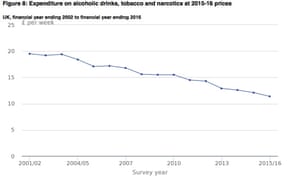
Weekly spending on booze, fags and narcotics fell below £12 for the first time since the survey began, partly reflecting the decline in the number of people who smoke.


On the other hand, households spent more than £45 a week on restaurants and hotels for the first time in five years, the Office for National Statistics said. The figures are for the year ending March 2016.


Jo Bulman, ONS statistician, said: “While overall household spending didn’t change much in real terms since the previous year, we did see some interesting shifts in the types of things people are spending their money on.”


Spending on alcohol, cigarettes and drugs has fallen below £12 a week


Spending on alcohol, cigarettes and drugs has fallen below £12 a week.

The report showed that households have still not fully recovered from the financial crisis, with family spending still below the levels seen before 2007.


Average total spending – adjusted for inflation – was unchanged from a year earlier at £528.90 a week. Low income families continued to spend a higher proportion of their spending on food and energy compared with people on higher incomes.


Transport was the biggest costs for households over the year, averaging £72.70 a week or 14% of spending. It was closely followed by housing – excluding mortgage interest payments and council tax – fuel and power, which averaged at £72.50 a week.


Average weekly family spending in the year ending March 2016


  • Transport: £72.70

  • Housing, fuel and power: £72.50

  • Recreation and culture: £68

  • Food and non-alcoholic drinks: 56.80

  • Restaurants and hotels: £45.10

  • Miscellaneous goods and services: £39.70

  • Household goods and services: £35.50

  • Clothing and footwear: £23.50

  • Communication: £16

  • Alcoholic drinks, tobacco and narcotics: £11.40

  • Health: £7.20

  • Education: £7


Britons spending more on food and leisure than booze, smoking and drugs

31 Aralık 2016 Cumartesi

New Year"s Eve partygoers told to beware of fake booze

New Year’s Eve partygoers are being urged to avoid cheap fake booze containing potentially lethal ingredients found in antifreeze.


The warning in the run-up to the UK’s biggest drinking night of the year comes from the Local Government Association (LGA), which represents more than 370 councils in England and Wales. It follows recent council seizures of counterfeit vodka laced with highly dangerous chemicals found in cleaning products and paint solvent.


After a series of raids on suspect premises leading up to New Year’s Eve, council trading standards teams are also warning sellers of illegal alcohol that they face confiscation of their stock, prosecution and being stripped of any relevant licences.


As people stock up on alcohol at home and attend major celebrations in towns and city centres, councils are issuing safety advice to help people avoid harm from dangerous alcohol containing lethal chemicals such as chloroform – which can induce comas – and high levels of methanol which is a key ingredient in antifreeze. Drinking the bogus booze can lead to vomiting, permanent blindness, and kidney or liver problems, and can be fatal in extreme cases.


The LGA is urging shoppers to look out for telltale signs of fake booze. These include unfamiliar names or names mimicking recognised brands, crooked labels, spelling mistakes, and very low prices that seem “too good to be true”. Drinkers being served vodka in pubs and clubs should also smell the drinks as fake vodka will often smell of nail varnish.


“New Year’s Eve is the biggest drinking night of the year but people need to avoid suspiciously cheap, fake alcohol at all costs because it could seriously harm your health, and even kill you,” said Simon Blackburn, a councillor and chair of the LGA’s Safer and Stronger Communities Board.


“Counterfeit alcohol also harms legitimate traders and threatens livelihoods, with the black market trade helping to fund organised criminal gangs. Council trading standards teams have been cracking down on businesses selling fake alcohol and rogue sellers should think twice about stocking these dangerous drinks as we will always seek to prosecute irresponsible traders.”


In a prosecution brought by Halton borough council, a taxi driver had his vehicle seized and was given a suspended sentence after counterfeit vodka was found in his taxi. Twenty-six litres of fake vodka – found to be unfit for human consumption – and 108 bottles of illicit wine were seized following a search of a storage unit.


Separately, Lincolnshire county council’s trading standards officers helped seize 3,570 litres of beers, wines and spirits – most believed to be counterfeit – from 20 premises as part of an operation with police and HMRC.


Drinking industrial-strength isopropanol – which is more commonly found in antifreeze, lotions and cosmetics – can lead to dizziness, vomiting, anaesthesia and even blindness, and can leave someone in a coma. Other substances found in fake bottles of spirits include ethyl acetate, which is normally found in glues, nail polish removers and cigarettes, and can lead to organ damage.


New Year"s Eve partygoers told to beware of fake booze

21 Ekim 2016 Cuma

If the booze doesn’t get you, the crisps will | Letters

As a retired brewer I can confirm that all alcoholic beverages are to a degree fattening (Letters, 18 and 19 October). Alcohol is produced during fermentation by yeast breaking down short chain carbohydrates (primarily glucose) to produce ethyl alcohol and carbon dioxide. At the end of fermentation there is always a residue of carbohydrate carried forward to the final product. This together with the complex degradation of alcohol by the liver to produce further carbohydrate gives the beverage its high calorific content.


I am undergoing alcohol-free October and can provide evidence of the above. In three weeks of no alcohol and eating the same amount as before I have lost 10lbs in weight. It is not, as my wife believes, an indication that I normally consume far more than 21 units of alcohol a week. Roll on 1 November.
Frank Smith
Aspatria, Cumbria


Colin Purdom says (Letters, 18 October) that alcohol contains no calories. The trouble is though, my glass of wine tends to lead to “You know some cheese and biscuits would go nicely now” followed by “Mmm think I’ll just finish off that bag of crisps from last night”; and then, “Those two sweet biscuits left at the bottom of the pack would finish things off perfectly”. So I reckon my glass of wine “contains” at least 300 calories.
Peter Hanson
Exeter


Alcohol does make you fat, but not directly. The liver detoxifies it and what is left is used as a fuel for metabolism in the body. This displaces the fat in food which would otherwise be used to fuel metabolism, so that is stored and you get fat. Pity really.
Joe Millward
Emeritus professor of human nutrition, University of Surrey


Jo Gibson’s explanation (Letters, 19 October) is only partly correct. The acetate formed from alcohol is also the two-carbon unit from which all fatty acids are made. All the acetate formed from carbohydrates, some amino-acids and alcohol is treated in the same way by the body, either oxidised to produce energy as ATP (adenosine triphosphate), or, if there is too much acetate from whatever source, the excess is converted into fat. Fat is the major energy store of the body and we need it but, as with many things, too much of it is the problem.
Ian Skidmore
Welwyn, Hertfordshire


Join the debate – email guardian.letters@theguardian.com


If the booze doesn’t get you, the crisps will | Letters

16 Haziran 2014 Pazartesi

Drunks ought to be handled in "booze buses" to ease A&E overcrowding

They referred to as for option schemes to be set up, in city centres, or up coming to casualty units.


Anthony McGeown, a nurse from Higher Glasgow, said: “It is reported that every single year 2 million visits to Accident &amp Emergency in England and Wales are due to alcohol connected illness or injury.”


The nurse suggested that Britain should take into account introducing “drunk tanks” – holding facilities launched in many parts of the United States, to accomodate individuals who are heavily intoxicated – or broaden the use of “booze buses” which have been attempted in some British cities in the course of the Christmas season.


Mr McGeown stated: “With the drunk tank tank concept, those who are intoxicated can sober up – without the need for being arrested or hospital care.”


Dr Peter Carter, RCN chief executive, explained pilot schemes ought to be produced to examine options to A&ampE.


He mentioned as well several patients had been struggling worse care, or being treated in frightening surroundings, due to the fact they were surrounded by other individuals who were drunk and sometimes violent.


Dr Carter stated: “Folks that come in inebriated and unconscious they need a whole lot of nursing care and that detracts from care currently being given to other people, but also there are examples of people coming in an aggressive state, perhaps getting been in a battle, blood all over the place, careering all around the area – it can make items extremely tough.”


He stated pilot schemes would need to test regardless of whether choices have been secure, warning that they would need to be ready to identify health care emergencies, this kind of as head injuries.


Dr Carter mentioned: “If you can locate techniques that folks can be securely cared for without going to A&ampE then that is very good, but this will not be low cost because you will need to have diagnostic facilities.”


The head of the RCN warned that Britain now has the highest ever levels of alcohol relevant sickness, this kind of as liver disease, with A&ampE units now dealing with higher numbers of drunks each and every evening of the week.


He stated: “There was a time this was a Friday and Saturday evening phenomenon now it is round the week.”


“Booze buses” have been tried in London, Cardiff, Norwich and York in the course of the Christmas season, with ambulance personnel and 1st assist volunteers assisting inebriated party goers.


Uwem Otong, from the south east Northern Ireland branch of the RCN, stated: “The reality stays that alcohol intoxication is not an accident. A&ampEs in all countries are under intense strain. At a time in which the NHS is dealing with financial burden, it is essential that services are channeled appropriately.


He said it was a “waste of sources” for patients struggling from alcohol-associated difficulties to be sent to A&ampE.


“Somebody takes alcohol being aware of exactly what he or she is doing. With that in thoughts I would propose a circumstance in which people who are intoxicated are moved to a diverse environment to give area to these who are actually possessing accidents, or individuals that demand emergency care.”


Numerous nurses raised issues that producing separate units could suggest that medical problems went undetected, with head injuries simply mistaken for intoxication if not examined closely.


Some recommended new solutions need to be set up near to A&ampEs.


Nykoma Hamilton, from the RCN’s Fife branch, stated: “Sadly this topic is not new. We have witnessed a growth in the binge consuming culture across the Uk.”


She suggested that finding units up coming to A&ampE could relieve strain on units, even though making sure emergency care and exams were shut at hand.


“Absolutely A&ampE currently being complete of drunk men and women will slow down remedy times – there has to be a better remedy. So what about setting up an region adjacent to, but separate from A&ampE at the weekends, when it’s the most hectic, staffed by nurses?”


Highlighting study exhibiting that drunk patients are the principal trigger of violence in hospitals at weekends, growing staff workload, waiting times and patient anxiety, she said: “This need to have a wearing impact on employees morale – they did not go to perform in A&ampE just to deal with a bunch of drunk men and women every weekend who have fallen more than.”


A Department of a Health spokesman mentioned: “Alcohol locations a heavy burden on the NHS and costs around £3.5 billion each year.”


He said the nearby NHS has the freedom to investigate how to make improvements to services.


* Nurses need to be informed to stop waking up patients with noisy chatter or needless interruptions, the conference heard.


Delegates said too several sufferers were becoming subjected to “sleep deprivation” simply because of loud conversations, noisy surroundings and needless wake-up calls – with sufferers even becoming woken up to be provided sleeping drugs.


Drunks ought to be handled in "booze buses" to ease A&E overcrowding
30 Mayıs 2014 Cuma

The "booze Britain" stereotype is flagging now let"s finish it off | James Nicholls

pub and bar beer glasses

‘The dynamics of drinking culture are complex, but the political query is whether decreasing connected harms is a job for government, civil society or the alcohol industry.’ Photograph: Yui Mok/PA


This week the Well being and Social Care Details Centre released its most recent update on alcohol consumption and harm in the United kingdom. It showed that alcohol consumption in Britain was continuing to fall, as it has been for a amount of many years, but also that the harms caused by alcohol were starting up to show indications of dropping as well. These encouraging trends recommend we might be seeing a change in some facets of British consuming culture, but how most likely are they to be sustained?


To read a lot of the news reporting on alcohol, you might be forgiven for pondering the British are an incorrigible nation of boozers – and that most of these drinkers are young girls who finish up lying on benches or kerbs, such is the ubiquity of stock pictures in reporting nowadays. The actuality is considerably a lot more complicated.


For most of the 20th century, Britons drank moderately in comparison to our Victorian forebears and our continental neighbours. British consuming usually involved a lot more of the rapid binge than the long soak acquainted in parts of the continent, but our all round consumption was comparatively minimal.


Then, in the final two decades of the 20th century, there was a transformation. Amongst 1980 and 2004, per capita consumption in Britain increased by all around thirty%, a massive proportion of which was due to a large enhance in wine drinking between both men and women. Wine revenue rose more than 150% in that time period, even though beer consumption fell. We began consuming more at house than ever prior to, which meant a lot more corks popping at dinner parties but also more pub closures. Supermarkets led the way in selling the notion that alcohol was an indispensable part of the weekly store. All this added up to a cultural shift within a generation.


Even so, since 2005 average consumption has fallen to amounts close to people in 1992, a trend that appears most pronounced among the typically vilified sixteen-24 age group. The recession has been one particular factor in lowering consumption – people just have less money to devote on booze – but it is by no signifies the only one particular. For reasons that are not entirely clear, there has been a downswing in consuming amongst the younger age group.


Alcohol-related deaths have also dropped slightly, down 4% given that 2011. To place that fall in context, even though, alcohol-relevant mortality is still 19% larger than in 2001. That is not anything any society can be complacent about. In addition, there are many regional and social variations: consumption and harm degree are lowest in London, and significantly greater in Scotland, the north-west and the north-east.


Another issue is inequality. These in the poorest communities are numerous occasions much more probably to suffer alcohol-associated overall health problems – regardless of consumption becoming relatively increased, on typical, between the far more affluent – and in a number of deprived places harm charges continue to rise. There are a lot of plausible explanations for this – poor housing and diet regime, pressure, limited entry to healthcare, various patterns of consumption, larger prices of dependency – but the reality is that we don’t entirely comprehend why.


Alcohol Research United kingdom, with Liverpool John Moores University, is funding study into this “alcohol harm paradox” which will, hopefully, offer some answers. We are also supporting a study of the most severely dependent drinkers in Glasgow and Edinburgh. The part of cheap white cider and price reduction vodka in maintaining the habit of these desperately addicted individuals (many of whom have died in the course of the research) is an indictment of the firms that continue to make and supply this kind of products.


The dynamics of consuming culture are complex, but the political question is no matter whether minimizing related harms is a work for government, civil society or the alcohol sector. This government, getting initially manufactured fantastic play of its commitment to intervention, has opted for sector self-regulation. Minimal unit pricing has been abandoned, and the a lot-vaunted early-morning restriction orders and late-evening levies have been left to wither on the vine as trade bodies challenge neighborhood authorities across the nation when they try out to get them introduced.


We have also been advised that the alcohol industry’s “accountability deal” is working. Some 253m units – a quarter of the 1bn the industry pledged to remove from the market place among 2012 and 2016 – have been lower in 2012-13. Nonetheless, while a billion units sounds like a lot, our consumption yearly is closer to 50 billion. Furthermore, the vast bulk of that fall resulted from worldwide brewers cutting the power of their foremost lagers from five% alcohol to four.8% by volume to minimize the quantity of duty paid to the exchequer. It has subsequently been sold as a shining illustration of corporate social responsibility, and an illustration – contrary to the actuality – of why voluntary regulation is much more efficient than government policy.


It’s constantly tempting so say, “Ah the British drinker – plus ça modify“. In reality, considerably adjustments, and it modifications in response to vogue, advertising and marketing and economic trends – but also government action. Judging from their vociferous campaigns towards minimum alcohol pricing, alcohol taxation and stricter licensing powers, considerably of the market wants the recent declines in consumption to be stemmed. The question for our society is whether or not we agree – and that implies generating tough selections about our challenging relationship with alcohol.


The "booze Britain" stereotype is flagging now let"s finish it off | James Nicholls