Revealing etiketine sahip kayıtlar gösteriliyor. Tüm kayıtları göster

13 Şubat 2017 Pazartesi

Tipping point: revealing the cities where exercise does more harm than good

Who says exercise is always good for you? Cycling to work in certain highly polluted cities could be more dangerous to your health than not doing it at all, according to researchers.


In cities such as Allahabad in India, or Zabol in Iran, the long-term damage from inhaling fine particulates could outweigh the usual health gains of cycling after just 30 minutes. In Riyadh, Saudi Arabia, this tipping point happens after just 45 minutes a day cycling along busy roads. In Delhi or the Chinese city of Xingtai, meanwhile, residents pass what the researchers call the “breakeven point” after an hour. Other exercise with the same intensity as cycling – such as slow jogging – would have the same effect.


“If you are beyond the breakeven point, you may be doing yourself more harm than good,” said Audrey de Nazelle, a lecturer in air pollution management at Imperial College’s Centre for Environmental Policy, and one of the authors of the report.


The study, originally published in the journal Preventive Medicine before the World Health Organization’s latest global estimates, modelled the health effects of active travel and of air pollution. They measured air quality through average annual levels of PM2.5s, the tiny pollutant particles that can embed themselves deep in the lungs. This type of air pollution can occur naturally – from dust storms or forest fires, for example – but is mainly created by motor vehicles and manufacturing.
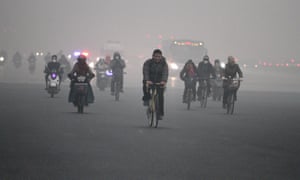


People cycle in heavy smog in Beijing.


People cycle in heavy smog in Beijing. Photograph: Imaginechina/Rex/Shutterstock

Breathing polluted air has been linked to infections including pneumonia, ischemic heart disease, stroke and some cancers. The Institute for Health Metrics and Evaluation’s Global Burden of Disease study ranks it among the top risk factors for loss of health.


The report in Preventive Medicine assumed cyclists moved at speeds of 12/14kph, with health benefits calculated in a similar way to the WHO’s Heat assessment tool. It also assumed cyclists used roads with double the background levels of air pollution, which may underestimate how poor air quality is in many developing world cities: for example, a study in Lagos found five out of eight sites exceeded Delhi’s annual PM2.5 concentration.


People commuting to work along busy roads in a city with average annual background PM2.5 levels of 160 micrograms per cubic metre (μg/m3) or above will pass the breakeven point at just 30 minutes a day, the study found. Using the WHO’s latest global estimates, published in May, those levels are only reached in Zabor, and in Allahabad and Gwalior in India – although many large cities in the developing world do not accurately measure air pollution so were not included in the WHO database.


Breakven point for different levels of cycling and air pollution

Fifteen cities (see map above and table below) have annual mean PM2.5 levels of 115μg/m3 or above, according to the WHO data, so the breakeven point is reached after an hour of active travel. Fine particulate levels above 80μg/m3 were found in 62 cities, making cycling more harmful than beneficial after two hours.


The study found people in western cities such as London, Paris or New York would never reach the point where PM2.5 air pollution’s negatives outweigh exercise’s positives in the long term.


“The benefits of active travel outweighed the harm from air pollution in all but the most extreme air pollution concentrations,” said Nazelle. “It is not currently an issue for healthy adults in Europe in general.”


London’s annual average PM2.5 pollution was estimated at 15μg/m3 by the WHO – above the WHO’s guideline of 10, but still at a level at which the study estimated active travel would always be beneficial. Paris had ambient PM2.5 levels of 18μg/m3, while New York had 9μg/m3.


However, the study did not consider the health impacts of short-term spikes in PM2.5 pollution, or take into account the effect of exercising in air containing larger PM10 particulates, ozone, or toxic nitrogen oxides (NOx) from diesel cars.


London mayor Sadiq Khan issued his first “very high” air pollution alert last month when air in the UK capital hit the maximum score of 10 on the Air Quality Index, equivalent to PM10 in excess of 101μg/m3. NOx pollution causes 5,900 early deaths a year in the city, and most air quality zones across Britain break legal limits.


“This is the highest level of alert and everyone – from the most vulnerable to the physically fit – may need to take precautions to protect themselves from the filthy air,” Khan warned.


Air pollution – cities where harm from exercise outweighs benefits – table

Guardian Cities is dedicating a week to investigating one of the worst preventable causes of death around the world: air pollution. Explore our coverage at The Air We Breathe and follow Guardian Cities on Twitter and Facebook to join the discussion


Tipping point: revealing the cities where exercise does more harm than good

17 Ocak 2014 Cuma

The "Conversion Fee" On Healthcare.Gov: The Obamacare Variety Nobody"s Speaking About Might Be The Most Revealing

When officials at the Department of Overall health and Human Services announced the most recent Obamacare enrollment figures earlier this week, they centered on a single brag stage amidst otherwise discouraging information about the program’s progress.


In accordance to government tallies, 44.five million people known as or visited state and federal internet sites they explained, presumably indicating broad curiosity in the new benefit.


But we also know that only two.two million individuals have signed up for Obamacare. Factoring in all of the professed web visitors, this would suggest that the variety of people who signed up (but did not necessarily pay) for an Obamacare health strategy quantities to a conversion rate of significantly less than five% of the Obamacare web visitors.


And this is among buyers who had the patience to navigate the faulty Obamacare internet portals.


This data strongly suggests that eligible customers, who consider the time to kick the tires on Obamacare, don’t like the products that they are obtaining in the exchanges. They are browsing, but not acquiring.


In the lexicon of the World wide web, “conversion rate” quantities to the quantity of effective actions on a internet site (e.g. an e-commerce buy) divided by the visitors to the site. Obamacare’s fee of converting net site visitors into clients would area the plan on par with the click via costs enjoyed by Net banner adverts, and nicely below revenue figures on other e-commerce internet sites.


Taking into consideration the reality that most of the men and women who visited the exchange portals weren’t mere curiosity seekers (but are in fact buying for overall health insurance coverage coverage) you get a sense how dismal these figures are.


E-commerce websites report that, on regular about eight% of visitors to a site will add a item to their basket.  For specialist services web sites that are promoting specialized goods or companies, the prices can be considerably greater. Data exhibits that conversion rates for professional financial providers run at ten%, for application sales seven%, and education is 8%.


The day the Obamacare information was released, I was coincidentally meeting with Jonathan Bush, the CEO of Athena Health. So I place the question of conversion price to him, considering that he sells a specialized service into the healthcare space. He said that the conversion fee for Athena’s internet site, for doctors who go to the internet site to assess Athena’s suite of companies and then make a purchase, is 22%.


The difficulty is that the Obamcare ideas aren’t eye-catching to buyers. They were made in Washington to suit political prerogatives rather than getting made in the marketplace to meet the demands of buyers. They’re laden down with pricey mandates that depart the items as well pricey. The programs try out and make up for these costs by employing narrow networks of low cost doctors and closed drug formularies. Regardless of the skinny networks, the strategies nonetheless leave customers with huge premiums and deductibles. Washington managed to concurrently degrade the coverage, and make it more high-priced.


This point was articulated effectively by insurance coverage market skilled Robert Laszewski, the president of Wellness Policy and Technique Associates: “If an entrepreneur had crafted Obamacare he would’ve gone to a middle class loved ones. A family of 4 make $ 54,000 a year has to pay $ 400 in premiums net of subsidy and for that the common silver program has an common deductible all around $ 2,500 and a narrow network. They are going to shell out nearly $ five,000 for that? So the entrepreneur would say I’ve received $ five,000 in premium and all this deductible, what do they want for that? And they possibly would’ve stated we want workplace visits and lab tests simply because the little ones need to go in occasionally and then we want catastrophic care. The problem with Obamacare is it’s product driven and not market driven. They did not ask the client what they needed. And I think that is the fundamental difficulty with Obamacare. It meets the demands of extremely poor people since you are offering them health insurance for free of charge. But it doesn’t really meet the wants of wholesome people and middle-class individuals.”


You Can Stick to Dr. Scott Gottlieb On Twitter @ScottGottliebMD


More on Forbes:


The "Conversion Fee" On Healthcare.Gov: The Obamacare Variety Nobody"s Speaking About Might Be The Most Revealing