box' etiketine sahip kayıtlar gösteriliyor. Tüm kayıtları göster

29 Temmuz 2016 Cuma

"My baby in a box": Irish GP tells of trauma of travelling to UK for abortion

A Dublin doctor has spoken of the trauma of returning the foetal remains of her baby from England after Ireland’s near total ban on abortions forced her to travel to Liverpool to terminate her pregnancy.


Dr Lara Kelly is one of the first members of the Irish medical profession to speak publicly about travelling to the UK for an abortion. The 35-year-old GP said her decision to speak out was motivated by the blocking of a bill in the Irish parliament earlier this month that would have allowed for abortions in Irish hospitals in cases of fatal foetal abnormalities.


Kelly and her husband, Mark, learned in March that their baby’s brain had not developed properly, that it only had half of a heart, and that it would die shortly after birth.


After receiving confirmation from their consultant around Easter, they travelled to a Liverpool clinic, where the termination took place a fortnight before their first wedding anniversary.


Kelly wanted to take the foetal remains home to be cremated, a process she described as traumatic and unfair.
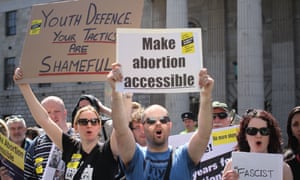


Pro-choice activists protest against a pro-life march on Dublin’s O’Connell Street.


Pro-choice activists protest against a pro-life march on Dublin’s O’Connell Street. Photograph: Alamy

“The Tottenham Hotspur football team were staying at our hotel [in Liverpool],” Kelly said. “I remember carrying the remains past the entire Spurs squad. It was the weirdest thing, walking past them and some of their fans in the packed lobby.


“There was me with my little plastic bag and the baby’s remains in a cardboard box. It was just so bizarre passing by the players with the remains of our baby under my arm.”


At Liverpool airport, Kelly and her husband decided to carry the remains on to the plane, rather than have them placed in the hold, in case the luggage went missing. Passing through security brought on further trauma, she said.


“We were queuing at security for ages and I wasn’t feeling physically great after the procedure the day before,” she said. “When we got to the top we said to the security guy that we had to declare foetal remains. The guy said, ‘What?’ He didn’t seem to understand and so we said it out loud again. He didn’t know what foetal remains meant so Mark said, ‘It’s a baby in the box’, and the man said out loud, ‘A baby in the box?’ Half the queue heard that, probably some of those who were getting on our flight to Dublin heard that.”


Related: UN calls on Ireland to reform abortion laws after landmark ruling


The whole experience was an ordeal, she said. “People – from the hotel clerk to the taxi man taking us to the clinic – kept asking us what we were doing over in Liverpool. Having to avoid those questions was the start of it all feeling so unfair.


“I didn’t even let the taxi drop us right outside the clinic and instead got out before the entrance further down the road. It was all about keeping it secret and to ourselves. I wasn’t questioning what I was going to do, I just didn’t want people to know. We had to lie to people about why we were really over in Liverpool, a series of lies and I couldn’t stop. You lied because you were supposed to lie.”


Kelly and her husband said they had not taken the decision to have an abortion lightly. “We discussed the termination and we felt it was absolutely the best decision for us,” she said. “This was very much a wanted baby. It was an enormous decision that we took very seriously.”
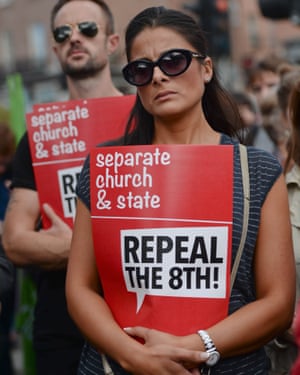


Protesters demand the abolition of the eighth amendment in Dublin in 2014.


Protesters demand the abolition of the eighth amendment in Dublin in 2014. Photograph: NurPhoto/Rex Shutterstock

According to statistics compiled by the UK’s Department of Health between 1980 and 2015, at least 165,438 Irish women and girls accessed UK abortion services. Last year, the figure was 3,451.


However, the Irish Family Planning Association pointed out that these figures underestimate the real numbers, as not all women will provide Irish addresses for reasons of confidentiality. Thousands of other Irish women access abortion through pills bought online, the IFPA adds.


Two incidents from Kelly’s experience bore out the high numbers. When Kelly found the website for the clinic in Liverpool that dealt with fatal foetal causes, she noticed there was a specific section called Travelling from Ireland.


“Bizarrely, the terminations are cheaper for women coming from Ireland because they are mindful about the costs of going over to England,” Kelly said. “It shows how many Irish women use their services.”


On her way back to Dublin, Kelly approached a member of staff at Liverpool airport to ask for advice about travelling with foetal remains. “The girl was Irish as it happened and she said something astonishing to me. ‘It’s fine,’ she said. ‘You need to go over to the gentleman at customs and declare the remains at security. It’s fine, I did it a few weeks ago.’ That’s what she said to me. It was said with such normality because she had done it herself.”


After landing in Dublin the couple drove straight to a funeral home. Once home, Kelly was upfront about her termination within her wider family, who she said supported her decision fully.


However, she said she would have preferred to have had the termination in her home city, adding: “I could have gone to my local hospital that morning, I could have been with my mum and dad recovering that night after it; in my own bed under supervision of my own doctor. I was made to get on a plane to go to a different country because I was not allowed to be here.”


Related: ‘I’ve seen horrible things’: photographer Laia Abril on her history of misogyny


Kelly supports demands by pro-choice campaigners for a referendum aimed at abolishing the eighth amendment to the Irish constitution. It was passed in a previous plebiscite in 1983, under pressure from powerful anti-abortion groups, and effectively makes the embryo an Irish citizen with full constitutional rights from the moment of conception.


Pro-choice reformers believe that there can be no liberalisation of Ireland’s strict anti-abortion laws until the amendment is abolished, as it generates a climate of fear among Irish medical teams even considering terminations allowed under current legislation. Abortions are only legal in Irish hospitals if there is a direct threat to a mother’s life or the woman is suicidal.


Kelly said her experience underlined the need to abolish the amendment. “I would like the people of this country to have the right to vote on this. Give us our referendum. None of the people of my generation got to speak in 1983. I was 18 months old the last time this was voted on,” she said.


“As for politicians, I would say to them that I have a story and they should speak to the women who have gone through it instead of just exporting the problem.”


"My baby in a box": Irish GP tells of trauma of travelling to UK for abortion

3 Mayıs 2014 Cumartesi

Sian Williams: "Sometimes it"s much better to open the box"

“Well, I’ve constantly wanted to review the workings of the mind, inasmuch as you can, and imagined I’d do an MSc to challenge myself.”


She says her interest in psychology constructed slowly, stemming from a expanding unease about numerous dimensions of the unequal connection between journalists and the topics whose lives are pillaged for broadcasts and print.


“I was in Liverpool in the Eighties – there had been a good deal of massive news stories going on which was why I needed to go there. But sometimes you’d be sent out on a street targeted traffic accident or to interview victims with no correctly knowing how to manage them. I did a great deal of interviews, aged 21, with folks who had been at Hillsborough and who were in a state of shock. Now I appear back and feel, ‘How did I handle people people? Were they even mindful I was there? These had been their stories, their lives.’”


She started critically to assess her personal direction at the end of 2009, the yr in which her youngest child, a daughter, was born and her mom died of bowel cancer. Then when BBC Breakfast transferred to Salford in 2012 she resigned from the programme and determined to use the time to embark on the course.


Williams with her research (MARTIN POPE)


We pause for a second to order. The menu is modern comfort meals: small plates, soups – there is lobster lasagne on the menu but we demur.


Williams set out some of her views on how journalism might be honed and improved in a latest and extremely lucid cover story for The Psychologist, the regular monthly magazine for members of the British Psychological Society.


In it, she discusses practice all around the coverage of mental well being stories and the fine line in between making it possible for people’s stories to be told and utilizing tactics to extract juicy particulars that may well not very be in the greatest interests of the vulnerable.


She’s appropriate, of course. The statistics say that one in 4 individuals will have a psychological health issue at some stage in their lives nevertheless these are nevertheless stigmatised and we haven’t identified the right language to speak about it openly and very easily. But how realistic is a much more considerate strategy in other regions? Is her editor – she has recently started an interview demonstrate for BBC Wales – going to consider she’s gone soft?


This draws a wicked laugh. “An interview with a politician is always going to be an interview with a politician. No.”


The piece also touches on her recent area of analysis, the difficult-to-manage emotions of people sent to cover the stories in catastrophe zones.


“You’re caught up,” she says now, speaking quickly. “You’ve got conflicting feelings. There is the adrenalin. You’re operating to consider to hold up, what’s taking place now? What are the most current casualty figures? How many individuals have pledged to the helpline? When’s the support coming by means of? Receiving all this, asking what was it like, what did you encounter, how several household members have you misplaced, where are you going to rest? But you are in a position in which you can request people questions, their lives have been changed forever.


“In Pakistan we were sleeping in a automobile and we did not have any foods. However, we had a auto to rest in, whereas most people had practically nothing. And afterwards you get to go house and they really don’t and I do not like that feeling.”


A single of the problems faced by information teams is the struggle to locate a way to approach what they have observed and heard when it is filtered through this sense of guilt. Williams says sharply, “It feels self-indulgent to acknowledge your own feelings in this kind of situations – it is self-indulgent,” but her own investigation is about the require to do specifically that, so it’s obviously a conflict she’s even now resolving.


She has also said that following covering stories, recollections were returning “uninvited”. What was returning?


“Images, folks. Smell. Smell goes straight to the limbic program and gets locked in there. Even if we attempt to control all these other bits. I can block out that picture, I really do not need to have to keep in mind that. By some means you can not shake smell.”


What smells came back? There is a extended silence ahead of she solutions.


“The smells that you would expect in a catastrophe spot. Which is just… what you’d anticipate. What you’d assume following five days of tsunami. Where there’s no sanitation and there is no care and aid is taking time to come by way of and dysentery is starting up and bodies haven’t been cleared away and you do not have foods. That type of issue.”


She is rapid to stage out that she has by no means experienced PTSD herself but investigation suggests war correspondents demonstrate comparable ranges of signs and symptoms to those who have been in energetic services. Not only is there little assistance but newsroom culture is all about coping, staying specialist, and moving on.


“And you don’t want to bring it home simply because of what benefit is that to folks who enjoy you? None. So you put it away and maintain the box very firmly closed. Whereas what I am learning now is at times it is much better to open the box and get stuff out and have a search at it and place it back.”


Our meals has arrived by now – there is a especially wonderful tiny plate of pickled watermelon and goat cheese, and I’ve ordered a springlike and uplifting glass of Framingham pinot noir from New Zealand (you can consider the girl off the wine page…). But we’re not producing much headway with it. There is as well a lot chat to consume or drink. Sian will not inform me what she has in people mysterious boxes, so I request about receiving to grips with the deeper demands of academic examine when you are used to daily deadlines.


“Slowing down was the most demanding thing. The lecturer would stand in front of me and I’d be like, appropriate, inform me everything about cognitive psychology and I’ll write it down, thank you really significantly, and then I’ll know it by the end of the day. But you want to consider time to analyse.”


Is she very impatient? Does she get cross with men and women who stroll slowly down the street? There is a lengthy laugh then a prolonged silence. I’m contemplating the answer’s yes but she’s worried that will sound undesirable.


“Do you meditate?” No. “I remember getting a CD years ago and sitting there, it was slow! I wanted to say to her, just get to the bit that I need to have to know. I desired to put it on quick forward!


“But individuals who do mindfulness programs usually appear calmer in the rest of their lives. One issue I’ve learnt is that the brain is plastic and there are real physical changes within it – a single review showed those who’d accomplished an eight-week mindfulness course had significantly less grey matter in their amygdala (a part of the brain thought to be connected with concern amounts), it wasn’t firing up so significantly, their anxiety amounts were diminished.”


So has she now signed up for meditation? “I did, but I had to cancel due to the fact I was also occupied.”


We speak a bit more about her course. She tells me about becoming wired up to a heart-charge keep track of and shown a video of a brain dissection. “You feel nicely, I can watch Casualty, my son’s undertaking medicine, how undesirable can it be? But – the guy had grey hair and you hear this large crack as they’re opening the skull – and I closed my eyes. Oh! You’re consuming your lunch! Sorry!”


And about her investigation task, “It’s particularly about one thing referred to as subsequent publish traumatic development which has been recorded in firefighters, emergency responders, social workers, therapists, carers. It is a strengthening of resilience and a modify inside oneself and your daily life that can happen as a consequence of PTSD. The hope is to locate one thing new, to include one particular small cog of data to what we know.”


We also chat about her mother, who had been an intensive-care nurse and ended up getting handled for cancer in the very same hospital in which she had worked for twenty many years and who was moved to a Macmillan hospice two days just before she died. “It was really quick and I slept there so I was with her when she died.”


There’s almost a teary second as she loses her composure for a second. “Don’t open that box,” she says quietly. “That’s 1 of the boxes.”


The photographer arrives and she’s straight back to fast-fire, competitive form. “Have you considered a PhD? Does not a small small bit of you want to be a medical doctor? Just a tiny bit? My son is instruction to be a medical doctor, and I thought it would be great if we could each be physicians at the same time! Then I realised he would be truly annoyed with me. So I am not going to do that.”


And dashing off to the college pickup, all the while talking about how she’s going to Feel Gradually, that is Believe Gradually,yes, definitely Feel S-L-O-W-L-Y, about what she does up coming.


Sian Williams: "Sometimes it"s much better to open the box"

2 Mayıs 2014 Cuma

Sian Williams: "Sometimes it truly is greater to open the box"

“Well, I’ve always wanted to study the workings of the mind, inasmuch as you can, and thought I’d do an MSc to challenge myself.”


She says her interest in psychology built gradually, stemming from a growing unease about many dimensions of the unequal relationship between journalists and the subjects whose lives are pillaged for broadcasts and print.


“I was in Liverpool in the Eighties – there were a lot of big news stories going on which was why I wanted to go there. But sometimes you’d be sent out on a road traffic accident or to interview victims without properly knowing how to handle them. I did a lot of interviews, aged 21, with people who had been at Hillsborough and who were in a state of shock. Now I look back and think, ‘How did I handle those people? Were they even aware I was there? These were their stories, their lives.’”


She began seriously to assess her own direction at the end of 2009, the year in which her youngest child, a daughter, was born and her mother died of bowel cancer. Then when BBC Breakfast transferred to Salford in 2012 she resigned from the programme and decided to use the time to embark on the course.


Williams with her research (MARTIN POPE)


We pause for a moment to order. The menu is contemporary comfort food: small plates, soups – there’s lobster lasagne on the menu but we demur.


Williams set out some of her views on how journalism might be honed and improved in a recent and very lucid cover story for The Psychologist, the monthly magazine for members of the British Psychological Society.


In it, she discusses practice around the coverage of mental health stories and the fine line between allowing people’s stories to be told and using tactics to extract juicy details that might not quite be in the best interests of the vulnerable.


She’s right, of course. The statistics say that one in four people will have a mental health problem at some point in their lives yet these are still stigmatised and we haven’t found the right language to talk about it openly and easily. But how realistic is a more considerate approach in other areas? Is her editor – she has recently started an interview show for BBC Wales – going to think she’s gone soft?


This draws a wicked laugh. “An interview with a politician is always going to be an interview with a politician. No.”


The piece also touches on her current area of research, the difficult-to-handle emotions of those sent to cover the stories in disaster zones.


“You’re caught up,” she says now, talking rapidly. “You’ve got conflicting emotions. There’s the adrenalin. You’re running to try to keep up, what’s happening now? What are the latest casualty figures? How many people have pledged to the helpline? When’s the aid coming through? Getting all this, asking what was it like, what did you experience, how many family members have you lost, where are you going to sleep? But you’re in a position where you can ask those questions, their lives have been changed forever.


“In Pakistan we were sleeping in a car and we didn’t have any food. However, we had a car to sleep in, whereas most people had nothing. And afterwards you get to go home and they don’t and I don’t like that feeling.”


One of the difficulties faced by news teams is the struggle to find a way to process what they have seen and heard when it is filtered through this sense of guilt. Williams says sharply, “It feels self-indulgent to acknowledge your own emotions in such circumstances – it is self-indulgent,” but her own research is about the need to do exactly that, so it’s clearly a conflict she’s still resolving.


She has also said that after covering stories, memories were returning “uninvited”. What was returning?


“Images, individuals. Smell. Smell goes straight to the limbic system and gets locked in there. Even if we try to manage all those other bits. I can block out that image, I don’t need to remember that. Somehow you can’t shake smell.”


What smells came back? There is a long silence before she answers.


“The smells that you would expect in a disaster area. Which is just… what you’d expect. What you’d expect after five days of tsunami. Where there’s no sanitation and there’s no care and aid is taking time to come through and dysentery is starting and bodies haven’t been cleared away and you don’t have food. That sort of thing.”


She is quick to point out that she has never experienced PTSD herself but research suggests war correspondents show similar levels of symptoms to those who have been in active service. Not only is there little support but newsroom culture is all about coping, staying professional, and moving on.


“And you don’t want to bring it home because of what benefit is that to people who love you? None. So you put it away and keep the box very firmly closed. Whereas what I am learning now is sometimes it’s better to open the box and take stuff out and have a look at it and put it back.”


Our food has arrived by now – there’s a particularly lovely small plate of pickled watermelon and goat cheese, and I’ve ordered a springlike and uplifting glass of Framingham pinot noir from New Zealand (you can take the girl off the wine page…). But we’re not making much headway with it. There’s too much chat to eat or drink. Sian won’t tell me what she has in those mysterious boxes, so I ask about getting to grips with the deeper demands of academic study when you’re used to daily deadlines.


“Slowing down was the most challenging thing. The lecturer would stand in front of me and I’d be like, right, tell me everything about cognitive psychology and I’ll write it down, thank you very much, and then I’ll know it by the end of the day. But you need to take time to analyse.”


Is she very impatient? Does she get cross with people who walk slowly down the street? There’s a long laugh then a long silence. I’m thinking the answer’s yes but she’s worried that will sound bad.


“Do you meditate?” No. “I remember buying a CD years ago and sitting there, it was slow! I wanted to say to her, just get to the bit that I need to know. I wanted to put it on fast forward!


“But people who do mindfulness courses always seem calmer in the rest of their lives. One thing I’ve learnt is that the brain is plastic and there are actual physical changes within it – one study showed those who’d done an eight-week mindfulness course had less grey matter in their amygdala (a part of the brain thought to be associated with fear levels), it wasn’t firing up so much, their stress levels were reduced.”


So has she now signed up for meditation? “I did, but I had to cancel because I was too busy.”


We talk a bit more about her course. She tells me about being wired up to a heart-rate monitor and shown a video of a brain dissection. “You think well, I can watch Casualty, my son’s doing medicine, how bad can it be? But – the guy had grey hair and you hear this big crack as they’re opening the skull – and I closed my eyes. Oh! You’re eating your lunch! Sorry!”


And about her research project, “It’s specifically about something called subsequent post traumatic growth which has been recorded in firefighters, emergency responders, social workers, therapists, carers. It’s a strengthening of resilience and a change within yourself and your life that can happen as a consequence of PTSD. The hope is to find something new, to add one tiny cog of information to what we know.”


We also chat about her mother, who had been an intensive-care nurse and ended up being treated for cancer in the same hospital in which she had worked for 20 years and who was moved to a Macmillan hospice two days before she died. “It was very fast and I slept there so I was with her when she died.”


There’s nearly a teary moment as she loses her composure for a second. “Don’t open that box,” she says quietly. “That’s one of the boxes.”


The photographer arrives and she’s straight back to quick-fire, competitive form. “Have you considered a PhD? Doesn’t a little tiny bit of you want to be a doctor? Just a tiny bit? My son is training to be a doctor, and I thought it would be great if we could both be doctors at the same time! Then I realised he would be really annoyed with me. So I am not going to do that.”


And dashing off to the school pickup, all the while talking about how she’s going to Think Slowly, that’s Think Slowly,yes, definitely Think S-L-O-W-L-Y, about what she does next.


Sian Williams: "Sometimes it truly is greater to open the box"