farm etiketine sahip kayıtlar gösteriliyor. Tüm kayıtları göster

8 Ocak 2017 Pazar

Will new FDA rules curb antibiotic use in farm animals?

New federal rules went into effect last week that ban the use of antibiotics to help livestock gain weight, a practice that leads to antibiotic-resistant bacteria that pose health threats to humans. Meat producers will also need a veterinary prescription to use these drugs for other purposes such as treating or preventing disease.


The new rules by the Food and Drug Administration (FDA) represent a broad attempt to limit antibiotic use in farm animals, not just banning a class of antibiotic for a type of livestock. Historically, antibiotics are given regularly to chicken, cattle, pigs and other animals not only to treat diseases but also to prevent them and to make the animals grow faster and bigger. But most of the antibiotics given to them are also used to treat humans and referred to as “medically important”.


The widespread use of antibiotics in both animals (and humans) has contributed to the rise of so-called superbugs, bacteria that have grown resistant to antibiotics. Drug-resistant infections currently kill an estimated 700,000 people worldwide each year, a number that could increase to 10 million by 2050 if the drug resistance trend continues, according to a report commissioned by the UK government. In the US, at least 2 million people get sick from drug-resistant bacteria each year, and roughly 23,000 die annually, said the Centers for Disease Control and Prevention (CDC).


Critics contend the FDA’s new rules are weak. The National Resources Defense council, for example, says the rules would still let farmers use antibiotics for disease prevention, an allowance that continues to sanction the prolonged use of the drugs.


Below are some charts that show why the widespread use of antibiotics threatens public health.


More meat in the future
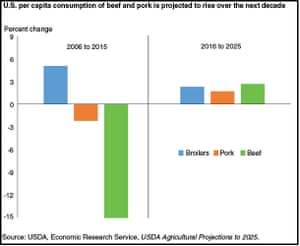


US per capita meat consumption projection

Illustration: USDA

Americans’ meat diet has changed. In the past decade, we’ve eaten less beef and pork, but more chicken. But the government is projecting an increase for all three types of meat as their prices fall, a result of a growing demand for them domestically and overseas and falling cost to feed the animals. Beef consumption is forecast to grow 11.7% and pork 10.3% from 2016 to 2025.


The term “broilers” in the chart refers to young chickens (as opposed to, say, hens raised primarily for eggs), which make up the bulk of chickens eaten.


Tracing antibiotic-resistant bacteria
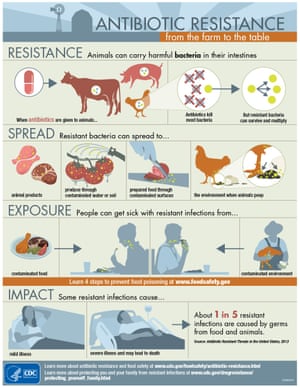


Antibiotic resistance from farm to table CDC


Illustration: CDC

When bacteria that dwell in farm animals develop resistance to drugs, they are more likely to reach humans. Some of the paths for the bugs take to get to their human hosts include handling and eating raw or undercooked and contaminated meat, drinking or swimming in water contaminated with animal feces and taking care of animals.


The sales boost
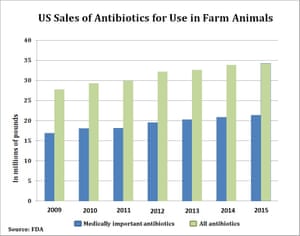


Antibiotic sales for farm animals


Illustration: Ucilia Wang/The Guardian

For more than a decade, the meat industry has faced mounting pressure from consumers and health groups to phase out the routine use of antibiotics in raising animals. The industry had to stop using certain antibiotics because the practice contributed to drug-resistant bacteria and caused a rise in food-born illnesses. Yet sales of medically important antibiotics to raise livestock, such as penicillins, tetracyclines and macrolides, have grown 26% from 2009 to 2015, according to the FDA.


As much as 70% of antibiotics developed to treat humans are sold for use in feed and water for farm animals.


Detoxing Chicken
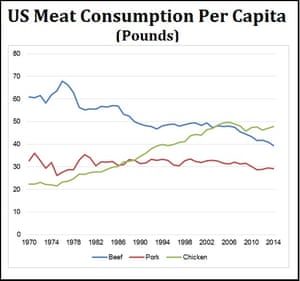


Meat consumption per capita

Illustration: USDA

Americans are eating more chicken than before, partly because it’s cheaper than beef or pork, as well as the belief that white meat is healthier than red meat. Chicken farmers have been ahead of other meat producers in reducing the use of antibiotics.


The FDA also has banned the use of certain antibiotics – sarafloxacin and enrofloxacin – in chicken because their use led to a type of drug-resistant bacteria called Campylobacter, which shows up in food poisoning cases in humans and causes diarrhea, stomach pain and fever. The bacteria developed resistance to ciprofloxacin, which belongs to the same class of antibiotics as the banned versions for chicken. Bacterial resistance to ciprofloxacin has persisted, however, mainly because many people contract the infection while traveling overseas, said the CDC.


How fast food chains respond
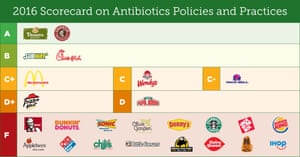


Restaurant antibiotic policy scorecard


Illustration: Natural Resources Defense Council

In response to the changing FDA rules and pressure from consumer advocates, fast food restaurants such as McDonald’s, Subway and Chick-fil-A in recent years have pledged to use meat raised with minimal or no antibiotics. Several consumer groups, including Center for Food Safety and Consumer Union, issued a report in September that graded big chain restaurants on their antibiotics policies. The scorecard, shown above, gave a failing grade to well-known brands such as KFC and Dunkin’ Donuts.


Consumer food and safety groups sent a petition earlier this month to 16 fast food restaurants, including KFC, Burger King and Jack in the Box, demanding that they stop using these drugs in their meat products.


Will new FDA rules curb antibiotic use in farm animals?

16 Aralık 2016 Cuma

Bird flu outbreak confirmed at turkey farm in Lincolnshire

A bird flu outbreak has been confirmed at a turkey farm housing more than 5,000 birds in Lincolnshire.


The Department for Environment, Food and Rural Affairs (Defra) said on Friday the H5N8 strain had been found at the farm near Louth. The virus has been circulating in mainland Europe.


All of the surviving animals will be culled and a protection zone has been placed around the facility. Officials said there was a low risk to the public and insisted there would be no impact on the Christmas turkey supply.


Most birds at the premises have died already, officials said, adding that a 3km (1.9 mile) protection zone and a 10km surveillance zone had been put in place around the farm to help stop the spread. Birds must be kept housed in the zones and the moving or gathering of them is banned.


An update on the Defra website said: “We are taking immediate and robust action and an investigation is under way to understand the origin of the disease and confirm that there are no further cases.”


Public Health England said the risk to public health from the virus was very low and the Food Standards Agency said bird flu did not pose a food safety risk. Thoroughly cooked poultry and poultry products, including eggs, were safe to eat, officials said.


The chief veterinary officer, Nigel Gibbens, said: “Avian flu has been confirmed on a turkey farm in Lincolnshire. This is the same strain that has been affecting poultry in Europe. Immediate steps have been taken to limit the risk of the disease spreading and all remaining poultry at the farm will be culled.


“Bird keepers should remain alert for any signs of disease, report suspected disease immediately and ensure they are maintaining good biosecurity on their premises. We are urgently looking for any evidence of disease spread associated with this farm to control and eliminate it.”


A PHE spokesperson said: “Avian flu (often called bird flu) is primarily a disease of birds. There have never been any recorded cases of H5N8 in humans and the risk to public health is considered very low. We continue to work closely with Defra throughout this investigation. Despite the risk being very low, we will offer health advice to those people who may have been exposed on the farm as a precaution.”


Defra said a detailed investigation was in progress to determine the most likely source of the outbreak, which is the first in the UK since January.


Since June, countries in Europe and Asia have detected A(H5N8) infections in wild birds and/or domestic poultry including Austria, Croatia, Denmark, Germany, Hungary, India, Israel, the Netherlands, Poland, Russia and Switzerland, according to the World Health Organisation, although most were associated with wild birds.


Bird flu outbreak confirmed at turkey farm in Lincolnshire

27 Eylül 2016 Salı

Growing Up on a Farm May Help Protect Against Allergies

TUESDAY, Sept. 27, 2016 (HealthDay News) — Growing up on a farm may help ward off allergies later in life, a new study suggests.


The study also found that women who spend their early years on a farm typically have stronger lungs than their suburban or city-dwelling peers.


Other research has suggested that exposure to germs and potential allergens in early childhood could protect people against allergies later. A team led by the University of Melbourne’s Shyamali Dharmage put this “hygiene hypothesis” to the test. Dharmage is a professor in the Center for Epidemiology & Biostatistics.


The team analyzed data from a survey of more than 10,000 adults in 14 countries in Europe, Scandinavia and Australia.


Nearly 64 percent said they spent their first five years of life in a rural village, small town or city suburb. About 27 percent lived in the city and about 9 percent grew up on a farm.


Kids who spent their early years on a farm were more likely to have had pets and older brothers or sisters. These kids also were more likely to have shared a bedroom but less likely to have had a close family member with allergies.


Though their study didn’t prove cause and effect, the researchers found that farm kids were less likely to have allergies, nasal symptoms or over-reactive airways as adults than people who grew up anywhere else.


Farm kids were also 54 percent less likely to develop asthma or hay fever and 57 percent less likely to have nasal allergies than city kids. Farm kids were also 50 percent less likely to have asthma than other groups.


The researchers noted that women in all 14 countries who grew up on farms had stronger lungs than those who lived in the city until 5 years of age.


The research was published online on Sept. 26 in the journal Thorax.


More information


The American College of Allergy, Asthma & Immunology provides more information on risk factors for allergies.


Growing Up on a Farm May Help Protect Against Allergies

19 Haziran 2014 Perşembe

US Government"s marijuana farm grows for researchers


It may possibly be legal to get marijuana in 22 states, but increasing pot is nevertheless against federal law.


And however, the US government grows some of the purest pot in the nation, spending virtually a million dollars a yr on a contract with the University of Mississippi to expand cannabis and manufacture marijuana cigarettes.


The UMiss farm is presently the only source in the US for legal marijuana for researchers, and the government at the moment offers it away to researchers who get all the right approvals.


US Government"s marijuana farm grows for researchers

US Government"s marijuana farm grows for researchers


It may be legal to get marijuana in 22 states, but growing pot is nonetheless against federal law.


And nevertheless, the US government grows some of the purest pot in the country, paying almost a million bucks a year on a contract with the University of Mississippi to expand cannabis and manufacture marijuana cigarettes.


The UMiss farm is at present the only supply in the US for legal marijuana for researchers, and the government at the moment offers it away to researchers who get all the correct approvals.


US Government"s marijuana farm grows for researchers

US Government"s marijuana farm grows for researchers


It may possibly be legal to acquire marijuana in 22 states, but increasing pot is still towards federal law.


And nevertheless, the US government grows some of the purest pot in the country, spending virtually a million dollars a year on a contract with the University of Mississippi to develop cannabis and manufacture marijuana cigarettes.


The UMiss farm is currently the only supply in the US for legal marijuana for researchers, and the government at the moment gives it away to researchers who get all the appropriate approvals.


US Government"s marijuana farm grows for researchers

19 Mayıs 2014 Pazartesi

Antibiotic resistance in farm animals "threatened by United kingdom cuts"

Government cuts could influence the UK’s potential to detect antibiotic resistance in farm animals, senior veterinary authorities have warned.


The advancement of germs that are resistant to even the strongest of our recent antibiotics is one of the most significant health threats in the globe, in accordance to the government’s chief public health official, Professor Dame Sally Davies.


Last month the Planet Health Organisation explained above-use of antibiotics had meant they had misplaced their effectiveness at fighting infections in each and every country in the globe. Antiobiotic resistance among animals is a separate but associated issue, and can have repercussions for human wellness.


Professor Peter Silley, of the University of Bradford, said: “Surveillance [of antibiotic resistance in animals by normal testing on farms and in depth lab perform] is expensive to do properly – really costly. But if you search at surveillance now it is significantly much less than it was ten many years ago – I believe most of that is budgetary.”


He added: “If surveillance is not mandatory, that is a difficulty. It is costly and will not happen. Then we will struggle. We need to fund this science correctly. My concern is that we are not going to be ready to do that.”


The Division of Environment, Meals and Rural Affairs, which has obligation for agriculture and animal health, has accepted some of the steepest cuts of any Whitehall department. Defra had not responded at the time of publication.


John Fitzgerald, secretary basic of the Accountable Use of Medicines in Agriculture Alliance, said: “With the Defra cuts, ministers have to pick what it is most essential to invest on. The question of antibiotic use should be one of their top ten risk assessments. I hope that the government cuts would not have an effect on this – it must be given income – but we really don’t know.”


Scientists at a briefing held by the Science Media Centre in London also warned that no move to curb antibiotic use in humans – this kind of as the proposal by Davies for a United Nations convention to manage antibiotic use – ought to be taken without having related focus to the use of the medicines in animals.


Even though animal diseases are different to these of people, and the vets mentioned there was tiny evidence that growing resistance in animals was a main threat to human wellness in the Uk, they stated that in some areas of the world antibiotic use is largely unregulated, or laws go unenforced, and that this was a serious concern.


Professor Stuart Reid, principal of the Royal Veterinary University, said: “In the absence of great worldwide controls, there are places of the planet that have significantly less management, and this is a actual concern. There are substantial gaps we have to function on collectively.”


Fitzgerald said: “If there is going to be a UN [treaty], we should include animal health, as there will otherwise be no point to it.”


Outbreaks of ailment in animals that have affected people contain salmonella and campylobacter, which result in meals poisoning.


But the vet said that the controversial rise of “megafarms” – in which hundreds of cattle, chickens or pigs are kept in huge warehouses – was good for cutting down on animal ailment, in spite of worries that trying to keep so a lot of animals in 1 location could intensify any outbreak.


Fitzgerald said: “Megafarms are not utilizing far more [antibiotics] per animal. They are bigger but significantly a lot more hygienic [than other farms], they are greater managed, and substantially greater created to make certain of optimum problems to avoid condition.”


He explained the conditions had been carefully managed to stay away from ailment outbreaks, and their owners had a vested interest in keeping their “biosecurity” tight, since it would demonstrate so pricey if drugs had to be utilized.


In Europe, employing antibiotics in a schedule way – no matter whether animals are sick or not, to encourage the beasts to expand faster – has been outlawed considering that 2006. The vets stated it was unlikely that this regulation was becoming flouted in the Uk, due to the fact of the cost of the medication and the oversight of veterinary experts.


Worries have also been raised about the widespread use of antibiotics in fish farming, but in the Uk their use amongst fish has come down in recent many years, according to Prof Silley.


However, these practices are nonetheless widespread in other nations, like the US and South America.


Prof Reid explained: “In the US, there are issues [because of] the use of growth promotion is even now permitted. What transpires elsewhere [in some countries] is a entirely unregulated surroundings.”


He extra: “Sometimes I’m disappointed that there is not a holistic view currently being taken.”


Antibiotic resistance in farm animals "threatened by United kingdom cuts"