partner etiketine sahip kayıtlar gösteriliyor. Tüm kayıtları göster

31 Ocak 2017 Salı

Worried your partner might have a bisexual history? Why? | Phoebe Jane Boyd

“Use a condom, the pill, or get an IUD – avoid pregnancy” was the drill from sexual health practitioners who came to speak at my comprehensive school in Kent. There wasn’t much detail or thought beyond, “Some of these boys are going to get some of these girls pregnant before they hit 16 – let’s try to get that down to a lower number than we had last year.”


Thankfully, when it comes to the subject of sexual identity, there’s now more guidance than ever trickling down into the societal subconscious in the west – hopefully in schools, but certainly during publicity rounds for films starring Kelly Rowland and Cat Deeley. While talking about Love By the 10th Date to the New York Post last week, Rowland espoused the importance of knowledge when embarking on a sexual relationship with another: “I can’t tell someone how to feel about dating someone who is bisexual or had a past gay experience, but it’s proper to ask [if they have] in today’s times.”


Women who have sex with women are less likely to get a smear test, because many of us don’t realise we need to


It is “proper” to ask? Maybe it’s unfortunate phrasing, or maybe not being able to hear the tone of voice in which the opinion was offered gives it negative impact, but the sentence rings faintly of suspicion and mild disapproval: “Please submit your history of sex with people of the same gender, and it will then be decided whether or not you are too risky to be intimate with.” That’s how it comes across to this particular someone who is “bisexual or [has] had a past gay experience”, anyway.


Bisexuality just continues to have a bad rep, even though it’s on the rise (according to CNN) … or then again, maybe it’s not on the rise (according to the Verge). Statistics on the spread of sexually transmitted diseases, and which groups of people are spreading them, are easily found (and quickly wielded by those mistrustful of anything beyond heteronormativity), but they can obscure a simple and universal truth that applies to all groups, whether those groups are on the rise or not. And that is: whatever genitalia you and your partner(s) have, you should protect yourselves (condom/dental dam/wash your hands and accoutrement between uses, thank you). Ignoring that fact in favour of “it’s the bisexuals, mostly” is the source of so much harm.


You don’t have to openly identify as bisexual to get the bad side of bisexuality, because it goes beyond the myths of promiscuity, greed and dishonesty still held by some – biphobia also has an impact on physical health. Here in the UK, if you’re a man who’s had sex with another man in the last 12 months, you can’t donate blood (though that stance is currently being reviewed). Women who have sex with women are less likely to get a smear test, because many of us don’t realise we need to – we’re forgotten by the healthcare system, or our needs are misunderstood.


“Gay and bisexual women are at lower risk for HPV,” we confidently tell each other, “we don’t need a smear test.” A lot of us have heard that from our doctors, as well. It was only after seeing a leaflet about the issue from lgbthealth.org.uk during this month’s Cervical Cancer Prevention Week that I realised this was just ignorance.


In 2008, Stonewall released findings that one in 50 lesbian and bisexual women had been refused a smear test, even when they requested one. The 2015 survey on training gaps in healthcare, Unhealthy Attitudes, found that three in four patient-facing staff had not received any training on the health needs of LGBTQ people. Many women get variations of the “use a condom, the pill, or get an IUD – avoid pregnancy” mantra from our doctors to this day, if we don’t declare our gayness or bisexuality as we walk through the surgery door. Sometimes even a declaration is ignored by an uncomfortable practitioner. Straightness is still automatically assumed, unless you’re lucky enough to have a doctor who doesn’t see heterosexuality as the default for everyone they treat.


According to that 2015 Stonewall study, a third of healthcare professionals felt that the NHS and social care services should be doing more to meet the needs of LGBTQ patients, which is encouraging. Knowledge is wanted – needed – to undo the harmful myths that block help and prevent education. And that is what is “proper” (to quote the star of Freddy vs Jason and Love By the 10th Date) – fighting ignorance and biphobia, rather than continuing to be suspicious of sexual histories that might have featured people of the same gender. Whatever and whoever is in our sexual pasts, we must protect each other, and stay informed. That’s healthy.


Worried your partner might have a bisexual history? Why? | Phoebe Jane Boyd

7 Ocak 2017 Cumartesi

My partner bought me a Fitbit but I’m a couch potato – is it worth trying?

Every week a Guardian Money reader submits a question, and it’s up to you to help him or her out – a selection of the best answers will appear in next Saturday’s paper.


This week’s question:


I’ve been given a Fitbit Flex by my partner. I’m a bit of a couch potato and reckon I won’t use it that much. Should I try and take it back and swap it for something else, or can other Fitbit users convince me it’s worth keeping? Did it work for you?


Do you have a problem readers could solve? Email your suggestions to money@theguardian.com or write to us at Money, The Guardian, Kings Place, 90 York Way, London N1 9GU.


My partner bought me a Fitbit but I’m a couch potato – is it worth trying?

29 Ağustos 2016 Pazartesi

Grandmother of African art finds unlikely partner in war on Aids

On the outskirts of a sprawling low compound stands a sun-bleached, hand-painted billboard. It welcomes visitors to the village and proclaims: “Esther is here … First lady to travel over sea.”


Esther Mahlangu is indeed here. She is sitting, legs outstretched, on a reed mat lain across a mud floor, painting careful black lines on a rough piece of paper with her chicken-feather paintbrush, inside an open-sided thatched-roof hut. This is the classroom where she teaches young girls, just as her mother and grandmother taught her “long, long ago”, she says.


This culture must not die. Our young people are vandalising our traditions. This is why I try to motivate them


Esther Mahlangu


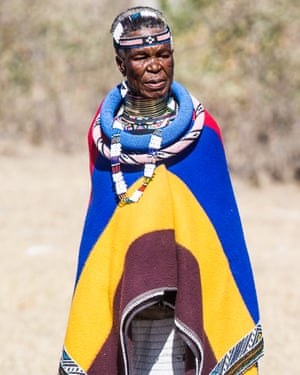
At 82 years old, Mahlangu is not only an artist and teacher, but one of the last skilled custodians of the traditions of the Ndebele people. Her painting uses the pigments of her surroundings: the black comes from the mud in the river; the grey from a tree leaf pounded into paste; and there are five colours to be extracted from the African soil nearby. Shop-bought paints also fill giant well-used pots. She is especially fond of an azure, which can be seen in her wild geometric patterns that adorn every cow dung-plastered surface of the surrounding huts, walls and houses.


One of the most famous artists in South Africa, Mahlangu is a living tourist attraction, although visitors are few and far between in this far-flung village, two hours’ drive from the nearest city. And she is indisputably the most honoured gogo – Zulu for grandmother – of the Ndebele who remain in the Mpumalanga homelands.


The tribe’s numbers have dwindled as young people have departed to look for work in the big South African cities. The scourges of poverty, malaria, Aids and TB have also taken their toll. Mahlangu herself, a widow, has outlived all three of her sons and three of her grandchildren. However, she sees the real risk as the extinction of her tribe’s traditions, and it is that which has driven this little old lady to travel the world pushing Ndebele art internationally, in the hope of making the next generation at home also see its worth.


“This culture must not die,” she said. “Our young people don’t wear the clothes or respect their forefathers, the girls have hair extensions and wear western clothes. This does not make me feel comfortable. They are vandalising our traditions. This is why I talk to them, try to motivate them with my travels and teach them too about Aids.”


Along with art, the battle against Aids is Mahlangu’s passion now and the two obsessions have led her into an extraordinary collaboration. As part of a campaign promoted by John Legend, she has just created a classic Ndebele design for a special-edition bottle of Belvedere vodka (Red). Half of the profits will be donated to the Global Fund to be used in tackling HIV/Aids, malaria and TB.


Red’s strategy of partnering with big-name, luxury and designer brands to produce a bespoke product, sales of which generate donations to the fund, has been criticised for being too consumerist. It was set up by Bono’s One charity, but is run separately.


Charles Gibb, president of Belvedere vodka, is happy to acknowledge the PR benefits for his brand, but is also proud of his relationship with the most famous artist of the Ndebele people, whom he calls “a very special woman”.


“For celebrities and artists, it’s as important to do something as much as it is for anyone else,” said Gibb. “And most of them have something they care about. So everyone is tapping into something and at the end of the day it’s people relying on the Global Fund who benefit.”


It’s an unlikely alignment. A little great-grandmother from a yellow-dusted African village and a Polish luxury spirit drunk in some of the world’s more upmarket bars and hedonistic nightclubs. Mahlangu doesn’t drink alcohol and she certainly doesn’t drink vodka.


“I am very proud of her,” says her son, William. “She is our queen, queen of Ndebele, and our happy mascot.”


Mahlangu perches cheerfully on the chair, feet dangling, enjoying the role of dignitary. A tiny woman, her body is from the top of her head to her sandalled feet swamped by strips of beadwork, tapering metal and coloured bands. A heavy wool blanket in bright stripes of primary colours completes her plumage.


In 1986, when she was “discovered” by a passing French art dealer, Aids was still unknown. It is still a taboo subject and Mahlangu will touch only briefly on it but is passionate about educating young people on prevention.


Esther Mahlangu


‘I love to travel, but I love most to come home’: Esther Mahlangu Photograph: Jonx Pillemer/(RED)

In Weltevreden clinic, the local health centre, there are signs already of prevention. They have not seen a baby born with HIV since 2008. “It’s very different now, less people are dying,” said Sister Bathabile, who runs the clinic for a population of 9,500, of whom almost one in 10 are HIV positive. “It’s 15km to the hospital and our clinic is very, very small, too small,” she said, indicating the packed waiting room and queue of patients outside on the grass. “The doctor comes once a week, so it’s not ideal, but we never have a shortage of medicines at least. It is very rare for us to not have antiretrovirals.”


But charities stress that the real danger in South Africa is in slipping backwards. While the government and the Global Fund are supporting HIV/Aids work, the epidemic can be controlled, but eradicating it is still a pipe dream. Mahlangu still hopes it will happen in her lifetime. In October she will be in London for the opening of the British Museum’s exhibition of South African art, which will run from 27 October to 26 February. The only thing that fazes Mahlangu about such a long trip is airport security. Not because of the large bag of mealie meal she insists on carrying with her to combat her fear of being stuck with foreign food, but because of the metal detectors.


“They are always trying to make me take off my wedding bands,” she said, showing the rows and rows of brass rings on her wrists and ankles that are carefully tapered to accentuate the limbs. Given to her on her wedding day by her husband, her neck rings came on the same day from her parents.


“I say no, I cannot, these are from my husband. And oh they get very upset. Maybe they want me to sit on the X-ray machine.” She goes off in gales of laughter.


“No, I love to travel, but I love most to come home again. It makes me happy if people like Ndebele art.” And now, by buying it, people can contribute to battling the scourge that has blighted her homeland’s recent history.


The limited edition Red bottle, designed by Esther Mahlangu, is available from September. For every bottle bought, Belvedere will donate 50% of the profits to the Global Fund, the leading financier supporting HIV/Aids prevention in Africa.


Grandmother of African art finds unlikely partner in war on Aids

15 Temmuz 2014 Salı

Google announces wise get in touch with lens partner

The chip and sensor are embedded among two layers of soft get in touch with lens material. A pinhole in the lens enables tear fluid from the surface of the eye to seep into the glucose sensor, which can measure glucose levels when a 2nd.


The layers of electronics embedded inside the lens


The lenses are not anticipated to go on consumer sale for at least 5 many years, Google has mentioned.


In April the company filed a US patent for embedding microscopic cameras into make contact with lenses, enabling the wearer to take images of their direct line of vision.


The patent in depth how wearers will be capable to management the camera via a sophisticated program utilizing the owner’s distinctive blinking patterns, according to Patent Bolt.


Every lens could be designed to incorporate several small camera elements and sensors which could be programmed to detect light, colour, specific objects, faces and movement without having obstructing the vision of the wearer.


The device could be potentially existence-modifying for blind users, as the camera and analysis components could method image data to establish the wearer is approaching a busy road, for instance.


The lens could then problem a command to a remote device, such as a smartphone, to omit a voice-produced warning about the impending road.


“Our dream is to use the most current engineering in the miniaturisation of electronics to help enhance the good quality of daily life for hundreds of thousands of men and women,” said Google co-founder Sergey Brin. “We are really enthusiastic to perform with Novartis to make this dream come real.”


Jeff George, division head of Alcon, mentioned the two firms shared a deep and common passion for innovation.


“By combining Alcon’s leadership in eye care and experience in speak to lenses and intraocular lenses with Google’s revolutionary ‘smart lens’ technology and groundbreaking pace in analysis, we aim to unlock a new frontier to jointly tackle the unmet healthcare needs of hundreds of thousands of eye care sufferers close to the planet,” he explained.


Google announces wise get in touch with lens partner