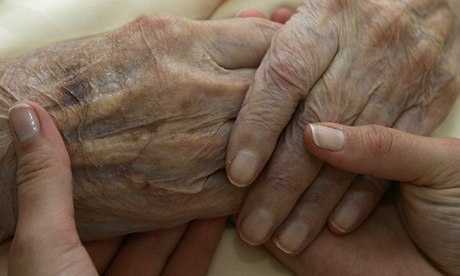
‘It felt like an extraordinary privilege to see someone slip from lifestyle to death.’ Photograph: Michaela Rehle/Reuters
Thanks to Julie Myerson for her report (Death in hospital need not be a medicalised trauma, 13 January). Although one cause I purchase the Guardian is for its coverage of the NHS, I have for a long time had a sense of disquiet that the stories are so biased in the direction of the poor news (great news is no news?). While we require to shout loud about the problems of the NHS, we also need to continually celebrate its successes. Not undertaking so would seem to me to be, ironically, getting ready the nation for letting the NHS, depicted as ineffective and malfunctioning, slip away to open private hands. As someone who operates for the NHS, I would also stage out that we need to see a reflection of the services we give as worthwhile, even outstanding at occasions, to aid us carry on to strive to be the very best that we can be, specifically considering that our managers seem to be hellbent on completely demoralising us at times. The NHS will survive only if the public can worth what it does well alongside campaigning for far better when it does not provide.
Suzanne McCall
Luton, Bedfordshire
• I was moved by Julie Myerson’s stylish report about her mother-in-law’s death. I know specifically what she signifies. In 2007, my mother suffered a cerebral haemorrhage which left her in a coma. The consultant at St Richard’s hospital, Chichester, recommended that we “let nature consider its program”, to which we agreed. Unlike Julie’s mother-in-law, my mom was capable to die at residence, with the hospital arranging almost everything. She lasted two a lot more weeks, with a group of nurses coming in three times a day and a man or woman sitting with her by way of the evening, allowing members of the family to pay a visit to her each time they wished. My brother and I had been with our mom at the second of death. It was profoundly moving. Sad although it was, it felt like an extraordinary privilege to see a person slip from existence to death. Seeing our mother die peacefully in her personal residence produced her dying seem to be like the all-natural event it was. I thank the NHS for making that possible.
Emma Dally
London
• Julie Myerson writes movingly of the organic death of her mother-in-law. The workers communication and selection-producing sounded delicate and knowledgeable. Even so, non-medical intervention can be an umbrella to hide bad practice underneath, and that is the danger. My 94-yr-old mom was in her neighborhood hospital in Scotland, soon after a fall. They discovered tumours in her chest and even though she expected to get property after soreness manage, a person somewhere decided she wasn’t well worth the bother when she acquired a bladder infection right after three days. No therapy meant that we located her in agony, alone, with no nursing care. The doctor refused to attend as it was a bank holiday and when we begged for aid he prescribed morphine by phone until, right after hours of pain, the last dose killed her speedily. Apparently this is all acceptable for an outdated man or woman since someone had made a decision it was time she was dispatched and she was denied the natural death that Julie’s mother-in-law had.
Allowing nature to consider its program in which enlightenment and information prevail is the excellent. But where ignorance and callousness prevail it turns into a quite distorted and harrowing encounter that haunts loved ones evermore.
Andrene Messersmith
Innellan, Argyll
• It was the image utilized by Julie Myerson that drew my interest. Death is “oddly akin to a birth”. My father John Hughes (Obituary, two January) died on 1 November. Previously a principal at Ruskin University, he sadly produced dementia and invested years in an increasingly locked-in state. I had taken a break from his bedside when my sister called. He was on no medicines and the nurses at the nursing house were fine about leaving us alone. We the two strangely – or perhaps not – seemed to know exactly what to do. We talked gently, stroked his head and hands, told him we loved him but we were prepared for him to go. We reminded him of his superb contribution to people’s lives and said he deserved a rest now. It came into my thoughts that I felt like some type of midwife assisting him on. He died so peacefully. It was amazing to be at a “normal” death. I have been at two deathbeds in which medicines had been very rightly involved so this was quite unique. We ought to speak about death more and allow men and women to feel they can support folks they adore die so peacefully.
Katherine Hughes
Oxford
A excellent death with the NHS"s assist | @guardianletters

Hiç yorum yok:
Yorum Gönder