China's etiketine sahip kayıtlar gösteriliyor. Tüm kayıtları göster

16 Şubat 2017 Perşembe

Where the wind blows: how China"s dirty air becomes Hong Kong"s problem

At the age of three, Margaux Giraudon developed something akin to a smoker’s cough. Thereafter, she became all too familiar with the inside of her doctor’s office in Hong Kong.


For years, her father Nicolas Giraudon was told the same thing by doctors: “Your daughter is sensitive to changes in the weather.” Eventually she grew so ill that she was hooked up to breathing machines in the hospital for three days, inhaling medicine delivered in a mist. At that point, Giraudon decided it was time for the family to return to his native France.


“She was scared – she didn’t know what was going on, and she saw the look on our faces,” Giraudon recalls. “Her mother and I were completely shocked. When you have children, you want the best for them; you want to protect them as much as possible.”


For Giraudon, those three days transformed Hong Kong from an international city bustling with excitement and opportunity into a death trap that was slowly poisoning his family. Born on the island, Margaux had developed asthmatic bronchitis, which caused her lung capacity to fall by nearly a third compared to other children her age.


While Hong Kong’s air pollution rarely commands the attention of the toxic cloud that frequently covers northern China, dubbed the “airpocalypse”, the air is anything but clean here. Levels of cancer-causing pollutants have exceeded World Health Organization standards for over 15 years, rising to more than five times acceptable levels at its peak.


In winter as much as 77% of dust in the air comes from China


As far back as 2013, the government called air pollution the “greatest daily health risk to the people of Hong Kong”. Despite awareness of the dangers, this notoriously pro-business city has moved at a glacial pace in tackling the problem, commissioning study after study but taking little concrete action.


The fast-paced business world is what originally brought Giraudon to Hong Kong in 2009. In the six years before his daughter became sick, he didn’t experience any noticeable effects from air pollution. The 42-year-old media executive went hiking in the mountains around the city and jogged all over his new home, realising a lifelong dream of working in Asia. He didn’t buy air purifiers, dismissing the costly machines as a marketing trick.



Margaux Giraudon


Margaux Giraudon developed asthmatic bronchitis while living in Hong Kong. Photograph: Nicolas Giraudon

After his daughter’s hospital stay, however, Giraudon transformed completely. He bought a device to measure air pollution and became obsessed. Every room in his house was fitted with an expensive air purifier, and he checked the air quality constantly.


“My flat in Hong Kong felt like living in a spaceship,” he says. “I was measuring the level of pollution 24 hours a day, measuring humidity to combat mould, to make sure everything was within acceptable levels.”


Giraudon would hear his neighbour’s children coughing at night, and knew they didn’t have air filters.


“I became the guy nobody invited for dinner,” he recalls with a sigh. “Especially the newcomers, who were all really excited to arrive in Hong Kong – and then I would come with my readings and warnings. People didn’t want to hear about it.”


Giraudon began taking his testing equipment to his daughter’s school and was shocked to discover the air was terrible. But he also found another group of people who did not want to hear about the problem: school officials. He launched a campaign to clean the air there, and was met with resistance at every turn.


The city is notorious for capitalism run amok, and the authorities have long preferred the status quo or very slow change – a perpetual complaint among activists.


In a sign that ignorance about the health effects of pollution extends to the very top, one former chief executive famously said: “Life expectancy [in Hong Kong] is the highest on earth, higher than that in Japan these days. It must be our air.” The year he made that statement, pollution levels were more than four times WHO recommendations.
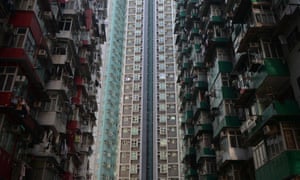


A general view shows residential estates in Hong Kong


Hong Kong is one of the most densely populated places in the world. Photograph: Dale de la Rey/AFP/Getty Images

The source of the smog


While equipping every room of a school or home with filters can clean the air, it’s only a plaster over the larger problem: tackling pollution at the source.


Emissions from cars and container ships are some of the largest contributors to Hong Kong’s smog. Old diesel vehicles still number in the tens of thousands, and ships sailing into the city’s port, one of the busiest in the world, are allowed to burn high sulphur fuel right up until they dock. Power plants, meanwhile, rely almost entirely on fossil fuel, with coal supplying 52% of the city’s energy.


Much of Hong Kong’s pollution, however, wafts across the border from China. About 60-70% of particulate matter comes from the mainland, according to a study commissioned by the city’s Environmental Protection Department. In winter, when the wind direction tends to blow more pollutants towards Hong Kong, as much as 77% of dust in the air comes from China.


Hong Kong has signed a series of agreements with Guangdong province directly to the north – but they are unenforceable, stymying efforts by the local government and activists to have a meaningful impact. In the meantime, the health impact on Hong Kong’s population is severe.


There were more than 1,600 premature deaths last year because of air pollution, according to Hong Kong University’s school of public health. In the first month of 2017 researchers estimate there were more than 300,000 doctor’s visits linked to smog.


A landmark study last year found that air pollution increased the risk of dying from any type of cancer by 22% in Hong Kong. An increase of just 10 micrograms of PM2.5 – a tiny airborne particulate linked to cancer and heart disease – heightened the risk of dying of breast cancer by 80%.
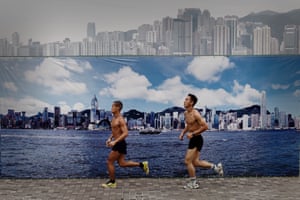


Two men run past a billboard in Hong Kong


A clean, blue-skied billboard against the city’s polluted skyline. Photograph: Philippe Lopez/AFP/Getty Images

With a government that is scarcely accountable to Hong Kong residents, environmental campaigners are fighting an uphill battle to contain even local sources of pollution. The city’s leader, known as the chief executive, is elected by a 1,200-strong committee made up of elites, where China has considerable sway over the votes. Only half the seats in the legislature are directly elected, with the remaining lawmakers returned by professional organisations that overwhelmingly support Beijing.


Tanya Chan, chairman of the environmental affairs panel in the city’s legislature, recalls constituents clamouring for the government to clean up the air, fearing for the health of their children. “The government can try harder and they should push harder,” she says. “We need to be improving fuel standards and expanding the use of electric vehicles.”


Cleaner air the most challenging product to sell: everyone wants it but it’s not just something you buy


Patrick Fung


Chan is in favour of introducing congestion pricing to some of the city’s most clogged districts, but lawmakers are hamstrung by a political system where all power related to government spending or levies requires approval from the chief executive.


“He is only accountable to a small election committee, where most come from business sectors,” Chan says. “We have no choice but to breathe this air.”


The city’s air quality standards (government targets for clean air) remained unchanged for 27 years before eventually being updated in 2014. But they still fall short of WHO guidelines.


“We need to improve our air quality standard to catch up with international standards,” Chan adds. “That process has been a bit slow and I hope the government will do more, especially for the PM2.5s.”


The Environmental Bureau only began publicising Hong Kong’s PM2.5 figures in 2012, nearly seven years after it began monitoring the harmful pollutant, and only after Beijing began publishing the same information.


But locals are increasingly concerned, and hungry for information.
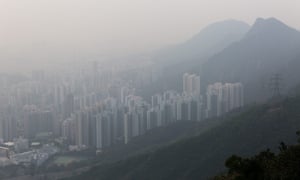


Kowloon buildings in polluted air


Hong Kong’s air pollution caused more than 1,600 premature deaths last year. Photograph: Jerome Favre/EPA

The activists


On a recent evening, tucked away on the second floor of a sleepy cafe, about two dozen people gather to receive a crash course in Hong Kong’s pollution situation. The mostly young crowd are a mix of office workers, salesmen and artists, all united by their previous ignorance of the dangers in the air and their anger at the officials they say kept them in the dark.


Leading the meeting is Patrick Fung, chief executive of the Hong Kong Clean Air Network. The 31-year-old has become the face of the fight for better air quality in the city, and while he’s often dressed in tailored shirts and trousers to ensure his message is taken seriously, his shoulder-length hair, goatee and glasses evoke an image of environmental activists from years past.


A lot of the bureaucrats don’t want to be blamed for something,. They just try to keep ignoring it and ignoring it


Peter Brar


In many ways the former advertising executive lives by the phrase: “There’s no such thing as bad publicity,” taking any opportunity to counter the narrative that dirty air is a fact of life.


“I’m just advertising something else now: cleaner air,” Fung says. “It’s the most challenging product to sell: everyone wants it but it’s not just something you buy, some sacrifices need to be made.”


On the most basic level, Fung and his fellow campaigners want the government to update its air quality targets. The Hong Kong government’s targets for annual air pollution are three and a half times higher than those recommended by the World Health Organization.


But beyond that are a host of problems unique to Hong Kong: the city is one of the most densely populated places in the world, with its most crowded district nearly four times more packed than Islington, London’s densest borough. Narrow streets surrounded by high-rises have created “street canyons”, which can trap pollutants between buildings.


Fung’s group advocates for large swaths of the city’s main thoroughfares to be turned over to pedestrians, similar to New York’s Times Square or plans for Oxford Street in London. Cindy Wong listens to Fung’s speech with rapt attention, bombarded with information she had never heard before.


“People in Hong Kong spend all their time worrying: prices are expensive, rent is high, salaries are low, so no one has time to care about pollution,” she says after the meeting. “The government should have a strict policy to control pollution; the government should lead and people will follow.”
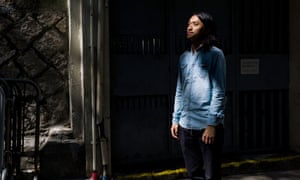


Patrick Fung, the head of the clean air NGO.


Patrick Fung: ‘[Clean air] should be a basic right.’ Photograph: Benjamin Haas for the Guardian

“The air seems much better in foreign countries, in Europe,” Wong adds. Although she’s never been, she often watched with envy as travel programs highlighted tree-lined streets and plentiful gardens in cities abroad.


“A lot of Hong Kongers know about the poor air quality, but they feel powerless,” Fung says. “It’s an issue of justice – this should be a basic right.”


After five years heading the environmental NGO, he says he can tell the air quality by his nose alone. “Everyone in this office can tell just by the smell of the air.”


Ignoring the problem


The vast majority of Hong Kong people don’t have air purifiers, and those that do tend to be wealthier and better educated, according to Peter Brar, manager at air quality testing company Renaud Air, which also sells filters. He estimates about half of all expats have at least one air filter in their homes.


“A lot of the local people who’ve never had an opportunity to live abroad don’t know any better,” Brar says. “They think going to the doctor and getting sick three times a year is normal; it’s not normal.”


Although many in Hong Kong may not be aware of the hazards of dirty air, the government has over a decade of data illustrating the problem – but it has been slow to act.


“A lot of the bureaucrats don’t want to be blamed for something,” Brar says. “They just try to keep ignoring it and ignoring it as long as possible – and saving money, saving money until they have to do something.


“Hong Kong is a very pro-business environment,” he adds. “The government does know the air quality is really bad – but they try to hide the problem.”


In a town obsessed with money, the fact that air pollution is estimated to have caused HK$ 20.bn (£2.2bn) worth of economic losses in 2016 may change more minds.


Brar points to a system where buildings in Hong Kong can apply for a clean air certificate from the government – but the process only tests for PM10, particulate matter akin to dust or pollen, entirely ignoring the smaller, more harmful PM2.5.


He says companies that sell air purifiers frequently meet resistance from schools and business, with executives either in denial or unwilling to spend the money required to provide clean air.


When Giraudon wanted to present a professional report at his daughter’s school, Brar offered to test the air quality for free, but was also rebuffed by school officials. Other schools have been more receptive – particularly international schools that have more money compared to government-run institutions.


Giraudon, however, has left behind his battle for classroom purifiers in favour of a suburb of Annecy, a small French city that has the reputation of having the cleanest lake in Europe.


Having arrived last December, Giraudon reports that his daughter Margaux already seems to be doing better. Frequently sick in Hong Kong, she has yet to fall ill, is coughing less and no longer needs to carry an inhaler.


After eight years of living in Hong Kong, Giraudon admits he misses the excitement, opportunities and low taxes, which max out at 15% rather than France’s 45%.


“But I prefer to pay tax than to kill my children,” he says.


Guardian Cities is dedicating a week to investigating one of the worst preventable causes of death around the world: air pollution. Explore our coverage at The Air We Breathe and follow Guardian Cities on Twitter and Facebook to join the discussion


Where the wind blows: how China"s dirty air becomes Hong Kong"s problem

25 Ekim 2016 Salı

Antibiotic waste is polluting India and China"s rivers; big pharma must act

Antibiotic-resistant superbugs are a fundamental threat to global health, UN secretary general Ban Ki-moon recently told a general assembly meeting. Failure to address the problem, he said, would make it “difficult if not impossible” to provide universal healthcare, “and it will put the sustainable development goals in jeopardy”.


For pharmaceutical companies the attention on antimicrobial resistance has also brought a focus on one of its key drivers: the unabated environmental pollution of drug factories in developing countries.


In India and China, where a large proportion of antibiotics are produced, the poorly regulated discharge of untreated wastewater into soils and rivers is causing the spread of antibiotic ingredients which cause bacteria to develop immunity to antibiotics, creating superbugs.


A study of drug factories in China found that antibiotic-resistant bacteria were not only escaping purification but also breeding. For every bacterium that entered one waste treatment plant, four or five antibiotic-resistant bacteria were released into the water system, tainting water, livestock and communities.


Superbugs are able to travel quickly through air and water, aboard airplanes and through global food supply chains. By 2050, the total death toll worldwide as the result of contracting an infection that proves resistant to treatment is expected to reach 10 million people (pdf).


Environmental pollution is now a material issue for the pharmaceuticals sector. Global investors such as Nordea and BNP Paribas have raised concern about the potential damage to global health and environment, and are worried that a local factory pollution scandal in India could affect the value of a global pharma company in their portfolio. As the world goes on a global quest to combat antimicrobial resistance, the focus on industry pollution will continue grow.


Last month 13 pharmaceutical companies signed a declaration (pdf) calling for collective action on antimicrobial resistance. They committed to review their manufacturing and supply chains and assess good practice in controlling releases of antibiotics into the environment. They also committed to establish science and risk-based targets for discharge concentrations of antibiotics and to reduce the environmental impact of manufacturing discharges by 2020.


Most global sectors now have a corporate platform where companies seek to tackle intractable sustainability challenges. For pharma companies, the Pharmaceutical Supply Chain Initiative (PSCI) was set up to demand better social and environmental conditions in the communities from where drugs are supplied. However, only 12% of the 140 largest global pharmaceutical companies are members of PSCI according to sector analysts.


Voluntary corporate initiatives are necessary but by no means sufficient to address the industry challenge of environmental pollution. This is partly because not every company signs up and partly because better government policies and law enforcement on the ground are necessary to ensure voluntary commitments are achievable.


The governments where global pharma companies are domiciled – including the UK, US and Switzerland – must play a role. Companies must collaborate with governments to encourage and support a tougher stance on law enforcement in developing counties. At Earth Security Group we call this business diplomacy for sustainable development.


The aid budget of agencies such as the UK Department for International Development could be used to strengthen pollution controls in sourcing countries such as India. This would be a win-win for health in developing countries and for national business interests abroad.


Through the PSCI, the global pharmaceutical industry has called upon governments to collaborate on the threat of increasing antibiotic resistance. PSCI must now also urgently work with governments to achieve the goal of curbing environmental pollution in drug manufacturing.


Ultimately, business diplomacy goes beyond corporate philanthropy and corporate social responsibility, by focusing on the deeper governance failures that threaten progress on sustainable development as well as the license to operate of global companies. Pharmaceutical companies now need to cooperate with governments, to root out pollution from their global supply chains.


Antibiotic waste is polluting India and China"s rivers; big pharma must act

7 Mart 2014 Cuma

China"s pollution amounts spark boom in sale of air purifiers and encounter masks

Customers shop for air purifier at an appliance store in Beijing, China

Clients decide on air purifier at an appliance shop in Beijing, China. Photograph: Gong Lei/Corbis


Sales of air purifiers and encounter masks are booming in China as citizens try to protect themselves from the lung-choking smog that plagues many of the country’s cities.


Total revenue of air purifiers hit three.5bn RMB (£293m) in 2013, according to Daxue Consulting who have carried out marketplace research. “There is 80-100% development yr-on-12 months compared to 2012,” said Matthieu David-Experton, CEO of Daxue Consulting, which has offices in Shanghai and Beijing. Far more than 40% of these revenue in 2013 were recorded in November and December when air pollution ranges have been notably large, according to their figures.


Revenue of face masks have also risen dramatically with many retailers in Beijing reporting that they had sold out stock throughout the city’s most recent bout of smog. Chinese state media reported that 217,000 individuals purchased masks in seven days on the on the internet retail platform Tmall.com. 1 manufacturer, 3M, which sells its goods on Tmall, offered out of 26 of its 29 products.


Louie Cheng, president of PureLiving China, an indoor environmental consulting company based in Shanghai mentioned his company’s income of encounter masks and air purifiers surged when air pollution levels reached off index ranges in the city final December.


“Right after that specifically bad week at the beginning of December, over a two day period we probably had 300 consumers pass although our workplace to acquire filters and masks,” Cheng stated. “We had been offered out of issues. There was a clearing of the shelves type of response.”


This is echoed by Thomas Talhelm, founder of Intelligent Air, a organization that sells price range air purifiers. “It truly is quite clear that items get type of crazy every time the air pollution gets undesirable,” said Talhelm. “Our revenue doubled every single day for three days when the air was genuinely negative in Shanghai.”


Even so, there have been considerations raised at the lack of regulation in this lucrative market place. “There is no business regular,” stated David-Experton. The Shanghai Municipal Bureau of Good quality and Technical Supervision (SMBQTS) has previously stated some businesses that make air purifiers are inaccurately describing the abilities of their items.


Recently there had been calls for a nationwide common for anti-pollution face masks as some on the industry declare to filter out PM2.five, small particulate pollution which is deemed unsafe, but are not powerful.


The anti-pollution industry is expanding swiftly, explained Cheng. “As a whole the tide is rising, every person is jumping in. It’s variety of like green washing ten years in the past in which almost everything was ‘eco friendly’,” he explained. “It was a lot of advertising and marketing but there was not a lot of labelling manage.


Chinese commuters wear face masks as heavy air pollution continues to shroud Beijing Commuters put on encounter masks in Beijing to keep away from inhaling smog. Photograph: Mark Ralston/AFP/Getty Images


“There is regulation but there is not a lot of enforcement all around the regulation. Individuals will place their trust and cash into anything and it might not be justified.” It is not just at the lower end of the industry, mentioned Cheng. “We see some extremely pricey programs and they are either employed incorrectly or they are just flat out ineffective.”


As Talhelm identified, the technologies behind air purifiers is not challenging and some of the price tags of up to 16,000 RMB (£1,565) are not justified. He set up his business final September right after he had discovered it difficult to get a fairly priced yet productive air purifier to protect himself from the smog in Beijing. “I set out to get a advised 1 and realised it was $ 1,000. I couldn’t justify the expense,” he said.


Soon after carrying out analysis, Talhelm found that a HEPA filter attached to a fan is as productive as some of the more pricey designs he could not afford. “HEPA filters are not some crazy thing, in reality if you have a vacuum cleaner at property, it almost certainly has a HEPA filter and you did not pay $ 1,000 for it.”


This week the Chinese premier Li Keqiang stated China is “declaring war” on pollution, an indication of how serious the issue has turn out to be. Whilst there have been blue skies in excess of Beijing as Li created his declaration, air pollution has turn out to be a persistant issue and final 12 months the Chinese capital, Beijing, skilled a complete of 189 polluted air days.


This declaration was substantial, explained Ma Jun, director of the Institute of Public and Environmental Affairs and one particular of China’s most wellknown environmentalists. “There is excellent political will now to try and deal with the problem,” he mentioned. But economic development “nevertheless trumps every thing,” he extra. “Pollution is not just an environmental issue, it is an concern of livliehood and if unchecked it could turn out to be a political issue,” Ma said. “There is an comprehending that this is not just about public well being and assets but also about social stability.”


China"s pollution amounts spark boom in sale of air purifiers and encounter masks

6 Şubat 2014 Perşembe

China"s little one hatch scheme expands for unwanted disabled newborns

Baby Hatch Tianjin Institute of Children

A baby hatch named “little one safety island” at the Tianjin Institute of Children’s Welfare, in Tianjin, China. Photograph: China Stringer Network/Reuters


Fangfang was just a couple of days old when she was abandoned on a close to-freezing New Year’s Day in north China. She was fairly lucky. Unlike the a lot of who are found dumped in train stations or toilets, her loved ones left her at a risk-free, warm shelter.


Dozens of babies have been secretly dropped off at the so-known as infant security islands, or hatches, set up late last year below a scheme to protect undesirable offspring.


“We need to have to develop these islands to shield children from even more injury,” says Zhang Min, head of a government-run orphanage in the northern coastal city of Tianjin, exactly where Fangfang was found. The babies there are brought to a cosy room with pink walls, a cradle and an incubator. Fangfang was left in a handbag on the floor.


The Chinese media usually reviews harrowing tales of infants currently being dumped, a problem attributed to youthful females unaware they are pregnant, or the birth of an undesired woman in a society that puts greater value on boys, or China’s strict household preparing guidelines.


In one this kind of case, a baby was found in a skip on the outskirts of Beijing. He did not survive. In another, firefighters in eastern China rescued an abandoned newborn boy from a sewage pipe.


Chinese orphanages have witnessed a falling quantity of abandoned children given that 2005, but officials estimate about ten,000 unwanted kids are received every single year. An unknown quantity of abandoned babies are also adopted informally.


When orphanages in China were overwhelmingly filled with women due to the fact of the cultural preference for male heirs and three decades of a strict 1-youngster policy – if couples have been permitted only a single kid, numerous needed to ensure it was a boy.


The preference stays, but it is much less prevalent as the world’s second-greatest economy grows and the country gets to be wealthier. So the abandoned kids tend to be of the two genders – and they are generally significantly sick or disabled.


Fangfang, the 1st child abandoned at the Tianjin hatch, outside the gates of a city orphanage, has Down’s syndrome and congenital heart condition.


Government officials say little one hatches are required due to the fact some new arrivals have serious illnesses and disabilities and are typically in need to have of fast health-related consideration. Every province have to set up a minimal of two by the finish of the yr.


“With a lot more and more disabled young children, it could mean they die if we locate them even ten minutes late,” says Ji Gang, an official with the China Centre for Children’s Welfare and Adoption.


Child hatches have triggered issues that they could encourage far more mothers and fathers to abandon babies. “Youngster abandonment exists. Little one hatches will not encourage much more mother and father to abandon young children,” says Wang Zhenyao, a social welfare specialist. “They will only offer far more accurate numbers.”


Officials note that China has different charity funds and government wellness insurance schemes to aid the sick and disabled. But they also note that China suffers from a lack of a unified welfare technique.


“If there have been this kind of a method, a lot of mother and father would not abandon their young children,” says Ji, of the welfare and adoption centre. “We would not have to develop so several infant hatches.”


China"s little one hatch scheme expands for unwanted disabled newborns

1 Ocak 2014 Çarşamba

China"s Outbound Tourism 2014: The Young And The Old Joining The Middle Aged Abroad

In the autumn of 1989 I identified myself for a amount of complicated reasons organising the first ever German festival of Maltese literature (yes, beside falcons they also have literature on that minor island in the Mediterranean Sea) in West-Berlin. With my six guests I also ventured for a day-trip to East Berlin, where they were “flabbergasted” to comprehend that from the platform of the tower of the French Cathedral they could in fact see the creating in West-Berlin exactly where our festival was taking place, but that the East German citizens standing following following to us would be shot if they attempted to reach it. I, getting grown up with the Berlin Wall cutting my kin into two halves on the two sides of it, even so assured them that this was a properly standard, if unfortunate, predicament which was not about to alter anytime soon. So there was little need for me to be reminded by the popular guide by N.N. Taleb that a “Black Swan”, an unforeseen and unprecedented event, can occur at any time and that stability in the past does not ensure stability in the future. Nevertheless, assuming that the new 12 months in China will be the Year of the Horse, not the 12 months of the Black Swan, we can forecast that nearly all developments described in my last website about China outbound tourism trends in 2013 will continue in 2014.


China will nonetheless be the biggest supply industry for worldwide tourism, very easily surpassing 110 million border crossings, even more supported by the Chinese government exploiting the Soft Energy policy possibilities coming with it. The push variables pollution and overcrowding will continue to motivate Chinese tourists to make the switch from domestic to outbound traveller, even however it is to be hoped that pollution levels will not continue to rise as substantially as in 2013.


The wish of Mr. Huang Ping, director-basic of the Department of Consular Affairs in the Chinese Foreign Ministry, that a lot more countries must signal bilateral visa-free agreements with China, as reported in the January 2014 concern of the COTRI magazine China Outbound Marketplace Intelligence, will almost certainly turn into fulfilled as countries hasten to steer clear of dropping out in the battle for the affluent Chinese guests.


A lot more self-organised travellers will flip up in new areas all above the world from Denver to Turku to Dunedin and the large cash will join the enjoyable each in type of Chinese and global investment aiming at the Chinese outbound market.


Additionally some additional developments need to be pointed out, which are largely linked to the “Long tail” of the Chinese outbound industry. Next to the nonetheless prevalent bundle excursions providing second and third tier city dwellers their first taste of global travel, the officials spending discreet but heavily and the smartphone-wielding (each and every third smartphone in the planet is supposed to be offered in China in 2014) self-organised travellers uploading their minute-by-minute visual report of their trip, niche markets will grow. Is there a want to remind you, dear reader, that every thing is large in China, so niche markets can even now suggest hundred 1000′s of customers? Almost certainly not.


Going on an international ocean cruise will be among these developing niches, as will equipment-based mostly outside pursuits like skiing or diving. Less evident pursuits will have to be extra to this listing, which will probably be triggered by a celebrity, praising on WeChat or Sina Weibo the coolness of walking along beaches in the snow or staying on a houseboat or visiting small workshops making steampunk couture.


Another massive trend for 2014 will be the widening of the age band of Chinese outbound travellers. International travel currently being much less and much less perceived by frequent travellers as unique or dangerous, far more kids can be expected to join their dad and mom or travel in youth travel groups with their classmates or pals. At the other end welcome the Chinese affluent pensioners, a group just beginning to come into existence. Most of them will be still rather in the age group fifty five-65 than over and almost certainly even now be involved in a bit of genuine estate trading and stock markets, but not like the vast majority of middle-aged affluent travellers they are not “time-poor” and can afford to go on journeys which are significantly less frantic, last numerous weeks and are significantly less driven by the question what the other individuals will believe about my trip.  


So if you encounter this year Chinese vacationers at sudden areas performing surprising things – or asking you for the following steampunk couture store – don’t fear, it is all completely typical. Hopefully you can even earn some money from it.


China"s Outbound Tourism 2014: The Young And The Old Joining The Middle Aged Abroad