wind etiketine sahip kayıtlar gösteriliyor. Tüm kayıtları göster

16 Şubat 2017 Perşembe

Where the wind blows: how China"s dirty air becomes Hong Kong"s problem

At the age of three, Margaux Giraudon developed something akin to a smoker’s cough. Thereafter, she became all too familiar with the inside of her doctor’s office in Hong Kong.


For years, her father Nicolas Giraudon was told the same thing by doctors: “Your daughter is sensitive to changes in the weather.” Eventually she grew so ill that she was hooked up to breathing machines in the hospital for three days, inhaling medicine delivered in a mist. At that point, Giraudon decided it was time for the family to return to his native France.


“She was scared – she didn’t know what was going on, and she saw the look on our faces,” Giraudon recalls. “Her mother and I were completely shocked. When you have children, you want the best for them; you want to protect them as much as possible.”


For Giraudon, those three days transformed Hong Kong from an international city bustling with excitement and opportunity into a death trap that was slowly poisoning his family. Born on the island, Margaux had developed asthmatic bronchitis, which caused her lung capacity to fall by nearly a third compared to other children her age.


While Hong Kong’s air pollution rarely commands the attention of the toxic cloud that frequently covers northern China, dubbed the “airpocalypse”, the air is anything but clean here. Levels of cancer-causing pollutants have exceeded World Health Organization standards for over 15 years, rising to more than five times acceptable levels at its peak.


In winter as much as 77% of dust in the air comes from China


As far back as 2013, the government called air pollution the “greatest daily health risk to the people of Hong Kong”. Despite awareness of the dangers, this notoriously pro-business city has moved at a glacial pace in tackling the problem, commissioning study after study but taking little concrete action.


The fast-paced business world is what originally brought Giraudon to Hong Kong in 2009. In the six years before his daughter became sick, he didn’t experience any noticeable effects from air pollution. The 42-year-old media executive went hiking in the mountains around the city and jogged all over his new home, realising a lifelong dream of working in Asia. He didn’t buy air purifiers, dismissing the costly machines as a marketing trick.



Margaux Giraudon


Margaux Giraudon developed asthmatic bronchitis while living in Hong Kong. Photograph: Nicolas Giraudon

After his daughter’s hospital stay, however, Giraudon transformed completely. He bought a device to measure air pollution and became obsessed. Every room in his house was fitted with an expensive air purifier, and he checked the air quality constantly.


“My flat in Hong Kong felt like living in a spaceship,” he says. “I was measuring the level of pollution 24 hours a day, measuring humidity to combat mould, to make sure everything was within acceptable levels.”


Giraudon would hear his neighbour’s children coughing at night, and knew they didn’t have air filters.


“I became the guy nobody invited for dinner,” he recalls with a sigh. “Especially the newcomers, who were all really excited to arrive in Hong Kong – and then I would come with my readings and warnings. People didn’t want to hear about it.”


Giraudon began taking his testing equipment to his daughter’s school and was shocked to discover the air was terrible. But he also found another group of people who did not want to hear about the problem: school officials. He launched a campaign to clean the air there, and was met with resistance at every turn.


The city is notorious for capitalism run amok, and the authorities have long preferred the status quo or very slow change – a perpetual complaint among activists.


In a sign that ignorance about the health effects of pollution extends to the very top, one former chief executive famously said: “Life expectancy [in Hong Kong] is the highest on earth, higher than that in Japan these days. It must be our air.” The year he made that statement, pollution levels were more than four times WHO recommendations.
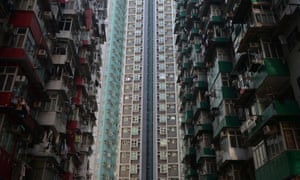


A general view shows residential estates in Hong Kong


Hong Kong is one of the most densely populated places in the world. Photograph: Dale de la Rey/AFP/Getty Images

The source of the smog


While equipping every room of a school or home with filters can clean the air, it’s only a plaster over the larger problem: tackling pollution at the source.


Emissions from cars and container ships are some of the largest contributors to Hong Kong’s smog. Old diesel vehicles still number in the tens of thousands, and ships sailing into the city’s port, one of the busiest in the world, are allowed to burn high sulphur fuel right up until they dock. Power plants, meanwhile, rely almost entirely on fossil fuel, with coal supplying 52% of the city’s energy.


Much of Hong Kong’s pollution, however, wafts across the border from China. About 60-70% of particulate matter comes from the mainland, according to a study commissioned by the city’s Environmental Protection Department. In winter, when the wind direction tends to blow more pollutants towards Hong Kong, as much as 77% of dust in the air comes from China.


Hong Kong has signed a series of agreements with Guangdong province directly to the north – but they are unenforceable, stymying efforts by the local government and activists to have a meaningful impact. In the meantime, the health impact on Hong Kong’s population is severe.


There were more than 1,600 premature deaths last year because of air pollution, according to Hong Kong University’s school of public health. In the first month of 2017 researchers estimate there were more than 300,000 doctor’s visits linked to smog.


A landmark study last year found that air pollution increased the risk of dying from any type of cancer by 22% in Hong Kong. An increase of just 10 micrograms of PM2.5 – a tiny airborne particulate linked to cancer and heart disease – heightened the risk of dying of breast cancer by 80%.



Two men run past a billboard in Hong Kong


A clean, blue-skied billboard against the city’s polluted skyline. Photograph: Philippe Lopez/AFP/Getty Images

With a government that is scarcely accountable to Hong Kong residents, environmental campaigners are fighting an uphill battle to contain even local sources of pollution. The city’s leader, known as the chief executive, is elected by a 1,200-strong committee made up of elites, where China has considerable sway over the votes. Only half the seats in the legislature are directly elected, with the remaining lawmakers returned by professional organisations that overwhelmingly support Beijing.


Tanya Chan, chairman of the environmental affairs panel in the city’s legislature, recalls constituents clamouring for the government to clean up the air, fearing for the health of their children. “The government can try harder and they should push harder,” she says. “We need to be improving fuel standards and expanding the use of electric vehicles.”


Cleaner air the most challenging product to sell: everyone wants it but it’s not just something you buy


Patrick Fung


Chan is in favour of introducing congestion pricing to some of the city’s most clogged districts, but lawmakers are hamstrung by a political system where all power related to government spending or levies requires approval from the chief executive.


“He is only accountable to a small election committee, where most come from business sectors,” Chan says. “We have no choice but to breathe this air.”


The city’s air quality standards (government targets for clean air) remained unchanged for 27 years before eventually being updated in 2014. But they still fall short of WHO guidelines.


“We need to improve our air quality standard to catch up with international standards,” Chan adds. “That process has been a bit slow and I hope the government will do more, especially for the PM2.5s.”


The Environmental Bureau only began publicising Hong Kong’s PM2.5 figures in 2012, nearly seven years after it began monitoring the harmful pollutant, and only after Beijing began publishing the same information.


But locals are increasingly concerned, and hungry for information.
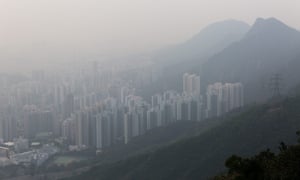


Kowloon buildings in polluted air


Hong Kong’s air pollution caused more than 1,600 premature deaths last year. Photograph: Jerome Favre/EPA

The activists


On a recent evening, tucked away on the second floor of a sleepy cafe, about two dozen people gather to receive a crash course in Hong Kong’s pollution situation. The mostly young crowd are a mix of office workers, salesmen and artists, all united by their previous ignorance of the dangers in the air and their anger at the officials they say kept them in the dark.


Leading the meeting is Patrick Fung, chief executive of the Hong Kong Clean Air Network. The 31-year-old has become the face of the fight for better air quality in the city, and while he’s often dressed in tailored shirts and trousers to ensure his message is taken seriously, his shoulder-length hair, goatee and glasses evoke an image of environmental activists from years past.


A lot of the bureaucrats don’t want to be blamed for something,. They just try to keep ignoring it and ignoring it


Peter Brar


In many ways the former advertising executive lives by the phrase: “There’s no such thing as bad publicity,” taking any opportunity to counter the narrative that dirty air is a fact of life.


“I’m just advertising something else now: cleaner air,” Fung says. “It’s the most challenging product to sell: everyone wants it but it’s not just something you buy, some sacrifices need to be made.”


On the most basic level, Fung and his fellow campaigners want the government to update its air quality targets. The Hong Kong government’s targets for annual air pollution are three and a half times higher than those recommended by the World Health Organization.


But beyond that are a host of problems unique to Hong Kong: the city is one of the most densely populated places in the world, with its most crowded district nearly four times more packed than Islington, London’s densest borough. Narrow streets surrounded by high-rises have created “street canyons”, which can trap pollutants between buildings.


Fung’s group advocates for large swaths of the city’s main thoroughfares to be turned over to pedestrians, similar to New York’s Times Square or plans for Oxford Street in London. Cindy Wong listens to Fung’s speech with rapt attention, bombarded with information she had never heard before.


“People in Hong Kong spend all their time worrying: prices are expensive, rent is high, salaries are low, so no one has time to care about pollution,” she says after the meeting. “The government should have a strict policy to control pollution; the government should lead and people will follow.”



Patrick Fung, the head of the clean air NGO.


Patrick Fung: ‘[Clean air] should be a basic right.’ Photograph: Benjamin Haas for the Guardian

“The air seems much better in foreign countries, in Europe,” Wong adds. Although she’s never been, she often watched with envy as travel programs highlighted tree-lined streets and plentiful gardens in cities abroad.


“A lot of Hong Kongers know about the poor air quality, but they feel powerless,” Fung says. “It’s an issue of justice – this should be a basic right.”


After five years heading the environmental NGO, he says he can tell the air quality by his nose alone. “Everyone in this office can tell just by the smell of the air.”


Ignoring the problem


The vast majority of Hong Kong people don’t have air purifiers, and those that do tend to be wealthier and better educated, according to Peter Brar, manager at air quality testing company Renaud Air, which also sells filters. He estimates about half of all expats have at least one air filter in their homes.


“A lot of the local people who’ve never had an opportunity to live abroad don’t know any better,” Brar says. “They think going to the doctor and getting sick three times a year is normal; it’s not normal.”


Although many in Hong Kong may not be aware of the hazards of dirty air, the government has over a decade of data illustrating the problem – but it has been slow to act.


“A lot of the bureaucrats don’t want to be blamed for something,” Brar says. “They just try to keep ignoring it and ignoring it as long as possible – and saving money, saving money until they have to do something.


“Hong Kong is a very pro-business environment,” he adds. “The government does know the air quality is really bad – but they try to hide the problem.”


In a town obsessed with money, the fact that air pollution is estimated to have caused HK$ 20.bn (£2.2bn) worth of economic losses in 2016 may change more minds.


Brar points to a system where buildings in Hong Kong can apply for a clean air certificate from the government – but the process only tests for PM10, particulate matter akin to dust or pollen, entirely ignoring the smaller, more harmful PM2.5.


He says companies that sell air purifiers frequently meet resistance from schools and business, with executives either in denial or unwilling to spend the money required to provide clean air.


When Giraudon wanted to present a professional report at his daughter’s school, Brar offered to test the air quality for free, but was also rebuffed by school officials. Other schools have been more receptive – particularly international schools that have more money compared to government-run institutions.


Giraudon, however, has left behind his battle for classroom purifiers in favour of a suburb of Annecy, a small French city that has the reputation of having the cleanest lake in Europe.


Having arrived last December, Giraudon reports that his daughter Margaux already seems to be doing better. Frequently sick in Hong Kong, she has yet to fall ill, is coughing less and no longer needs to carry an inhaler.


After eight years of living in Hong Kong, Giraudon admits he misses the excitement, opportunities and low taxes, which max out at 15% rather than France’s 45%.


“But I prefer to pay tax than to kill my children,” he says.


Guardian Cities is dedicating a week to investigating one of the worst preventable causes of death around the world: air pollution. Explore our coverage at The Air We Breathe and follow Guardian Cities on Twitter and Facebook to join the discussion


Where the wind blows: how China"s dirty air becomes Hong Kong"s problem

25 Mart 2014 Salı

Sahel meningitis outbreaks linked to wind and dust ranges, declare scientists

Sahel

A donkey throws up dust in Chad’s Mao area. Research suggests wind and dust levels can be employed to predict meningitis. Photograph: Rebecca Blackwell/AP


Scientists could soon be in a position to forecast ailment outbreaks in sub-Saharan African’s “meningitis belt” using climate information. The forecasts could be used to strategy early vaccination drives aimed at preventing or limiting casualties.


In the “meningitis belt” of sub-Saharan Africa, which stretches across the Sahel from Senegal to Ethiopia, major epidemics of lethal meningitis are schedule. A devastating 1996-97 outbreak killed about 25,000 individuals.


An powerful new vaccine has driven a decrease in meningitis, but the common method in the area has been to carry out vaccination drives and antibiotic therapy of the condition in districts previously struggling outbreaks. In some cases, assist arrives as well late to make a substantial influence, overall health officials say.


In the close to future, although, scientists may well be ready to use climate factors this kind of as wind and dust circumstances to forecast these epidemics and develop earlier vaccination methods to prevent or limit casualties.


New research carried out in Niger by the Nasa Goddard Institute for Room Research and Columbia University’s Global Study Institute for Climate and Society found that measured amounts of wind and dust can be utilised to predict some of the yearly variability in meningitis outbreaks, at both nationwide and district levels.


“We’ve recognized that the disease is associated to climate and environmental problems for a extended time, due to the fact it really is quite seasonal,” explained Carlos Pérez García-Pando, one of the report’s lead authors.


The challenge, he said, was to figure out which climate factors have been essential in buy to greater equip public wellness selection-makers to act.


“The idea was to try to use designs and observations from satellites and all kinds of data on possible (climate-connected) parameters that might be affecting the ailment, and consider to use that data to provide advance warning,” Pérez said.


What the group of researchers found was a notably shut correlation in between wind and dust levels and meningitis outbreaks.


Madeleine Thomson, another researcher concerned in the task, named the strength of the romantic relationship astonishing.


“A lot of professionals have known for a prolonged time that setting is crucial, but not how important,” she stated.


The analysis on meningitis follows equivalent perform with malaria, connecting climate aspects to the mosquito-borne condition.


Thomson explained that the distinctions in between the two illnesses produced them effectively-suited for comparative scientific studies.


“We had some experience working on malaria, and chose to function on meningitis, because it truly is an essential ailment, specifically for the Sahel area in Africa, and it is a dry season condition, as an alternative of a moist season ailment … So it permitted us to investigate some of the issues of dealing with a diverse sort of the condition, but again with environmental and climate elements.”


“What we have realized is that yes, this strategy can be utilized to climate sensitive illnesses, writ huge,” she said.


The researchers stated their operate was made to assist wellness officials make successful decisions about meningitis vaccination campaigns. “We have been collaborating extremely closely with decision makers,” extra Pérez.


The following actions are to increase the investigation outdoors of Niger and build models for other elements of the affected area, he explained.


“What we’ve developed is a valuable tool that can assist selection makers to think, organise, distribute medicine, and make their choices much more in advance,” Pérez said.


Sahel meningitis outbreaks linked to wind and dust ranges, declare scientists

17 Mart 2014 Pazartesi

AMA gives wind farms clean bill of health and attacks "misinformation"

The Australian Healthcare Association has dismissed any website link between bad health and wind farms, stating that the spreading of “health scares and misinformation” could be heightening neighborhood anxiousness, possibly leading to sickness.


Australia’s peak entire body for medical doctors explained domestic and international proof “does not support” the theory that infrasound or minimal frequency sound created by wind farms triggers adverse health results in men and women residing near them.


“Individuals residing in the vicinity of wind farms who do knowledge adverse wellness or wellbeing, may do so as a consequence of their heightened anxiousness or negative perceptions with regards to wind farm developments in their area,” said the AMA’s place statement.


“The reporting of ‘health scares’ and misinformation with regards to wind farm developments may possibly contribute to heightened anxiousness and local community division, and above-rigorous regulation of these developments by state governments.”


The AMA advised that the regulation of wind farms need to be “guided entirely” by the proof of their impacts.


The federal government is hunting to press ahead with an “independent review” of wind farms. The Victorian government, which has banned the establishment of wind farms within 2km of any dwelling, has presented $ 100,000 in the direction of the examine.


Maurice Newman, who is Tony Abbott’s top company adviser, has been a higher-profile critic of wind farms, calling them a “danger to human health” and threatening to sue a farmer for erecting wind turbines upon a home adjacent to Newman’s.


Despite the objections of Newman, and anti-wind groups this kind of as the Waubra Foundation, several studies into wind farms have discovered they there is no clear website link to ill results in humans.


Dozens of symptoms have been attributed to wind farms by complainants, like accelerated ageing, back discomfort, bowel cancer and diarrhoea. Wind farms have also been blamed for killing emus and for missing eyeballs in newborn calves.


In February, a overview of proof by the National Well being and Health care Study Council discovered there was no trustworthy evidence of health troubles triggered by wind farms.


Professor Geoffrey Dobb, vice president of the AMA, said: “The infrasound and lower frequency sound created by modern day wind farms in Australia is effectively beneath the degree where acknowledged overall health effects take place.


“And there is no accepted physiological mechanism where sub-audible infrasound could cause well being effects.


“The reporting of supposed ‘health scares’ or the spreading of misinformation about wind farm developments might contribute to heightened nervousness.


“Community consultation and engagement at the start of the approach is crucial to minimise misinformation, anxiousness, and community division.”


AMA gives wind farms clean bill of health and attacks "misinformation"

7 Mart 2014 Cuma

We should wind back the harms of also a lot sugar

In truth, we now know that extra levels of sugar are much more dangerous than people of unwanted fat, creating a far better contribution to our soaring amounts of obesity, as well as the rise of problems this kind of as variety two diabetes, heart illness, cancer and even dementia.


Our contemporary day obsession with minimal fat meals can be traced back to investigation in the 1970s by Ancel Keys – an American scientist who had produced the “K-rations” employed by servicemen in the course of the 2nd World War.


His claims – of a hyperlink between the consumption of saturated excess fat to elevated cholesterol and heart ailment – grew to become orthodox and led to a alter in dietary tips, as properly as a higher demand from shoppers for much less body fat.


There was a lone voice which challenged this see. John Yudkin, a British nutritionist, who believed that sugar – not fat – was the cause of coronary-associated deaths. Despite flaws in Keys’ examination, he efficiently led a charge to have Yudkin’s analysis discredited.


Fundamental to his victory was the sugar sector who had funded some of Keys’ research. The sugar industry masterminded a brilliant PR campaign for the businesses benefiting from the sale of lower unwanted fat merchandise and indirectly influenced physicians and the public to have an unhealthy obsession with lowering cholesterol.


Their vested interest was not just in preserving the degree of sugar in goods, but in fact seeing it utilized much more extensively in minimal body fat products – as manufacturers relied on the substance getting utilised in higher volumes to keep taste, in the absence of unwanted fat.


But analysis more and more shows that it was Yudkin – not Keys – who had it spot on, and – as I can see from my sufferers – the results of these decades of sugar indulgence are now plain to see.


We are now in a circumstance in which 64 per cent of grownups in England are overweight or obese, with a body mass index (BMI) of 25 or in excess of, whilst three million men and women in the Uk have sort 2 diabetes. Between them, weight problems and sort two diabetes presently charges the Uk more than £20 billion a 12 months, a figure very likely to rise to £40 billion in the up coming twenty many years.


The function sugar of sugar in this, as effectively as in other circumstances, is no longer in doubt.


Scientific studies reveal that the fructose part of added sugar is toxic to the liver when consumed in excess, being turned into excess fat.


It also increases persistent ranges of insulin, which is a driving force in the development of kind 2 diabetes, heart illness, cancer and dementia.


Just in recent weeks, we’ve seen a report from the US exhibiting a robust association amongst the proportion of every day calories from sugar-laden meals and death prices from cardiovascular illness and the World Overall health Organisation noting that half of cancers could be prevented by means of life-style adjustments – singling out sugar, as effectively as alcohol and weight problems as aggravating factors.


Nevertheless in spite of all this, the myth is nevertheless becoming perpetrated that sugar can be beneficial and advertisers exploit this by linking it to sport and exercise. So we have a predicament exactly where Mars is an official sponsor of the England football team.


The reality is, though, that not like body fat and protein, additional sugar has no nutritional worth and that – contrary to what the food market claims – the physique does not need any carbohydrate for vitality from added sugar.


But the biggest ongoing con, maybe, is in the continued marketing of lower-body fat foods, as currently being healthier. As this evaluation demonstrates right now, these objects are crammed with eye-wateringly high ranges of the ingredient. I advise all my patients to steer clear of something marketed as lower unwanted fat.


We launched Action On Sugar not only to raise awareness of an fully pointless source of calories, but also to strain the business to progressively reduce by forty per cent the amount of sugar much of which is hidden.


I met with Jeremy Hunt, the Wellness Secretary, final month and he does seem keen to engage on the topic. But what we need to have is an finish to the scenario, set up by his predecessor Andrew Lansley, which sees the sugar sector influencing well being policy.


What I dread, is the exact same method of denial that we noticed from the tobacco business, as it effectively defended it’s core practices for 50 years from when the very first research revealed a hyperlink amongst smoking and lung cancer ahead of any efficient regulation and the food industry continues to do the identical.


Important to this strategy was denial, planting doubt, evasion, confusing the public and even acquiring the loyalty of scientists, and I dread we will see much more of this, as the debate in excess of sugar intensifies.


The present recommendations, from the Globe Well being Organisation – that grownups ought to not eat much more than twelve teaspoons of added sugar per day – are unsustainable. The organisation has now issued draft advice which retains that formal recommendation but says that halving the restrict to 6 teaspoons “would have further benefits”.


This is an improvement, but the reality is that there is that there is definitely no requirement for additional sugar and it should not be included as any element of a balanced diet – just an occasional deal with which we can all get pleasure from.


The United kingdom government has an chance to lead the planet in dealing with this worsening overall health catastrophe. Mr Hunt was absolutely proper when he told me that there’s no silver bullet in tackling weight problems but if he would like a plan of action then he presently has a single.


A year ago the Academy Of Health-related Royal Colleges representing the bulk of Britain’s 220,000 medical doctors produced a report with ten suggestions for necessary interventions to tackle this public wellness crisis.


These included the introduction of a sugary drinks tax, a ban on junk foods advertising to young children, and compulsory dietary specifications in schools and hospitals.


There is too a lot at stake for us to carry on to allow political ideology and an illusionary personal obligation argument to trump scientific evidence. It is time to protect the population and our children’s well being from the manipulations and excesses of the food sector and wind back the harms of as well a lot sugar.


Dr Aseem Malhotra is a London-based mostly cardiologist, science director of Action on Sugar and a member of the Academy Of Health care Royal Colleges Weight problems Group


We should wind back the harms of also a lot sugar