Defend etiketine sahip kayıtlar gösteriliyor. Tüm kayıtları göster

27 Mart 2017 Pazartesi

America rose to defend healthcare. But Trump’s attack on the poor is not over | Mary O’Hara

Obamacare will be the law of the land for the “foreseeable future”, the speaker of the US House of Representatives, Paul Ryan, admitted in the aftermath of the abject failure of Donald Trump or the Republican party to “repeal or replace” Obama’s flagship Affordable Care Act (ACA) after seven years of bleating about it. The colossal and humiliating collapse of the proposals was met with jubilation last Friday by millions of people, especially the poorest and disabled, who were in line to lose access to healthcare if the American Health Care Act had been successful.


Watching the events unfold I wondered: what if there had been a similar sudden downfall of the austerity programme in the UK in those early days when the dire warnings of the harm it would unleash were being shouted from the rooftops? How many people would not now be turning to food banks or battling to access social care if austerity had been stopped in its tracks?


The political rollercoaster in the US as the new health bill failed to garner the necessary votes to be passed in the house (partly because rightwing hardliners wanted an even harsher version) was stunning. The debacle came against a backdrop of months of anxiety and fear at what would unfold if it were passed and, the closer the vote deadline got, the more it hit home how much ordinary citizens would suffer. Across the country, individuals and groups rose to oppose it, highlighting the potentially devastating consequences for access to reproductive health services and the disproportionate impact on low-income women and children. Disabled campaigners worked tirelessly to draw attention to the particular injustices they would face if the law passed. Last Wednesday, more than 50 disability rights activists were arrested in Washington DC for protesting against it.


As longtime campaigner Bruce Darling from the disability rights organisation Adapt explained, many people risked being placed in institutions rather than supported in their own homes if proposed cuts of $ 880bn (£705bn) to Medicaid, the government-funded programme that assists the very poorest and disabled people, went ahead. “Disabled people will die,” Darling told me.


Leading up to the healthcare vote I talked to people who were terrified about the impact of the new act. One of these was Marta Conner, a charity consultant from Virginia whose seven-year-old daughter, Caroline, has Rett syndrome, a neurological condition that severely limits her control over her body and means she needs round-the-clock care, expensive medication and specialist equipment. Conner was like many of those speaking out. She told me she felt “it was important to have our voices heard” because children like Caroline and millions more disabled and seriously ill people could lose a lifeline.


Paul Ryan on failed healthcare bill: ‘This is a disappointing day’

According to independent analysis from the non-partisan Congressional Budget Office, the AHCA would have seen 24 million people lose health cover in the next decade – and sent insurance premiums for older people rocketing. And, just to rub salt in the wounds, it would have meant a doling out of tax breaks to the rich.


Nevertheless, despite the healthcare reprieve, if you are poor or disabled in the US right now, the fight for rights to support and quality care is far from over. For a start, the healthcare debate isn’t going to disappear: health insurance remains prohibitively expensive for many and even with the advances of Obamacare, it is not a universal system.


But there are other reasons why complacency is not an option. The attack on the poorest is coming on multiple fronts. Trump’s “blueprint” budget, which was also published this month, is a source of widespread anxiety. It has been overshadowed somewhat by the healthcare issue, but with clear echoes of cuts in Britain, initiatives that help the most vulnerable could be decimated if Trump gets his way.


In a similarly absurd vein to Tory claims of “compassionate Conservatism” while they slash budgets, preside over soaring levels of child poverty and pummel the NHS, Republicans have had the gall to argue that culling anti-poverty programmes such as after-school nutrition initiatives and Meals on Wheels are acts of compassion towards taxpayers. The question now is, can these radical proposals come crashing down as the healthcare bill did? For the sake of the most vulnerable, let’s hope so.


America rose to defend healthcare. But Trump’s attack on the poor is not over | Mary O’Hara

5 Mart 2017 Pazar

"Defend NHS with all your might", Corbyn urges demonstrators

Jeremy Corbyn has told tens of thousands of demonstrators to “defend the NHS with all of your might” at a protest march through central London.


Organised to warn that further funding cuts in the health service represent “a real risk to the safety of patients”, the event on Saturday sought to demand a fully and publicly funded NHS and social care services.


The Labour leader said to the crowd in Parliament Square: “The NHS is in crisis, in crisis because of the underfunding in social care and the people not getting the care and support they need.


“There are those waiting on trolleys and those who are desperate to get into an A&E department waiting hours for treatment. It is not the fault of the staff. It is the fault of a government who have made a political choice.”


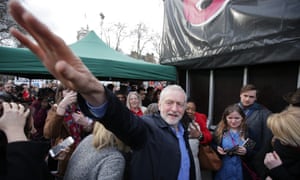
The Labour leader, Jeremy Corbyn, waves to supporters at the rally in support of the NHS in London.


The Labour leader, Jeremy Corbyn, waves to supporters at the rally in support of the NHS in London. Photograph: Daniel Leal-Olivas/AFP/Getty Images

Corbyn called for the budget to be unveiled by the chancellor, Philip Hammond, on Wednesday to properly fund the health service with an emphasis on social care and mental health services.


Ahead of the demonstration, the Green party spokesman Larry Sanders wrote in the Guardian: “The government tells us there isn’t enough money, but this isn’t true. We are the fifth-richest country in the world – we have the money to stop our health service turning into a humanitarian crisis, and to care for people when they grow old: in hospitals, the community and homes.”


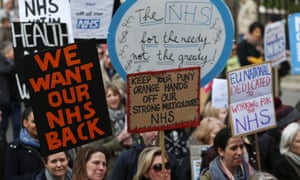
Campaigners, medical staff and members of the public who took part in the march held up homemade banners with slogans including “We want our NHS back” and “The NHS for the needy, not the greedy”.


David Wrigley, a GP from Carnforth, Lancashire, and deputy chair of the British Medical Association council, was among the frontline staff marching under the slogan “Our NHS, No Cuts, No Closures, No Privatisation”.


He said the march was a cry for help because funding cuts had put the NHS in a desperate situation.


“Patients are not getting the care they deserve. We are a country that can afford the funding that is required,” he said.


The campaigners, who say the NHS is at breaking point, hope the march will put pressure on the government ahead of next week’s budget.


Protesters march through central London to demand more funding for the NHS.


Protesters carry homemade banners during the march through central London to demand more funding for the NHS. Photograph: Neil Hall/Reuters

Wrigley said: “I guess it is also a wakeup call for Theresa May and the chancellor … we demand they fund the NHS adequately. If the budget does not bring about any further funding increase, there would be uproar.”


The junior doctor and GP trainee Dr Jeeves Wijesuriya said the demonstration was a chance for the government to plot a new course for the NHS.


Speaking on behalf of the BMA, he told the crowd: “What is sustainable about debts that can only be paid with our patients’ health and yet still won’t be settled? Where is the transformation when the money to build new hospitals and health centres is being siphoned off to pay debts?”


Felix Ramos, 53, of Hackney, east London, said: “Many people are not going to get the help they need … privatisation does not work. It is not going to care for the vulnerable.”


Support came from the Great British Bake Off presenter Sue Perkins, who tweeted: “Love and support to all those marching for the NHS today.”


Sue Perkins (@sueperkins)

Love & support to all those marching for the NHS today, with a special shoutout to KONP, West Cornwall Health Watch & the gang in Penzance.


March 4, 2017


A spokesman from the Department of Health said: “We are committed to the NHS, which is why we’re investing £10bn in its own plan for the future, including £4bn extra this year to transform services and improve standards of care.”


"Defend NHS with all your might", Corbyn urges demonstrators

6 Ocak 2017 Cuma

What I wish I could tell my boss: "You never defend me"

You never stick up for your junior members of staff. When another healthcare worker said recently: “I don’t see the point of pharmacists on the ward”, instead of defending us, you brought the complaint to us and lectured us about how we do our jobs. This is the role that you – a senior managing pharmacist – created, and recruited us for. So why don’t you defend us?


And I don’t just hear this from colleagues. Patients routinely tell me: “Oh you wouldn’t know what that tablet is for” and speak to me like I am an uneducated, inexperienced member of staff – oblivious to the fact I have a four-year degree. While others tell me they “don’t understand my job”.


People often assume that the pharmacist is simply there to pick the tablets off the shelf, count them out and hand them over. I get asked by patients’ relatives: “Why does it take three hours just to get the medications up?” I have to defend the job that I do on a daily basis, explaining that I have to make sure the medications are safe before I simply hand them over.


I wouldn’t expect the public to know exactly what a pharmacist does, but now it seems the healthcare colleagues I work with don’t understand the concept of my job either. I am left feeling unappreciated by everyone around me. Our senior pharmacists, managers and leaders do nothing to defend our positions or highlight the importance of our roles.


I continue to do what I do without recognition. Patients are often none-the-wiser about the corrections I’ve made to their prescribed medications. On a daily basis I find myself having to tell junior doctors how they have prescribed essential medicines incorrectly: Parkinson’s medications, cancer treatments, anti-hypertensives, anti-epileptics and anti-diabetics. The prescriptions quietly get changed without the patient or other healthcare professionals knowing.


A doctor prescribes a double dose of a toxic drug – I see the prescription and instantly instruct the doctor to amend it so that the patient is not given a potentially dangerous dose. A doctor documents a plan to start phosphate supplements yet accidentally prescribes potassium supplements – I tell them to change the prescription to avoid potential heart problems. In both instances the patient is unaware. When junior doctors went on strike, we were left with consultants who didn’t know how to use electronic prescribing systems. On whom did they rely? You guessed it: us. It would be nice if, instead of agreeing with colleagues who say they don’t understand my role, you explained to them the importance of what we do.


From a distance it might seem that I am doing nothing, sitting at the corner of the ward behind a screen staring at drug charts, prescriptions and blood results. But if it was not for me checking and cleaning up the mess of inaccurate prescribing by doctors who are too busy and tired to pay attention, then patients would not be treated safely. They would be given the wrong medication in hospitals, with potentially fatal consequences, and they would go home with the wrong prescriptions.


So next time someone questions the importance of our jobs and makes a demeaning remark asking what is the point of us “sitting around on the wards all day”, it would be nice if you stood up and highlighted just how essential our jobs are. I do not expect understanding, praise or recognition from patients and the public, but I do expect appreciation and respect from the other healthcare professionals that I work with – and even more so from you.


What I wish I could tell my boss: "You never defend me"

23 Nisan 2014 Çarşamba

Why we should defend Josie Cunningham"s appropriate to an abortion | Martin Robbins

Josie Cunningham on

Josie Cunningham’s actions are no different from individuals of thousands of women working out their reproductive rights. Photograph: Ken McKay/Rex Functions


Like many British girls, model and celebrity-wannabe Josie Cunningham had a selection to make about her pregnancy. She could have had the baby she didn’t want, by a man she didn’t enjoy, and abandoned the job she craved or she could put her occupation 1st, acquire monetary safety, and believe about including to her family members later, when she was prepared. She chose the latter, and for that she’s been vilified by the nation’s press, condemned by leading public figures, and subjected to trial by detest mob. A female exercises her reproductive rights, and Twitter burns.


The coverage of this story has seen newspapers spew the type of rhetoric that would not appear out of area in the 1950s. The Metro speaks of her, “Claiming her job was really worth far more than the existence of her unborn little one,” a line that wouldn’t seem out of location on anti-abortion literature. Nicola McLean, a glamour model and reality Television star herself, explains that the “stupid slag … isn’t going to deserve young children.” The Mirror, abandoning its liberal credentials, describes the abortion of a bundle of cells as a “life or death determination”, with an effortless vast majority of its readers threatening to boycott Huge Brother need to she take part.


Significantly of this would seem to come down to simple snobbery. The Mirror gleefully estimates Cunningham’s vision: “An abortion will more my profession. This time up coming 12 months I will not have a child. Rather, I will be popular, driving a bright pink Variety Rover and purchasing a large home.” It really is a statement that invites judgment, from the type of character tabloids thrive on mocking – a female who does not know her area.


In reality, her actions are no various from individuals of thousands of women who exercise their reproductive rights in buy to make informed selections about their long term careers and families, nevertheless because she utilizes the incorrect language, because she talks “typical”, and needs to be on Huge Brother alternatively of functioning in a call centre, she has been subjected to a torrent of vile abuse and bullying. Much of it incited by the extremely newspapers that market the celebrity life-style in the first location.


To read through Cunningham’s mentions on Twitter is to explore a globe of medieval morality I did not believe even now existed in the United kingdom. The “murdering cow” requirements “locking up”, you see. “It’s a psychological institute you require,” explains one man. A single female tells her to throw herself off a cliff, although a man named Warren patiently explains that, “somebody demands to throw acid on you.” “I sincerely hope this lady is flattened by a lorry,” prays an additional. Girls who’ve in no way met her contact her an “unsightly no excellent cunt,” a “rank slut,” who “doesn’t deserve the capacity to conceive” and demands “a excellent challenging kick in your piss flaps.” Numerous speak erroneously about murdering babies or children, one particular female asking if she can come to feel the 18-week-old foetus kicking inside her.


Equally troubling is that considerably of this abuse came from the followers of a GMC-registered medical professional, Dr Christian Jessen, who tweeted, “this is a new minimal, even for her” to his 300,000 supporters in reaction to the information then retweeted a comment that “She is a vile human being,” before advising “I WOULD Leave IT JOSIE, Genuinely” when she complained about the avalanche of detest this provoked.


It is well worth taking a minute to appear at what the GMC’s good healthcare practice guide says about doctors’ use of social media. The guidance explains that “the requirements expected of physicians do not adjust since they are communicating by way of social media rather than face to face.” In particular, “You need to not use publicly available social media to go over individual individuals,” and “You should not bully, harass or make gratuitous, unsubstantiated or unsustainable remarks about individuals on the internet.”


Dr Jessen utilized the moral authority invested in him as a rich, white, male celebrity to smack down a girl searching for an abortion. Her crime? Wanting to be as famous and wealthy as TV’s Physician Christian is, and not expressing that eloquently enough. Whether or not Jessen’s behaviour is deemed professionally unacceptable is between him, the GMC and Josie Cunningham, ought to she choose to make a much more formal complaint, but either way I hope he will take some time to reflect on his perform.


In the meantime, this sudden backlash towards abortion highlights just how fragile women’s rights remain in Britain, and how easily sentiment can shift. It comes as the end result of yet another disturbing trend, an increasing acceptance of the notion that only specified individuals deserve human rights. Therefore cellphone hacking wasn’t witnessed as a large deal till much more ‘deserving’ victims than “celebs” had been highlighted only “challenging-working” households “deserve” support from the state people suspected of terrorism never “deserve” the proper to be charged inside of a affordable period and so on, and on.


The moment you introduce the language of “deserving”, you invite other people to judge just how deserving you are and a right extremely speedily gets a privilege. What tends to make the “debate” about Josie Cunningham so disturbing is that it refuses to even acknowledge the idea that entry to abortion is a basic human proper, or that women are entitled to choose what they do with their own bodies. If we fail to defend Cunningham, then we accept that only those females who are “deserving” enough should be allowed to have an abortion. And if we accept that, then it really is only a matter of time prior to others are deemed undeserving as nicely.


Why we should defend Josie Cunningham"s appropriate to an abortion | Martin Robbins