[unable to retrieve full-text content]
Live coverage of all the day’s campaign action with the last PMQs before the election and a row over Labour’s NHS funding promises
- Labour will lift pay cap for ‘overworked’ NHS staff
- Sign up for the Snap, our daily election email – and read today’s
- PMQs – Snap verdict
- PMQs – Verdict from the Twitter commentariat
- Afternoon summary
You’d have to have a screw loose not to think things are pretty tough. I noticed when Jeremy addressed the PLP [parliamentary Labour party] he didn’t announce the key seats we’d need to take off the Tories to form a Labour government. I thought that was ominous.
It is a remarkable achievement for the leadership to have taken a catastrophic situation in Scotland and made it quite a lot worse. We seem to be doing worse in Wales … We’ve gone backwards amongst every demographic, every region of the country. Jeremy is behind Theresa May on managing the NHS! It’s quite a special achievement to put all of that together in a short period of time. Hats off to Jeremy and Seumas [Milne], Diane [Abbott] and John [McDonnell]. That’s pretty special.
In February the government announced that it would close the so-called Dubs scheme for taking unaccompanied child refugees from Europe after a total of 350 were admitted. This caused outrage because, when the government accepted Lord Dubs’ amendment to the Immigration Act committing it to take some unaccompanied child refugees, it was expected that around 3,000 could be admitted.
Today, in a written ministerial statement, the Home Office minister Robert Goodwill has admitted that a further 130 places are available for unaccompanied child refugees. The Home Office should have know about these extra places when it made its announcement two months ago but it didn’t because it lost the submission from a council saying it could provide the places.
The government remains fully committed to the implementation of our commitment under section 67 [the Dubs amendment] to transfer unaccompanied children to the UK from Europe and no eligible child has been refused transfer to the UK as a result of this error. The home secretary has written to her counterparts in France, Greece and Italy and we are working closely with member states, as well as the UN High Commissioner for Refugees (UNHCR), the International Organisation for Migration (IOM) and NGO partners so we can identify and transfer children to the UK as soon as possible.
It is welcome that an extra 130 children will be brought to safety in Britain under the Dubs scheme. But it beggars belief that these children weren’t helped earlier because of a basic admin error. This shows a shameful failure by the Home Office to talk properly to local councils who were willing and able to help or to check they had counted the figures up right. This shows the Home Office simply hasn’t taken this seriously enough.
Time and again the select committee and local councils across the country told the Home office that there were more places available, but they wouldn’t budge and they failed to follow up. Surely on something as important as this, when children are at risk of trafficking and prostitution, they would have checked the numbers were right.
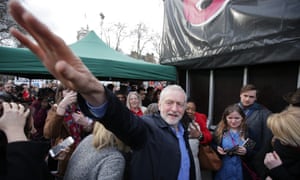
Here is another picture from Jeremy Corbyn’s NHS visit this afternoon.
The Scottish Labour party has named a former chief of the pro-UK Better Together campaign, Blair McDougall, and a leading Corbyn supporter, Rhea Wolfson, in their first tranche of general election candidates.
After its rout by the Scottish National party at the 2015 election, Scottish Labour was left with one MP, leaving it the major task of finding up to 58 new candidates when its popularity is at a record low of 14%. This is the first election where Scottish leader Kezia Dugdale and her officials have autonomy from the UK party in choosing candidates.
Leanne Wood, the leader of Plaid Cymru, has also criticised Jeremy Corbyn for not being willing to take part in a leaders’ debate without Theresa May. She is echoing what her friend and political ally, the SNP leader Nicola Sturgeon, said on Twitter earlier. (See 2.08pm.) In 2015 Wood and Sturgeon joined Ed Miliband, the Labour leader, Natalie Bennett, the Green party leader, and Nigel Farage, the Ukip leader, in a so-called “challengers’ debate” that did not feature David Cameron.
Wood said:
It is disappointing to hear that the leader of the Labour party is not prepared to take part in any televised leaders’ debates without the prime minister.
These debates are a good opportunity for people to engage with the election and for the leaders to put forward their vision to voters.
You have probably got the point about “strong and stable leadership” by now, but just in case you haven’t, the Guardian video team have produced a video pointing out just how frequently the Tories hammered home this message at PMQs.
Jeremy Corbyn has renewed his call for Theresa May to take part in TV election debates. And he has signalled that he won’t take part if she is not included. Speaking to Sky News, he said:
I asked Theresa May this morning about the TV debates, lots of people asked her about it, and she said they’re over because there are no more prime minister’s question times because parliament is now dissolved, or will be dissolved next week. And so, actually, the debate has to include the prime minister, the leader of the Conservative party, and we are up for that debate.
You will see me all over the country taking questions from people on the streets.
This is from the BBC’s Laura Kuenssberg.
CPS source confirms they’ve received a file from Kent Police over election expenses in South Thanet
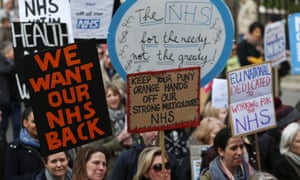
Jeremy Corbyn has been meeting health workers today.
A Panelbase poll is out today giving the Conservatives a 22-point lead over Labour. Here are the figures.
Westminster voting intention:
CON: 49% (+10)
LAB: 27% (-4)
LDEM: 10% (+4)
UKIP: 5% (-9)
GRN: 3% (-)
(via Panelbase)
Chgs. w/ Jan 2016
On BBC Radio 5 Live Michael Gove, the former Conservative justice secretary and a leader of the Vote Leave campaign, said he was “absolutely convinced” that Brexit would result in more money going to the NHS. When it was put to him that Vote Leave had said at one point that an extra £100m a week would go to the NHS if the UK left the EU, and he was asked if he still expected that, he replied:
I am absolutely convinced that we will be spending significantly more on the NHS [after Brexit.] I hope it’s £100m.
Tim Farron, the Lib Dem leader, has tweeted saying that he has “sacked” David Ward as a candidate. (See 2.26pm.)
I believe in a politics that is open, tolerant and united. David Ward is unfit to represent the party and I have sacked him.
Arlene Foster, Democratic Unionist leader and first minister in the last power sharing government in Northern Ireland, took time out today from electioneering to pay a highly symbolic visit to Irish language pupils at a Catholic school near the border.
Foster had been criticised earlier this year for her opposition to an Irish Language Act – a key demand by Sinn Fein – which would put Gaelic on an equal par to English throughout Northern Ireland.
Now Tim Farron, the Lib Dem leader, is accusing Jeremy Corbyn of “running scared” after it emerged that Corbyn will not take part in TV election debates if Theresa May is not included. Farron said:
Corbyn is running scared. He is running away from facing his opponents, he is running away from defending his policies, he is running away from leadership.
The Liberal Democrats have barred former Bradford East MP David Ward from standing again for the party, after Tim Farron said his comments about Jews had been “deeply offensive, wrong and antisemitic”, my colleague Jessica Elgot reports.
Related: Tim Farron sacks Lib Dem candidate for ‘deeply offensive and antisemitic’ comments
In the huddle for lobby journalists after the final PMQs of the parliament, Jeremy Corbyn’s spokesman struck an upbeat note about Labour’s prospects. He said the Conservatives’ poll lead will narrow once the campaign gets underway and the public get to hear Labour’s message, “in our own voice”.
We are confident that we can win this election, and we’re fighting for every seat, and we’re confident that once Labour’s message is clearly heard, and there is a chance for the public to hear policies that many of them won’t have heard before, but which are extremely popular, and we know to be so, that will have cut-through, and Labour support will increase.
The politics and the polling is actually quite complex and quite varied across different countries, and I don’t think it’s just a technical issue to do with the polling companies that we’re in; I think it’s to do with the volatile and fluid political situation, with much more fragmentation.
This was all dealt with when the allegation first came out, and it’s not the case that John McDonnell signed any such statement. When the story was first run about a year ago it was made clear that it was confusion about another statement; he never signed the statement involving MI5, it was another story entirely. This is recycled fake news.
Nicola Sturgeon, the Scottish first minister, has been campaigning in Stirling today.
On the World at One Andrew Gwynne, Labour’s general election coordinator, said the party’s manifesto would be published on Monday 15 May. Asked how Labour would fund its promises, he replied:
I’m not in a position to spell out the Labour party’s full manifesto here. But we will have to wait until May 15 for the manifesto.
Conservatives have denied that Boris Johnson is being sidelined from the party’s general election campaign by Theresa May, the Press Association reports.
Reports have suggested the foreign secretary has been told to keep a low profile because he is vulnerable to challenge over his pre-referendum claims that Brexit would deliver £350m a week to spend on the NHS.
A senior Conservative source dismissed the claims as speculation, and said Johnson would soon enter the fray.
Nicola Sturgeon, Scotland’s first minister, has criticised Jeremy Corbyn for apparently refusing to take part in an election debates if Theresa May is not involved. She posted this on Twitter.
Faced with an open goal, Corbyn decides against even attempting to score . Unbelievable, if true. https://t.co/JkRBLxgLID
Source close to Jeremy Corbyn reveals he won’t take part in TV debates if Theresa May doesn’t. #GE17
This is what political journalists and commentators are saying about PMQs.
Mostly people are quite positive about Jeremy Corbyn, although several people think Angus Robertson was more effective.
Corbyn uses last #PMQs to attack May on triple lock, NHS, housing, education spending cuts. Weak ground 4 May but no real blows dealt #PMQs
May is a master at not answering the question. That is why Corbyn should use #PMQs to ask her the same one 6 times. Makes her uncomfortable
Corbyn channelling impressive levels of passion at #PMQs
Corbyn is doing rather well, as he did last week. Spitting out the questions. May quite pugnacious in reply
There’s much more to being a good PM than PMQs, of course, but May remains quite weak at this. No wonder she’s dodging tv debates
COMMENT AR shows JC how to do #PMQs but remember TM wants to drop pensions triple lock. If this is the worst this gets for her…
Theresa May savages Jeremy Corbyn at final PMQs before election #GE2017 https://t.co/9X2W54WHBL pic.twitter.com/hsy094eOaX
.@AngusRobertson there proving he’s the best opposition leader in the Commons. Skewers May on pension lock #pmqs
SNP’s Angus Robertson doing what Corbyn cd hv done: forcing May to wriggle on triple lock for pensions. May refuses to guarantee it. #pmqs
Corbyn channelling Miliband 2013: “He may be strong at standing up to weak, but always weak when it comes to standing up against the strong”
Corbyn with decent election lines the tories are for ‘the rich not the rest, the strong against the weak, and weak against the strong’
Corbyn quoted both Blair (“many not the few”) and Miliband (“weak against the strong”) at #PMQs. https://t.co/Q15ztRfeIH
Some very glum faces from Labour moderates sitting behind Corbyn during PMQs.
This is #PMQs at its worst – neither answering questions, talking about completely different subjects and shouting slogans #PMQs
Labour sources are also criticising Theresa May for referring to Jeremy Corbyn at PMQs as a terrorist sympathiser.
Senior Labour source says May calling Corbyn “a terrorist sympathiser” in #pmqs was a “discredit to the office of Prime Minister”
I Like Corbyn, But… https://t.co/xZPMEvtpjH
It gets so much better #ILikeCorbynBut pic.twitter.com/YzQwd7xrC8
Labour are ruling out Jeremy Corbyn taking part in any TV debates that do not feature Theresa May, Huffington Post’s Paul Waugh reports.
Labour source just ruled out Corbyn taking part in any TV debates that don’t feature Theresa May.
Theresa May refused to commit to keeping the triple lock at PMQs. But, according to today’s Times, the Tories are thinking of keeping the policy, which ensures pensions rise every year in line with earnings, inflation or 2.5%, whichever is highest, on the grounds that it would be cost free. Here’s an extract from Francis Elliott and Oliver Wright’s story (paywall).
Theresa May is considering keeping the “triple lock” guarantee on state pension increases because it is likely to be a cost-free promise for the next parliament, according to senior ministers.
Labour has promised to increase the state pension by a minimum of 2.5 per cent a year, despite warnings that it could cost taxpayers an additional 1 per cent of GDP by 2036. The lock is triggered only if inflation falls below that figure and the Office for Budget Responsibility is predicting that wages and prices will increase at a faster pace in the next few years.
The Lib Dem peer Olly Grender, who worked in Number 10 as deputy communications director during the coalition, says Theresa May was wrong at PMQs to argue that the Conservatives deserved credit for increasing council house building during the coalition.
Under Coalition NOT Con Govt increase in council house building thanks to LibDems who insisted (Tories at time didn’t give a ****) #PMQs
This is from Politico Europe’s Tom McTague.
French ambassador Sylvie Bermann in the chamber for PMQs. Chuckling away. Would love to read her diptel!
The SNP’s Alex Salmond says Liam Fox went to the Philippines and said we had “shared values” with it. What shared values do we have with Rodrigo Duterte?
May says we need trade deals after Brexit to ensure a strong economy.
Sir Simon Burns, a Conservative, says he has been Chelmsford MP for 30 years. They are perspicacious, he says. They want a government with a strong economy, strong defences and strong leadership. May will deliver that for the next five years, he says.
May thanks Burns for his contribution as an MP and as a minister.
Douglas Carswell, the independent MP, asks what assurance May can give to the 3.8m people who voted Ukip at the last election.
May says she wants to see the UK getting control of its borders and control of its laws.
Dame Angela Watkinson, a Conservative, asks May why people should continue to vote Conservative.
May says every vote for her and the Conservative candidate will be a vote to strengthen her hands in the Brexit talks.
Labour’s George Howarth says Andy Burnham had a debate yesterday on contaminated blood. He called for a Hillsborough-style panel to get to the truth. Will May join the SNP and Labour in backing the idea.
May says the government has put more money into compensation. The department of health will respond to the consultation.
Mike Wood, a Conservative, says it is good to be back. Doctors saved his life in January. Will May look at what can be done to reduce deaths from sepsis.
May says it is fantastic to see Wood back. She says he is right to focus attention on this problem. The department of health is working on a new sepsis action plan.
Labour’s Grahame Morris asks why May is afraid of TV debates. One should be held in Easington, he says, where May could see the impact of her policies.
May says she has been debating Corbyn every week.
Sir Gerald Howarth, a Conservative who is standing down, says he came into the Commons in 1983, when the country had a strong woman leader, and he leaves as another one is restoring British sovereignty. He appeals to Howarth to protect the armed forces guarding “this sceptred isle”.
May says people will have a choice at the election. The Tories will continue to protect the armed forces.
Tim Farron, the Lib Dem leader, says May once berated her party as the “nasty party”. But it has never been nastier. And Labour is not holding to account. Doesn’t the country need the Lib Dems?
May says Farron talks about a decent opposition. She says Farron cannot say that when the Lib Dems have just elected a candidate with a questionable record on antisemitism.
Sir Eric Pickles, the Conservative, asks May about anti-semitism, and if she shares his disgust at the selection of David Ward, a former MP accuses of anti-semitism, as a Lib Dem candidate. (See 10.35am.)
May pays tribute to the work Pickles had done tackling anti-semitism. She says people will be disappointed to see the Lib Dems adopt a candidate with a questionable record on anti-semitism.
Jeffrey Donaldson, the DUP MP, asks May if she agrees that those who refuse to take their seats (Sinn Fein) and who are refusing to form a government in Northern Ireland are not serving their constituents.
May agrees. She says she wants to work for the restoration of a government in Northern Ireland.
Peter Lilley, the Conservative, says he is standing down because of Theresa May. He says he has confidence that she will deliver Brexit properly. And we must accept that no deal is better than a bad deal. To deny this would be to admit that no price would be too high. That would be the worst possible deal, he says.
May thanks Lilley for everything he has done, not just as an MP, but as a minister in government. She says it is right to get on with delivering Brexit. The only way to ensure that is to get a Conservative government elected.
PMQs – Snap verdict: At PMQs you can deploy the sniper’s rifle or the shotgun, and today we saw Angus Robertson try one, and Jeremy Corbyn use the other. They were both effective in their way, although Theresa May’s shield of slogans and talking points managed to protect her quite adequately. It did not feel as if anyone secured a great triumph.
But in the circumstances, and with polling organisations pouring humiliation over Corbyn by the hour, that probably amounted to something of a win for the Labour leader. He asked about a range of topics, resorting to the “here’s a question from a viewer” formula that he used frequently in his first PMQs outings and neatly skewering May over her reluctance to take questions from members of the public. It was not flashy or eye-catching, but it was honest and solid and his points were strong. In response, May resorted to carpet-bombing Corbyn with the “strong and stable” leadership stuff. Her message discipline is outstanding, and conventional wisdom has it that you cannot repeat these slogans too often (although May seems to be testing that theory to destruction.)
Angus Robertson, the SNP leader at Westminster, asks for a clear and unambiguous commitment to keeping the triple lock for pensioners.
May says she has been very clear that pensioners have benefited to the tune of £1,250 a year. Under her pension incomes will continue to increase.
Ben Howlett, a Conservative, asks if May agrees that his voters should give him a renewed mandate to improve traffic around Bath.
May agrees. A vote for any other party is a vote for wrecking the economy.
Corbyn says millions of women will have heard that answer. Labour will guarantee the triple lock. And it won’t move the goalposts. Sybil, who witnessed the founding of the NHS, said she is 88. She has had wonderful service from the NHS. But now she is scared of going into hospital. With more delayed discharges, isn’t she right to be frightened.
May says the NHS is treated more people than ever before. But that is only possible with a strong economy. She says she will defend her record. She says Diane Abbott has been directing her followers to a website “I like Corbyn but ..”. It addresses questions about Corbyn not being able to pay for his policies and being a terrorist sympathiser. Even Corbyn’s supporters know he is not fit to run the country.
Corbyn says the last Labour government delivered a decent homes standard for every council in the country. House building has fallen to its lowest level since the 1920s. Children are being held back by cuts. Laura, a teacher, said she was seeing less cash every year to pay for children, and more reliance on parent funding. Is May still denying funding per pupil is being cut.
May says record levels of funding are going into schools. People will have a choice, she says. The government has delivered more good school places. Corbyn believes in a one-size-fits-all, take-it-or-leave-it approach to education.
Corbyn says Andy is concerned about how his children are being held back. All three of his children, in their mid 20s, cannot afford to move out of the family home. Don’t we need a housing strategy to deal with it?
May asks what happened under Labour. Under Labour, house building starts fell by 45%. And the number of social homes fell. Under the Conservatives more than twice as much council housing has been built as under Labour.
Jeremy Corbyn says this is the last PMQs of this parliament. It would be appropriate to pay tribute to MPs who are leaving, he says. And he thanks the speaker for presiding over these exchanges.
He says when he became leader 18 months ago he said he wanted people’s voices to be heard in parliament. So, instead of just speaking to handpicked audiences, will May today answer questions from the public. Christopher wrote to him this week saying hus husband had only a 1% increase in wages. But their buying power had gone down 15%. So where is his share in the stronger economy.
Richard Drax, a Conservative, asks about a leftwing campaign for socialist victory that proposed disbanding M15. Would May allow anyone like that to draft her manifesto?
No, says May. She says the plan to disband MI%, disarm the police and scrap the deterrent was endorsed by Jeremy Corbyn’s policy chief, Andrew Fisher. Corbyn is “simply not up to the job”, she says.
Theresa May starts by answering a closed question from the Conservative MP Michael Fabricant about the economy in the West Midlands. It is doing well, she says. And so are public services, because you can only have those with “strong and stable leadership”.
Fabricant says the country needs “strong and stable leadership”.
This is from the Daily Mail’s Jason Groves.
More Labour MPs in for #PMQs than there have been for a while – some taking a last look around?
Very loud cheers for Theresa May as she enters Commons chamber for #PMQs
Here is the list of MPs down to ask a question.
#PMQS LIVEBLOG: These lucky MPs will be grilling the PM from 12. Follow all the action here – https://t.co/B8kBRMA48K pic.twitter.com/mTlwnKdOKL
This is from the BBC’s Laura Kuenssberg.
This Parliament has only sat for 299 days – and had 61 PMQs – for some MPs, today’s the leaving do! Election will decide which ones
PMQs will start in 10 minutes. It is the last of this parliament.
And it is also only the second, and last, election TV debate between Theresa May and Jeremy Corbyn (counting last week’s PMQs as the first.)
Ipsos MORI has more good news for the Conservatives on the polling front. As Joe Murphy reports in the Evening Standard, Theresa May has the best ratings on “best PM” since the firm started polling on this in the 1970s. Here’s an extract from Murphy’s story.
Theresa May’s leadership score has soared higher than either Margaret Thatcher or Tony Blair enjoyed in their best years, an exclusive poll reveals today
The Ipsos MORI survey shows the Conservatives on 49 per cent, with an extraordinary 23 per cent lead over Jeremy Corbyn’s Labour who are on 26 …
Mahatma Gandhi was one of the great figures of the 20th century. He led India to independence and championed a form of non-violent civil disobedience that inspired campaigners around the world. It is hard to think of a modern equivalent, but the Ukip leader Paul Nuttall has suggested a possible candidate: himself.
Nuttall did quite put himself in the same league as the great Gandhi, but in an interview with the Wolverhampton Express and Star suggested they had something in common and the paper’s website has headlined the story: “I’m like Gandhi, says Ukip leader Paul Nuttall in Wolverhampton.” This is what Nuttall told the paper:
Raising issues of equality, women’s rights, and FGM are the issues other parties don’t want to tackle.
Ukip will lead on these and as I said in our press conference I feel as if we are a decade ahead of our time – a bit like we were a decade ahead of our time on getting out of the EU, and on mass immigration.
YouGov has released some new polling this morning. Since February, Theresa May’s net favourability rating has gone up (from +6 to +10) and Jeremy Corbyn’s has gone done (from -40 to -42).
Peter Lilley, the Conservative former social security secretary regarded as one of the Eurosceptics cabinet “bastards” once denounced by John Major, is standing down, the Guido Fawkes blog reports. In a statement announcing his decision Lilley said:
Now we have in Theresa May an outstanding Prime Minister in whom I have great confidence.
I profoundly hope she will be returned with a strong mandate to complete the process of leaving the EU and to seize the opportunities which regaining control of our laws, border, money and trade will give our country.
Lib Dem leader Tim Farron is continuing his tour of remain seats with Brexiteer MPs, after vowing to unseat Labour’s Kate Hoey in Vauxhall. His stop today is St Albans, where more than 62% of voters backed staying in the EU but Conservative MP Anne Main campaigned for leave.
Farron used the campaign stop to highlight the risk to the economy of leaving the EU and tell businesses they should stop funding the Conservatives while they pursue a hard Brexit.
My message to business is this – dump the Tories. Every penny you give them will hurt you; you are funding your own funeral. The success of British business matters. Strong British businesses mean more jobs and a stronger society.
With this disastrous hard Brexit the government is hurting businesses, both big and small, costing jobs and hitting families. All this means fewer jobs, higher prices and spiralling costs of things like fuel. This is a Brexit squeeze affecting millions of people.
.@timfarron visits the National Pharmacy Association in St Albans with @libdemdaisy talking about the #NHS & care pic.twitter.com/ZImwhVQEX1
The Conservatives have also produced a briefing accusing Labour of spending the money it proposes to raise from corporation tax over and over again. The Lib Dems cited 10 examples, although two items on their list were essentially the same. (See 9.09am.) In a note for journalists a few days ago, the Tories cited 11 examples. Most of the Tory ones were the same as the Lib Dem ones, but the Tories had three examples not on the Lib Dem list. Here they are, as set out in the Tory briefing.
Scrapping university tuition fees. Jeremy Corbyn said:‘At the moment what we’re doing is asking students to fund universities rather than the public to fund universities. I would rather move in to the other way around, with public funding of it … It would be largely on levels of corporate taxation’ (Victoria Derbyshire Labour Leadership Hustings, 17 August 2016).
Reversing changes to Universal Credit. John McDonnell:‘Universal Credit. We’re hoping on Wednesday the government will reverse that … If you had a fair taxation system, you weren’t giving the tax giveaways to corporations and to the rich, if you seriously tackle tax evasion and tax avoidance, if you grew the economy we’d be able to afford – we’d be able to afford our public services’ (The Andrew Marr Show, BBC One, 21 November 2016).
Tuition fees will be scrapped and maintenance grants brought back, the Green party are announcing as key features of their election manifesto.
Co-leaders Jonathan Bartley and deputy leader Amelia Womack will also say in a speech today that students and universities will be protected after Brexit if the Green party were in power.
The Green party is the only party standing up for students and putting young people at the heart of its campaign.
Education is a right not a commodity to be bought and sold, and we need a level playing field so everyone has the chance to go to university or college.
If the referendum result had gone the other way David Cameron – remember him? – would be in Downing Street this morning preparing for PMQs. Instead he happens to be in Bangkok, where he has just finished speaking at a tourism conference. My colleague Oliver Holmes was there and he has sent me the highlights.
Here are some of the key points he made.
Let me be optimistic … It’s very good that we are having this election, because I think if Theresa May is successful, she’ll actually have a larger majority and, potentially, more time to deal with Brexit and its consequences.
Arguably, you could say, looking at the state of British politics, the Conservative party having accepted the referendum result and got on with the process and responsibly delivering it, is probably the most healthy mainstream political party anywhere in western Europe.
It was a legitimate cause of populist concern, that Britain was a member of this organisation, the organisation had changed a huge amount over the last forty years, it had gained more powers, it had passed more treaties, it had become more important in more areas. And yet in spite of the fact that the British people were occasional offered a referendum by their leaders, most famously by Tony Blair, they never got a referendum.
If you want to address the causes of populism, it was necessary, in my view, to have a referendum.
But I think it was the right thing. The lack of a referendum was poisoning British politics and so I put that right.
These terrorists and their apologists are trying hijack a great religion and twist and pervert it for their own ends. We must not play into their hands. And that was to me, the biggest problem with President Tump’s travel ban. It would be seen, could be seen, as labelling whole countries as extreme and dangerous because they were predominately Islamic. It’s not a clash between civilisations that we face. That is what the extremists want us to think. This is if you like a war within Islam.”
There would have been a big lesson learn. I thought it was misconceived from the very outset.
Paul Johnson, the director of the Institute for Fiscal Studies, told the Today programme earlier that Labour would have to raise “significant extra sums” to fund its plan to give NHS staff a pay rise. He said:
Each 1% on pay, just 1%, costs half a billion pounds each time. It’s not possible to say from what the Labour party have said quite how much more they intend to spend on the NHS.
If you are going to do that over the next two or three years you will also clearly need to raise significant extra sums in tax revenue.
Norman Lamb, the Lib Dem former health minister, told the Today programme that he agreed with Labour about the need for NHS staff to be paid more. He said the current 1% cap on NHS pay increases was unsustainable.
In effect we are asking very many staff across the NHS to just, year on year, take a pay cut in real terms in order to sustain our NHS. And I don’t think that’s acceptable. I think ultimately it’s dangerous. We are seeing widespread vacancies … Actually people will vote with their feet and leave if you don’t maintain wages at least in real terms.
The problem with the Labour position is their proposal just isn’t credible … The money from corporation tax increase has been spent about 10 times over.
Labour have already committed to using funding from an increase to corporation tax ten times since the last general election:
1. Bringing back the education maintenance allowance and university maintenance grants.
Jonathan Ashworth, the shadow health secretary, will announce his guarantees for NHS staff in a speech to the Unison conference in Liverpool. According to extracts released in advance he will say:
NHS staff have been taken for granted for too long by the Conservatives. Cuts to pay and training mean hard working staff are being forced from NHS professions and young people are being put off before they have even started. Now Brexit threatens the ability of health employers to recruit from overseas.
What is bad for NHS staff is bad for patients too. Short staffing means reduced services and a threat to patient safety. Labour’s new guarantees for NHS staff will help keep services running at the standard which England’s patients expect …
In his Today interview earlier Jeremy Hunt admitted that Brexit would have an impact on the NHS.
There’s no point saying that Brexit and the Brexit negotiations won’t affect the NHS. This is absolutely critical for our public services.
Q: Are you saying you will give the NHS whatever it needs?
Ashworth says the NHS has not had what it needs.
Good morning. I’m taking over from Claire.
Jonathan Ashworth, the shadow health secretary, is on Today now.
We will outline what level corporation tax will be in our manifesto when we publish it in the coming days … The whole programme that the Labour Party will be putting to the country in this election campaign will be costed.
I’m now handing over the live reins to Andrew Sparrow, who’ll take you through the rest of the day’s political news.
A quick reminder: you can sign up for the Snap, our daily election briefing email, here.
In a video for the Guardian, Paul Mason pushes back against the argument from the Daily Mail and others that those who oppose the government and its Brexit plans are “saboteurs”. Meaningful opposition to the Tories is necessary for the country and for democracy, he argues:
Meg Hillier, the Labour MP who chairs the cross-party public accounts committee, has been talking about its free schools report.
We will consider the recommendations carefully and respond in due course.
As well as Labour’s own NHS pledges, we might expect Jeremy Corbyn to press Theresa May on this damning MPs’ report on free schools when the two leaders meet for the final PMQs of this parliament at noon.
In the – so far – planned absence of televised head-to-head debates during the campaign, today could be the last time we see May and Corbyn take each other on ahead of 8 June.
The DfE is spending well over the odds in its bid to create 500 more free schools while other schools are in poor condition. Many free schools are in inadequate premises, including many without on-site playgrounds or sports facilities …
The department is in a weak negotiating position and commonly pays well in excess of the official valuation. On average, it has paid 19% over the official valuation, with 20 sites costing over 60% more.
Leaders in Europe will demand that Theresa May respects the right of EU nationals who have lived in the UK for five years to acquire permanent residence, Daniel Boffey and Lisa O’Carroll report:
In a sign of growing anger over the perceived bureaucratic hurdles being put in their way, the call will be made at a summit on Saturday, where the leaders of the 27 other EU member states are set to sign their negotiating guidelines.
The guidelines were amended by officials on Monday to strengthen demands over Britain’s €60bn divorce bill, open the door to further cooperation on EU-UK foreign policy and law enforcement, and add a call for transparency during the talks.
Such guarantees must be effective, enforceable, non-discriminatory and comprehensive, including the right to acquire permanent residence after a continuous period of five years of legal residence. Citizens should be able to exercise their rights through smooth and simple administrative procedures.
Related: Brexit: EU leaders to demand May respect citizens’ residency rights
Pressed on the issue of social care – which Theresa May has pledged to “stop ducking” – Jeremy Hunt is similarly reticent about what the not-ducking will look like:
We need a long-term sustainable solution.
You’ll have to wait and see what manifesto says … I’m not going to speculate on what the contents of our manifesto are.
And here’s Jeremy Hunt, the health secretary, who’s popped up to defend his record against the Labour claim that staff are “ignored, insulted, undervalued, overworked and underpaid by this Tory government”.
I think they are working harder than they’ve ever worked before … You see a government that’s responding to that.
We will be able to train record number of nurses.
Applications do then recover.
You’ll have to wait and see what the manifesto says.
Labour will be attempting to shift the debate today on to the NHS, with shadow health secretary Jon Ashworth making a number of pledges:
Related: Labour will give pay rise to ‘overworked and underpaid’ NHS staff
Jonathan Bartley, co-leader (with Caroline Lucas) of the Green party, has been updating Radio 4’s Today programme on the progress of the progressive alliance, their proposed anti-Tory electoral pact.
The response from Jeremy Corbyn and Tim Farron, says Bartley, has been
very disappointing … they haven’t responded.
On a local level, people are talking to each other …
We want people to vote Green [but] we will support whatever the local party wants to do. But it has to be a reciprocal arrangement.
Good morning and welcome back to another day on the campaign marathon.
I’m Claire Phipps, bringing you this morning’s essential – should your morning be incomplete without news of constituency selection battles – briefing, and steering the live blog until Andrew Sparrow joins us later.
Remember, the opinion polls were wrong in the 2015 general election; they were wrong in the referendum; and Jeremy Corbyn himself has said that he was a 200-1 outsider for the Labour leadership in 2015 – and look where that got him.
In effect, this is EU Referendum 2. This is the chance for those who didn’t vote/couldn’t vote, to come out. It’s a chance for Remainers to convert more people, help their friends to see the catastrophe that Brexit is …
‘My own constituency voted Remain,’ Theresa May announced in the Commons as an example of her adhering to the ‘will of the people’. But if everyone in Maidenhead who voted Remain backed the Lib Dems in June, the PM could lose her seat.
The Labour party will need more than a wish list and a collection of grievances. I’ll offer three topics for starters. How do we ensure a fair intergenerational settlement? How can our education and tax system respond to the changes of the world of work and employment? Where do we anchor democratic accountability in a world of global flows of goods, money and people?
Planning for parliamentary deadlock and pacts with other parties might be tempting. But these are the methods of counter-insurgents. If Labour instead wants to be a party of government, it has to go into the 2017 election fighting for every vote.
The gap between first- and second-place party in 2015, 2010 or earlier, as well as any byelection result, is not the only factor. Strategists are having to look at how many people in a given seat voted leave or remain in last year’s EU referendum. This information is especially crucial for the Liberal Democrats …
A 30- to 40-point improvement (that is, a 15% to 20% swing that went entirely from the first-placed party to the Lib Dems) would do the job in seats where a majority voted remain – but that is an incredibly ambitious target.
I do not want the people of Scotland to think that English eurosceptics put their dislike of Brussels ahead of our bond with Edinburgh and Glasgow.
It took two months but Trudy Harrison’s first speech as MP was good. “Who knows if you’ll be back,” SNP MP replies in praise. “Or any of us”
Continue reading…
General election 2017: Theresa May and Jeremy Corbyn square off in final PMQs before election – politics live