Institute etiketine sahip kayıtlar gösteriliyor. Tüm kayıtları göster

2 Eylül 2016 Cuma

Francis Crick Institute: cathedral of science "looks better from 1,000 ft"

Appearing on London’s King’s Cross horizon like an upturned beetle, with its row of metal chimneys protruding like little pairs of legs from the fattened silver belly of its roof, the Francis Crick Institute cuts a strange silhouette. As its dichroic-coated glass fins shimmer with rainbow iridescence in the late summer sun, it could be one of the specimens under the electron microscope buried in the bowels of this new £700m biomedical research facility.


“It looks better from 1,000 ft,” says Sir Paul Nurse, the jovial Nobel prize-winning director of the country’s new flagship research centre, the largest such hub in Europe, now charged with furthering our understanding of the fundamental biology of human health. “You can’t really see it properly from the ground.”


Some passersby might wish that were true. Walking the streets of Somers Town, one of the most deprived wards in the UK, it’s hard to miss the 1,000,000 sq ft pile, signalled from all directions by the great aluminium slug that slithers across its rooftop and the orange tiled walls that loom above the streets.


Almost 10 years in the making, the Crick is an ocean-liner of medical research that will soon hold 1,500 scientists tackling the roots of everything from cancer and HIV to tuberculosis and neurodegenerative diseases.
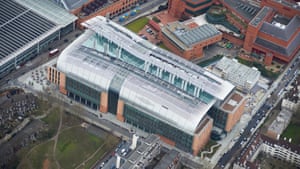


Better from the sky? Francis Crick Institute.


Better from the sky? Francis Crick Institute. Photograph: Wellcome Images

It is the product of a landmark partnership between the UK’s three largest funders of biomedical research (the Medical Research Council, Cancer Research UK and the Wellcome Trust) and three of its leading universities (University College London, Imperial College London and King’s College London), bringing different disciplines together under one big, bulbous roof. With three Nobel prize winners on its staff, expectations for groundbreaking discoveries are high; but does the architecture live up to the cutting-edge science?


Filling a four-acre site directly behind Colin St John Wilson’s British Library and George Gilbert Scott’s St Pancras hotel, the building joins a huddle of brick behemoths, and is evidently trying its best to fit in. Clad in terracotta tiles, it echoes the warm orange hues of its neighbours, while the curving aluminium roof is a nod to the station’s barrel-vaulted Victorian train shed. Yet it misses the mark on both counts, lacking either the confidence or elegance of its forebears.


In an attempt to break up the building’s bulk, the architects have employed a multitude of different claddings, using fins and grids and faceted walls of glazing, but the pick’n’mix collage only calls attention to the building’s heft. The roof – designed to hide the three-storey technical plant needed to keep the labs chugging along – looks like the swooping canopy of an airport terminal, cut and pasted on to a cluster of generic office blocks.
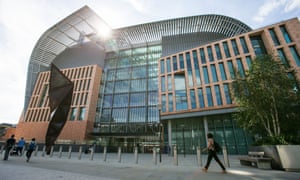


The new building was nominated for this year’s Carbuncle Cup.


The Crick was nominated for this year’s Carbuncle Cup award for Britain’s worst building. Photograph: Daniel Leal-Olivas/AFP/Getty Images

The resulting dog’s dinner was perhaps inevitable, given the project’s convoluted gestation. The original design competition was won by HOK, a vast firm with US headquarters, who concocted a faceted-glass object similar style in to lumpen Siemens Crystal in London’s Royal Docks. Their proposals were met with fierce opposition from Camden’s planners, who had earmarked the site for affordable housing (a plan that was overturned by central government pressure). Camden had a more sober scheme in mind, preferring a costume of masonry to glass – something more akin to the exemplary, if rather beige, King’s Cross Central development nearby.


Keen to ease the project through the system, the client brought on PLP – architects of the monstrous 22 Bishopsgate Tower proposal – to dress the great hulk in planner-friendly clothing. The outcome is neither fish nor fowl, neither faceted crystal nor background filler, but something that tries to be both at once: a portly scientist stuffed into an ill-fitting suit and crowned with a shouty hat. It’s no surprise that it was recently nominated for the Carbuncle Cup, the annual award for the country’s worst building.


For all its exterior clumsiness, complete with a ground floor that reveals little of what’s going on inside, the building seems to be more successfully configured within. As you enter the complex, it quickly becomes clear why some science wags have nicknamed it Sir Paul’s Cathedral, after Nurse. A soaring nave-like atrium extends the full 200-metre length of the building, rising 50 metres past the three main levels of laboratories, crossed halfway by transepts and bridges, and opening up views between the teams of researchers busying away at their benches.
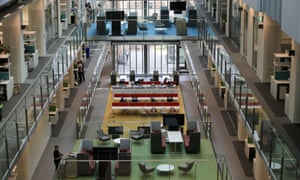


The Crick is Europe’s biggest biomedical research institute.


The Crick is Europe’s biggest biomedical research institute. Photograph: Daniel Leal-Olivas/AFP/Getty Images

“Discovery without boundaries is our tagline,” says Nurse, “so we didn’t want any physical barriers between our 120 labs. It’s all about open-plan, collaborative working and direct sightlines, in an environment that I hope will encourage a sort of gentle anarchy.”


In other hands, this building could have had the thrill of the Pompidou Centre in Paris


Scientists who have moved here from the usual siloed university departments appear delighted at their newfound world of transparency and chance encounters. “I hardly ever met my research partner before,” says Nick Luscombe, whose work focuses on the computational crunching of genomic data. “But now I wave to him every morning across the bridge and we can instantly share our test results.” Further moments of gentle anarchy are encouraged with lots of break-out spaces and an open staircase (not a double helix, alas), although the designers could have tried harder to make these areas more inviting.


While the labs are well configured, the clunky hand of the HOK-PLP partnership is never far away. A big white blob squats at the bottom of the atrium like an invasive tumour, housing the 450-seat auditorium, while the public “gallery” area feels like an afterthought, occupying a corner of leftover space on the ground floor. The cacophony of materials continues, with chequerboards of wooden veneer in three different shades, whiteboard surfaces for passing boffins to jot down their brainwaves and acoustic panels bolted on to every soffit.


Things are more successful in the working guts of the building. On the uppermost floor, the huge ventilation ducts finally break out from their plasterboard hiding places and shoot up through the roof, with the majesty of a ship’s engine room. It’s a moment that makes you realise that, in other hands, this building could have had the thrill of the Pompidou Centre, in Paris. It could have celebrated the astonishing fact that this 12-storey building (a third of which is underground) weighs the same as a 25-storey tower block and expels enough air to fill an Olympic swimming pool every 10 seconds.


The building will no doubt serve the Crick’s founding purposes just fine, but it could have been so much more. Compare it with the Stirling prize-winning Sainsbury Laboratory in Cambridge and the difference is striking: the clunks cannot be excused as the inevitabilities of a working science lab.


“Sometimes in Britain we do amazing things, almost by accident,” says Nurse, referring to the miraculous foundation of the Crick. Except in this case, the accidental fumbling of the design process didn’t quite work out as hoped.


Francis Crick Institute: cathedral of science "looks better from 1,000 ft"

19 Şubat 2014 Çarşamba

Victor Dzau Leaving Duke To Head The Institute Of Medicine

Really don’t miss this critical update: Newly Elected President Of Institute of Medicine Is On The Pepsico Board Of Directors 


Cardiologist Victor Dzau will depart his positions as the chancellor for health affairs at Duke University and the CEO of the Duke University Wellness Method to turn into the next president of the Institute of Medication. He will replace Harvey Fineberg, who has been the IOM president for the last 12 years.


“I am humbled and honored to be picked to lead the IOM at a time of unprecedented opportunities and issues in health, well being care, and biomedical sciences,” said Dzau in a statement from the IOM. “Harvey Fineberg has been an outstanding leader of the IOM, and I am committed to creating on his outstanding perform and advancing the impact of the IOM on the nation and globally.”


Before moving to Duke almost a decade in the past Dzau was the chair of the department of medicine and director of analysis at Brigham and Women’s Hospital and the Hersey Professor of the Concept and Practice of Physic (Medicine) at Harvard Medical College. Prior to that he had been the chair of the department of medicine at Stanford University. In his job as a researcher Dzau played a essential role in comprehending the renin-angiotensin-aldosterone program.


Robert Califf, director of the Duke Translational Medication Institute, sent the following comment:


This appointment is a genuine honor for Victor and for Duke. In the course of his tenure, the instituiton has grown into an academic wellness and science method, created numerous scientific contributions and thrived financially.


Dzau was initial elected to the IOM in 1998. He will get started his 6-12 months term as president on July 1.


Victor Dzau Leaving Duke To Head The Institute Of Medicine

Newly Elected President Of Institute of Medication Is On The Pepsico Board Of Directors

A group of Duke students protested the excessive compensation provided to some best Duke officials, including cardiologist Victor Dzau, who is the Chancellor for Well being Affairs at the University. In response to the protest, one mentioned advocate for overall health care reform says that Dzau has enriched himself even even more through support on four separate corporate boards, and that Dzau or Duke has been much less than forthcoming about completely disclosing Dzau’s board memberships.


The protesters took issue with Dzau’s total compensation for 2009 of more than $ two.2 million. The figure appears excessive, especially in the context of latest monetary difficulties at Duke, resulting in “frozen pay and eliminated jobs,” in accordance to newsobserver.com.


But Dzau’s compensation at Duke is far from uncommon, according to Roy Poses, creating  on Health Care Renewal. He notes that compensation for “leaders of not-for-profit organizations, which includes academic institutions, is now frequently in the millions per 12 months selection.”


But what is striking in this situation, in accordance to Poses, is the large sums of funds Dzau receives from sources outside of Duke. In particular, Dzau serves on many corporate boards, Alynlam Pharmaceuticals, Genzyme, Medtronic, and PepsiCo, even though his biography on the Duke website lists only his Genzyme affiliation.


Right here are the specifics of Dzau’s corporate compensation for 2009, as reported by Poses:


  • In accordance to the Alnylam Pharmaceuticals 2010 Proxy Statement, Dr Dzau’s compensation as a director in 2009 was $ 234,433.  In 2009, Dr Dzau owned the equivalent of 45,000 shares, well worth $ 424,800 at today’s $ 9.44 price per share.

  • According to the Genzyme 2010 Proxy Statement, Dr Dzau’s compensation as a director in 2009 was $ 412,942.  In 2009, Dr Dzau owned the equivalent of 75,137 shares, well worth $ five,312,937 at today’s $ 70.71 price tag per share.

  • According to the Medtronic 2010 Proxy Statement, Dr Dzau’s compensation as a director in 2009 was $ 173,698.  In 2009, Dr Dzau owned the equivalent of 14,552 shares, worth $ 493,895 at today’s $ 33.94 value.

  • In accordance to the PepsiCo 2010 Proxy Statement, Dr Dzau’s compensation as a director in 2009 was $ 260,000.  In 2009, Dr Dzau owned the equivalent of 25,065 shares, worth $ 1,622,458 at today’s $ 64.73 value per share.

  • So, in summary, in 2009, Dr Dzau received  $ 1,081,073 in compensation to be a director of these four companies.  In 2009, Dr Dzau owned stock or equivalent in these 4 firms valued at $ seven,854,090.  He has turn out to be what most individuals would take into account rich just from his work on these boards, in addition to the hundreds of thousands he has acquired from Duke.


Poses raises numerous critical queries about these problems, but focuses on the conflict of interest angle. He asks why Duke doesn’t totally disclose all of Dzau’s relationships and observes that all these firms signify “severe conflicts of interest” for Dzau:


Dr Dzau’s service on the board of each of these businesses implies he has fiduciary duties to every single business, and is supposed to show unyielding loyalty to the companies’ stockholders…. Even in the ideal case, showing unyielding loyalties to the stockholders of companies that make medication, medical units, and sugary drinks appears to be likely to influence a leader of an academic medical institution in ways that chance degrading the leader’s responsibilities to uphold the institution’s mission, i.e., to create significant conflicts of curiosity.


Poses then asks what is Dzau’s degree of responsibility for some of the troubling, properly publicized episodes that have plagued Genzyme and Medtronic in latest years. He points out, for instance:


Medtronic has been the source of several alleged conflicts of interest involving influential doctors. (see posts about Medtronic here).   Possibly someone could ask Dr Dzau what he imagined about such actions, and whether he would get any obligation for them.


Remarkably, Poses does not focus on Dzau’s involvement with PepsiCo, which strikes me as the most troubling of all. As a prominent and influential health care leader, how could Dzau treat a tax on soda, or a ban on vending machines in schools, or any of a multitude ofother well being policy problems relating to the weight problems and diabetes epidemic? In addition, might Dzau’s involvement with PepsiCo (and the other companies) make a chilling effect on the free speech and activities of Duke faculty and affiliated medical professionals?


Newly Elected President Of Institute of Medication Is On The Pepsico Board Of Directors

30 Ocak 2014 Perşembe

The Royal Institute of British Architects report "could not have been a lot more timely"


The Royal Institute of British Architects’ report on the connection among the design and style of cities and public overall health could hardly be much more timely. April will see the reopening of east London’s Queen Elizabeth Olympic Park: a public space that is as huge as any built in Europe in the previous 150 years.


It might have represented an unprecedented public investment but the park promises to have a major affect on the living situations of the neighborhood that lives all around it – one particular of the poorest in the nation – providing both a room for recreation and a protected means of travelling across a huge location of east London by foot or bicycle.


The Olympics represented a particular opportunity, but there is proof of an growing appetite to produce green infrastructure projects across the Uk. Although the National Trust’s remit has been increasingly dominated by the the maintenance of country homes over latest decades, its recent administration is keen to refocus its pursuits about its unique mission of delivering working individuals with accessibility to open land.


The charity is actively pursuing ways of obtaining that ambition in a quantity of Britain’s significant cities. A key inspiration has been the High Line, the mile-lengthy park that a not-for-profit organisation designed on a stretch of abandoned elevated railway in New York over the past decade.


Wildly popular with residents and vacationers alike, the High Line has also demonstrated that investment in green space can have a transformative result on the value of surrounding actual estate. British cities would do well to heed that lesson: if they are savvy enough to purchase land in anticipation of an upswing in value, they may just discover that an investment in a green infrastructure task can very quickly spend for itself.


The Royal Institute of British Architects report "could not have been a lot more timely"

29 Ocak 2014 Çarşamba

The Royal Institute of British Architects report "could not have been far more timely"


The Royal Institute of British Architects’ report on the partnership among the design and style of cities and public health could hardly be much more timely. April will see the reopening of east London’s Queen Elizabeth Olympic Park: a public area that is as large as any constructed in Europe in the previous 150 years.


It may possibly have represented an unprecedented public investment but the park promises to have a major affect on the residing circumstances of the neighborhood that lives around it – a single of the poorest in the nation – offering both a area for recreation and a safe means of travelling across a large region of east London by foot or bicycle.


The Olympics represented a special possibility, but there is evidence of an escalating appetite to produce green infrastructure projects across the United kingdom. While the National Trust’s remit has been increasingly dominated by the the servicing of country houses above latest decades, its present administration is eager to refocus its pursuits around its original mission of offering working individuals with entry to open land.


The charity is actively pursuing methods of achieving that ambition in a variety of Britain’s significant cities. A key inspiration has been the Large Line, the mile-lengthy park that a not-for-profit organisation developed on a stretch of abandoned elevated railway in New York over the previous decade.


Wildly well-liked with residents and vacationers alike, the Large Line has also demonstrated that investment in green space can have a transformative result on the price of surrounding true estate. British cities would do nicely to heed that lesson: if they are savvy enough to acquire land in anticipation of an upswing in value, they may well just uncover that an investment in a green infrastructure task can extremely speedily pay out for itself.


The Royal Institute of British Architects report "could not have been far more timely"