Makers etiketine sahip kayıtlar gösteriliyor. Tüm kayıtları göster

15 Mart 2017 Çarşamba

Makers of thalidomide to be tried - archive, 1967

Bonn, March 14
After an investigation lasting five years, the Public Prosecutor at Aachen has brought charges against the manufacturers of the drug thalidomide which is blamed for causing at least 5,000 babies to be born malformed and nervous disorders in 5,000 adults.


The case against the managing director and eight other executives of the pharmaceutical firm, Grünenthal, of Stolberg, near Aachen, is expected to begin in about a year’s time and to last for a year. The charge sheet includes allegations of manslaughter, grievous bodily harm, and infringement of the West German pharmaceutical laws.


Dr Gierlich, the prosecutor, said today that about a thousand of the cases of malformation or nervous disorder were abroad, most of them in Sweden and Britain.


20M a month
Thalidomide first went on sale in 1957 and 20 million tablets a month were sold until it was withdrawn by the firm in November, 1961. In several countries, including Britain, it was manufactured under licence.


A spokesman for the firm said no comment would be made until the charges had been studied.


Thalidomide court case this year?
A test damages claim, begun in the English courts five years ago by the father of a handicapped thalidomide child, may be heard in the autumn or very early next year. The Lord Chancellor, Lord Gardiner, said this in a letter to Mr Alfred Morris, Labour MP for Wythenshawe, who asked him to inquire into the progress of the case.


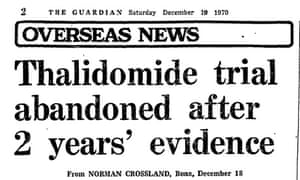
In 1970, the trial in Germany was discontinued under a compromise settlement that gave some compensation for those who claimed to be victims of the drug.


The Guardian, 19 December 1970.

The Guardian, 19 December 1970.

Makers of thalidomide to be tried - archive, 1967

14 Mayıs 2014 Çarşamba

Cigarette makers cannot market to youngsters. So why do tobacco farms even now utilize them? | Margaret Wurth
Grace, whose identify has been changed to defend her privacy, does not smoke – at 15, she’s too youthful to buy a pack of cigarettes, anyway – but she might as nicely have had a standard habit. At her work on a tobacco farm final summer season, she dealt with tobacco plants for up to 12 hours a day, steadily absorbing nicotine through her skin.


Although precise numbers are tough to come by, it is fairly common to find kids working on US tobacco farms in the summertime months (the height of the increasing season). But even though the US has laws to defend kids from the harms of nicotine in cigarettes, there are no restrictions to shield them from nicotine exposure in tobacco fields – in spite of proof that this kind of publicity could be particularly dangerous to young children, whose brains and bodies are still developing.


In 2013, my colleagues and I interviewed 141 kids who worked on tobacco farms in North Carolina, Kentucky, Tennessee and Virginia, exactly where 90% of US tobacco is developed. In every single state, we heard comparable stories of sickness and struggling.


Most of the youngsters we spoke to stated they received sick even though doing work. Grace explained how she got sick on her initial day doing work in tobacco final summer: “My abdomen began hurting. I felt like throwing up,” she mentioned, “And then I received a headache.” The symptoms she described are consistent with acute nicotine poisoning, a well-documented condition also identified as Green Tobacco Sickness.


Many of the children we interviewed labored for 50 to 60 hours a week in sweltering heat, usually with out shade. Some described how pesticides – acknowledged neurotoxins with the possible to cause long-phrase neurological and reproductive damage, among other damaging effects – drifted more than them as tractors sprayed in fields in which they worked, leading to their eyes and skin to itch and burn.


“Your hands get really dirty,” Grace said as I followed her down a row of tobacco plants six feet tall and watched as she snapped off huge white and pink flowers to help the tobacco plants grow. “They get black.”


But it wasn’t just filth on her hands: they turned black in component from the toxic residue of nicotine and pesticides.


Other teenage staff described hacking down tobacco plants with axes, at times cutting their legs and hands, and climbing numerous stories into the eaves of barns to hang tobacco plants to dry, without having any safety from falls. One boy I met lost two fingers on the job after he was suspended in mid-air to trim seedlings with a mower.


Under US law, young children are not permitted to function until they are at least 14, and there are strict limits on the hrs they can perform and the jobs they can do, except in one business: farm operate. As prolonged as a parent offers permission, a child as young as 12 can legally be employed to function on a farm for any number of hours– and there are no special protections for kids doing work on tobacco farms.


The worlds biggest tobacco businesses obtain tobacco grown in the United States – businesses like Altria Group (mother or father of Philip Morris USA), British American Tobacco, China National Tobacco, Imperial Tobacco Group, Japan Tobacco Group, Lorillard, Philip Morris International and Reynolds American. Most of people tobacco firms informed us that they are concerned about youngster labor in their provide chains.


But their existing approaches do not sufficiently defend youngsters from hazardous function and some firms allow for reduce standards of protection for youngsters in their US provide chain than for young children working on tobacco farms in other countries.


Grace, however, was pleased to have a summer season work and be earning funds. When I asked why she commenced doing work in tobacco, she stated, “I just wanted to assist out my mom.” Like Grace, most of the little ones we interviewed utilized their earnings for school supplies, for clothes or to aid their mothers and fathers pay the payments. But earning funds for standard wants shouldn’t expose a kid to nicotine and pesticides, not to mention debilitating, or even fatal, injury.


There are people who say that there have always been youngsters functioning on tobacco farms in the US, or that specific jobs on tobacco farms are protected for children. But offered the hazards and the exclusive vulnerability of kids, a tobacco farm is no place for a little one to function.


Tobacco firms must make it clear that they will not buy tobacco from farms that use kid labor, and help option educational and employment options. And Congress ought to enact laws restricting youngster labor in tobacco fields.


In the meantime, children across the southeastern US are getting ready for nevertheless another prolonged summer season in the tobacco fields.


Cigarette makers cannot market to youngsters. So why do tobacco farms even now utilize them? | Margaret Wurth

24 Şubat 2014 Pazartesi

Company linked to drug makers sought pact on access to patient records database

Pills

By extracting patient data, drug makers will be ready to know which medicines a medical doctor is prescribing and how that compares with other individuals locally. Photograph: Alamy


A organization working to access NHS prescription data on behalf of pharmaceutical firms attempted to signal a gentlemen’s agreement last yr for accessibility to the new central database of medical information on every patient in England, the Guardian has discovered.


The firm, i4Health, lobbied the new Overall health and Social Care Info Centre (HSCIC) in July 2013 for a memorandum of understanding to “ensure that requests [for patient information] from daily life sciences acquire prompt focus”, an examination of the stakeholder forums of HSCIC exhibits.


Senior NHS officials are due to seem at the parliamentary wellness pick committee on Tuesday soon after ideas to extract patient data from GP files have been place on hold final week.


A single of the important concerns is likely to be how patient privacy will be protected provided that, under the scheme, data from GP records – including children’s mental wellness diagnoses, family histories and medicines prescribed, as properly as smoking and drinking habits – would be offered to public and private analysis organisations, industrial organizations, universities and “data intermediaries”.


On Monday it emerged that an insurance society, Staple Inn Actuarial Society, mentioned it was capable to entry the hospital information of 47 million sufferers in excess of 13 many years to help it decide premiums for clients.


According to the Competitors Commission, i4Health will “offer entry to NHS prescription information”. 1 of the aims of the new company is to allow drug firms to get collectively to access health care details simpler than if they applied individually. i4Health has currently created substantial-profile appointments, hiring the HSCIC’s former chair Candy Morris as a non-executive director.


The pharmaceutical industry has championed the proposed “care.information” scheme, claiming that health-related surveillance is key to creating certain firms are obtaining the appropriate drug to the proper sufferers. Critics say the database’s true worth is as an intrusive advertising instrument.


By extracting patient data, drug makers will be in a position to know which medicines a doctor is prescribing and how that compares with other folks locally. They will also be ready to discern whether or not individuals are picking up their prescriptions and, crucially, will be ready to collect details of patients’ health-related circumstances and lab exams.


Organizations argue that the recent database utilized for investigating patient conditions, identified as the Clinical Practice Research Datalink, is incomplete and the available pharmacy prescription data does not reveal patient situations as GP records would – only the medicines they take.


Professionals warned that the public would be uncomfortable with the notion of patient information becoming utilised to sell medication. Ian Herbert, of the British Laptop Society, and a member of the committee that advises the HSCIC on customer requests, informed the Guardian: “Patient surveys demonstrate that the public get most upset when their records are utilized by business outfits for promoting or advertising merchandise. Numerous clinicians will not be satisfied about this as well.”


Below the care.information scheme, delicate medical records containing NHS numbers, date of birth, postcode, ethnicity and gender will be extracted from each and every GP surgery in England, unless sufferers opt out. Patient information will be scrubbed of some of the most obvious private identifiers – a approach recognized as pseudonymisation – but not adequate to make the info fully anonymous prior to it is offered to third parties.


“You have to keep the data quite lean if you are going to hold the threat of identification at an insignificant degree,” Herbert stated. “Once you commence accessing it in excess of time and comparing it with other datasets it swiftly gets to be quite a wealthy source of info. Then you can identify patients. That’s the danger with massive industries like pharma which have a good deal of data.”


Drugs firms deny there is a chance of patients’ personal medical files getting rifled by means of. Lawrence Berry, i4Health’s chief executive, said: “Businesses this kind of as ours use anonymised data, not identifiable confidential data, to appear for exactly where enhancements can be created to increase treatments and outcomes for individuals.”


Berry previously founded a healthcare details company, Datapharm, which is funded by 200 pharmaceutical companies. He mentioned i4Health would be a non-profit firm whose members would include drug firms.


The HSCIC confirmed that i4Health had been searching to signal a memorandum of knowing with it last 12 months to reduce delays in acquiring hold of patient data, but stated the business would not now be asking for unique therapy and would make requests like any other applicant.


Nonetheless, campaigners claim that i4Health seems to be like a front for the medication business. Phil Booth, of the patient privacy campaign group medConfidential, said: “Initial NHS England officials flat out deny they are promoting our data, even even though income alterations hands. Then they deny they promote information to insurers, but they’ve just been caught doing that.


“Now we uncover pharmaceutical organizations are queuing up behind so-called not-for-revenue front firms to spy on what capsules we consider to get far better. The complete care.information scheme is starting to search like absolutely nothing far more than a giant healthcare information-laundering machine.”


Company linked to drug makers sought pact on access to patient records database

17 Şubat 2014 Pazartesi

The Crazy Makers: Red Heart Suckers and M&M’s

Crazy Makers 101


I was standing in line at our nearby Health Meals shop the day just before Valentine’s Day.  There was a minor girl about 3 ½ years old and she stored ramming her head into her mom.  She was virtually working circles about her mom and then when I explained hello to her, she crashed into my leg.  I observed she was consuming a brilliant red sucker. Her mom apologized and explained, she just came house from her get together at school and she’s on her threerd sucker. It must be a fairly wild day!  I don’t think it will take a rocket scientist to figure out that the artificial coloring and overload of sugar may possibly just be a dilemma for this little one!


Shame on M&ampM’s


A 2004 meta-examination affirmed that artificial dyes boost hyperactivity. The United Kingdom’s Foods Requirements Agency has urged foods businesses eliminate dyes from their items based mostly on two studies that it commissioned, on leading of all the earlier evidence, and that identified that mixtures of dyes adversely have an effect on the habits of ordinary children (not kids thought to be delicate). The European Union then essential meals that have any of the dyes utilised in people two British scientific studies to bear a warning label. Individuals dyes include Red forty, Yellow 5, and Yellow 6—the 3 most extensively dyes in the United States and Canada. Partly as a end result of that action, really number of meals in Europe contain the dyes and bear the warning discover. M&ampM’s in America incorporate Blue 1, Blue 1, Red forty, Yellow five, and Yellow six. (http://www.cspinet.org/new/201310161.html)


I was speaking to a pal the other day and she was telling me that her daughter, age eleven, was currently being tested for Focus Deficit Disorder.  I asked her how her diet regime was and she just pointed out that she was a really picky eater and survived on junk food.  She also mentioned that the only issue that worked for her daughter’s migraines was Mountain Dew and Tylenol.  So what’s in Mountain Dew that may be problematic?


The primary issue ingredient in Mountain Dew is bromine. It is a poisonous, corrosive chemical, linked to major organ method injury, birth defects, development problems, schizophrenia and hearing loss. There is flame retardant in your Mountain Dew. That soda with the lime-green hue (and other citrus-flavored bubbly pops) won’t keep your insides fireproof, but it does incorporate brominated vegetable oil, a patented flame retardant for plastics that has been banned in foods all through Europe and in Japan.  After a number of severe soda binges — not too far from what numerous gamers frequently eat — a number of sufferers have essential health care interest for skin lesions, memory reduction and nerve problems, all signs of overexposure to bromine, according to a latest post in Environmental Information.


I consider the very best guide I ever go through about this subject  is known as The Crazy Makers: How the Meals Market Is Destroying Our Brains and Harming Our Kids. It aided me to consider an trustworthy look at what I allowed to make it into my children’s mouth.  This guide might just be the 1 that assists you reclaim your child’s daily life by taking charge of their consuming routines.


Be Nicely,


Beth


Visit our Healthy Living Weblog


The Crazy Makers: Red Heart Suckers and M&M’s

27 Ocak 2014 Pazartesi

E-Cigarette Makers Give Public the Finger


With Sarah Mittermaier and Lily Swartz


In 1964, smoking was everywhere: on television, on airplanes, in workplaces and movie theatres, school campuses, doctors’ offices, dining establishments and bars. In the 50 years given that the very first Surgeon General’s report on smoking and health was launched, smoking has slowly faded to the margins of public lifestyle. The Marlboro Marlboro man was bounced from the airwaves, complete smoking bans have been passed in hundreds of cities and 28 states, and smoking costs have been lower almost in half. The struggle to safeguard the public’s health is far from over—and shocking disparities in tobacco use and exposure to tobacco advertising and marketing remain—but we’re now reaping some rewards, with eight million lives saved more than the previous half-century.


But now a new threat is emerging. The use of e-cigarettes is increasing rapidly, with teenagers a essential target of advertising efforts. “Vaping” is producing smoking acceptable—even cool—once again as the tobacco sector returns to its outdated methods, putting e-cigarette commercials back on the airwaves for the 1st time considering that the 1970s.


Right now, e-cigarettes exist in what tobacco manage researcher Stanton Glanz calls a regulatory “Wild West,” with no federal regulation of the manufacturing, advertising and marketing and sales of these items. This regulatory vacuum threatens to undo the tough-won victories of the past 50 years in tobacco control.


E-cigarette firms are taking a page appropriate out of Big Tobacco’s outdated-college playbook: advertising their merchandise with intercourse appeal, celebrity endorsements, even cartoons. The companies argue that “vaping” is safer than classic smoking and that might or could not be true—there are far too few research to back up that claim or refute it. But it’s also a smokescreen.


The tobacco market is out to hook youngsters, and it’s functioning. E-cigarettes come in an array of child-friendly flavors, from“Cherry Crush” to “Coca Cola.” And in contrast to conventional cigarettes, e-cigarettes can legally be sold to kids in most US states. Information released last year by the Centers for Disease Management and Prevention showed that e-cigarette use more than doubled among middle and large college college students in the previous year. For twenty % of the middle schoolers, e-cigarettes were their first knowledge with smoking, raising considerations that e-cigarettes may act as a gateway to the use of other tobacco merchandise.


E-cigarettes also threaten to reintroduce smoking to workplaces, restaurants, bars and other public spaces the place challenging-fought public overall health campaigns have succeeded in banning cigarettes. These policies have transformed our communities from the ground up, producing new expectations and norms about smoking. The science is even now out on no matter whether e-cigarettes threaten non-smokers with toxic exposure, but their use in public legitimizes their use, generating them look acceptable, even Golden Globes-glamorous. We can not allow e-cigarettes undo the hard work tobacco manage advocates have attained in excess of the past 50 many years.


Some cities and states are pushing back towards e-cigarettes, taking measures to regulate the sale and public use of e-cigarettes. Above the past number of months, New York and Chicago city councils voted to regulate e-cigarettes as tobacco merchandise, extending current smoking bans to cover vaping. The Los Angeles City Council voted unanimously to regulate the revenue of e-cigarettes. Boston has banned e-cigarette smoking in workplaces. States this kind of as Utah, New Jersey, and North Dakota ban the use of e-cigarettes in indoor public spaces.


These regional and state efforts should be followed—and strengthened—by federal action. Attorneys general from forty states have known as on the Meals and Drug Administration to regulate e-cigarettes as tobacco items, a move that would give the FDA the electrical power to impose age restrictions and limit advertising and marketing of e-cigarettes. Proposed rules drafted by the agency have not yet been launched publicly.


We can not wait many years for scientists to carry out new research on the health risks of vaping just before we take action. We know better than to trust the tobacco industry’s wellness claims about their products—or to trust the business with our children’s long term. The time for action is now. To paraphrase a single anti-cigarette business in California: “Some folks will say anything to promote (e-) cigarettes.”


E-Cigarette Makers Give Public the Finger

4 Ocak 2014 Cumartesi

Grocery Makers To Petition FDA To Label GMO Food As “Natural”

by Lengthy Island Attorney Paul A. Lauto, Esq./www.liattorney.com


In the extremely latest in underhanded moves to “force feed” the globe GM food items, the Grocery Companies Association (GMA) is reportedly seeking to deem GMO meals “natural.”  The GMA, representing above 300 organizations, has sent a letter to the FDA detailing its ideas to petition the FDA to permit GMO meals to be labelled as “natural.”  In their letter the GMA states that, “There is absolutely nothing ‘synthetic or artificial’ about food items derived from biotechnology, as that term has been utilized by the company.”  This declare is based on the 1992 FDA policy that biotech food items are no various than foods designed from traditional plant breeding.


1 glaring cause of the difficulty at hand, is the FDA’s failure to define what food is “natural.”  The FDA defends its failure by claiming that it is hard from a scientific perspective to define what is “natural,” as numerous foods are processed.  However, the FDA does not object to the use of the phrase for meals that do not contain artificial flavors, extra colors or synthetic substances.


Once again the FDA’s failure to take the required action to shield the men and women, has left the door open to courruption of the program.  As extended as the door remains open, the Biotech Sector will employ it as an open invitation to stroll through.  If you consider there is no way the FDA will enable GMO food items to be labelled as “natural,” then you may not know the FDA.  The Biotech Market can smell the buyer blood and is efficiently going in for the destroy.


It is time for the hunter to turn into the hunted.  Consumers everywhere should actively stand up for the right to know what is in our meals and to have a governmental foods agency with out Biotech influence and conflicts of interest.  Let your voice be heard by your congressman, senator, grocery store proprietor and the FDA.  Buy meals with a lot more credible labels, this kind of as individuals certified as natural and GMO free of charge.  Tell your grocer that if they do not conform to defending the people, that you will consider your enterprise elsewhere.


Boycott companys that are members of the GMA, this kind of as Bumble Bee Foods, LLC, Campbell Soup Company, The Coca-Cola Company, Colgate-Palmolive Firm, Del Monte Meals, Basic Mills, Inc., Kraft Food items Group, Land O’Lakes, Inc., McDonald’s Corporation, Submit Food items, LLC, Procter &amp Gamble Business, DuPont and Monsanto.  In this merciless GMO battle fueled by corporate greed, the client might be down, but not out.


Long Island Attorney
Paul A. Lauto, Esq.


www.liattorney.com


Grocery Makers To Petition FDA To Label GMO Food As “Natural”