Musical etiketine sahip kayıtlar gösteriliyor. Tüm kayıtları göster

20 Ekim 2016 Perşembe

A Pacifist"s Guide to the War on Cancer review – bold musical demystifies the disease

A musical about cancer? I see no reason why not. For much of its length this show, co-presented with Complicite Associates and written by Bryony Kimmings and Brian Lobel with a score by Tom Parkinson, offers a robust demystification of it subject. Only in its later stages does it turn from a piece of theatre into a dubious form of group therapy.


The premise is simple. Emily, a single mum, takes baby Owen into hospital for a series of scans. We share her helpless anxiety as her son is taken from her and she follows the stories of a group of cancer patients. They include a radical feminist, a pregnant 18-year-old, a woman seeking a miracle cure for a terminal condition, a defiant working-class smoker and a young man with a testicular problem who is accompanied everywhere by his mother. They are a representative bunch, all, we later discover, based on real-life cases.


Clearly the point of the show is to sabotage cliche responses to cancer: not just the vocabulary of “struggle” that surrounds it but also, as one character says, the “aggressive sorrow” and special “cancer face”, assumed by friends. The advantage of the music is that it gives each patient his or her moment in the spotlight while showing collective attitudes. Purloining a phrase from Susan Sontag, Kingdom of the Sick is a jaunty choral number capturing the sense that cancer patients are part of a large, ever-growing club. But we are also reminded that each case is different: Mark, the heavy smoker pining for his estranged daughter, sings a Willie Nelson-type cowboy song while Laura, destined for a hospice because of ovarian cancer, rips off her clothes to launch into a shake-it-all-about 70s rock routine.



Battering at an open door … A Pacifist’s Guide to the War on Cancer.


Battering at an open door … A Pacifist’s Guide to the War on Cancer. Photograph: Tristram Kenton for the Guardian

But, as the show proceeded, my reservations started to mount. It increasingly seems to be battering at an open door. Far from being reticent in speaking about illness or death, I would say we have never been more open about it: I am at an age when any social occasion is prefaced by what a friend calls “the organ recital” and, when I was diagnosed with a kidney tumour three years ago, I saw no need to hide the fact. Although I welcome the show’s candour about cancer, it also lapses at the end into an extraordinary form of self-display: as cast and audience are invited to shout aloud the names of patients they know, I felt I was attending a secular revivalist meeting.


Kimmings herself directs with great verve and there are good performances from Amanda Hadingue as the distressed single mum, Golda Rosheuvel as the miracle-seeking Laura, Rose Shalloo as the teenager facing genetic issues and Naana Agyei-Ampadu as a tough American who wisecracks her way through trouble. The show is bold in confronting cancer with ebullient music rather than hushed reverence but when Kimmings, in a climactic voiceover, endorses the point, it comes dangerously close to self-congratulation.


At the Dorfman theatre, London, until 29 November. Box office: 020-7452 3000.


A Pacifist"s Guide to the War on Cancer review – bold musical demystifies the disease

11 Eylül 2016 Pazar

How we made a musical about cancer

In the theatre, work in progress is fiercely protected from journalists. Write even so much as a preview, and its establishment is likely to come down on you with all the weight of a full props cupboard. At the very least, you can expect a firm tweet from Sam West. But the performance artist and director Bryony Kimmings is not yet a fully paid-up member of the theatrical establishment, for all that her new show, a musical called A Pacifist’s Guide to the War on Cancer, will shortly arrive at the National Theatre. And so it is that, one afternoon in early September, I’m invited to a “share” of several scenes from the production in a windowless South Bank rehearsal room alongside some of the cancer patients who helped her research it and – oh, yes – two leading representatives of the aforementioned theatrical establishment: Rufus Norris, the National Theatre’s artistic director, and Simon McBurney, the actor and artistic director of Complicite, the company that is producing the show.


Norris and McBurney, both of whom can be said to be taking something of a gamble on Kimmings, appear tantalisingly impassive, at least at first, and as I find my seat, I have to tell myself to look at the actors rather than at them. The problem is, though, that I’m nervous of looking at the actors. Forty-eight hours ago I was at the funeral of a friend who died from leukaemia – my second-oldest school friend – and while I know not to expect mawkishness from Kimmings, who is nothing if not fierce and plain-speaking, there is still every possibility I will burst into tears. Sure enough, this is exactly what happens. The cast are singing a riotous song called Even C***s Get Cancer (this production includes, audiences will be warned, “adult content”). It’s very funny, the tune is great, and there is tap-dancing, which never fails to make my heart soar. Even so, something about it – a particular combination of vulnerability and determined optimism – has me leaking like a colander, the lump in my throat the size of Scafell Pike. At which point, I find myself thinking: this is going to be a hit. Are others thinking the same? I can’t believe that they’re not.


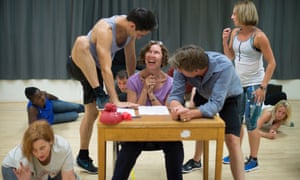
Rehearsals for A Pacifist’s Guide to the War on Cancer.


Rehearsals for A Pacifist’s Guide to the War on Cancer. Photograph: Sarah Ainslie

The atmosphere in the room, it seems to me, has shifted from coiled nervousness – after all, it’s only two weeks, now, until A Pacifist’s Guide to Cancer makes its debut at Home in Manchester – to relieved excitement. Norris is smiling; Ben Power, his deputy, seems not to be able to stop jiggling his knee; McBurney is about to urge the cast to eat the cakes – “sugar!” – he has brought with him. Kimmings wanders through the audience, the huge black and white bow in her hair flopping over her forehead, shaking hands and smiling, receiving compliments in the way only she can (“Yeah, it’s going to be brilliant”). I look over my shoulder, in the direction of Judith Dimant, the Complicite producer to whom this singular show owes its miracle birth. Her eyes, like mine, are red. But she exudes a kind of steely happiness, too. For her, this is a hugely significant moment. This production is certainly about bums on seats, not to mention the triumph of a certain kind of creativity. But it also marks the point when she decided that, for her, the post-cancer world – if such a thing can ever be said to exist – would be replete with new possibilities, new energy, new life.


Dimant has worked at Complicite, a company described by Emma Thompson as the “most trailblazing in our theatrical history”, for more than two decades, a job that has given her nerves of steel, and allowed her to build up a production company that thinks nothing at all of taking on difficult work (one definition of “difficult”, in case you’re wondering, might be a production that lacks a script until the very last moment).


Three years ago, however, it occurred to her that it was time to think about the next generation. The question was: where would she find this particular unicorn? Having been sequestered with McBurney for so long, she wasn’t exactly sure. “But the young people I work with are very well informed, and they said: you should see Bryony Kimmings. She is just fantastic. You’ll love her. So I went to see Credible Likeable Superstar Role Model [Kimmings’s hit 2013 show about the sexualisation of childhood, in which she co-starred with her nine-year-old niece], and it was incredible. Her work is very different from what McBurney makes, but there are similarities, too, particularly in the creative process. So, we met, and we decided we’d do a new programme of work – only by that time, I had got ill.” Dimant had recently been told that she had breast cancer.


Kimmings interjects (the three of us first meet at the National Theatre in early August). “No, what happened was that I pitched loads of ideas at her, and she didn’t like any of them, and she kept backing away from me every time I coughed. I was thinking: what is wrong with this woman? Finally, she said: ‘I might as well tell you, I’m having treatment for cancer.’ So I said: ‘Would you ever want to make something about that?’ She said: ‘Yes, but not my own story.’ And I knew I had always wanted to make a musical. So, it was agreed: Judith would produce my musical about cancer, and it would be the next stage in my practice.”


Kimmings’s work has always, until now, been highly autobiographical. In Sex Idiot (2010), she tracked down her ex-boyfriends after discovering she had chlamydia; in 7 Day Drunk(2011), she spent a week intoxicated to see if it would improve her creativity; and last year’s Fake It ’Til You Make It was about her partner Tim Grayburn’s depression (he co-starred). Has she had experience of cancer? “Not direct experience, no. But my last two shows really told the stories of other people, so I just carried on with that. I thought: I’ll work with real cancer patients. We had a group of about 10 who helped us, all with different stories. One had had cancer seven times; one had late-stage terminal ovarian cancer; one was a lad with lymphoma who was in denial and out raving all the time; one had bowel cancer and was pissed off with everyone saying breast cancer is sexy and bowel cancer is disgusting; one was living with long-term cancer. Basically, the kind of alternative cancer stories you don’t see in films like Wit, or whatever.” She also spoke to doctors and scientists.


“I hate musicals,” says Kimmings. “Well, when I was young [she’s 35], I really liked Hairspray and Little Shop of Horrors, but that was it. I like camp musicals, not ones that take themselves really seriously.” So why did she want to create one? “I thought I could do them better. I mean, I like them now. OK, there are some that I hate. No, I’m not going to say which ones… OK, I hated The Book of Mormon. But I liked London Road [the National Theatre’s show about the 2006 Ipswich murders]. So I started off with the idea that I’d use verbatim text, like they did in London Road. We tried for a whole week! But in the end, we couldn’t do better than London Road. So we had to start again.” By “we”, she means her collaborators Brian Lobel, with whom she wrote the book of A Pacifist’s Guide to Cancer, and Tom Parkinson, who wrote the music (she wrote the lyrics). “Brian has been making shows about cancer for years, and he’s one of my friends anyway, so it would have been weird not for him to be involved, especially since he loves musicals.”


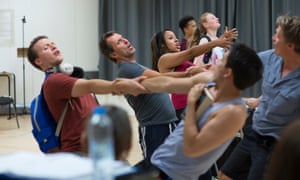
The company rehearsing A Pacifist’s Guide to the War on Cancer.


The company rehearsing A Pacifist’s Guide to the War on Cancer. Photograph: Sarah Ainslie

In the end, she came up with the idea of a narrative in which someone is trying to write a guide to cancer, for which reason she must poke around inside the kingdom of the sick – a concept she borrowed from the US intellectual Susan Sontag, who in her 1978 book, Illness as Metaphor, suggests that we are all of us born with two passports: one for the kingdom of the well, and one for the kingdom of the unwell. “This narrator poses the question: why don’t we know about illness until we have it? But then, her kid gets sick, and everything changes: her pragmatism, her ability to be non-emotional about it. It’s very funny and it’s very silly in places, but it’s also quite sad. My work’s always like that. It’s super-bonkers. It starts as a musical, but it ends up being just a lot of people sitting in a room talking about death. That’s what it’s really about: death. It deconstructs itself. In the end, the stage gets cancer, and the performers are pushed off it, and into the auditorium.” It sounds clever. “Well, I’m a clever person.” Kimmings, you soon gather, doesn’t go in for false modesty.


What particularly fascinated her about cancer? “I was interested in people who’ve caused their own cancers. There’s a character in the show who smokes while he’s ill. I was interested in Li-Fraumeni syndrome [a hereditary predisposition to cancer]. There’s a character in the show who has it, and she’s pregnant and thinking: ‘Do I keep this baby?’ I was interested in people who look for miracles, in the way cancer can make you non-rational. And I’m very interested in afterwards. Earlier, you asked Judith if she was well again. She is, but that doesn’t mean she is ever going to be the same again. She’s never not going to have had cancer. That’s a very important theme in the play.”


Dimant is nodding. “Everyone wants you to go back to normal, but you never do, even if you look the same, wear the same clothes. The impetus to work with Bryony became even stronger after being ill because I suddenly thought: I’ve got to do something completely different. I’ve had an amazing career, but I’ve still got so much to give to something else.” Does the show replicate some of her own experiences? “It is very, very accurate.” They both hate the language of cancer: the talk of courage, of battles won, or lost. “Our characters aren’t brave,” says Kimmings. “They don’t have that choice. Cancer is outside their control. That’s what’s so terrifying about it.”


To say that all this has been an intense experience for them both is an understatement. As they worked on the show, Dimant underwent chemotherapy, radiotherapy and surgery (sometimes, Kimmings accompanied her); meanwhile, Kimmings had a son, Frank, who was diagnosed with epilepsy when he was just a few months old (he is the main reason she’s glad not to be appearing in it herself; she no longer wants to go on the road). It has made them close, and they are certain they’ll work together again: Kimmings wants to do a musical in which all the performers are in their 80s; Dimant wants to make a piece about suffrage.


For Kimmings, though, this is also a gear change; plucked from the smaller fringe venues she’s used to filling, her creation will soon land bang, smack in the National Theatre. (Every theatre with whom, early on, they shared the work wanted to stage it; she and Dimant chose the National simply because “it is the biggest”.) Does she feel under pressure? I can’t tell if she is being blithe, or merely pretending to be. “I feel under pressure when people talk to me about budgets,” she says. “I’m just, like, whatever. But I don’t come from a world where this was my dream. I didn’t start making small studio pieces so I could have a musical at the National, so it’s not blowing my mind.” She pauses, has a little rethink. Ah, so she was pretending. “Look, I’m really pleased about it, of course. I’m super-psyched. Fuck, yeah, I’m excited. I hope it gets bigger and bigger, and goes into the Olivier [it will be staged first in the National’s smallest space, the Dorfman], and then into the West End. That’s what should happen. That’s what I want. That’s what I’m imagining.”


A Pacifist’s Guide to the War on Cancer is at Home in Manchester 20-24 September; Exeter Northcott 28 September-2 October; and the National Theatre 14 October-29 November


How we made a musical about cancer

29 Haziran 2014 Pazar

Musical interaction brings harmony to dementia individuals

music in mind therapy

Music therapist Greg Hunford and musicians from Manchester Camerata foremost a Music in Thoughts session in Crewe for elderly individuals with dementia Jack Burrow and his wife Vera who joined him in the session. Photograph: Christopher Thomond for the Guardian


Vera and Jack Burrows met as teenagers. “Childhood sweethearts,” explained Vera, brightly. “Then he dumped me when I was 17 and married somebody else and we didn’t see each other for 54 many years. We have been at a dance and he explained: ‘Is that you, Vera? I can recognise you from your thick ankles!’”


In spite of this risky chat-up line, the pair have been engaged within 4 months of their reunion – after Jack split up with 3 other lady friends. (Vera: “He utilized to get them identical Christmas presents so he didn’t get them mixed up.”)


5 and a half many years into their really happy marriage, Jack had a stroke although roasting a chicken, and has in no way returned residence. Ever since he’s been living in Station Home care house in Crewe. Now 86, he is lost his speech and has rising memory difficulties, but his bawdy sense of humour is very much intact.


Vera, a quite glamorous 84 with turquoise eye shadow and a cloud of blond hair, had accompanied Jack to a particular music session at the care house run by the music therapist Greg Hanford, director of MusAbility, and musicians from the Manchester Camerata chamber orchestra.


Overseen by Manchester University, it is element of a 10-week pilot project named Music in Thoughts, funded by the charity Care Uk, which runs 123 residential homes for elderly people. The aim is to locate out if classical music can enhance communication and interaction and lessen agitation for people in the United kingdom residing with dementia – estimated to number just in excess of 800,000 and set to rise rapidly as the population ages.


The Crewe project is the fourth Music in Mind pilot. An evaluation of the very first three, by the Manchester-based thinktank New Economic climate, located that some participants no longer had to be medicated soon after taking portion. Carers reported reduced agitation, much better moods and improved posture residents who had been slumped in their chairs raised their heads to get an energetic part.


“The energy of music treatment enables, excites, enthuses, entertains,” one musician informed New Economy. “It really is like opening the window of a stuffy space and allowing scented fresh air to waft in, lifting the spirits, altering the nature of the space.”


Jack’s session concerned flautist Amina Hussain and French horn player Naomi Atherton, two of 7 Camerata musicians qualified in dementia awareness by the Alzheimer’s Society, and a specialist nurse. Along with Hanford, two care staff and Jack (with Vera at his side), had been two other residents: Pete, who has only one particular leg, and Taff, a tattooed Welshman who was keen on the tambourine.


Proceedings began with Hanford strumming his guitar and singing hello to each participant in flip. Jack clucked a return greeting, Pete looked straight ahead and Taff managed a delayed hello.


To an outsider, it at first felt somewhat infantilising and all also reminiscent of a mom and little one singing group. But by the end of the half hour, the males were engaged in a rather moving overall performance, with Pete gently tapping out a rhythm on a cymbal, Taff shaking a rainstick and Jack on bells, all accompanied by globe-class horn and flute.


“There is a crossover, or at least parallels, between functioning with really youthful children and men and women with dementia,” said Hanford afterwards. “The ‘hello’ song is anything I use with all various kinds of men and women. But keeping dignity is at the heart of what we are performing.”


“We have to make confident we do not child anybody,” explained Hussain. “We have to don’t forget these are men and women who have led full lives, with jobs, families. At initial you do wonder if they believe you’re a appropriate plonker, coming in and providing them brightly coloured instruments.”


Gill Capewell, actions coordinator at Station Property, stated she initially anxious the knowledge may possibly be also daunting for residents. “I considered there would be a complete orchestra. I did not realise how subtle it would be.”


Atherton mentioned she volunteered partly as a outcome of the death of her father, who produced Alzheimer’s in his late 60s. The operate brought huge rewards for the most subtle developments, she mentioned: “Like Pete right now – when I put the ocean drum in front of him, his fingers have been twitching.” Yet another time, a resident with a extremely limited, fixed pattern of conversation finished her sentence in a way that showed she was engaged, she additional.


“It can be like viewing a flower open, at the danger of sounding dreadfully cheesy,” said Hussain.


The musicians encourage individuals to live in the current, rather than the past, exactly where several have typically taken refuge. “Typically in care residences they sing war songs, which could be really good but what if it triggers a undesirable memory? That’s the past. We want them to be residing in the second,” mentioned Atherton.


Most other music treatment with this group tended to be efficiency-based, mentioned Hanford. “The Liverpool Phil, for instance, plays to patients. What’s occurring right here is massively various due to the fact we’re employing music treatment as an intervention. It is like the distinction among watching Television and making use of the net. A single is interactive.”


But does it need to have expert musicians? Hanford explained Manchester Camerata’s involvement was a luxury, admitting this kind of perform mostly demanded persistence and creativity rather than virtuoso capacity. But Hussain said her knowledge was essential: “We are able to talk with music really subtly, in a way that, for example, a grade eight player might not be able to. It could be that subtle distinction that connects with a person.”


Musical interaction brings harmony to dementia individuals