assessments etiketine sahip kayıtlar gösteriliyor. Tüm kayıtları göster

16 Şubat 2017 Perşembe

Portable brain-scanning helmet could be future for rapid brain injury assessments

A transportable brain-scanning helmet that could be used for rapid brain injury assessments of stroke victims and those felled on the sports pitch or battlefield is being tested by US scientists.


The wearable device, known as the PET helmet, is a miniaturised version of the hospital positron emission tomography (PET) scanner, a doughnut-shaped machine which occupies the volume of a small room.


Julie Brefczynski-Lewis, the neuroscientist leading the project at West Virginia University, said that the new helmet could dramatically speed up diagnosis and make the difference between a positive outcome and devastating brain damage or death for some patients.


“You could roll it right to their bedside and put it on their head,” she said ahead of a presentation at the American Association for the Advancement of Science’s (AAAS) annual meeting in Boston. “Time is brain for stroke.”


Despite being only the size of a motorbike helmet, the new device produces remarkably detailed images that could be used to identify regions of trauma to the brain in the ambulance on the way to hospital or at a person’s bedside. The device is currently being tested on healthy volunteers, but could be used clinically within two years, the team predicted.
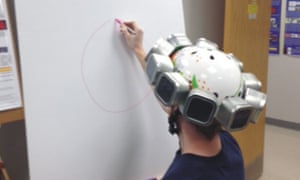


Despite being only the size of a motorbike helmet, the new device produces detailed images that could be used to identify regions of trauma to the brain in the ambulance on the way to hospital or at a person’s bedside.


Despite being only the size of a motorbike helmet, the new device produces detailed images that could be used to identify regions of trauma to the brain in the ambulance on the way to hospital or at a person’s bedside. Photograph: Stan Majewski

Rapidly diagnosing stroke patients, who often wake up unaware of what has happened, is crucial as every passing minute without treatment can result in more extensive and permanent brain damage.


In the hours after a stroke, the brain tissue surrounding the main injury hangs in the balance as it is starved of oxygen due to blockages in the brain’s blood vessels. A rapid surgical intervention, within two to four hours of a stroke, can salvage neurons in the so-called “penumbra” area. After that the risks of brain surgery tend to outweigh any potential benefits to the patient.


“The more you wait, the more that penumbra area gasps and dies,” said Brefczynski-Lewis. “If you can see there’s a bit of activity you might say let’s do an intervention.”


Depending on the brain region affected by stroke, a patient’s speech and language abilities could be saved or paralysis prevented.


In the future, the team said it may be possible to diagnose sports concussion “within minutes”.


“If one can determine quickly whether a head injury is a concussion, then one might be better able to assess if the player, or the soldier, should continue or take time to heal,” said Brefczynski-Lewis.
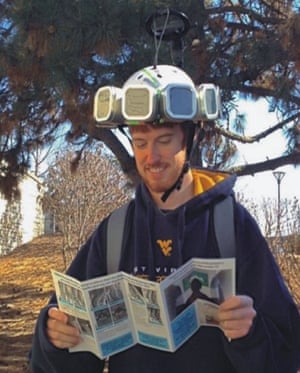


The device, which can be worn while walking around could also enable scientists to study people’s mental patterns as they walk aroundmove about, socialise and respond to threats in their day-to-day environment.


The device, which can be worn while walking around could also enable scientists to study people’s mental patterns as they move about, socialise and respond to threats in their day-to-day environment. Photograph: Stan Majewski

The helmet was developed in the lab and Brefczynski-Lewis describes it as the equivalent of “going from a big computer to a smartphone”.


The wearable scanner works on the same basic principle as a conventional PET scan. The patient is injected with glucose that has been tagged with a radioactive tracer. Radiation emitted by the tracer is captured by sensors on the helmet, allowing scientists to pinpoint which brain regions are metabolising glucose most rapidly, providing a heatmap of brain activity.


The team were able to miniaturise the scanner by using much smaller detectors fitted with crystal arrays designed to turn PET radiation into measurable electrical signals with a high degree of efficiency.


The device, which can be worn while walking around could also enable scientists to study people’s mental patterns as they move about, socialise and respond to threats in their day-to-day environment. Brefczynski-Lewis said it could also be useful for understanding addiction, where people can respond very differently in a lab setting to in their day-to-day lives where environmental triggers suddenly set off cravings.


“You could put [addicts] in a room similar to where they’ve used drugs before and ask what allows you to have the willpower to walk away,” she said.


A potential limitation is that the helmet is cumbersome, weighing nearly 3kg (6.6lbs) in its current form and up to 9kg (20lb) in an upgraded version designed to give full-brain coverage. The scientists have developed a counterweight system that is pushed along on a stand or carried in a rucksack to avoid the patient being crushed, but Brefczynski-Lewis acknowledges: “you’re probably not walking down the street in Manhattan wearing it”.


Portable brain-scanning helmet could be future for rapid brain injury assessments

31 Ekim 2016 Pazartesi

Sick pay and work assessments to be reviewed, Jeremy Hunt reveals

The system of sick pay and GP “fit notes” is to be reviewed by the government, as Jeremy Hunt, the health secretary, highlighted the growing cost of long-term sickness to the NHS and suggested getting people back to work had major benefits for health.


The review will be announced in a draft consultation document published by the Department for Work and Pensions (DWP) on Monday, which will also examine changes to the controversial work capability assessments (WCA) undergone by disabled people in order to obtain welfare.


Ministers released little detail about how sick pay and fit notes, previously known as sick notes, would be changed, but said they wanted to “support workers back into their jobs faster and for longer”. It could involve a greater move towards people having a phased return to work after they are signed off sick and more contact between employers and sick employees.


Hunt said there was a £7bn cost to the NHS of treating long-term health conditions that keep people out of work, and suggested that employment could be a part of recovery. “This green paper launches a wide-ranging debate about recognising the value of work as a health outcome,” he said. “With all the evidence showing that work is a major driver of health, this is a big opportunity: to make sure that people get the support they need, improve their health, and benefit the NHS all at the same time. I hope that health professionals will contribute their expertise so that we can ensure the best possible outcomes.”


Hunt was backed by Duncan Selbie, the chief executive of Public Health England, who said health, wellbeing and happiness were “inextricably linked to work”. Selbie said: “People in work generally have better health, so it makes perfect sense for the government to do all it can to support employers to close the gap around employment, disability and illness and to enable people to work when they can.”


The consultation document is aimed at helping to get disabled people and those with long-term conditions back into work, with a specific focus on mental health and musculoskeletal conditions such as arthritis.


Damian Green, the work and pensions secretary, appears to be unwinding some of the policies of his predecessor, Iain Duncan Smith, by reconsidering the work capability assessment. He announced at the Conservative party conference that people with severe, long-term health conditions would no longer have to be reassessed for their benefits under the WCA.


The new review will consult on scrapping the process that puts disabled people into two groups of being unable to work or capable of some work.


“When things need improving, like the work capability assessment and fit notes, we mustn’t shy away from big decisions,” he said. “We must be bold in our ambition to help disabled people and those with health conditions. This green paper marks start of our action to confront the attitudes, prejudices and misunderstandings that, after many years, have become ingrained within the welfare state, within the minds of employers and across wider society.”


However, Debbie Abrahams, the shadow work and pensions secretary, said the review of the disability benefit assessment process did not go far enough. “For Damian Green to claim that this Tory government is confronting the negative ‘attitudes and prejudices’ that it has spent six years encouraging is ridiculous,” she said. “It is an insult to the hundreds of thousands of disabled people who have been on the receiving end of their callous social security regime, like my constituent who was sanctioned after having a heart attack during his jobcentre appointment.


“I have announced that Labour will scrap the work capability assessment and the Tories’ punitive sanctions; anything less is tinkering at the edges.”


Sick pay and work assessments to be reviewed, Jeremy Hunt reveals

9 Şubat 2014 Pazar

Workers off sick for a month to obtain wellness assessments

Ministers think the programme – covering England, Wales and Scotland – will conserve employers £70m a yr and minimize the sum of time folks invest off work by between 20 and 40 per cent.


It will be funded by abolishing a compensation scheme for companies paying out lengthy-term sick shell out to their personnel.


Nowadays, the move was criticised by union leaders who claimed it would lead to sick people getting forced back to operate just before they are in very good wellness.


Hugh Robertson, head of wellness and safety at the Trades Union Congress, explained: “The emphasis of this support must be about getting them far better as opposed to just back to function and the two are not necessarily the same.”


But Mike Penning, the Disabled Folks Minister, mentioned: “A lot more than 130m days a 12 months are misplaced to sickness absence in Great Britain, which has a significant influence on workers, employers and taxpayers.


“As component of the Government’s extended-phrase financial strategy, we are taking action to receiving men and women back into perform.


“This is a triple-win. It will imply a lot more men and women with a work, reduced cost for company, and a far more financially secure long term for Britain.”


Below the scheme, employers or GPs will be ready to refer employees for a operate-targeted occupational wellness assessment.


It will identify the troubles avoiding staff from returning to function and draw up a strategy recommending how they can get back into the workplace. This may possibly consist of fitness for operate guidance, medical care, doing work from property or retraining.


The DWP mentioned the service would commence working this yr and would be run by the private sector, with companies tendering for a contract to run the program.


To cover the fees, ministers will scrap the Statutory Sick Pay out Percentage Threshold Scheme, which gives compensation to employers faced with higher ranges of sick depart.


Mr Penning stated the compensation amounted to only £10 a week on typical for each and every worker, adding: “We consider we can use that cash considerably much better.”


Modest organizations which do not typically have occupational health solutions would notably advantage from the move, the Government claimed.


Workers off sick for a month to obtain wellness assessments