audit etiketine sahip kayıtlar gösteriliyor. Tüm kayıtları göster

10 Ocak 2017 Salı

John McDonnell calls for NHS funding audit as winter crisis deepens


NHS funding levels should be checked by the government’s budget watchdog amid public distrust of the figures and a worsening winter crisis in hospitals, John McDonnell has said.


The shadow chancellor wrote to Robert Chote, head of the Office for Budget Responsibility (OBR), asking him to look at NHS funding levels, as doctors warned that the shortage of resources in health and social care has created a crisis.


There have been a number of calls from Labour and the Liberal Democrats for an
independent auditor for the NHS. But McDonnell called on the existing OBR to see if it could establish the truth about public spending on the NHS.


The level of NHS funding has become hotly contested amid claims that cuts to social care have been causing unprecedented pressure on hospitals and further controversy over the government’s claims to be putting in another £10bn a year into the health service by the end of this parliament.


“It has become clear that Labour’s warnings of a looming winter crisis in the NHS were not heeded,” McDonnell wrote to Chote. “And we have seen in recent days that the British Red Cross has now had to describe the ongoing situation as a humanitarian crisis. The response from the prime minister at the weekend was to play down this situation despite the volume of continued complaints from frontline NHS staff.


“I strongly believe that this is leading to widespread public distrust in the government’s presentation of the level of funding and support for the NHS and social care. Therefore, it seems that now is the time to assess further enhancing the role of the OBR, and add additional responsibilities to your organisation.”
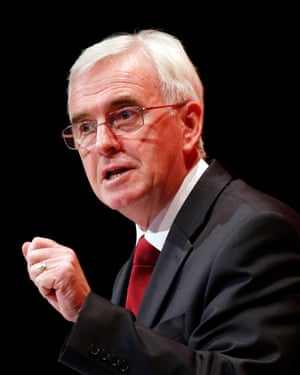


John McDonnell


John McDonnell Photograph: Danny Lawson/PA

He suggested there should be an “annual standalone report that assesses short-medium term policy decisions made on health spending by the government, that takes into account the analysis you already do on the long-term trends and drivers of health spending.”


On Monday night, frontline doctors issued an unprecedented warning that patient safety was at risk at many A&E units across the NHS because hospitals are overwhelmed.


The health secretary, Jeremy Hunt, ­told the Commons in an emergency statement that hospitals may have to cancel operations and outpatient appointments so that staff can concentrate on the sickest patients.


GPs may also be drafted in to help hospitals cope with record demand for medical care. He also provoked controversy by suggesting the four-hour treatment target should exclude people who waste time by presenting with minor ailments.


The Royal College of Emergency Medicine said a substantial number of A&E departments were falling significantly short of the four-hour standard – but Hunt said that as many as 30% of those turning up were neither an urgent case nor a genuine emergency.


The college, which represents doctors in emergency care, warned: “In our expert opinion, when an emergency department falls below 75% against the four-hour standard, it shows a significant level of overcrowding and begins to put safety at risk. Present figures suggest a substantial number of departments are falling below this level.”


The college believes that one in four A&E units are at risk of offering poor care, citing delays in assessing patients and administering pain relief.


In an emergency statement prompted by reports of intense pressure at A&E units around the NHS in England, Hunt said that the four-hour waiting time had to be revised to remove non-urgent cases.


“This government is committed to maintaining and delivering that vital four-hour commitment to patients,” Hunt said. “But since it was announced in 2000 there are nearly 9m more visits to our A&Es, up to 30% of whom NHS England estimate do not need to be there. And the tide is continuing to rise.


“So, if we are to protect our four-hour standard, we need to be clear it is a promise to sort out all urgent health problems within four hours, but not all health problems, however minor.”


NHS Providers, which represents hospital bosses, welcomed the change as “potentially helpful” in relieving the strain on A&Es.


But Jonathan Ashworth, the shadow health secretary, said: “Is he now really telling patients that rather than trying to hit the four-hour target, the government is now rewriting and downgrading it?”


John McDonnell calls for NHS funding audit as winter crisis deepens

15 Mayıs 2014 Perşembe

Care for people dying in hospitals: the information behind the audit final results

There is a “substantial variation in the common of care for people dying in hospitals” across England, according to the results of a new audit which calls for ‘widescale improvements’ in finish of daily life care.


Health Editor, Sarah Boseley writes:


Fewer than half of NHS individuals who were in their final hrs or days have been informed that they had been dying by hospital personnel, according to a critical report from the Royal University of Doctors (RCP), even though a significant variety of households and family members are left feeling they have no emotional support.


The report also highlights the continued lack of professional palliative care at weekends, ten many years on from Good recommendations that it ought to be provided 7 days a week.


The National Care of the Dying Audit for Hospitals, led by the Royal School of Physicians (RCP) in collaboration with the Marie Curie Palliative Care Institute Liverpool (MCPCIL) was funded by Marie Curie Cancer Care and Public Well being England. The report states:


Although each patient has diverse requirements, and some will want far more ache relief than others for instance, there should be no variation in the quality and provision of companies, or coaching in the care of men and women dying in hospitals. The audit displays that key enhancements want to be created to guarantee far better care for dying men and women, and greater assistance for their households, carers, pals and those critical to them.


About half of all deaths in England happen in hospitals according to the Workplace for Nationwide Statistics (ONS). The audit found that despite longstanding nationwide suggestions from the National Institute for Health and Care excellence (Wonderful), only 21% of hospital websites had accessibility to encounter-to-encounter palliative care providers 7 days per week. 73% presented encounter-to-encounter palliative care services on weekdays.


Only 28% of trusts had techniques in spot for mandatory training for nurses in care of the dying and only 19% for medical doctors. The audit recorded that 82% of trusts provided some kind of coaching in the prior yr, whilst 18% had not presented any. Practically half (47%) of Trusts did not have a named board member with accountability for care of the dying.


It also identified that 87% of individuals had documented recognition that they had been in the final hours or days of daily life, but discussion with sufferers was only documented in only significantly less than half (46%) of those considered capable of discussing this. Communication with families and close friends was recorded in 93% of cases and on average, these discussions occurred 31 hours prior to death.


27% of the participating trusts undertook a nearby survey of bereaved relatives: of individuals finishing the questionnaire, 76% reported getting quite or relatively concerned in decisions about care and therapy of their household member. Practically a quarter, even so, did not come to feel they were involved in decisions at all.


63% of respondents said that the all round level of emotional assistance provided to them by the healthcare crew was very good or exceptional, although 37% considered it was honest or poor. General, 76% mentioned they felt adequately supported in the course of the patient’s last two days of existence, practically a quarter did not.


Other crucial findings from the audit are below:


  • Only 21% of patients capable of getting the conversation have been asked about their spiritual needs, and only 25% of family members/carers asked about their own demands

  • Most individuals (63-81%) had medication prescribed ‘as required’ for the five important signs typically seasoned close to the end of life: discomfort, agitation, noisy breathing, problems in breathing, nausea and vomiting. Not all patients require the medication and in the final 24 hours of daily life 44% acquired discomfort relief and 17% medicine for shortness of breath

  • 59% of individuals were clinically assessed to see if they essential artificial hydration, but discussions with the patient was only recorded with 17% of individuals capable of discussing it. The circumstance was discussed with far more than twice as numerous (36%) family members and buddies. Artificial hydration was in location for 29% of sufferers at the time of death

  • 45% of patients were clinically assessed to see if they needed artificial nutrition, but discussions with the patient was only recorded with 17% of individuals capable of obtaining the conversation. The situation was discussed with 29% of relatives and pal. Artificial nutrition was in location for seven% of individuals at the time of death

  • Only 47% of Trusts reported having a formal structured procedure in location to capture the views of bereaved family members or close friends prior to this audit


What did the audit assess?


The new audit evaluated:


  • The quality of care received right by 6,580 individuals who died in 149 hospitals in England among one Could and 31 Could 2013. This was done by reviewing the case notes of a sample of sufferers and is not the total variety of individuals who died in hospital throughout this time. The audit only covered expected deaths

  • Outcomes from questionnaires completed by 858 bereaved relatives or close friends, asking about the treatment method of their relative, their involvement in determination producing, and the assistance accessible to them. The questionnaire was distributed by some hospitals concerned in the audit, and the benefits have been aggregated nationally

  • The organisation of care which includes availability of palliative care services, numbers of staff, instruction, and responsibilities for care.


The table below displays the final results of only three of the clinical audit important performance indicators (KPIs) employed in the NCDAH audit. You can see the info by hospital believe in, they are listed in alphabetical order. You can find full table of the outcomes which includes each clinical and organisational KPIs final results by hospital trust in the downloadable spreadsheet.


Download the data


• Information: download the total spreadsheet


A lot more open data


Data journalism and data visualisations from the Guardian


Development and assist data


• Search the world’s global improvement data with our gateway


Can you do more with this information?


• Contact us at information@theguardian.com
• Stick to us on Twitter
• Like us on Facebook


Care for people dying in hospitals: the information behind the audit final results

30 Nisan 2014 Çarşamba

States ought to be given accessibility to earnings tax, audit report says

State governments would be given entry to revenue tax and complete duty to supply a host of public providers, such as schooling and health, underneath a radical reworking of federal-state relations proposed by the Commission of Audit.


The commission’s tax reform proposal is that Canberra ought to permit state governments to entry the federal income tax base. This would give them with a trustworthy income stream when their very own revenue raising choices are limited.


In idea, the reform works like this:


  1. Canberra would lessen by ten percentage factors the current individual tax price of 32.five% – to 22.5%.

  2. The state would then apply its personal surcharge of 10%, delivering a new source of revenue of up to $ 25bn yearly.

  3. Provided the state would then have the money to manage and deliver public companies, the commonwealth would then abolish the grants it now provides to the states for packages such as colleges and hospitals.


Malcolm Fraser supplied a comparable deal to the states in the 1970s– but the proposal was rebuffed by the premiers on the basis that it was double taxation.


The Commission of Audit envisages a fundamental reworking of commonwealth/state relations and responsibilities at both the philosophical and practical level.


It says government providers – like wellness, schooling, housing and disability – should be delivered by the tier of government closest to the men and women receiving them.


In practice that implies most of the providers now becoming funded and managed in a policy sense by the commonwealth would shift back to the states.


“Underneath the principle of sovereignty, as far as practicable, each degree of government must be sovereign in its personal sphere,” the report says. It adds that allocating the accountability for solutions to one particular level of government, rather than across the federation, will provide “better clarity and accountability”.


The tax proposal would see the federation revert back to a model of competitive rather than collaborative federalism. Every single state would be given scope to fluctuate their very own surcharges, which means states could undercut one particular an additional with their respective tax attractiveness.


The commission also says – of the lengthy-running dispute among state premiers about the carve-up of the GST – that revenue from the consumption tax should be shared on an equal, per capita basis.


This recommendation sides with the large states, so will be controversial in the smaller states. The commission says the revenue shortfalls must be dealt with by supplying further grants to the states which are manufactured worse off by the adjust.


States ought to be given accessibility to earnings tax, audit report says