The new leader of Britain’s 50,000 family doctors says the “five-a-day” target for fruit and vegetable consumption should be revised because it is unaffordable for many Britons.
In her first interview since becoming the chair of the Royal College of GPs, Dr Helen Stokes-Lampard told the Observer: “For people that have got a low income five-a-day is really, really hard. It’s expensive to have five-a-day. I get my five-a-day, no problem, but for many people they can’t afford that five-a-day.” Fruit and vegetables should be reduced in price to encourage greater uptake, she said.
In general, consumption targets that people find unachievable or unrealistic should be rethought because they demoralise those who do not achieve them, Stokes-Lampard said.
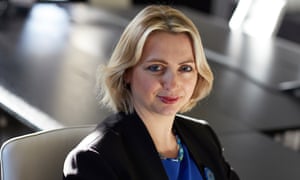
Dr Helen Stokes-Lampard, the new Chair of the Royal College of General Practitioners, says alcohol guidelines also need to be adapted. Photograph: Andy Hall for the Observer
She also doubted the wisdom of always trying to persuade smokers to give up. “Many people love to smoke still. Any reduction they can make is a good thing.Encourage them to reduce. If you only say to them ‘the only positive outcome is quitting’, then you’re going to turn them off, you’re not going to be able to have an ongoing conversation.”
Stokes-Lampard speculated that the alcohol guidelines introduced in January, which state that men should drink the same maximum 14 units a week that women have been advised to stick to for years, risked being seen as too strict. “It’s realistic, because a lot of people don’t drink that much. But, for those who do, that seems like a hard task to achieve,” she said.
Breaking bad news is an essential skill taught to us at medical school, one that I had to employ when explaining to my friends and family that after seven tough years at university, I’m leaving the profession.
If I take a step back and look at where it all began, I see a 17-year-old with a supportive, medically-oriented family who were absolutely certain of their child becoming a doctor. My entire childhood was a subliminal path towards making this choice, from having Scrubs or House on TV daily, to admiring the respect with which everyone addressed my father at his clinics.
Despite having a clear inclination towards technology, and general geekiness, I chose to continue my medical degree for lack, or perhaps fear, of pursuing other options. It was, however, not long into my training before I started dabbling with non-medical opportunities while masking them as “CV-beefers” for my medical career. This included spending two weeks traveling across Sweden and the Netherlands with a group of like-minded and skilled individuals, helping to improve their healthcare systems using technology.
The pressure that comes from understanding the importance of the job you’re preparing for, life or death in the case of medicine, results in students wanting to study and perfect each topic to a point where other interests are boiled off. Eventually, I started reprioritising my interests over this urge for academic perfection.
Along the way, my drive to become a doctor has diminished by increasing disillusionment of working for the NHS. This is not to say the NHS isn’t a fantastic organisation and one we should be immensely proud of. My main gripe as someone with a strong entrepreneurial gene is that it isn’t an institution that embraces innovation. For me, the deal-breaker is that the NHS doesn’t treat its employees as individuals and isn’t open to new ideas. I feel I could have a bigger impact on healthcare working outside the NHS rather than for it – this is why I aim to pursue a career as a doctorpreneur, not a doctor.
Coming to this decision has led me back towards my passion for exploring technology and despite the demands placed on me by my full-time university course, I have launched a tech company called Synap, which is already having a big impact on the way thousands of students study for exams.
But while entrepreneurship is the right path for me and, I believe, many other medical students with a passion for innovation – it’s not right for everyone.
My family have come to terms with my decision to leave the profession because they know I am driven enough to succeed. Have they questioned the time and money spent on a degree I won’t be pursuing as a career? Of course, but they also believe that my time spent at Leeds University is an investment for the future. The medical skills and training I’ve learned and developed are transferable to so many areas of my life and I know they will make me a better businessman.
There’s a lot I love about medicine and the NHS, but being a doctorpreneur will provide me with an opportunity to help more people from the outside.
If you would like to write a blogpost for Views from the NHS frontline, read our guidelines and get in touch by emailing sarah.johnson@theguardian.com.
Join the Healthcare Professionals Network to read more pieces like this. And follow us on Twitter (@GdnHealthcare) to keep up with the latest healthcare news and views.
Rhiannon Beauregard, 33, is visiting New York for a few days. But the sex and marriage therapist is not here for a vacation, to see the sights or visit friends in the city where she once went to college. She is here to freeze her eggs.
Beauregard lives in Austin, Texas where she runs her own practice, but has opted to come to New York to use the services offered by Extend Fertility. The clinic is the first of its kind – focusing only on egg freezing and not offering any other fertility services and treatments such as in vitro fertilization. By doing that, the clinic has been able to cut costs of its services to $ 5,000 while offering personalized service to each one of its clients.
One of the barriers to egg freezing becoming mainstream is the cost. The procedure was still deemed to be experimental until just a few years ago and was mostly an accepted way to extend fertility for older women, cancer patients or those diagnosed with fertility disorders.
Since it is considered to be an elective procedure, egg freezing is typically not covered by health insurance. The average cost of the procedure is about $ 10,000 with an additional $ 2,000 to $ 5,000 for the necessary medication and another couple of thousand dollars for storage. If the frozen eggs are actually to be used for IVF later on, that would cost an additional $ 12,000.
Related: Silicon Valley tries egg-freezing perks. How about just hiring more women?
Altogether, that adds up to more than $ 25,000 – not exactly chump change. Aware of the costs, two years ago, Facebook and Apple announced that they would cover up to $ 20,000 in costs for any female employee that wanted to freeze their eggs.
While Extend Fertility is unable to cut the costs of medicine (the clients are required to pay for it on their own) or the future costs of IVF, its founders hope that by cutting the cost of the initial procedure in half they will make the procedure accessible for more women.
“It’s expensive either way. We know that,” says Joshua Klein, co-founder and chief medical officer of Extend Fertility. He points out that $ 5,000 is still half as expensive as $ 10,000 and adds that the Extend is “working with financing partners” so that those interested could opt to pay $ 200 or $ 300 a month for a while instead of a one-time payment. “We are trying to be innovative and thoughtful about that,” he says.
Joshua Klein, co-founder and chief medical officer of Extend Fertility. Photograph: Extend Fertility
Should women view egg freezing as some kind of down payment on their future? Klein would prefer that they think of it an investment for both the future and the present. Many women worry about meeting the right guy because “they hear that biological clock ticking loudly”, he says. That ticking is a stress factor in their lives. By freezing their eggs and knowing that they have preserved their fertility, they can silence that ticking and receive the immediate benefit of “peace of mind”.
On 8 August, two days before the clinic officially opened, Beauregard was on the fourth day of her pill regiment.
Beauregard has to inject herself daily with some very expensive drugs. Prior to starting the regimen, she had to come off her birth control pills, which resulted in a couple of days of feeling “weepy”. She is bloated and on the mornings that she goes in for checkups at Extend, she ends up watching an ultrasound of her uterus – staring at her eggs instead of a baby.
However, she says, the staff at Extend have been extremely supportive. Every client is assigned their own fertility specialist and is available to accompany them to all of their meetings. The Extend office, just a block or two south of Central Park, also does not resemble a typical fertility clinic. The walls are light blue. The rooms look more like small conference rooms with round tables and a handful of chairs. There are no big tables with stirrups, no posters with uteri or models of babies nestled in a uterus.
A meeting room at Extend Fertility. Photograph: Courtesy of Extend Fertility
“Even the way this room is set up, we are trying to build into our experience the idea that this is not an illness thing, that we are not trying to cure a disease,” says Klein, sitting in one of the meeting rooms. “Here we don’t want to make people feel that they have a problem. They are just a woman living in the 21st century, coming to the doctor about preserving options for the future. It shouldn’t feel like a problem.”
For some, it might be a combination of the two. A while back Beauregard was diagnosed with polycystic ovary syndrome (PCOS) – an disorder that affects hormone production and can affect woman’s fertility in women of reproductive age. She was 32 at that time and single.
“I didn’t really have any plans to go out and find me a partner to have a child with,” she says. She began thinking about what would happen over the next 10 years. PCOS can lead to complications during pregnancy, increased chances of miscarriage, infertility and high levels of estrogen, which can cause cancer of the uterine lining.Beauregard realized that if she wants to have children in the future, she might have to undergo treatments such as IVF at that time. “I started to think about what the difference would be between now and later and the biggest difference between now and later is that after 35 my eggs start to … age, I guess, for the lack of better term.”
Klein agrees.
“We know without a shadow of the doubt that when you freeze eggs when you are younger, you are going to be putting away something that’s much, much, much more likely to be helpful for you than if you wait to do it as a reactionary measure when you are older,” he says.
According to him, the profile of women interested in egg freezing is slowly shifting from “panic-mode 40-year old” to “a proactive smart-thing-to-do-because-I am-a-young-aspiring-woman 30-year-old”. Fertility company EggBanxx, which targets younger career-focused women with slogans like “Lean in, but freeze first!”, estimates that by 2018, 76,000 women will have frozen their eggs.
Beauregard says she would have eventually considered freezing her eggs even without the PCOS diagnosis.
“Since I am single now I don’t want to put that kind of pressure on a new relationship,” she says. “If I hadn’t frozen my eggs, it would be one of the first things we talk about: ‘Hey, how do you feel about kids? Because we have to start making decisions in the next four to five years.’ I feel like a lot of pressure has been lifted off of me.”
Related: I had my eggs frozen. I wish someone had told me how difficult it was | Eleanor Morgan
The cost was the only thing that made Beauregard think twice. While researching her options, she often felt that this was a moneymaking scheme for doctors and clinics.
The $ 5,000 price tag at Extend seemed affordable in comparison. Despite that, the procedure and the drugs cost all her savings.
“Most women in their mid-30s do not have a large savings to fall back on and because we do not have any other support like a partner. The big risk for me was less about the procedure and more about ‘OK, I don’t have any savings left’,” she says. Then laughing, she continues: “There is a risk of walking out into the world with some eggs in the bank but no money.”
‘I drained my savings to do this.’ Photograph: Royalty Free/Getty Images
Beauregard admits she underestimated the cost of the drugs, which she assumed would be a few hundred dollars. It turned out to be closer to a couple of thousand dollars, instead. Additionally, she has to pay for storing of her eggs. At Extend, storage for one year costs $ 450. For five years, it’s $ 2,000 and $ 3,500 for 10.
To Talia Zapolanski, freezing her eggs is akin to an insurance policy.
Zapolanski, who worked in finance for 11 years and now works for a real estate investment firm, had been thinking of doing this for about a year and had gone in for a consultation at another hospital before being referred to Extend by a friend of one of the clinic’s doctors.
“I definitely know that I want children. That’s something I feel strongly about. I haven’t found the right person yet. I am not dating anyone now and I don’t know when I will find the right person,” says the 33-year-old New Yorker. “You start hearing a lot more about egg freezing these days and I thought I would look into it. It seems like a good idea. Hopefully I will be able to, when the time comes, get pregnant and have kids the natural way but you never know.”
Egg freezing should not be one of those things that we don’t talk about, according to both Beauregard and Zapolanski.
“When I was telling people that I was freezing my eggs, a lot of people didn’t know what to say. It makes people uncomfortable – eventually they will get curious about it, but a lot of people are a little dumbfounded that I am so open about it,” said Beauregard. “I want to make sure that people feel comfortable talking about these options.”
Zapolanski says she has encouraged “no less than five friends to go do the same”.
Recently, when she was visiting Los Angeles, she shared with a friend from college that she recently froze her eggs.
“She kind of paused and looked at me in shock that I had shared that and she said: ‘I am glad you said that, I am about to go through the process and I am so nervous about and I have nobody to talk to’,” she said. “It’s a very taboo subject.”