infertile etiketine sahip kayıtlar gösteriliyor. Tüm kayıtları göster

16 Mayıs 2017 Salı

3D-printed ovaries allow infertile mice to give birth

Infertile mice have given birth to healthy pups after having their fertility restored with ovary implants made with a 3D printer.


Researchers created the synthetic ovaries by printing porous scaffolds from a gelatin ink and filling them with follicles, the tiny, fluid-holding sacs that contain immature egg cells.


In tests on mice that had one ovary surgically removed, scientists found that the implants hooked up to the blood supply within a week and went on to release eggs naturally through the pores built into the gelatin structures.


The work marks a step towards making artificial ovaries for young women whose reproductive systems have been damaged by cancer treatments, leaving them infertile or with hormone imbalances that require them to take regular hormone-boosting drugs.


“Our hope is that one day this ovarian bioprosthesis is really the ovary of the future,” said Teresa Woodruff at Northwestern University in Chicago. “The goal of the project is to be able to restore fertility and endocrine health to young cancer patients who have been sterilised by their cancer treatment.”


[embedded content]

Of seven mice that mated after receiving the artificial ovaries, three gave birth to pups that had developed from eggs released by the implants. The mice fed normally on their mother’s milk and went on to have healthy litters of their own later in life.


Writing in the journal Nature Communications, the scientists describe how they printed layered lattices of gelatin strips to make the ovary implants. The sizes and positions of the holes in the structures were carefully controlled to hold dozens of follicles and allow blood vessels to connect to the implants. Mature eggs were then released from the implants as happens in normal ovulation.


Chemotherapy and high doses of radiation used in cancer treatment can destroy some or all of a woman’s eggs, putting them at risk of infertility and an early menopause. And while doctors have had some success in restoring women’s fertility from frozen ovarian tissue, an implant could potentially help those who do not bank healthy tissue when they are children.


Monica Laronda, a co-author on the study, said that an ovary implant could also help cancer survivors whose eggs are so damaged that they need hormone replacement therapy to trigger puberty. “We’re thinking big picture, meaning every stage of the girl’s life, so puberty through adulthood to a natural menopause,” she said.
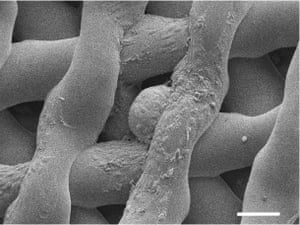


A microscopic image of an immature mouse egg, surrounded by supportive cells, after it has been housed in a bioprosthetic ovary scaffold for six days.

A microscopic image of an immature mouse egg, surrounded by supportive cells, after it has been housed in a bioprosthetic ovary scaffold for six days. Photograph: Northwestern University

Scientists have made artificial ovaries for mice before, but the latest research is believed to be the first time that researchers have used 3D printing to manufacture them. It is not clear if the same approach will work in people because human follicles are much larger and grow rapidly until they are visible to the naked eye.


Other animal experiments performed nearly a decade ago hinted that women who had ovarian tissue transplants later in life might enjoy broader benefits from the procedure than restored fertility. In 2010, scientists at Kato Ladies Clinic in Tokyo found that ovarian transplants extended the lives of old mice, and led older females, who were normally inactive, to seek out mates and have babies. The researchers conceded that far more work was needed to assess the effects in women.


Advances in 3D printing have already transformed some areas of medicine by allowing the doctors to make bespoke body parts that can be directly implanted into patients. Last year, South Korean surgeons printed a titanium heel bone for a man who had a tumour removed from his foot.


Meanwhile, researchers in North Carolina announced that they had made ears, jawbones and skeletal muscles by 3D printing structures laced with living cells. Other groups have printed vascular networks that will be vital for creating large synthetic organs in the lab.


3D-printed ovaries allow infertile mice to give birth

10 Haziran 2014 Salı

Robert Winston: infertile ladies being "exploited"


At question time, the Labour peer explained several clinics had been marketing on the London underground and “some have relationships to do perform overseas in other clinics which are not permitted by British regulation”.


Lord Howe informed him: “I recognise the value of the problem which you have raised and some of those problems are incredibly troubling.”


The minister said he did not have an up-to-date statement on the policy place the Government was taking but promised to compose to Lord Winston.


Lord Winston was recently reported to have warned that a developing market place for fertility treatments could “threaten our humanity”, which includes if the wealthy have been capable to spend for so-called “designer infants”.


The fertility specialist who designed important developments in IVF therapy advised fellow academics at a conference “we have been carried away” by breakthroughs in reproduction.


Robert Winston: infertile ladies being "exploited"

1 Mayıs 2014 Perşembe

Research turns skin tissue from infertile males into early-stage sperm cells

Live sperm seen through a microscope.

Live sperm by means of a microscope. The research suggests infertile men may possibly have misplaced the stem cells in their testes that typically produce into sperm. Photo: Mads Nissen/Panos


Scientists have turned skin tissue from infertile males into early-stage sperm cells in a groundbreaking study that raises hopes for new therapies for the situation.


The unexpected achievement of the method has stunned some scientists, because it was believed to be not possible for the men to make any sperm.


The men who took part in the study had significant genetic defects on their Y sex chromosomes, which meant they could not create healthy adult sperm on their own.


About one% of males cannot make any sperm, a problem acknowledged as azoospermia, while a fifth of men have reduced sperm counts. Male fertility is a concern for approximately half of couples who seek IVF therapy.


In the most current study, researchers took skin cells from three infertile men and converted them into stem cells, which can expand into practically any tissue in the entire body. When these cells have been transplanted into the testes of mice, they designed into early-stage human sperm cells.


“What we located was that cells from guys who did not possess sperm at the time of clinical observation were capable to generate the precursors for sperm,” said Cyril Ramathal, of Stanford University.


Skin cells from infertile males grew into fewer early-stage sperm cells than cells taken from usually fertile men, the research found.


The investigation is at an early stage, but scientists suspect that the converted skin cells might have grown into mature sperm cells if they had been transplanted into the infertile men’s testes.


If additional operate confirms the suspicion, it may be possible to restore male fertility by taking men’s skin cells, turning them into stem cells, and injecting these into their testes. The identical might be accomplished for men who are left infertile soon after getting chemotherapy for cancer.


“Currently being able to efficiently convert skin cells into sperm would let this group to become biologic fathers,” explained Michael Eisenberg, director of male reproduction and surgical procedure at Stanford, who was not involved in the study. “Infertility is one particular of the most widespread and devastating problems of cancer treatment options, specially for young boys and males.”


The examine, published in the journal Cell Reports, suggests that rather than becoming unable to make healthier sperm, the men may just have misplaced the population of stem cells in their testes that typically increase into sperm.


The scientists took skin cells from the guys and produced batches of one.5m induced pluripotent stem (iPS) cells to transplant into the mice. Every single batch was injected into the seminiferous tubules in mouse testes, in which sperm usually develop. The cells that lodged in the tubules created into early-stage sperm cells, but others turned into little tumours. The danger of leading to cancer in the guys is one of the major hazards that scientists need to overcome.


“It is remarkable that you can make iPS cells flip into early sperm cells in males with these genetic deletions,” explained Allan Pacey, senior lecturer in andrology at Sheffield University. “By the time we see them in clinic, they are not creating sperm and don’t have any stem cells to make them from, but that isn’t going to imply they did not have them when.


“This function suggests these infertile guys might have had testicular stem cells at some stage, and the issue is that they are not able to sustain them. So if you can make iPS cells and put them back into the guy, you may possibly be ready to keep ample in the testes for them to create some sperm. You are going to in no way restore them back to normal, but they may have a number of months or many years of producing sperm which is adequate to give them fertility back,” Pacey mentioned.


In the United kingdom, the use of artificially produced sperm to make babies is banned. But sperm created via this strategy – in which converted skin cells are grown into sperm in the men’s testes – may be legal to use as they are produced within the body.


Research turns skin tissue from infertile males into early-stage sperm cells