loose etiketine sahip kayıtlar gösteriliyor. Tüm kayıtları göster

5 Ocak 2017 Perşembe

Don"t loose your snooze: the technology that"s promising a better night"s sleep

A bed that adjusts itself in the night to stop people from snoring. A princess and the pea-style gadget that fits under a mattress and monitors sleep. A “water-based, app-controlled mattress topper”, which will encourage deep slumber.


Sleep technology is one of the biggest trends at CES, the world’s premier electronics show, which opened to the public on Thursday.


The range of products on show reflect the growing interest in solutions to insomnia and other sleep problems – as well as the predictions that the global sleep market will be worth $ 80bn by 2020.


The “Sleep Number 360 smart bed”, made by bed company Sleep Number, is among the most eye-catching products. The mattress can detect a change of body position during the night and uses air chambers in the mattress to contour to the sleeper’s frame.


Sampling the bed on Thursday morning, a Guardian reporter was promised “the most comfortable, effortless sleep” of his life.


The reporter did not actually fall asleep during the three minutes he spent on the bed, but could feel the bed adjusting to support his lower back and shoulders. Invited – by a video demonstration screened above the bed – to turn to his side, the bed adjusted again.
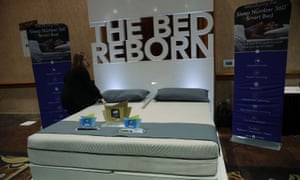


The Sleep Number 360 smart bed at CES in Las Vegas, Nevada.


The Sleep Number 360 smart bed at CES in Las Vegas, Nevada. Photograph: Alex Wong/Getty Images

A video presentation explained that the Sleep Number 360 bed is “even smart enough to sense snoring before you do”.


Should it detect a snorer, the bed will raise the top of the mattress by 7%, which Sleep Number claims will stop the snoring. “It’s the only bed that goes to work when you go to sleep,” said Kelley Parker, senior product brand manager at Sleep Number.


The bed is able to detect the sleeper’s heart rate, breath rate and motion, to provide an excellent premium sleep experience, Parker said. It can adapt to two different sleepers’ positions. But this kind of sleep, it seems, does not come cheap.


Parker said that “pricing is not finalized” but that it would be similar to existing Sleep Number pricing. (The manufacturer’s top-of-the-range bed retails at $ 7,099.99 – although it is currently on sale for $ 5,899.99.)


A recurring theme at CES is connectivity. Almost every device on show – including some washing machines and ovens – will connect to cell phones and even smart home devices like the Amazon Echo or Google Home.


The Sleep Number 360 bed, and most of the other sleep devices on show at CES, connect to an app on a smartphone to give the user information on how they slept, and even remind a person when they should go to bed. The Sleep Number 360 will also connect to your thermostat to control room temperature during the night. (If you can afford a wireless thermostat after buying the bed.)


A few stalls along from the magic bed, Sleep Ace was demonstrating its own line of sleep-friendly products. The Sleep Dot attaches to the sleeper’s pillow and feeds information back to a cell phone on movement and sleep cycles.


Some wearable devices already to this, but the attraction of the Sleep Dot, which costs $ 49.99, is that you don’t need anything strapped to your wrist.


The National Institutes of Health estimates that 50 to 70 million Americans suffer from some kind of sleep disorder. Nearly one in five adults are said to suffer from chronic insomnia, while in February 2016 the Centers for Disease Control and Prevention said more than a third of people in the US do not get enough sleep.
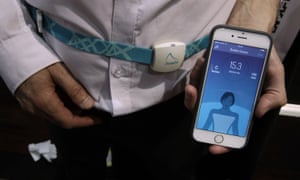


Another product at CES, 2breathe Sleep Inducer, is a device that helps people sleep using guiding tones composed from the user’s breathing.


Another product at CES, 2breathe Sleep Inducer, is a device that helps people sleep using guiding tones composed from the user’s breathing. Photograph: Alex Wong/Getty Images

Sleeping less than seven hours a day can lead to increased risk of obesity, diabetes, heart disease and “frequent mental distress”, the CDC said.


One product that may be appreciated by fans of the Hans Christian Andersen, author of the The Princess and the Pea tale, is the Emfit QS. It’s a sensor that can be installed under a mattress to monitor sleep. It connects to a smartphone to provide “comprehensive reports” about “physical recovery, stress levels, and sleep quality”.


The company says it will be of particular interest to athletes seeking to track physical recovery. Like the Sleep Number the Emfit QS will also send alerts telling a userwhen to go to bed, which could potentially be helpful (or annoying).


Another sleep device generating interest at CES is the “Kryo Sleep Performance System”: a mattress topper that cools down to 60F(16C), which the company claims is optimum for deep sleep.


The Kryo connects to a smart phone – of course – and within ten nights of collecting data it will understand a sleeper’s habits enough to optimize its temperature. The mattress topper has been financed by an Indiegogo campaign, and Kryo estimates it will ship out some of the Kryo sleep performance systems in 2017. It is expected to cost $ 299.


Don"t loose your snooze: the technology that"s promising a better night"s sleep

10 Temmuz 2014 Perşembe

Marjorie Wallace: "All hell broke loose - I took a lot of flak for what I did"

“All hell broke loose,” she admits, “I took a lot of flak for what I did. But I was travelling all over the nation, meeting households who have been at their wits’ finish, unable to care for severely mentally ill people who had merely been sent home and might be psychotic, violent or suicidal.”


Marjorie is a redoubtable character, but when we meet she is fragile, as well. 5 months ago, her beloved partner of more than 30 many years, Tom Margerison, the journalist who commenced New Scientist, died aged 90, soon after suffering Parkinson’s condition for 15 many years. A week after the funeral, a automobile crash left Marjorie with a broken arm.


Nevertheless, she has continued doing work at SANE virtually without a break. Her passion to understand and support other folks stems from her time at University College London in which she studied psychology. There, she met the Polish psychoanalyst Count Andrzej Skarbek, who was having to pay college students £3 a session to consider antipsychotic drugs for study.


“At the time, I was so poor, I was surviving on a bowl of chips each other day, so it sounded excellent,” says Marjorie.


Ahead of lengthy, she was currently being romanced by the Count. “The vodka came out, Polish tangos went on – he was far from the lonely émigré medical professional I had supposed, but a married aristocrat whose family had been patrons of Chopin. He referred to as me his Traviata.” Marjorie fell madly in really like.


At close to the very same time, in the Sixties, she fell just as heavily for journalism – working extended hours to meet the “exorbitant demands” of the pioneering Frost Programme, which went out dwell. Her day would begin at 7am and finish at 1am, and concerned persuading guests this kind of as Nikita Khrushchev and Sir John Betjeman to appear. Marjorie then worked with Sir David Frost on the moon landings just before moving to the BBC’s flagship evening news programme Nationwide. She was employed following one particular of the producers accredited her legs for “shapeliness”.


Her connection with the Count continued, and in 1972 she gave birth to their son, Sacha. At the time, Marjorie was sharing a flat with the writer Mary Kenny, and the youthful females threw wild and glamorous parties, exactly where Peter O’Toole would bounce the baby on his knee whilst novelist Edna O’Brien held court.


In 1974, right after the Count had divorced his wife, the couple married, moving to the heart of Hampstead. “Every fortnight, I’d serve the coffee and the sandwiches for the regional psychoanalysts,” she says.


The Count’s operate started to dominate their lives. “Even in the early days, our meetings took spot in some of the hospitals the place he worked. I’d devote hrs speaking to sufferers.”


But, after Sacha’s birth, Harold Evans, then editor of the Sunday Times, recruited Marjorie to join the paper, to work on its ground-breaking campaign to secure compensation for the victims of the drug thalidomide. She travelled about the nation, monitoring down young children born with foreshortened limbs, the consequence of their mothers taking the drug for the duration of early pregnancy. “It was incredible,” she says. “These families have been shunned and isolated.”


Marjorie began to develop what her personal youngsters would later laughingly get in touch with her “method acting” college of journalism. “I would reside with the families I interviewed, rest on the sofa, carry their kids into cafés and watch as the area emptied – everyone else as well shocked and embarrassed to be in the very same room.”


In 1976, Marjorie had her second son, Stefan, and wrote a book, On Giant’s Shoulders, about Terry Wiles, one of the thalidomide kids. It was later on produced into an award-winning film.


Marriage to a career was not fairly what her husband had had in mind, nonetheless. “He considered he was marrying his second countess – there to be gracious, not to be functioning. And then I had a miscarriage at five months, soon after operating in Italy to expose the Seveso tragedy.” This was the spillage of industrial chemical substances that resulted in thousands of Italians getting exposed to the carcinogen dioxin. Did it cause the miscarriage? Marjorie can only wonder.


The couple’s third son, Justin, born in 1978, was just nine months old when the Count left for Canada with out his family. “I think he imagined I would join him, but I did not want to abandon my career, or my elderly mom, so I was a single mum with 3 boys and no financial support.”


Marjorie had grow to be close to Tom Margerison, who had worked on the dioxin story, and later on collaborated with her on the book The Superpoison. Finally, in 1982, they set up home and in 1984, their daughter Sophia was born. “It was a joy to have Tom in my lifestyle,” she says.


The subsequent couple of many years had been “crowded”: Marjorie wrote the book The Silent Twins, about two women who communicated in their own language and had been sent to Broadmoor, and each the book and her screenplay for the BBC movie won acclaim. During her function, her 4 young children went all over the place with her. “They’d say: ‘Mum, what are we performing this weekend? Not Broadmoor yet again?’ ”


From this stage on, Marjorie started to focus on psychological illness. “The stories I located were breaking down this thought that care in the community would work this idea that if you get people out of hospitals, by some means they will not be mentally ill. The idea of liberating the sick from these previous-fashioned institutions was hugely seductive – but, without the promised money, individuals were becoming abandoned.”


Following a series of trailblazing articles or blog posts known as “The Forgotten Illness”, she was permitted by the Sunday Times to devote half her time as a journalist and half setting up SANE. And, by 1996, she had raised £6 million from the Greek shipping family members Xylas, the late king of Saudi Arabia and the sultan of Brunei for an global study centre, the Prince of Wales International Centre for SANE Research (POWIC) in Oxford. She is rightly proud that the creating is a busy hub with researchers investigating concerns from suicide prevention to mindfulness training.


For the duration of the early Nineties, Marjorie was diagnosed with breast cancer – and seven years later on Tom produced Parkinson’s. She nursed him devotedly, as well as visiting the Count, who had returned to Britain and lived nearby. He died in 2011.


It later on emerged that Marjorie had a connection with Lord Snowdon, in the many years when her domestic daily life had turned to caring. Of this, Marjorie says only: “We are and have constantly been the best of pals who enjoyed working collectively. He was my ‘partner in crime’, exposing injustice and trying to get assist for disabled individuals.”


Her campaigning goes on. “There is a lack of acute beds for the mentally ill, which is an absolute scandal,” she says. “I feel psychological well being services are in breakdown once more.”


Marjorie acknowledges that throwing herself into operate and the difficulties of other folks will not ease the ache of Tom’s death. Her children, though, are a wonderful support: Sacha is a songwriter with No 1 hits such as James Blunt’s You are Lovely below his belt Stefan writes music, as well Justin lives at property and operates in the neighborhood pub and Sophia is in the music business in Los Angeles.


“Somehow, I have to locate the time and the way to mourn,” says Marjorie. “People say Tom’s death should be a relief, and I’m glad he is not suffering. But there is no relief for me. He was my emotional lodestone, and with out him, I come to feel adrift. I have lost my secure harbour.”


Indeed she may have carried out, but Marjorie Wallace is practically nothing if not a survivor.


Marjorie Wallace: "All hell broke loose - I took a lot of flak for what I did"