official etiketine sahip kayıtlar gösteriliyor. Tüm kayıtları göster

21 Mart 2017 Salı

It"s official: access to green spaces leaves you in the pink

People living close to trees and green spaces are less likely to be obese, inactive, or dependent on anti-depressants, according to a new report.


Middle-aged Scottish men with homes in deprived but verdant areas were found to have a death rate 16% lower than their more urban counterparts. Pregnant women also received a health boost from a greener environment, recording lower blood pressures and giving birth to larger babies, research in Bradford found.


Overall, nature is an under-recognised healer, the paper says, offering multiple health benefits from allergy reductions to increases in self-esteem and mental wellbeing.


A study team of 11 researchers at the Institute of European environmental policy (IEEP) spent a year reviewing more than 200 academic studies for the report, which is the most wide-ranging probe yet into the dynamics of health, nature and wellbeing.


The project first appeared as an unpublicised 280-page European commission literature review last autumn, before being augmented for Friends of the Earth Europe with analysis of the links between nature-related health outcomes and deprivation.


“The evidence is strong and growing that people and communities can only thrive when they have access to nature,” said Robbie Blake, a nature campaigner for Friends of the Earth Europe, which commissioned the analysis.


“We all need nature in our lives, it gives us freedom and helps us live healthily; yet deprived communities are routinely cut off from nature in their surroundings and it is suffocating for their well-being.”


The report makes use of several studies that depict access to nature as being inextricably linked to wealth inequality, because deprived communities typically have fewer natural environments within easy reach.


Despite this, the study cites research that 26% of England’s black and minority ethnic populations visit natural environments up to three times a year, compared with 15% of the rest of the population.


Patrick ten Brink, the IEEP’s director, praised cities such as Oslo and Victoria-Gasteiz for taking steps to make nature accessible to all.


“We should be inspired by this and work together so that all Europeans have nature within 300 metres of their homes in the next 10 years,” he said.


Previous US research has found that that hospital patients with tree views from their windows were discharged a day earlier than those whose rooms faced walls.


An extra 10 trees on a Toronto city block provided health benefits to residents equivalent to a $ 10,000 increase in annual income, or being seven years younger, another study in 2015 found.


It"s official: access to green spaces leaves you in the pink

7 Şubat 2017 Salı

China may still be using executed prisoners" organs, official admits

An official in charge of overhauling China’s organ transplant programme has said the country may still be using organs from executed prisoners in some cases, even though there is technically zero tolerance for the practice.


The admission by Huang Jiefu, a former Chinese deputy health minister, came as human rights activists and medical ethics experts voiced strong objections to his inclusion at a Vatican summit designed to tackle illicit organ trafficking.


The activists said that by giving Huang a platform, the Vatican risked giving China’s practices an air of legitimacy. Huang told reporters on Tuesday that the controversy was “ridiculous” and repeated assertions that the use of organs from prisoners is now “not allowed”.


“There is zero tolerance. However, China is a big country with a 1.3 billion population so I am sure, definitely, there is some violation of the law,” he told reporters at a conference in Rome.


Pope Francis has called illicit organ trafficking a form of modern slavery. At the start of the conference on Tuesday participants painted a bleak picture of the scale of the problem, with patients who are desperate for life-saving procedures flocking to countries like Egypt, India, and Mexico to buy organs cheaply.


Huang, who has long been a controversial figure in the world of transplantation, said trafficking could be stemmed through the creation of a global task force headed by the World Health Organisation.


But experts have questioned Huang’s assessment of the situation, saying China probably still systematically uses the organs of executed prisoners in order to meet an overwhelming demand.


Last year, China’s alleged use of prisoners’ organs was debated at an international conference after two doctors said it was premature to declare China an ethical partner in the international transplant community.


Nicholas Bequelin, the east Asia director for Amnesty International, said it was known at the time that the vast majority of organ transplants in China came from executed prisoners.


The number of prisoners China executes annually is a state secret, but Bequelin said estimates ranged from 3,000 to 7,000. He said experts had cast doubt on Huang’s claims that China had outlawed the practice. “They haven’t stopped the practice and won’t stop. They have a need for organ transplants that far outpace the availability of organs,” Bequelin said.


Details of the process are grim. Bequelin said China did not adhere to World Health Organization recommendations on how doctors should determine whether a person is legally dead. In some cases, organs have been removed before the prisoner would be considered medically dead by international standards.


“The timing of the execution is – we think – sometimes dependent on the need of a particular transplant surgery. You will execute this person at this time on this day, because that is when the patient has to be ready,” Bequelin said. “It is very secret and there is not a lot of reliable information.”


The Vatican has released new bioethics rules that say organ transplantation must involve the free consent of living donors or their representatives and that in ascertaining the death of a donor, it must be diagnosed with certainty, especially when a child is involved.


China may still be using executed prisoners" organs, official admits

29 Eylül 2016 Perşembe

Captured and cut: FGM returns to Sierra Leone despite official ban | Umaru Fofana

Khadija Balayma Allieu sits on her hospital bed, grimacing at every movement of her legs. It has been five days since she was forcibly genitally mutilated, she says.


As she receives treatment in the eastern Sierra Leonean town of Kenema, Khadija, 28, recounts what she went through at the hands of five cutters. She is now in hiding because the soweis – as the cutters are known locally – are looking for her.


Khadija says she was blindfolded and held by five or six women. “They gagged me as I shouted. Then [one of them] started cutting. They held my head down. I started bleeding profusely. I tried screaming but there was cloth inside my mouth.”


Khadija, the mother of a 12-year-old boy, says she was left locked inside the house for four days “without food or medicine”. Eventually, the police were alerted. They raided the house, extracting her through a smashed window.


Living in fear of FGM in Sierra Leone: ‘I’m not safe in this community’

As Khadija explains her nightmare, she constantly wipes away tears and turns her sunken eyes towards the window, to be sure no one is coming to get her. She is in genuine fear for her life.


The woman accused of cutting her, Elsie Kondoromoh, is an influential figure in Sierra Leone. Initially detained by police, she was released when hundreds of cutters mounted a protest outside the police station. Kondoromoh’s supporters have been to the courthouse to make a case for legal investigations against her to be dropped.


Police inspector Marty Tarawille said: “[Kondoromoh] was with us [at the police station] but the sowei people came in numbers …They were singing, they were shouting that we should leave that lady [alone] … If we had not released her it would have been a problem for us in this station.”


The case highlights the challenges facing anti-FGM campaigners in Sierra Leone. The minister for social welfare, Sylvia Blyden, has said the government’s focus is on children under 18. This is seen as leaving adult women free to decide what they do with their bodies.


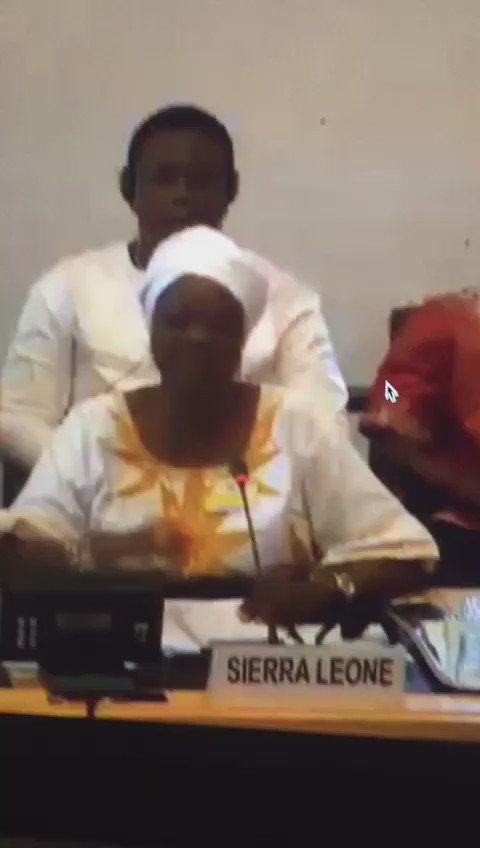
— diasporan hands (@diasporanhands) September 16, 2016

Sierra Leone minister on fgm pic.twitter.com/aGJi4Sy7Es


FGM has been banned in the country since emergency health measures were introduced after the Ebola outbreak in 2013. But despite the continued ban, the practice has returned through all-female secret societies, the Bondoand condemnation by the authorities has become increasingly absent.


In August, a young woman died in the northern town of Makeni shortly after undergoing the procedure, prompting the arrest of several soweis. In another recent case, police say children were rescued from a disused house in Magburaka, also in the north, after undergoing an initiation ceremony.


The World Health Organisation estimates that 88% of women in Sierra Leone between the ages of 15 and 49 have undergone FGM.


That the women who converged on the police station were able to secure Kondoromoh’s release is indicative of the power soweis wield in Sierra Leonean culture. Civil society organisations have called for Khadija to be evacuated from the town, expressing concern for her safety, but fear of the soweis is such that campaigners are afraid to come to the fore.


“The soweis are so powerful that nowhere in Sierra Leone will be safe for her again,” one activist says.


Soweis, or FGM cutters, protest in Kenema after their head cutter was detained by police in relation to a case of a 28 year old woman alleged to have been forcibly cut


Soweis protest in Kenema after police detained a local leader. Photograph: Umaru Fofana

Kondoromoh, who is national vice-president of the Sowei council, admits she carried out the procedure but says she did not force Khadija to go through with it. She claims Khadija asked for it.


“She met me at home saying she was being taunted by her fellow women because she had not been circumcised,” says Kondoromoh. “She came to me to initiate her and asked how much it would cost. I told her that I did not want anything from her because she was being provoked. I took her to a nearby society bush to initiate her”.


Kondoromoh says Khadija asked to stay with her until she recovered because she would be taunted if she went back home: “I bought her provision. I woke up every morning to prepare food for her before leaving home.”


Medics treating Khadija say her condition is improving, but predict it will take some time for her to heal both medically and psychologically. One nurse described her as “badly traumatised”.


“With elections in early 2018, it is unlikely the government will take any serious action against the soweis, who will now be emboldened by their apparent success in having their way,” says a local journalist whose radio station has been threatened if it continues to cover the issues surrounding FGM.


He believes that even if the matter reaches court – “which is unlikely” – the victim will be in danger if she testifies.


Captured and cut: FGM returns to Sierra Leone despite official ban | Umaru Fofana

22 Ağustos 2016 Pazartesi

Secret documents reveal official concerns over "seven-day NHS" plans

The health service has too few staff and too little money to deliver the government’s promised “truly seven-day NHS” on time and patients may not notice any difference even if it happens, leaked Department of Health documents reveal.


Confidential internal DH papers drawn up for Jeremy Hunt and other ministers in late July show that senior civil servants trying to deliver what was a totemic Conservative pledge in last year’s general election have uncovered 13 major “risks” to it.


While Hunt has been insisting that the NHS reorganise around seven-day working, the documents show civil servants listing a string of dangers in implementing the plan – as summarised by a secret “risk register” of the controversial proposal that has prompted a bitter industrial dispute with junior doctors.


The biggest danger, the officials said, is “workforce overload” – a lack of available GPs, hospital consultants and other health professionals “meaning the full service cannot be delivered”, they say in documents that have been obtained by the Guardian and Channel 4 News.


The risk register and other documents also show that the DH sees the NHS’s 1.5 million staff, especially doctors, as a “barrier” to the high-profile but controversial ambition of increasing patients’ access to hospitals and GP surgeries at weekends “because they do not believe in the case for change”.


Hunt has angered hospital consultants and junior doctors over the last year by ordering them to work more at weekends in order to help deliver the seven-day goal, even though both groups are often on duty on Saturday and Sunday.


Juniors have held eight days of strikes to protest against a new contract Hunt is imposing on them which they claim ignores the need for extra doctors to enable the expansion of care he wants – a claim that the BMA said was vindicated by the documents.


Dr Mark Porter, leader of the British Medical Association, said the papers proved that government had ignored warnings from healthcare organisations, especially that a lack of extra staff and more funding would hinder progress. That it has also “disregarded its own risk assessment’s warnings about the lack of staffing and funding needed to deliver further seven-day services, is both alarming and incredibly disappointing”, he added.


He also seized on the DH’s admission in the documents that it still has not worked out what No 10’s objectives were. In pushing ahead with implementing the plan, Porter said: “[It] only goes to show that this was nothing more than a headline-grabbing soundbite set to win votes rather than improve care for patients.”


Shortly after the May 2015 election, David Cameron, the then prime minister, made a speech in which he referred on 18 separate occasions to his “plan” for a seven-day NHS. Fourteen months later, the BMA added, that the documents show that there was still a painful lack of detail.


The papers also show that senior officials at the Department of Health:


Fear the seven day plan might fail to deliver its stated aims, which include improving the quality of hospital care at weekends and reducing death rates among those admitted for treatment as an emergency on Saturday or Sunday. “It is possible that the programme delivers the planned outputs, but this does not result in the desired change (delivering against the plan but missing the point),” one states.


Voice concern that there is also a risk that even if weekend services are successfully enhanced, that “patients do not report any difference/improvement in their experience [of] out of hours and at the weekend”.


Worry that Britain’s decision on 23 June to leave the European Union “may adversing (sic) impact upon the delivery of the 7 Day Services programme, particularly with regards to workforce and finances” because the NHS employs 55,000 staff from around the EU.


A DH spokesman said: “Over the past six years eight independent studies have set out the evidence for a ‘weekend effect’ – unacceptable variation in care across the week. This government is the first to tackle this, with a commitment to a safer, seven day NHS for patients and£10bn to fund the NHS’s own plan for the future, alongside thousands of extra doctors and nurses on our wards.”


A department source added: “A risk register by definition details all potential issues under a worst-case scenario to help the government develop robust plans to ensure we meet our promises to the electorate, but we are confident our programme for a safer seven-day NHS is on track‎, and will deliver real benefits for patients.”


Hunt has persistently championed the idea of a seven-day NHS. On 25 April the health secretary told MPs of “the government’s determination to be the first country in the world to offer a proper patient-focused seven-day health service”. In that speech he specifically rejected “the concern that a seven-day NHS might spread resources too thinly”.


That was unfounded, Hunt said, because the government has increased doctor numbers by 10,100 since 2010 and would add a further 11,420 to the headcount by 2020.


The documents also show that privately some of Hunt’s most senior civil servants worry that the pledge to increase the NHS budget by £10bn by 2020-21 will not be enough to deliver the promised NHS expansion by 2020. The risk register notes that much of the £10bn will not reach the NHS until near the end of this parliament and thus not be immediately available to fund the changes. “This could result in ‘back loaded’ delivery increasing the risk that deadlines for completing roll-out [between now and 2020] are missed,” they say.


Several of the risks reveal damaging internal disagreements among those taking forward the seven-day drive, including over what the purpose of the plan is. That included tension between the DH and Downing Street in May when Cameron was still in power. In a section of the risk register headed “scope creep”, which was last reviewed on 10 May, it says: “The planned objectives and scope of the programme do not meet the expectations of No10/Cabinet Office, meaning that they may continue to change. This could lead to an inability to deliver the desired outcomes to the agreed timescales.”


Prof Chris Ham, the chief executive of the King’s Fund, rejected Hunt’s insistence that the £10bn was enough to deliver a seven-day NHS by 2020.


“It is not credible to argue that it can continue to meet rising demand for services, maintain standards of care and deliver new commitments such as seven-day services within its current budget,” he said. “Implementing seven-day services is a laudable ambition but is not realistic unless additional funding becomes available and workforce challenges can be overcome.”.


The shadow health secretary, Diane Abbott, said: “This is a shocking indictment of the Tory government’s plans. They pressed ahead with their proposals even when campaigners and NHS staff argued they were unworkable. It has now been confirmed by the advice the government received from its own civil servants.


“This is a scandal. The government is undermining the NHS with plans it knew to be unworkable.”


Abbott said she would be contacting Hunt to see if he had misled parliament.


Secret documents reveal official concerns over "seven-day NHS" plans

7 Ağustos 2016 Pazar

New York"s "queer health warrior": city official funds grassroots fight against HIV

At New York City’s Pride parade this summer, tucked between the rainbow-dyed dogs and the thousands of hairy legs in tiny shorts, was the head of the city’s HIV/Aids bureau, Demetre Daskalakis, wearing a mesh T-shirt and DJing the health department’s float.


The parade’s party atmosphere echoed the sex clubs where Daskalakis still occasionally offers consultations and the spin classes he teaches each week. And that atmosphere remained as health department staff handed out New York City-branded condoms and kits filled with HIV prevention drugs to the cheering crowd. This might be because the health commissioner, Mary Bassett, was voguing next to the DJ table.


The health department in New York City, once the center of the country’s HIV/Aids epidemic, has made a point of directing funds to small, on-the-ground initiatives like the program that emerged from Daskalakis’s nights providing care in sex clubs.


Daskalakis, now the assistant health commissioner in charge of the Bureau of HIV/Aids Prevention and Control, achieved widespread acclaim while testing people in city sex clubs in 2013 to successfully combat a meningitis outbreak among gay and bisexual men. There the man known as “Dr Demetre” would offer HIV and hepatitis-C screenings and provide consultations while clubbers waited for the results of their tests.


But now he is funding the same programs he helped create. The bureau has contracts with 375 local and national groups. And money from the state’s Ending the Epidemic fund is being directed towards small transgender rights groups who do not yet have the resources to offer the sort of interventions provided by much more powerful HIV/Aids groups.


Demetre Daskalakis


Demetre Daskalakis, the New York City assistant health commissioner in charge of the Bureau of HIV/Aids Prevention and Control. Photograph: Courtesy of City of New York

“That money is being used to actually teach these organizations how to get bigger and thrive and be organizations,” Daskalakis said. “In fact, at the beginning of this, we don’t care what service they do, we just care that they grow.”


The comment might seem flippant, but Daskalakis surges with energy when he’s detailing HIV policies on a humid Monday afternoon at the health department headquarters or tweeting about Israeli singer Ofra Haza at 8am.


“HIV allows us to leverage the healthcare system to support the health of people who weren’t always getting that support,” Daskalakis said.


While the nature of government means a person with this much energy and experience may have to lower their ambitions – Daskalakis said he “tortured” his staff with ideas when he first started at the department – the bureau is the largest of its kind in the country with 413 staff members, and its initiatives are closely watched by other agencies. “We’re also bossing the feds around a little bit,” Daskalakis said.


One example of that is the city’s push to provide grants to groups that offer “status neutral” care to people whether they are HIV positive or negative – instead of focusing on people who already have the lifelong disease, this gives more flexibility in providing resources to at-risk communities.


Daskalakis said the city’s “status neutral” plan is part of a demonstration project the department is running for two federal health agencies – the Centers for Disease Control and Prevention and the Health Resources and Services Administration. “Obviously we have to see if this going to work,” he said. He barely took a breath before continuing: “But it’s going to work, it’s a great idea.”


Some of the LGBT groups who have not worked as closely with the health department, like the Services & Advocacy for GLBT Elders (Sage), said they’ve noticed a more aggressive response to the epidemic in recent years.


“The whole orientation around ending the epidemic has been an important step forward – that if we take a more aggressive and more proactive and more energetic approach, that we can really turn the corner on HIV,” said Michael Adams, SageUSA CEO. “It has been encouraging to watch that orientation, and that’s coming from leadership at both the city level and the state level.”


Sage gets money from the city, mostly through the Department of Aging, but said elder health in the HIV crisis is often overlooked – even though 50% of the people living with Aids in the city are over 50 years old. His group is still working to get the city to respond to that population more strongly, but in general, he has been encouraged by the energy emanating from the department.


And when it comes to the bureau chief of HIV/Aids, Adams said advocacy is essential to the role. “It has always been and remains the case that in order to advance an effective response to HIV activism, advocacy is required and a willingness to challenge the status quo and challenge assumptions that are often really wrong-headed,” he said.


Challenging the status quo has been a driving force during Daskalakis more than 30 years in the field. When medical schools were keeping students away from hospital Aids wards in the 1990s, Daskalakis, trained as an infectious disease doctor,was skipping classesto follow rounds and listen to doctors treating those patients.


Now, he’s “a kid in the candy store” with the extensive collection of data the city has on HIV/Aids in its health department headquarters. And though he jokingly whispered in his office that the department’s role is “secretly an advocacy group in government”, it is no secret to any visitor who sees the small rainbow flags flying above the 22nd floor cubicles.


But his work in the department has even pushed Daskalakis to an even more activist bent.


He was “the gay health warrior” before he took over the HIV/Aids bureau in September 2014, but his time in office has ramped up his activist bent. Recently, he changed his title to “queer health warrior” to encompass sexual and gender identities beyond gay.


“I was dubbed gay health warrior and kind of realized that with all the work we’re doing in the transgender space, the gender nonconforming space, it’s a lie, that it’s not really accurate to what I’m doing anymore,” he said. “So I kind of thought though at least it has a little political overlay to it, I feel like it captures a lot of what we’re doing, which is sort of for all of that universe trying to sort of advocate for a population that in some way hasn’t had that.”


New York"s "queer health warrior": city official funds grassroots fight against HIV

10 Temmuz 2014 Perşembe

European official commits to safeguarding NHS in EU-US trade deal

NHS TTIP

A new EU-US trade deal could include an additional £4bn a year into the Uk economic system, but it has prompted fears NHS providers will be threatened by privatisation. Photograph: Dominic Lipinski/PA


Campaigners for a new EU-US trade deal, which could include an extra £4bn a year to the Uk economic system, have been given a increase right after an undertaking from Europe’s lead negotiator that US healthcare firms will not be allowed to run NHS services.


Amid trade union fears that the proposed deal could act as a cover to privatise the NHS, the primary European commission negotiator has mentioned that the NHS would be “fully safeguarded”.


Ignacio Garcia Bercero, director of the USA and Canada division in the European commission, produced the commitment in a letter to the former Labour shadow health secretary John Healey who is chairman of the all-party group on the trade deal. It is recognized as TTIP – the Transatlantic Trade and Investment Partnership.


Bercero informed Healey: “Though wellness companies are in principle inside of the scope of these agreements and ongoing negotiations, we are assured that the rights of EU member states to handle their health methods in accordance to their various requirements can be fully safeguarded.”


The intervention by the European commission was welcomed by Healey who is facing a battle in the Labour movement towards the EU-US trade deal. The Unite union published investigation at its latest conference which warned that the proposed partnership locations the NHS at “unique risk” in the face of a “Tory drive in the direction of privatisation”. There are moves to table a vote at the TUC congress in September and there is strain for an emergency movement to be tabled at Labour’s annual conference.


Healey explained the commission letter need to reply fears in the Labour motion about the threat to the NHS. Healey told the Guardian: “This letter confirms that the NHS can be totally exempted in any TTIP deal. Now it is for United kingdom ministers and EU negotiators to make positive that the commitments the lead negotiator is producing are put in area in full. This letter confirms that the biggest risk to the NHS is the Tories not TTIP.”


The former minister spoke out after the European commission moved to allay fears about the effect of the trade deal on the NHS. Bercero wrote that:


• Bilateral agreements produced by the EU exclude or incorporate particular reservations “for publicly funded health providers”. He wrote: “This policy space means that member states do not require to supply accessibility to their markets for foreign organizations and even if they do give accessibility they can discriminate in between foreign organizations and EU / domestic ones.”


• EU member states are entitled to preserve and adopt new measures to handle accessibility to their well being service industry by foreign suppliers. “The EU does not intend to change its technique to health services in trade negotiations for TTIP.”


• EU members states face no restrictions on “liberalising the health sector nor from deliberalising it”. He wrote: “The EU does not intend to modify its method to public procurement for wellness companies in TTIP.”


Bercero also answered critics who warn that the controversial Investor-State Dispute Settlement (ISDS) – the dispute mechanism attacked by critics as secretive – could pose a chance to the “existing mix of public and personal well being support delivery”. He mentioned that adjustments to the NHS above the previous two decades have not been affected by EU trade policy.


In an obvious attempt to allay issues in the Labour get together, which programs to repeal Andrew Lansley’s overall health and social care act, the commission official wrote: “If a future Uk government, or a public entire body to which energy has been devolved, had been to reverse choices taken underneath a preceding government, for example by discontinuing companies supplied by a foreign operator, it would be entirely at liberty to do so. However, it would have to respect applicable United kingdom law.”


Bercero concluded: “We can previously state with self-assurance that any ISDS provisions in TTIP could have no influence on the UK’s sovereign proper to make modifications to the NHS. I hope that this details obviously demonstrates that there is no purpose for worry both for the NHS as it stands right now, or for modifications to the NHS in potential, as a outcome of TTIP.”


The Huffington Submit reported Len McCluskey, the Unite general secretary, as telling his conference: “David Cameron … have to use his powers to defend our cherished NHS. US health businesses will even have the right to sue a long term United kingdom government in secret courts if politicians try out to reverse privatisation.


“The most considerable effect will be felt in wellness, enabling US healthcare multinationals and Wall Street traders to sue the Uk government in secret courts if it attempts to reverse privatisation. David Cameron can exempt the NHS from these trade negotiations. Except if the prime minister acts, bureaucrats in Brussels and Washington will make the sell-off of our NHS irreversible.”


Healey mentioned of the transatlantic deal: “Even on the most measured assessment it could be really worth an further £4bn a yr to Britain’s GDP.”


European official commits to safeguarding NHS in EU-US trade deal

15 Şubat 2014 Cumartesi

Doctors paid up to £3,000 a shift, official figures show

All the sums incorporated costs paid to agencies, which typically consider around 15 per cent of the bill. Some medical doctors had been rewarded not just for the hours they worked, but for all the time they had been on phone, like when they have been sleeping.


The figures propose that the complete bill for these agency employees in 2013 was almost £250 million, a rise of one particular third in two many years. This would have been enough to pay out the yearly wages of 3,000 consultants or more than seven,000 junior doctors.


Experts stated the figures disclosed the full extent of a crisis in which casualty departments have turn into “entirely dependent” on short-term workers, amid desperate shortages of senior physicians and consultants.


Senior managers have previously insisted that rates of £1,000 per shift or far more are paid only in crisis situations where there is no alternative.


The investigation by The Telegraph shows that NHS trusts are routinely paying out such sums to meet workers shortages.


The evaluation located:


  • Heart of England NHS Basis Believe in in Birmingham paid at least £1,000 per shift on 719 occasions final 12 months


  • Kettering Common Hospital Foundation Believe in paid such charges 595 occasions in 2013, while Northern Devon Healthcare Trust did so for 255 shifts


  • Barking, Redbridge and Havering University Hospitals Trust in Essex had the highest bill for A&ampE company personnel, spending £7.1 million last 12 months, like 217 shifts paid at prices of at least £1,000 each and every.


The hospital was recently put on special measures right after its casualty unit was discovered to have the worst shortages of senior medical professionals in the country, with 13 out of 21 posts vacant.


The University of Emergency Medication, which represents A&ampE medical professionals, says there is a shortage of virtually 400 consultants in Britain.


They say shortages have occurred since not sufficient physicians had been skilled, while hundreds much more have emigrated to countries where the workload is less onerous.


Authorities say the crisis is prompting consultants to take on added work at extremely lucrative costs, whilst others come here from abroad.


Dr Cliff Mann, president of the College of Emergency Medicine, mentioned: “The use of agency medical professionals has turn into endemic in the NHS. There are units which would implode if they weren’t relying on them, day in, day out.”


Dr Mann, the most senior A&ampE medical doctor in the United kingdom, extra: “The figures are surprising and ludicrous. The worst of it is that with the cash we are wasting on temporary personnel we could double the number of A&ampE consultants, if only a far more long-phrase technique was taken. It doesn’t make financial sense, nor does it make clinical sense — because this is not great for patients.”


In total, 64 hospital trusts, out of 144 with A&ampE departments, responded in some kind to freedom of info requests.


Of people, 36 trusts supplied particulars on how many occasions they had paid more than £1,000 to cover a shift in A&ampE in 2013. Among them, they invested such sums on 2,317 events last year — the equivalent of 9,268 shifts, when extrapolated to cover all 144 hospital trusts in England with a casualty unit.


The trusts presented information of the highest quantities paid to a single medical professional or nurse at any time because 2011. At Lancashire Teaching Hospitals Basis Believe in, a consultant was paid £2,400 in May possibly 2012 to operate 9 hours in the hospital, plus 15 hours on contact.


Hospitals also spent heavily plugging gaps for nurses. Royal Devon and Exeter Basis Believe in paid £1,620 for a twelve-hour nursing shift in January 2012, even though University Hospitals Bristol Basis Trust invested £1,235 on an eleven.five-hour shift last April. Close by North Bristol Trust spent £1,150 on a twelve-hour shift in Could final year.


Amid desperate shortages, even the most junior employees were paid at inflated prices. Walsall Healthcare Believe in paid £968 for a clinical support employee to function an 11.5-hour shift last Christmas. This kind of staff, who assist in clinics and laboratories, are normally paid in between £14,000 and £17,000 per yr.


The trusts also offered figures for the overall complete commit on temporary medics for each of the final 3 many years. These had been employed to determine an NHS-broad figure, which exhibits £242 million invested final year, compared with £181 million in 2011 — a rise of 33 per cent.


Many of the trusts explained they struggled to find workers simply because of the national shortage of consultants and that security of patients came initial. Many mentioned they have been doing work to reduce their investing on agency workers, but that payments were in line with normal fees paid for locum employees.


Heart of England NHS Basis Trust explained it was one of the largest trusts in the United kingdom, and that its priority was providing protected care, which often meant exceeding standard fees. It said it had just recruited 10 far more A&ampE medical professionals.


Kettering Common Hospital Foundation Believe in explained lowering spending on company employees was a priority, even though Northern Devon Healthcare Believe in said it suffered “abnormally high” workers sickness among A&ampE consultants last 12 months.


Wye Valley Trust said its difficulties have been compounded by its rural spot in Herefordshire.


Barking, Redbridge and Havering University Hospitals Believe in explained it was functioning “tirelessly” to recruit employees in spite of the nationwide shortage. Last winter, senior medics warned that A&ampE units had been like “war zones” as they struggled to cope with rising numbers of sufferers, several of whom had failed to safe help from out-of-hrs GPs.


On Friday, figures disclosed that casualty departments have had their worst week but, with a hundred of England’s 144 NHS trusts with A&ampE units missing targets to deal with patients inside 4 hrs.


A Division of Well being spokesman explained: “Holding on to doctors in A&ampE has been a dilemma for over a decade. There are a lot more than 20 per cent far more A&ampE consultants than there had been in 2010, but we know we need to have even a lot more and we have a program to make that happen.”


A spokesman for NHS England mentioned: “We recognise there are challenging troubles about senior healthcare staffing in the emergency medicine specialty, and this is compounding pressure on hospitals as A&ampE attendances improve 12 months-on-12 months.”


Doctors paid up to £3,000 a shift, official figures show