safest etiketine sahip kayıtlar gösteriliyor. Tüm kayıtları göster

7 Mart 2017 Salı

Is Lymph Node Removal the Safest Choice for Breast Cancer?

If you have been diagnosed with breast cancer, your oncologist may suggest lymph node removal as part of the course of treatment. Whether to get this procedure done is a personal choice that each woman must make. It is important to know the risks—and your options– before you commit to this potentially-dangerous procedure, however.


Why is lymph node removal so common?


When a woman is diagnosed with breast cancer, often times “sentinel lymph nodes” around the affected area may be removed via biopsy before conventional treatment begins (other times they are removed during surgery). Conventional oncologists often suggest this based on the premise that cancer cells tend to spread first to “sentinel lymph nodes,” i.e. the lymph nodes closest to the tumor, before they spread to “auxiliary nodes” and the rest of the body.


Lymph node removal in breast cancer patients has been around since the early 1900’s; it is part of an old paradigm that focuses primarily on “getting all of the tumor out.”  As new ways of looking at cancer are come to the forefront, however, even researchers and doctors within the halls of conventional medicine are beginning to question whether the procedure is necessary for all women.


The field of breast cancer oncology was turned upside down in 2011 when a study out of John Wayne Cancer Center in Southern California announced that for roughly 20% of all U.S. breast cancer, lymph node removal did not make any difference whatsoever in their recovery. For approximately 40,000 women per year who have stage T1 or T2 cancer tumors that have not traveled elsewhere in the body, it did not improve their survival nor their metastasis rates in any way.


“I have a feeling we’ve been doing a lot of harm,” said Dr. Grant W. Carson, one of the authors of the report, in reflecting on the legacy of lymph node removal for breast cancer patients that has persisted until this point.


The Perils of Lymphedema


Lymph nodes are vital for the body for several reasons. They are one of the areas where white blood cells and Natural Killer Cells are produced. The lymphatic system is also the body’s second most important line of defense against harmful pathogens (besides the skin). It filters unwanted substances that may accumulate throughout the whole body to detoxification pathways so that they can be eliminated.


For those who have a Sentinel Lymph Node Biopsy (SLNB), an estimated 5-17% will develop lymphedema, according to the National Cancer Institute. For Auxiliary Lymph Node Dissection (ALND) surgery, the percentage jumps to between 20 to 53 percent. And a whopping 70% of those who elect to have all of their breast-area lymph nodes removed will develop the condition.


Lymphedema is a painful condition that happens when lymph fluid becomes clogged and collects under the skin’s surface—and edema and fibrosis can follow if it is not addressed. Fibrosis in particular stops the natural flow of oxygen and healthy substances through the lymph system and can lead to bacterial overgrowth and infection.


3 Easy Ways to Keep Your Lymph System Flowing…Naturally


If you have already had some or all of your breast area lymph nodes removed as part of a conventional breast cancer protocol (or are prone to lymphedema for other reasons), be sure to add these important practices to your overall health routine:


  • Move your body! This is perhaps the most important thing you can do to keep your lymph and detoxification pathways healthy. Remember that lymphatic fluid needs to flow and regular exercise can help that process. A 2011 review of 11 other studies published in the Journal of Cancer Survivorship found that “strong evidence is now available on the safety of resistance exercise” for breast cancer patients.” Resistance exercises for lymphedema would include gentle exercises that lightly use your muscles against an opposing force, such as a resistance band. Many experts also claim that “rebounding” (using a small trampoline) is also one of the most effective exercise modalities for both the lymph nodes and the immune system.

  • Consider ancient Ayurvedic lymphatic modalities such as dry skin brushing and traditional and as well as modern versions of lymphatic massage;

  • Finally, assist your detoxification process in general by staying hydrated with lots of fresh, filtered water and also by staying away from toxins that may come in contact with the skin, such as commercial deodorants which contain aluminum.

Research and evidence over the last few years tells us that conventional medicine may be veering away from lymph node removal as an instant protocol for all breast cancer patients. This is a very good thing. In the meantime, if you are considering it, just keep the risks in mind and, if at all possible, discover ways to work with your body, not against it, on your healing journey with breast cancer.


Is Lymph Node Removal the Safest Choice for Breast Cancer?

13 Kasım 2016 Pazar

The world’s safest bed for baby?

To the uninformed viewer it has a touch of the straitjacket about it, but according to its makers this “smart crib” is based on sound paediatric advice. Called a Snoo, the cot is a collaboration between Yves Behar, the designer of Jawbone, a wristband that tracks movement and sleep, and Dr Harvey Karp, an LA paediatrician and the author of The Happiest Baby on the Block.


Karp argues that human babies are born less developed than other mammals and the first three months of life are, in effect, a “fourth trimester”. It follows that his method for promoting a restful baby is to recreate a womblike experience. He recommends employing “the five Ss” to soothe a crying infant: swaddling, side/stomach positioning, shushing, swinging and sucking. His methods are controversial: critics claim there is no evidence for his concept of a “calming reflex”, but this hasn’t stopped the paediatrician earning celebrity endorsements from, among others, Michelle Pfeiffer and Madonna.


Behar’s fuseproject design studio worked with Karp for five years to develop a cot to soothe crying babies, and the result is, according to Behar, the “world’s safest bed”.


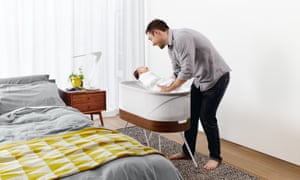
The crib has three microphones to detect if the baby is crying, and underneath the mattress are movement sensors, speakers and a motor. These devices combine to detect noise and movement, and then trigger white noise and/or a gentle rocking movement until the baby drifts back to sleep. The Snoo sack contains a built-in sensor to monitor the baby’s temperature and is designed to mimic the “snug embrace” of the womb, while allowing sufficient soothing movement. The onesie is, of course, removable for washing.


Snoo man at cot


The mattress is fitted with sensors to detect a baby’s crying – it responds with a gentle rocking motion. Photograph: Happiest Baby

Naturally, no smart cot would be complete without its own app. Parents can monitor their child’s sleep using the Snoo app and fuseproject promises that future updates will allow parents to track their baby’s sleep habits over time for signs of progression or irregularities. The aim is not only to improve the infant’s sleep but that of its parents.


As Behar says, “As a father of four children, I am intimately familiar with sleep deprivation. It is more than a burden – it can quickly become a health problem for both parents and the baby.”


The world’s safest bed for baby?

20 Ağustos 2015 Perşembe

The 33 "Safest" New Cars For 2015

As with all of the designs in this gallery, the Lexus CT 200h was awareded a Prime Safety Pick+ designation by the Insurance Institute for Highway Safety for across-the-board “great” ratings in their stringent crash tests as nicely as for accident avoidance. It is rated “sophisticated” for frontal crash avoidance, with “superior” becoming the top grade in that regard.(Applies to models built after 9/14).


The 33 "Safest" New Cars For 2015

20 Mayıs 2014 Salı

Newborn overall health: which are the safest nations to be born in?

Much more than 5.5m babies are born and die every year without a birth or death certificate, in accordance to new research published in The Lancet.


The findings from the Every single Newborn Series published on Tuesday in the health-related journal declare that one particular in three newborns, or more than 45m babies, do not have a birth certificate by their initial birthday.


Wellness editor Sarah Boseley writes:


3 million of the deaths are amongst newborns and 2.six million a lot more infants are stillborn. Practically all the deaths are preventable – half take place throughout labour. The stillborn infants are over 28 weeks gestations and capable of surviving. [Professor Joy] Lawn blames fatalism, lack of interest and lack of investment.


The numbers are a lot more than deaths from Aids, she stated, which caused 2.3 million to die in the peak year of 2005. The death toll is dropping thanks to medical professionals and activists who marched on the streets and campaigned for better treatment. The identical does not happen for newborn and stillborn babies.


They also found that infants who are born too early, are stillborn or who die as well quickly right after birth are least probably to be registered, even in large cash flow countries. The release stresses the value of counting births and deaths as an indicator of progress in the direction of enhancing newborn wellness.


Note: for 177 nations with birth registration information

Joy Lawn, professor of maternal, reproductive and youngster health at the London College of Hygiene &amp Tropical Medicine and lead researcher of the study, stated:


Each day, 15,000 infants are born and die with out ever receiving a piece of paper. The lack of recording displays the world’s acceptance that these deaths are inevitable. This fatalism, lack of consideration and lack of investment are the motives behind lagging progress in reducing newborn deaths – and even slower for progress in reducing stillbirths. In reality, these deaths are virtually all preventable


A table of 195 nations is also presented, ranking the safest and least secure countries to be born in, the countries in which infants are least likely to get a birth certificate, and the large-income nations with the slowest progress on neonatal mortality. The table beneath shows the safest spots to be born in accordance to the ranking which is based on neonatal mortality charge per thousand reside births in 2012.


Sierra Leone is ranked as the least risk-free nation to be born in with a neonatal mortality charge of 49.five per thousand live births in 2012. The table of the least risk-free nations to be born in according to the rankings can be discovered under.


The report identified that South Asia and sub-Saharan Africa are the areas with the highest burden of newborn deaths, with India (779,000), Nigeria (267,000), and Pakistan (202,400) topping the listing.


These 3 countries – which also have the most births – have exhibited the slowest prices of progress in decreasing deaths in accordance to the release. In 2012, eight of the nine countries with neonatal death rates higher than forty for every one,000 reside births have been in sub-Saharan Africa half of these nations have been affected by conflict.


The table under demonstrates the most current figures on a range of indicators employed in the rankings such as stillbirth price per thousand complete births, neonatal mortality charge per thousand live births and the percentage of reside births in 2012 registered by first birthday.


The total information including figures on the higher revenue countries with the slowest progress can be identified in the downloadable spreadsheet.


Download the information


• Data: download the complete spreadsheet


Much more open data


Data journalism and information visualisations from the Guardian


Advancement and aid information


• Search the world’s global growth information with our gateway


Can you do far more with this information?


• Speak to us at information@theguardian.com
• Adhere to us on Twitter
• Like us on Facebook


Newborn overall health: which are the safest nations to be born in?