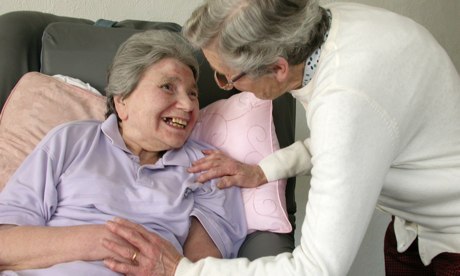
Individuals becoming cared for in the final years, months and days of their lives want clear, compassionate communication. Photograph: Libby Welch/ Social Care Institute for Excellence
Did you hear about the female who was advised her husband had ‘palliative’ care, only to discover out later that he was dying?
Just lately, as component of a film undertaking, we posed the query to the standard public: “What do you think and really feel when you hear the terms ‘palliative’ and ‘end of life’ care?”
The responses included: “Palliative care indicates you happen to be not getting much better, does not it?” “‘End of life care’ sounds a bit frightening.” ‘Palliative’ is gentler but much more perplexing” and “I have acquired no notion”.
These responses prompted us to commence a venture on terms utilized by professionals. We will be functioning in partnership with the Nationwide Council of Palliative Care (NCPC) who leads the Dying Matters Coalition. The proof we collect will be employed to take into account whether or not there may be other, much more readily understood terms or phrases that could be employed as an alternative of ‘palliative’ and ‘end of life care’. And if we can not uncover more acceptable words, we will disseminate our findings so that individuals working in health and social solutions are mindful of the confusion, bafflement and misunderstanding that these terms can develop for folks.
Current reviews, this kind of as ‘More care, significantly less pathway’ – which followed the evaluation of the Liverpool Care pathway – and the Keogh report, emphasise the urgent need for clear, compassionate communication, particularly when people are currently being cared for in the final many years, months and days of their lives.
The case, referred to earlier, of the woman who was told that her husband was obtaining ‘palliative care’, and who found two weeks later that he was really dying, highlights the significance of utilizing the correct words. One can only picture the damage that was completed, because she did not comprehending what the phrase meant.
Our project will aim to capture, comprehend and investigate what individuals think and come to feel when they hear the terms ‘palliative care’ and ‘end of life care’. We’ll be utilizing a broad assortment of methods to engage with men and women, in certain digital media and film.
In addition to members of the general public we are previously speaking to folks who are loosely linked to end of existence care tasks, this kind of as individuals functioning for insurance coverage business in the social care sector. We would as a result connect with people who are acquainted with the terms and other folks who are not.
We would like to hear views from a wide cross-section of the two health and social care professionals and the public. We also want to attain out to people who are isolated and individuals who are not connected to the web. We will be speaking to folks in a range of settings, for example buying centres, care residences, youth clubs, universities and schools.
We want to enhance the communication among those who give care and people who acquire it. 1 particular person we spoke to, misheard us and believed we’d asked her about “palace of care”. She described a stunning area where worries and cares could be hidden away the concept was interesting. Even so, as well typically, misunderstanding creates anxiousness and worry. That is why we are proud to be undertaking this perform. Collectively we can support to improve the care that men and women and their households obtain at the end of lifestyle.
Pamela Holmes is the Practice Development Manager at the Social Care Institute for Excellence (SCIE)
Why not join our social care local community? Becoming a member of the Guardian Social Care Network means you get sent weekly e-mail updates on policy and greatest practice in the sector, as properly as exclusive offers. Signal up for free here
"Palliative" or "end of life"? Why it is crucial to say the right phrases

Hiç yorum yok:
Yorum Gönder