compassionate etiketine sahip kayıtlar gösteriliyor. Tüm kayıtları göster

25 Temmuz 2016 Pazartesi

Kate Granger inspired all of us in the NHS to be more compassionate

He’d been rushed the day before to our surgical emergency unit. An elderly man, crying out in pain, he’d looked haggard, gaunt and frightened as we wheeled him straight to the CT scanner. Now, stripped of his clothes and draped in a gown, he stared up in trepidation as my consultant surgeon, impatient to be done with his morning ward round, stopped by the bedside. Without so much as an introduction, this experienced doctor broke the news to the patient of his terminal illness by turning to the bedside entourage and muttering, perfectly audibly: “Get a palliative care nurse to come and see him.” No one had even told “him” he had cancer.


As panic began to rise in my patient’s face, I remember catching the ward sister’s eye to see her cringing alongside me. The ward round had already swept on. I felt sick, complicit in something barbaric. But, as an inexperienced house officer barely qualified as a doctor, I scuttled dutifully after my boss, leaving someone else to pick up the pieces.


Related: I want my legacy to be that the NHS treats all patients with compassion


For the past five years, one woman has unleashed a quiet revolution to banish such casual brutality from our NHS. My fellow doctor Kate Granger died on 23 July from a rare and aggressive form of sarcoma. Three years ago – without introducing himself or even looking her in the eye – a doctor issued her with a death sentence by telling her that her cancer was inoperable. She told delegates at the annual NHS Confederation conference in 2014: “Without any warning or asking if I wanted anyone with me, he just said, ‘Your cancer has spread’. He then could not leave the room quickly enough and I was left in deep psychological distress. I never saw him again.”


Aged 29, Kate harnessed the inhumanity of her treatment that day to become a tireless campaigner for kindness and compassion in the NHS. Her idea was simple but brilliant. She wanted NHS staff to build vital, caring relationships with their patients by – at the very least – introducing themselves by name. Her #hellomynameis campaign, launched with a single tweet, turned into a nationwide NHS movement, with more than 400,000 frontline NHS staff and innumerable hospital trusts backing it.
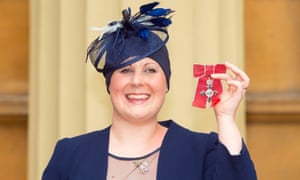


Dr Kate Granger


Dr Kate Granger’s #hellomynameis campaign has turned into a nationwide movement. Photograph: Dominic Lipinski/PA

Kate didn’t know it but she, more than any other individual, inspired in me zero tolerance of the inadvertent, accidental, all too frequent inhumanity we in the caring professions sometimes display towards our patients. Though we met only once, and I never felt able to tell her she was my unsung heroine, her example imbues my daily practice. Each morning, I prepare for my ward round by slinging a stethoscope round my neck, clipping a pager to my waistband and pinning my name badge carefully to my collar. No patient of mine will know me only as an anonymous, identikit doctor. I greet every one of them with my name and a smile.


The truth is that through her dual perspectives as doctor and patient, Kate forced all of us in the NHS to confront uncomfortable truths about the ways we may unintentionally strip our patients of their dignity and individuality. For me, it started in medical school when, over many months, I dissected skin from muscle, sinew from bone until I’d mastered human anatomy through the precision flaying of a human corpse, but had been forced to wall off something primitive within me that would, from now on, temper empathy with new-found detachment.


That process continued after qualification. If doctors allowed our emotions free reign on the ward, if we empathised in full with the life and death enormities that suffuse every hospital, we’d be useless with grief, no good to anyone. To function, we have to keep ourselves in check, at least to some degree.


Perhaps more than anything, the enemy of compassion in today’s NHS is understaffing. When doctors and nurses are too few on the ground we are left scrabbling, exhausted and demoralised, merely to keep our patients safe. Taking time to connect with our patients as fellow human beings is all too often squeezed out.


Kate reminded us all that kindness, though freely dispensed, is priceless. If we lose our humanity, we are shadows of the doctors we should be. I like to believe that her legacy in part will be that every one of your doctors and nurses might sometimes, thanks to her, intone the same silent plea: “When you lie before me in your hospital bed, distressed, frightened, in pain, vulnerable, may the day never come that I cease to see an individual, a human being in front of me.”


I know I do. Thank you, Kate, for your inspiration.


Join the Healthcare Professionals Network to read more pieces like this. And follow us on Twitter (@GdnHealthcare) to keep up with the latest healthcare news and views.


Kate Granger inspired all of us in the NHS to be more compassionate

12 Mayıs 2014 Pazartesi

We need to have protected, compassionate psychological well being care | Norman Lamb

Mental health

A group fishing session for patients. The Constructive and Safe programme aims to generate constructive therapeutic environments. Photograph: Christopher Thomond


If you had been becoming taken care of for a physical sickness or injury – like a broken leg or a heart problem – you would never picture that as element of that treatment method you could be tied to your hospital bed to avert you from moving or restrained encounter-down by the wellness professionals caring for you.


But for many folks who have a psychological illness, a finding out disability or autism, this is a probability.


The problem of restraint in health and care is some thing that has been grappled with for numerous many years. The overuse of restraint and restrictive interventions is component of a absolutely outdated culture in wellness and care providers but they are even now currently being employed too often in today’s system. Last year’s report from Thoughts demonstrated that very powerfully.


Final month, I was proud to oversee the launch of Optimistic and Protected, a two-year programme to end the deliberate use of encounter-down restraint in all well being and care settings. It aims to generate more positive, therapeutic environments in which restrictive interventions such as physical, chemical or mechanical restraint and seclusion are in no way the norm.


To obtain this, we have worked with the Royal College of Nursing, Expertise for Health and Capabilities for Care to create new guidance for pros as well as workforce instruction tips in two key documents: Good and Proactive Care and A Good and Proactive Workforce.


Creating these has concerned a genuine work to get it right so that service customers and employees, outdoors groups and charities representing sufferers, and companies all truly feel capable to assistance the approach. Even so, what’s grow to be obvious is that everybody needs the very same thing: protected, compassionate, humane care. This has been stored at the heart of our work and we’ve acquired overwhelmingly good suggestions from a assortment of men and women across the method.


I have heard some of the extremely distressing stories of individuals who have been restrained. Becoming held face-down for a prolonged time period in a way that may be unpleasant or make it difficult to breathe is something we would all hope never to knowledge. I have also heard from personnel who have struggled with this concern, who are following protocol but who locate the use of restraint as frightening and potentially unsafe as individuals do.


The situation for alter is absolutely clear.


We want to promote a culture exactly where the use of forcible interventions is radically decreased, in which personnel and sufferers are secure and where dignity and respect are paramount. Nevertheless, we require to make confident that the advice forming the basis of Positive and Secure is useful and workable. I recognise that there are a good deal of men and women working in really challenging situations with individuals who do display challenging behaviour. Where a person has behaved in a way that poses a danger to themselves or others, it’s completely proper that action is taken but the priority need to usually be to maintain folks safe.


Which is why the advice suggests different approaches, such as constructive behaviour help, that target on enhancing top quality of life as well as meeting demands and minimizing distress. It functions by encouraging good behaviour alternatively of restricting unfavorable behaviour. Caring for individuals in this way indicates that restrictive interventions are considerably much less most likely to be required.


Between the extremely optimistic responses to this programme, the question has been raised: will this really make any difference?  A essential part of Optimistic and Risk-free is that the guidance will kind portion of the Care Quality Commission’s rigorous inspections. This is not just a document that will sit on a shelf. It is backed by a programme of instruction and advice and it has teeth attached since if organisations flout the principles and carry on with enterprise as typical, then there are consequences, which could be as severe as a criminal conviction.


But this is only a start, change isn’t going to occur overnight. Very good practice requirements to become standard practice.


Many overall health and care suppliers and staff have presently committed to championing this programme and guaranteeing it works in practice and I strongly urge anyone functioning in health and care to do the exact same.


There are presently some outstanding examples across the method. When I visited Oxleas psychological well being hospital not too long ago to launch our Crisis Care Concordat, employees demonstrated how they are taking action to decrease the use of restraint and provide much more supportive, compassionate crisis care. Such examples present that it is achievable.


That’s why I want to see progress on this and why we have committed £1.2m for 2014-15 to assistance Positive and Protected, like building an modern programme of instruction across overall health and social care.


This is complex and there is a prolonged way to go. Nonetheless, this hugely critical programme has been constructed on a powerful consensus across the method that modify is essential and it really is by doing work collectively that we’ll drive the adjust that we all want to see.


Are you a member of our online neighborhood? Join the Guardian healthcare network to acquire typical emails and unique gives.


We need to have protected, compassionate psychological well being care | Norman Lamb

4 Mayıs 2014 Pazar

Jeremy Hunt: compassionate carers and households important to tackling dementia


On the latter, I believe we are lastly commencing to make very good progress. This Government has doubled funding to discover a cure, challenged the NHS to improve shockingly reduced diagnosis rates, and is creating more money obtainable to enhance dementia services. In December last yr the Prime Minister brought with each other global leaders with scientists, researchers, charities and pharmaceutical businesses at the initial ever G8 Dementia Summit in London to mobilise global energy in tackling what he described as the ‘quiet crisis’.


Ronald Reagan when explained the 9 most terrifying words in the English language had been “I’m from the government and I’m here to support.” So we should be humble adequate to recognise that while there is a vital function for governments, they alone are not able to crack this – we need to tackle stigma and misunderstanding about dementia across society as a whole. Have you ever felt impatient with an older man or woman ahead of you in a queue fumbling for change? Or annoyed at an individual walking as well slowly as they try out to navigate round an underground station? I have – and if this can take place in what might be one particular of the politest and kindest countries in the globe, then we all want to get far better at recognising what could well be someone fighting a horrible battle to live with dementia.


In short, we need to rethink the social contract when it comes to older people. In Asian nations like China and Japan you nevertheless locate many much more older individuals living with their children, although in these spots as well this has come under pressure recently. Having Mum and Dad at residence will not constantly be the correct answer – but it is not immediately the incorrect 1 both. And even if they really do not live with you, we know that neural pathways in the brain are strengthened by standard make contact with with pals and family in a way that can slow the onset of dementia. In non-health care language, really like helps.


It’s also why the Alzheimer’s Society’s Dementia Friends programme is so crucial. This helps individuals to find out what it’s like to dwell with dementia – and then to flip that comprehending into action. A short session of significantly less than an hour, both encounter-to-encounter or on the internet, aids you realize how somebody with dementia sees the planet. That understanding assists bring out our individual empathy and compassion – and if enough individuals do it, society will gradually commence to adjust.


Socially responsible businesses like Marks &amp Spencer, Argos, Lloyds Bank and Lloyds Pharmacy have previously committed to rolling out the Dementia Pals programme amongst their employees, which is hugely welcome. A lot more than a quarter of a million individuals have pledged to grow to be Dementia Buddies – and we hope to have a million by 2015. On Wednesday, the next stage of the campaign will get started as celebrities and people living with dementia crew up to inspire more of us to turn out to be Dementia Close friends.


I not too long ago asked the manager of a care residence in London how she motivates staff working with residents whose dementia is so advanced they can’t talk. She told me that generating a resident smile, even if they won’t don’t forget that smile the subsequent day, sends her home with an even bigger smile on her encounter. So component of this campaign need to be to recognise the important role played by carers and households seeking following individuals with dementia.


An academic after stated that compassion “is not a essential component of healthcare.” What rubbish. Compassionate care should be difficult-wired into our health and care method, as we learnt from the tragedy of Mid Staffs. But not just in our hospitals and care houses – we need it all over the place when it comes to dementia. Only people power will do.


Jeremy Hunt: compassionate carers and households important to tackling dementia