country etiketine sahip kayıtlar gösteriliyor. Tüm kayıtları göster

26 Eylül 2016 Pazartesi

France Is the First Country to Ban All Plastic Dishware

France leads the way by being the first country to initiate a widespread ban on plastic dishware.  This is the country’s most recent effort to reduce pollution and be more environmental friendly.


France will ban the sales of single-use plastic plates and cups unless the products are made of bio-sourced materials that can be composted in a domestic composting unit.


France Initiates Ban on Plastic Dishware


The Europe Ecologie-Greens Party initially proposed the ban.  French lawmakers approved the ban on plastic dishware in an effort to reduce the energy consumed and waste produced by the plastic processing industry.  The new law is also one more attempt to reduce the pollution caused by plastic litter.


Initially, ecologists wanted this ban of plastic dishware to be introduced as soon as 2017.  However, it was postponed until 2020 because of Environment Minister Segolene Royal’s initial opposition to the law.  Royal considers the ban an “anti-social” measure — arguing that families who struggle financially regularly use disposable plastic tableware.


Opposition to France’s New Law


Though France’s new measure took effect last month, producers have until 2020 to make certain that all disposable dishes sold in France are made of biologically sourced materials and can be composted.


Ecologists’ organizations praise the new French law and hope it sets an example for other countries.


On the other hand, opponents argue that banning products hurt consumers — even if such products are made of plastic.  Those who oppose the French ban on plastic dishware also claim such measures violate European Union rules on free movement of goods.


Resisting France’s Ban


Pack2Go Europe, a Brussels-based organization representing European packaging manufacturers, is concerned that the French ban could carry over into other countries.  They say they will keep fighting this new French ruling.


According to a report by the Associated Press, Pack2Go Europe secretary-general Eamonn Bates told the multinational nonprofit news agency, “We are urging the European Commission to do the right thing and to take legal action against France for infringing European law.  If they don’t, we will.”


Bates argues there’s no proof that bio-sourced disposable cutlery is more environmentally beneficial.  He also claims that no products made from bio-sourced plastics will degrade in a domestic composting unit.


Bates added, the ban “will be understood by consumers to mean that it is OK to leave this packaging behind in the countryside after use because it’s easily bio-degradable in nature. That’s nonsense!  It may even make the litter problem worse.”


In July, France banned plastic bags — an environmentally conscious move other countries have also made.  But France is the first country to expand these types of bans to plastic dishware.


France Is the First Country to Ban All Plastic Dishware

2 Ağustos 2016 Salı

Bilston"s revival: the pursuit of happiness in a Black Country town

Are you happy living in Bilston? “Why wouldn’t I be?” giggles a young mother pushing a stroller through a pub car park on the Stowlawn Estate.


My question is not as daft as it sounds. Seventy-one years ago, this corner of the Black Country town was part of a pioneering social experiment, devised by exiled Viennese philosopher Otto Neurath and a visionary town council, to “make Bilston happy”.


Today, the happiness industry is a lucrative business. In recent years we’ve had a government happiness tsar, and bookshelves groaning with bestsellers including Stumbling on Happiness, The Secrets of Happiness, and The Pursuit of Happiness.


But Bilston got the jump on them all in 1945 when it invited Neurath, then lecturing in Oxford, to become its consultant on human happiness. The hope was he could bring a visionary approach to housing to Bilston, as he had done to the rebuilding of post-war Vienna.


Heaven knows, Bilston needed something to cheer it up. “Surely no place could have grown up as ugly as this without some evil mind having deliberately planned to wipe out every trace of beauty,” wrote socialist politician Fenner Brockway about this town of more than 31,000 people in 1932, in his book Hungry England.


Brockway was visiting the Black Country town, scarred by years of coal mining and pollution from blast furnaces and factories, to see its notorious slums. “I find it difficult to describe the first house I visit. It would be more suitable for chickens than human beings … There are some streets which show efforts to maintain respectability and an appearance of comfort; but most folk seem to have given in. Poverty has got on top of them.”


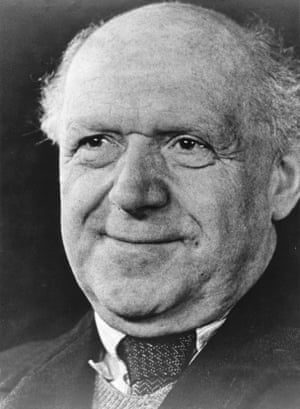
Otto Neurath-1945


Otto Neurath in 1945. Photograph: Otto and Marie Neurath Isotype Collection, University of Reading

Ten years later, despite building new council estates, Bilston still led the way in Britain for all the wrong reasons. A 1943 civic survey found that 1,400 tons of smoke particles per square mile were falling on Bilston each year, which local historian Frank Sharman colourfully suggests is “roughly the weight of 11 blue whales or 233 elephants per annum”.


According to Sharman, a national survey of housing conditions assessed the number of families in each local authority area who were living in “overcrowded conditions”. “The figure for England and Wales as whole was 3.8%. In Bilston it was 13.7%.” A later civic survey, just before the end of the war, found that of 7,771 houses in Bilston, 2,655 were unfit for human habitation.


Bilston, then, needed thousands more new houses for slum dwellers – and one of the prime sites for building those new council houses was land in the north-west of the borough. Today Stowlawn is green and pleasant, an estate of whitewashed houses, verdant verges and bucolic trees. But in the late 1940s, it was land which had been plundered for coal and road stone and then abandoned. “It was not exactly a greenfield site,” says Sharman. “Even calling it ‘brownfield’ would have been a bit optimistic.”


Neurath made us feel that the pursuit of beauty and happiness could be achieved by the common man


AV Williams


This plan to rebuild Bilston and rehouse its slum dwellers was fairly well advanced when in early 1945, Bilston’s town clerk, AV Williams, had an epiphany in Wolverhampton. He was there to attend a lecture given to the International Friendship League; the speaker was Otto Neurath, and his subject was “Housing in Vienna”.


Williams was impressed by the socialist philosopher’s humane vision: “He made one believe in the dignity of human beings.” Soon after, Neurath was invited to Bilston to see the nature of its housing problem and help eradicate it. “He made us feel that the pursuit of beauty and happiness could be achieved by the common man,” Williams explained.


Neurath believed that the common man – and woman – could and should have a role in designing their own homes. It was a perspective he had become committed to in the aftermath of the first world war in Austria, when he helped revolutionise working-class housing in the era of Red Vienna – the nickname of the capital between 1918 and 1934 when, following the collapse of the Habsburg Empire, its city government was ruled by social democrats.


It was a time and place when acute housing shortages had led to conditions of inhuman squalor – conditions, it’s not fanciful to argue, that applied to inter-war Bilston too.


During this time, Vienna became a crucible for communal living. Architecturally, the era is synonymous with vast apartment blocks such as the Karl Marx Hof and the Rabenhof, featuring communal facilities ranging from bathhouses, laundries, kindergartens, libraries and even kitchens.


Neurath was gaining fame at the time as a member of the Vienna Circle of “logical positivist” philosophers, and for developing the pictographic language isotype, one designed to help grasp by means of pictures complex information.


He was an unusual socialist, improbably influenced by Samuel Smiles, the Scottish Victorian reformer whose 1859 book Self-Help appealed to Neurath’s sensibility. Smiles had argued that poverty was caused largely by irresponsible habits and that human progress, perhaps even happiness, would come from the poor being given what Smiles called “the means of education, and of exerting freely all the powers of his godlike nature” .


The Stowlan estate


The Stowlawn estate is more green than black today, but are its people happy? Photograph: Neil Jeffries

This philosophy – the Christian sense of mission notwithstanding – inspired Neurath. He thought happiness could be achieved if workers could be educated on the principles of house design and communal living, and then be involved in the creation of their living spaces rather than having it inflicted on them from above – and he tried to put these ideas into practice in Vienna.


Shortly before this Jewish thinker was compelled to emigrate as Austrian fascists came to power in 1934, he saw the opening of the Werkbundsliedung, an estate of 70 houses in south-west Vienna that, as Dr Sabrina Rahman, co-curator of a recent exhibition called Bilston’s Happy Housing explains, “offered working-class families the opportunity to purchase or rent homes designed by a diverse group of 31 international architects”.


According to Rahman, “the Werkbundsiedlung remains one of the most important estates in modern architecture”. And the hope was Neurath could realise something similar in England’s Black Country.


Before Neurath came to Bilston, British architect Sir Charles Reilly was already sketching plans for Stowlawn estate, using ideas the Viennese would have found sympathetic, if a little more patrician. As Frank Sharman points out: “The chief feature of Reilly’s plans was that the houses should be built around greens, somewhat in the style of a village green, which Reilly seems to have seen as an archetype of a good community. And on each of these greens there would be a club, containing library, reading rooms, billiards room and catering facilities – to which families could go to eat or from which they could order meals to be delivered.”


These ideas chimed not only with Neurath’s but with the new Labour government’s housing minister Aneurin Bevan’s vision of a New Jerusalem in Britain – of mutually supportive, mixed communities. Bevan wrote in his introduction to the 1949 Housing Act: “We should try to introduce in our modern towns and villages what was always the lovely feature of English and Welsh villages, where the doctor, the grocer, the butcher and the farm labourer all lived in the same street.”


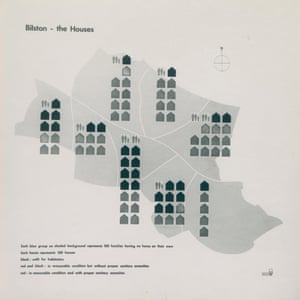
Bilston’s housing: each house represents 100 homes, the black colour are uninhabitable.


Bilston’s housing: each house represents 100 homes, the black houses are uninhabitable. Photograph: Otto and Marie Neurath Isotype Collection, University of Reading

Neurath went further in his philosophy of how Bilston’s new estates could create such communities and make the town happy. Some were noted down by AV Williams from meetings with Neurath at the time, and are cited by Frank Sharman. Even now they seem wonderfully sane and pertinent ideas for how we should – but often don’t – live:


“On estates,” advised Neurath, “mix up individuals: married and unmarried, old and young. Do not create ghettos of, for example, old people who, if they are stuck altogether in flats, will feel isolated, lonely and unwanted. If you put them in with young people, they can do things like babysitting and feel useful and wanted.


Care must be taken to avoid the accidental creation of a lunatic asylum


Otto Neurath


“Unmarried persons can be divided into those who will eventually marry and those who never will. If you put them all into one block of flats, the marrying kind will move out and you will be left with nothing but people who will never marry. Care must be taken to avoid the accidental creation of a lunatic asylum.


“You must study the existing community structure in the slums you are rehousing, and ensure these connections are not broken upon the new estate. Bear in mind that different people had different needs, and do not plan housing on a ‘one size fits all’ basis. You have to work out what sorts of houses and flats to build and who to put in them.”


One big idea Neurath was keen on was an exhibition of the plans for the benefit of those who would be living in these new houses. “You must consult the people who were to be re-housed and educate them on housing matters,” he told Bilston’s town clerk and his colleagues. “You should do this through an exhibition which made the issue understandable by anyone – through the use of isotypes – and that such an exhibition should be somewhere which was accessible to the people who were to be re-housed.” Nowadays, perhaps, this sounds like common sense; in 1945 it was a radical overturning of a patrician social order.


But before Otto Neurath could make Bilston happy, he died unexpectedly aged just 63 in his Oxford home in December 1945. His widow Marie recalled that he was reading a newspaper article about happiness before he passed away, and then commented on what he had read to her.


“What does happiness mean?” he reportedly said. “I can tell you what I mean by happiness. If godfather would come to me and say: ‘Dear Otto, I make you an offer as you are living now with your books and your work and your wife. You can live for ever and ever but you will never be more prosperous than you are now. Will you accept?’ ‘Yes, dear godfather. I gladly accept.’”


After his death, Marie went back to Bilston to fulfil her husband’s happy dream. She set up his planned exhibition in a disused store on Bilston’s Oxford Street, aimed at getting slum dwellers and other ordinary citizens to see what was being planned.


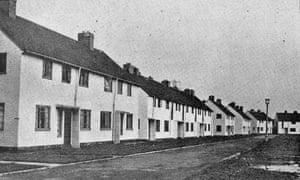
Oaklands Green on the Stowlawn estate, 1950.


Oaklands Green on the Stowlawn estate, 1950. Photograph: City of Wolverhampton archives

The year after Neurath’s death, Ella Briggs, who had worked with Otto in 1920s Vienna, became one of the main architects of the Stowlawn estate. She intended to build eight-house terrace blocks around common greens as her predecessor Reilly had envisaged, keeping designs simple to reduce building costs in the post-war austerity era. Bilston council gave the resultant streets rustic names such as Lawnside, Fairway, and Oaklands – evoking a bucolic mood in much the same way earlier and snootier developments such as Hampstead Garden Suburb did in north London.


‘It is a happy place’


What remains of the original vision for Stowlawn today? When I stroll around the estate, I notice many of the houses remain white-painted, which was unusual for 1940s British council estates and gave this corner of Bilston a continental, crypto-Bauhaus vibe. For a while, Stowlawn was known as the White City.


Stowlawn in 2016 is undeniably peaceful and green, and no doubt a nice place to live, but it’s also a traditional English bodge – a history of compromises, frustrations and muddling through inscribed on every brick, every blade of grass.


I look in vain for the community clubs Reilly envisaged – they were never built. Many of Stowlawn’s greens were replaced with new houses when land was in short supply in the 1960s. Nowadays only Lawnside Green remains, and even it is planted densely with shrubbery and bears a sign saying “No Ball Games” – which, I suspect, Neurath would have frowned at.


Much of the original vision for the estate got dismissed by central government or obliterated by later developments, argues Frank Sharman. He then points out a particularly poignant irony in Stowlawn’s evolution.


In 1979, Margaret Thatcher was elected prime minister, and soon after embarked on a sell-off of Britain’s council estates, as part of her policy of reducing the public sector and giving the market free reign. Sharman notes that she used to hand out copies of the Viennese economist Friedrich Hayek’s The Road to Serfdom which, she said, set out her economic vision – one of minimal state intervention and negligible public ownership.


Bilston Steel workers striking for better wages in January 1980.


Bilston Steel workers striking for better wages in January 1980. Photograph: David Bagnall/REX

“Such ideas were, of course, anathema to Otto Neurath, who had spent much time advocating the necessity of government regulation of the free market and a degree of central planning,” writes Sharman in his superb history of the Stowlawn estate. “In fact, it seems that Hayek’s book had been written with the specific intention of refuting Neurath. And on Stowlawn the game played out – the planned community lost out to the forces of the unbridled free market.”


Did Bilston ever get happy? Well, one thing worth saying is that it was never quite as unremittingly miserable as Fenner Brockway portrayed it. My late mother went to Bilston Girls’ High School, on the southern edge of Stownlawn while the estate was being built in the late 1940s. It was a neo-Queen Anne-style building that had opened in 1929 and is now converted into luxury flats. That school, perhaps, was emblematic of the more genteel Bilston that existed alongside apocalyptic slums and industrial hell.


And my late father used to work at Quasi-Arc, the British Oxygen Corporation’s electrical welding division, in Bilston in the 1960s. That business, like many other of the Black Country’s heavy industries, is long gone. It wasn’t just the Thatcherite sell-off of council houses that changed Bilston; it was also her ideological commitment to destroying the industries that toxically thrived here.


In 1979, emblematically, the year Thatcher was elected was the year the final steel cast was made at the Elisabeth furnace at Bilston’s Spring Vale steelworks. The entrancing flames from that furnace, that I used to savour as they lit the Black Country at night from my nan’s back step in Wednesbury, were gone forever. Never such squalor, nor such grandeur, again.


Bilston, town of furnaces, flames and inhumane squalor, once looked like Mordor; now it’s more like Hobbiton.


Happy BilstonStowlan Estate, Bilston


No ball games allowed in the Stowlawn estate. Photograph: Neil Jeffries

These days, I reflect, as I walk from Stowlawn back to the tram stop to take me to Birmingham, I’ll bet the smoke particles falling on Bilston amount to rather fewer than 233 elephants per annum. This is, in many ways, not so much the Black Country as the Green Country. Bilston, town of furnaces, flames and inhumane squalor, once looked like Mordor; now it’s more like Hobbiton.


Otto Neurath may not have succeeded in making Bilston happy, and the ideas he set out may only have been realised in botched form – and even then diluted further. But perhaps it got there anyway. His vision of encouraging people to participate in the creation of a happier Bilston didn’t die with him.


Online, there’s a fascinating interview from 1975 with a Bilston town planner on local news programme ATV Today. With a superbly straight face, this nameless civic champion suggests putting tin foil over the gasometer so that it interestingly refracts the sunlight, pumping out coloured smoke rings from disused factory chimneys, covering an abandoned gantry with wire netting to make the Black Country’s biggest aviary, transforming the abandoned railway line into a green corridor complete with picnic areas, fishing holes and cycle paths. It’s not just Viennese philosophers who have visionary ideas for urban living.


Related: Story of cities #34: the struggle for the soul of Milton Keynes


Better yet, the interviewee invites town citizens to submit their own ideas to make Bilston beautiful. Otto Neurath would surely have liked that: anything to get locals involved in planning the circumstances of their own happiness.


True, Neurath’s vision of cities composed of mutually supportive, mixed communities, living together in harmony isn’t exactly voguish in our era of gated communities, sheltered accommodation, streets too dangerous for kids to play in. But it would be a fool or a snob who said Bilston isn’t a happy place.


“I’ve lived here all my life and I want my daughter to be as happy here as I’ve been,” says the young mother outside the pub which, I belatedly notice, is called The Happy Wanderer. “It is a happy place.”


Stuart Jeffries’s book Grand Hotel Abyss: The Lives of the Frankfurt School will be published by Verso in September


Follow Guardian Cities on Twitter and Facebook and join the discussion


Bilston"s revival: the pursuit of happiness in a Black Country town

29 Nisan 2014 Salı

Mum"s kitchen-created drink to be offered across the country

She explained: ”I had my daughter Rosie five many years ago, Of course at the beginning children just drink milk and water, but then she began to get to the stage the place she wanted squash or juice.


”I knew that cordials have a great deal of sugar, even though squashes are total of additives. I couldn’t locate anything at all as an substitute.


”It is a huge concern for mothers and fathers. For me, it is about striving to do one thing to tackle obesity. People are never going to give up the items they like, and I would never ever say they need to.


”I am all up for getting a pizza on a Friday night, but if I can do something to assist a loved ones minimize their sugar consumption by 37 per cent then I have been ready to help do one thing good.


”I didn’t want to just make it for myself and give it to Rosie – I wanted everyone else to taste it.”


Clippy had previously place her culinary skills to the check on the Television present Masterchef where she competed towards Wahaca founder Thomasina Miers, who won the competitors.


Inspired by her foray into the kitchen, in 2008 she persuaded her companion Paul to depart his well-paid work as a supply chain advisor and launched a productive line of lower-sugar jams.


In 2011 she made a decision to launch a selection of cordials and with the assist of her young kitchen helper Rosie fine-tuned her recipes.


Clippy said: ”We had to try out all our recipes out on Rosie, it doesn’t get anyplace otherwise.


”When I started out she would say ‘Oh mummy I never like it’. We would give her the drink whilst she was doing something else – I did not want her to put on a white coat and hair net like I had to.


”Once I received the recipe I liked I tried it out on Rosie, and the neighbours youngsters, and it proved a hit.


”And now the cordials have gone from getting a recipe I was attempting out in the kitchen of our semi-detached residence to being in supermarkets up and down the country.


”It is a weird feeling – but excellent.”


The couple, who run their booming organization from their tiny spare room at their property in Sale, Manchester, decided to use the plant-primarily based sweetener stevia to slash the drink’s sugar material.


Their drinks, sold as Clippy’s Cordials, incorporate 37 per cent less sugar, 37 per cent fewer calories than other cordials and have no artificial sweeteners, colourings or flavourings.


They have now hit shelves in 220 Tesco retailers across the United kingdom.


Mum"s kitchen-created drink to be offered across the country

18 Mart 2014 Salı

Britons have shortest retirement of any key EU country

All round British males now get pleasure from 19.1 years of retirement while women, who in the past have historically lived longer, control 22.one.


By contrast guys in Germany are expected to dwell just beneath twenty years soon after leaving the workplace although individuals in Canada are forecast to have yet another 19.six many years.


All round the OECD said there had been “remarkable” enhancements in existence expectancy across the developed world which has grown by a decade on typical in the space of a generation.


The regular retirement age of 65 for males and 60 for girls has recently been abolished in Britain foremost to a surge in the amount of older employees.


There are now nearly nine million people working previous what was as soon as retirement age – all around 1 in 3 of the total workforce.


The Coalition has set in movement adjustments which will progressively raise the pension age in the coming many years.


Prof Sarah Harper, director of Oxford University’s Institute of Population Ageing, stated that the common lifestyle expectancy figures for the United kingdom conceal broad variations among various social groups.


She stated: “The investigation we have completed has advised that there is a spectrum of among 12 many years of retirement for what employed to be named doing work class men, in manual [roles], up to 22 years for the specialist middle class occupations.


“In any of these counties which have massive inequalities, like the US and the United kingdom, that would have a tendency to bring the average down.”


She explained that the tendency of people in folks in Mediterranean nations to reside longer properly acknowledged and considered to be linked to diet.


But she extra: “The big difference between French ladies and British females is notably fascinating, it isn’t as if they have more healthy lifestyles in standard.


“They tend to have increased ranges of smoking, some say it is to do with healthcare services and some say it could be to do with obesity levels [in Britain].”


But she extra that the retirement gap amongst Britain and neighbouring countries is likely to narrow.


“This distinct Government has pushed ahead with an improve in the state pension age and I feel we will increasingly be seeing that in other European countries,” she said.


“In many ways this is the potential.”


But Prof Les Mayhew, an expert in ageing at the Cass Enterprise College mentioned that the contrast in between Britain and other countries could have a lot more to do with later retirement than earlier death.


He said the situation in France, the place the former President Nicolas Sarkhozy experimented with attempted to increase the retirement age, was especially marked.


“They nonetheless take pleasure in exceptional pension and other rights in contrast with other nations,” he mentioned.


“Whether that outcomes in greater lifestyle expectancy I doubt it but it definitely outcomes in increased taxes.”


He mentioned that the most striking modify in Britain in recent years was a dramatic improvement in men’s lifestyle expectancy.


“The spur to development in existence expectancy amongst males in the Uk is more rapidly than in any other country in the globe at the minute.


“In a few years it might even overtake Japanese males and a crucial element accounting for these rates of growth is hat males have moved away from smoking and hazardous occupations.


“The trend in the Uk for males is extremely great but it is not specifically spectacular for women in fact guys may catch up with females in 10 or 15 years time.”


Britons have shortest retirement of any key EU country

31 Aralık 2013 Salı

If NHS was a country it would "barely have a credit score rating", says BMA

“The NHS is struggling just to preserve tempo. A increasing and ageing population, public well being issues like obesity, and continual advances in remedy and technology are all contributing to push NHS charges nicely above general inflation.”


Dr Porter extra: “The numbers total are so poor that if the NHS had been a country, it would barely have a credit rating at all. The Nuffield Trust has estimated that if the NHS price range continues only to preserve tempo with basic inflation, there will be a shortfall of in between £44 billion and £54 billion in England by 2021-2022, unless there are productivity gains.


“But even with a 4 per cent productivity achieve every yr, the funding gap would nonetheless develop to as considerably as £34 billion. It would consider savage cuts to even commence to discover this considerably funds out of even more ‘efficiency’ savings.”


He mentioned that NHS staff have “borne the brunt” of the Government’s NHS efficiency drive – the well being service has been charged with producing £20 billion in efficiency savings by 2015.


“The Nationwide Audit Workplace explained the NHS had produced the ‘easiest’ cost savings very first,” he said.


“They were surely not simple for the medical doctors and other healthcare personnel who were created to bear the brunt. And it was not simple for the individuals and personnel every time a vacancy is not filled, a ward is closed, or a clinic is cancelled.”


He explained that “fundamental adjust” to the service is needed but added: “Even though not necessarily the sort of alter most of us would want. A senior NHS leader warned not too long ago at a policy gathering that efficiency financial savings would not be sufficient in the years ahead, and that the NHS would have to ‘take out capacity’. That translates as cutting companies to patients.”


And since the Government’s NHS reforms, which came into force in April this 12 months, individuals functioning across the NHS in England are unsure of who is in charge.


“A main dilemma, in England at least, in that in a submit-Well being and Social Care Act planet no-1 actually understands who is in charge,” he said.


“As well often, service adjust decisions are driven by a mishmash of political and financial imperatives, alienating the regional communities that the providers are meant to serve.”


Dr Porter also created a dig at feedback created by Jeremy Hunt, the Wellness Secretary, about the role of GPs in exacerbating difficulties at overstretched accident and emergency departments.


Mr Hunt said earlier this year that alterations to the way GPs provide out-of-hours care had had a “enormous affect” on accident and emergency solutions.


Responding to the Health Secretary’s remarks, the BMA chairman of council said: “You will don’t forget what happened when politicians made inaccurate and demoralising feedback blaming GPs for the pressures on emergency care, and we must be alert to these sorts of attacks on our professionalism and integrity, and fight them with information.”


If NHS was a country it would "barely have a credit score rating", says BMA

If NHS was a country it would "barely have a credit score rating" - BMA

“The NHS is struggling just to hold pace. A expanding and ageing population, public health troubles like obesity, and continual advances in treatment method and technology are all contributing to push NHS expenses properly above common inflation.”


Dr Porter added: “The numbers overall are so undesirable that if the NHS were a country, it would barely have a credit rating at all. The Nuffield Trust has estimated that if the NHS price range continues only to keep pace with common inflation, there will be a shortfall of between £44 billion and £54 billion in England by 2021-2022, except if there are productivity gains.


“But even with a four per cent productivity achieve every yr, the funding gap would nevertheless develop to as considerably as £34 billion. It would take savage cuts to even get started to find this a lot income out of further ‘efficiency’ financial savings.”


He stated that NHS workers have “borne the brunt” of the Government’s NHS efficiency drive – the wellness services has been charged with producing £20 billion in efficiency financial savings by 2015.


“The Nationwide Audit Office said the NHS had produced the ‘easiest’ savings 1st,” he mentioned.


“They were surely not easy for the physicians and other healthcare personnel who have been produced to bear the brunt. And it was not effortless for the individuals and personnel each time a vacancy is not filled, a ward is closed, or a clinic is cancelled.”


He mentioned that “basic alter” to the services is needed but extra: “However not always the type of change most of us would want. A senior NHS leader warned not too long ago at a policy gathering that efficiency savings would not be enough in the years ahead, and that the NHS would have to ‘take out capacity’. That translates as cutting services to sufferers.”


And considering that the Government’s NHS reforms, which came into force in April this 12 months, folks operating across the NHS in England are uncertain of who is in charge.


“A key difficulty, in England at least, in that in a publish-Wellness and Social Care Act globe no-a single really is aware of who is in charge,” he stated.


“As well usually, services adjust selections are driven by a mishmash of political and monetary imperatives, alienating the neighborhood communities that the providers are meant to serve.”


Dr Porter also made a dig at feedback manufactured by Jeremy Hunt, the Health Secretary, about the function of GPs in exacerbating issues at overstretched accident and emergency departments.


Mr Hunt stated earlier this year that alterations to the way GPs give out-of-hrs care had had a “massive effect” on accident and emergency providers.


Responding to the Overall health Secretary’s remarks, the BMA chairman of council mentioned: “You will bear in mind what happened when politicians created inaccurate and demoralising feedback blaming GPs for the pressures on emergency care, and we have to be alert to these kinds of attacks on our professionalism and integrity, and battle them with information.”


If NHS was a country it would "barely have a credit score rating" - BMA