happiness etiketine sahip kayıtlar gösteriliyor. Tüm kayıtları göster

12 Mart 2017 Pazar

Schools to trial happiness lessons for eight-year-olds

Eight-year-old children will be given lessons on happiness and teenagers will be instructed on combating anxiety and suicidal thoughts, under government projects due to be trialled.


The Department for Education (DfE) is inviting bidders for multimillion-pound contracts to teach and train on mental health in more than 200 schools.


Typical mindfulness lessons will reportedly encourage children to think of disturbing thoughts as “buses” that will move away, and they will be given questionnaires on bullying and friends.


It is the latest attempt by Theresa May’s team to tackle what she called in January the “burning injustice of mental health and inadequate treatment that demands a new approach”.


An estimated 10% of children suffer a diagnosable mental health condition and mental illness is costing roughly £105bn each year.


Lord Layard, who is a government adviser for a current four-year trial of once-a-week mindfulness classes in 26 schools, said there was an obsession with only measuring academic achievement.


“The development of the character of children is an incredibly important issue,” said Layard, who is also a professor at the London School of Economics and Political Science (LSE).


“If you really want schools to take the wellbeing of their pupils as an important goal, there has to be a way of measuring that.”


The trials will follow an Institute for Public Policy Research report that said all secondary schools needed access to a mental health professional on site, at least one day a week, to combat anxiety and depression.


The National Audit Office claims there is a £3bn funding gap in schools.


Laura Henry, an award-winning early years specialist consultant and Ofsted inspector, said the trials could save the government billions in social care and housing costs down the line.


“I think it’s an excellent idea,” said the mother-of-two, whose eldest son is on the autistic spectrum. “Over the last decade there has been a massive push to academia, results and school league tables and children’s personal social development has been left behind.


“A holistic approach is needed and children should be able to self-regulate their own behaviour.”


Henry, a former teacher, said specially trained teachers should help with grieving techniques and that any questions about bullying and pupils’ friends needed to be sensitive.


“It’s absolutely the best way to spend DfE money. It will save x amount of money in social care when they are adults,” she added.


The government’s contracts for three trials, the Youth Aware of Mental Health (YAM), The Guide, and the “preventative programmes”, are out to tender until Friday 24 March.


The Guide, based on a Canadian model, will involve specially trained teachers giving 13 to 15-year-olds 60-minute classes on the different types of mental illnesses and how to combat them.


YAM, which mirrors schemes elsewhere in Europe, will give sessions by a trained instructor, lasting 45 to 60 minutes, focusing on collecting pupils’ attitudes.


The two will be rolled out to 135 secondary schools.


The third trial, of the preventative programmes, designed for 100 primary schools and 50 secondaries, will be a “lighter touch” all about wellbeing for kids between Year 4 and Year 8.


The trio of projects will run between this May and summer 2019.


The Sunday Times reported that children would be told to compare mental illness to buses and be asked to rate statements such as: “Other people pick on me or bully me.”


A spokesperson for the DfE, which says it is pumping £1.4bn into mental health support for young people, refused to comment on detail.


The spokesperson added: “We know that schools often want to provide specific interventions to promote the mental wellbeing of their pupils but sometimes struggle to know what approaches to use. That is why we have announced plans to do further research trials in schools on what interventions work best.”


Schools to trial happiness lessons for eight-year-olds

16 Ocak 2017 Pazartesi

You cannot buy happiness – not even on ‘Blue Monday’ | Polly Mackenzie

Waking up today, on so-called Blue Monday, the “most depressing day of the year”, you may already be aware that this concept is based on a fraud. An almost deliciously spurious mathematical formula was dreamed up by a PR agency, given the veneer of academic rigour by attaching the name of a lecturer at a further education college, and a media phenomenon was born. More than a decade’s worth of articles and social media memes have at turns reinforced and defied the Blue Monday myth, and it is often now held up as a case study of bad science.


It is, of course, laughable to have a formula where W stands for weather and days-since-Christmas is raised to the power of Q, the days-since-we-quit-our-new-year-resolutions. But the driver behind this mockable maths is a much more sinister lie, one from which many struggle to escape 365 days of the year.


Blue Monday was originally invented for an advertising campaign for Sky Travel. Its sole purpose was to sell holidays with the false promise that spending money would raise flagging spirits. Blue Monday has now been used to sell everything from flowers to Ferraris, takeaways to airport parking. Beat Blue Monday, they tell us (laughing knowingly at the fact that it’s made up): buy something new today.


We’re told every day by advertisers that buying stuff will make us happy. A new pair of shoes will help us to feel better after a breakup. New beauty products will give us a sense that we’re “worth it”. A bigger car will give us social status. New toys will make the children happy. Even loans are sold this way: one payday lender is currently running a campaign with a smiling woman, snuggling a mug of tea and feeling happy thanks to a 1,200% APR loan, an implausible scenario if ever there was one. So it’s no wonder that on Blue Monday, the day our anxieties and misery are supposed to peak, the advertisers scream that the path out of unhappiness is paved with till receipts.


Sometimes the harm this causes is relatively trivial: overconsumption of stuff we don’t need; a bit less money in the bank; a wardrobe that won’t close because we’re not very good at throwing away our throwaway fashion buys.


But the harm can be deadly serious for people struggling with mental health problems. Imagine it: your mood is low. You find yourself crippled by anxiety. You feel like a failure, a burden on your family and friends. This is the moment when a lifetime of being told that stuff will make you feel better takes its toll: in desperation, nine in 10 people with a mental health problems find themselves spending more when they’re feeling unwell.


In my work at the research charity Money and Mental Health, I’ve lost count of the stories I’ve heard that stop me in my tracks. Mothers spending their way through months of postnatal depression – one who bought nearly 100 buggies over four years. A man who tried to buy a villa in a country he didn’t have a visa for, convinced it would turn his life around. A young woman who found buying something online was the only way she could stop a panic attack, so she did it almost every day. A husband who felt such a burden he’d buy endless presents he couldn’t afford for his wife. And many of them tell us that the boxes sit in the living room, unopened, unwanted, but impossible to ignore.


Because buying stuff is just the first part of the cycle. Next comes the guilt. People with mental health problems are far more likely to be living on a low income, and the financial damage that compulsive shopping can do is extraordinary. The boxes – or if they’re actually opened, the new possessions – are a constant reminder of the mistakes made. Too often, people don’t return unwanted goods: nearly half tell us that’s because they just want to pretend it never happened. The guilt brings their mood lower and then buying something for a temporary buzz feels like the only way back up.


We have just launched a new tool, the Shopper Stopper, which is helping people to curb their night-time shopping in particular by allowing them to set the opening hours of online shops. But it’s going to take a wider societal shift to really shake us out of these habits for good.


Comfort eating and substance abuse – other common ways to medicate mood – have physical effects. But the psychological impact of new stuff comes from our culture, not our chemistry. We can, if we change the way we talk about belongings, change the way we all think about shopping. And the people who would benefit the most are those struggling every day to find enough happiness to stay alive, and driving themselves into debt on a doomed quest to find it in a shopping basket. You cannot buy happiness – not even on “Blue Monday” – and the sooner we destroy the myth that you can, the happier we all will be.


You cannot buy happiness – not even on ‘Blue Monday’ | Polly Mackenzie

12 Aralık 2016 Pazartesi

Happiness depends on health and friends, not money, says new study

Most human misery can be blamed on failed relationships and physical and mental illness rather than money problems and poverty, according to a landmark study by a team of researchers at the London School of Economics (LSE).


Eliminating depression and anxiety would reduce misery by 20% compared to just 5% if policymakers focused on eliminating poverty, the report found.


Lord Richard Layard, who led the report, said on average people have become no happier in the last 50 years, despite average incomes more than doubling.


The economist and former adviser to Tony Blair and Gordon Brown said the study, called Origins of Happiness, showed that measuring people’s satisfaction with their lives should be a priority for every government. The researchers analysed data from four countries including the US and Germany.


Extra spending on reducing mental illness would be self-financing, the researchers added, because it would be recovered by the government through higher employment and increased tax receipts together with a reduction in NHS costs from fewer GP visits and hospital A&E admissions.


“Tackling depression and anxiety would be four times as effective as tackling poverty. It would also pay for itself,” he said.


The report supports the arguments put forward by Layard over several decades that social and psychological factors are more important to the wellbeing of individuals than income levels.


“Having a partner is as good for you as being made unemployed is bad for you,” he said.


The report claims that state-run organisations, including schools, must become more focused on tackling anxiety and mental health issues.


“This evidence demands a new role for the state – not ‘wealth creation’ but ‘wellbeing creation’,” Layard said. “In the past, the state has successively taken on poverty, unemployment, education and physical health. But equally important now are domestic violence, alcoholism, depression and anxiety conditions, alienated youth, exam mania and much else. These should become centre stage.”


The economist said it was a curse on children that they were judged by society solely on their educational attainment. The report adds: “The strongest factor predicting a happy adult life is not children’s qualifications but their emotional health. There is also powerful evidence that schools have a big impact on children’s emotional health, and which school a child goes to will affect their emotional wellbeing as much as it affects their exam performance.”


Layard rejected accusations that he was arguing against closing income inequalities but said improvements in mental health services would have a greater impact.


The health secretary, Jeremy Hunt, has pledged to increase funding for mental health services. In September he said the care offered to children and young people was the service’s biggest weakness.


But the Department of Health admitted last month that the number of mental health nurses working in the NHS in England has dropped by almost a sixth since the Conservatives came to power in 2010, from 45,384 in England to 38,774 in July this year.


The report will be presented to a conference in London on Monday that has been organised by the LSE and the Organisation for Economic Co-operation and Development.


Happiness depends on health and friends, not money, says new study

14 Kasım 2016 Pazartesi

The Guardian view on public health: walking to happiness | Editorial

Across England and Wales 140,000 miles of tidy and scrappy, rough and smooth and muddy, open, wooded, exposed, sheltered, peaceful and exhilarating rights of way roll and ramble across some of the two nations’ finest landscapes. They meander from pub to hamlet and farm to school, or sometimes just from suburb to suburb by the scenic route. Now, over a little more than a year and helped by more than 3,000 citizen’s surveys, Ramblers (formerly the Ramblers’ Association) has mapped the condition of enough of these sometimes ancient routes to conclude that more than half are in a good condition, treasured, enjoyed, and as well maintained as a vital part of the common interest should be.


But the picture is uneven. Where the landowner is the National Trust, the National Forest or a national park, the story is usually good – streams with stepping stones, fences with working gates. But as many as a tenth are in serious disrepair: unsignposted, overhung by inhospitable brambles and thick with threatening nettles. That is 14,000 miles of rambling that hovers between the difficult and the impassable. No surprise that these paths are often in areas where local councils, responsible for maintaining rights of way, have experienced the worst cuts. How obvious it must seem, when faced with the choice between closing a day centre or maintaining 100 miles of footpaths, to let the axe fall first on what seems inessential.


Yet, as the Ramblers point out, walking is probably the best single way of promoting both physical and mental health yet to be devised. If everyone walked for two and a half hours a week, fewer people would need doctors and the NHS could be nearly £2bn better off. It is something that almost everyone can do. No special equipment is needed – just paths there to walk on, safe, traffic-free and easy to reach. There is even a budget, just not the obvious one. Under the largely destructive Health and Social Care Act of 2012, responsibility for public health was devolved to local councils. There are some obligations they must fill, relating to the provision of access to such things as sexual health services and baby and child health measures. But there is scope for local interpretation too, to chose what form of public healthcare local people will get the most benefit from. Some things – stop-smoking and substance abuse programmes – are usually essential. But walking, along with facilities like green spaces and play areas, could be part of the programme too.


Unfortunately, the Treasury view does not encompass public health; if extra cash for the NHS has to be found, it is invariably the public health budget that is raided. So, after the last election, £200m was taken out mid-year. Earlier this year, it was announced that the budget, now at £3.38bn, would shrink again, by just short of 4% a year until 2020. The sub-budget for promoting physical activity, King’s Fund research found, has now been cut by nearly 15%.


MPs on the communities and local government committee have just launched an inquiry into the state of parks in England. They are hearing bleak messages about play areas closed because councils can no longer afford to maintain them and about park wardens, who kept spaces safe, made redundant. To that toll can now be added thousands of miles of rights of way that, like parks and play areas, should be playing their part in keeping the NHS solvent by making us all healthier.


The Guardian view on public health: walking to happiness | Editorial

10 Eylül 2016 Cumartesi

Holistic Parenting for Lifelong Health and Happiness

Parenthood is a life-changing journey. As new parents, we learn that our choices have important consequences for the health and well-being of our children. Holistic parenting embraces that journey. It emphasizes natural health, a strong and loving parent-child bond, and green living. This article discusses 5 approaches to holistic parenting during pregnancy, infancy, and childhood.


  • Practicing Prenatal Yoga

Prenatal yoga is a holistic approach to pregnancy that involves gentle stretching, meditation, relaxation, and breathing. Prenatal yoga increases strength and flexibility, improves mood, and reduces pain, stress, and the risk of preterm labor. Mothers who attend prenatal yoga classes also have the opportunity to meet and bond with other pregnant women.


  • Breastfeeding

Holistic parenting encourages breastfeeding for natural immunity and healthy development. Breast milk has antibodies that protect babies from numerous infections and diseases. Breastfeeding also reduces the risk of long-term health problems, such as obesity, allergies, diabetes, and autoimmune disease. Breast milk even facilitates mother-infant bonding through the release of oxytocin, a love-promoting hormone.


  • Co-sleeping

Holistic parenting embraces co-sleeping, where parents and children sleep in the same room or bed. Co-sleeping helps parents and babies get more sleep; breastfeeding during the night is easier when babies are nearby; and babies have less nighttime distress when parents are within close proximity.


  • Sharing a Good Laugh

Holistic parenting encourages laughter. Laughter brightens family life and offers numerous health benefits. Kids with a sense of humor are smarter, happier, and better able to handle life’s challenges. So do something silly to get those giggles flowing, like watching a funny movie, running around the house, or sharing a good joke.


  • Spending time outdoors

Holistic parenting values green living, like spending outdoor time with your child. Outdoor play reduces aggression, improves muscle development, and enhances imagination. There are many fun ways to enjoy the outdoors, such as organic gardening, hiking, biking, horseback riding, and camping.


Conclusion


Finally, holistic parenting respects every parent’s unique approach to health and child rearing. Parents should make open-minded and informed decisions that best suit their personal values and family needs. Remember, only you and your child truly know what is best for you and your child.


References:


http://www.baeacupuncture.com/17024172.pdf


http://jaoa.org/article.aspx?articleid=2093315


http://kellymom.com/parenting/nighttime/cosleeping/


http://kidshealth.org/en/parents/child-humor.html


https://www.nwf.org/What-We-Do/Kids-and-Nature/Why-Get-Kids-Outside.aspx


https://www.researchgate.net/profile/Nicole_Else-


https://www.researchgate.net/profile/Nicole_Else-Quest/publication/247828086_Breastfeeding_Bonding_and_the_Mother-Infant_Relationship/links/54256bd50cf26120b7ac9829.pdf


http://spiritualityhealth.com/articles/what-holistic-parenting


Holistic Parenting for Lifelong Health and Happiness

7 Eylül 2016 Çarşamba

"Shocking" number of Indigenous teenagers rate happiness at zero

The Indigenous leader Tom Calma says he is “shocked” by a Mission Australia survey that found 10% of young Indigenous men and 5% of young Indigenous women rated their usual mental state as “very sad”, compared with just 1% of non-Indigenous people of the same age.


The national Aboriginal and Torres Strait Islander youth report 2016, released on Thursday, asked 1,162 Aboriginal or Torres Strait Islander teenagers aged 15 to 19 to rate their general happiness out of 10, where zero was “very sad” and five was “not happy”.


One in 10 young Indigenous men and one in 20 young Indigenous women rated their happiness as “zero”, compared with one in 100 non-Indigenous respondents.


Calma, a former Aboriginal and Torres Strait Islander justice commissioner who is now chancellor of the University of Canberra, said he was “not easily shocked” but that Mission Australia’s report “rang a loud alarm”, particularly when coupled with high rates of Indigenous suicide.


The suicide rate among Indigenous people aged 15 to 24 is four times higher than for non-Indigenous people of the same age. In children under 14, the rate is nine times higher for Indigenous people than non-Indigenous people.


Calma said the report showed the need for a “fundamental shift” in policies and services aimed at Indigenous youth. “We must re-set the relationship so that Aboriginal and Torres Strait Islander people are genuinely and meaningfully engaged in policymaking,” he said in a foreword to the report.


“It is my hope, as these young people grow to become leaders in their culture, communities and nation that government policies and programs will be made with them and not for them.”


The survey was conducted in 2015 and had 18,727 respondents, of which 6.2% were Indigenous. About 3.5% of the Indigenous respondents said they spoke an Indigenous language at home.


Indigenous respondents were more likely to have an unstable home life, with 30% saying they had spent time away from home in the past three years because they felt they could not go back, compared with 15% of non-Indigenous respondents, and 36% saying they had left home more than 10 times in that period, compared with 25% of non-Indigenous respondents.


Indigenous respondents also showed higher levels of concern about gambling, drugs, discrimination, suicide and personal safety.


Catherine Yeomans, the chief executive of Mission Australia, said the results showed the need for an urgent rethink of how programs and services are delivered to Aboriginal and Torres Strait Islander people. “Australia has a moral, social and economic duty to support all young people to reach their potential,” she said.


“And sadly, this report shows we are failing miserably, with too many Aboriginal and Torres Strait Islander young people falling through the cracks. This is not a sustainable way for us to proceed as a nation and to me it suggests a divided society.”


But the survey also showed high levels of participation in education, with 84.3% of Indigenous respondents saying they were engaged in full-time education and 35.1% saying they planned to attend university. That was higher for young Indigenous women, with 44.8% saying they planned to go to university.


Half of all Indigenous respondents said they were confident of achieving their goals.


Yeomans said services should be calibrated to help young Indigenous people achieve. “Their ambitions are often thwarted by the lack of age and culturally appropriate mental health services, alcohol and drug services and homelessness services,” she said.


“These gaps in the service system are leaving Aboriginal and Torres Strait Islander young people unsupported during the important time of transition to adulthood and should be urgently remedied.”


"Shocking" number of Indigenous teenagers rate happiness at zero

2 Ağustos 2016 Salı

Bilston"s revival: the pursuit of happiness in a Black Country town

Are you happy living in Bilston? “Why wouldn’t I be?” giggles a young mother pushing a stroller through a pub car park on the Stowlawn Estate.


My question is not as daft as it sounds. Seventy-one years ago, this corner of the Black Country town was part of a pioneering social experiment, devised by exiled Viennese philosopher Otto Neurath and a visionary town council, to “make Bilston happy”.


Today, the happiness industry is a lucrative business. In recent years we’ve had a government happiness tsar, and bookshelves groaning with bestsellers including Stumbling on Happiness, The Secrets of Happiness, and The Pursuit of Happiness.


But Bilston got the jump on them all in 1945 when it invited Neurath, then lecturing in Oxford, to become its consultant on human happiness. The hope was he could bring a visionary approach to housing to Bilston, as he had done to the rebuilding of post-war Vienna.


Heaven knows, Bilston needed something to cheer it up. “Surely no place could have grown up as ugly as this without some evil mind having deliberately planned to wipe out every trace of beauty,” wrote socialist politician Fenner Brockway about this town of more than 31,000 people in 1932, in his book Hungry England.


Brockway was visiting the Black Country town, scarred by years of coal mining and pollution from blast furnaces and factories, to see its notorious slums. “I find it difficult to describe the first house I visit. It would be more suitable for chickens than human beings … There are some streets which show efforts to maintain respectability and an appearance of comfort; but most folk seem to have given in. Poverty has got on top of them.”


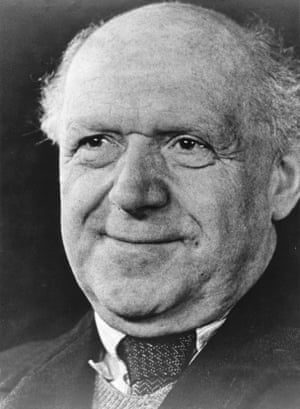
Otto Neurath-1945


Otto Neurath in 1945. Photograph: Otto and Marie Neurath Isotype Collection, University of Reading

Ten years later, despite building new council estates, Bilston still led the way in Britain for all the wrong reasons. A 1943 civic survey found that 1,400 tons of smoke particles per square mile were falling on Bilston each year, which local historian Frank Sharman colourfully suggests is “roughly the weight of 11 blue whales or 233 elephants per annum”.


According to Sharman, a national survey of housing conditions assessed the number of families in each local authority area who were living in “overcrowded conditions”. “The figure for England and Wales as whole was 3.8%. In Bilston it was 13.7%.” A later civic survey, just before the end of the war, found that of 7,771 houses in Bilston, 2,655 were unfit for human habitation.


Bilston, then, needed thousands more new houses for slum dwellers – and one of the prime sites for building those new council houses was land in the north-west of the borough. Today Stowlawn is green and pleasant, an estate of whitewashed houses, verdant verges and bucolic trees. But in the late 1940s, it was land which had been plundered for coal and road stone and then abandoned. “It was not exactly a greenfield site,” says Sharman. “Even calling it ‘brownfield’ would have been a bit optimistic.”


Neurath made us feel that the pursuit of beauty and happiness could be achieved by the common man


AV Williams


This plan to rebuild Bilston and rehouse its slum dwellers was fairly well advanced when in early 1945, Bilston’s town clerk, AV Williams, had an epiphany in Wolverhampton. He was there to attend a lecture given to the International Friendship League; the speaker was Otto Neurath, and his subject was “Housing in Vienna”.


Williams was impressed by the socialist philosopher’s humane vision: “He made one believe in the dignity of human beings.” Soon after, Neurath was invited to Bilston to see the nature of its housing problem and help eradicate it. “He made us feel that the pursuit of beauty and happiness could be achieved by the common man,” Williams explained.


Neurath believed that the common man – and woman – could and should have a role in designing their own homes. It was a perspective he had become committed to in the aftermath of the first world war in Austria, when he helped revolutionise working-class housing in the era of Red Vienna – the nickname of the capital between 1918 and 1934 when, following the collapse of the Habsburg Empire, its city government was ruled by social democrats.


It was a time and place when acute housing shortages had led to conditions of inhuman squalor – conditions, it’s not fanciful to argue, that applied to inter-war Bilston too.


During this time, Vienna became a crucible for communal living. Architecturally, the era is synonymous with vast apartment blocks such as the Karl Marx Hof and the Rabenhof, featuring communal facilities ranging from bathhouses, laundries, kindergartens, libraries and even kitchens.


Neurath was gaining fame at the time as a member of the Vienna Circle of “logical positivist” philosophers, and for developing the pictographic language isotype, one designed to help grasp by means of pictures complex information.


He was an unusual socialist, improbably influenced by Samuel Smiles, the Scottish Victorian reformer whose 1859 book Self-Help appealed to Neurath’s sensibility. Smiles had argued that poverty was caused largely by irresponsible habits and that human progress, perhaps even happiness, would come from the poor being given what Smiles called “the means of education, and of exerting freely all the powers of his godlike nature” .


The Stowlan estate


The Stowlawn estate is more green than black today, but are its people happy? Photograph: Neil Jeffries

This philosophy – the Christian sense of mission notwithstanding – inspired Neurath. He thought happiness could be achieved if workers could be educated on the principles of house design and communal living, and then be involved in the creation of their living spaces rather than having it inflicted on them from above – and he tried to put these ideas into practice in Vienna.


Shortly before this Jewish thinker was compelled to emigrate as Austrian fascists came to power in 1934, he saw the opening of the Werkbundsliedung, an estate of 70 houses in south-west Vienna that, as Dr Sabrina Rahman, co-curator of a recent exhibition called Bilston’s Happy Housing explains, “offered working-class families the opportunity to purchase or rent homes designed by a diverse group of 31 international architects”.


According to Rahman, “the Werkbundsiedlung remains one of the most important estates in modern architecture”. And the hope was Neurath could realise something similar in England’s Black Country.


Before Neurath came to Bilston, British architect Sir Charles Reilly was already sketching plans for Stowlawn estate, using ideas the Viennese would have found sympathetic, if a little more patrician. As Frank Sharman points out: “The chief feature of Reilly’s plans was that the houses should be built around greens, somewhat in the style of a village green, which Reilly seems to have seen as an archetype of a good community. And on each of these greens there would be a club, containing library, reading rooms, billiards room and catering facilities – to which families could go to eat or from which they could order meals to be delivered.”


These ideas chimed not only with Neurath’s but with the new Labour government’s housing minister Aneurin Bevan’s vision of a New Jerusalem in Britain – of mutually supportive, mixed communities. Bevan wrote in his introduction to the 1949 Housing Act: “We should try to introduce in our modern towns and villages what was always the lovely feature of English and Welsh villages, where the doctor, the grocer, the butcher and the farm labourer all lived in the same street.”


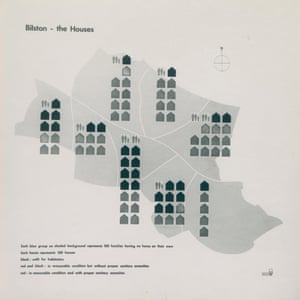
Bilston’s housing: each house represents 100 homes, the black colour are uninhabitable.


Bilston’s housing: each house represents 100 homes, the black houses are uninhabitable. Photograph: Otto and Marie Neurath Isotype Collection, University of Reading

Neurath went further in his philosophy of how Bilston’s new estates could create such communities and make the town happy. Some were noted down by AV Williams from meetings with Neurath at the time, and are cited by Frank Sharman. Even now they seem wonderfully sane and pertinent ideas for how we should – but often don’t – live:


“On estates,” advised Neurath, “mix up individuals: married and unmarried, old and young. Do not create ghettos of, for example, old people who, if they are stuck altogether in flats, will feel isolated, lonely and unwanted. If you put them in with young people, they can do things like babysitting and feel useful and wanted.


Care must be taken to avoid the accidental creation of a lunatic asylum


Otto Neurath


“Unmarried persons can be divided into those who will eventually marry and those who never will. If you put them all into one block of flats, the marrying kind will move out and you will be left with nothing but people who will never marry. Care must be taken to avoid the accidental creation of a lunatic asylum.


“You must study the existing community structure in the slums you are rehousing, and ensure these connections are not broken upon the new estate. Bear in mind that different people had different needs, and do not plan housing on a ‘one size fits all’ basis. You have to work out what sorts of houses and flats to build and who to put in them.”


One big idea Neurath was keen on was an exhibition of the plans for the benefit of those who would be living in these new houses. “You must consult the people who were to be re-housed and educate them on housing matters,” he told Bilston’s town clerk and his colleagues. “You should do this through an exhibition which made the issue understandable by anyone – through the use of isotypes – and that such an exhibition should be somewhere which was accessible to the people who were to be re-housed.” Nowadays, perhaps, this sounds like common sense; in 1945 it was a radical overturning of a patrician social order.


But before Otto Neurath could make Bilston happy, he died unexpectedly aged just 63 in his Oxford home in December 1945. His widow Marie recalled that he was reading a newspaper article about happiness before he passed away, and then commented on what he had read to her.


“What does happiness mean?” he reportedly said. “I can tell you what I mean by happiness. If godfather would come to me and say: ‘Dear Otto, I make you an offer as you are living now with your books and your work and your wife. You can live for ever and ever but you will never be more prosperous than you are now. Will you accept?’ ‘Yes, dear godfather. I gladly accept.’”


After his death, Marie went back to Bilston to fulfil her husband’s happy dream. She set up his planned exhibition in a disused store on Bilston’s Oxford Street, aimed at getting slum dwellers and other ordinary citizens to see what was being planned.


Oaklands Green on the Stowlawn estate, 1950.


Oaklands Green on the Stowlawn estate, 1950. Photograph: City of Wolverhampton archives

The year after Neurath’s death, Ella Briggs, who had worked with Otto in 1920s Vienna, became one of the main architects of the Stowlawn estate. She intended to build eight-house terrace blocks around common greens as her predecessor Reilly had envisaged, keeping designs simple to reduce building costs in the post-war austerity era. Bilston council gave the resultant streets rustic names such as Lawnside, Fairway, and Oaklands – evoking a bucolic mood in much the same way earlier and snootier developments such as Hampstead Garden Suburb did in north London.


‘It is a happy place’


What remains of the original vision for Stowlawn today? When I stroll around the estate, I notice many of the houses remain white-painted, which was unusual for 1940s British council estates and gave this corner of Bilston a continental, crypto-Bauhaus vibe. For a while, Stowlawn was known as the White City.


Stowlawn in 2016 is undeniably peaceful and green, and no doubt a nice place to live, but it’s also a traditional English bodge – a history of compromises, frustrations and muddling through inscribed on every brick, every blade of grass.


I look in vain for the community clubs Reilly envisaged – they were never built. Many of Stowlawn’s greens were replaced with new houses when land was in short supply in the 1960s. Nowadays only Lawnside Green remains, and even it is planted densely with shrubbery and bears a sign saying “No Ball Games” – which, I suspect, Neurath would have frowned at.


Much of the original vision for the estate got dismissed by central government or obliterated by later developments, argues Frank Sharman. He then points out a particularly poignant irony in Stowlawn’s evolution.


In 1979, Margaret Thatcher was elected prime minister, and soon after embarked on a sell-off of Britain’s council estates, as part of her policy of reducing the public sector and giving the market free reign. Sharman notes that she used to hand out copies of the Viennese economist Friedrich Hayek’s The Road to Serfdom which, she said, set out her economic vision – one of minimal state intervention and negligible public ownership.


Bilston Steel workers striking for better wages in January 1980.


Bilston Steel workers striking for better wages in January 1980. Photograph: David Bagnall/REX

“Such ideas were, of course, anathema to Otto Neurath, who had spent much time advocating the necessity of government regulation of the free market and a degree of central planning,” writes Sharman in his superb history of the Stowlawn estate. “In fact, it seems that Hayek’s book had been written with the specific intention of refuting Neurath. And on Stowlawn the game played out – the planned community lost out to the forces of the unbridled free market.”


Did Bilston ever get happy? Well, one thing worth saying is that it was never quite as unremittingly miserable as Fenner Brockway portrayed it. My late mother went to Bilston Girls’ High School, on the southern edge of Stownlawn while the estate was being built in the late 1940s. It was a neo-Queen Anne-style building that had opened in 1929 and is now converted into luxury flats. That school, perhaps, was emblematic of the more genteel Bilston that existed alongside apocalyptic slums and industrial hell.


And my late father used to work at Quasi-Arc, the British Oxygen Corporation’s electrical welding division, in Bilston in the 1960s. That business, like many other of the Black Country’s heavy industries, is long gone. It wasn’t just the Thatcherite sell-off of council houses that changed Bilston; it was also her ideological commitment to destroying the industries that toxically thrived here.


In 1979, emblematically, the year Thatcher was elected was the year the final steel cast was made at the Elisabeth furnace at Bilston’s Spring Vale steelworks. The entrancing flames from that furnace, that I used to savour as they lit the Black Country at night from my nan’s back step in Wednesbury, were gone forever. Never such squalor, nor such grandeur, again.


Bilston, town of furnaces, flames and inhumane squalor, once looked like Mordor; now it’s more like Hobbiton.


Happy BilstonStowlan Estate, Bilston


No ball games allowed in the Stowlawn estate. Photograph: Neil Jeffries

These days, I reflect, as I walk from Stowlawn back to the tram stop to take me to Birmingham, I’ll bet the smoke particles falling on Bilston amount to rather fewer than 233 elephants per annum. This is, in many ways, not so much the Black Country as the Green Country. Bilston, town of furnaces, flames and inhumane squalor, once looked like Mordor; now it’s more like Hobbiton.


Otto Neurath may not have succeeded in making Bilston happy, and the ideas he set out may only have been realised in botched form – and even then diluted further. But perhaps it got there anyway. His vision of encouraging people to participate in the creation of a happier Bilston didn’t die with him.


Online, there’s a fascinating interview from 1975 with a Bilston town planner on local news programme ATV Today. With a superbly straight face, this nameless civic champion suggests putting tin foil over the gasometer so that it interestingly refracts the sunlight, pumping out coloured smoke rings from disused factory chimneys, covering an abandoned gantry with wire netting to make the Black Country’s biggest aviary, transforming the abandoned railway line into a green corridor complete with picnic areas, fishing holes and cycle paths. It’s not just Viennese philosophers who have visionary ideas for urban living.


Related: Story of cities #34: the struggle for the soul of Milton Keynes


Better yet, the interviewee invites town citizens to submit their own ideas to make Bilston beautiful. Otto Neurath would surely have liked that: anything to get locals involved in planning the circumstances of their own happiness.


True, Neurath’s vision of cities composed of mutually supportive, mixed communities, living together in harmony isn’t exactly voguish in our era of gated communities, sheltered accommodation, streets too dangerous for kids to play in. But it would be a fool or a snob who said Bilston isn’t a happy place.


“I’ve lived here all my life and I want my daughter to be as happy here as I’ve been,” says the young mother outside the pub which, I belatedly notice, is called The Happy Wanderer. “It is a happy place.”


Stuart Jeffries’s book Grand Hotel Abyss: The Lives of the Frankfurt School will be published by Verso in September


Follow Guardian Cities on Twitter and Facebook and join the discussion


Bilston"s revival: the pursuit of happiness in a Black Country town

16 Temmuz 2014 Çarşamba

Celebrating cellulite isnt the route to happiness | Bella Mackie

I spent a lot of my 20s becoming incredibly aware that my cellulite was deemed disgusting by the magazines I read through. When I identified stretchmarks on my thighs aged 18, I cried in a modifying area. I happily hoovered up lotions, creams, and depilatory merchandise, all in the identify of seeking very good and attaining this best of elegance I had so willingly absorbed. The distorted photographs of women that are fed to us consistently are unhealthy and damaging. But then, we know this, due to the fact it’s a subject that’s tackled on an virtually every day basis. So absolutely it can only be a good issue when these ridiculous requirements of elegance are challenged?


Recently, there has been a surge of blogs and pieces encouraging women to celebrate elements of being a woman that previously wouldn’t have been observed as praiseworthy. This week I’ve read through a number of gushing pieces about the Hairy Legs club, which brightly welcomes you with the message: “This is a Optimistic space.” This site encourages women to throw away the razor and send in images of their hairy legs (there is the odd “fuck the patriachy” comment integrated for very good measure).


If hairy legs really do not make you want to pop open the prosecco, then why not celebrate your cellulite, or show off your stretchmarks? There are also countless blogs which display photographs of girls following they have offered birth, full of compliments, praise and exhortations that we should cherish our challenging-won little one bellies.


But just as I employed to hear a disapproving Greek chorus if I ate an ice-cream in the run up to “bikini body” season, I also truly feel a creeping sense of discomfort with this new celebratory motion. If you are happy to keep your body hair as nature meant, you’ve certainly created a selection that suits you effectively. But this new enthusiasm for documenting our bodies and cheerleading the private choices we make about them looks at ideal patronising, and at worst to be perpetuating the old, regimented way that girls are essential to see their bodies as comprised of constructive or negative components.


We are naturally repulsed when we see a variety of celebrity magazines use the equivalent of the old circle of shame – scrutinising the bodies of female celebrities for “flaws” – but, rather of renouncing techniques like this, these blogs reinforce the message that women’s bodies must be continually and closely examined, divided into constituent components.


A site that demonstrates ladies embracing their hairy legs unwittingly reinforces the notion that to be a hirsute woman is unattractive – it asks the reader to throw off the modern common of femininity by generating a new one. To contact stretchmarks “tiger stripes” is to imply that the marks themselves can only be borne if we understand to see them as something that we have earned. By celebrating our post-little one bodies, we admit that we view the components that have transformed as separate and distinct physical entities which must pass some type of muster.


This want to rejoice in our kind, whatever its shape, is however an additional way for females to see our bodies as the priority. We may refuse to see our cellulite as ugly or unsightly, but we are nonetheless getting asked to emphasis on an external element of ourself, to flip the negative into a optimistic and examine our physical attributes from a various angle. Is this what we see as progress? If you cannot imagine a weblog where men happily praise every others’ beer guts then the response must certainly be no.


I have spent the past 12 months working. I’ve acquired more powerful and leaner. I can truly feel my bodily strength rising. I have realized to appreciate how every single part of the physique connects, and how fantastic it is to be ready to use it entirely. But this trend towards physique good language and imagery requires us to do the opposite it asks us to see our bodies as superficial.


When writing about the historical past of the suffrage movement, Jeanette Winterson argued that if a female cannot come to feel comfy in her personal entire body then she has no residence. In purchase to really feel fully at ease with ourselves, probably we need to throw off the notion that one’s entire body, and one’s specific physique elements, should be noticed as either praiseworthy or wanting. Acceptance, rather than jubilation, is the only way we women may have a actual chance of moving away from the consistent fixation with our image.


Celebrating cellulite isnt the route to happiness | Bella Mackie

4 Mayıs 2014 Pazar

Salary Level and Happiness Degree

As you rise up the corporate ladder you get much more income but also far more stress and a lot more problems that can make you much less happy on the task, right? No, possibly not, in accordance to a new survey by the jobs web site CareerBliss.com. It finds that employees with larger salaries are happier with all facet of their function life, not just their compensation.


Salary Level and Happiness Degree

Can Cash Actually Buy Happiness? Well, Maybe

Happiness study in excess of the last decade has a lot more or significantly less concluded that we can in reality get happiness, as prolonged as it comes in the type of experience. The conclusion can be described thusly: investing funds on items, no matter how elaborate, leaves us wanting more, even though investing on experiences, specifically with other individuals, yields long-phrase fulfillment. Very good? Very good.


Except maybe that conclusion is not quite very good enough.


New research from researchers at San Francisco State University takes a wrecking ball to that neat dichotomy by suggesting that for many of us, paying cash on experiences also leaves us wanting.


“Everyone has been informed if you devote your money on life experiences, it will make you happier, but we found that isn’t often the situation,” explained Ryan Howell, an associate professor of psychology at SF State and co-author of the research. “Extremely materials customers, who signify about a third of the all round population, are sort of caught. They are not actually happy with either purchase.”


The “extremely material buyers” Howell describes suffer a kind of fulfillment blindness about what purchases mesh properly with their personalities and values.  For these folks—and in accordance to Howell they’re a single in every 3 of us—buying experiences is actually no more successful than buying things, since the experiences will not accurately reflect who they are. In other words, no matter how they devote their funds, they miss the mark of authentic “identify expression.”


Howell supplies an instance: “I’m a baseball fan. If you inform me, ‘Go devote cash on a life knowledge,’ and I buy tickets to a baseball game, that would be authentic to who I am, and it will possibly make me satisfied,” Howell mentioned. “On the other hand, I’m not a massive museum guy. If I bought tickets to an artwork museum, I would be paying funds on a lifestyle expertise that looks like it would be the correct selection, but due to the fact it’s not real to my character, I’m not going to be any happier as a outcome.”


Howell and his staff surveyed consumers with questions designed to find out what factors limit the happiness they should come to feel (in accordance to prior scientific studies) from spending income on experiences. They located that the heaviest consumers of material factors felt the least happiness from experiential purchases.


“The benefits display it is not correct to say to every person, ‘If you commit money on lifestyle experiences you will be happier,’ because you want to consider into account the values of the purchaser,” mentioned Jia Wei Zhang, the lead writer of the study and a graduate student at the University of California, Berkeley who conducted the research with Howell even though an undergraduate at SF State.


So what’s the remedy? According to the researchers, it’s all about directing our getting power toward experiences that jibe with who we think we are. Spending on experiences that others say are universally edifying (i.e. museums and art galleries)–but that really do not genuinely mesh with our identities–is likely to leave us feeling just as empty as investing cash on possessions that lose their novelty minutes after we get them.


“There are a good deal of factors a person may buy something,” Howell stated, “but if the explanation is to maximize happiness, the best thing for that individual to do is obtain a existence experience that is in line with their personality.”


Although I believe this research adds a valuable dimension to happiness studies, I’d like to know a lot more about the impact of investing income on that which pushes the boundaries of our expertise. Would seem to me that someone who hasn’t traveled outside the U.S. could simply say, “I’m not a Europe kind of man or woman,” but really have no thought what that statement indicates. With out taking a possibility on new experiences, our “identity expression” may by no means increase past the relaxed, and limiting, life niches we carve out for ourselves.


The study will be published in the June edition of the Journal of Study in Persona.


You can find David DiSalvo on Twitter @neuronarrative and at his website, The Day-to-day Brain. His newest guide is Brain Changer: How Harnessing Your Brain’s Power To Adapt Can Adjust Your Daily life.


Relevant on Forbes…


Can Cash Actually Buy Happiness? Well, Maybe

18 Nisan 2014 Cuma

Happiness is good for your well being, so what are councils undertaking about it?

Hispanic woman running in park field

The New Economics Basis has recognized 5 ‘ways to wellbeing’: connect, be active, take observe, hold learning and give. Photograph: Priscilla Gragg/Mix Images


Public well being has been in the hands of local government for a minor over a year now, spawning some exciting projects if couple of instant results. From a ban on super-power ciders in Ipswich to totally free accessibility to sport in Islington, it’s been a rare possibility for councils to exert some personality in excess of their choices.


So far most public health function has targeted on clear locations of need: cease smoking campaigns, sexual well being guidance for youthful individuals, new ways to tackle developing charges of obesity and stem the rise in diabetes diagnoses. It truly is all important, and should carry on, but although budgets are tight there is even now one thing missing.


The marketing and advertising bumf that local authorities generate on public well being talk not only about wellness problems with measurable costs of good results – a stem in the increasing tide of type two diabetes diagnoses, for example – but the broader situation of general wellbeing. But is anything at all truly being completed about it?


To answer that query we need to have to realize what wellbeing is. The New Economics Foundation has carried out analysis seeking at how wellbeing impacts men and women, communities and businesses and its influence on economic performance. It identifies five “approaches to wellbeing”: connect, be energetic, consider observe, keep understanding and give.


These concepts assist people comprehend the straightforward steps they can take to improve their lives, but they also have critical roles to perform in wellbeing at operate or in colleges. Offered that councils now say they are accountable for bettering neighborhood wellbeing, it truly is also fascinating to apply them straight to the public overall health agenda.


Two of the 5 are previously accounted for. Trying to keep communities energetic is the mainstay of public well being agendas with most councils locating new techniques to get the nation’s potatoes off their proverbial and literal couches and out into the community, regardless of whether through cost-free entry to gyms and sports activities centres or new local community exercise groups.


It truly is not just the public overall health crew that help us to connect with one yet another organizing departments style open public area to inspire interaction, library services deliver us collectively, schemes aimed at certain groups (older men and women, youthful mothers) support us make new ties with like-minded nearby folks. Where more can be accomplished is in cementing people relationships and actively stopping isolation.


Jonathan Carr-West makes an exciting point when he suggests it will become the task of councils to aid us make close friends. Library bookgroups and other particular interest gatherings start doing this work – why not launch an equivalent of singles nights where nearby individuals, especially individuals new to an location, can meet every other and build links?


That still leaves 3 concerns unaddressed, but they are all interlinked. Lifelong finding out is also usually sidelined as part of additional schooling policy, but it is critical for all residents to have accessibility to new approaches to learn and develop. 1 way people can understand new skills (and meet new individuals, for that matter) is by volunteering, receiving concerned in neighborhood brings about – and that also affords a room to reflect and believe about ourselves and other people, to “consider discover” of what goes on close to us and within our communities.


All these factors could be achieved by generating simple projects which, by no coincidence, support councils to tackle the funding crisis in crucial public solutions this kind of as social care. Here’s an example: let’s inspire residents to give an hour of their time a week to consider component in a skills-sharing group activity which limits isolation for older folks. You could even give participants a council tax discount for taking part. This, not just avoiding teenage pregnancy, is the task of public health.


For individuals who feel all this is new age bunkum, investigation suggests that wellbeing has as much of an influence on our general health than earnings. Large amounts of private wellbeing can add seven and a half many years to your lifestyle expectancy. Bad wellbeing, meanwhile, can result in several of the problems that public health is attempting to conquer such as alcohol and drug abuse. It needn’t value considerably, but thinking creatively about how to access folks and aid them accomplish the “five ways” is firmly within the remit of public health.


• Want your say? Electronic mail sarah.marsh@theguardian.com to recommend contributions to the network.


Not already a member? Join us now for much more comment, examination and the newest job possibilities in nearby government.


Happiness is good for your well being, so what are councils undertaking about it?

7 Nisan 2014 Pazartesi

Can Your Yearbook Photo Predict Happiness, Divorce, Death?

Seem back at your high college or university yearbook photo, and what does it inform you? A whole lot much more than whether you had been a geek or a homecoming princess, it turns out. From your expression, psychologists say, they may possibly be capable to predict how content your life will be, whether or not your marriage will last, even how lengthy you will dwell. Think it? Let’s appear at the studies.


Can Your Yearbook Photograph Predict If Your Marriage Will Last?


The most recent photo-prediction analysis to get interest comes from Matthew Hertenstein, professor of psychology at DePauw University, who studied yearbook and childhood pictures and documented a correlation in between how often men and women smile and the probability they’ll divorce.


Your yearbook photo smile might predict how long you

Your yearbook photo smile might predict how extended you will dwell and if you’ll be content, research present. (photo: wiki media)


Hertenstein’s study was very first published in 2009 in the journal Determination and Emotion but obtained a new round of focus a few months in the past with the publication of his book The Inform: The Small Clues That Reveal Massive Truths About Who We Are (Simple Books, 2013).


“Those who smiled least, compared to people who smiled most, had been really 5 occasions more probably to be divorced at some point in their lifestyle,” Hertenstein told interviewer Meredith Viera on the Nowadays Present. Watch this clip to see him show how your smile – or lack of it – in a snapshot can reveal no matter whether or not your marriage will last.


How in the world can a yearbook photograph make a prediction like this? It is all about the intensity of your smile, researchers say.


Can Your Yearbook Photo Predict How Prolonged You’ll Live?


That’s the query posed by Ernest Abel and Michael Kruger of Wayne State University in a 2010 research published in Psychological Science.


The researchers started with 230 pictures of baseball players published in the 1952 Baseball Register. They then divided the pictures into three classes: no smile, partial smile, full “Duchenne smile” (see below) to capture the “intensity” of the player’s positivity. Next they utilized matched the player’s smile rating against his age at death, controlling for elements like how long the gamers continued to play ball, whether they had a university schooling, and their physique-mass index.


The fascinating conclusion: Baseball players who turned a higher-wattage smile on the photographer have been only half as likely to die in the course of any given year as individuals who smiled only partially or not at all. Those who showed a half-hearted smile lived longer than these who didn’t smile at all, but not as lengthy as their grinning teammates.


(This Psychology Right now column by noted late good psychologist Christopher Peterson provides a very good sense of the affect Abel and Kruger’s investigation created on colleagues.)


How Can Researchers Read through a Smile?


Image the smiley face icon – the only point differentiating it from a frowning encounter is the upwardly curving mouth line. But in reality, professionals say, there are really two sets of muscle groups at work when you smile. The cheek muscle groups, identified as the zygomatic main, lift up the outside corners of the mouth, although the orbicularis oculi, a ring of muscle surrounding the eye sockets, crinkle your eyes into a pleased squint.


As far back as the 1860s, a French scientist by the name of Guillaume Duchenne studied the mechanics of smiling using electrical currents to stimulate facial muscle tissue and identified that while we can make our mouths smile on cue, we cannot do the exact same with our eyes. The eyes, for that reason, can be utilized to “unmask a false buddy,” as he famously wrote. Therefore the term “Duchenne smile,” nonetheless utilized by researchers nowadays.


Nowadays, the “Duchenne smile” has given rise to an even more in depth rating identified as FACS (Facial Action Coding Program) which catalogues 3,000 distinct facial expressions by the actual mixture of muscle groups needed to make them.


Can Your Yearbook Photo Predict Happiness, Divorce, Death?

21 Mart 2014 Cuma

A happiness index tends to make for sound economics

Policy-makers could allocate more income to psychological overall health – cognitive behaviour therapy has a achievement charge of in excess of 50 per cent. Ah, I hear you cry, this is all a stealthy plea for increased public investing. Yet, as Lord O’Donnell says, much better government doesn’t have to suggest bigger government. Unemployment has a disastrous affect on psychological well being. Assist men and women to turn into mentally powerful and they are significantly more very likely to find work, which implies they come off benefits and shell out tax.


Previously some departments, including Perform and Pensions and the Treasury, are starting up to use life satisfaction ratings to carry out a social price-benefit analysis of policies. It should be the way forward. In the longer term, the ideas in the Legatum report may have much more effect on our lives and politics than this week’s Spending budget.


THE Wonderful MINOUCHE


Egyptian-born Nemat Shafik, the new deputy governor at the Bank of England, roused passions when she was a Whitehall official. Known as Minouche, she was the most senior civil servant at the Department of Global Affairs, where she did not hesitate to speak reality to energy. “When you grow to be a cabinet minister, your first everlasting secretary is constantly rather unique and she was mine,” says Andrew Mitchell. “She’d place her head on one side, repair you with her beady eyes and make clear precisely why she disagreed with you.” He sighed. “She was wonderful.”


His see is broadly shared. One particular of her former civil support colleagues, a quite senior lady, advised me: “Minouche is glamorous, classy, funny, a brilliant economist and her American accent can make her a global figure.” So, is she a potential Governor of the Financial institution? “Oh, I hope so!”


UNCIVIL Services


George Osborne, in his Budget speech, praised the independence of Robert Chote, head of the Workplace for Price range Accountability. Mr Chote, who is married to Sharon White, 2nd permanent secretary at the Treasury, surely doesn’t hold back when it comes to speaking publicly about this Government’s reforms in Whitehall. There have been significant tensions amongst some ministers and their senior civil servants, not least in the Home Office and the Division for Operate and Pensions, whose prime official had to endure the politicians briefing against him.


I comprehend that throughout a seminar at Manchester University Mr Chote said: “Those engaged in civil services reform must ask themselves regardless of whether, at the end of the approach, any sane, competent person not under the influence of drink or medicines would want to be everlasting secretary of DWP or the Property Office.” You have been warned, minister.


A happiness index tends to make for sound economics