delivering etiketine sahip kayıtlar gösteriliyor. Tüm kayıtları göster

25 Ekim 2016 Salı

Midwife in Haiti tells of delivering babies knee-deep in water by torchlight

A midwife in Jérémie, Grand’Anse, one of the worst-hit towns in Haiti during Hurricane Matthew, has told how she delivered six babies, two boys and four girls, in a blackout during the night of the storm.


Marie-Lyrette Casimir, a midwife at St Antoine hospital, worked by flashlight as the fiercest Caribbean storm in almost a decade ripped though the south-west tip of the country, killing more than 500 people and causing widespread devastation.


Casimir, who was trapped in the hospital with her patients for hours after the storm, due to rising floodwater, said: “During the deliveries, the mothers were saying: ‘Miss Casimir, please save us. You’re going to save us.’ I was worried a lot, but I tried to calm them down, to be reassuring. I said to them: ‘Even in this desperate situation, you have to play your role, in the interests of the baby.’”


In a town where 80% of the buildings have reportedly been destroyed, St Antoine’s maternity unit, housed in one of three buildings that make up the hospital, emerged relatively unscathed. One of the hospital’s adjacent buildings was flattened by winds of up to 145mph, the other suffered extensive damage.


Casimir, who works for the United Nations Population Fund (UNFPA), described how windows were shattered and doors wrenched off their hinges during the storm and, amid fears the building itself would collapse, mothers were screaming and crying. There were two nurses in the ward that night, but she was the only midwife, she told the Guardian.


“I was very sad and worried … At first, the wind wasn’t very strong but the hurricane became really strong around midnight.”


When a power cut plunged the hospital into total darkness, she carried on using a rechargeable lamp and a flashlight, she said. “I was afraid, there was a lot of noise and I was worried I could be injured. But I had to stay – my work was to help women give life.”


Casimir, 46, said that by dawn the floodwater in the hospital had reached her knees. At one point she had to raise the bed in the delivery room, which was becoming contaminated with floodwater.


But her fears that falling debris or, worse, the collapse of the building, could risk all their lives, went unrealised. “I’m very proud of what I achieved that night. There were no deaths. The deliveries went well and none of the babies needed to go to paediatric care. Everything was great.”


Casimir’s story emerged after an assessment by the UNFPA and Haiti’s ministry of women’s affairs revealed the scale of devastation in Grand’Anse and Nippes, two of the country’s hardest-hit departments. It found most of the population affected were living in appalling conditions, with 176,000 in temporary shelters. Almost 100% of crops were destroyed in what is one of this impoverished country’s most fertile areas.


Up to 1.4 million people, 40% of them children, are in need of humanitarian assistance, according to a report (pdf) by the Office for the Coordination of Humanitarian Affairs (Ocha), with 806,000 people being at what it described as at “extreme-impact level” of food security (near-famine conditions), mainly in Grand’Anse and Sud. A further million people were at a “very high” or “high” level, it said.
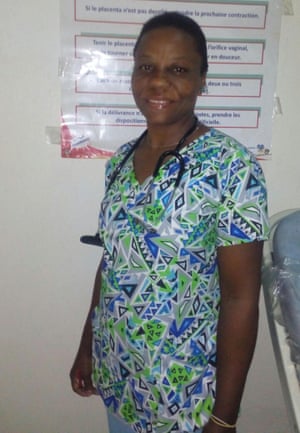


Marie-Lyrette Casimir, a midwife at St Antoine hospital


Marie-Lyrette Casimir, a midwife at St Antoine hospital. Photograph: Courtesy UNFPA

Maternal health facilities were badly hit, particularly St Antoine and the City Med hospital in Beaumont. All seven of the main health facilities in the area were flooded and remain without power, water, equipment and short of staff. The directorate of civil protection of the Haitian government has reported 11 of the 33 hospitals in Grand’Anse, Nippes and Sud were damaged.


Along with the unmet basic needs of food and shelter for thousands, an estimated 13,650 women – among the most affected people – are due to give birth in the next three months, according to Ocha.


Vavita Leblanc, reproductive health programme manager of UNFPA in Haiti, said the agency has sent two teams of six midwives into the affected areas.


“In Grand’Anse, we found none of the health facilities have power [or] water, and all are flooded,” said Leblanc. “They have problems with medical supplies. Human resources have also been affected as nurses and doctors are facing their own problems, with their houses and with food.”


Leblanc said the devastation caused by the hurricane would severely affect the country’s maternal mortality rate – it is already the worst in the Americas but had been falling due to more hospital births.


“People will now stay in their communities to give birth,” said Leblanc. “It will set us back a decade.”


Two-thirds of babies in Haiti are delivered without qualified help. The country’s maternal mortality rate stands at 359 per 100,000 births in 2105. Cuba has a maternal mortality rate of 39 per 100,000.


Amid warnings by aid agencies of the risk of a fresh cholera outbreak, the storm also damaged most of the cholera treatment centres of Grand’Anse, according to the Ocha report. The country’s cholera epidemic began in 2010, when UN peacekeepers unwittingly introduced the disease shortly after a devastating 7.0 magnitude earthquake. The disease, previously unknown in the country, went on to kill more than 9,000 people.


This week, a UN official said he was concerned the scale of the cholera outbreak may be under-reported because remote areas are cut off. He also warned that protests, by desperate people angry about the slow pace and uneven distribution of aid, were impeding progress.


A spokesman for the World Food Programme’s Haiti operation told the Guardian it had so far managed to get food assistance to just 10% of the 800,000 estimated to urgently need it. “Initially, the response took time,” the WFP spokesman said. “We started distributing on 8 October and so far, 80,000 people have received assistance.”


He said the damage to infrastructure and roads delayed trucks going to the peninsula until 7 October, four days after the hurricane. It is now sending out between two and four trucks a day to the hardest-hit areas, as well as helicopters, he said. They plan to use boats to get out to the coastal areas.


There have been a few security issues, he said, but they represent a small proportion of the response. “People are really suffering, they are desperate and hungry, but we expect safe passage so that we can get to the communities that need it.”


To support the government-led response, the humanitarian community in Haiti launched an appeal for $ 120m, only $ 15.1m of which, according to the latest Ocha report, has been raised.


Paul Brockman, MSF head of mission in Haiti, speaking from Baradères, around 50km from Jérémie, said that while cholera is not as bad as they feared, significant risks remain. Brockman said: “There is a great need for shelter and drinkable water everywhere. Cholera could be a very substantial risk. It’s important to remember, that, as a small country, Haiti was very affected by the rain in the hurricane, even in the areas where the wind did not devastate – and with cholera still present everywhere, it increases the risk when treatment centres [have been] flooded.


“In every coastal area we’ve been in, there has been partial or total destruction of the cholera treatment centres.”


Midwife in Haiti tells of delivering babies knee-deep in water by torchlight

27 Mayıs 2014 Salı

Sana"a, Yemen: delivering medication in a city below siege

Damaged vehicles are seen at the scene of a suicide attack at the Defence Ministry compound in Sanaa

Damaged automobiles are observed in the course of the three months of civil unrest at the Defence Ministry compound in Sana’a. Photograph: Handout/Reuters


In late 2010 and the beginning of 2011, the situation in my nation commenced to deteriorate. Very first, there have been the demonstrations and protests in the capital Sana’a then violent clashes broke out all more than the nation.


At the time, I was functioning for Medecins Sans Frontieres (MSF) and the ministry of health at the HIV clinic in Al-Gumhuri hospital, the only facility in Sana’a that offers antiretroviral therapy to individuals suffering from the virus.


It was clear to us that we necessary to be ready for the worst. With a lot more than 350 patients obtaining reside-conserving ARV treatment at our facility, we essential to put a prepare in location that meant we could carry on to get medication to individuals if conflict broke out.


In Yemen, receiving therapy for HIV is currently challenging. As a basic rule, HIV good patients discover receiving examined and taken care of for the sickness quite hard due to the fact of the stigma associated with it. They’ve been misinformed about the condition and have lived their entire lives seeing how HIV optimistic individuals are discriminated against – even by health employees. Even I had misconceptions all around HIV until I trained as a nurse and learned the science behind it.


In spring 2011 the fighting intensified and Sana’a was divided into two sides. Various armed groups took in excess of sections of the city and moving about grew to become extremely difficult. Clashes close to the hospital meant the workers had been trapped within for three days. The predicament became too harmful for foreign personnel to hang all around, they have been all moved to risk-free homes and flown out of the nation.


But most of the Yemeni employees stayed on. Though we could no longer run our regular actions at Al-Gumhuri, we nonetheless required to get ARV medication to the HIV patients, or else their condition could deteriorate and they could even die. So we place our effectively-laid programs into action.


In the months leading up to the conflict, the MSF and Ministry of Well being staff had offered special cards to every single of our sufferers. The cards were a way for individuals to get in touch when they essential their medication delivered, must we have to suspend our normal pursuits. These overall health cards did not have any information on them that could determine them or me, they had my cellphone amount on it, and that is all.


The patient would get in touch with me and give me their patient quantity. From that number, I’d know what sort of drug regimen they had been on and I’d be ready to gather the acceptable ARVs from storage. The patient would then give me a place, and I would both take my vehicle to drop the proper ARV medicine off there, or I’d depart it – tucked discreetly into a shopping bag wherever they requested. Doing this I visited some quite uncommon places – I as soon as was asked to depart the medicines in a supermarket and another time at a photographer’s studio.


Sometimes individuals would even come to my house and acquire the medication that they necessary or I would choose them up in the street, give them their medication whilst I drove, and then drop them off in another location so as to avoid putting ourselves in danger. People would phone me day and evening I had no thought how long this was going to go on for, so at instances it appeared like it would in no way finish. It did not matter to me how it happened, though. All that mattered is that the sick individuals got handled, even while the two sides of the city had been on lockdown.


Early on, it became clear that we have been going to have to move the retailers of drugs. We had originally planned to preserve them in the National AIDS programme facility in a central portion of town. As it occurred, though, that area became the scene of steady hefty fighting and it wasn’t risk-free for me to be going in and out. We agreed that the greatest factor to do would be to get all those prescription drugs and move them to a loved ones residence. As soon as, as I was leaving the facility, there was a large explosion, a bomb went off near my auto. I was fine but it shook me, I had no idea it was coming.


The city was divided along political lines and crossing frontlines to make deliveries was challenging. I was continually questioned at checkpoints, as every single side was concerned that I may be supporting the other. Of course, MSF is a neutral humanitarian organisation that treats everybody, regardless of any sort of affiliation or belief but you consider telling that to the guy with the automated weapon. Sometimes my wife and two children would come with me, if I had my household in the auto, we wouldn’t be stopped.


Right after three months, the energetic fighting came to an finish, and we have been in a position to resume complete pursuits in Sana’a. And for all the difficult function, the prepare was a success: we were ready to reach all of the 363 individuals needing ARV therapy during the fighting, with 97% of them coming back to us to continue their therapy soon after it was more than. There had been some scary and stressful times, but I by no means felt like it was too much for me. In truth, the sufferers became like loved ones to me, I was often the only individual they could trust. I hope there will by no means once again be unrest like this in my nation. But if ever there is, we’ll be prepared.


Read far more stories like this:
• Safety awareness for assist employees in conflict zones
• Staying secure: support staff and crime
• Worldwide growth: how to minimise the risks


Join the local community of worldwide advancement pros and professionals. Turn out to be a GDPN member to get far more stories like this direct to your inbox


Sana"a, Yemen: delivering medication in a city below siege

7 Nisan 2014 Pazartesi

Delivering On The Healthcare Opportunity - Citrix Reviews In

I’ve written just before about cloud synchronization and sharing vendors moving into vertical sectors in buy to differentiate their brand. Right after some discussions with Citrix recently about their own resolution, ShareFile, I was invited to take a look at what the firm is undertaking far more broadly in one particular particular vertical – Healthcare.


Recently I took the opportunity to speak with Lindsay Sanchez, head of the vertical advertising organization unit inside of Citrix. Sanchez lately returned from the HIMSS medical technology conference, and I was interested to talk with Sanchez because the healthcare business is a single the place we frequently hear of hugely beneficial likely that the cloud permits. In spite of this speak nonetheless, I’m however to see examples of widespread implementations of large value solutions – confident some healthcare organizations are moving to cloud based mostly electronic healthcare record (EHR) or electronic medical record (EMR) methods, but this is not truly a transformative move compared to some of the far more conceptual examples we’ve noticed from vendor’s advertising and marketing departments.


Initial up Sanchez gave me a roundup of how Citrix is typically undertaking in the area. Not surprisingly, the significant driver for enterprise is organizations that have a pressing require for mobile accessibility to EHR/EMR. Anecdotally Sanchez is seeing that 80% of time and hard work from health care organizations is going towards gadget simplification and the consolidation of EHR/EMR answers. Organizations are delivering on this need to have via a couple of directions – desktop virtualization, a technology I’ve been somewhat dismissive of, has seen tons of get up in the sector. Sanchez was sympathetic to my views about VDI but also offered a sensible counterpoint:


The potential is not client server but the reality is [health-related organizations] are desktop centric and that’s not shifting fast. Their main driver is delivering data to heterogeneous gadgets


It’s a legitimate stage, and one particular that vendors need to have to stability – it is all quite well articulating an aspirational vision, but you need to have to give clients a way of progressing along that path – although it pains me, I have to concede that at times VDI is portion of this progression. Sanchez pointed out that it’s about taking tiny, incremental methods, and that little innovations can make huge modifications in a sector that is as compliance and method heavy as overall health. Often, explained Sanchez, technologies will get a small ahead of itself. Without a doubt.


CHE-Trinity (the 4th biggest overall health technique in the US), Baylor Well being, Seattle Children’s and Miami Children’s are all clients of Citrix, and making use of a variety of Citrix technologies to update how they function with EHR/EMR. Citrix reviews that they are supplying all of the leading ten US healthcare suppliers and there are two.eight million licenses for Citrix goods specifically for the room.


Sanchez reviews that Citrix is seeing a degree of follow via in terms of larger value solutions on leading of EHR/EMR modernization, Sanchez gave the instance of some consumers whose practitioners want to seamlessly accessibility a assortment of applications as component of one workflow – such as an EHR to verify the patient, voice management/dictation computer software, integrated imaging viewer, secure texting, file sharing or e-mail and web entry


I recommended that possibly Podio, the business that delivered a platform for customers to construct straightforward and hugely contextual workflow applications would be a beneficial tool inside the healthcare setting. Apparently Citrix is not seeing a lot uptake of Podio in the room – rather file synchronization and sharing via ShareFile is there mid-term purpose. Accurate workflow is apparently a “later end goal” for these customers who aren’t, as however, looking to set off workflows within applications but rather just want to simplify manual and complicated processes.


Although it would be simple to be a small unhappy that innovation is not taking place as fast as the a lot more visionary marketers would like it, in the context of how much acquire the healthcare sector can make from even the easiest “low hanging fruit” it was good that some initiatives are occurring. Whilst it might suggest that those conceptual movies of real e-well being and paperless healthcare establishments may still be a prolonged way off – the primary thing is that a slow and inefficient technique is improving incrementally. Talking with Citrix about what they’re seeing in the sector signifies that is the case.


Delivering On The Healthcare Opportunity - Citrix Reviews In

10 Şubat 2014 Pazartesi

Feel Get in touch with the Midwife appears like challenging graft? Consider delivering infants in the dark

Mary Raphael in her Tanzania clinic


As a midwife, I want to give mothers and their babies a greater possibility. There is so considerably for them to search forward to, but there is much to worry about as well. Like mothers anywhere, they are anxious about caring for their little one with out significantly income and how a new addition to the loved ones may affect their lives.


That’s why my colleagues and I don’t just provide infants. We perform in the hospital and in the community to help the effectively-being of mothers as well as their newborns. We keep track of babies to check their feeding and fat. As for the mother, we’ll make confident she’s healing well right after the delivery and give guidance on family organizing – it is important mothers come to feel they can have these discussions with us.


All this signifies that life is quite hectic. I wake up at about 5am and make breakfast for my loved ones. I have a daughter of my very own and also care for my brother’s daughter. We all reside at my mothers residence and she’s a large assist. The two ladies consider I’m as well occupied at perform, but they comprehend I’m undertaking a excellent occupation.


Typically, I’ll get to perform about 7.30am, when I’ll appear at the evening nurses’ report. I’ll also get the instruments and medicine ready for the day ahead, and have almost everything on standby for any deliveries. I’ll then start off on my ward round, checking up on post-natal cases. I’m concerned in deliveries from start to finish and the length of my operating day varies depending on the variety of situations we’ve received.


Mary attends to a newborn


At the second, I’m also fitting additional examine about my work. I want to do far more for mothers and their children. But with restricted resources, I couldn’t go back to college. So, I’m performing a distance finding out program to produce my capabilities. I’m 1 of 89 students in Tanzania studying by means of an ‘e-learning’ programme that is supported by Africa’s overall health growth organisation AMREF and the well being care company GSK. The two organisations have worked collectively for a prolonged time to support strengthen well being care systems in nations like mine.


Schooling like this will assist us swell the ranks of experienced midwives, enabling us to care for a lot more females and kids. The training I’m undertaking signifies I’ll be able to control a lot more cases on my personal. It offers me a lot more self confidence in diagnosing problems and offering tips to colleagues – even the medical doctors. I’ve commenced providing talks to patients also. They request me why I’m performing this and I tell them I want to share what I’ve learned.


Hopefully, the far more abilities I can get, the far more girls I can reach – and the far more lives I can assist conserve.


Mary’s e-learning programme has been supported by the African Healthcare and Investigation Basis (AMREF) and GSK, through GSK’s initiative to reinvest twenty per cent of profits in developing nations back into strengthening the overall health care infrastructure in those nations.


Feel Get in touch with the Midwife appears like challenging graft? Consider delivering infants in the dark