Egypt's etiketine sahip kayıtlar gösteriliyor. Tüm kayıtları göster

7 Ekim 2016 Cuma

Egypt"s obesity battle: "No one cares about calories here"

Inside the neon palace that is Koshary Abou Tarek in downtown Cairo, the air smells of fried onions. Plates are heaped high with koshary, a traditional dish containing rice, macaroni and lentils topped with tomato sauce and onions – a filling mainstay across all Egyptian social classes.


An average serving at the restaurant costs the equivalent of £1.80, and contains an estimated 800 calories. The place is filled with families who are given a choice of sugary soft drinks as an accompaniment.


“We don’t measure the calories in the dish as no one here cares about that,” laughs the manager, Tarek Hosny. He elaborates on a prevailing theory that while koshary is all carbohydrates, these are somehow removed with the water they are cooked in.


Low to mid-income countries have some of the highest child obesity rates in the world and, Egypt ranks seventh with 32% of children obese, according to datafrom the World Obesity Federation. A diet heavy in meat, carbohydrates and sugar combined with few opportunities for exercise are taking a toll on the Arab world’s most populous country.


Nor is obesity bound by social class. Low-income families turn to rice and potato dishes to fill stomachs at the end of a long day. The wealthy, who can afford to eat meat with almost every meal, also have access to fast food, considered a luxury in the Middle East.
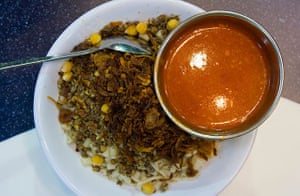


Koshary, a popular carb-dense dish, is served in a restaurant in Cairo.


Koshary, a popular carb-dense dish, is served in a restaurant in Cairo. Photograph: Alamy

A survey by the World Health Organisation (WHO) covering 2011-12 found that 62.2% of Egyptian adults were overweight, and 31.3% of them were classed as obese.


“This is more than a health issue,” said Dr Randa Abou el Naga of the WHO in Egypt, who cites a lack of physical activity as the main driver of obesity.


“City planning is responsible,” she said. “There should be proper places for playing sports. Overcrowding in schools also means no sports classes; 75% of Egyptians aren’t doing any vigorous physical exercise.”


Naga said the Egyptian government could easily switch from subsidising sugar and oil to healthier options such as milk. Kiosks and corner shops throughout the country offer a range of sugary and salty snacks, a cheap option for children and their parents.


A Pizza Hut restaurant near the Giza pyramids in Cairo.


A Pizza Hut restaurant near the Giza pyramids in Cairo. Photograph: Alamy

“It might sound like a cliche, but Egyptians really love sugar. It’s an addiction,” said dietician Dr Sherine el Shimi. “They add sugar in their tea, and have five or six of these per day, each with two or three teaspoons of sugar in. If they just took out the sugar, their lives would be different.”


She said most if not all social gatherings revolve around food, and that social pressure to eat more was high. “Plus we also have delivery for everything,” Shimi said. For those who can afford it, a burger from one of Egypt’s growing number of burger chains can be delivered to your home within an hour.


“Fighting this starts in schools,” she said. “I know we’re not doing great economically right now, but nutrition classes and subsidising one fruit or vegetable per day per child would given them something they don’t get at home.”


Egypt"s obesity battle: "No one cares about calories here"

28 Mart 2014 Cuma

Morsi"s overthrow assists Egypt"s pork farmers get their sizzle back

Pigs in Cairo

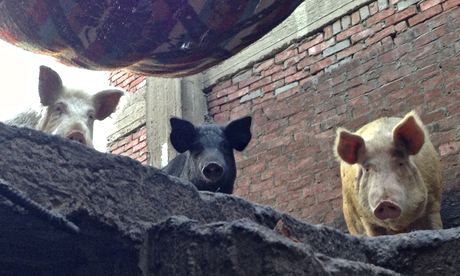
Up to 80,000 pigs are now getting stored in the Cairo suburb of Manshiyet Nasr. Coptic Christian breeders fed the city’s organic waste to the pigs. Photograph: Patrick Kingsley


The overthrow of Mohamed Morsi final year did little to help Egypt’s economy. But for the butchers and pig breeders of the slums close to Cairo, it has been an sudden fillip.


Five months ago, pork was so scarce in Cairo that a butcher like Bishoy Samir offered pig meat just twice a month. Now Samir reckons he sells an whole pig’s well worth of pork each day.


5 many years ago, the Egyptian government culled most of Egypt’s pig population, leaving Samir’s family members with nothing to serve. “It was quite unusual to discover some thing to cook,” Samir says. “We employed to function 1 week on, one week off.” But five months ago issues commenced to choose up, and “now we’re getting ready 1 pig a day – and other people are doing two or 3.”


Pork’s comeback began slowly following the 2011 revolution that toppled Hosni Mubarak, when some farmers started to breed small herds of pigs once again and hid them in their basements. But the revival was constrained until the fall of Morsi’s Muslim Brotherhood final July. Pig farming is nevertheless unlawful, but here and there smaller sized-scale breeders say they are now much more brazenly rebuilding a approach that was decimated in 2009.


“Under Morsi, absolutely everyone was afraid – people hid the reality we had pigs as they feared the government would come to kill them,” says Sayeed, yet another pork butcher in Cairo, who rears a now-expanding herd on the roof of his property in the east Cairo slum of Manshiyet Nasr.


“But right after Morsi left, that was that – it was freedom,” says Sayeed. “Now the government is pleased acting like they never know there are pigs here.”


Today, there are 50,000-80,000 pigs in Manshiyet Nasr, estimates Ezzat Naem, the head of the neighborhood workers’ union – far fewer than the 350,000 in 2009, but double or triple final year’s figure. A 12 months ago, Samir’s household was one particular of just two or 3 butchers who secretly grilled pork in Manshiyet Nasr, known internationally as Garbage City. Now locals say there are a dozen or so, as far more residents again turn parts of their houses into makeshift pig sties. Outside space is restricted, so the swine reside on the roof, or in converted bedrooms.


In 2009, government employees killed Egypt’s pigs in brutal trend – several of them buried alive in the desert, and covered in acid. Ostensibly, it was to ward off swine flu, then regarded a main risk. But World Health Organisation officials explained the pigs had nothing to do with the spread of the condition, top many of Egypt’s Coptic Christians – who type about ten% of the population and who run the pork industry – to see the cull as yet another bid to marginalise their minority.


They felt victimised for economic as effectively as social factors. The Christians of Manshiyet Nasr and half-a-dozen other Cairo slums are collectively recognized as the Zabaleen, or “garbage people”. They collect and recycle about two-thirds of the 15,000 tonnes of rubbish that Cairo generates day-to-day – and once fed the natural waste to their pigs. But that ended with the cull.


“It was revenge on the Christians of Egypt,” claims Father Barsoum Barsoum, a Coptic priest. This feeling of alienation rose beneath Morsi, when policemen and vigilantes besieged Egypt’s largest cathedral and fired teargas above the walls.


It was felt the president had accomplished tiny to condemn the violence. “Morsi didn’t care about the nation – he just cared about his group,” argues Abu John, who used to own a single of the largest pig herds in Manshiyet Nasr, as effectively as a chain of butchers. “As Christians, we felt like we couldn’t live in Egypt.”


Now Abu John feels a lot more at ease and is breeding far more pigs yet again – 10 times more than final year, he says.


The regional price tag of pork reflects this rise. A kilogram of pork at a close by butchers expenses about 50 Egyptian pounds (£4.30) down from E£70 final year (though nevertheless greater than the E£20 it would have cost 5 many years ago). “In the past 4 to 6 months, men and women have realised that it truly is far more lucrative once again,” says Ezzat Naem, the union leader and head of the Spirit of Youth, a regional non-governmental organisation.


But for the minute, the renaissance remains restricted to subsistence farmers in districts this kind of as Manshiyet Nasr, where the influence of the government is weak. Egypt’s two pig slaughterhouses continue to be closed, and the guys who as soon as bred the country’s biggest herds of pigs have refused to reopen their farms – and thereby spark a more substantial revival – while the practice is still illegal.


“If the government want to check out on any individual, we’re the very first on the checklist – so we will not want to consider the risk,” says Ihab Israil, whose family when owned Egypt’s biggest pork enterprise, but who are now diminished to importing mortadella. “I am not going to start off unless of course I get official documentation from the government. What we require is the slaughterhouses back.”


In other Zabaleen slums men and women are reluctant to speak about the pigs’ return. “No a single here is slaughtering pigs,” says Barsoum, whose parish is on the other side of Cairo. “And of program I miss it. There is practically nothing like barbecued pork.”


Added reporting by Manu Abdo


Morsi"s overthrow assists Egypt"s pork farmers get their sizzle back