Indian etiketine sahip kayıtlar gösteriliyor. Tüm kayıtları göster

31 Mart 2017 Cuma

New rules for Indian mothers – so long as the government accepts they exist

The Indian government’s new maternity bill, which comes into force this week, has been branded an elitist policy that will do little or nothing to help the vast majority of the country’s mothers.


According to women’s groups, the new rules – which raise maternity leave from 12 to 26 weeks, putting India ahead of France and the US – will apply only to a small fraction of the female workforce.


“It’s as if, for the government, 95% of India’s women don’t even exist,” said Juin Dutta, from Paatshala, a group helping impoverished female handicraft workers. She pointed out that the extension will only apply to women in the formal sector, which amounts to just 5% of India’s working women.


India’s prime minister, Narendra Modi, hailed the bill as “a step forward for Indian women” when he introduced details of the legislation on his monthly radio address this week.


“The basic aim is to ensure proper care of the newborn, the future citizen of India, from the time of birth,” he said. “The newborn should get the complete love and attention of the mother. That is how these children will become true assets of the country when they grow up. Mothers too will remain healthy.”


Internationally, the bill has been touted as a success for India, which has one of the world’s lowest female employment rates – 25% – and where mothers often feel under pressure to leave their jobs after having children. A headline in Fortune magazine said India’s move “puts the US to absolute shame”.


But most Indian women will never reap the benefits, according to the International Labour Organisation. “India’s informal economy is huge, it employs over 435 million men and women who never see the benefits of government laws,” said Aya Matsuura of the ILO.


“In the informal sector, you never have to sign a formal employment contract and your relationship with the employer is unclear. For example if women work as maids – and up to 10 million Indian women work as domestic cleaners or cooks – they will not have signed a contract. They have a verbal agreement, so in reality they are not really covered by formal rules and are not recognised by law.”


Those working in the informal industries are among the most vulnerable, Matsuura said: “They have problems. If a woman gets pregnant, she has to find a temporary replacement for herself, like a sister or a sister-in-law. Otherwise, she loses the job.”


Pratibha R, of the Garment and Textile Workers Union in Bangalore, said the bill did little to resolve the problems of working mothers. “Our members are entitled to the 26 weeks, but what happens after? According to the new law, workplaces are supposed to provide creches on site, and women are supposed to be able to go see their babies four times a day, but in practice that doesn’t happen.


“The facilities provided are unclean and low quality, women don’t feel comfortable leaving their babies there. Women are very afraid to leave small babies there, and so they just leave after pregnancy.”
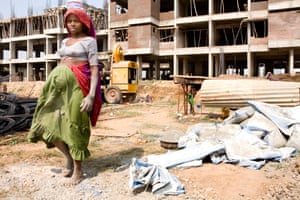


A pregnant female worker at a construction site in Ahmedabad, in India’s Gujarat state


A pregnant female worker at a construction site in Ahmedabad, in India’s Gujarat state. Photograph: Dinodia Photos/Alamy Stock Photo

A survey by the Associated Chambers of Commerce and Industry suggests that a quarter of women in India don’t return to work after having their babies.


Reducing that number could increase India’s national income by 27%, according to the International Monetary Fund.


But increasing female participation in India is complex, said economist Rupa Subramanya. Maternity benefits may make women more willing to work, but they also make employers less willing to hire them.


“India is still a developing country. Countries like Norway can afford to give mothers a year’s maternity leave now but they didn’t have that while they were still developing,” Subramanya said.


LocalCircles, a citizen engagement organisation that surveyed more than 4,000 small businesses about the new maternity rules, found that 26% of firms said they would favour men over women because of the new rules.


Yatish Rajawat, chief strategy officer for LocalCircles, said: “There is a lot of political correctness on hiring for diversity. Many people say something and do the opposite. The fact is that business dynamics will take over politically ‘right’ things. Now businesses are looking at women and thinking I’ll have to pay two persons’ salary for one person’s work. Now employers will not just look at women’s qualifications and capability but also the fact that they come with an additional cost.”


One solution, according to Naiyya Saggi, founder of BabyChakra, India’s largest online community of mothers, would be to introduce paid paternity leave. “When an employer is deciding between a man and a woman, the burden of parental leave should be equally shared,” said Saggi. “The government hasn’t put in place proper childcare infrastructure for women, and instead has passed that burden on to employers.”


She said women still feel taking any time off would have a negative impact on their careers. “Six months is a long time in today’s world, with automation and artificial intelligence. Mothers already feel they need to be reskilled after taking that much time off.”


But Nidhi Gupta from the Takshashila Institute, a thinktank, said the law was a step in the right direction despite its limitations.


She said: “Women bring as much skill and talent to the table as men do. We go to the best schools, best colleges, as we are as talented and skilled as men are. So why should we be excluded?”


The argument that employers will be reluctant to hire women over maternity leave is unproven. “In the UK, when they introduced the Equal Pay Act, the same argument was made,” said Gupta. “But actually studies have shown that it has not made employers less willing to hire women.”


New rules for Indian mothers – so long as the government accepts they exist

8 Şubat 2017 Çarşamba

Data inconclusive linking death and air pollution, says Indian minister

India’s environment minister has been accused of playing down the health risks of the country’s extremely polluted air by claiming, contrary to research, that there is no conclusive data available linking “death exclusively with air pollution”.


The environmental group Greenpeace released a report in January citing Global Burden of Disease (GBD) research that estimated nearly 1.2 million Indians die each year due to high concentrations of airborne pollutants such as dust, mould spores, arsenic, lead, nickel and the carcinogen chromium.


It found that no cities in northern India, and only a handful of regions in the rest of the country, met international air quality standards, with pollution rates particularly high in the capital, Delhi, and the neighbouring state Uttar Pradesh.


Asked about the report in India’s upper house, the environment minister, Anil Madhav Dave, said on Tuesday: “There is no conclusive data available in the country to establish direct correlation-ship of death exclusively with air pollution.”


He said the health effects of air pollution were a “synergistic manifestation of factors which include food habits, occupational habits, socio-economic status, medical history, immunity, heredity etc of the individuals”.


“Air pollution could be one of the triggering factors for respiratory associated ailments and diseases,” he added.


Sunil Dahiya, a campaigner with Greenpeace India, said the remarks were contrary to the findings of the GBD survey, a comprehensive global research program that monitors the causes of illness and death in every country in the world.


The 2015 edition of the survey estimated that 3,283 Indians died each day due to outdoor air pollution, making for around nearly 1.2 million deaths annually. Dahiya said the air pollution estimate controlled for “all imaginable risk factors, from obesity, to smoking and insufficient consumption of fresh fruit … and many other risks”.


“The number of deaths attributed to air pollution in the study are only due to air pollution,” he said.


Researchers have argued that the frequent inhalation of tiny pollutants in particular may increase the likelihood of blood clots, damage the body’s ability to oxygenate blood and inflame tissue in the nervous system.


India has been slower than its neighbour, China, to address the problem of toxic air, which in Delhi is attributed to a range of sources including road dust, vehicle exhaust fumes, open fires, industrial emissions and the burning of crop residues in neighbouring states.


But India has taken steps in the past two years to grow its network of air-quality monitors, push cleaner fuels, upgrade vehicle emissions standards and has mandated – but not yet fully rolled out – new technology to limit emissions from coal-fired power stations.


While acknowledging the problem, Indian government bodies have been sensitive about accepting international findings on the issue, rejecting a 2014 World Health Organisation study that declared Delhi the world’s most polluted city.


It has also repeatedly had run-ins with Greenpeace, temporarily freezing the NGO’s funding and accusing it of being one of several groups conspiring to stymie India’s economic growth.


Polash Mukherjee, a researcher with the Delhi-based Centre for Science and Environment, said different groups came up with different estimates of the number of deaths caused by air pollution because of varying methodologies or interpretations. “But what is undeniable is that there is an effect on the health of people,” he said.


The burden of harm from air pollution falls mainly on the poor, the elderly and children. A report from Unicef in October estimated that poor air quality contributed to the deaths of 600,000 children around the world each year.


Data inconclusive linking death and air pollution, says Indian minister

13 Ocak 2017 Cuma

Politics and protocol leave Indian teen"s life in the balance pending TB drug ruling | Amrit Dhillon

Shreya Tripathi sleeps most of the day. At night, she lies awake. Only 18, she has been fighting tuberculosis for five years. Her voice on the telephone from her home in Patna, eastern India, is a whisper. If she speaks for more than a few minutes, she becomes breathless.


Though exhausted, Shreya is also fighting another battle – in the Delhi high court – to demand a new TB drug. Every other medication she has tried has failed to beat the disease.


Shreya has a form of TB caused by bacteria resistant to treatment even with the most powerful drugs. She wants the Indian government to give her bedaquiline, the first new TB drug to be registered in more than 50 years. Its use is tightly controlled. Only six government hospitals are allowed to administer it, and even then only as a last resort.


India has one of the highest levels of drug-resistant tuberculosis in the world. To preserve bedaquiline’s effectiveness – if the bacteria mutate to resist it, there is nothing else available – the Indian government is strict on who can have it and how they are monitored. The National Institute of Tuberculosis and Respiratory Diseases in New Delhi, one of the authorised six centres, has refused to give Shreya the drug.


Shreya was diagnosed with TB in 2012, when she was 13. Doctors in Patna started her on a TB regimen but she proved resistant to the first and second lines of treatment. She and her father, Kaushal, a civil servant, are tired of running around hospitals getting nowhere, while Shreya’s condition worsens.


Two years ago, she had to drop out of school because she was so weak. She needs a wheelchair to get around. Swimming and badminton – her favourite sports – have become distant memories.


Shreya is a category five patient, which means she needs treatment for “extreme” drug resistant tuberculosis, or XDR-TB.


The family only became aware of bedaquiline in October, after a visit to Dr Zarir Udwadia, a consultant chest physician at Hinduja hospital in Mumbai. “It gave us hope. I was desperate by then because nothing had worked for my daughter,” says Kaushal.


Udwadia knew the exact combination of drugs that Shreya needed to take with bedaquiline, which does not work on its own. However, government protocol concerning the drug prevents him, as a private doctor, from accessing it. He told the family to get the drugs from the national institute in New Delhi, but they were refused because Shreya was not a resident.


“We argued and fought with them,” says Kaushal. “They agreed to take a sputum sample from Shreya in November for a drug susceptibility test to see which drugs she is resistant to, but they already knew she was drug resistant from earlier such tests. They wasted precious time.”


They kept calling the hospital for the result. Two months later, they were told the sample had been contaminated. On 28 December, Shreya provided a fresh sample and was told to wait four to six weeks for the culture.


“It was then I told Papa to go to court. Even if it’s too late for me, at least other patients will benefit from it. Just imagine how hard it must be for really poor people to get this drug,” says Shreya.


The case has been heard in Delhi high court this week.Saket Sikri, counsel for the national institute, says that the hospital cannot prescribe the other drugs that must be administered with bedaquiline until it gets the culture report.


“A wrong combination can kill and, since this drug is her last hope, we have to get it right. We are being humane, not bureaucratic, and are following World Health Organisation guidelines,” says Sikri. “The institute cannot choose which parts of the WHO protocol to follow and which to ignore.


“I think the judge’s final decision will hinge on whether he thinks my client is following WHO’s guidance on the use of [bedaquiline]. The judge can’t decide which doctor or which line of treatment is correct but he can judge if the guidelines are being followed and, in that respect, the institute is justified in waiting for the drug susceptibility test report to come.”


However, TB experts have said the culture the institute is awaiting is unnecessary, since it is already known that Shreya is drug resistant.


Anand Grover, a senior lawyer with the Lawyers Collective, which represents Shreya, says that the government has failed to update its own protocol to reflect the latest WHO guidance on bedaquiline, under which several XDR-TB patients have been put on drug regimens similar to the one prescribed by Udwadia. “There is evidence from other countries, including South Africa, showing that this combination has been successful in treating XDR-TB,” says Grover.


Grover has told the court that the prospect of Shreya losing her life without access to bedaquiline should outweigh concerns about any possible resistance that might occur. He has also told the court that the government is following the WHO protocol dating from 2013, when there was limited data on the efficacy and safety of the new drug.


Backing Shreya’s team is testimony from Dr Jennifer F Furin, from the Department of Global Health and Social Medicine at Harvard Medical School, who said Shreya should have been started on a bedaquiline-containing regimen in October.


“Additional delays … threaten her life and the effectiveness of this agent. It is unfortunate that there have already been so many significant delays in providing [bedaquiline] to Ms Tripathi,” said Dr Furin in her written testimony.


Dr Furin has previously criticised India for its slow rollout of the drug. In her Delhi high court testimony she said that scientific publications have set a benchmark that between 30% and 45% of patients with multi-drug resistant TB in a country should be able to access bedaquiline.


“In India, this means a minimum of 30,000 persons per year, based on 2016 estimates. As of 1 December 2016, only 164 individuals had been reported … to be receiving [bedaquiline]. This slow rollout … was noted as a problem by the WHO,” said Dr Furin.


There will be a further hearing on 18 January. “I don’t think the court will give it to me,” says Shreya. “But because of Papa’s efforts, at least other patients may get it later.”


Politics and protocol leave Indian teen"s life in the balance pending TB drug ruling | Amrit Dhillon

26 Nisan 2014 Cumartesi

Indian doctors interviewed on Skype to fill A&E vacancies

The recruitment drive comes amid growing concern about the standards essential for overseas doctors to work in the United kingdom.


Final week a study by University University London found that half of all foreign physicians practising in Britain would fail international competency exams if they have been held to the very same standard as Uk colleagues.


Even so, beneath the new plans, drawn up to tackle urgent employees shortages in casualty units, the recruits from India will be in a position to operate right here with no undergoing the exams.


For the duration of the past three years, 368 of 835 posts for expert instruction have gone unfilled, with escalating numbers of trainees selecting other specialities or emigrating amid warnings from senior colleagues that units are turning into “like war zones”.


Last evening, Britain’s most senior Accident and Emergency medical doctor explained the ideas were desperate – but had been required to conserve the NHS from a spiralling crisis.


Dr Cliff Mann, President of the School of Emergency Medication mentioned: “The pressures are heaped on Accident and Emergency we at present have the worst medical professional to patient ratio that we have ever had, with demand vastly outstripping provide.


“Having failed to recruit for the past 3 many years, I believe we have small selection other than to get methods like this simply because otherwise the situation can only get worse.”


To operate in the United kingdom, medical professionals from outdoors the EU are normally essential to undertake exams set by the Skilled and Linguistics Assessments Board.


Even so, health officials working the programme stated that as medical instruction in India follows the exact same curriculum as in the United kingdom, successful candidates will not have to undergo the exams, despite the fact that they will be required to get language tests.


Peter Walsh, chief executive of security campaigners Action towards Medical Accidents, explained: “I am truly concerned to hear about the exceptions getting produced to the typical principles. I can see that the scenario is urgent, but we actually need to steer clear of becoming forced to consider the sorts of panic measures which could compromise patient safety.”


Senior doctors say Accident and Emergency units are being “overwhelmed” by the number of sufferers arriving as emergency situations when they must have acquired help earlier from GPs and community services.


Dr Mann mentioned many trainee physicians had been turning to other specialities or emigrating because the pressures were as well fantastic.


Final yr, a research found that the amount of youthful doctors skilled in the Uk or Ireland but now doing work in Australian Accident and Emergency departments has risen by 69 per cent in the past five years.


Given that 2010, NHS hospitals have noticed a 60 per cent rise in paying on company physicians, with some locum medics paid up to £3,000 a shift last 12 months.


Interviews via Skype for the new programme are due to begin this week, followed by face-to-encounter interviews in New Delhi following month just before productive candidates begin perform in the Uk in August.


The programme is trying to recruit junior medical professionals who have just completed healthcare college, and trainees who have had two years’ training given that medical college, but have nevertheless to comprehensive professional coaching.


Officials said a lot more than 50 medical doctors could be recruited this yr depending on how numerous “appointable” candidates are found, with decisions yet to be taken about potential recruitment rounds.


Health Education England explained it has also taken steps to enhance the amount of United kingdom trainees getting into specialist instruction, by means of a new “run through” programme which implies medics can specialise earlier.


A spokesman said: “Our recommendations will ensure availability of far more physicians in emergency medicine in 2014, each in terms of appropriately competent middle grade medical professionals and added trainees for the future, to support guarantee that individuals receive consistent, substantial quality, secure and efficient care.”


Indian doctors interviewed on Skype to fill A&E vacancies