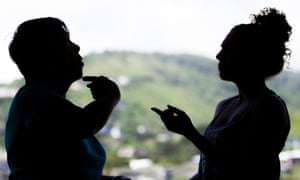
Yesterday I made history by becoming the first member of parliament to ask a question in the House of Commons using British Sign Language (BSL). I have always fought for equality for all, and am pleased to have been able to help raise awareness of BSL. But recognising one struggle should not detract from recognising another – it is important to focus on equality for deaf people and those who are hard of hearing.
I have submitted an early day motion, which I hope will speed the way towards a BSL Act
Tomorrow will be the 14th anniversary of the official recognition of BSL as a language in its own right. But my request yesterday was that BSL be given full legal status in this country, which is why I asked the minister to bring forward a BSL bill. It’s a big concern for a large part of our society. There is a significant BSL community in the UK with an estimated 151,000 BSL users, 87,000 of whom are deaf. A British Sign Language act would give BSL the same status that other languages have in the UK. Deaf people deserve the right to communicate and live their lives with their preferred language.
BSL has been used in the Commons before – but never to question the government. That’s why, as an ambassador for the Brent and Harrow United Deaf Club, in north-west London, I invited some members to watch proceedings from the House of Commons public gallery. I have a level two qualification in BSL, but to deliver a question under that kind of pressure was something else entirely – I was pretty nervous about getting it wrong!
However, I felt it was hugely important to raise this question using BSL, not only so that many deaf people and those hard of hearing could understand what I was asking, but also because it signifies the seriousness of the issue at hand. The MP Rosie Cooper, whose parents are deaf, helped me to rehearse, and Rachael Maskell, another Labour colleague, started signing to me when I sat next to her, which was a nice surprise.
We need to make parliament representative of wider society. One important part of this is to make parliament as open and accessible as possible. Some great steps for equality have been taken in the house, helped by the efforts of our modernising Speaker, John Bercow – but there is still much more to be done. So I’m delighted that asking my question in sign has raised awareness for this cause.
Tomorrow’s 14th anniversary of the official recognition of BSL was a hugely significant moment, and is a date to celebrate with great pride. It gave deaf people the basic recognition they deserve. But we must also acknowledge that there is still a way to go until BSL is equal under the law. The only way to give the deaf community the equality and recognition they deserve is to bring a British Sign Language bill before parliament to address all these issues. Such a law would surely garner support from all sides of the house.
Legal status would ensure that British Sign Language is protected. Information and services would be produced in BSL, therefore giving equal access. It could put BSL on the national curriculum and ensure that it is offered in schools, as other languages are. This would enable BSL users to access education in their first language.
Many won’t even realise that we are currently in the middle of #SignLanguageWeek, with charities raising awareness of the importance that BSL has on hundreds of thousands of lives – hopefully my question can help that cause. Earlier this week I held an event in the Speaker’s apartments to promote the UN international day against race discrimination (for which I will be leading a debate in Westminster Hall this coming Tuesday) – and I invited staff from St Michael’s Nursery, in Brent, who are unique in that they teach their children, aged four and five, sign language. All schools should follow that example and teach basic sign language.
I have submitted an early day motion, which I hope will speed the way towards a BSL Act. And I hope many more MPs will pledge their support to this important campaign in order to enshrine these rights into law. I know that colleagues from the Labour party will support this cause, but in order for such a law to pass, we need the government to get on board too. I hope that it will.
There are lots of words used to describe people such as me. Medics and their allies will use some Latin or Greek to make their language appear authoritative and scientific. According to them I am obese, or someone requiring bariatric intervention. By extension, in newspapers I am part of an anonymous population blob known as “the obese”.
If I go shopping for clothes I might be called plus size. If I meet someone who finds someone with a body like mine shameful, I might be euphemistically described as big or large. Others might try to spin this shame into something more positive and pretty, like curvy. If someone tries to translate my work, they might use words such as gordo, dicke, grasso, grande. In some places there might not be words for me, either because no language exists, or because some people relate to me through a lexicon of disapproving looks and disgusted sounds.
I like to call myself, and be called, fat. This is simple and descriptive and it feels powerful to reclaim a word that is frequently used pejoratively. I am a fat activist, which is a term that can mean many things, but for me it means that I think fat is a political subject.
Fat is typically framed as a health problem but health is not apolitical, as bodies of work in the social sciences have come to reveal. Debates about the NHS, and fat people being held responsible for funding crises, are just one area in which fat is a political subject. The social hatred and scapegoating of fat people can also be seen as political.
In my most recent book, Fat Activism: A Radical Social Movement, I argue that fat activism can be anything done by anyone for any reason. It is not necessarily about self-acceptance, improving health, developing self-love or addressing stigma – though that can be part of it. It can be as much about joining organisations as tweeting; as going to a fat clothes-swap as writing and sharing a poem; as having a conversation with someone as presenting a paper at a conference. It can be weird, illegible, ambiguous and antisocial. There is no singular way of being a fat activist.
I think the experience of being fat is valuable. This is heresy to those who think fat people should not exist
In calling myself fat I am drawing on a feminist practice of naming things in order to bring them into being. This means naming myself, on my own terms, and using language to define the world around me as I experience it. I do this because I think the experience of being fat is valuable. This is heresy to those who think fat people should not exist. But the view from the margins illuminates a lot about the shadow side of conformity, norms, and fears concerning embodiment and difference, and how these are manipulated for power and profit.
Earlier this year I published a homemade dictionary of fat activist words and concepts. I wanted to subvert the language of medicine and public health to give readers a playful glimpse of a subculture. Here are some examples.
Alliteration
A literary device that is irresistible to people writing about fat, especially journalists: piling on the pounds, fat fighters, weight watchers, and so on. Maybe they do this because fat is intrinsically funny to write about, not like serious stories or hard news.
Belly
The part of your body that’s under your tits and above your privates. Can be any size, shape, texture, colour, levels of hairiness, sweatiness. A place where fat accumulates on some people. Sometimes flops around, sometimes is bold and stout. Sometimes makes gurgling noises. Sometimes has creases and stretch marks. Sometimes has a mind of its own and will not behave. A delightful, gorgeous thing, a source of physical power much maligned and fretted over. Important resource in gut-barging competitions.
Calorie
A way of talking about energy that you get through eating food. An obsession. A pretty name for a girl child.
Fathlete
A fat athlete.
Thin
A person who is not fat. A person who is better-looking, healthier, more intelligent, more likely to succeed in life, sexier, more lovable and better to be with than any fat person. A very good and virtuous and normal person.
Wings
Fat upper arms that get more wobbly and loose with age. Source of power.
I created A Fat Activist Vernacular because I am interested in language and power in relation to fat people. The weight-loss industry is worth a fortune, and there is a lot of money and status riding on the question of who gets to define fat experience – generally public health politicians and their friends and allies in the weight-loss industry and medicine. My preference would be that this is a subject for fat people to work out for ourselves by valuing and sharing our own experiences. But there are many others with vested interests in owning and wielding this information.
The language of fat activism, frequently raw and emotive when people talk about being objects of hate, is being appropriated and gentrified by academics and professionals, tidied up and made respectable, while ousting the originators. You can see this in the transformation of the activist term fatphobia into the blandly inoffensive “weight bias”, which is sure to make its way into policy sometime soon.
My own term, “headless fatty” – referring to media images of fat people whose heads have been cropped out of the frame – was also cleaned up by a prominent academic at Yale as “headless stomach”. What happens more often is that fat activist originators of language and concepts are not cited, and their ideas become appropriated and made respectable without anyone being the wiser.
Meanwhile, at the age of 46, I have found other ways of speaking about this subject. After embarking a few years ago on a lifelong ambition of becoming a contemporary dancer, in November I will be dancing a piece called But Is it Healthy? in the Wellcome Collection’s Obesity gallery. I get asked the question all the time and it is impossible to answer it in words, not least because fat people are a diverse group, health is constructed in myriad ways, and expert science is not incontrovertible. So I will dance the answer instead! This will be performed as a duet by Kay Hyatt and me to a soundtrack I have made based on archival recordings by fat feminist activists made in 1980 by Karen Stimson at the New Haven Fat Women’s Health Conference. The speakers are Diane Denne, Judy Freespirit, Aldebaran and Judith Stein; a recording of Marcia Duvall, also present on the panel, has unfortunately been lost. These women are founders of many of the ideas circulating in fat activism today, but they have been neglected historically. I would love more people to know about their work.
The dance emerged from a period of research in which Hyatt and I explored what it is like to be continually asked: “But is it healthy?”; it brings together years of activism, explaining, patient listening and deep frustration in response to this question.
Through dance I am developing a different kind of language, using my body expressively and encountering audiences who have been worn down by the rhetoric of the obesity epidemic for the past decade and a half, and want something different.
I hope that by watching us dance in the Obesity display at the Wellcome Collection, audiences will understand that there are other ways of talking and thinking about fat than those which have been dominant in recent years. It is unbelievable that fat people like me have to lobby so very hard to be seen simply as human. I hope the dancing, and its soundtrack, helps people recognise that fat people have community, histories, cultures, agency, thoughts and lives all of our own.
• Charlotte Cooper and Kay Hyatt are performing on 4 November 2016 as part of the Friday Late Spectacular: Body Language at the Wellcome Collection
The NHS is faced with a rising tide of demand for care combined with a tight rein on both NHS and social care finances. The impact of these pressures is seen across the health and care system. It manifests itself obviously in delayed transfers out of hospitals.
Year on year these delays are rising, with more people staying in hospital when they don’t need to be there. It has an impact on the care of some of the frailest and most vulnerable people and is the subject of continued attention from the media, healthcare regulators and politicians.
When media and commentators discuss this issue it’s only a matter of time before a certain horrible term is used – “bed blocker”.
The phrase “blocked bed” originated in the UK in the late 50s, driven by hospital clinicians’ concerns about a lack of beds. Its use grew between 1961 and 1967, when the elderly population increased by 14% while bed numbers remained static. In 1986 “bed blocking” made its first appearance in a British Medical Journal headline. Although it was not accepted as a medical term, by the 90s it was being widely used by health economists as a marker of inefficiency.
The term persists to this day, despite many efforts to move away from it, such as the Department of Health’s redefinition of delayed discharge and delayed transfer in April 2001.
Surely the time has come to remember to whom bed blocking is referring. These “blockers” are often older people, who are frail and vulnerable and who would like nothing more than to return home to their families. The phrase “bed blocker” puts all the emphasis, and blame, on the individual. The reality is that it is the system that has failed to move quickly enough to put together the right package of care to enable the person in the bed to return home.
Language matters. How we talk about people reflects how we treat them and, in the health service, how we engage them in the care they receive. When we stop talking about people as people and instead use the language of the system (units, targets, blockers) we risk undermining the compassionate care the health service was created for and has delivered for almost 70 years.
I rarely hear anyone who works in the health and care sector use this phrase. Those working with and caring for people see the individual. They know their individual stories and what matters to them.
There is a quiet revolution under way in the NHS. It’s increasingly recognised that people should no longer be seen as passive recipients of their care but as participants in both the decision making process and the care they experience.
This is the right thing to do and what people want. But it is also a response to people’s changing health needs. With more and more people managing long-term conditions, sometimes more than one at a time, the old “patch ‘em up, ship ‘em out” approach is a thing of the past. The health service needs to work with people to manage their own care, and this means understanding their individual circumstances, wants and needs. To do this well also means looking beyond the health service towards their family life and other institutions like local government, schools and community groups.
The NHS Confederation brought together experts from across health and care to form a commission on improving urgent care for older people. In Sheffield, new processes discharge many more patients home, to be assessed there rather than in a mock environment in the ward. A saving of more than 30,000 bed days was recorded there over the first year and people report better experiences of care.
North east London foundation trust and the London Ambulance Service have together provided a home-based emergency assessment and care package for people who fall, resulting in only one in 20 recipients being admitted to hospital within 48 hours. There are similar examples in Derbyshire, Oldham, Greater Manchester, Norfolk, Aintree and right across the country.
The NHS has a way to go in making sure these examples make up a default approach. But the term “bed blocking” is unhelpful and arguably one of the most inappropriate terms in the healthcare lexicon. Let’s consign it to the dustbin and focus on what we know works both for the individual and the health and care system.
Join the Healthcare Professionals Network to read more pieces like this. And follow us on Twitter (@GdnHealthcare) to keep up with the latest healthcare news and views.
Patient safety could be at risk because doctors, nurses and dentists from elsewhere in Europe are not facing stringent enough language tests, leading medics have said.
In only one year, 29 medics from the European Economic Area faced allegations of “inadequate knowledge of English language”, according to data obtained by the Royal College of Surgeons.
By contrast, only 10 doctors from outside the EEA faced the same accusations during 2014/15, the figures obtained by the RCS from the General Medical Council show.
Under current EU rules, doctors coming to Britain from the EEA only have to show they have general English language skills. Those arriving from further afield have to prove their language abilities in a clinical context – showing they can talk fluently about symptoms and equipment. Brexit negotiations pose an “excellent opportunity” to ensure language checks are up to scratch, the RCS said.
Professor Nigel Hunt, dean of the faculty of dental surgery at the RCS, said: “The NHS would struggle to provide care in hospitals, clinics and dental practices without the very skilled doctors, dentists and nurses that come from both the EU and non-EU countries.
“It’s absolutely vital that the government find ways to ensure they can remain working in the NHS post-Brexit. That said it’s unquestionable that such staff should be able to communicate clearly with patients in English about their clinical problems, illnesses and treatment.
“While the professional regulators are able to require proof of the clinical language skills of non-EU applicants, the same checks do not apply to EEA applicants and our fear is that this could be putting patients at risk. We want the same rules to apply to all non-UK professionals, regardless of where in the world they come from.”
During 2014/15, 145 allegations were made about poor communication by dentists from the EEA compared with 27 about dentists from the rest of the world, according to data from a freedom of information request to the General Dental Council by the RCS.
A new briefing paper from the faculty of dental surgery at the RCS warns that despite attempts to improve language checks, EU law still prevents regulators from systematically testing EEA applicants’ language skills in a clinical setting, including on medical terms, ensuring consent, describing a procedure and possible side-effects.
A Department of Health spokesman said: “Patient safety is of the utmost importance, and we expect all healthcare professionals working in the UK to have a good command of the English language.
“That is why we have tough rules, allowing the GMC and individual employers to test employees at and beyond the initial point of employment – and these cases represent just 0.002% of NHS staff.”
Niall Dickson, chief executive of the General Medical Council, said: “Our language requirements are among the toughest in the world, and we keep them under regular review to make sure they continue to be effective.
“We have twice raised the standard in recent years and have secured a change in the law to allow us to take action against doctors who cannot communicate effectively.
“In the past we were not able to check doctors from Europe. Now we can and the difference is clear – this has been a huge step forward for patient safety. Since 2014 nearly 1,100 doctors from Europe have not met our English language requirements and cannot therefore practise in the UK.
“We have always argued that we should have the right to test the competence of European doctors as well as language and that remains our position.”
In 2013, at a conference on endangered languages, a retired teacher named Linda Lambrecht announced the extraordinary discovery of a previously unknown language. Lambrecht – who is Chinese-Hawaiian, 71 years old, warm but no-nonsense – called it Hawaii Sign Language, or HSL. In front of a room full of linguists, she demonstrated that its core vocabulary – words such as “mother”, “pig” and “small” – was distinct from that of other sign languages.
The linguists were immediately convinced. William O’Grady, the chair of the linguistics department at the University of Hawaii, called it “the first time in 80 years that a new language has been discovered in the United States — and maybe the last time.” But the new language found 80 years ago was in remote Alaska, whereas HSL was hiding in plain sight in Honolulu, a metropolitan area of nearly a million people. It was the kind of discovery that made the world seem larger.
The last-minute arrival of recognition and support for HSL was a powerful, almost surreal vindication for Lambrecht, whose first language is HSL. For decades, it was stigmatised or ignored; now the language has acquired an agreed-upon name, an official “language code” from the International Organization for Standardization, the attention of linguists around the world, and a three-year grant from the Endangered Languages Documentation Programme at the School of Oriental and African Studies in London.
But just as linguists were substantiating its existence, HSL stood on the brink of extinction, remembered by just a handful of signers. Unless the language made a miraculous recovery, Lambrecht feared that her announcement might turn out to be HSL’s obituary.
Three years after announcing its existence, Lambrecht is still unearthing her language sign by sign. She may be the only person in the world who still uses HSL on a regular basis, signing into a camera while a linguist named James “Woody” Woodward and a handful of graduate students from the University of Hawaii document her every move.
Led by Lambrecht, Woodward, and researcher Barbara Earth, the project aims to document what may be the last-ever conversations of native HSL signers. The goal is to record at least 20 hours of high-quality video footage of natural HSL and then transcribe, translate, and archive it. The researchers hope that this work – along with a series of illustrated handbooks depicting over 1,000 signs, and a regular class at the University of Hawaii set to begin next year – will jump-start the revitalisation of HSL.
The project faces numerous obstacles. The first is the scepticism of many of the remaining signers themselves. Hawaii’s tiny Deaf community is deeply divided. Some say HSL is not a real language, others see it as backward; still others are sceptical of Lambrecht.
Illustration by Christian Montenegro
But the gravest threat to HSL is American Sign Language (ASL), which is advancing across the globe – from Hawaii to Thailand to Togo – just as fast as English. The Deaf world, intensely local until recently, is consolidating and globalising in unprecedented ways. And the forward march of ASL, which in certain ways brings people together, also poses a significant danger to many of the estimated 400 sign languages used all over the world – most of which we know nothing about.
Hawaii is a bellwether, but Deaf culture all around the world – for many on the inside it is a “capital-D” culture, not a “lower-case-d” disability – faces threats from every direction. The “mainstreaming” of deaf students means that they are placed in hearing schools, where they are encouraged to be just like everyone else but with “special needs”, in a process that some call deliberate assimilation. Cochlear implants (and the potential of gene therapy) even more fundamentally endanger sign languages – some Deaf activists condemn such “cures” as being akin to genocide.
If the loss of a particular language such as HSL means the end of a whole expressive system, the disappearance of sign language in general – the only fully fledged form of language completely independent of speech – would permanently impoverish human communication.
Like every natural language, HSL is the evolved product of a specific history, the unconscious creation of a community. For it to survive, local signers will have to make a deliberate choice to use it. The same may be increasingly true of Deafness itself. The story of HSL raises crucial questions in an age of globalisation: Do cultures on the margins have a future? Will enough people choose to be that different, and will they do it together?
Though they parallel spoken languages in certain ways, sign languages represent a fundamentally different way of communicating. They neither derive from, nor correspond to, spoken languages. Nor are all sign languages mutually intelligible, as hearing people often assume – they are as various as spoken languages.
Their historical evolution is distinctive. Infants can sign before they can speak, and the great sign language linguist William Stokoe argued that sign may have preceded speech in the history of human language. It’s considered normal for one in 1,000 children to be born profoundly deaf, but places with higher rates of inherited deafness – such as the village of al-Sayyid in Israel and Bengkala in Bali – have been natural hotspots for sign languages.
For sign languages, and for Deaf culture more broadly, intergenerational transmission is far from straightforward. The vast majority of deaf adults give birth to hearing children, while most deaf children are born to hearing adults who have no connection with the Deaf communities.
Signing is not miming, and signs are not just gestures that anyone can immediately grasp
Signing is not miming, and signs are not “just” gestures that anyone can immediately grasp. “Iconic” signs, where the gesture self-evidently expresses meaning, play a role in every sign language, but even they can be wonderfully nuanced. In HSL, for instance, “cry” is signed with spread-finger “tears” running out from the sides of the eyes, while “bawl” has the fingers running straight down. Still, abstraction and convention are essential, just as in speech, because not everything can be expressed with self-evident gestures. There is nothing obvious, for example, about the HSL sign for “man” or “boy”: a spread hand moving down across the head.
For most of recorded history, sign languages have been effectively invisible to hearing people. It was not until William Stokoe’s groundbreaking study of ASL, published in 1960, that any sign language had been analysed as a fully fledged communication system with a grammar of its own. In 1965 Stokoe published an ASL dictionary, also the first of its kind.
Now that the kind of geographical isolation that once bred new languages is no more, sign languages represent something of a final frontier. “We really don’t know how many sign languages there are,” says Albert Bickford of the global sign languages team at the language database Ethnologue. “It seems reasonable to assume that the majority of sign languages currently in use in the world have not been discovered yet,” Victoria Nyst, a linguist at Leiden University, told me.
The most recent edition of Ethnologue, published earlier this year, mentions 141 sign languages. Over a hundred more have been reported, Bickford says, but no solid information on them exists – just the barest indication that Deaf people may sign differently in a particular place. We may never know much about these languages, or even confirm their existence.
Lambrecht’s announcement in 2013was the culmination of a lifetime of work. Born deaf, she hears almost nothing, barely even the noise of a siren blaring in her street. “I grew up very frustrated, thinking I’m not deaf, I’m not deaf, I’m hearing! I want to be an actress, I want to be a dancer, I want to be a movie star!” Lambrecht told me late last year at the University of Hawaii. “I was so frustrated that I couldn’t be those things.”
Teletype, an early form of texting, and closed captioning, which made TV and films accessible, were life-changing developments for her when they became widespread in the 1970s. “After that, I settled down,” she said. “I hated being deaf until that communication barrier broke down, when all those devices came out.”
The youngest of seven children, Lambrecht started signing HSL at home in the late 1940s – learning it from two of her older brothers, who were both deaf like her. She was probably one of the last people anywhere to learn HSL naturally, as a first language, and picking it up from family was particularly unusual. By then, the dorm at Hawaii’s only deaf school was the closest thing HSL had to a homeland – it was there that one of her brothers learned it.
But ASL was already coming in. Soon after the second world war, an unprecedented number of Deaf mainlanders came to Hawaii to work or retire. Within a few decades, ASL was dominant, HSL almost dormant. “We would get a lot of insults, a lot of negativity,” Lambrecht recalled. “Deaf people here would put themselves into an inferior category compared to the people who brought ASL. People said, ‘They’re from America, they’re white people, they know better.’”
Lambrecht made a living by teaching ASL for 33 years, mostly to hearing people, but in her spare time she pursued HSL, tracking down old signers in hospitals and nursing homes. “We used to go to the other islands to drum up people, and now they’re all dead, dead, dead,” her husband, Jeff, said. Interested mainlanders had documented a small number of local signs, and they encouraged Lambrecht to do more. Years in, she realised she had been collecting the remains of a complete and original language.
Without funding and without linguistic expertise, Lambrecht’s efforts stalled until 2007, when a woman named Barbara Earth came to Hawaii and enrolled in her ASL class. After a career working on gender and development in Asia and Africa, Earth was going deaf and wanted to learn how to sign.
Embracing Lambrecht’s cause and digging into HSL history, Earth hunted for money to support the project. Three years later, she found enough for a pilot study, interviewing 19 elderly Deaf people and two children of Deaf adults on four Hawaiian islands. William O’Grady, the linguistics department chair at the University of Hawaii, agreed to host the project at the university: “Barbara knocked on my door and said there was an unknown sign language here in Hawaii, and she needed help to prove that it existed.”
Linda Lambrecht, left, teaches Hawaii Sign Language. Photograph: Eugene Tanner Photography, LLC
An initial estimate of up to 280 surviving HSL signers was soon revised down to 40, then down to just 10 or so old-timers still likely to be competent in HSL. ASL had made deep inroads even among these signers, but there was evidence, especially from Lambrecht’s signs, that HSL was distinct, and lay close enough to the surface to be recovered. Spoken languages such as Basque, Welsh, and Hawaiian have come back from the brink of extinction – could HSL be the first sign language to do it?
For James Woodward, the mass extinctionof sign languages is bound up in prejudice and chauvinism. He believes that every local sign language should have the chance to become a valued, modernised language of education, giving communities a choice and a chance at continuity. Like the spread of English, the triumph of ASL might enable communication, but convenience cannot replace intimacy and history, which people soon forget ever existed.
Related: Signs of the times: deaf community minds its language
One day late last year in Honolulu, I sat in on a gathering that included some of the last active HSL signers. Besides Lambrecht, there were the three other elderly signers who had joined the project within the last year. Their funny and furious signing was almost all in ASL, as usual, but here and there old bits of HSL were surfacing.
“Is this Deaf culture or what!?” Hilda Lopez signed. “I love it, I love it, I love it.” She kissed her own hands as she signed. “HSL is really number one in my life. The ones who don’t like it are small-minded!”
Lopez explained to me that her first name in English is Hilda, but her name sign – her real, everyday name in the Deaf community – is a pointing gesture towards the mouth, based on an incident at her fifth birthday party when someone fired a BB gun and shot out some of her teeth. It’s a classic HSL name sign: blunt, comic and personal, based on physical characteristics and memorable incidents.
Like any language, HSL can be broken down by linguists, but its personality, its characteristic style of discourse, is harder to get a handle on. Even when signing ASL, Lopez seems to embody the HSL style. “When they’re using ASL, people talk too long and make other people bored,” she told me. “HSL is short and thrilling and fast.”
HSL has a bigger ‘signing space’ than ASL – anywhere from the top of the head to the bottom of the torso
HSL has a bigger “signing space” than ASL – meaningful signs can be made anywhere from the top of the head to the bottom of the torso. Signs that occur not on the hands but elsewhere on the body also play an important role. “Kick” is signed only with the leg, for instance, while a raised eyebrow is a vital bit of grammar, signalling a yes or no question, or a conditional clause beginning with “if”. The “vocalisations” accompanying certain signs, which fellow signers can sometimes lip-read, echo different spoken languages: borrowed words from Hawaiian, English and Hawaii Pidgin.
Lopez thinks and talks to herself in sign. “I’m 100% Deaf!” she said proudly. “I don’t hear sound, but I can feel it, I feel the body vibrations in my chest: bass drums, police sirens. The only thing I can hear is fireworks — I don’t like the smell of them, they make me sick, but I like the noise and vibration.”
Lopez never knew her biological parents, but she is fiercely proud of her Native Hawaiian and mixed-ethnic roots. At least one piece of evidence, an 1821 letter discovered by Barbara Earth, seems to link HSL to the Native Hawaiian past. In that year, an American missionary, newly arrived in the Kingdom of Hawaii, met a deaf man and bargained with him over 40 sticks of firewood and a pig. Some of the man’s signs were “in common use”, seemingly among both deaf and hearing people, wrote the missionary. The signs he recorded for “pig”, “money”, “see”, and a system of counting by clapping, are still present in HSL today.
The rate of inherited deafness in Hawaii is normal. But by the late 19th century, waves of Japanese, Chinese, Portuguese and Filipino immigrants were coming to Hawaii to work on the American-run plantations, and a new multi-racial Deaf community took shape in Honolulu, including boot shiners, launderers, and flower sellers. There was even what a contemporary newspaper called a “fancy deaf wedding”, where 80 of the guests used “the sign language”.
“The turning point, the beginning of the end of HSL,” according to Barbara Earth, was the founding of Hawaii’s deaf school in 1914. Like most schools at the time, it promoted oralism, the system of lip-reading and speaking that is almost universally despised in Deaf communities for being painful, unnatural and ineffective. But for a while the school was also a unique environment for the clandestine transmission of HSL. One former student, Norman Galapin, told me that he learned HSL “on the playgrounds and in the dorm”, though “if the teacher saw you signing, sometimes they would slap your hands, or hit you with a ruler, or pinch your cheek.”
During the 1940s, HSL was already a language in transition, according to Galapin: “They weren’t using the old [HSL] sign for ‘mother’, they were using this [ASL] one, but they were still using the old sign for ‘father’.” Starting in 1939, a few charismatic teachers from the mainland played a vital role in overturning oralism and legitimising sign language, but they ended up promoting ASL over HSL in the process.
Employment, education and access to government services – from court interpreters to mental health provision in sign language – were perennial problems in the community, but many deaf Hawaiians thrived as master carpenters, printers, mechanics, postal workers and even ukulele makers. As elsewhere, an informal Deaf Club was at the centre of an unusually tightknit community, organising Christmas parties, bowling nights and an annual summer camp-out on the beach, with up to 100 people fishing and cooking for two weeks straight.
Yet Hilda Lopez, like many Deaf Hawaiians, left Hawaii for the mainland for education and for work, arriving in California in her teens. The culture shock was intense: “It was all ASL, and I wasn’t really comfortable with it,” she said. “People seemed to know so much, I felt that I wasn’t very smart…. I got confused and I lost HSL, I didn’t really remember it any more.” Only now, haltingly peeling away the layers of ASL, is she starting to reclaim the language.
No other sign language comes close to having the influence of ASL. Accurate, up-to-date signer numbers do not exist for any sign language, but most of the larger ones are not even yet secure in their own countries. There are more than 20 million deaf people in China, for instance, but Chinese Sign Language, which has hardly been documented, has only been acknowledged as a distinct language for the last 30 years.
By comparison, ASL is a powerhouse, supported and promoted by institutions such as the National Association of the Deaf, and Gallaudet University in Washington DC, which describes itself as “the world’s only university with programmes and services specifically designed to accommodate deaf and hard of hearing students”. Gallaudet plays a critical role in the American Deaf community and in the life of ASL. Until recently, the university supported both a college prep centre in Honolulu (to ensure qualified deaf applicants to Gallaudet) and ASL interpreter training in Hawaii (to bolster ASL more broadly).
Linda Lambrecht having a conversation in Hawaii Sign Language, Honolulu. Photograph: Eugene Tanner Photography, LLC
ASL may now be going global, but the language is at least partly rooted in local sign languages that have long since gone extinct. French Sign Language was the first modern, “methodical” sign language, codified in the 1760s and 70s for formal instruction from existing signs used in the Deaf community of Paris by the Abbé Charles-Michel de l’Épée. When America’s first school for the deaf opened in Hartford, Connecticut in 1817, French Sign Language was imported and likely fused with a handful of existing New England sign languages. The result was ASL. (British Sign Language, dominant in the UK but only granted official status in 2003, is not directly related to ASL.)
Today, there are at least 500,000 ASL signers in the US, while ASL and ASL-derived sign languages are also widespread across the Caribbean, the Pacific and much of Africa and south-east Asia. The language’s increasing dominance in countries on every continent reflects the strength of Deaf culture in America and the role that well-meaning American missionaries and educators have played in spreading Deaf education through ASL.
In the past, James Woodward told me, missionaries would often tell deaf people in other countries that they didn’t have a language. “It’s improving now,” he added, “but I saw that going on as late as 1999 in Thailand, when some Americans came over. I think there’s a growing awareness in the Deaf community in the US of how ASL has really endangered many other sign languages, and even destroyed some.”
As with English, prestige plays a major role in the growth of ASL. The linguist Victoria Nyst has written that “signers in West Africa tend to perceive ASL-based sign languages as being superior to sign languages of local origin.” Similarly, Misella Tomita, a young Gallaudet graduate from Hawaii, described visiting the Netherlands and seeing everyone using ASL rather than Dutch Sign Language: “I felt like ASL is taking over the world.” Closer to home, Woodward has studied Black ASL, which seems to have evolved in the second half of the 19th century at segregated deaf schools in the southern US. The dialect, which is an inspiration to Lambrecht, carries a heavy stigma and has become highly endangered. Almost all black signers now use standard ASL.
At the Hawaii School for the Deaf and Blind, ASL became the standard in 1960. Today, more than half the teachers are Deaf and students are expected to sign ASL while learning to read and write English. HSL is only used, occasionally, by one dedicated teacher, and Linda’s proposal to teach the language there was turned down.
“I think ASL is the reason for the decline of HSL,” Woodward told me matter-of-factly, but then added: “You can’t really separate the personal issues from the linguistic issues.”
The impending disappearance of a language puts enormous stress on a community. For years, the last two fluent speakers of Ayapaneco in Mexico were not on speaking terms, until outside pressures and incentives convinced them to reconcile. According to William O’Grady, one language with just 60 speakers has four competing writing systems. In any community that speaks an endangered language, there are often groups who think the language is not worth saving. “But usually when it’s too late, there’s a deep sense of regret,” O’Grady said.
In Hawaii, the remaining community of HSL signers is deeply divided. Lambrecht is the face of the language, but as a past president of the Aloha State Association of the Deaf (ASAD), she is on the opposite “side” from many of the older signers, who belong to a group known as the Diamond Head School Alumni (after the former name of the deaf school).
The impending disappearance of a language puts stress on a community. The remaining HSL speakers are deeply divided
The two organisations are the institutional expression of a seemingly intractable split in the Deaf community that dates back to at least the 1970s. Some explain it as generational, historical and linguistic, but it is also personal, visceral and mysteriously self-perpetuating. In 2014, when the deaf school marked its 100th anniversary, there were two separate celebrations: one for the Diamond Head group, one for the group Lambrecht is a part of. “I feel like it’s just natural now, this fighting,” Lopez told me.
Because HSL was in retreat by the 1950s, most younger Deaf people can hardly sign in the language – there was virtually nowhere for them to pick it up. Many take great pride in their identity as Deaf Hawaiians and emphatically support HSL as a symbol of that identity. But some of the most fluent of the older HSL signers, in the Diamond Head group, are deeply ambivalent about reviving the language. “Even though they use it in their conversations, they don’t feel that HSL is a real language,” said Darlene Ewan, a community activist who teaches at the deaf school.
Early on, Wanda Andrew, who is part of the Diamond Head group, warned off the researchers: “I said, ‘To tell you the truth, for HSL it’s too late, it’s dead,’” she told me. “The loss of HSL is sad, but it was just sort of a mixture of everything, like chop suey, just kind of like an accent.” For Andrew, who is in her 70s, ASL enabled a cosmopolitan life, from studies at Gallaudet to decades on the mainland and eventual marriage to a Deaf Australian man.
Explaining why some keep their distance from the project, Andrew added that “People will just say they don’t want to, because they don’t want to work with Linda.” She continued, “And if they don’t remember [signs], then they just don’t remember [them]. Or they might be afraid of what it’s for, or they don’t want to feel dumb… I don’t support Linda, I think she’s a little narcissistic.”
Others close to the Diamond Head group agreed that personal animosity and questions of authority – whose signs to record and revitalise? – are part of the problem. Lambrecht’s supporters counter that she has almost single-handedly led the revitalisation effort. Lambrecht herself points to the lingering power of the stigma: “HSL is in their hearts, but they’re resistant. They want to be modern.”
The divide, which has implications for how the language is documented, is now reflected in a similar rift between the researchers. Earth and Woodward now acknowledge that ASL must have had a deeper impact than was initially understood, obliterating HSL and leaving in its place a hybrid of ASL and HSL that Woodward calls CHSL (Creolised HSL).
Earth believes that when signers refer to HSL today, they may actually mean CHSL – a view Woodward does not share.After meeting more members of the Diamond Head group, Earth argues that CHSL is the only thing left: “I have never seen pure HSL. Fewer and fewer old folks retain strong HSL elements… They cannot recover pure HSL because they never knew it.” Woodward counters that “the past two years have shown that Lambrecht is using a different language from CHSL” – during recording sessions where Earth, increasingly estranged from the project, was not present.
The signs for “blue”, “green” and “yellow” have become a particular flashpoint in this dispute. Woodward argues that Lambrecht’s distinctive signs for these colour terms make semantic sense, because they are clearly related to the HSL signs for “water”, “bamboo” and “pineapple”. But other signers were incredulous, saying they had never seen the signs before and suggesting that they might be specific to Lambrecht or her family. Their own signs for those colours were basically ASL, and they couldn’t remember any others that might be original to HSL. Earth felt that the pressure to find such “original” non-ASL signs risked distorting the research.
“If no other person has a sign and Linda has a sign, I don’t know what else to do except use her sign,” said Woodward, who worked with the last known signer of Chiang Mai Sign Language in northern Thailand before he died of complications from diabetes in early 2015. Lambrecht’s signs for “blue”, “green”, and “yellow” are likely to be the standard for teaching HSL going forward. “If there’s only one person left,” Woodward said, “then that’s what you have to document.”
Now in its final month, the three-year project to document and revitalise HSL has made progress, but the hardest work remains ahead. “We haven’t been able to do everything we wanted,” Woodward told me recently. He is applying to the Endangered Languages Documentation Programme for a six-month grant extension. Even now, he said, the team is still finding new signs.
While she continues her work with Woodward, Lambrecht is looking beyond Hawaii, since ASL is spreading to other islands across the Pacific: “I want to tell people there: it’s not that you’re stuck with your local sign language, you can borrow signs from ASL, but please don’t throw out your local language.” Woodward believes that many of the Pacific’s innumerable islands had, or may still have, traditional, indigenous sign languages of their own – he has already identified one on Majuro, one of the Marshall Islands.
“Time is passing quickly,” Lambrecht said the last time I talked to her. The oldest signer who had joined the project, a Japanese-Hawaiian woman named Mildred, was dying. “I remember Mildred would always tell me, ‘I don’t like HSL, I like ASL, it’s for educated people like me,’ and I would say, ‘No, no, no, it’s our local language!’” Mildred was seen as one of HSL’s remaining masters, but she had been reluctant to sign for the camera when I visited last year.
Then in February, Linda told me, Mildred had a bad fall and went to the hospital. She couldn’t walk and was now under hospice care, living with her son. Linda visited her recently: “I saw her signing – and I noticed that she had reverted to HSL. We were just shocked. The others didn’t understand her, I said let me translate. Now when I visit her I try to catch every story I can, while she’s still here. Next time I go I really want to bring the camera and record her.”
• Follow the Long Read on Twitter at @gdnlongread, or sign up to the long read weekly email here.
The previous saying that we can solve difficulties more properly when we “sleep on it” may be especially real if the issue we’re striving to resolve is studying a new language.
Researchers from two Swiss universities desired to know if they could increase the learning of phrases from a foreign language by exposing individuals to the phrases in the course of non-quick eye movement sleep (NonREM sleep) – the deep, dreamless rest time period that most of us knowledge for the duration of the very first number of hours of the night.
To discover out, they gathered two groups of study participants, all of whom were native German speakers, and gave them a series of Dutch-to-German word pairs to learn at 10 pm. One particular group was then instructed to get some sleep, although the other group was kept awake. For the up coming handful of hours the two groups listened to an audio playback of the word pairs they’d currently been exposed to and some that they hadn’t however heard.
The researchers then re-gathered the two groups at two am and gave them a check of the Dutch words to uncover any variations in learning.
And certainly there was a distinction: the group that listened to the phrases for the duration of NonREM sleep did drastically better at recalling the phrases they’d heard at 10pm.
The basic however potent trick the researchers employed is acknowledged as “verbal cueing,” and this isn’t the 1st declare created for its accomplishment although sleeping. But what can make this review various is that it puts a finer point on the situations necessary for this trick to truly work—namely, it only operates when we’ve already been exposed to the verbal cues before we rest.
The researchers extra a techie dimension by conducting electroencephalographic (EEG) recordings of the sleeping participants’ brains to track neural electrical action throughout the understanding time period. They found that finding out the foreign phrases overlapped with the appearance of theta brain waves, an intriguing consequence since theta is the brain wave state often related with heightened understanding whilst awake (usually we’re in either the large-frequency, higher-alertness alpha or beta states while awake, but it’s believed achievable to induce theta state—slower in frequency than alpha and beta—through concentration techniques).
So, to make useful use of these findings you will require to make positive of two circumstances: only perform audio of foreign words you’ve currently heard, and set the audio to run for the first two to 3 hrs of sleep. When you wake, give oneself a quiz to test your recall. Do that for a couple of weeks just before going on the big overseas vacation, and you will most likely discover your self communicating more fluently with the locals.
The research was published in the journal Cerebral Cortex.
You can discover David DiSalvo on Twitter @neuronarrative and at his website The Everyday Brain. His most recent guide is Brain Changer: How Harnessing Your Brain’s Electrical power To Adapt Can Alter Your Lifestyle.
The participants had been offered an intelligence check in 1947 at the age of eleven and have been retested in their early 70s, amongst 2008 and 2010. Of the participants, 262 explained they had been in a position to talk in at least one particular language other than English. Of people, 195 learned the second language ahead of the age of 18, while 65 learned the language after this age.
Researchers found that individuals who spoke two or far more languages had considerably far better cognitive talents in later existence, in contrast to what would be predicted from their overall performance in the tests at age eleven.
The strongest results had been noticed in basic intelligence and reading. Researchers said the results were existing in individuals who acquired their second language later in lifestyle, as well as early.
No unfavorable results of bilingualism have been observed in any group.
Dr Bak stated the improvements in cognitive improvement could not be explained by unique levels of intelligence.
He added: “These findings are of substantial sensible relevance. Millions of men and women close to the world get their 2nd language later on in lifestyle. Our examine exhibits that bilingualism, even when acquired in adulthood, might advantage the ageing brain.”
Dr. Alvaro Pascual-Leone, a professor of medication at Harvard Medical College mentioned, “The epidemiological examine gives an essential 1st phase in comprehending the influence of learning a second language and the ageing brain.
This research paves the way for future causal scientific studies of bilingualism and cognitive decline prevention.”
Caroline Abrahams, charity director at Age Uk which supported the investigation, said: “Over 1 million folks in the United kingdom aged 65 and more than are estimated to have some degree of cognitive impairment. We urgently need to realize what influences cognitive ageing so that we can give individuals far better tips about protecting their cognitive well being. This most current breakthrough is another stride forward in obtaining out how considering capabilities can be preserved in later on life.”