bigger etiketine sahip kayıtlar gösteriliyor. Tüm kayıtları göster

16 Mayıs 2017 Salı

Yes, Barbie has got bigger. But her old body-image message endures | Afua Hirsch

“Eurgh! This doll’s fat!” Those were the words of my five-year-old daughter and seven-year-old niece on encountering the Fashionistas range of new-size Barbies in a toyshop this weekend. To describe these dolls as “plus size” would be an exaggeration. But, given the emaciated state of regular Barbies, I can see what the fuss is about. These dolls look normal – and normal, in a Barbie context, looks decidedly weird.


I have to act. “See these Barbies,” I say, pointing at the more traditional ones. “They are really hungry. They haven’t had enough to eat. But these new Barbies” – I hold up a Fashionista – “feel much better. They’ve got strong legs, see?”


“Ohhhh,” one of them nods. I realise my explanation is not perfect: I don’t want these two telling skinnier children in the playground that they’re malnourished. But given that traditional Barbies represent the body shape of 1 in 100,000 real-life women, have a waist size 20cm smaller than a group of anorexia sufferers, and would have insufficient body fat to menstruate, I’ll take my chances.


There is no ideal way to counter the messages these impressionable young girls are absorbing about body image. I welcome the fact that Barbies now come in four body types and seven skin tones, and wear their hair in braids or Afros. Beyoncé’s stylist, Marni Senofonte, who designed those dolls, says: “I want a girl who is not necessarily small to say: ‘OK, I could wear a crop top, and I could wear jeans with big holes in and fishnets underneath it, and I am cute.’”


That’s great. But let’s not forget that the legacy of old Barbie – who in 1963 was released with a book entitled How to Lose Weight – looms large. So much so that when a five and seven year old – neither of whom have yet graduated on to being critical of their own bodies, thankfully – see a doll with a normal figure, their initial reaction was disgust.


The small world of Brexit
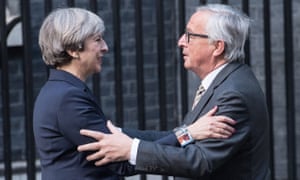


Theresa May greets Jean-Claude Juncker at 10 Downing Street.


Theresa May greets Jean-Claude Juncker at 10 Downing Street. Photograph: Carl Court/Getty Images

There has been plenty of debate about the estimated rise in hate crime since the EU referendum, which ranges from 40% to 100%. But less often discussed is the impact of the vote on British people’s sense of identity.


A recent report suggests that this is widespread, and perhaps more enduring. It finds that, since the referendum, ethnic minorities in the UK are now less likely to identify as British, and more likely to claim the identity of their ethnic heritage instead.


White British people too are becoming less likely to embrace Britishness or other national identities, such as English or Scottish, and more likely to identify with their local area or community. They have, according to Opinium, “withdrawn from a wider sense of belonging to focusing in on the immediate world around them”. Long after the bickering of Theresa May and Jean-Claude Juncker, these injuries to our identity will remain.


Celebrity shares



Stormzy at the Brixton Academy.


Stormzy at the Brixton Academy. Photograph: PJP photos/Rex Features

Labour has now pledged in its manifesto to scrap university tuition fees in its manifesto launch todayyesterday. But if, as is widely predicted, the Tories win, fees are likely to rise above the current £9,000 a year; and as long as they do so, inevitable comparisons will continue to be made with the cost of study in the US, which currently averages a cool $ 33,000 (£26,000) a year at a private college.


If we are going to have US-style fees, we will need US style benefactors, made generous by US-style salaries, which are 50% higher than UK equivalents in some sectors.


In the meantime, celebrities have been stepping in. The UK rapper Stormzy this week became the latest to dip into his fortune, giving a final-year Oxford student £9,000 to do her master’s at Harvard. With some of the funding promises currently going around, I wouldn’t be surprised if sourcing donations from superstars appears somewhere as an election pledge.


Yes, Barbie has got bigger. But her old body-image message endures | Afua Hirsch

22 Kasım 2016 Salı

Private firms should have bigger role in care says NHS leader

A senior NHS leader has sparked controversy by urging ministers and health service bosses to let private firms treat more patients in a bid to cut hospital waiting lists.


Stephen Dalton, the chief executive of the NHS Confederation, said Theresa May and Jeremy Corbyn should stop denying that private sector health companies are “a force for good” in the NHS. They are not “bogeymen”, look after patients well and should start treating more than the 10 million patients a year they are already paid for out of the NHS’s budget, he said.


The service is under such intense pressure that private firms should urgently be handed a greatly enhanced role, just as Tony Blair’s Labour government did in the early 2000s, in order to help it cope with fast-rising demand, Dalton argues in an article in Tuesday’s Guardian.


“What was seen a decade or so ago as a sensible way of attracting investment, and helped get average waiting times down from 18 months to 18 weeks, is now seen as a political no-go area, with the Tories and Labour locked in an arms race over who has used the private sector the least while in office”, Dalton writes.


“This is a con-trick, when the reality is that the private sector has been used for decades to help sustain a health service which is free at the point of use and available to all based on need and not ability to pay. So let’s stop pretending that private sector involvement in the NHS is a uniformly bad thing; it isn’t.”


Dalton also wants private firms to help provide the “billions” of pounds needed to build a new generation of hospitals and clinics as part of the NHS’s Sustainability and Transformation Plans, though acknowledged that lessons should be learned from Labour’s use of the discredited Private Finance Initiative.


The Confederation represents most of England’s 238 NHS acute, mental health, ambulance and community services trust but also, through its NHS Partners Network, private firms who have been awarded contracts to treat patients.


But Dalton’s views prompted warnings that the private sector’s track record in the NHS made it unfit to expand its role and that handing it more contracts would pose “serious dangers” to patient care. The firm Coperforma recently lost its contract to ferry tens of thousands of patients in Sussex to and from hospital after a string of blunders sparked huge concern.


Two former health ministers said they shared Dalton’s belief that private firms can deliver real benefits for patients and his belief that “the public sector doesn’t have the monopoly on caring.”


“What matters is what works best for patients”, said Conservative MP Dr Daniel Poulter, who was a health minister until May 2015 and is also doctor in the NHS. The fact that GPs and pharmacies work closely with the NHS but operate outside it shows that the NHS has always been a public/private partnership, he added.


Liberal Democrat MP Norman Lamb, who was also part of the health ministerial team during the coalition, said: “We should focus on the quality of care and equal access rather than on who provides it. Around the country there are good collaborations between statutory and independent sector, which I welcome.”


But both MPs said they feared that a greater private sector role could threaten the drive to integrate NHS and social care services, which the government has pledged to deliver by 2020. “While there is undoubtedly considerable benefit to the approach taken by Tony Blair of using the private sector to help the NHS to increase capacity, the history of wider private sector NHS commissioning tells us that private providers tend to ‘cherry pick’ the most profitable services to deliver,” said Poulter.


“So there is undoubtedly a serious danger that widespread commissioning of alternative – private – providers will result in greater fragmentation of the health and care system at the very time when there is need for increasing integration of services.”


Lamb warned against relying on private capital to build new NHS premises. “We must never again allow the outrageous profiteering under the last Labour government’s Private Finance Initiative, which has mortgaged the future of the NHS to the tune of tens of billions of pounds.”


Labour rejected Dalton’s call and said that problems with contracts previously awarded to private firms meant they could not be trusted to expand their role.


“In recent times private providers have utterly failed to offer patients the quality of care they would expect. What’s more when the priority should be public investment in the NHS, privatisation such as the selling off of NHS Professionals announced last week could very well end up costing the taxpayer more”, said Jon Ashworth, the shadow health secretary.


Dalton’s plea was prompted by ministers denying the NHS enough money to do its job properly, he added. “It is indicative of the government’s neglect of our NHS that senior figures are saying we now must resort to the private sector for the investment our NHS so badly needs”.


At last month’s Conservative annual conference Theresa May used her set piece speech to deny Labour claims that her government was privatising the NHS. “Every election, they say we want to privatise the NHS – and every time we have protected it. In fact, the party that expanded the use of the private sector in the NHS the fastest was not this party, but the Labour Party”, she said.


The Department of Health said only that “Any decisions about use of the private sector are taken by local doctors who know their patients best. We are clear that patients should be able to access the best possible treatments based on quality of care not the provider.”


Private firms should have bigger role in care says NHS leader