disability etiketine sahip kayıtlar gösteriliyor. Tüm kayıtları göster

31 Mart 2017 Cuma

Depression is leading cause of disability worldwide, says WHO study

Cases of depression have ballooned almost 20% in a decade, making the debilitating disorder the leading cause of disability worldwide, the World Health Organization (WHO) has said.


By 2015, the number of people globally living with depression, according to a revised definition, had reached 322m, up 18.4% since 2005, the UN agency said on Thursday.


“These new figures are a wake-up call for all countries to rethink their approaches to mental health and to treat it with the urgency that it deserves,” WHO chief Margaret Chan said.


According to the agency’s definition, depression is a “persistent sadness and a loss of interest in activities that people normally enjoy, accompanied by an inability to carry out daily activities for two weeks or more”.


Lack of energy, shifts in appetite or sleep patterns, substance abuse, anxiety, feelings of worthlessness and thoughts of self-harm or suicide are also common, and can affect entire families.


Jamal Edwards breaks taboos around men’s mental health

The drop in productivity, and other medical conditions often linked to depression, also takes a financial toll, with the global cost estimated at $ 1tn annually, the WHO said.


Shekhar Saxena, head of the agency’s mental health and substance abuse department, said both psychosocial and medical treatments could be highly effective, insisting on the importance of reaching more of those in need.


Even in the most developed countries, about half of people suffering from depression are not diagnosed or treated, and the percentage soars to between 80-90% in less developed nations.


Treatment can be difficult to access, while a fear of stigma also prevents many people from seeking the help required to live healthy and productive lives, the agency said.


According to the WHO, every dollar invested in improving access to treatment leads to a return of $ 4 in better health and productivity.


And “early identification and treatment of depression is a very effective means of decreasing death by suicide,” Saxena said.


There are about 800,000 suicides worldwide every year, amounting to one every four seconds. And the link to depression is clear.


Saxena pointed to studies showing that 70-80% of people who kill themselves in high-income countries, and around half of those in low-income countries, suffer from mental disorders, of which depression is the most common.


In the UK, the Samaritans can be contacted on 116 123. In the US, the National Suicide Prevention Hotline is 1-800-273-8255. In Australia, the crisis support service Lifeline is on 13 11 14. Hotlines in other countries can be found here


Depression is leading cause of disability worldwide, says WHO study

26 Haziran 2014 Perşembe

Making use of 3D Printing And Layout To Change The Way We Search At Disability

The engineering concerned in producing artificial limbs has come a lengthy way in the last handful of decades. We have now witnessed a paralyzed guy kick a soccer ball at the opening ceremonies of the World Cup, and a double-amputee snowboarding champion stun the audience on Dancing With The Stars. Today’s prosthetics include advanced sensors and components of robotics and nanotechnology, and there are some incredible developments taking place with integrating the physique and the thoughts.


However for all the progress that has been made, these devices nevertheless search cold, industrial, and impersonal.


For Travis Ricks, an amazingly completed athlete, advocate, and educator – and amputee of eleven years, layout has been the missing ingredient. Offered prosthetics search clearly fake, but, he says, “you’re caught with what they give you: skinny legs and generic covers.” Whilst there have been some flashy presentations with soaring rhetoric, there is not actually considerably out there that seems to be excellent and is offered to buyers at a sensible value level.


UNYQ (pronounced: special), a commence-up primarily based in San Francisco and Seville that is barely a month outdated, has set out to modify that by offering cost-effective 3D printed prosthetic leg covers, known as “fairings,” immediately to shoppers. The firm was co-founded by legendary entrepreneur Eythor Bender, who is ideal known for establishing a prototype bionic exoskeleton that allows paraplegics to stroll yet again. Bender, who has worked with the disabled for above twenty many years, was frustrated by the lack of consideration of type in the medical device growth procedure. Despite all the progress made in other regions, the units nevertheless look more or less like a “wooden stick.”


Bender would like to challenge what we believe is possible with prosthetics. Employing 3D printers, UNYQ can capture the individuality of a man or woman whilst supplying them with an precisely symmetrical substitute limb. The identical way that 3D printing has revolutionized the way we develop hearing aids, Bender believes that something equivalent is feasible with artificial limbs.


Right here, he draws a fascinating parallel to eyeglasses: we would in no way presume that every person wants to wear the very same pair of glasses, we worth style since they reflect our personality – and just as prosthetics need to do.


The lack of alternatives has been aggravating for medical doctors as properly. “As a clinician, and as a female as nicely, I’ve by no means been capable to have a excellent option to supply sufferers in terms of cosmetic covers,” says Katie Taylor, a prosthetist who is joining UNYQ as their Clinical Director. “Historically they’ve been produced with foam and a plastic covering that doesn’t search like genuine skin. They get dirty, they are tough to change, and quite costly. Frequently occasions, folks just really do not put on them. For the initial time I’ll be ready to say, here’s an selection for you that is really really great. Alternatively of feeling self-conscious, they can feel fashionable, trendy, and stunning.”


Although the fairings themselves are extremely fashionable, their higher importance has much more to do with high quality of lifestyle. Prosthetics can at times expense many tens of thousands of dollars, and any efforts that support to ease their maintenance or enhance their utilization is welcome by everyone. But most importantly, it can change the way amputees feel about themselves by directly addressing the psychological trauma that they suffer from their disability.


With UNYQ, Bender’s objective is to give choice back to consumers in a area that is been historically dominated by intermediaries. Ordering the fairings immediately is a shockingly easy process: you choose a style from their site (or design and style your own), take eight photos with your telephone, wait four to six weeks for delivery, and, four screws later on, your prosthetic leg now seems to be and feels totally diverse.


But the globe is complete of promising technologies that never ever make an affect due to the fact they in no way turn into accessible to the folks that want them. When describing his 2011 exoskeleton demonstration at TED Bender struck a surprisingly sad tone, “I felt like I was teasing them.” He described how he was he was in a position to “turn no into yes,” but the technologies was so pricey that it would not be in a position to make a widespread impact for a lot of many years to come. For him, that just does not reduce it anymore – bold techno-utopian pronouncements by themselves are not ample.


To that finish, his firm announced right now that they are cutting all of their costs in half – with their merchandise line now starting up at just $ 500. Thanks to greater-than-anticipated demand, improved sourcing, and advancements in approach as they’ve scaled up, Bender now feels fully comfy calling his merchandise reasonably priced. He hopes 1 day to be capable to print a lot more of the leg with greater supplies, and well as expand to other elements of the physique. “The physique is a very difficult issue to replace,” he reflected as he laid out his ideas to use “human-centric design” to blur the boundaries of style, technologies, and medication.


As for Ricks, he’s acquiring much more involved with UNYQ in an try to get this out to more folks, saying that “he loves wearing the solution.” He feels far more confident when he has his fairings on. It utilized to be that anything as easy as putting on a pair of pants could be extremely frustrating. He would get insecure when it was windy, but now his legs are symmetrical. The product does not replace what he’s misplaced, but it does give him dignity, control, and pride.


Ricks explained, the modify is drastic, “I get stopped by folks who inform me how excellent my fairings look. In eleven many years of currently being an amputee, I’ve never had people tell me that ‘my leg is badass.’  They are saying that my disability is really cool.”


Check out my upcoming book, Identified: Why They Are Receiving To Know Every thing About Us


(Source: UNYQ) Travis Ricks shows off his UNYQ fairings. In 2011 Ricks became the Triathlete National Champion at the USA Paratriathlon National Championships in New York City.

(Supply: UNYQ) In 2011 Ricks became the Triathlete National Champion at the USA Paratriathlon National Championships in New York City.


(Source: UNYQ) Lacey Henderson, currently the US record holder in her competition categories for the 200m and the long jump, shows off her fairings.

(Supply: UNYQ) Lacey Henderson, at the moment the US record holder in her competitors classes for the 200m and the prolonged jump, demonstrates off her fairings.


Making use of 3D Printing And Layout To Change The Way We Search At Disability

10 Haziran 2014 Salı

Intellectual disability may be induced by prenatal gene mutation

The mutation of a gene vital for foetal brain development could be responsible for impaired mental function in children born with intellectual disabilities, Australian researchers have discovered.


The gene, TUBB5, is critical for building connections between nerve cells of the brain involved in speech, sight, co-ordination and higher level cognition, researchers found.


It acts as a type of scaffolding inside neurons, enabling them to shape their connections to other neurons, said lead researcher Dr Julian Heng from the Australian Regenerative Medicine Institute at Melbourne’s Monash University. When a mutation occurs these connections cannot be properly made.


“What we have been able to do is clarify the role of TUBB5 in how neurons connect and its importance to a healthy, functioning brain,” Heng said.


“This is only the beginning of our journey into understanding the importance of scaffolding proteins and their role in helping neurons make brain circuits.”


The discovery may have implications for prenatal testing and for genetic counsellors who may be able to test patients for TUBB5 mutations, he said. But he said parents could not pass the faulty gene on to their children and the mutation occurred during pregnancy. The cause is unknown.


Heng’s research will now focus on how TUBB5 mutations might be targeted and potentially repaired.


The discovery, published on Wednesday in the journal Human Molecular Genetics, builds on previous research from Heng’s team, which looked at three unrelated patients with microcephaly, a rare brain disease in children.


“They all had intellectual disabilities and they all had one other thing in common – they all encoded a genetic mutation to TUBB5,” Heng said.


His latest research clarifies the role of this mutation in brain circuits and may have implications for other developmental conditions such as autism or schizophrenia.


Figures from the Australian Institute of Health and Welfare estimate that more than half a million Australians have an intellectual disability.


The president of the Australasian Society for Intellectual Disability, Dr Angus Buchanan, said most of those were born with it, though it often was not detected until children failed to meet developmental milestones such as in speech and walking.


“I think this new research has the potential to provide more information to some people with intellectual disabilities and their families,” he said.


“But intellectual disabilities include a whole range of conditions with a range of potential causes.


“Some people may find it helpful to know of a potential cause, but others prefer not to focus on that because regardless, they will still be living with an intellectual disability.”


Intellectual disability may be induced by prenatal gene mutation

25 Şubat 2014 Salı

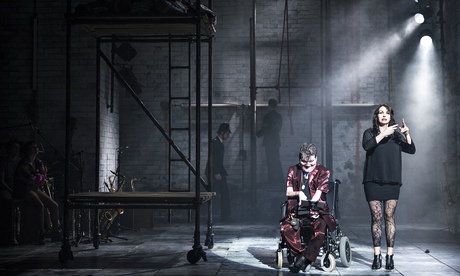
Graeae"s Threepenny Opera: "it dissipates the dread of disability"

Centre stage … Graeae

Irreverent and deadly serious … Graeae’s production of The Threepenny Opera. Photograph: Patrick Baldwin


An empty tv studio in Nottingham, presently the rehearsal room for the disability-led theatre company Graeae, consists of a variety of objects you could only find in a Graeae production. A row of saxophones sits up coming to a prosthetic limb. A length of rope replaces the normal floor-tape, for the benefit of cast members who are blind. In one particular corner, the props department is active transforming an electric wheelchair into a polystyrene horse.


  1. The Threepenny Opera

  2. Nottingham Playhouse

  3. NG1 5AF


  1. Until finally 8 March then touring


  2. Box workplace:
    0115 941 9419

  3. Venue web site


“The exceptional point about this space is that absolutely absolutely nothing right here is taboo,” says Graeae’s artistic director, Jenny Sealey. “We have been practising some of the prosthetic arm gags in the pub final evening. It gave some of the city types in there really a flip.”


This is Sealey all in excess of – humorous, irreverent, nevertheless deadly severe in her mission to carry mainstream acceptance to disabled performers. Sealey, who misplaced her hearing in a classroom accident at the age of 7, was awarded an MBE in 2009 and acquired national prominence as co-director of the opening ceremony of the 2012 London Paralympic Games. Her recent undertaking – a manufacturing of Bertold Brecht and Kurt Weill’s Threepenny Opera – is Graeae’s most ambitious to date: a shared initiative in between the New Wolsey theatre in Ipswich, Nottingham Playhouse, West Yorkshire Playhouse and Birmingham Rep.


Graeae previously has a shut romantic relationship with the New Wolsey, possessing collaborated on productions of Richard Cameron’s Flower Ladies and the Ian Dury musical Motives to be Cheerful. The theatre’s artistic chief, Peter Rowe, is co-directing the operate and explains how the collaboration came about. “We had been looking for a piece that would take exposure for disabled actors to yet another degree,” Rowe says. “The Threepenny Opera is a satire of the gross inequalities in society, and our inspiration came from the Occupy movement. Our beggars are a group of contemporary activists who consider more than the theatre and put on a edition of The Threepenny Opera that reflects their own diversity.”


In Brecht’s opera the beggar-master, Peachum, problems his workforce with artificial limbs in order to elicit extra sympathy. However Graeae’s version contains a more twist. “In this manufacturing, the character who complains that he has been offered a defective stump is played by a non-disabled actor,” Sealey says, “even though Peachum himself is in a wheelchair. And Mrs Peachum is played by a blind opera singer, even though she is the 1 character in the piece who sees every little thing.”


Just never phone it the alienation impact. “Men and women regularly inform me that I have a Brechtian directing style, but I never pretend to know what that signifies,” Sealey says. “I am no great Brecht professional – I just adhere to my instincts. But anytime you put a group of talented and empowered disabled actors on stage it demands that an audience feel twice about what they are seeing. Some people can’t cope and disconnect. But the all round impact is not alienating – really the opposite in reality. It dissipates the fear of disability and big difference.”


Even so, The Threepenny Opera was written to be provocative, and Graeae’s version is made up of components that are bound to prove controversial. The setting has been up to date from Victorian London to a stage in the near potential in which the homeless foment programs to disrupt the coronation of Charles III. Jeremy Sams has revised his lyrics, originally written for the 1994 Donmar Warehouse production, to incorporate references to sex-pest priests and paedophiles inside of the BBC.


“Jeremy has come up with very an ingenious new rhyme for ‘fix it’,” Rowe says.


“Which turns into even much more graphic when you see it in British Signal Language,” Sealey adds.


The participation of four significant regional theatres marks what Sealey perceives as “an attitudinal shift” towards disabled performers. The Nationwide Theatres of Scotland and Wales have employed disabled actors and imaginative teams and in January this year the Royal Shakespeare Business and Nationwide Theatre held the very first joint round of open auditions for disabled actors. But there’s a prolonged way to go ahead of the taking part in field becomes level. “It is still regarded as properly acceptable to see non-disabled actors ‘crippling up’,” Sealey says. “I know a performer who was not too long ago told by a drama school to come back when she was cured. As if anybody would dare to say ‘come back when you’re white’.”


Then, of program, there is the Paralympic impact. Sealey recalls the day of the opening ceremony as the proudest of her existence. “It was pure euphoria,” she says. “It was a massive statement: ‘We’re here, we did it, and we’re not going away.’ And yet, when it was more than, there was a horrible, horrible silence. We went back to currently being advantage scroungers and undesirables. I had to be assessed for how a lot of hours I could have an interpreter.”


Sealey is notably proud that many cast members of The Threepenny Opera took element in the Paralympic ceremony. “I had a as soon as-in-a-lifetime possibility to construct up a organization of world-class deaf and disabled artists in the greatest circus-coaching initiative ever. However there had been times above the previous year when I genuinely felt it could all go to waste. So thank God for The Threepenny Opera. It truly is restored my faith.”


Graeae"s Threepenny Opera: "it dissipates the dread of disability"

20 Şubat 2014 Perşembe

Outdoors the box: rethinking how museums existing disability

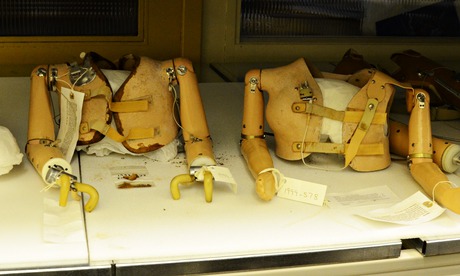
Prosthetics, artefacts in a museum collection

The Cabinet of Curiosities staff had been amazed by the volume and variety of objects they found in museum collections. Photograph: Richard Sandell


Richard Sandell and Jocelyn Dodd, from the Study Centre for Museums and Galleries (RCMG) have been functioning closely with artist and performer Mat Fraser for the past two years. The research-led collaboration, supported by the Wellcome Believe in, just lately culminated in a series of cabaret-meets-lecture museum performances called The Cabinet of Curiosities: How Disability Was Stored in a Box.


A heady mix of research, visual culture, songs and an inspired rap, the performances check out the function that health care contemplating and practice has played in shaping attitudes towards differences, and aim to challenge the way we believe about disability.


Richard Sandell


Jocelyn and I 1st noticed Mat reside in 2005 when his demonstrate – Thalidomide! A musical – was on tour. Sitting in the audience, we seasoned a potent mix of emotions. We realized a good deal about the story of thalidomide and along the way we have been discomfited, shocked and angered. We also laughed.


We laughed a great deal. Following the display we sat in the bar listening to other members of the audience talk animatedly about the performance and we reflected on the marked differences amongst Mat’s therapy of the subject matter and the way that a museum might normally tell the story of thalidomide.


In which museums have tended to be measured and cautious – anxious to present materials in a balanced, frequently dispassionate way – Mat’s approach was imbued with emotion, flagrantly personalized and extremely political. Nevertheless, like museum presentations, it was also grounded in rigorous study. It was compelling, provocative and utterly memorable.


At that time our research was very strongly rooted in museum practice and even though our subject was novel, our method was largely tried and tested. We had grow to be interested in comprehending why disabled folks – occasionally referred to as the greatest minority – have been largely absent from museum narratives. Why, at a time when museums were increasingly making an attempt to represent much more inclusive histories, was engagement with the background and culture of disability hardly ever tackled?


We set about investigating museum collections and were surprised by the volume and selection of objects and artworks we identified – materials that was strongly linked to disability but really seldom presented in a way that manufactured these links visible.


Over time our analysis practice has turn out to be more and more concerned not merely with comprehending this phenomenon, but with effecting modify – both in how museums present disability and in unlocking museums’ prospective for modifying the way audiences (and society much more broadly) consider about disability. It was this ambition that led us to approach Mat in 2011 to check out the prospects for collaboration.


Mat Fraser


When I 1st met Richard and Jocelyn, I was not even remotely acquainted with the way museums technique their exhibitions. I did have a familiar sense of not belonging – feeling as if my standpoint of getting a disabled man or woman was absolutely absent whenever an artefact to do with disability was presented in collections and exhibiting presentations. Museums, like a lot of mainstream environments, do not demonstrate us as we actually are, or had been.


When they asked me to think about undertaking a show about the re-presenting of disability in museums, even though it was extremely much outdoors of my knowledge, I jumped at the chance.


Each Richard and Jocelyn have been and are obviously quite at ease with all of the politicised and socially concerned elements of disability, and have a comfort about the entire subject that is rare to discover, definitely in such professions. So of course, when I started out to do the real research in the archives of the project’s partner museums, I expected to encounter a a lot more reticent, conservative and fearful ignorance, from each artefacts and workers.


Rather what I typically identified was a rigorous enthusiasm for uncovering the previous, redressing the medicalised past methods of disability representation, and an virtually relieved pleasure that their museum was taking component in this task. That they had been health care and scientific museums made this all the a lot more surprising, and welcome.


The biggest shock in my discoveries was how a lot of artefacts there are in the archives that never just talk about disability they veritably shout about them. Hunting at all of these occasionally incredibly illuminating objects from the previous stored focusing me on the general job at hand. I increasingly came tosee this as helping folks – the public, disabled individuals, museum curators, managers, medical college students, medical professionals, scientists, everybody – to understand why things require to change, and to illustrate approaches in which that may be feasible (in a hopefully non-threatening way).


Thankfully, there was considerably proof from earlier museum experiments in this spot to bolster and inspire what I was saying. My total occupation was the two brilliantly supported by the prior analysis and writing, and enormously aided by the enthusiasm from the curators and museums staff I was operating with.


I still found it a challenge, and it truly did assist me produce as an artist, expanding my practice and reconnecting me with levels of academia I would virtually forgotten I could do. It also significantly expanded my demographic for audiences, but when all the dust settles on it all, what remains is the real reality in society that these improvements are painfully overdue and that we require to preserve operating in this discipline to get the work completed. It really is one thing I hope, inside the capacities of what I do and past them, I can be a component of.


Follow Richard on Twitter @RSMuseumStudies and Mat @mat_fraser


This content material is brought to you by Guardian Specialist. To get more articles like this direct to your inbox, signal up totally free to turn into a member of the Culture Experts Network.


Outdoors the box: rethinking how museums existing disability