It has been horrific to watch all mass shootings in America over the last 8 years. Everyone has been traumatized by the images of carnage week in and week out. Have you noticed these mass shootings are no longer happening in America?
In any political environment, it is important to observe what is actually happening not just what is being said. This is an observation only. Considering all the Machiavellian possibilities. Looking through history, it would be naïve not to question the surge of mass shootings in the Obama era in this context.
Under the Obama Administration, mass shootings were up many times over any previous president. A constant bombardment of horrific incidents involving mass shootings was endured by the public during the last 8 years. It seemed every couple of weeks a deranged person was killing in mass. Hardly a month went by without these scenes being projected through the media. With hyperventilating commentary from mainstream media on how gun rights were to blame. The constant drumbeat of gun control as the only answer to stop the carnage. Obama himself saying this had become routine. Routine indeed as there was a mass shooting on average of about every 3 weeks. Some shootings in clusters and others further apart. Sometimes multiple instances in a row when certain legislation was being pushed. Always used to for political advantage.
Accompanied by ridiculous coverage ready to go by the mainstream media. In many instances, the killers were known to the Intel Agencies like the San Bernardino shooters and the Boston Marathon bombers. Yet the Intel Agencies were called off months before each incident. This has happened many times. Instead of talking about false flags, Operation Gladio, or the Obama justice departmentprotecting their wind up toys from an investigation. Let’s ask a simple question. What happened to all the Obama Era Mass Shootings under the Trump Administration?
Mass Shootings under the Last Five Presidents
Ronald Reagan: 1981-1989 (8 years) 11 mass shootings Incidents with 8 or more deaths = 5
George H. W. Bush: 1989-1993 (4 years) 12 mass murders Incidents with 8 or more deaths = 3 Bill Clinton: 1993-2001 (8 years) 23 mass murders Incidents with 8 or more deaths = 4
George W. Bush: 2001-2009 (8 years) 20 mass murders Incidents with 8 or more deaths = 5 Barrack H. Obama: 2009-2015 (in 7th year) 162 mass murders Incidents with 8 or more deaths = 18
Source: List of each event by TruthStreamMedia
What happened to all the Obama Era Mass Shootings under the Trump Administration?
We are already well past the longest time without a mass shooting under Obama. Statistically, if these were all organic events, there would have been one by now. Under Obama, there would have been several by now. Sometimes week in and week out. Trump has been in office for 52 days as of the writing of this article. Not one mass shooting or terrorist attack. Canada had a conveniently timed shooting when the temporary travel ban was introduced but nothing in America.
Why hasn’t there been one of these attacks in America since Trump was elected? Perhaps without the lax oversight or outright protection of a corrupt justice department. These wind-up toys can no longer operate in the continental United States. In the most heavily surveilled population on the planet, it would be very difficult to pull off one of these operations if the government were actually intent on stopping them. These types of operations take money and coordination that is very detectable by Intel agencies.
Trump has instructed the Justice Department to focus resources on actual terrorists, not veterans and gun owners. Breaking up and disrupting plans that would have gone through under Obama. Bringing to bear all of the surveillance tools used on the American people to stopactual plots.
Is this what we are seeing?
Now there is no clear political advantage is to be gained through such acts by the establishment, mainstream media or gun control advocates. If a mass attack were to happen, it would only bolster Trump’s calls for better vetting of immigrants, border security, and 2nd Amendment rights. So they stop. Very interesting. Of course, mass shootings and terror attacks will never completely end. Yet the suspicion is there will be much less under a Trump Administration.Just an observation that many may be thinking themselves.
Sources:
Visit RaptormanReports for news, science, and history
Why Have There Been More Mass Shootings Under Obama than the Four Previous Presidents Combined?
After recent events, some will already be nostalgic for a pre-Trump world. Yet nostalgia is a feeling of familiarity which doesn’t always connect to actual memories. Indeed those who wanted Trump to make America great again were harking back to a version of the country that never really existed. Research has found that the brain systems which control recognition and familiarity are quite different from each other. The two usually work together but can be activated separately, meaning it’s possible to feel a strong sense of acquaintanceship with a place or thing, when in fact you have never been here or used it before.
This is why you can completely forget where and when you were introduced to someone, but just know that you’ve seen them before. Familiarity is instant, whereas memory recall can be a slow process – with lots of effort, it’s sometimes possible to remember the room where you met them, or the time of year it was. These details can then help unearth the full memory, something we should rely upon more than fleeting familiarity, especially in the post-factual world we live in.
Dr Daniel Glaser is director of Science Gallery at King’s College London
Gregory Pincus, the maverick scientist who co-invented the female contraceptive pill, first tried to come up with a male equivalent in the 1950s. Nearly six decades on we are still waiting.
Friday’s news that male contraceptive jabs are almost as effective as the female pill, is remarkable as much for the lack of progress it highlights as for the impressive result the trial delivered.
There are genuine scientific reasons why creating a male pill is tricky. But today’s results, together with a separate advance earlier in the week , make it a good time to ask whether the main obstacles are technical or a lack of will to develop the drug.
A central scientific challenge in developing a male pill is achieving the right balance of hormones that provides reliable and reversible contraception without inducing unacceptable side-effects.
Getting this right is a tightrope walk and the research fell just on the wrong side of the line. The World Health Organisation decided to stop enrolling men on its trial earlier than planned after being alerted to side effects, including low mood, acne and higher than usual libido (today some coverage interpreted this as a bonus of the drugs, although there is no suggestion that this is how the men or their partners saw it).
Participant safety must always be the first consideration when running clinical trials. It is worth noting, though, that three-quarters of the 300 men who took part in the trial, said they would continue to use this method if they had the choice – and the decision to halt the trial was not unanimous.
Richard Anderson, a professor of clinical reproductive science at the University of Edinburgh and a co-author, says: “It was a big disappointment when the trial was stopped, as the trial monitoring committee were happy with progress and safety, but another WHO committee made the decision.”
The scientists did not attempt to quantify whether the side-effects were comparable or worse to known side-effects of the female pill, but we know that these can also be substantial.
“There are many couples for whom the female pill is not an option,” says Sarah Jones, a reader in pharmacology at the University of Wolverhampton, who is working on an alternative form of male contraceptive.
“It has terrible side-effects as well for some women. It’s not much of a choice. I’m sure there are couples that would relish this [male contraceptives].”
A second challenge, for the male contraception, is that the hormones they normally rely on are quickly metabolised by the liver, meaning that it’s difficult to package the drugs in a pill form. Again, it is worth noting that most of men on the trial said they would be happy to go forward with the injection method.
Anderson and colleagues are due to start another trial using a similar hormone combination delivered through a gel that men could rub onto their chest each morning.
There are also new findings suggesting that targeting the sperm directly – by using a fast-acting pill or a nasal spray that a man could take before sex, for example – rather than using hormones might work. Until now, this approach had eluded scientists, because sperm is so impenetrable – or, as Jones puts it, “you just can’t get into the little buggers”.
She published findings this month showing that designer compounds could be smuggled inside sperm cells and target proteins that are required for the sperm to swim, essentially stopping them in their tracks.
The progress convinces Anderson that a male contraceptive will be available eventually. “It’s just disappointing that it’s going so slowly,” he adds.
Focus groups run by Anderson and others convince him that there is a clear and immediate demand. “About 90% of women we saw at a family planning clinic said it was a good idea, to share the responsibility,” he says.
“They say: ‘I’ve done that [taken the pill] for 15 years and had a baby. Come on it’s someone else’s turn.’”
However, funding from pharma companies – essential to run the trials involving thousands of men that would be required to get a product licensed – is not forthcoming.
Herjan Coelingh Bennink, who was global executive vice-president at Schering’s reproductive medicine programme until 2000 when the company was bought by German rival Bayer, has offered an insider’s perspective on why this might be the case.
“At board level it was only middle-aged white males,” Bennink told Mosaic , an online science magazine produced by the Wellcome Trust, this year. “I tried to explain how important it could be, but they never got further than saying to each other, ‘Would you do it?’ ‘No, I wouldn’t do it’. It was not considered male behaviour to take responsibility for contraception.”
Anderson said that commercial factors may have also impacted the decision to shift away from developing a male pill. “I’m not convinced by that characterisation,” he says. “Though it probably does have a grain of truth,” he says.
Undoubtedly, there are still scientific hurdles to be overcome before we have a safe, reliable male contraceptive.
But science is not there to solve life’s simple problems. When someone at the European Space Agency said let’s chase down a comet 250m miles away and land a robotic probe on it, nobody said “That sounds easy – let’s do it”.
If we’re looking for reasons why we’re still so far from equality in who bears the burden of birth control, let’s not place lack of scientific ingenuity at the top of the list.
Had there been a male contraceptive pill in 1976, I might not be here to write this. That year my mum – may she rest in peace – was told by her doctor to come off the pill, after 12 years, because of health worries. “She said to the doctor, ‘I’ll get pregnant,’” my dad recalls. “And in a very short while, she was.” He explains, much to my discomfort, that although my parents switched to condoms, I was conceived because “sometimes you feel reckless”. But if a male pill had existed, my dad says, he would definitely have used it.
So why didn’t it? It certainly wasn’t because of a lack of scientific interest. Gregory Pincus, who co-invented the female pill, first tested the same hormonal approach on men in 1957, and various hormonal and non-hormonal methods have been explored since. Although attitudes among those who might use a male pill were once considered a daunting obstacle, it’s now clear that many men want a new option.
But we’re still waiting. Developing a method that men would accept has brought decades of frustration, yet researchers are confident that they are close to overcoming the scientific barriers. But, crucially, drug makers’ commitment to contraceptives has always been tentative, particularly with products for men – and today, the whole contraceptive industry is struggling. So who is actually going to make the male pill happen?
Related: The foul reign of the biological clock | Moira Weigel
In the 1970s, when my dad might have used the pill, prospects seemed better in some ways. Male fertility control was an active research field, with governments backing various ideas to limit overcrowding on Earth. One product my dad might have been interested in – a non-hormonal drug called gossypol – was being tested on a scale unmatched since. At the UN’s 1974 World Population Conference, Elsimar Coutinho, today a famous sex and fertility doctor in Brazil, was promoting the drug, which he was testing on men at the Federal University of Bahia. However, attitudes surrounding sex and reproduction can be unpredictable, and not everyone was convinced of its worth.
“The conference hall was full of women,” Coutinho says on the phone, his gravelly voice matching his website’s picture of a suave doctor with slicked-back grey hair. “I was going to tell them, ‘Now you don’t have to take pills if you don’t want.’” Yet, having determined their own fertility through the contraceptive pill for little more than a decade, his female audience were determined not to relinquish control. “To my surprise, I was shouted down and booed out.”
Despite such reactions, poorer countries with fast-growing populations found gossypol appealing because it could be extracted cheaply from cotton farming waste. Coutinho also worked with the Chinese government, which in 1972 ran gossypol trials with 8,806 men. Daily doses successfully reduced sperm counts enough to satisfy researchers, but side-effects were a cause for concern. One notable problem was that 66 of the men had low potassium in their blood. More importantly, sperm levels in many men didn’t return to normal when they stopped taking the drug.
Researchers continued tests for years, showing that, in rats, gossypol doesn’t just stop sperm moving, but also damages the lining of epididymis ducts, which store sperm. Eventually, an October 1986 symposium in Wuhan, China – whose sponsors included the Chinese government and the World Health Organization (WHO) – concluded that gossypol was “of little interest”.
The science is difficult but not impossible. What the field really lacks is a champion with lots of money and enthusiasm
Attempts to revive interest in Brazil after fresh trials put the potassium problem down to the Chinese diet also foundered, and in 2001 the gossypol saga came to an end. Coutinho mischievously suggests machismo in government may have been a contributing factor. “We worked on this for many years and realised men are very afraid of losing virility,” he says. “Maybe those judging our application were among them.”
But my dad would not have seen a male pill as a threat to his virility, and I too would be interested in rather than threatened by the idea – I believe it would benefit, rather than harm, the sex my partner and I have. Are we unusual?
In fact, plenty of men are interested in a male pill. A 2005 study found that more than half of 9,000 men from across the world were keen. In 2011, Susan Walker at Anglia Ruskin University in Chelmsford published a study of 54 men in an unnamed town in England. Twenty-six of them said they would take it. “They were not concerned about losing fertility – as long as they could be sure of regaining it,” Walker stresses.
The rest, split between “no” and “don’t know”, showed some gender-based reluctance. “It’s a strange idea,” one man said. “I’m so used to women taking the pill.” Those who were unsure were more concerned about side-effects, Walker notes. “They said: ‘I’ve seen what the pill does to my girlfriend’, ‘What would the long-term effects on my fertility be?’, ‘Could I be sure my fertility would return?’ – that kind of really quite sensible concern.”
The survey also included 134 women, roughly half of whom would let their partners use a male pill. However, more than half were worried that men would forget to take it; just one in six of the men had this worry. But, says Richard Anderson, a professor of reproductive science at the University of Edinburgh: “Whenever there’s a study published, a radio journalist will walk up and down the high street in their local town and ask women whether they would trust a man to take a pill, and of course they all run for the hills. But if you ask a woman if they would trust their partner – who they share children, their bank account and a bed every night with – then you’re going to get a different answer.”
A single crumpled piece of A4 paper on an almost-bare wall in Anderson’s office illustrates how hormonal male contraceptives work, reducing men to brain and balls. In the brain, it picks out the hypothalamus and pituitary gland. In the testicles it shows cells that make testosterone, and the tubules they neighbour, where sperm are made. Progestogen hormones like those used in female pills can stop the glands in a man’s brain making luteinising hormone and follicle-stimulating hormone. The absence of these hormones stops the testicles producing sperm and testosterone. Testosterone replacement is given, along with progestogens, to avoid undesirable effects such as weaker muscles and reduced sex drive.
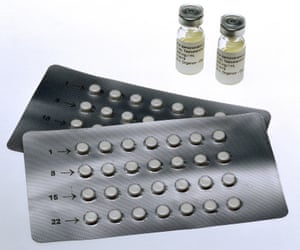
Dutch company Organon’s prototype male contraceptive pills and testosterone replacements, from 2001. Despite promising trials, they never took off. Photograph: SSPL via Getty
The Edinburgh trials attracted a lot of media attention. “‘100% success’ for male pill trial”, trumpeted the BBC in 2000, reporting on the suppression of sperm production in 30 men – reportedly without side-effects – from a combined progestogen pill and testosterone-releasing implant. Both hormones came from the Dutch drug company Organon, which, after what Anderson calls “a lot of persuading”, began to pay attention. But a larger clinical trial with Germany’s Schering threw up “adverse events” such as acne, sweating and effects on weight, mood and sex drive. Some of these were serious and even life-threatening, including one attempted suicide.
This would prove to be the pinnacle of big pharma’s interest. Herjan Coelingh Bennink, global executive vice-president in Organon’s reproductive medicine programme until 2000, echoed Coutinho’s account of his experience with gossypol. “At board level it was only middle-aged white males,” Coelingh Bennink recalls. “I tried to explain how important it could be, but they never got further than saying to each other, ‘Would you do it?’ ‘No, I wouldn’t do it.’ It was not considered male behaviour to take responsibility for contraception.”
Since then, he and others have continued in the field, but low profit margins have kept drug companies away. According to Anderson, the biggest obstacles are not scientific. “Getting male fertility down to acceptable levels is difficult but not impossible, and there have been many years of experience of how to do that,” he says. “What the field has really lacked is a champion with lots of money and enthusiasm. Thereafter you get industrial involvement.”
Lately, one particularly striking approach has been taken by Nnaemeka Amobi from King’s College London, who is developing a non-hormonal “instant male pill”. Also known as the “dry orgasm pill”, Amobi’s contraceptive stops men releasing semen and the sperm it contains. He stresses that otherwise the normal physical processes of a man’s orgasm are unaffected.
“The movement of semen from the testes to where it stays until ejaculation happens long before climax,” Amobi says. “As soon as you’re aroused, spermatic fluid is moved towards the seminal vesicles and prostate. Our pill stops that initial movement by inactivating the tubes that propel fluid from the testes to the prostate.”
Amobi and his fellow researchers started from two existing drugs that had caused dry orgasms as an undesirable side-effect. They redesigned the drugs to remove the original intended actions and focus on this. Animal tests suggest they have succeeded. “We used rams because rats and rabbits don’t have seminal fluid like humans,” Amobi says. “We tried boars, which produce 250ml of semen. Can you imagine that? Rams have 1ml, closer to humans’ 2-5ml.”
Related: Who wants a male pill?
These tests show the method could become effective within 3-4 hours, and wear off after a day. “A woman can say, ‘Here’s the pill – let me see you take it’,” Amobi says. And as well as avoiding pregnancy, preventing semen emission should help reduce sexual transmission of semen-borne diseases, such as HIV.
One potential backer interested in the drug was the Parsemus Foundation, a small private organisation based in Berkeley, California. Ultimately, though, its founder, Elaine Lissner, faced a tough choice between funding Amobi’s research and another promising new male contraceptive technology. She chose to spend the foundation’s limited cash on the latter. Amobi isn’t bitter because, in his opinion, Lissner is the main reason people still talk about male contraception. But she still has regrets. “It’s shocking that they can’t get backing for the first new idea about HIV transmission-prevention in ages.”
Lissner dislikes hormonal approaches because of their side-effects, and also dislikes risk. She is therefore researching a “hydrogel” that can be injected into the vas deferens – the tube linking the epididymis to the penis.
Called Vasalgel, it lets through semen but not sperm, and is intended to be washed out by another injection when men want the use of their sperm back. The blocked sperm are cleared from the epididymis and eaten up by immune cells, as happens normally if a man hasn’t had an orgasm for a while. Lissner publicises Vasalgel energetically, and one glance at its thriving Facebook page should dispel any doubts that men would be interested. “People are crazy for Vasalgel, desperate for it,” she says. “We have over 32,000 people on the mailing list waiting to hear about clinical trials.”
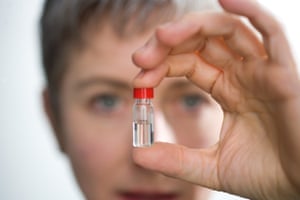
Elaine Lissner of the Parsemus Foundation with a vial of Vasalgel, a non-hormonal contraceptive for men. Photograph: Male Contraception Information Project
One man who is keen to try it is Justin Terry, a married 30-year-old machinist who makes vehicle parts in Alabama. He and his wife don’t have children, and she is taking the contraceptive pill. “We’ve been married 10 years,” Terry says. “She doesn’t want kids and neither do I, really. She wants to get off the pill.” It gives her tender breasts, and she is concerned about adverse effects of continuing to take it. Terry has also considered vasectomy (as have I), but has hesitated because it is more invasive and not completely reversible. “Vasalgel sounds like it will be reversible and would involve much less invasive surgery,” he says.
Parsemus’s efforts have been helped by the David and Lucile Packard Foundation, also based in California, which provided $ 50,000 to help them test Vasalgel in baboons. “We expected to be out of money last year and we’re not,” Lissner says. “But the clinical trial is half a million dollars, so that’s a different scale. Beyond that, it’s multimillions.” The trial will involve about 30 men and will test Vasalgel as a vasectomy alternative, without looking at reversibility.
Knowing the field’s status, Lissner is not relying on government or the pharmaceutical industry. Instead, she is looking for backing from wealthy social investors – and potential users – and is publicising what might be possible in the field to bring interested parties together. “The difference is that we have built an infrastructure where the public is able to channel its support,” she says.
On Blithe’s suggestion, I watch a Channel 4 documentary called The Great Sperm Race, which shows the journey sperm make through a woman’s uterus to her fallopian tube. It has people dressed in white as sperm, and they die in vast numbers. From the millions of sperm ejaculated, 20-100 get close enough to the egg to try to fertilise it.
Related: Pills, thrills and polymer gels: what’s the future for male contraception?
As I watch, I imagine the white-clad actors instead represent the many possible male pills. There have been, and still are, masses of ideas – far more than I have been able to mention here. And yet, like the unsuccessful sperm, many have fallen by the wayside. I think of the contraceptive drug industry’s current status and I can’t help think we have missed its fertile period. If the perfect idea were to fight its way through development today, there is only a tiny chance that there would be a partner to meet it and eventually produce a fully formed male pill from it.
It seems obvious that if a new male contraceptive does make it to maturity, it will be thanks to the efforts of people such as Blithe and Lissner. They, as much as anyone, are trying to create environments where the right technology can take seed. But without keen interest from the traditional contraceptive industry, that will require an enormous effort. Lissner’s energetic attempts to consolidate support from men like Justin Terry, my dad and me could prove critical.
Lissner is adamant that the ideas that seem to have faltered are not dead – they’re just resting. “We keep collecting new methods, and never finish the ones we have,” she fumes. “Pick one and make something! Finish the job!”
• A longer version of this article first appeared in Mosaic and is republished here under a Creative Commons licence.