mannequins etiketine sahip kayıtlar gösteriliyor. Tüm kayıtları göster

12 Mayıs 2017 Cuma

Female mannequins aren"t just skinny, they"re emaciated


There have have been several observations in the press and on social media in the past few years that some of the mannequins used to sell women’s fashion represent unrealistic and unhealthy body sizes. But until we started to look into it, the issue had not been researched properly, and the evidence was mostly anecdotal.


Back in 1992, researchers surveyed a handful of mannequins from the 1930s-1960s housed in museums. They concluded that real women of a similar body size would be so thin that they would be unable to menstruate. More than 80 years on, and with women in a very different societal position than previously, you might expect things to have changed.


Sadly, however, that’s not the case. Our newly published research concludes that the body sizes of mannequins being used to sell female fashion on the British high street today represent those of severely underweight women.


Unhealthily thin


In 2015, we conducted a formal study of mannequins by surveying all national chain fashion stores on the high streets of two cities in England – Liverpool and Coventry – that were using mannequins. In total, we visited 17 stores and got acquainted with 58 mannequins, 32 of which were “female” and 26 “male”.


What we found was that all of the female mannequins in these shops had body sizes that corresponded to that of an underweight human. We didn’t find a single female mannequin that was a normal body size on display.


Samantha Jenkins (@samanthajenkins)

Is it even humanly possible to be as skinny as this Topshop mannequin? pic.twitter.com/fDJSO88v2L


October 30, 2014


The “ultra-thin ideal” is something that I, and many others across the world, loathe. Size zero culture and glamorisation of unrealistic and unobtainable body sizes has meant that the “ideal” body size frequently and implicitly communicated to women is dangerously unhealthy.


Promotion of the ultra-thin ideal has been shown to cause women to be dissatisfied with their body size. And, in turn, this dissatisfaction is thought to be one step along the path of developing an unhealthy desire or “drive” for thinness, and subsequent eating disorders.


Not everyone will develop an eating disorder from having the ultra-thin ideal pushed upon them, and it is difficult to say why some people develop them and others don’t. However, the academic community is pretty convinced that promotion of ultra-thinness is a major player in eating problems, and that it is responsible for the propagation of body image problems in young women.


An ideal model?


Interestingly, we found that most of the male mannequins in our survey didn’t look underweight – only 8% of those surveyed were too thin. This fits well with what we know about ultra-thin body ideals and gender: it is primarily communicated to women, who are a lot more likely than men to develop an eating disorder like anorexia.
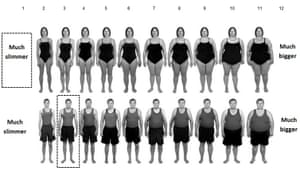


Mean mannequin sizes rated using the BMI-based body size guide rating scale.


Mean mannequin sizes rated using the BMI-based body size guide rating scale. Photograph: Eric Robinson

Our observation of male mannequin shows that there is no legitimate reason why mannequins used to sell female fashion have to be ultra-thin. If their male counterparts can be a “human” shape and size, then why can’t they?


Although some nation fashion stores say they are using larger bodied mannequins, we found no evidence of this in any of the stores that we visited. Of course, we can’t rule out that there may be some larger mannequins knocking about in a small number of stores, but we found that unhealthily thin mannequins are the norm on the high street.


Mannequins aren’t people, nor do they have a sign on them saying “you need to look like this”. But they are representations of the human body that are used to sell fashion and the idea of beauty. There is clear evidence showing that the ultra-thin ideal is contributing to the development of mental health problems and eating disorders.


There is no excuse for the continued use of emaciated mannequins.


Eric Robinson is a senior lecturer in the department of psychological sciences at the University of Liverpool.


This article was originally published on The Conversation. Read the original article.


Female mannequins aren"t just skinny, they"re emaciated

28 Mayıs 2014 Çarşamba

Do thinner mannequins make men and women buy clothes?

With Memorial Day and summertime come a few other traditions: swimsuit purchasing, skimpier clothing – and with them, a host of entire body troubles.


So who needs to search up into a keep window and, currently dissatisfied with one’s physique, see a mannequin with a concave stomach and visible ribs?


Does that spur the impulse to buy out of aspiration? Or is it a turnoff?


La Perla apparently imagined its chic customers – who drop hundreds of dollars on high-standing underthings – would relate to, or admire, this kind of a vision.


It did not really function out that way. “How does #LaPerla consider ribs on a mannequin is ok?! @SethMatlins,” fumed influential tech entrepreneur Michael Rudoy on Twitter, tagging truth-in-marketing activist Seth Matlins.


Score one for Matlins. La Perla quickly eliminated the mannequins, and tweeted that they wouldn’t be utilised in yet another La Perla boutique. The business extra that it is updating its whole mannequin collection.


“The mannequin photographed has been eliminated from the store and will not be employed once again by any La Perla boutique. We are in the process of redesigning all La Perla shops with a new notion image and the mannequins that are at the moment displayed in our US merchants will no longer be employed. We enjoy and value everyone’s feedback, thank you for bringing this to our focus.”


Nevertheless La Perla is not a one particular-time offender – numerous weeks in the past the lingerie company’s Instagram featured a model beside a mannequin with impossibly skinny legs.


“I believe it is a lot worse to have their ribs exhibiting,” stated Jean Kilbourne, a former model and honorary member of Wellesley’s Centers for Women.


But even Kilbourne will inform you: “The extremity of it catches our interest, but this is actually not new.”


In truth, it’s turning out to be a lot more of a trend: expect the impossibly slim, the white and the sinewy to dominate chic windows.


Normal mannequin measurements, excluding the very chesty or bootylicious, are an practically extremely hard excellent: about 6ft tall, 34in bust, 24in waist, 34in hips.


Two massive mannequin suppliers said their most popular colour is alabaster white, though it utilised to be “flesh tone” – that is, flesh-toned if you are white. And each mentioned their clients’ wishes are trending towards a lot more “sculpted” mannequins that display off “musculature”.


“If you do something that’s kind of a thinner mannequin, you’re doing that 1 group that says it is too thin,” stated Goldsmith’s creative director and CEO Dan Evans. His firm supplies mannequins to many high-end division retailers, like Nordstrom, Bergdorf Goodman and Macy’s. Evans has also worked with La Perla.


The enduring very best-vendor of Goldsmith’s assortment, he said, is the “classic” mannequin. The quite in depth female model does not have noticeable ribs instead, she has six-pack abs.


That’s Okay, say suppliers.


“Most individuals are searching at the garment, and not what the mannequin represents,” explained Barry Rosenberg, spouse at Mondo Mannequins, which can make up to two,000 mannequins a day.


“I imply, I am not going to tell you anything you wouldn’t presently know. Why are models 6ft tall with modest breasts, and extremely lengthy legs? Simply because they seem the ideal in the garment,” explained Rosenberg.


Rosenberg laughed at the description of the possibly also-skinny ribby mannequins.


“We do not make mannequins that are 5ft 3in and 160lbs,” he said.


The common American woman is 5ft 3in and 166lbs, according to the CDC.


Venezuelan mannequins
Mannequins with intense proportions on show in Caracas, Venezuela. Photograph: Meridith Kohut/New York Occasions/Redux / eyevine

The industry’s also been questioned about utilizing more substantial mannequins, as Evans mentioned. Dame Sally Davies, England’s chief healthcare officer, advised the Telegraph she felt size-16 mannequins introduced in Britain’s Debenhams department shop “normalized” obesity.


Goldsmith’s Evans suggests it truly is not his choice. “At that stage, the fashion market and our buyer dictate these sizes,” he mentioned.


The trend is in direction of thinner and ribby mannequins encourage unhealthy physique picture, as several truth-in-promoting advocates will tell you.


“It’s undesirable enough that they are so thin,” stated Kilbourne. “It tends to make them search even more anorexic. Obtaining the ribs exhibiting is a signal of starvation, malnutrition, consuming disorders. It really is appalling,” she explained.


Other unrealistic mannequins? In Venezuela and Miami Beach, Florida, chesty mannequins appear like they’ve had silicone implants. In Gap retailers, a Twitter account called @InMySkinnyDream chronicled Gap’s toothpick-legged dolls by the “Always Skinny” jean.


“One of the massive – and I’ve been speaking about this forever – is it all turns into invisible in a way simply because we’re so used to it, and if its brought to people’s focus, that type of breaks by means of the clutter,” mentioned Kilbourne, the body-image advocate. “I consider it truly is fairly freakish for ribs to be exhibiting.”


Do thinner mannequins make men and women buy clothes?

27 Mart 2014 Perşembe

Dimension sixteen mannequins make being fat "normal"

“Larger mannequins are currently being introduced into clothing outlets, “size inflation” means that outfits with the very same size label have turn out to be more substantial in recent decades, and news stories about weight frequently characteristic photographs of severely obese people, which are unrepresentative of the majority of obese individuals.”


In December Debenhams became the very first department retailer to display dimension sixteen mannequins in its 179 retailers, and urged rival substantial street shops to stick to its lead.


Earlier in the year qualities minister Jo Swinson known as for trend shops to encourage a much more varied selection of females, saying it was “as if there’s only one particular way of being beautiful”.


Practically all garments shops in Britain use dimension ten or size eight mannequins. despite the fact that the average British woman is a dimension sixteen.


At the time a spokeswoman for the British Retail Consortium explained it was down to every single personal shop regardless of whether to show plus-dimension designs.


“We won’t be issuing guidance in the quick term but it is an concern Uk merchants get really seriously,” she mentioned.


A spokesman for Marks &amp Spencer said it takes a “responsible technique to visual merchandising” and pointed out that it utilizes dimension ten versions, which is above the size 8 market place common.


Most recent estimates recommend that almost two thirds of adults and one third of children under 18 are overweight or obese.


Dame Sally mentioned she was concerned by studies which showed that a lot of men and women who are obese believe they are “about the right weight” and highlighted 1 piece of analysis which identified 77 percent of mothers and fathers of obese young children did not recognise that their kid was overweight.


The report also reaffirms the CMO’s earlier views on added sugar in drinks and alcohol minimal pricing. The report highlights the reality that in young children aged eleven-18, virtually a third of the extra sugar in their average diet regime comes from soft drinks. The CMO calls on makers to reformulate and resize items to use less sugar exactly where feasible. She also says that if voluntary efforts fail, then we may need to consider the rewards of regulation such as a ‘sugar tax’. She also explained we should investigate the affect of minimum unit pricing for alcohol in Scotland, if it is introduced there.


She also calls for enhancements in security for pedestrians and cyclists to encourage individuals to walk and cycle far more and reap the related overall health rewards.


Dame Sally stated that the relative dangers of strolling and cycling have grow to be unacceptably substantial, with the threat of serious damage for every kilometre travelled on a bike is 21 times increased than by automobile.


The report suggests that soap operas encourage poor habits in viewers.


It says: “In common culture, drinking alcohol to extra is often portrayed as normal behaviour. An analysis of 6 weeks of soap operas in the Uk in 2010 discovered 162 situations of characters drinking to extra, with negative consequences rarely proven. In reality, 75 per cent of the population does not eat extreme quantities of alcohol, and the proportion of the population which abstains from alcohol is increasing.”


The report also says research is suggesting an growing prevalence of dementia, which includes Alzheimer’s illness, in people with severe vision loss or serious hearing impairment.


Dame Sally mentioned much more data was needed to investigate the association in between this kind of impairment and the causes of dementia.


Dimension sixteen mannequins make being fat "normal"