Saturday 1 April marks the fourth anniversary of NHS’s medical director Bruce Keogh’s scathing report on the regulation of cosmetic procedures. It concluded that dermal fillers are a crisis waiting to happen – and said they should be classified as a prescription-only medical device.
Yet today little has changed. As an NHS reconstructive surgeon, I am frequently called on to fix the mistakes of unqualified beauty consultants.
Understanding the intricacies of facial anatomy and physiology has taken me half a lifetime of rigorous medical training to master. Yet flimsy regulation means an individual can jump on to YouTube, watch a couple of “how-to” clips, order supplies online and set up as a bona fide consultant.
The dangers are clear. I have seen around 50 women in the past few years, some with allergies to filler, others with filler pouring out of their faces – many in need of multiple, complex procedures to restore their features. And it is clear numbers are increasing.
Health minister Philip Dunne recently said that the majority of these products were intended to be used in reconstructive surgery, and regulated medical professionals are bound by professional standards and terms of registration. But what of the budding hairdresser turned beauty consultant? Who is there to regulate these rogue practitioners?
The non-surgical cosmetic procedures market is worth £3.6bn. And non-surgical procedures account for 90% of all cosmetic interventions. Individual filler sessions can cost £300. Such clear financial incentives are unlikely to dissuade the let’s-give-it-a-go brigade. Regulation is key. The General Medical Council has compiled a guide for physicians to establish standards. But binding regulation is needed. Other non-medical organisations such as Save Face have also tried to direct the public to practitioners with appropriate training.
As a plastic surgeon who works in the NHS, I have a team of colleagues who reconstruct the faces of children and adults with facial deformities.
Sadly, a new group of patients are emerging whose features have been changed, sometimes irreversibly, by non-surgical cosmetic procedures. It is essential that anyone receiving these treatments has confidence in their practitioner, and we must encourage patients not to be lured by quick fixes and unbelievable deals. Simon Eccles Member, British Association of Plastic, Reconstructive and Aesthetic Surgeons
• Join the debate – email guardian.letters@theguardian.com
• Read more Guardian letters – click here to visit gu.com/letters
Anonymous, 40 I am a spider. I reach out and all I find is the cobweb I have woven. Woven out of experiences and childhood trauma. I reach out and find I can’t get out of this sticky mess. I can’t get out of bed. Something keeps me there and every time I try there is a wall. A wall of doubt, stigma and pain.
My name is Cobweb and I have schizoaffective disorder, which is a type of schizophrenia. As soon as you read “schizo”, parallels are made with “split personality” and perhaps craziness. Only the other day I heard someone say “schizo” in a casual way. They did not mean this in a kind way – it was referring to a kind of madness or craziness that is associated, perhaps, with crime or being possessed.
I recently explained to a friend that having schizophrenia did not mean a split personality. I believe I have suffered from this condition from the age of 17 or earlier. I was diagnosed only three years ago and got the help and support I needed. When I was 17, I was admitted to a psychiatric ward and suffered a psychotic episode and other complications. As a result, I suffer from chronic pain. I have this to cope with for the rest of my life, and I do not really know what the future holds for me.
Since this episode, I have been ill off and on, however, this did not stop me from studying for a degree, an MSc and a postgraduate course. It has not stopped me from raising awareness of mental health issues in Scotland and helping others with similar conditions. Whenever I have been out of work I have always done voluntary work and been an active member of my community. I may have schizoaffective disorder, but I’m a human. I’m slightly quirky and different, but no one is the same and the world is made up of many beings who deserve their right to be here.
I was born into a broken world, and experienced some things that others may never have. However, it has made me who I am. I have experienced trauma at an early age and am now living proof that with support and resilience it is possible to live with schizoaffective disorder. There is still much to be done. I want to tell Theresa May that more needs to be done to raise awareness of mental health generally, but most specifically among young people.
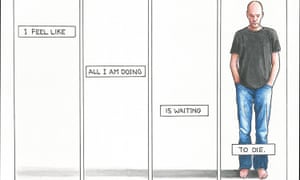
Ed, 45, from Liverpool I have a diagnosis of schizophrenia, which means I am pretty much excluded from society. Doors that are open to most people are firmly closed to me. The reality of my life is isolation, poverty, fear and hopelessness. I sometimes like to express my thoughts and experiences in little cartoon strips.
Ed’s depiction of living with schizophrenia.
Lisa Heinlen, Arizona, US My son was diagnosed with schizophrenia last March, and it was pretty sad the way it all went down. My mom has paranoid schizophrenia, so I knew the signs. I was trying to get help in a hurry and the crisis unit sent out an officer to assess the situation. The officer had no idea how to deal with someone having a breakdown, and put him in handcuffs. My son was hearing voices and this made him worse. He flipped out and kicked the officer in the groin area and tried to resist, so they took him to jail, and blamed me for his behaviour.
The only thing I can hope and pray for is that officers get more training and understanding. As long as people with mental health problems have a good support system, they’re less likely to end up back in the hospital. I spent months trying to get my son on the correct medicine. It has been a hard road for us. I encourage and love my son. It’s one day at a time for us.
In the UK, the Samaritans can be contacted on 116 123. In the US, the National Suicide Prevention Hotline is 1-800-273-8255. In Australia, the crisis support service Lifeline is on 13 11 14.
Medicine in the UK has traditionally been deemed an elite profession that excludes those from low socioeconomic groups. A mere 7% of students are privately educated, but 26% of medical students went to fee-paying schools.
However, when you look closely at the figures, many students leave school at 16, and 18% of 16- to 18-year-olds are in fact privately educated; the proportion is even higher for those studying science subjects. Suddenly, the figure of 26% of privately educated medical students seems to reflect numbers studying sciences at school. It is not surprising that the majority of doctors come from more affluent backgrounds.
I do not come from a privileged background. But I had opportunity. I did not attend a state school but was awarded a bursary to study at a private school. My husband, a hospital consultant, was state educated. His father was a bus driver and arrived in the UK as an immigrant in the 1960s. In many places in the world, perhaps neither of us would have been given such opportunities.
It is opportunity that social mobility organisations and medical schools themselves are asked to create, in order to remove this disparity in entrants. Universally, access to medical school is limited due to a lack of places; this generates stiff competition and entry criteria tighten every year. Historically, selection for medical school has consisted of exam performance and interview scores (most medical schools will interview their applicants). In recent years, we have seen the introduction of a national UKCAT aptitude test, which all candidates complete. Universities are also moving away from a single interview, which can be an arduous experience for candidates.
The new multiple mini interviews (MMIs) consist of several short stations, which test candidates on standard questions (Why do you want to study medicine?), ability to complete a practical task, communicate effectively or explore an ethical dilemma. These seem to be a fairer way of judging students, who may otherwise perform badly through nerves or even assessor bias.
It has been surmised that MMIs favour state students, but in my experience as an assessor this is not always the case. MMIs favour those who are confident, communicate well and display empathy: all the qualities we would expect from a good doctor. Often students from failing schools do not perform well, if they have had neither coaching nor exposure to similar situations. And modifying the selection process further is unlikely to have major impact as few students from less affluent backgrounds apply in the first place.
Many of the widening access to medical education programmes promote initiatives, such as arranging mentoring or work experience with doctors, and by introducing summer medical schools for sixth formers. This is certainly showing some encouraging results but it does not get to the root of the problem, and you only have to look at school dropout rates to see why: one in five students will leave school after GCSEs; of those who continue in education, few will study core academic or science subjects.
State-educated medical students are usually from good comprehensive or grammar schools, which operate within narrow geographical boundaries. These are often in affluent areas, with little chance of access to those from broken families or challenging neighbourhoods. Many of the independent schools’ bursaries, such as the one I was educated on, have since been abolished.
University tuition fees have also changed the demographics of students. Medicine is usually a five or six-year course, or even longer if students undertake foundation or catch-up medical courses. Students from low-income families are discouraged at the prospect of spiralling debt, which can run into hundreds of thousands of pounds. The government’s controversial plans to change the junior doctor contract and to consider tying newly-qualified doctors to the NHS for four years is unlikely to increase diversity in applicants.
A mix of poor schooling, lack of aspirations and financial deprivation limits access to the medical profession. It is simplistic and even detrimental to try to tackle it through university or social mobility organisations alone. Our aim should always be to have competent and empathetic doctors from different social and cultural backgrounds who reflect our society.
One way of improving diversity is by having doctors from EU and non-EU countries as well, but we still need to increase access to the professions within the UK to young people from all social backgrounds.
The solution to this societal and educational problem is complex. It requires a wider commitment from us and the government towards our children, their education and wellbeing.
If you would like to write a blogpost for Views from the NHS frontline, read our guidelines and get in touch by emailing sarah.johnson@theguardian.com.
Join the Healthcare Professionals Network to read more pieces like this. And follow us on Twitter (@GdnHealthcare) to keep up with the latest healthcare news and views.
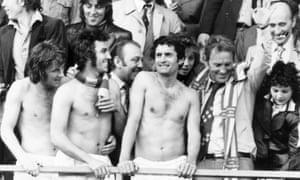
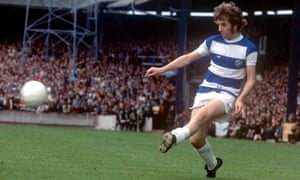
The smile has not changed, as puckish as it always was; nor has the mischievous glint in Stanley Bowles’s sea-blue eyes. I remember it all like yesterday, when Bowles bedazzled football, weaving, winding through a humiliated defence yet again, in the hoops of Queens Park Rangers, atop the league, back in the 1970s.
But at a pub in his native Manchester, Stan himself remembers none of this. His Alzheimer’s disease is now, as they say, “100%”, both sides of the brain, “and something at the back”, adds his daughter Andria, nowadays, as she describes herself, “full-time carer” – and lifeline. Of course, we recall a few goals of yore: “We’re talking about you playing football, Stan.”
“Football?”
Fifty years ago last weekend, QPR won one of the most remarkable cup finals in football history: from the Third Division, they overcame a two-goal deficit to defeat First Division West Bromwich Albion 3-2, and win the League Cup. I was at Wembley that unforgettable day, aged 12, with my father and brother, dizzy with disbelief.
Little did we know, though, that 1967 was just the beginning for hitherto humble Rangers. Within 10 years the club came within 14 minutes (during which Liverpool put three past Wolves, in a deciding game) of the First Division title, equivalent to today’s Premier League. But memory of the zenith decade casts a shadow over QPR’s half-centennial, for that achievement in 1975-76 was synonymous with the uncanny brilliance and waggish personality of one player: Bowles. The man who, as his best friend Don Shanks says, “can hardly remember who he is. It’s heartbreaking, soul-destroying.”
My God, those days. I travelled every long weekend either back from university to west London or up and down the M6, M1, usually in a Morris Minor driven by my best friend Patrick Wintour (of this parish), brother Tom and a friend, William, whose family had shared our house. We went to watch the Superhoops and above all the greatest player ever to wear them, Bowles. My sister, now a professional illustrator, started her career by winning, aged 15, a “Draw Stan Bowles” competition. My first ever article was published in The Superhoop supporters’ club magazine.
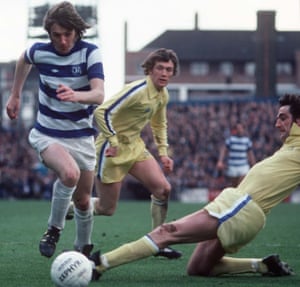
QPR’s Stan Bowles eludes Leeds’ Norman Hunter and Trevor Cherry in April 1976. Photograph: Stewart Fraser/Colorsport
We would drive to Sunderland or Manchester, take supporters’ club chartered trains to Stoke, hitchhike back from Everton. After listening to that last terrible Wolves v Liverpool game on the wireless, Patrick said: “I’ve never felt so philosophical in my life. Nothing’s ever meant so much.” His girlfriend was furious. At the centre of it all: Bowles’s flair, long hair, gawkish gait but spellbinding ability to accelerate, decelerate, anticipate. His late winner at Newcastle, voodoo with the ball against Middlesbrough, a perfect winning goal at Leicester, then what could have been a title-clincher against Leeds in our last game of the season.
Among those also watching was the former home secretary Alan Johnson, who says: “Bowles’s impish wizardry left so many Rangers fans with wonderful memories. I am privileged to be one of them.” The broadcaster Robert Elms insists: “The bond between QPR and Stan Bowles is more complete than between any other single player and a football team. This wayward, wondrous, magical, yet totally down-to-earth street genius is the embodiment of our Queens Park Rangers.” The composer Michael Nyman says: “My love of Stan goes back to a muddy match when he first played at Loftus Road against Rangers for Carlisle in 1972 [we signed him five months later]. He was as astonishing then as in every subsequent match I saw him play in.”
Stan’s golden years were shared, on and off the pitch, with Shanks, the QPR defender famous for “stealing” Miss World Mary Stavin from Liverpool’s Graeme Souness. Bowles reputedly took every opportunity during a game at Anfield to remind Souness of his mate’s conquest. “Stan played football without stress or pressure,” Shanks recalls. “While other players would be in a panic during a big game, or poor shape for a bad one, Stan would just play. ‘Give me the ball, I’ll do the rest.’ A football pitch was Stan’s natural home.”
Stan can hardly remember who he is. It’s heartbreaking, soul-destroying
The manager Dave Sexton stressed then what he called Rangers’ “continental” football, inspired by Dutch games, and Shanks places Bowles in the history of what has happened to British football since. Shanks says: “Stan was like players who come from Europe now, before their time: Costa, Agüero. A star, but unselfish; he was a team player … amazing rapport. We knew what Stan would try to do – the amazing thing is that he did it. Round the back of the defence, with pace – and magic.”
But it was Stan the man that Shanks – and QPR fans and players – loved too. “Everyone was equal to Stan,” he says. “It didn’t matter if you were collecting rubbish or a pop star. If QPR were up in Manchester, he might stay over and play for a Sunday league team.” Bowles would stop over at Shanks’s parents’ flat on the White City estate, next to Loftus Road: “Always polite – ‘Thank you Mr Shanks, thank you Mrs Shanks’ … I used to say: ‘It’s OK Stan – no one else talks to them like that.’”
I remember Bowles joining fans in The Crown & Sceptre near QPR’s ground on Christmas Eve – his birthday. He was offered more pints than even he could manage, and bought a few himself, for total – albeit adoring – strangers.
Most famously: “Stan loved a bet,” says Shanks, who was also his partner at the White City dog track or bookmakers. “Not big money – it was a pastime, 50 quid between two dogs, for the adrenaline rush. He hardly went to a casino, but if he did, he’d put £20 here, £20 there. Later, he’d go to those card schools and play for six hours.” A barman at the dog track was John O’Mahony, now among fans campaigning for a Bowles testimonial. He says: “Stan always drew people round him, but he never showed off. He was always just himself.”
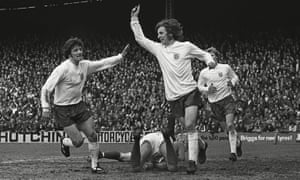
England’s Stan Bowles celebrates with Kevin Keegan after scoring against Wales in 1974. Photograph: Colorsport/Rex/Shutterstock
And he still is, but actually not. Bowles moved back from London to Manchester before the family announced his condition in 2015. And here he is, at the Whitegate Inn on the road to Oldham, enjoying lager-and-lemonade-top with Andria, his friend Mike, a builder who visits every day, and Joanne Connolly, a fan whose dad – “Taxi Teddy” – knew Bowles from outings to the dogs; Joanne calls Stan the “adolescent fervour that lasted a lifetime”.
Stan wears a dapper woollen overcoat, tartan tweed hat and smart scarf. Now he puts on a pair of sunglasses. “Dino!” he says. “That’s Robert De Niro,” explains Mike. “Dino!” repeats Stan. “It’s hard to speak Stan-ish,” says Andria. “He’s having a good day today, but it’s not always like this. On bad days, he’s a rabbit in the headlights, very anxious and confused.” Andria, the modern-day matriarch of Moston, is a woman of humbling strength and commitment, but insists to the contrary: “It’s something I do,” she says of her charge. She admits: “He was a selfish Dad, but he’s mellowed, he’d started to do that before the disease. Now he’s home, with us, where my own Nan and Grandpa lived.”
There are moments of sudden clarity from Bowles. I mention Gerry Francis, the QPR captain with whom Stan had telepathic rapport: “Gerry, he’s alright he is.” And when you call him Stan he corrects you: “It’s Stanley!”
In comes Stanley’s great-granddaughter, Macie, aged five. Andria used to run another pub down the road “where my Nan used to drink”, but gave it up to look after Macie (“my son’s daughter, but …”) before Stanley was diagnosed. “So it’s like having two children now,” says Andria. I ask: “Macie, does he do what he’s told?” “No, ’cause he doesn’t know what you’re saying. He can’t talk proper because he’s poorly. But I understand him.”
Stan Bowles’s great-granddaughter Macie says: ‘He can’t talk proper because he’s poorly. But I understand him.’ Photograph: Christopher Thomond for the Guardian
Mike says he still takes Stanley for a bet: “He’ll write ‘2.15C’ – it could be Cheltenham, it could be Catterick. Once he put a tenner on a winner, worth £130, but he’d thrown away the chit.”
“London!” Stanley repeats. Mike takes him “up” to the smoke occasionally, and they stay around Brentford, Bowles’s last professional club. Mention of the Bees starts another, urgent, conversation: that club staged a benefit game in 1987, and this season published a commemorative programme to raise funds for Stan’s welfare. “I see myself looking after him for the rest of his life,” Andria insists, but talk inevitably turns to the possibility that Stan will need residential care one day. “There are two options,” Shanks had said, “go the NHS way or get private so he can be comfortable and his family can visit.” “There’s a place down the road,” says Andria, “£600 a week.”
Bowles played in days when footballers even at his level were unable to plan for what might follow. The announcement that Billy McNeill – the first captain of a British team, Celtic, to hoist the European Cup, half a century ago – suffers from dementia reopened the dual debates over welfare and head injuries. Bowles’s condition – and dire financial straits – is an example of the game’s reluctance to look after its own; Nobby Stiles also suffers from Alzheimer’s, but there is scant care from mighty Manchester United. Alex Young, who died last week from a short illness after suffering from dementia, had better luck having played for Everton who operate, says O’Mahony, “a role-model system for former players”.
Stan Bowles, left, with Gerry Francis, Frank McLintock and manager Dave Sexton after QPR beat Leeds 2-0 in May 1976 amid a thrilling title run-in. Photograph: Reg Lancaster/Getty Images
QPR has an ex-players association, but with no benevolent welfare charge. “Sometimes,” says Shanks, “I wonder what the PFA is there for if not to help people like Stan and Frank Sibley [Rangers midfielder in that 1967 Wembley final, now battling Parkinson’s]. I also wonder if the people running QPR understand the legacy, who Stan was, what he meant to the club and its fans.”
The club did organise a Stan Bowles Day in 2015, at which he waved to adoring crowds before a game with Rotherham. Fifty pence from each programme went to Bowles, and there’s a fund with over £15,000 in it – but the matter of a proper testimonial at QPR has embittered some corners of Shepherd’s Bush.
Discussions began in 2015, when supporters met the club soon after Bowles’s family made his condition public. “The first meeting was positive,” says O’Mahony, “but it was down to us to arrange it all, and raise funds. Now we’re two years down the line, and Stan has deteriorated.”
A spokesman for the club referred to a statement a fortnight ago from the CEO, Lee Hoos, who said: “To set the record straight: QPR, as a club, welcome the proposal of a Stan Bowles benefit match. We are determined to help put on an event for Stan that supports his care and raises money … We are today starting the steps to ensure this event is a success.”
“There’s no coming back from where Stan is now,” says Shanks. “But …” He recalls Stan Bowles Day – “when Stan walked out at Loftus Road he knew exactly where he was, for some reason; a moment of knowing who he was. The family’s been fantastic, and now this should be testimonial year for Stan – he was the greatest, this is a special case. I’ve got a lump in my throat saying this, but we don’t have long. We can’t get to that situation of: ‘Oh, should’ve done this, should’ve done that.’ It has to be now.”
Stan Bowles in action for QPR in a Division One win against Manchester United in September 1975. Photograph: S&G and Barratts/Empics Sport
We raise another glass in Manchester. “We all love you Stan!” Bowles puts down his beer, takes my hand with a vice-grip, and stands. “Stay still,” he says, takes my head between his palms and plants a smacker on my cheek. I glance towards the others and, as Mike says, “I’ve got glass in my eyes”. Stanley sits and says: “I’m still going.” His eyes twinkle. And again: “I’m still going.”
Efforts to promote gender equality in workplaces of all kinds may be widespread, but the number of men in nursing remains stubbornly low. Last year just 11.4% of registered nurses in the UK were male, according to figures from the Nursing & Midwifery Council – only a marginal increase from five years earlier, when they made up 11% of the workforce.
And the proportion of nursing students in the UK who are men hasn’t shifted either, according to the Higher Education Statistics Agency: in 2016 it stood at 11.6%, compared with 11.5% a decade earlier.
“It’s disappointing,” says Janet Davies, chief executive of the Royal College of Nursing, “because we’ve promoted nursing for men. I think it’s good to match the balance in the communities we’re working for. And also we don’t want to lose those people who would make fantastic nurses.”
She believes continued stereotyping about what a nurse looks like is partly to blame – despite the presence of male nurse characters in TV dramas. “When people think of a nurse perhaps they do think of a woman. Some of the details don’t help – the term matron is weird – but it’s about the job, and in my experience men take it in their stride and work with it.”
Davies questions whether it is the work itself that doesn’t attract men, or whether other factors are to blame: “Is it something about people being conditioned at school? Is it suggested by careers officers? It isn’t the best paid job in the world and I think people do look at salary and feel perhaps they want more than that.” And yet once men are working as nurses, Davies says, the role is accepted by the vast majority of people. “I don’t think anybody bats an eyelid anymore,” she says.
At Queen’s University Belfast, a campaign to increase the number of male nursing students that includes targeting all-boys schools – which are more common in Northern Ireland – has prompted a rise from 6% three years ago to 10% today.
Prof Donna Fitzsimons, head of the university’s school of nursing and midwifery, says: “Nursing is all about the empathy and caring that people show, but those traits are not exclusively female and it’s very important for patients that we have diversity on all levels.”
Paediatrics is one field where that’s especially apparent, Fitzsimons says. “Boys, in particular, can find it hard to relate to women at times. Sometimes a male nurse can really bring out a side of a child that helps to lift their mood and allows them to feel more comfortable in a hospital setting.”
The department now tests nurse applicants in five-minute simulated clinical scenarios, as well as interviewing them. “Men seem to have benefited from that exercise,” says Fitzsimons. “Men might find it harder to put into words their caring and compassionate qualities, but can demonstrate them more easily.”
Davies believes that strong role models and encouraging school-age children to think about nursing as a career are key. “It really is a superb job,” she says, “and men are fabulous nurses.”
‘It’s now more recognised that men can do the job in the same way fathers can parent’
I made my mind up that I wanted to be a nurse when I was 14 or 15. My mum’s a care assistant so, subconsciously, that influenced me quite a bit. I did work experience in a school for children with learning disabilities, where a lot of the pupils had epilepsy, and that inspired me too. I knew I wanted to be in a caring profession.
I received a little bit of teasing from my friends, but no one ever questioned why I was doing it. And once I started my training they became more and more interested. That’s always been the case.
I’ve been a nurse most of my working life, so being outnumbered by female colleagues is what I’m used to; I don’t really notice it. Earlier in my career I had a few comments where patients seemed to have expected that the nurse caring for them was going to be a woman, but men were already becoming more commonplace in the profession when I qualified.
Now I’m in a more senior role, patients occasionally assume I’m a doctor if I’m addressing a complaint or helping them with an issue. I correct them, but I don’t challenge them as to why they think that – it wouldn’t be very useful for the caring relationship. And it doesn’t bother me. Occasionally a female patient has preferred to have a female nurse look after her care needs and that’s understandable, especially with elderly patients.
When I was a ward manager, or sister, I did get some people saying: “Shouldn’t you be a brother?” But, actually, no one has ever commented on the fact that I’m a matron and a man. I’ve worked on shifts where it’s been predominantly male nurses, and a lot of the wards I’ve worked on have had a good balance of men and women. It’s now more recognised that men can do the job, in the same way that fathers are getting more involved looking after children.
Once you see a nurse in action giving you excellent care – that’s when the gender disappears.
Dan Wicks, 38, cardiology matron at Guy’s and St Thomas’ NHS foundation trust
Join the Healthcare Professionals Network to read more pieces like this. And follow us on Twitter (@GdnHealthcare) to keep up with the latest healthcare news and views.
Lilian Hemsley, 86, was admitted to Queen’s Medical Centre on the outskirts of Nottingham on 30 December following a fall. Seven days later she was able to return home to Chilwell, south Nottinghamshire with a package of help in place. “The social workers were fantastic,” she says. “I had to have my bed moved downstairs and a commode – I wasn’t allowed home until they were sorted out. But they did it really quickly.” Following some interim homecare, Hemsley is getting help washing and dressing in the morning for four weeks through Nottinghamshire county council’s reablement service. She will soon be assessed for ongoing care needs.
But as last week’s figures from NHS England show, Hemsley was one of the lucky ones. All too often patients are stuck in hospital waiting for a social care package, even though they are fit to go home, including 89-year-old Iris Sibley, whose six months in Bristol Royal infirmary was widely reported. In December alone, across England, the number of patients who were officially recorded as stuck in hospital when they could have been discharged topped 6,000, while the number of delayed transfers of care days reached 195,286.
The issue of patients being fit to leave hospital but not able to be discharged – sometimes called “bedblocking” – costs the NHS some £800m a year. It leads to hold-ups in A&E as people are prevented from having operations and moving into wards. It also has an impact on elective surgery. About 70,000 delayed discharges were caused by social care provision not being in place either in the patient’s home or in nursing homes or residential care. As delayed transfers of care are very tightly defined, the true extent of patients remaining in hospital when they are fit to leave is widely believed to be much higher.
According to research by the Nuffield Trust, the number of patients delayed because they were waiting for a care package to be available at home or in a nursing home had risen 172% and 110% respectively since November 2010.
But Nottinghamshire is bucking the trend. Whereas in December, English councils were on average each responsible for 456 days’ delayed transfer of care, Nottinghamshire county council was responsible for just 65 days’ delay – none of them at Nottingham University hospitals trust, which runs QMC and the city hospital.
NUH is one of the biggest hospital trusts in the country, with 90 wards and 1,700 acute beds. On Friday, when I visit, it has 1,380 adult inpatients; 890 are aged over 65 and 111 are over 90. Each month, there are around 350 patients who need some form of social care on discharge.
Last year, Nottinghamshire county council introduced a “cluster” model that allocates 18 social workers to specific clusters of wards. They are the named care coordinators for those wards. From the moment a patient is admitted, the social workers are responsible for establishing potential care needs after discharge and sorting them out as quickly as possible.
As soon as a patient is admitted, social workers establish potential care needs – and sort them out quickly
“We have a nobody waits approach,” says Nicola Peace, a group manager at Nottinghamshire county council who is in charge of the social workers at both hospitals. That approach starts the moment a patient arrives in A&E. Like many hospitals, QMC is not meeting the target that 95% of patients should be seen within four hours in hospital A&E departments in England.
On Friday, 72.3% were seen within the four-hour window.
On a quiet day like Friday there were just three patients on a trolley waiting to go into one of the 20 dedicated bays where the most unwell patients are treated. Often this emergency assessment area is crammed to the rafters, says Dr Mark Simmonds, a critical care and acute medicine consultant at the hospital. “At one point over the new year, we had 180 patients in the emergency department,” he adds.
It is the community care officer Nicola Todd’s job to help ease the pressure on the emergency department. “Sometimes patients’ conditions could be dealt with in the community if they had a bit of social care,” she says. Todd spends most of her days on the phone organising urgent care packages for people who come through the emergency department’s doors but who don’t need to be admitted. Todd’s job is so demanding, the county council is paying for more temporary workers to help her do this triage.
QMC’s 45 wards are also under a lot of strain. On Friday, it had 93% occupancy, well above the 85% target. Over the winter it has opened 61 extra “escalation” beds and spent £139,000 running and staffing them in January alone.
The social workers liaise closely with doctors, nurses, occupational therapists, physiotherapists and dieticians to ensure discharge is not delayed. They attend daily “board round” meetings where patients’ medical progress and potential delays to discharge are discussed. And crucially, they assess patients’ social care requirements well before they are medically fit to go home. Peace says one of the best ways to prevent delayed discharge is to have a dedicated interim homecare service, which can provide services at very short notice, while a longer-term care package is organised.
On the dementia ward, Barry Jones, 83, is having the first assessment of his care needs. He has had a fall and may have heart problems and dementia. Denise Monaghan, a care coordinator based on the dementia ward, is here to do the assessment and to ensure social care doesn’t hold up his discharge when he is ready to return home. Monaghan explains to him that he will need more care and may not be able to go out as much as before. “My job is to make sure you will be safe and looked after at home,” she says. Monaghan checks that Jones wants to be at home and not in residential care. “I want to go home,” he says. Afterwards, Monaghan tells me he will need help getting dressed and ready for bed, and someone to help him with meals. An interim care package can be in place within 24 hours.
The case for reducing delays is overwhelming: on Friday there are 220 patients at QMC and the city hospital who are medically safe to go home, of whom 83 have already been logged as delayed transfers of care – most of them taking up beds because of bottlenecks within the hospital. These are not atypical numbers.
A homecare package costs £50 a day compared with the cost of a hospital bed of about £300. In Nottinghamshire, £818,000 of the health budget in 2016-17 has been redirected into the interim homecare service. This is in addition to £7.68m locally from the government’s Better Care Fund, which is designed to better integrate health and social care.
NUH could save £24.5m a year by cutting all its delays, as well as easing the pressure on the hospital. It has also invested heavily in a state-of-the-art IT system at both hospitals that records and monitors patients in real time. “Before, we used to walk around with pieces of paper and clipboards,” says Simmonds. “Now we no longer need observation charts at the end of patients’ beds. It connects everyone with the same information that’s totally up to date. And crucially it shows us where any delays are occurring.”
The system shows who is in A&E, how long they have been waiting, whether they are going to be admitted – and if so, to which ward. It shows where beds are available and possible pinch points. It is accurate to the minute and also flags up which patients could need social care before they can be discharged and what prescriptions they will need. Launched 18 months ago, this system, from the software company Nervecentre, has seen 6,500 mobile devices issued to all healthcare assistants, nurses, doctors, physiotherapists, occupational therapists and dieticians. They input patients’ medical details, any diagnostic tests or procedures that are necessary and provisional estimated discharge dates. Some social workers also have access to the system.
It is early days and Nottinghamshire has some way to go before it could be classed as the area with the fewest delayed transfers of care for social care. Latest NHS England figures from December show that Darlington reported none, Newcastle six and Rutland 10.
A spokeswoman for NHS England says: “Any increase in delays in being able to discharge patients as a result of pressures in social care affects the ability of hospitals to quickly admit emergency A&E patients, so the NHS is working closely with local councils and community health services to enable older patients to get the support they need after a hospital stay, back at home.”
Paul McKay, service director at Nottinghamshire county council, says: “The hospital discharge homecare service is a good investment as people can leave hospital sooner, and is also meeting the wishes of most older people who tell us they would prefer to live at home independently rather than in a care home setting.”
Liz Sergeant, part of the Emergency Care Improvement Programme (ECIP) at NHS Improve, says: “Our Emergency Care Improvement Programme teams are helping trusts to create teams within A&E and assessment units to allow patients to be treated at home when there is no clinical need for admission, or where the clinical needs can be met by services provided in the community.” Back in Chilwell, Hemsley is starting to feel much better. “I had my hair cut yesterday and tomorrow I’m going to church for the first time since before Christmas,” she says. “I’m really looking forward to that.”
Three days after his inauguration, Donald Trump reinstated the “global gag” rule, which prohibits the use of US aid money for abortions, prevents NGOs from using private funds for abortion services, from referring women to groups that provide abortions, and even from offering information on services.
We asked NGOs around the world to tell us how the policy impacted them in the past, and what it means for their work today.
‘The policy constitutes bullying and blackmail’
Sally Griffin, director, ICRH-Mozambique
Mozambique is at a crucial turning point. Abortion was recently decriminalised and the government and its partners are preparing to roll out services. We fear this policy could derail the process, either through its impact on funding for services, or through the climate of fear and restraint it creates.
We receive US funding to provide HIV, sexual and reproductive health (SRH) services to sex workers. The ‘global gag’ rule pushes us into a corner: abandon our efforts to support access to safe abortion or close down our programme providing essential SRH services to marginalised people. Either way, vulnerable women will have their reproductive and sexual rights compromised.
The policy constitutes bullying and blackmail, particularly of local organisations that are heavily dependent on US funding to provide services and to survive, and are therefore effectively powerless to turn it down.
This policy is going to undermine the reproductive health of our women
‘Impoverished women may not be able to afford quality abortion care’
Rani Jha, obstetrician and gynaecologist, Nepal
I work to provide free or subsidised safe abortions and contraceptive services to marginalised women. The services are funded by international donations and we are afraid that we may not be able to secure more funds in the future. Then, we may have to curtail our services or start charging patients. But Nepal is a poor country and impoverished women may not be able to afford quality abortion care. We can expect a rise in the rate of unsafe abortions, and subsequent mortality and morbidity. This is going to undermine the reproductive health of our women.
What is the ‘global gag rule’, and why does Trump support it?
‘The rule will reduce our work to near zero’
Claudia Dides, executive director, Miles Chile
In the past, the implementation of the policy meant that only government funding was available to support the promotion of sexual and reproductive rights. There was an increase in the number of girls aged 11–14 having unwanted pregnancies, and an increase in the prevalence of HIV/Aids.
The global gag rule will reduce our work to near zero as we depend almost 100% on external support to promote the sexual and reproductive rights of women and teenagers in Chile. They would be left without information on the latest contraceptive methods, they would have limited access to sex education (government programmes are limited or non-existent), and there would be restrictions on advocating preventive actions around HIV/Aids and other sexually-transmitted diseases.
‘Mothers will visit the clinic with problems they might have avoided’
Heloise, Ghana
In northern Ghana, it is common for poor young women to receive financial support from their boyfriend in exchange for sex. But without SRH and rights education, they often don’t know how to prevent pregnancy. If a woman does get pregnant, she will often rely on her boyfriend and his family to support her. And if she goes to school, she may have to drop out. After the baby is born, the man’s family is considered free of responsibility and this can leave the woman without financial or family support. In this region, girls and women are often so poor they have no money to get treatment for any pregnancy or newborn complications, resulting in extremely high rates of maternal and child mortality.
Family planning clinic in Gambia. Photograph: Chloe Hall/REX Shutterstock
With the reinstatement of the ‘global gag’ rule, mothers will visit the clinic with gynaecological problems they might have avoided had they received preventative SRHR education. There will be more deaths, our clinics and health professionals will be burdened by higher caseloads of complications, and maternal and child mortality, and an already overburdened and under-financed health system will face yet more problems.
‘The policy violates human rights to information, bodily integrity and autonomy’
Kathy Mulville, executive director, Women’s Global Network of Reproductive Rights, Philippines
The policy will feed stigma around abortion and prevent millions from making informed decisions about their own bodies
In countries where abortion is decriminalised, and comprehensive safe abortion information and services and contraceptives are widely accessible, we have seen that unsafe abortions and maternal mortality and morbidity are effectively eradicated. This has significant ripple effects for economic and social development; increased school attendance among girls, reduced levels of household poverty and hunger, reduced inter-generational transfers of poverty, mitigated socioeconomic impact of HIV/Aids, and improved environmental sustainability.
In addition to putting much-needed funding in jeopardy, the ‘global gag’ rule will only worsen the already challenging context in which we, our members and local partners work, further stigmatizing efforts to advocate for safe and legal abortions. The policy will feed the already rampant stigma around abortion and will prevent millions from making free and informed decisions about their sexuality and their own bodies, while also violating their human rights to information, bodily integrity, and autonomy in reproductive decision-making.
Demonstrators protest at an abortion rights rally in Chicago. Photograph: Kamil Krzaczynski/Reuters
‘It will weaken evidence-based services for the poorest and most vulnerable women and girls’
Suzanne Petroni, senior director – global health, youth and development, International Center for Research on Women, US
The International Centre for Research on Women is not subject to the gag rule, but our local partners around the world would have to sign it – several have already indicated they are not willing to do so. This may constrain our ability to conduct efficient research, used to improve the design and implementation of policies and programmes that reach thousands, if not millions, worldwide.
For example, our US–funded work to understand how to improve the wellbeing of girls in Zambia who are HIV-positive, to ensure adherence to anti-retroviral therapy services by problem drinkers in India, and to expand access to voluntary family planning in numerous countries, may all be affected by the imposition of this new and expanded “global gag” rule. As well as restricting services directly, the rule is likely to diminish the availability and use of solid evidence, and will weaken the design and delivery of evidence-based services for the poorest and most vulnerable women and girls – and men and boys – globally.
‘Women should determine the care they receive, not the US government’
Sera Bonds, CEO, Circle of Health International, US
This is not our first global gag rule rodeo – nor, sadly, is it likely to be our last
Too many organisations dependent on big government funds lose funding in times such as these and are no longer able to provide life-saving services like safe deliveries. We have not taken US government funding for this exact reason; women and their trusted healthcare providers should determine the care they receive, not the US government or a donor.
However, the governor of Texas, where we are based, has pledged to stop funding going to women’s health initiatives, and federal and state aid going to refugees in the state. This doubly impacts our work in the Rio Grande valley where we staff a clinic for refugees. I am sure that, together, we can figure a way through this. This is not our first global gag rule rodeo – nor, sadly, is it likely to be our last.
Do you work for a global health organisation funded by US aid? We want to know how the global gag rule will affect your work. Tell us in the comments below.
Join our community of development professionals and humanitarians. Follow @GuardianGDP on Twitter.
Ministers last week stepped in with an extra cash boost for social care. On top of a funding increase announced three months ago, they unveiled a further rise to help meet payroll costs and to help professionalise the workforce. Council leaders “warmly welcomed” the move and the emphasis on preventive support for older and disabled people.
You may have guessed this wasn’t in England. It was in Wales, where, as the Welsh Local Government Association (WLGA) observes, the policy position is “very different”. True, the sums involved are not huge. After a £25m grant increase for social care in 2017-18 set out last October, the Welsh government last week found a further £10m and raised the individual cap on homecare costs – a feature of the system not replicated in England – from £60 a week to £70, which should give councils another £4m for the year from April.
Overall, that makes £39m more against what the WLGA says would have been a £92m shortfall in social care funding. Still a problem, then, but if the Westminster government were to make an equivalent contribution towards a previously forecast £1.9bn shortfall in England in 2017-18, that would be worth £805m. As it is, measures hastily put together just before Christmas may amount to a maximum of £281m, according to the Institute for Fiscal Studies, and only £75m of that is grant.
If ministers thought a combination of face-saving package and festive goodwill would get them off the hook, they were mistaken: last week, the chairs of three influential Commons select committees sent a joint letter to the prime minister urging cross-party agreement on the future of social care and health funding, and the Liberal Democrats’ health spokesman, Norman Lamb, is expected to put the idea of a cross-party convention directly to Theresa May in the Commons on Wednesday.
Leading care charities are rallying behind Lamb with support for a cross-party “process” – note the difference – in another letter to May. “Such a process should not aim to ‘take the politics out of health and care’,” says the letter, coordinated by older people’s charity Independent Age, “but rather to make clear the costs and consequences of the political decisions that must be made.”
That is a degree of clarity May is unlikely to be comfortable with. In all her (admittedly limited) utterances on what she concedes is a need to review the social care funding system, she has been careful not to include reviewing NHS resources, too. The prospect of opening another bidding war on NHS cash plainly terrifies her. And the ease with which the hospitals lobby has slipped back into its familiar importunate mode in recent days – muscling social care aside after their brief united front last autumn – shows why.
Would social care be better off going it alone? While logic and principle suggest that the care and health system should be seen as an inseparable whole, and reviewed as such, realpolitik may dictate otherwise.
But social care should also show willingness to look at its own performance. May is convinced there remains money to be found in the system by making better use of existing resources. Although this does not obivate the need for funding reform, it is true that better value is being found in some places than others. Research by the Social Care Institute for Excellence (SCIE) in Birmingham shows that significant savings could be made if the city adopted three models of care reform pioneered elsewhere: the Living Well scheme of support for older people in the community, developed in Cornwall; Kent county council’s hospital discharge programme; and the Shared Lives concept of family-based accommodation for people with disabilities.
Using data supplied by Birmingham council, SCIE estimates that applying the three approaches could save the council £6.6m a year and the NHS £1.4m. To put that into perspective, the council has to make cuts of £78m in its overall budget in 2017-18 and the care and health economy across Birmingham and Solihull faces a £720m shortfall by 2020. But £8m is not to be sniffed at. Equally important, the kind of community support fostered in SCIE’s models plays perfectly to May’s vision of a “shared society”. If that’s the flow, social care needs to go with it.
• David Brindle is the Guardian’s public services editor