'Ayahuasca etiketine sahip kayıtlar gösteriliyor. Tüm kayıtları göster

28 Nisan 2017 Cuma

Using Ayahuasca for Anxiety And Depression Treatment

Ayahuasca has been brewed and consumed by tribes in the Amazon for centuries. They use it in healing ceremonies for its spiritual properties.


Lately, the psychedelic drink has attracted the attention of biometric scientists as possible treatment for depression and anxiety. Researchers in Brazil recently ran a study on Ayahuasca with some surprising results;


The Study


The study included just 6 volunteers with no placebo group, within a few hours the depression reduced and a sense of well-being and euphoria hit all 6, the effect was still present three weeks after the study ended. They are now conducting much larger studies, which they hope will support their findings.


Altering Your Mood and Brain


It’s possible that ayahuasca could treat depression and anxiety – the plant actually contains compounds that alter the concentration and mood-regulating neurotransmitter (serotonin) in the brain, which is exactly what commercial depressants do!


These compounds include the hallucinogen N, N-dimethyltryptamine, which binds to serotonin receptors, and also the chemicals harmine, tetrahydroharmine and harmaline, which are thought to inhibit an enzyme called monoamine oxidase A, which prevents the breakdown of serotonin and other neurotransmitters.


It Has Treated Millions


Millions of people travel to camps where they are treated by a real Shaman. The people experience enlightenment and transformation after taking it. Let’s not get this wrong here, ayahuasca is 100% natural and is grown in the Amazon of Central and South America. Take the Ayahuasca retreat in Iquitos for example; the prevalence of rainforest in the surrounding regions and the availability of facilities throughout the year enhance the healing process.


The vine enables a unique experience into the unknown. Some people return to their childhood memories while others see their future. Although Ayahuasca makes one hallucinate, it is not a drug. Rather, it’s a medicinal plant.


Three Reasons Why People Take It:


  1. Emotional Healing: Ayahuasca is a kind of medicine which heals the body and mind. When you drink the medicine, past emotions come up. Your hidden traumatic emotions will pop to the surface and then you get to face it head on. You will be able to resolve it as your emotional burden lessons, and so does your karma.


  2. Spiritual Advancement: Get out all of the questions that you have had on your mind and go through them one by one – such as “Is there a god?” I am not saying you will get all of the answers. However, you will get a better grip on reality and what is real.


  3. Finding Your Purpose: Got anything you always wanted to do but you felt too scared to do it? Whatever your purpose is, it will become a lot more clearly and you will be able to do what you have always wanted to.


More Resources:


A Personal Story – A personal success story of someone taking Ayahuasca retreat in Iquitos.


A Scientific Study– A study on Ayahuasca.


SociallyActive

I have been interested in health from such an early age, this threw me into the blogging world. Lately I have been looking up the herbal and 100% natural drug of Ayahuasca, those who wish to take it can experience a wide variety of visions. This helps depression and anxiety in the most natural form, for more information please visit the Shama Retreat


Using Ayahuasca for Anxiety And Depression Treatment

6 Nisan 2017 Perşembe

A puke bucket and an ancient drug: is ayahuasca the future of PTSD treatment?

I’m sitting on a blue plastic, wipe-down mattress with my back to a wooden pillar. Within arm’s reach on the floor is a small torch to light my way to the toilet during the night, on the other side an orange plastic bucket to puke into. As the light fades my four companions, each with his or her own plastic mattress and bucket, disappear from view while on every side the barks, croaks, growls and cries of jungle life grow louder. Twenty minutes ago I gulped down a draught of the bitter psychedelic brew known as ayahuasca and I have convinced myself that I can feel its hot, unstoppable progress through my body, from my seething guts into my veins and onwards to my brain.


This is hardly a recreational drug experience, what with the nausea, vomiting and diarrhoea, not to mention the possibility a truly terrifying trip, yet thousands now beat a path to Peru, Ecuador and Brazil every year to drink ayahuasca. Some are just looking for an exotic thrill, but others hope for enlightenment and healing from this ancient plant medicine. In the past few years, many of them have been war veterans desperate to escape the nightmares of post-traumatic stress disorder.


Combat-related PTSD is notoriously difficult to treat and in theory ayahuasca can work as a form of drug-assisted exposure therapy. When traumatised people repeatedly avoid fear-inducing situations this only serves to maintain and reinforce the deeply ingrained conditioning that underlies their illness. The idea is that by dredging up traumatic memories and exposing them to conscious awareness within a safe, controlled environment, ayahuasca allows the brain to reassess and extinguish conditioned fear responses.


Classic psychedelics such as DMT – an active component of ayahuasca – break the control that the prefrontal cortex normally holds over more primitive parts of the brain, triggering vivid hallucinatory memories and emotions. “That lets us go to places in our psyche or internal landscape that we wouldn’t normally allow ourselves to go,” says Gerald Thomas, who researches addiction at the University of Victoria, British Columbia. “In psychotherapy, it’s how we reconcile past events that have traumatised us.”


Thomas has conducted preliminary research suggesting that ayahuasca can reduce dependence on addictive drugs. Part of the explanation may be that it helps ease the pain of traumatic memories that people sometimes “self-medicate” with substances such as alcohol, tobacco and cocaine.


To date, any evidence that ayahuasca can do the same for people with PTSD has been anecdotal. But an ambitious study now under way at the Temple of the Way of Light in the Peruvian Amazon is monitoring its long-term effects on psychological wellbeing and may provide some answers. The research is a collaboration with the International Center for Ethnobotanical Research and Service in Spain and the Beckley Foundation in the UK. Around 580 retreat participants a year – among them combat veterans suffering from PTSD – are being recruited, making it the largest psychedelic study of its kind ever undertaken.


But the study highlights a problem. The Temple of the Way of Light rigorously screens applicants for any history of psychosis or mania, which can be triggered by ayahuasca. Adverse effects like these are rare, says bookings manager Karin Gingras, but the temple is in a remote jungle location far from the nearest hospital. “We have seen how difficult it can be to recover from psychosis for some of these folks and are very aware that we are not equipped with the professional psychological staff to safely support these individuals.”


Most ayahuasca retreat centres in Peru do not go to such lengths to screen applicants, and the cheaper ones advertised on the streets of tourist hotspots such as Iquitos and Cusco will take anyone’s money, no questions asked. They provide little or no psychological support.


“People should pursue using ayahuasca with great care and do thorough research to find reputable retreat centres,” advises Alli Feduccia of MAPS, the Multidisciplinary Association for Psychedelic Studies. “Counselling and support during and after ayahuasca retreats are necessary to integrate the intense experiences that can emerge,” she says. “People have been traumatised by ayahuasca experiences because this very needed support is lacking.”


Then there’s the risk of interactions with prescription drugs. In addition to DMT, ayahuasca contains potent monoamine oxidase inhibitors (MAOIs), which block an enzyme that usually breaks down neurotransmitters in the brain, including serotonin. As a result, taking ayahuasca while on an SSRI or MAOI antidepressant can cause potentially fatal “serotonin syndrome”. Under normal circumstances the enzyme also breaks down tyramine – found in pork, pickles, smoked and fermented foods, chocolate and alcoholic drinks – and excess tyramine can trigger a dangerous spike in blood pressure.


If you’ve got PTSD, it’s unlikely your doctor will send you on an ayahuasca retreat any time soon (you are more likely to be offered psychotherapy under the influence of MDMA). In the US, where DMT is outlawed as a schedule one drug, Feduccia says MAPS has faced major obstacles in its efforts to gain approval for a clinical trial of ayahuasca for PTSD. A perverse effect of the lack of research may be to drive desperate patients into the arms of dubious retreat centres in South America that will fail to screen them adequately, offer advice on potentially dangerous dietary and drug interactions, or provide the necessary psychological support.


My own encounter with ayahuasca was a happy one. I felt nauseous but didn’t vomit. I witnessed no earth-shattering visions, though I did experience perceptual distortions and a temporarily enhanced sense of meaning and beauty. The only long-term effect on my physical and psychological wellbeing appeared to be a persistent bout diarrhoea that lasted several days. Retreats like those at the Temple of the Way of Light usually involve a series of ceremonies over several days, but I attended just this one – at another reputable retreat centre near Iquitos – and requested a very low dose of the medicine. I have a family history of bipolar disorder, which can involve psychosis, so even though I don’t have the condition myself I was unwilling to take a major gamble with my mental health.


This article was edited on 6 April 2017 to make it clear that the author did not participate in a ceremony at the Temple of the Way of Light.


James Kingsland is the author of Siddhartha’s Brain: Unlocking the Ancient Science of Englightenment


A puke bucket and an ancient drug: is ayahuasca the future of PTSD treatment?

30 Temmuz 2016 Cumartesi

"Ayahuasca is changing global environmental consciousness"

Ayahuasca, as it has come to be known internationally, is a plant medicine that has been used in the Amazon for centuries for healing and spiritual purposes. Renowned for the often extraordinary visions it induces – not to mention the deep vomiting – it is made from an Amazonian vine known to western science as Banisteriopsis caapi and usually at least one other plant.


Over the last 25 years or so ayahuasca has gone global, with many 1000s of people travelling to Peru and other South American countries to drink it, and expert healers – curanderos, shamans, ayahuasqueros, maestros – travelling abroad to hold ceremonies. Many drink ayahuasca because they’re looking for healing, some are just curious, some mistake it for a recreational “drug.”


One of ayahuasca’s pioneer scientific researchers is Dennis McKenna, a US ethnopharmacologist and younger brother of the legendary ethnobotanist and author Terence. Some years ago, in an article titled “Ayahuasca and Human Destiny” published in the Journal of Psychoactive Drugs, McKenna emphasised the contribution ayahuasca can make to physical and spiritual healing – “if it is ever afforded its rightful place in medical practice” – and addressing potential environmental catastrophe.


“[Ayahuasca is] the conduit to a body of profoundly ancient genetic and evolutionary wisdom that has long abided in the cosmologies of the indigenous peoples of the Amazon who have guarded and protected this knowledge for millennia, who learned long ago that the human role is not to be the master of nature, but its stewards,” McKenna wrote. “Our destiny, if we are to survive, is to nurture nature and to learn from it how to nurture ourselves and our fellow beings. This is the lesson that we can learn from ayahuasca, if only we pay attention.”


Below are edited excerpts from an interview between McKenna, in the US, and the Guardian, in Iquitos, a city in Peru’s Amazon which the scientist calls the “epicentre” of the “global ayahuasca movement”:


DM: What can [ayahuasca] do for the environmental movement? I think a lot of people, especially if they come to South America, come away with a really renewed appreciation for our connection to and the importance of nature. I think that ayahuasca is a catalytic influence in changing global environmental consciousness, which is something that’s got to happen if we’re going to get out of the mess we’re in. The main challenge we have as a species is – getting on the soap-box for a minute – we have forgotten our connection to nature. We’ve come to the conclusion that we own nature, it exists for us to exploit, and we’re busy doing that. We’re destroying it in the process. We’re destabilising all of these global mechanisms that keep the biosphere habitable by life. I think ayahuasca is waking up a lot of people and reminding them that, “No, that’s not the way it is. You monkeys are not running the show. The plants are running the show, by sustaining life on earth, if nothing else.” There needs to be a global shift of consciousness. People need to understand this before they can really begin to change, and so in that sense I think ayahuasca is an ambassador from the community of species. The message is basically, “Wake up, you monkeys! You’re wrecking the place!” It’s very important and interesting that so many people come away with this strong message that they’ve really been moved and touched by something that they feel is an intelligent entity – an intelligent representative of the natural world.


Sina Ramirez Rios, a Shipibo curandero, ‘singing’ to ayahuasca before a ceremony near Pucallpa in Peru’s Amazon.

Sina Ramirez Rios, a Shipibo curandero singing to ayahuasca before a ceremony near Pucallpa in Peru’s Amazon. Photograph: Emilie Lescale

DH: Why is that? Why does it make clear to people our connection to nature? How does it do that? Because it teaches us that the plants and trees are alive, in a sense, and are intelligent and sentient?


DM: I don’t think there is a scientific answer. It’s more like a philosophical answer, or a spiritual answer. This is the challenge of our time: we have separated ourselves from nature and we really need to re-understand that relationship, and as part of the community of species, which we are – we may deny it, we may forget it, but we are part of the community of species. And I think that the community of species is concerned about this problematic primate that they have let loose on the planet. As a species, we are simultaneously the most dangerous thing that has appeared in the course of evolutionary time and we’re also the most promising. Indigenous people have this perspective that [ayahuasca and other plants] are teachers. They exist to give us guidance and wisdom – and I believe that, actually. [Indigenous people] have been the stewards of the plants, the stewards of this knowledge, but I think that now things are getting desperate on a global scale in terms of the environmental catastrophes that are looming. I think there’s a sense in the community of species we’ve got to step up the game and these are their tools to contact human beings and basically say, “Pay attention because you need to re-understand your relationship to nature”, and once that’s understood then you have to start making changes. I think one of the challenges of our species – one of our problems – is that we’re very, very clever. We can do amazing things with our big brains and our opposable thumbs and our ability to use and create technology. No doubt that we’re clever. The problem is we’re not wise – and that’s the whole thing. I think the message from ayahuasca and all these other teacher plants is, “Wise up.” Literally: “Get wise.” So that we can use the technologies we’ve invented in a way that supports and sustains life, rather than threatens life. That’s really the message. It’s a profound message, but it’s a simple one.


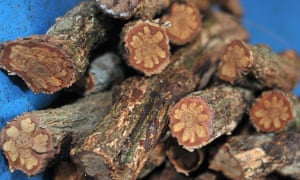
The Banisteriopsis caapi vine, the key ingredient to ayahuasca, known by numerous different names throughout the Amazon.

The Banisteriopsis caapi vine, the key ingredient to ayahuasca, known by numerous different names throughout the Amazon. Photograph: Emilie Lescale

DH: Do you feel Peru is the centre of what you call the “global ayahuasca movement”, or is it more Brazil?


DM: I think it’s Peru. In terms of its interfacing with the West, or Western culture, in Brazil, where you find it is through churches [like the Uniao do Vegetal], which have adopted ayahuasca as their sacrament. I don’t think there’s a big ayahuasca tourism industry in Brazil. It may be happening, but Iquitos is definitely the epicentre. People have been coming there regularly since about 1995 and it has grown a lot.


DH: Do you think more clinical studies [on ayahuasca] need to be done? That that would be positive for ayahuasca in general?


DM: I don’t need clinical studies to convince me ayahuasca is good medicine, that it’s helping people, but you can publish them [and it’s] a good way to convince skeptical colleagues in biomedicine, rather than just some guy raving about how great it is. . . This also grades over into some ethical issues. There are multiple ones. This is something that exists in the context of traditional medicine. It has already, in a certain way, been co-opted by the West through the ayahuasca tourism phenomenon and so on. Is it ethical to try and take a medicine like this and stuff it into a biomedical research structure? Is that the right way to approach it? I’m not saying that it is and I’m not saying that it isn’t. I just think that we have to be clear that there are aspects here of taking something out of its traditional context. Can it be used that effectively in biomedicine, or do you need the ceremonial ambience? It goes back to these hoary principles of setting. Which are very important. Does it have to be traditional? I don’t think so, but you could say, “Well, why not?” Because this is a Peruvian patrimony. Peru has declared ayahuasca a national patrimony, and you could say, “Well, if you’re going to develop therapeutic protocols and programs around ayahuasca, why not do them in Peru?” You’re not taking it away from anybody. You’re actually creating opportunities for Peruvian doctors, scientists and curanderos to work together to develop therapies that can help people – essentially taking a page out of the idea of medical tourism. Tourists are going to come to take ayahuasca for psycho-spiritual reasons. Why can’t they come and take it for medical reasons? That’s just an idea.


Miguel Ochavano Uquia, a Shipibo maestro working with ayahuasca at the Temple of the Way of Light near Iquitos in Peru’s Amazon.


Miguel Ochavano Uquia, a Shipibo maestro working with ayahuasca at the Temple of the Way of Light near Iquitos in Peru’s Amazon. Photograph: Temple of the Way of Light

DH: “Medical tourism.” Have you heard that term used by anyone else [regarding ayahuasca]?


DM: Medical tourism is kind of a buzz word now, especially in the States because of the crazy cost structure of so many medical procedures. . . Ayahuasca therapy is not something you can get [here], at least, not legally, so if you want to access it you can go to South America. In that sense it’s medical tourism. . . I think the ayahuasca tourism thing is definitely a two-edged sword. It’s having a lot of negative impacts on indigenous communities, but at the same time it’s benefitting a lot of people and, in some ways, keeping the tradition alive. But it’s also changing that tradition, as people start to cater to Western tastes and needs. So what needs to develop, I think, is some kind of a fusion of traditional and medical practices that takes the best from both and creates some kind of new paradigm. I hope that’s where it goes.


DH: What you said there about negative impacts on indigenous communities. . . What kind of impacts?


DM: There are multiple ones, but a lot is related to economics: the foreign tourists come to a place like Iquitos with their pockets full of money and their values and their interests and it can completely skew the economic situation. . . [But] it can also be good. Economic influx in communities can be a good thing if it’s properly done. Another aspect is that most of the centres [offering ayahuasca] around Iquitos aren’t owned by Peruvians. They’re owned by foreigners. That’s fine. They’re the ones that have the resources to set these things up, but then there’s a temptation to not treat their people well, not compensate them well, and then there’s the issue that you get in any kind of cult-like situation where you have a very powerful medicine, you have people coming in to have these experiences, often they’re put in a vulnerable situation because the whole point of the exercise is to go to a place where you can open up and examine your deepest, darkest fears and secrets and so on. If you happen to be with a curandero who doesn’t necessarily have your best interests in mind – there are plenty of those – you can be mistreated. As you know, sexual abuse of foreign tourists in ayahuasca centres is not uncommon. Ayahuasca, like anything else, is a technology. It’s a tool. It really doesn’t have any inherent moral qualities. It can be used in really positive ways and really negative ways because the ethics of it originate in the people who use it and how they use it and what they use it for.


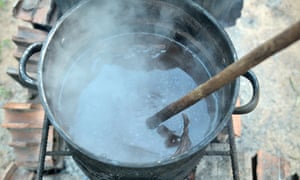
Ayahuasca being prepared near Pucallpa in Peru’s Amazon.

Ayahuasca being prepared near Pucallpa in Peru’s Amazon. Photograph: Emilie Lescale

DH: Just to pull back a second. If asked, “Are plants intelligent”, would your answer to that be, “Well, obviously, ayahuasca is a good example”?


DM: Yes, ayahuasca is intelligent. Yes, plants are intelligent. Not in the way that we are, but in some ways they’re much smarter than we are. It depends on how you want to define intelligence, right? If intelligence doesn’t require nervous systems, it it doesn’t require brains. . . if intelligence is when something reacts to their environment in a way that optimises its adaptation. Under that rubric plants are definitely intelligent – but not like we are. They don’t have brains and they work on different time-scales. This is part of a co-evolution we’re seeing. Co-evolution works on vast time-scales and ayahuasca has only been known to the West for less than 150 years. That’s a tiny slice of historical time. . . I think we’re only beginning to learn how to use ayahuasca, how we use it as a tool to wake up other people because, if you haven’t noticed, there’s a great deal of willful ignorance, at least, in the States, particularly with regard to environmental issues. Our politicians – at least, the Republican side of the equation – are proud of the fact they don’t know anything about climate science and they deny that it is even important. This is the attitude that needs to be changed. Stupidity is not going to solve our problems and yet they’re behaving as though it will. . . Are you familiar with the author Michael Pollan?


DH: Yes. Food Rules [the title of a book by Pollan].


DM: He wrote a wonderful article in The New Yorker. The Intelligent Plant. I think it really well summarises some of the issues right now that science is looking at, in terms of plant intelligence. I mean, a few years ago, you bring that up, you’d just be laughed at. Now, not so much. There’s really compelling evidence that plants are capable of planning, remembering, dealing with other plants and other things. . . Something else we’re learning about intelligence: you don’t have to have a brain. Brains are over-rated, you know. What you have to have is neural networks – very extensive networks of connections. If you look at eco-systems, if you look at forests, if you look at things on the macro-scale, these are tremendous, enormous neural networks. You can think of them from that perspective, like the connections between the roots of plants and the fungi in the soil. These are mycelial networks that can sometimes cover many miles. The biggest organisms in the world are actually mushrooms, believe it or not. Not psychedelic ones, as far as we know, but they’re mushrooms that grow in the forests in Oregon, places like this. They’re a cubic mile in extent. They’re 80,000 years old. Because the mushroom part is just the reproductive body. What’s really going on is the mycelial networks in the soil: the hyphae of the fungi is closely associated with the roots of plants, so it’s a very, very close symbiotic association. This is the intelligence of plants. This is the real thing. This is not just a romantic notion. This actually is real. It’s sometimes called the Gaia Hypothesis, originated by James Lovelock, a geophysicist and geochemist. . . His basic idea is that the entire biosphere is regulated, working together in such a way to keep it within these fairly narrow parameters that will support life.


DH: One more thing on plant intelligence. . . There was a book recently published, Brilliant Green, written by an Italian, Stefano Mancuso.


DM: He’s one of the leading researchers on this right now.


DH: I read the book by Mancuso, which really got me thinking. One of the things he doesn’t address is the idea that plants teach humans, that there is that kind of relationship.


DM: It’s a bit of a leap for him, but it is definitely where this is trending.


DH: Are you continuing with your scientific research into ayahuasca at the moment?


DM: Well, not so much, but I’m interested in moving in to the therapeutic area and I would like to do some structured chemical, clinical studies. But I want to do them in Peru. And I organize retreats in the Sacred Valley [in the Cusco region] at Willka T’ika.


DH: Can I just finish with one more question, Dennis? You say in “Human Destiny” [the article published in the Journal of Psychoactive Drugs] “You monkeys only think you’re running things.” And that’s quoted, as if someone else said it. Is that what your brother Terence said, or is that what you said at some point?


DM: It’s what the ayahuasca said.


DH: To who?


DM: Me.


DH: Ok. And what does it mean? Is the play on “You monkeys only think you’re running things?” or am I reading too much into it?


DM: When I took ayahuasca with the Uniao do Vegetal for the first time, in Sao Paulo in 1991, I had a very impactful ayahuasca experience in which I was shown photosynthesis at the molecular level. Being a plant biochemist I sort of understand these processes. It was extremely inspiring to me at the time. The take-home lesson was, “You monkeys only think you’re running the show.” It’s in my book [The Brotherhood of the Screaming Abyss].


"Ayahuasca is changing global environmental consciousness"