
Exercise wheels come in a assortment of sizes and types, but their basic objective is to provide confined animals with the opportunity to physical exercise, as you see these adorable dwarf hamsters carrying out here:
Studying on a mobile device? Here is the video link.
That’s an amusing video, and the hamsters seem to be enjoying themselves, but are they actually? And how may possibly you figure this out?
I ran across an exciting tiny study paper that addresses a fundamental — and controversial — question in exercising physiology: is running in an exercising wheel an artefact of captivity as exhibited by small pets, like hamsters, mice and rats? Why do they do it? Is it intended to alleviate pressure or neurosis triggered by near confinement, is it a repetitive and invariant behaviour that is devoid of any clear goal or function (stereotypy), this kind of as cage-pacing seen in some zoo animals, or may possibly it signify some thing else?
“When it comes to stereotyped behaviour, there are competing theories. 1 situation, as an instance, is no matter whether stereotyped behaviour is a symptom of bad welfare that must be prevented, or whether or not it is a coping technique that in fact increases welfare”, explained the study’s co-writer, Yuri Robbers, in e-mail.
Mr Robbers, who works as a grammar school biology teacher, has a master’s degree in animal behaviour and is at the moment researching animal behaviour, theoretical biology and ecology as he performs towards his PhD below the mentorship of neurophysiologist Johanna H. Meijer, a professor in the Department of Physiology at the Leiden University Medical Center in The Netherlands.
The controversy swirling about operating on an exercise wheel anxious the Dutch researchers so a lot that they developed many experiments to clarify the basis of this behaviour. Especially, they wished to test regardless of whether wheel running fulfills the criteria for a stereotypy: (one) it occurs only in captive animals, (2) it is repetitive, invariant and devoid of obvious goal or perform, (3) if it consists of all-natural behavioural factors, these factors happen at higher rates and for longer durations than located in nature, and (four) it is partially or not at all dependent on external stimuli.
Will wild mice use a working wheel if a single is presented in nature?
Well-known animal behaviourist Konrad Lorenz after remarked that rodents that had either escaped or been launched will enter and run on exercising wheels if a single is accessible to them (as cited right here: doi:10.1126/science.155.3770.1623). Intrigued, Professor Meijer and Mr Robbers made the decision to follow up on this observation by going one particular phase additional: they asked whether or not cost-free-living animals that had never just before witnessed an activity wheel would voluntarily use 1 if it was accessible to them.
They made a cage that particularly excluded large animals (so they wouldn’t knock more than the exercising wheel set up). Inside this cage, which could be freely accessed by small animals, they positioned a operating wheel along with some meals intended to attract mice. These exclosures have been set up in nature at two various discipline internet sites a green urban region (Professor Meijer’s back backyard) and a dune location that was inaccessible to the public (see under):
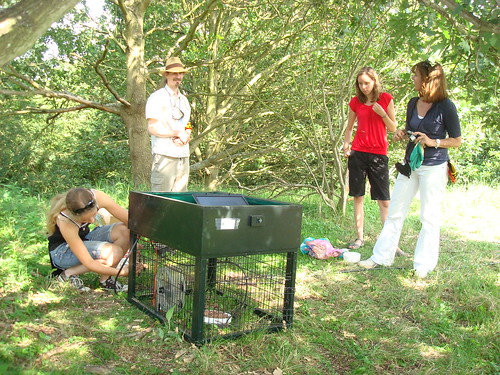 Setting up the gear in the dunes field site. (Left to appropriate: Eva Koster, Yuri Robbers, Doortje Krijbolder, Joke Meijer.)
Image: Jan Janse, with permission.
Every check out to the experimental set-up was recorded by a night-vision camera, employing passive infrared motion detection. At night, the camera relied upon infrared light (infrared light is invisible to mice), which did not interfere with motion detection.
 Wheel working and movement detection kit.
Picture: Johanna H. Meijer and Yuri Robbers, with permission.
Information have been collected for a lot more than three many years making use of this experimental set-up (green urban area information have been collected from October 2009 to February 2013, and dune region data have been collected from June 2011 to January 2013 figure two):
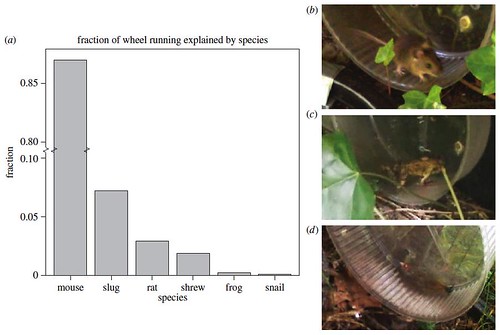 Figure two. Different animals use working wheels, though mice are by far the most common. Breakdown by species in (a). Note that the vertical axis has been broken to accommodate mice, which accounted for 88% of wheel running. Also note that birds visited the recording products occasionally, but never ran in wheels. Species identified making use of video recordings. Stills taken from these recordings display examples of a mouse (b), a frog (c) and a slug (d) utilizing the wheel.
The working wheels proved common with a range of free of charge-residing animal species. Above time period of above three many years, Professor Meijer and Mr Robbers created more than 200,000 recordings of animal site visitors and analysed much more than twelve,000 video fragments in which wheel motion was detected.
In the initial 24 months, the urban green location resulted in 1011 animal visits (of which 734 had been mice). The 1st 20 months in the dunes resulted in 254 animal visits (of which 232 had been mice). Although the cage was baited with food particularly meant to entice mice, other animals — shrews, rats, snails, slugs, and frogs — also stopped in to do some running (or sliming?). Interestingly (to this ornithologist), even little birds popped in sometimes, although they were never ever recorded operating on the wheel.
“Our information signifies that wheel working takes place in nature, currently being carried out by totally free-living wild animals”, mentioned Mr Robbers. Thus, “captivity, extended or otherwise, can not possibly be the lead to of wheel operating”. Because all the experts agree that stereotypical behaviours only happen in captivity, wheel running does not fit well into the criteria.
In view of the broad assortment of diet plans preferred by these other species of animal visitors, it would seem they had been not coming solely for the meals. So of course, Professor Meijer and Mr Robbers then asked what would occur if they stopped offering any meals at all — may well these animals even now pop in for a run on the workout wheel?
Will free of charge-living animals use a running wheel with out a foods reward?
Even though Professor Meijer and Mr Robbers stopped delivering food in the urban spot enclosures for more than a 12 months (October 2011–February 2013), animal visits continued. Professor Meijer and Mr Robbers observed 78 wheel operating visits (62 mouse visits — 36 of which have been really modest mice, indicating they have been as well young to know the cages had previously been baited with meals).
The information uncovered that the number of visits to the exercise wheel dropped substantially as quickly as the foods was removed, but visits that incorporated wheel running actually elevated by 42 percent, indicating that the animals (wild mice, primarily) were visiting the cage specifically to run on the exercise wheel, that exercise is rewarding in itself. The experimental gadget acts as a sort of neighbourhood mouse gym, it would seem.
Were action bouts comparable in between wild and lab mice?
Another check of whether or not wheel running fulfills a behavioural stereotypy was to assess wheel operating exercise between wild and lab mice. To get a clearer image of the animals’ action patterns, Professor Meijer and Mr Robbers compared wheel-working data from their wild mice to wheel-working information from laboratory mice that had been collected previously by another researcher (doi:ten.1126/science.155.3770.1623, see figure 3):
 Figure three. Distribution of operating wheel bout lengths in one min bins. Urban region (a), juvenile laboratory mice (b), 200 day outdated lab mice (c) 400 day previous lab mice. Note: juvenile lab mice have increased median bout lengths than wild mice but this variation disappears in older mice. 200 day old lab mice run as considerably as wild mice, whilst older mice run much less. Information panels (b–d) based on [doi:10.1126/science.155.3770.1623].
The data reveal that most of the wheel operating mice were juveniles, and 20 % of them had bouts that lasted longer than one minute, with the highest bout lasting 18 minutes. This is related to action bouts was reported for 200-day outdated lab mice that had been closely confined.
The wild mice had been actually doing work challenging, as well: despite the fact that the regular speed of running was slightly much less than for lab mice (1.3 versus
two.3 km/h), the optimum running speed observed for wild mice was increased
than the maximum for lab mice (five.7 versus 5.1 km/h).
Why do wild mice voluntarily run on workout wheels?
This research shows that wheel working is voluntary in wild mice, is not dependent on a meals reward, and takes place in bouts that are comparable to people recorded for captive mice, so it does not satisfy the established criteria for a stereotypical behaviour, as some scientists have argued. Of program, this raises the query: why do they do it?
“We’re considering play behaviour as a viable explanation, and have began follow-up experiments to test that hypothesis”, said Mr Robbers.
Wheel operating appears rather boring (suggestive of my least favourite piece of gym equipment, the treadmill), but possibly these animals view an exercise wheel similarly to humans when offered the option to climb musical stairs as an alternative of riding an escalator, as we see in this video?
Studying on a mobile gadget? Here’s the video link.
Why do we care about mice and their physical exercise wheels?
As any individual who reads the newspapers or listens to the radio is aware of, we are everyday advised to get far more exercise. Essentially, daily bodily exercise slows ageing, reduces the incidence of numerous cancers, assists maintain a reasonable body weight, lowers the incidence of diabetes, heart attack and stroke, and improves brain perform — and which is just to title a number of advantages that I’ve read about this week. Investigation into the human well being rewards of physical exercise depend upon the use of running wheels utilised by lab animals. If this wheel working is a stereotypy, this could be problematic.
“Some scientists … have had a tendency to dismiss analysis findings primarily based on the use of working wheels outright,” explained Mr Robbers in email. “This is rather far more challenging, now that our information is there to suggest that wheel working can occur in free residing animals.”
Reading on a mobile gadget? Here is the video hyperlink.
Sources:
Meijer J.H. & Robbers Y. (2014). Wheel running in the wild, Proceedings of the Royal Society B: Biological Sciences, 281 (1786) 20140210-20140210. DOI: ten.1098/rspb.2014.0210
Yuri Robbers [emails 17, 18, 20 & 21 May 2014]
Many thanks of course to my twitter followers who kindly sent at lightning velocity the PDF I requested @GOrizaola, @ConservResearch, @Rob0Sullivan, and @_inundata.
Also cited:
Sherwin C.M. (1998). Voluntary wheel running: a assessment and novel interpretation, Animal Behaviour, 56 (one) eleven-27. doi:ten.1006/anbe.1998.0836
Science&rft.artnum=http%3A%2F%2Fwww.sciencemag.org%2Fcgi%2Fdoi%2F10.1126%2Fscience.155.3770.1623&rft.volume=155&rft.issue=3770&rft.issn=0036-8075&rft.spage=1623&rft.epage=1639&rft.date=1967&rfr_id=info%3Asid%2Fscienceseeker.org&rft.au=Kavanau+J.+L.&rft.aulast=Kavanau&rft.aufirst=J.+L.&rfs_dat=ss.incorporated=one&rfe_dat=bpr3.included=1bpr3.tags=Biology%2CPsychology”>Kavanau J.L. (1967). Conduct of Captive White-Footed Mice, Science, 155 (3770) 1623-1639. doi:ten.1126/science.155.3770.1623 [Open entry]
.. .. .. .. .. .. .. .. .. .. ..
When she’s not doing work out in the gymnasium or operating up the stairs to her flat (situated on the 13th floor), GrrlScientist can also be located here: Maniraptora. She’s quite lively on twitter @GrrlScientist and at times lurks on social media: facebook, G+, LinkedIn, and Pinterest.
Wild mice in fact appreciate working on physical exercise wheels | @GrrlScientist
